

|
시장보고서
상품코드
2155637
머신비전용 액체 렌즈 : 시장 점유율 분석, 업계 동향과 통계, 성장 예측(2026-2031년)Liquid Lens For Machine Vision - Market Share Analysis, Industry Trends & Statistics, Growth Forecasts (2026 - 2031) |
||||||
 Mordor Intelligence
에 따르면 머신비전용 액체 렌즈 시장 규모는 2025년에 6,698만 달러에 달하고, 2031년까지 1억 2,034만 달러에 달할 것으로 예측되며, 2026년부터 2031년까지 CAGR 10.53%로 확대될 것으로 전망됩니다.
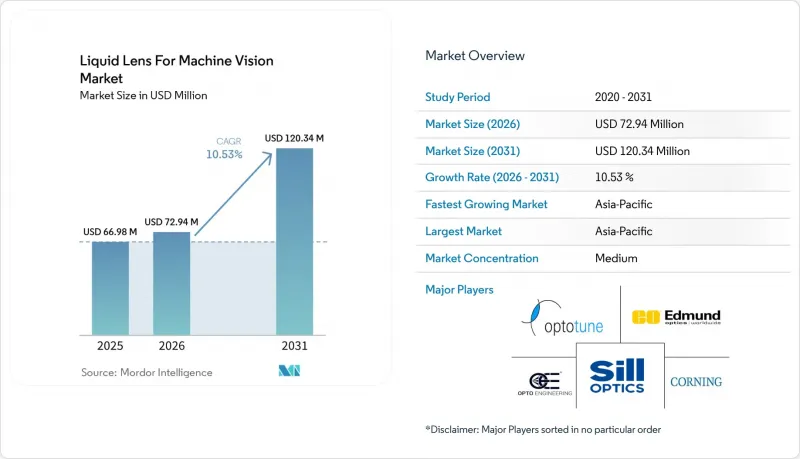
세계 머신비전용 액체 렌즈 시장 동향 및 인사이트
고속 자동 검사 수요 증가
대량 생산 라인의 품질 요구 사항이 높아짐에 따라, 머신비전 시장을 겨냥한 액체 렌즈의 적응형 초점 기능에 대한 수요가 증가하고 있습니다. 동일한 시야 내에서 피사체의 높이가 다른 경우, 고정 초점 렌즈로는 한계가 발생할 수 있습니다. 이는 인쇄회로기판의 솔더 접합부 검사, 반도체 패키징, 그리고 자동차 파워트레인 부품 검사에서 흔히 볼 수 있는 현상입니다. 액체 렌즈는 기계적 움직임 없이 2-25밀리초 만에 초점을 재조정할 수 있어, 단일 카메라로 높이가 다른 표면을 검사하면서도 라인의 처리량을 유지할 수 있습니다. 동일한 시스템에서 1회의 검사 사이클 동안 여러 초점면을 촬영하여, 컨베이어를 정지시키지 않고도 피사계 심도가 넓은 이미지를 생성할 수 있습니다. 이 기능을 통해 다이 부착 및 플립 칩 검사 시 멀티 카메라 어레이의 필요성을 줄일 수 있습니다.
컴팩트한 자동 초점 시스템의 채택 확대
렌즈 레벨 자동 초점 기술은 머신비전 시장을 겨냥한 액체 렌즈 분야에서 비전 장비 제조사들이 카메라 플랫폼을 구성하는 방식을 변화시키고 있습니다. 컨트롤러를 렌즈 본체에 내장하여 단일 케이블로 카메라에 연결할 수 있습니다. poLight사의 보고에 따르면, 2025년 말 기준으로 42건의 상용 TLens 설계 채택 실적이 있으며, 이는 2024년의 28건에서 증가한 수치로, 21개 제품이 지속적으로 출하되고 있습니다. 이 회사의 MLens 오프더쉘프 M12 초점 조절 렌즈 제품군은 비반복 설계(NRE) 비용 절감을 원하는 산업용 머신비전 OEM 제조사를 대상으로 2026년 1월에 출시되었습니다. 코닝(Corning)은 2025년, 8전극 일렉트로웨팅 설계를 채택한 가변 초점·난시 보정 렌즈 ‘V-PE-80R0’를 발표했습니다. 이 설계를 통해 가동 부품을 사용하지 않고도 구면도, 원주도, 축을 조정할 수 있어, 소형 자동 초점 어셈블리의 적용 범위가 확대됩니다.
높은 집적화와 인증 비용
머신비전 시장에서 액체 렌즈의 도입 비용은 렌즈 부품에만 국한되지 않습니다. 여기에는 구동용 전자기기, 펌웨어 개발, 트리거 동기화, 열 보정 및 검증 테스트 등이 포함될 수 있습니다. 규제 준수 등급의 시스템에서는 통합 및 인증에 12-24개월이 소요될 수 있습니다. 유체 계면의 진동 중에 이미지가 촬영되는 것을 방지하기 위해 렌즈 드라이버는 밀리초 단위의 정밀도로 카메라의 노출 트리거와 연동되어야 합니다. 시스템 총액이 40만-85만 달러인 적응형 광학 시스템의 경우, 투자 회수에는 18-24개월이 소요될 수 있습니다. poLight사나 코닝사의 표준화 제품을 활용하면 비반복적인 엔지니어링 요구 사항을 줄일 수 있지만, 광범위한 인증 부담은 여전히 장벽으로 남아 있습니다.
부문 분석
2025년, 머신비전용 액체 렌즈 시장 규모 중 독립형 액체 렌즈 소자가 52.37%를 차지했습니다. 시스템 통합업체는 개별 구성요소를 독립적으로 인증할 수 있기 때문에 모듈식 광학 설계를 선호합니다. 또한 이러한 설계를 통해 시스템 유지보수가 필요할 때 현장에서 교체가 가능해집니다. 초기 시스템의 대부분은 개별 소자, 드라이버 보드 및 맞춤형 통합 로직을 조합한 형태였습니다. 이러한 과거의 인증에 대한 투자로 인해, 기존 도입 사례에서는 통합형 제품으로의 신속한 전환이 어려울 수 있습니다.
통합형 카메라 모듈 어셈블리는 2026년부터 2031년까지 연평균 성장률(CAGR) 11.13%로 확대될 것으로 예측됩니다. 공장에서 교정된 모듈은 플러그 앤 플레이 방식을 통해 통합 작업을 줄여줍니다. Optotune사는 2026년 2월, 1.1인치 센서용으로 액체 렌즈, 고정 초점 광학 시스템 및 온도 보정 컨트롤러를 결합한 ELM-F C-마운트 모듈 시리즈를 출시했습니다. 렌즈 드라이버와 컨트롤러는 여전히 구성요소 아키텍처에서 필수적인 요소입니다. 렌즈에 컨트롤러의 지능을 통합함으로써 부품표(BOM)의 복잡성을 줄이고, OEM 제조업체의 소프트웨어 통합을 간소화할 수 있습니다.
2025년 머신비전 시장의 액체 렌즈 시장 규모 중, 전류 구동형 폴리머 막 액체 렌즈가 58.46%를 차지했습니다. 이러한 위상은 표준 산업용 전원과의 호환성과 확립된 신뢰성 실적을 반영합니다. 또한, 이러한 렌즈는 적당한 유효 개구 직경에서 유리한 비용 구조를 갖추고 있습니다. Optotune사의 EL 시리즈는 널리 도입된 상용 폴리머 막형 액정 렌즈입니다. 이 기술은 센서가 밀집된 검사 환경에서도 전자기 간섭을 최소화하면서 2-25밀리초의 응답 시간을 실현합니다.
일렉트로웨팅 방식의 액체 렌즈는 2026년부터 2031년까지 연평균 성장률(CAGR) 11.09%로 확대될 것으로 예측됩니다. 전압 제어는 디지털 시스템과 자연스럽게 조화를 이루며, 여러 광학 매개변수를 개별적으로 조정할 수 있습니다. 2026년 연구에서는 7링 전극 설계를 채택한 이중 액체 비구면 일렉트로웨팅 렌즈가 발표되었습니다. 해당 연구에서는 240V에서 1밀리미터당 80.635 라인페어의 영상 해상도가 보고되었습니다. 압전 폴리머 기반 및 액정 기반 접근 방식은 조사용 계측 기기에서 여전히 특수한 역할을 담당하고 있지만, 머신비전 분야에서의 보다 광범위한 활용을 위해서는 응답 시간과 유효 개구 범위의 추가적인 개선이 기대되고 있습니다.
지역별 분석
아시아태평양은 2025년에 전체 시장의 40.27%를 차지했으며, 2031년까지 연평균 성장률(CAGR) 11.52%로 성장할 것으로 전망됩니다. 이 지역은 견조한 도입 수요와 새로운 생산능력을 모두 갖추고 있습니다. 중국은 적응형 광학 분야에서 공급 측면과 수요 측면 모두의 활동을 뒷받침하고 있습니다. Q Technology사는 2025년 poLight사와 전략적 투자 계약을 체결한 후, 중국에 TLens 전용 조립 및 시험 라인을 설립했습니다. 정보원에 따르면, 이 계약을 통해 1억 7,150만 노르웨이 크로네(1,600만 달러)의 순수익이 창출되었습니다. 한국과 일본은 머신비전용 액체 렌즈 시장에서 고정밀 수요의 중심지입니다. Wintest사는 요코하마에서 개최된 ‘Image Sensing Exhibition 2026’에서 자사의 RYUGU 액체 렌즈를 전시했습니다. 또한 이 회사는 NanoTerasu 싱크로트론 시설로부터 자사 기술에 대한 주문을 받았습니다. 이러한 활동은 산업용 머신비전뿐만 아니라 과학용 정밀 계측 기기 분야에서의 활용 가능성을 보여줍니다.
북미 및 유럽은 여전히 고정밀 등급 제품 도입에 있어 중요한 수익원으로 자리 잡고 있습니다. 이 지역들의 반도체, 제약 및 산업용 자동화 시설에서는 엄격한 인증 요건이 적용되고 있습니다. 예노프틱(Jenoptik)은 2025 회계연도에 10억 4,600만 유로(12억 1,000만 달러)의 매출을 기록했으며, 반도체 장비를 핵심 성장 분야로 자리매김했습니다. 이 회사는 2026년 여름에 예나 공장의 생산능력 확대를 위한 작업을 시작하여, 2027년 하반기부터 생산을 시작할 예정입니다.
남미, 중동 및 아프리카는 머신비전용 액체 렌즈 시장에서 여전히 도입 초기 단계에 있는 지역입니다. 높은 통합 비용과 애플리케이션 엔지니어 부족이 단기적인 보급을 저해하고 있습니다. 브라질과 아르헨티나에서는 농업 분야의 선별 작업에서 초기 단계의 시도가 나타나고 있습니다. 또한, UAE와 사우디아라비아의 식품 가공 및 물류 프로젝트 역시 자동 초점 기능이 탑재된 바코드 판독에 대한 수요를 창출하고 있습니다. 사내 광학 기술 노하우가 부족한 지역에서는 기성 M12 모듈을 활용함으로써 엔지니어링상의 장벽을 낮출 수 있습니다.
기타 혜택:
- 엑셀 형식의 시장 예측(ME) 시트
- 3개월간의 애널리스트 지원
자주 묻는 질문
목차
제1장 소개
- 조사 가정과 시장 정의
- 조사 범위
제2장 조사 방법
제3장 주요 요약
제4장 시장 구도
- 시장 개요
- 시장 성장 촉진요인
- 시장 성장 억제요인
- 거시경제 요인이 시장에 미치는 영향
- 업계 공급망 분석
- 기술 동향
- 규제 상황
- Porter's Five Forces 분석
제5장 시장 규모와 성장 예측
- 구성요소별
- 기술별
- 최종 이용 산업별
- 스펙트럼 대역별
- 지역별
- 북미
- 미국
- 캐나다
- 멕시코
- 남미
- 브라질
- 아르헨티나
- 기타 남미 국가
- 유럽
- 독일
- 영국
- 프랑스
- 이탈리아
- 스페인
- 기타 유럽 국가
- 아시아태평양
- 중국
- 일본
- 인도
- 한국
- 기타 아시아태평양 국가
- 중동
- 아랍에미리트
- 사우디아라비아
- 기타 중동 국가
- 아프리카
- 남아프리카공화국
- 이집트
- 나이지리아
- 기타 아프리카 국가
- 북미
제6장 경쟁 구도
- 시장 집중도
- 전략적 동향
- 시장 점유율 분석
- 기업 개요
- Optotune Switzerland AG
- Corning Incorporated, Varioptic Business
- Edmund Optics, Inc.
- Opto Engineering S.p.A.
- Sill Optics GmbH and Co. KG
- poLight ASA
- LensVector Inc.
- Basler AG
- Elcyo Co., Ltd.
- Wintest Corporation
- SUSS MicroOptics SA
- Physik Instrumente(PI) GmbH and Co. KG
- Hamamatsu Photonics K.K.
- Schneider-Kreuznach GmbH and Co. KG
- Jenoptik AG
- Kowa Company, Ltd.
- Navitar, Inc.
- VS Technology Corporation
- Myutron Inc.
- Theia Technologies, Inc.
- Goyo Optical Inc.
제7장 시장 기회와 향후 전망
KSM 26.10.30According to Mordor Intelligence, the liquid lens for machine vision market size stood at USD 66.98 million in 2025 and is forecast to reach USD 120.34 million by 2031, expanding at a CAGR of 10.53% during 2026-2031.
Global Liquid Lens For Machine Vision Market Trends and Insights
Rising Demand for High-Speed Automated Inspection
Quality requirements on high-volume production lines are increasing the need for adaptive focusing in the liquid lens for the machine vision market. Fixed-focus lenses can become limiting when targets vary in height within the same field of view. This is common in printed circuit board solder-joint inspection, semiconductor packaging, and automotive powertrain component inspection. Liquid lenses can refocus in 2-25 milliseconds without mechanical movement, allowing a single camera to inspect height-varying surfaces while maintaining line throughput. The same system can capture multiple focal planes during a single inspection cycle and produce extended-depth-of-field images without stopping the conveyor. This capability can reduce the need for multi-camera arrays in die-attach and flip-chip inspection.
Increasing Adoption of Compact Autofocus Systems
Lens-level autofocus is changing how vision equipment makers configure camera platforms in the liquid lens for the machine vision market. The controller can be integrated into the lens body and connected to the camera via a single cable. poLight reported 42 commercial TLens design wins at the end of 2025, compared with 28 in 2024, and 21 products remained in shipment. Its MLens off-the-shelf M12 focusing lens portfolio launched in January 2026 for industrial machine vision original equipment manufacturers that want lower nonrecurring engineering requirements. Corning introduced the V-PE-80R0 variable-focus and astigmatism lens in 2025 with an 8-electrode electrowetting design. The design allows adjustment of sphere, cylinder, and axis without moving parts, extending the use of compact autofocus assemblies.
High Integration and Qualification Costs
The adoption cost for the liquid lens for the machine vision market extends beyond the lens component. It can include driver electronics, firmware development, trigger synchronization, thermal calibration, and validation testing. Regulatory-grade systems can require 12-24 months for integration and qualification. The lens driver must be coordinated with the camera exposure trigger at millisecond precision to prevent image capture during fluid-interface oscillation. Adaptive-optics systems in the USD 400,000-USD 850,000 total-system range can require an 18-24-month payback case. Standardized products from poLight and Corning can reduce nonrecurring engineering requirements, but the broader qualification burden remains a barrier.
Other drivers and restraints analyzed in the detailed report include:
- Growth of Semiconductor and Electronics Inspection
- Expansion of Barcode Reading and Logistics Automation
- Limited Availability of High-Aperture and High-Resolution Configurations
For complete list of drivers and restraints, kindly check the Table Of Contents.
Segment Analysis
Standalone Liquid Lens Elements accounted for 52.37% of the liquid lens market size for machine vision in 2025. System integrators favor modular optical designs because individual components can be qualified independently. These designs also allow field replacement when a system needs service. Many early systems combined separate elements, driver boards, and custom integration logic. Those prior qualification investments can make established installations less likely to switch quickly to integrated alternatives.
Integrated Camera Module Assemblies are projected to expand at a 11.13% CAGR from 2026 to 2031. Factory-calibrated modules reduce integration work through a plug-and-play format. Optotune launched the ELM-F C-mount module series in February 2026, combining a liquid lens, fixed focal-length optics, and a temperature-compensated controller for 1.1-inch sensors. Lens drivers and controllers remain essential to the component architecture. On-lens controller intelligence can reduce bill-of-materials complexity and simplify software integration for original equipment manufacturers.
Current-Driven Polymer-Membrane Liquid Lenses accounted for 58.46% of the liquid lens market size in the machine vision market in 2025. Their position reflects compatibility with standard industrial power supplies and an established record of reliability. These lenses are also supported by a favorable cost structure at moderate clear apertures. Optotune's EL series represents a widely deployed commercial polymer-membrane format. The technology can provide 2-25 ms response times with limited electromagnetic interference in sensor-dense inspection environments.
Electrowetting-Based Liquid Lenses are projected to expand at a 11.09% CAGR from 2026 to 2031. Voltage control fits naturally with digital systems and can allow independent adjustment of several optical parameters. A 2026 study presented a double-liquid aspherical electrowetting lens with a seven-ring electrode design. The study reported an imaging resolution of 80.635 line pairs per millimeter at 240 V. Piezoelectric polymer-based and liquid-crystal approaches retain specialized roles in research instrumentation, while broader machine-vision use awaits further improvements in response time and working-aperture range.
Complete Report Scope:
- By Component
- Standalone Liquid Lens Elements
- Integrated Camera Module Assemblies
- Lens Drivers and Controllers
- By Technology
- Electrowetting-Based Liquid Lenses
- Current-Driven Polymer-Membrane Liquid Lenses
- Other Tunable Liquid Lens Technologies
- By End-User Industry
- Semiconductor and Electronics
- Automotive
- Food and Beverage
- Pharmaceutical and Medical
- Logistics and Warehousing
- Energy and Power
- Other End-User Industries
- By Spectral Band
- Visible Spectrum
- Near-Infrared
- Short-Wave Infrared
- Ultraviolet
- Multispectral
- By Geography
- North America
- United States
- Canada
- Mexico
- South America
- Brazil
- Argentina
- Rest of South America
- Europe
- Germany
- United Kingdom
- France
- Italy
- Spain
- Rest of Europe
- Asia-Pacific
- China
- Japan
- India
- South Korea
- Rest of Asia-Pacific
- Middle East
- United Arab Emirates
- Saudi Arabia
- Rest of Middle East
- Africa
- South Africa
- Egypt
- Nigeria
- Rest of Africa
- North America
Geography Analysis
Asia-Pacific accounted for 40.27% of the regional total in 2025 and is projected to grow at a 11.52% CAGR through 2031. The region combines strong installed demand with new manufacturing capacity. China supports both supply-side and demand-side activity in adaptive optics. Q Technology established a dedicated TLens assembly and test line in China after its 2025 strategic investment agreement with poLight. The agreement generated NOK 171.5 million in net proceeds (USD 16.0 million) as stated in the source. South Korea and Japan are high-precision demand centers in the liquid lens market for machine vision. Wintest exhibited its RYUGU liquid lens at the Image Sensing Exhibition 2026 in Yokohama. The company also received purchase orders from the NanoTerasu synchrotron facility for its technology. These activities show use in scientific precision instrumentation alongside industrial machine vision.
North America and Europe remain important revenue pools for precision-grade deployments. Semiconductor, pharmaceutical, and industrial automation facilities in these regions apply demanding qualification requirements. Jenoptik reported revenue of EUR 1,046 million (USD 1.21 billion) in fiscal 2025 and identified semiconductor equipment as a core growth area. The company began work on expanded Jena production capacity in the summer of 2026, with production planned for the second half of 2027.
South America, the Middle East, and Africa remain earlier-stage regions for the liquid lens for machine vision market. Higher integration costs and a limited base of application engineers constrain near-term adoption. Brazil and Argentina have early activity in agricultural sorting. Food processing and logistics projects in the UAE and Saudi Arabia also create demand for autofocus barcode reading. Off-the-shelf M12 modules can reduce the engineering barrier in regions with less internal optics expertise.
- Optotune Switzerland AG
- Corning Incorporated, Varioptic Business
- Edmund Optics, Inc.
- Opto Engineering S.p.A.
- Sill Optics GmbH and Co. KG
- poLight ASA
- LensVector Inc.
- Basler AG
- Elcyo Co., Ltd.
- Wintest Corporation
- SUSS MicroOptics SA
- Physik Instrumente (PI) GmbH and Co. KG
- Hamamatsu Photonics K.K.
- Schneider-Kreuznach GmbH and Co. KG
- Jenoptik AG
- Kowa Company, Ltd.
- Navitar, Inc.
- VS Technology Corporation
- Myutron Inc.
- Theia Technologies, Inc.
- Goyo Optical Inc.
Additional Benefits:
- The market estimate (ME) sheet in Excel format
- 3 months of analyst support
TABLE OF CONTENTS
1 INTRODUCTION
- 1.1 Study Assumptions and Market Definition
- 1.2 Scope of the Study
2 RESEARCH METHODOLOGY
3 EXECUTIVE SUMMARY
4 MARKET LANDSCAPE
- 4.1 Market Overview
- 4.2 Market Drivers
- 4.2.1 Rising Demand for High-Speed Automated Inspection
- 4.2.2 Increasing Adoption of Compact Autofocus Systems
- 4.2.3 Growth of Semiconductor and Electronics Inspection
- 4.2.4 Expansion of Barcode Reading and Logistics Automation
- 4.2.5 Rising Demand for Dynamic Refocusing Across Variable Working Distances
- 4.2.6 Increasing Integration of Liquid Lenses With AI-Enabled Vision Systems
- 4.3 Market Restraints
- 4.3.1 High Integration and Qualification Costs
- 4.3.2 Limited Availability of High-Aperture and High-Resolution Configurations
- 4.3.3 Long-Term Sealing, Fluid Stability, and Thermal Drift Risks
- 4.3.4 Customer Dependence on Established Mechanical and Fixed-Focus Optics
- 4.4 Impact of Macroeconomic Factors on the Market
- 4.5 Industry Supply-Chain Analysis
- 4.6 Technology Outlook
- 4.7 Regulatory Landscape
- 4.8 Porter's Five Forces Analysis
- 4.8.1 Threat of New Entrants
- 4.8.2 Bargaining Power of Suppliers
- 4.8.3 Bargaining Power of Buyers
- 4.8.4 Threat of Substitutes
- 4.8.5 Intensity of Competitive Rivalry
5 MARKET SIZE AND GROWTH FORECASTS (VALUE)
- 5.1 By Component
- 5.1.1 Standalone Liquid Lens Elements
- 5.1.2 Integrated Camera Module Assemblies
- 5.1.3 Lens Drivers and Controllers
- 5.2 By Technology
- 5.2.1 Electrowetting-Based Liquid Lenses
- 5.2.2 Current-Driven Polymer-Membrane Liquid Lenses
- 5.2.3 Other Tunable Liquid Lens Technologies
- 5.3 By End-User Industry
- 5.3.1 Semiconductor and Electronics
- 5.3.2 Automotive
- 5.3.3 Food and Beverage
- 5.3.4 Pharmaceutical and Medical
- 5.3.5 Logistics and Warehousing
- 5.3.6 Energy and Power
- 5.3.7 Other End-User Industries
- 5.4 By Spectral Band
- 5.4.1 Visible Spectrum
- 5.4.2 Near-Infrared
- 5.4.3 Short-Wave Infrared
- 5.4.4 Ultraviolet
- 5.4.5 Multispectral
- 5.5 By Geography
- 5.5.1 North America
- 5.5.1.1 United States
- 5.5.1.2 Canada
- 5.5.1.3 Mexico
- 5.5.2 South America
- 5.5.2.1 Brazil
- 5.5.2.2 Argentina
- 5.5.2.3 Rest of South America
- 5.5.3 Europe
- 5.5.3.1 Germany
- 5.5.3.2 United Kingdom
- 5.5.3.3 France
- 5.5.3.4 Italy
- 5.5.3.5 Spain
- 5.5.3.6 Rest of Europe
- 5.5.4 Asia-Pacific
- 5.5.4.1 China
- 5.5.4.2 Japan
- 5.5.4.3 India
- 5.5.4.4 South Korea
- 5.5.4.5 Rest of Asia-Pacific
- 5.5.5 Middle East
- 5.5.5.1 United Arab Emirates
- 5.5.5.2 Saudi Arabia
- 5.5.5.3 Rest of Middle East
- 5.5.6 Africa
- 5.5.6.1 South Africa
- 5.5.6.2 Egypt
- 5.5.6.3 Nigeria
- 5.5.6.4 Rest of Africa
- 5.5.1 North America
6 COMPETITIVE LANDSCAPE
- 6.1 Market Concentration
- 6.2 Strategic Moves
- 6.3 Market Share Analysis
- 6.4 Company Profiles (includes Global Level Overview, Market Level Overview, Core Segments, Financials as available, Strategic Information, Market Rank/Share, Products and Services, Recent Developments)
- 6.4.1 Optotune Switzerland AG
- 6.4.2 Corning Incorporated, Varioptic Business
- 6.4.3 Edmund Optics, Inc.
- 6.4.4 Opto Engineering S.p.A.
- 6.4.5 Sill Optics GmbH and Co. KG
- 6.4.6 poLight ASA
- 6.4.7 LensVector Inc.
- 6.4.8 Basler AG
- 6.4.9 Elcyo Co., Ltd.
- 6.4.10 Wintest Corporation
- 6.4.11 SUSS MicroOptics SA
- 6.4.12 Physik Instrumente (PI) GmbH and Co. KG
- 6.4.13 Hamamatsu Photonics K.K.
- 6.4.14 Schneider-Kreuznach GmbH and Co. KG
- 6.4.15 Jenoptik AG
- 6.4.16 Kowa Company, Ltd.
- 6.4.17 Navitar, Inc.
- 6.4.18 VS Technology Corporation
- 6.4.19 Myutron Inc.
- 6.4.20 Theia Technologies, Inc.
- 6.4.21 Goyo Optical Inc.
7 MARKET OPPORTUNITIES AND FUTURE OUTLOOK
- 7.1 White-Space and Unmet-Need Assessment


