

|
시장보고서
상품코드
2155638
벌크 화물 운송 : 시장 점유율 분석, 업계 동향과 통계, 성장 예측(2026-2031년)Bulk Cargo Shipping - Market Share Analysis, Industry Trends & Statistics, Growth Forecasts (2026 - 2031) |
||||||
 Mordor Intelligence
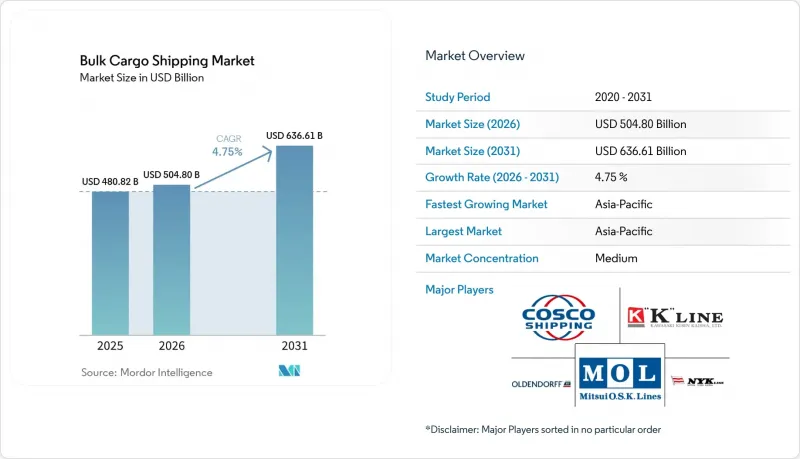
에 따르면 2025년 벌크 화물 운송 시장 규모는 4,808억 2,000만 달러로 평가되었으며, 2026년 5,048억 달러에서 2026년부터 2031년까지 CAGR 4.75%로 확대되어, 2031년에는 6,366억 1,000만 달러에 달할 것으로 추정됩니다.
세계 벌크 화물 운송 시장의 동향 및 인사이트
철광석 및 석탄의 해상 운송 수요 증가
해상을 통한 철광석 운송은 여전히 벌크 화물 운송 시장의 화물 수요를 이끄는 핵심 원천입니다. 시만두 광산의 상업적 생산 확대에 따라 중국으로 수출되는 철광석의 원산지 구성이 변화했습니다. 이 프로젝트에서는 2026년 5월까지 월간 출하량이 220만 톤을 넘어섰다고 보고되었습니다. 기니에서 중국으로 향하는 항로는 동일한 양을 호주에서 운송하는 것에 비해 톤마일이 4배에 달합니다. BIMCO는 총 화물량 변동과 무관하게, 2026년 건화물선 수요 증가의 절반은 평균 항해 거리 연장에 기인할 것으로 예측하고 있습니다. 인도네시아의 수출이 위축되면서 석탄 무역은 감소했으나, 대서양에서 아시아로 향하는 더 긴 항로는 구매자가 공급처를 대체하는 경우에도 여전히 선박 가동률을 지탱할 수 있습니다.
곡물 및 비료 무역량 확대
벌크 화물 운송 시장에서 농산물 화물은 철광석 및 석탄 이외의 수요를 확대하고 있습니다. 2025년 해상 농산물 무역량은 7억 1,650만 톤에 달했습니다. 2026년 첫 6주 동안, 남미의 생산 잉여로 인해 수출이 증가함에 따라 곡물 운송량은 전년 동기 대비 15% 증가했습니다. 호르무즈 해협의 혼란으로 인해 비료 운송의 상당 부분이 중단되었고, 요소, 유황, 인산염 화물의 운송이 지연되었습니다. 국제비료협회는 2026/27년 파종 주기 동안 질소 비료 공급이 부족해질 것으로 예측하고 있습니다. 공급이 재개될 경우, 재고를 소진하고 있는 구매자들이 동시에 운임 시장에 복귀할 가능성이 있으며, 이로 인해 농업 노선에서 스프라맥스급 및 파나막스급 선박에 대한 수요가 뒷받침될 것입니다.
건화물 운임의 주기성에 미치는 영향
운임은 여전히 선박 인도와 화물 수요의 균형에 좌우되기 쉬운 상황입니다. 건화물 수주 잔고 대 선대 비율은 2025년 상반기 9.5%에 비해 2026년 상반기에는 11.0%에 달했습니다. 수주 잔고에는 2026년 중 인도 예정인 600척이 포함되어 있습니다. BIMCO는 2026년 선박 공급 증가율을 2.8%로 예측하고 있으며, 이에 비해 선박 수요 증가율은 1.5%에서 2.5%로 전망됩니다. 파나막스급 및 슈프림맥스급 선단은 인도 예정 선박의 60% 이상을 차지하고 있어 더 큰 영향을 받게 될 것입니다. 장기 용선 계약을 통해 운항하는 선주는 스팟 항해에 의존하는 운항사보다 더 큰 보호를 받고 있습니다.
부문별 분석
건화물은 2025년 수익의 75.12%를 차지하며, 벌크 화물 운송 시장에서 가장 큰 점유율을 차지하고 있습니다. 철광석과 석탄은 벌크 무역 총량의 52% 이상을 차지하며, 호주-중국 및 브라질-중국 간 항로에서 케이프사이즈 및 파나막스 선박의 운항을 뒷받침하고 있습니다. 이러한 화물의 대규모 특성으로 인해 건화물은 선단 가동률에서 계속해서 중심적인 위치를 차지하고 있습니다. 보크사이트 역시 서아프리카발 장거리 운송 수요를 뒷받침하고 있습니다. 곡물은 세 번째 주요 화물 흐름으로, 선주들에게 계절적 농산물 무역에 진출할 기회를 제공하고 있습니다. 이 부문의 폭이 넓기 때문에 운항사가 단일 상품에 대한 의존에서 벗어날 수 있도록 돕고 있어, 벌크 화물 운송 시장은 그 혜택을 누리고 있습니다.
액체 벌크 화물은 2026년부터 2031년까지 연평균 성장률(CAGR) 6.17%로 확대될 것으로 예측됩니다. 호르무즈 해협의 혼란에 따른 원유 수송 경로의 연장, 새로운 LNG 액화 능력 확충, 그리고 아시아 지역의 화학제품 탱커 수요가 이러한 전망을 뒷받침하고 있습니다. 이러한 변화는 에너지 및 화학제품 수송이 벌크 화물 운송 시장 전체에 있어 점점 더 중요해지고 있음을 보여줍니다. COSCO Shipping Bulk사는 ‘YUAN HAI SI LU’호를 취항시켰습니다. 이 선박은 세계 최초의 325,000 DWT급 메탄올 듀얼 연료 광석 운반선으로 알려져 있습니다. 이 선박은 적재 능력과 연료 전환 대응력을 단일 자산에 통합할 수 있음을 보여줍니다. 건화물과 액체 벌크 무역을 모두 다루는 운항사는 다양화된 수요를 활용하여 항로 혼란을 관리할 수 있습니다.
지역별 분석
아시아태평양은 2025년 매출의 51.88%를 차지하며, 2031년까지 연평균 성장률(CAGR) 5.63%로 성장할 것으로 예측됩니다. 중국이 여전히 주요 상품 수입국인 만큼, 이 지역은 벌크 화물 운송 시장에서 가장 큰 점유율을 차지하고 있습니다. 호주는 철광석과 석탄의 주요 수출국인 반면, 중국은 벌크 화물의 주요 목적지입니다. 시만두(Simandou) 개발로 인해 아시아 구매자들에게 대서양을 경유하는 공급 경로가 확대되고 있습니다. 베트남, 인도네시아, 인도는 산업화, 인프라 구축 계획, 연안 해운 개혁을 통해 지역 내 수요를 확대하고 있습니다.
유럽과 북미는 벌크 화물 운송 시장에서 서로 다른 역할을 담당하고 있습니다. 벌크 화물 운송 시장에서 유럽은 석탄 단계적 폐지 정책으로 인해 해상 운송되는 발전용 석탄 수요가 감소하고 있어, 건화물 수입에서 그 중요성을 점차 잃어가고 있습니다. 한편, 북미는 주로 세계 시장으로의 곡물 및 야금용 석탄 수출국으로서 벌크 화물 운송 시장에서 기능하고 있습니다. 오대호와 세인트로렌스 수로도 지역 내 산업용·건설용 상품의 수송을 뒷받침하고 있습니다. 브라질을 필두로 한 남미는 곡물과 철광석의 중요한 대서양 측 공급원이 되고 있습니다. 이러한 위치적 관계로 인해 산토스-칭다오 노선은 파나막스급 선박의 운항에 있어 중요하며, 농업 생산물을 아시아의 소비지로 연결하고 있습니다.
중동 및 아프리카는 2026년 상반된 힘에 직면해 있습니다. 호르무즈 해협 봉쇄로 인해 걸프 지역의 원유 및 비료 수송이 혼란을 겪었으나, 사우디아라비아의 동서 파이프라인과 홍해로의 접근이 부분적인 대체 수단이 되었습니다. 아프리카는 시만두 광산 및 보크사이트 수송 확대를 통해 건화물 수출 지역으로서의 중요성을 높이고 있습니다. 시만두 광산은 연간 6,000만 톤의 생산능력을 향해 순조롭게 진행되고 있습니다. 대서양 연안에서의 화물 운송이 증가함에 따라, 벌크 화물 운송 시장에서 아프리카의 역할은 더욱 커지고 있습니다. 또한, 에너지 공급 경로의 재편으로 인해 혼란이 발생한 회랑 밖에 위치한 중계·무역 허브의 중요성도 높아지고 있습니다.
기타 혜택:
- 엑셀 형식의 시장 예측(ME) 시트
- 3개월간의 애널리스트 지원
자주 묻는 질문
목차
제1장 소개
- 조사 가정과 시장 정의
- 조사 범위
제2장 조사 방법
제3장 주요 요약
제4장 시장 구도
- 시장 개요와 산적화물 운송의 중요성
- 시장 성장 촉진요인
- 시장 성장 억제요인
- 업계 규제 프레임워크
- 밸류체인 및 유통 채널 구조 분석
- 기술 메가트렌드와 구조적 변화 벌크 화물 운송
- Porter's Five Forces 분석
- 운임 분석
- 비용 구조 분석
- 수출입 무역 분석
- 항만·터미널 인프라 분석
- 지속가능성 및 ESG 분석
- 지정학적 사건이 공급망 변화에 미치는 영향
제5장 시장 규모와 성장 예측(금액, 2026-2031년)
- 화물 유형별
- 운송 루트별
- 최종 이용 산업별
- 지역·국가별
- 북미
- 미국
- 캐나다
- 멕시코
- 남미
- 브라질
- 페루
- 칠레
- 아르헨티나
- 기타 남미 국가
- 아시아태평양
- 중국
- 일본
- 한국
- 인도
- 호주
- 동남아시아
- 기타 아시아태평양 국가
- 유럽
- 영국
- 독일
- 프랑스
- 스페인
- 이탈리아
- 벨기에
- 네덜란드
- 북유럽 국가(덴마크, 핀란드, 아이슬랜드, 노르웨이, 스웨덴)
- 기타 유럽 국가
- 중동 및 아프리카
- 아랍에미리트
- 사우디아라비아
- 남아프리카공화국
- 나이지리아
- 이집트
- 기타 중동 및 아프리카 국가
- 북미
제6장 경쟁 구도
- 시장 집중도
- 주요 전략적 동향
- 시장 점유율 분석
- 기업 개요
- Oldendorff Carriers
- COSCO Shipping Bulk Co., Ltd.
- NYK Line
- Mitsui O.S.K. Lines(MOL)
- Kawasaki Kisen Kaisha("K" Line)
- Star Bulk Carriers Corp.
- CMB.TECH(Including Golden Ocean Group)
- Pacific Basin Shipping Ltd.
- Berge Bulk
- D/S NORDEN
- Ultrabulk A/S
- Genco Shipping and Trading Ltd.
- Diana Shipping Inc.
- Navios Maritime Partners L.P.
- Safe Bulkers Inc.
- Fednav Ltd.
- CSL Group
- Bahri
- Wisdom Marine Group
- Algoma Central Corporation
- Pangaea Logistics Solutions
- Lauritzen Bulkers
제7장 시장 기회와 향후 전망
KSM 26.10.30According to Mordor Intelligence, the bulk cargo shipping market size was valued at USD 480.82 billion in 2025 and is estimated to grow from USD 504.80 billion in 2026 to reach USD 636.61 billion by 2031 at 4.75% CAGR over 2026-2031.
Global Bulk Cargo Shipping Market Trends and Insights
Rising Seaborne Demand for Iron Ore and Coal
Seaborne iron ore remains a central source of cargo demand for the bulk cargo shipping market. Simandou's commercial ramp-up changed the origin mix for iron ore bound for China. The project reported monthly shipments above 2.2 million tonnes by May 2026. A Guinea-to-China voyage creates 4 times the tonne-miles of an equivalent Australian shipment. BIMCO expects longer average sailing distances to account for half of dry bulk ship demand growth in 2026, independent of changes in total cargo volumes. Coal trade declined as Indonesian exports contracted, but longer Atlantic-to-Asia routes can still support vessel utilization where buyers substitute supply origins.
Expansion of Grain and Fertilizer Trade Flows
Agricultural cargoes broaden demand beyond iron ore and coal in the bulk cargo shipping market. Seaborne agricultural trade reached 716.5 million tonnes in 2025. Grain shipments rose 15% year over year in the first 6 weeks of 2026 as South American surpluses increased exports. The Strait of Hormuz disruption halted a significant share of fertilizer movements and delayed urea, sulfur, and phosphate cargoes. The International Fertilizer Association expects constrained nitrogen availability during the 2026/27 crop cycle. When supply resumes, buyers drawing down inventories may return to the freight market at the same time, supporting Supramax and Panamax demand on agricultural routes.
Exposure to Dry Bulk Freight Rate Cyclicality
Freight rates remain vulnerable to the balance between vessel deliveries and cargo demand. The dry bulk orderbook-to-fleet ratio reached 11.0% in H1 2026, compared with 9.5% in H1 2025. The orderbook included 600 vessels scheduled for delivery during 2026. BIMCO forecasts ship supply growth of 2.8% in 2026, compared with ship demand growth of 1.5% to 2.5%. Panamax and Supramax fleets face greater exposure because they account for more than 60% of scheduled deliveries. Owners operating through long-term charters have greater protection than operators dependent on spot voyages.
Other drivers and restraints analyzed in the detailed report include:
- Fleet Efficiency Gains From Larger Bulk Carriers
- Port Automation and Digital Voyage Optimization
- Decarbonization Compliance and Fuel Transition Costs
For complete list of drivers and restraints, kindly check the Table Of Contents.
Segment Analysis
Dry bulk cargo held 75.12% of 2025 revenue, giving it the largest position in the bulk cargo shipping market size. Iron ore and coal represented more than 52% of total bulk trade by volume and supported Capesize and Panamax employment on Australia-China and Brazil-China routes. The scale of these cargoes keeps dry bulk at the center of fleet utilization. Bauxite also adds to long-haul demand from West African origins. Grain provides a third major cargo stream and gives owners exposure to seasonal agricultural trade. The bulk cargo shipping market benefits because the segment's breadth helps protect operators from reliance on a single commodity.
Liquid bulk cargo is forecast to expand at a 6.17% CAGR from 2026 to 2031. Longer crude oil routes after the Hormuz disruption, new LNG liquefaction capacity, and Asian chemical tanker demand support this outlook. The shift indicates that energy and chemical flows are becoming more important to the broader bulk cargo shipping market. COSCO Shipping Bulk commissioned the YUAN HAI SI LU, described as the world's first 325,000-DWT methanol dual-fuel ore carrier. The vessel shows how cargo capacity and fuel-transition readiness can be combined in a single asset. Operators serving both dry and liquid trades can use diversified demand to manage route disruption.
Complete Report Scope:
- By Cargo Type
- Dry Bulk Cargo
- Iron Ore
- Coal
- Grain (Wheat, Corn, Soybeans, etc.)
- Fertilizers
- Cement and Clinker
- Bauxite and Alumina
- Steel Products
- Other Minor Dry Bulk Commodities
- Liquid Bulk Cargo
- Crude Oil
- Refined Petroleum Products
- Liquefied Natural Gas (LNG)
- Liquefied Petroleum Gas (LPG)
- Chemicals
- Edible and Vegetable Oils
- Molasses
- Other Liquid Bulk Commodities
- Dry Bulk Cargo
- By Shipping Route
- Domestic (Coastal)
- International
- By End-Use Industry
- Mining and Metals
- Energy and Utilities
- Agriculture
- Chemicals and Petrochemicals
- Construction and Infrastructure
- Food Processing
- Manufacturing (General Industrial)
- Others
- By Region/Country
- North America
- United States
- Canada
- Mexico
- South America
- Brazil
- Peru
- Chile
- Argentina
- Rest of South America
- Asia-Pacific
- China
- Japan
- South Korea
- India
- Australia
- Southeast Asia
- Rest of Asia-Pacific
- Europe
- United Kingdom
- Germany
- France
- Spain
- Italy
- Belgium
- Netherlands
- NORDICS (Denmark, Finland, Iceland, Norway, and Sweden)
- Rest of Europe
- Middle East and Africa
- United Arab Emirates
- Saudi Arabia
- South Africa
- Nigeria
- Egypt
- Rest of the Middle East and Africa
- North America
Geography Analysis
Asia-Pacific held 51.88% of 2025 revenue and is forecast to grow at a 5.63% CAGR through 2031. The region has the largest position in the Bulk cargo shipping market share because China remains the leading commodity importer. Australia is a major exporter of iron ore and coal, while China is a major destination for bulk cargoes. Simandou's development also gives Asian buyers a growing Atlantic supply route. Vietnam, Indonesia, and India broaden regional demand through industrialization, infrastructure programs, and coastal shipping reforms.
Europe and North America have different roles in the bulk cargo shipping market. For the bulk cargo shipping market, Europe is losing dry bulk import importance as coal phase-out policies reduce demand for seaborne steam coal. North America functions in the bulk cargo shipping market primarily as an exporter of grain and metallurgical coal to global markets. The Great Lakes and St. Lawrence Seaway also support regional industrial and construction commodity movements. South America, led by Brazil, is an important Atlantic source for grain and iron ore. Its position makes the Santos-to-Qingdao route important for Panamax activity and links agricultural output to Asian consumption.
The Middle East and Africa face opposing forces in 2026. The Hormuz closure disrupted Gulf crude and fertilizer cargo movements, while Saudi Arabia's East-West pipeline and Red Sea access provided partial alternatives. Africa is becoming a more important dry bulk export region through Simandou and expanding bauxite movements. Simandou is progressing toward 60 million tonnes of annual capacity. The movement of more cargo from Atlantic origins increases the role of Africa in the bulk cargo shipping market. Redirected energy flows also raise the importance of transit and trading hubs outside the disrupted corridor.
- Oldendorff Carriers
- COSCO Shipping Bulk Co., Ltd.
- NYK Line
- Mitsui O.S.K. Lines (MOL)
- Kawasaki Kisen Kaisha ("K" Line)
- Star Bulk Carriers Corp.
- CMB.TECH (Including Golden Ocean Group)
- Pacific Basin Shipping Ltd.
- Berge Bulk
- D/S NORDEN
- Ultrabulk A/S
- Genco Shipping and Trading Ltd.
- Diana Shipping Inc.
- Navios Maritime Partners L.P.
- Safe Bulkers Inc.
- Fednav Ltd.
- CSL Group
- Bahri
- Wisdom Marine Group
- Algoma Central Corporation
- Pangaea Logistics Solutions
- Lauritzen Bulkers
Additional Benefits:
- The market estimate (ME) sheet in Excel format
- 3 months of analyst support
TABLE OF CONTENTS
1 Introduction
- 1.1 Study Assumptions and Market Definition
- 1.2 Scope of the Study
2 Research Methodology
3 Executive Summary
4 Market Landscape
- 4.1 Market Overview and Importance of Bulk Cargo Shipping
- 4.2 Market Drivers
- 4.2.1 Rising Seaborne Demand for Iron Ore and Coal
- 4.2.2 Expansion of Grain and Fertilizer Trade Flows
- 4.2.3 Fleet Efficiency Gains From Larger Bulk Carriers
- 4.2.4 Port Automation and Digital Voyage Optimization
- 4.2.5 Growth in Specialized Liquid Bulk Trade Corridors
- 4.2.6 Commodity Supply Re-Localization and Trade Diversion
- 4.3 Market Restraints
- 4.3.1 Exposure to Dry Bulk Freight Rate Cyclicality
- 4.3.2 Decarbonization Compliance and Fuel Transition Costs
- 4.3.3 Port Congestion and Draft Constraints at Key Terminals
- 4.3.4 Counterparty Risk in Commodity-Led Shipping Contracts
- 4.4 Industry Regulatory Framework
- 4.5 Value Chain and Distribution Channel Architecture Analysis
- 4.6 Technology Megatrends and Structural Shifts Bulk Cargo Shipping
- 4.7 Porter's Five Forces Analysis
- 4.7.1 Threat of New Entrants
- 4.7.2 Bargaining Power of Suppliers
- 4.7.3 Bargaining Power of Buyers
- 4.7.4 Threat of Substitutes
- 4.7.5 Rivalry Among Competitors
- 4.8 Freight Rate Analysis
- 4.8.1 Freight Rate Trends
- 4.8.2 Spot Market Analysis
- 4.8.3 Regional Freight Rate Comparison
- 4.8.4 Factors Influencing Freight Rates
- 4.9 Cost Structure Analysis
- 4.9.1 Shipping Cost Components
- 4.9.2 Fuel Cost Trends
- 4.9.3 Port Charges
- 4.9.4 Cost Optimization Strategies
- 4.10 Import-Export Trade Analysis
- 4.11 Port and Terminal Infrastructure Analysis
- 4.12 Sustainability and ESG Analysis
- 4.13 Impact of Geo-Political Events on Supply Chain Shifts
5 Market Size and Growth Forecasts (Value, 2026-2031)
- 5.1 By Cargo Type
- 5.1.1 Dry Bulk Cargo
- 5.1.1.1 Iron Ore
- 5.1.1.2 Coal
- 5.1.1.3 Grain (Wheat, Corn, Soybeans, etc.)
- 5.1.1.4 Fertilizers
- 5.1.1.5 Cement and Clinker
- 5.1.1.6 Bauxite and Alumina
- 5.1.1.7 Steel Products
- 5.1.1.8 Other Minor Dry Bulk Commodities
- 5.1.2 Liquid Bulk Cargo
- 5.1.2.1 Crude Oil
- 5.1.2.2 Refined Petroleum Products
- 5.1.2.3 Liquefied Natural Gas (LNG)
- 5.1.2.4 Liquefied Petroleum Gas (LPG)
- 5.1.2.5 Chemicals
- 5.1.2.6 Edible and Vegetable Oils
- 5.1.2.7 Molasses
- 5.1.2.8 Other Liquid Bulk Commodities
- 5.1.1 Dry Bulk Cargo
- 5.2 By Shipping Route
- 5.2.1 Domestic (Coastal)
- 5.2.2 International
- 5.3 By End-Use Industry
- 5.3.1 Mining and Metals
- 5.3.2 Energy and Utilities
- 5.3.3 Agriculture
- 5.3.4 Chemicals and Petrochemicals
- 5.3.5 Construction and Infrastructure
- 5.3.6 Food Processing
- 5.3.7 Manufacturing (General Industrial)
- 5.3.8 Others
- 5.4 By Region/Country
- 5.4.1 North America
- 5.4.1.1 United States
- 5.4.1.2 Canada
- 5.4.1.3 Mexico
- 5.4.2 South America
- 5.4.2.1 Brazil
- 5.4.2.2 Peru
- 5.4.2.3 Chile
- 5.4.2.4 Argentina
- 5.4.2.5 Rest of South America
- 5.4.3 Asia-Pacific
- 5.4.3.1 China
- 5.4.3.2 Japan
- 5.4.3.3 South Korea
- 5.4.3.4 India
- 5.4.3.5 Australia
- 5.4.3.6 Southeast Asia
- 5.4.3.7 Rest of Asia-Pacific
- 5.4.4 Europe
- 5.4.4.1 United Kingdom
- 5.4.4.2 Germany
- 5.4.4.3 France
- 5.4.4.4 Spain
- 5.4.4.5 Italy
- 5.4.4.6 Belgium
- 5.4.4.7 Netherlands
- 5.4.4.8 NORDICS (Denmark, Finland, Iceland, Norway, and Sweden)
- 5.4.4.9 Rest of Europe
- 5.4.5 Middle East and Africa
- 5.4.5.1 United Arab Emirates
- 5.4.5.2 Saudi Arabia
- 5.4.5.3 South Africa
- 5.4.5.4 Nigeria
- 5.4.5.5 Egypt
- 5.4.5.6 Rest of the Middle East and Africa
- 5.4.1 North America
6 Competitive Landscape
- 6.1 Market Concentration
- 6.2 Key Strategic Moves
- 6.3 Market Share Analysis
- 6.4 Company Profiles (Includes Global Level Overview, Market Level Overview, Core Segments, Financials as Available, Strategic Information, Geographic/Network Coverage, Products & Services, and Recent Developments)
- 6.4.1 Oldendorff Carriers
- 6.4.2 COSCO Shipping Bulk Co., Ltd.
- 6.4.3 NYK Line
- 6.4.4 Mitsui O.S.K. Lines (MOL)
- 6.4.5 Kawasaki Kisen Kaisha ("K" Line)
- 6.4.6 Star Bulk Carriers Corp.
- 6.4.7 CMB.TECH (Including Golden Ocean Group)
- 6.4.8 Pacific Basin Shipping Ltd.
- 6.4.9 Berge Bulk
- 6.4.10 D/S NORDEN
- 6.4.11 Ultrabulk A/S
- 6.4.12 Genco Shipping and Trading Ltd.
- 6.4.13 Diana Shipping Inc.
- 6.4.14 Navios Maritime Partners L.P.
- 6.4.15 Safe Bulkers Inc.
- 6.4.16 Fednav Ltd.
- 6.4.17 CSL Group
- 6.4.18 Bahri
- 6.4.19 Wisdom Marine Group
- 6.4.20 Algoma Central Corporation
- 6.4.21 Pangaea Logistics Solutions
- 6.4.22 Lauritzen Bulkers
7 Market Opportunities and Future Outlook
- 7.1 White-space and Unmet-Need Assessment


