

|
시장보고서
상품코드
2155640
유럽의 벌크 화물 운송 : 시장 점유율 분석, 업계 동향과 통계, 성장 예측(2026-2031년)Europe Bulk Cargo Shipping - Market Share Analysis, Industry Trends & Statistics, Growth Forecasts (2026 - 2031) |
||||||
 Mordor Intelligence
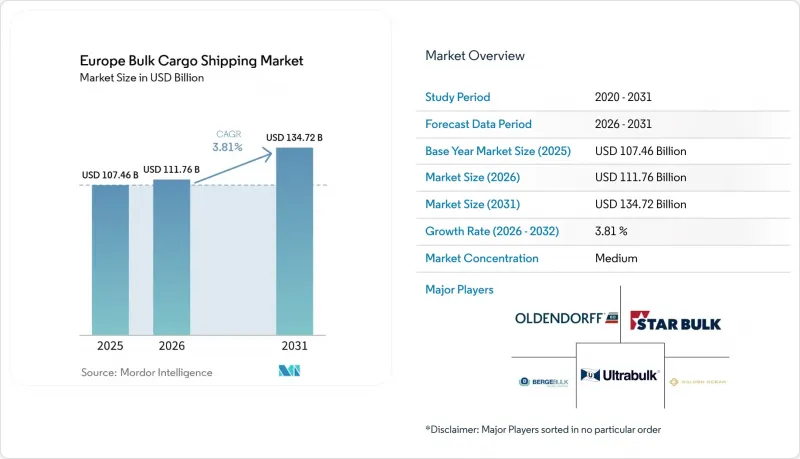
에 따르면 유럽의 벌크 화물 운송 시장 규모는 2025년에 1,074억 6,000만 달러로 평가되며, 2026년 1,117억 6,000만 달러에서 2031년까지 1,347억 2,000만 달러에 달할 것으로 추정되며, 예측 기간(2026-2031년) 동안 CAGR은 3.81%가 될 전망입니다.
유럽 벌크 화물 운송 시장의 동향 및 인사이트
에너지 전환에 따른 화물 구성 재편, 특히 바이오매스, LNG, 비료, 철강 원료
유럽의 에너지 공급 변화로 인해 주요 벌크 항로에서 취급되는 화물의 구성이 변화했습니다. 로테르담에서는 지역 구매자들이 가스 비축량을 재구축함에 따라 2025년에 1,300만 톤의 LNG를 취급하여 2024년 대비 15.1% 증가했습니다. 석탄 취급량이 감소하는 가운데, 바이오매스, 그린 수소 원료 및 비료는 점점 더 중요한 화물로 부상하고 있습니다. 유럽연합 집행위원회는 ‘대체 연료 인프라 규정’이 운송 네트워크 내 대체 연료 인프라 구축을 지원할 것이라고 밝혔습니다. 따라서 유럽의 벌크 화물 운송 시장에서는 다양한 화물의 사양과 변화하는 무역 경로에 대응할 수 있는 선박 용량이 요구되고 있습니다. 오픈 해치형 벌크선, 소형 LNG 운반선 및 복합선은 이러한 수요 변화의 일부에 대응할 수 있습니다.
유럽의 벌크 운송 회랑을 통한 산업 투입재의 니어쇼어링
유럽의 제조업체들은 더 짧고 탄력적인 조달 경로에 점점 더 주목하고 있습니다. 이러한 접근 방식은 유럽 전역의 산업 허브, 항만, 내륙 물류 거점 간의 화물 운송을 촉진합니다. 생산 거점의 이전에 따라 철광석, 비료, 골재, 화학제품의 정기적인 공급이 필요해질 경우, 유럽의 벌크 화물 운송 시장은 혜택을 받게 됩니다. 폴란드 및 기타 중동부 유럽 지역은 발트해와 북해를 경유하여 더 많은 산업용 투입 자재를 수용할 수 있게 될 것입니다. 유럽 내 화물 운송량이 증가하면, 신뢰성이 높은 근해 항로의 운항 일정과 이에 연계된 터미널 운영의 가치가 높아집니다. 이를 통해 해상, 철도, 내륙수로 각 서비스를 조정할 수 있는 해운사에게 새로운 비즈니스 기회가 생겨납니다.
EU의 배출량, 연료, 보고 관련 규제로 인한 높은 규정 준수 비용
EU 배출권 거래 제도(ETS)는 2024년 1월부터 해상 운송을 대상으로 확대되었습니다. ‘FuelEU Maritime’은 2025년 1월부터 유럽 경제 지역(EEA)의 항구에 기항하는 총톤수(GT) 5,000 이상의 선박에 적용됩니다. 이 규제는 2025년에 온실가스 배출 강도를 2% 감축할 것을 요구하며, 2050년까지 더욱 엄격한 감축 경로가 정해져 있습니다. 운항 사업자는 규제상 요건과 상업적 요건을 모두 충족하는 연료 기록, 배출량 정보 및 보고 시스템을 구축해야 합니다. 소규모 연안 운항 사업자의 경우, 이러한 고정 비용을 분담할 수 있는 자원이 부족하기 때문에 더 큰 행정적 부담에 직면할 가능성이 있습니다. 그 결과, 유럽의 벌크 화물 운송 시장에서는 규정 준수 체제가 확립된 선단이 더 높은 평가를 받게 될 수도 있습니다.
부문 분석
2025년, 유럽 벌크 화물 운송 시장 규모의 핵심을 이룬 것은 건화물(드라이 벌크)로, 시장 점유율의 62.63%를 차지했습니다. 철광석, 곡물, 비료, 시멘트, 철강 제품에 의존하는 산업 및 농업의 공급망이 이를 뒷받침하고 있습니다. 철강 수요가 변화하고 있음에도 불구하고, 북유럽의 철강 제조업체들은 여전히 철광석과 코크스용 석탄을 필요로 하고 있습니다. 제조업 및 건설업의 침체로 인해 2025년 EU의 철강 명목 소비량은 0.2% 감소했습니다. EUROFER는 산업 생산의 회복과 지정학적 압박 완화를 전제로 2026년 말까지 3.1%의 회복을 전망하고 있습니다. 2026년 상반기, 로테르담에서는 가스 가격 급등이 에너지 조달에 영향을 미치면서 석탄 취급량이 17.8% 증가했습니다. 바이오매스 펠릿, 해상 풍력발전용 골재 및 지속가능한 원자재는 석탄 취급량 감소를 부분적으로 상쇄하고 있습니다. 이러한 화물은 하역 요건이 서로 다르기 때문에 선사는 유연한 적재 계획, 하역 방법 및 항로 계획이 필요합니다. 이러한 공급망 덕분에 건화물은 계속해서 유럽 항만에게 폭넓은 사업 기반을 제공하고 있습니다. 또한, 산업 플랜트나 저장 시설이 예정된 재고 수준에 근접한 상태로 가동될 경우, 화주들은 예측 가능한 하역 기간에 의존하게 됩니다. 터미널 운영사는 고밀도 화물, 계절성 농산물 처리량 및 특수한 소규모 벌크 화물에 대응할 수 있도록 설비와 인력 체제를 유지해야 합니다. 이러한 요인들이 복합적으로 작용하여, 기초적인 화물 수요가 안정적일지라도 항만 간 선단 배치는 균일하지 않게 되고 있습니다.
액체 벌크 화물은 LNG 무역, 정제 석유 제품, 그리고 유럽 전역의 화학제품 생산 확대에 힘입어 2031년까지 연평균 성장률(CAGR) 5.23%로 확대되어 가장 빠르게 성장하는 화물 부문이 될 것으로 예측됩니다. 로테르담의 LNG 취급량은 2025년에 15.1% 증가하여 1,300만 톤에 달했습니다. 이러한 증가는 유럽의 에너지 조달원 변화에 따라 가스 수입 능력에 대한 수요가 높아지고 있음을 반영합니다. 액체 화물에는 전용 탱크, 터미널, 안전 시스템 및 화물 서류도 필요합니다. 반 무어 로지스틱스(Van Moor Logistics)는 1억 8,500만 유로(2억 1,762만 달러) 규모의 계획의 1단계로, 2026년 6월 워스란트하펜에 63기의 폴리머 사일로를 개장했습니다. 이번 투자는 화학 산업 클러스터 내 저장 및 하역 역량에 대한 지속적인 신뢰를 보여줍니다. 식품 수입의 다각화로 인해 식용유와 당밀의 운송량도 증가하고 있습니다. 취급 품목의 폭이 넓어짐에 따라 터미널 운영 사업자에게는 더 많은 기회가 주어지지만, 제품의 품질 관리, 보관 및 선박의 턴어라운드를 더욱 엄격하게 관리해야 합니다. 전용 인프라를 구축함으로써 오염, 온도, 안전 요건이 서로 다른 화물 간의 취급 상의 충돌을 완화할 수 있습니다. 따라서 상업적 성공은 선박의 기항 일정과 보관 공간의 가용성, 그리고 다운스트림 고객의 수요를 적절히 조율할 수 있는지에 달려 있습니다.
기타 이점:
- 엑셀 형식의 시장 예측(ME) 시트
- 3개월간의 애널리스트 지원
자주 묻는 질문
목차
제1장 소개
- 조사 가정과 시장 정의
- 조사 범위
제2장 조사 방법
제3장 주요 요약
제4장 시장 구도
- 시장 개요와 산적화물 운송의 중요성
- 시장 성장 촉진요인
- 시장 성장 억제요인
- 업계 규제 프레임워크
- 밸류체인 및 유통 채널 구조 분석
- 기술 메가트렌드와 구조적 변화 벌크 화물 운송
- Porter's Five Forces 분석
- 운임 분석
- 비용 구조 분석
- 수출입 무역 분석
- 항만·터미널 인프라 분석
- 지속가능성 및 ESG 분석
- 지정학적 사건이 공급망 변화에 미치는 영향
제5장 시장 규모 및 성장 예측(금액, 2026-2031년)
- 화물 유형별
- 항로별
- 최종 이용 산업별
- 국가별
- 영국
- 독일
- 프랑스
- 스페인
- 이탈리아
- 벨기에
- 네덜란드
- 북유럽 국가(덴마크, 핀란드, 아이슬랜드, 노르웨이, 스웨덴)
- 기타 유럽 국가
제6장 경쟁 구도
- 시장 집중도
- 주요 전략적 동향
- 시장 점유율 분석
- 기업 개요
- Oldendorff Carriers
- Ultrabulk A/S
- Star Bulk Carriers
- Golden Ocean Group
- Berge Bulk
- Gearbulk
- Fednav
- Spliethoff Group
- Wagenborg Shipping
- Western Bulk
- SAL Heavy Lift
- Torvald Klaveness
- NORDEN
- Wilson ASA
- Grieg Maritime Group
- Briese Group
- AAL Shipping
- VARAMAR
- MACS Maritime Carrier Shipping
- SMT Shipping
- Diana Shipping
- Cobelfret
제7장 시장 기회와 향후 전망
KSM 26.10.30According to Mordor Intelligence, the European bulk cargo shipping market size was valued at USD 107.46 billion in 2025 and is estimated to grow from USD 111.76 billion in 2026 to reach USD 134.72 billion by 2031, at a CAGR of 3.81% during the forecast period (2026-2031).
Europe Bulk Cargo Shipping Market Trends and Insights
Energy Transition Cargo Rebalancing, Especially Biomass, LNG, Fertilizers, and Steel Inputs
European energy supply changes have altered the cargo mix used by major bulk routes. Rotterdam handled 13 million tons of LNG in 2025, a 15.1% increase from 2024, as regional buyers rebuilt gas stocks. Biomass, green-hydrogen feedstocks, and fertilizers are increasingly relevant cargoes as coal volumes decline. The European Commission states that the Alternative Fuels Infrastructure Regulation supports the deployment of alternative-fuel infrastructure in transport networks. The European bulk cargo shipping market, therefore, needs vessel capacity that can serve different cargo specifications and changing trade lanes. Open-hatch bulkers, smaller LNG carriers, and combination vessels can address parts of this shifting demand.
Nearshoring of Industrial Input Flows through European Bulk Corridors
European manufacturers are placing more attention on shorter and more resilient sourcing routes. This approach supports cargo movements between industrial hubs, ports, and inland distribution points across Europe. The European bulk cargo shipping market benefits when relocated production requires regular deliveries of iron ore, fertilizers, aggregates, and chemicals. Poland and other Central and Eastern European locations can receive more industrial inputs through Baltic and North Sea connections. More intra-European freight can raise the value of reliable short-sea schedules and connected terminal operations. This creates an opening for carriers that can coordinate sea, rail, and inland-waterway services.
High Compliance Cost from EU Emissions, Fuel, and Reporting Rules
The EU Emissions Trading System began covering maritime transport in January 2024. FuelEU Maritime applied from January 2025 to ships above 5,000 GT calling at European Economic Area ports. The regulation required a 2% reduction in greenhouse-gas intensity in 2025, with a more stringent pathway through 2050. Operators need fuel records, emissions information, and reporting systems that satisfy both regulatory and commercial requirements. Smaller short-sea operators can face a heavier administrative burden because they have fewer resources to spread these fixed costs. The European bulk cargo shipping market may consequently place a higher premium on fleets with established compliance processes.
Other drivers and restraints analyzed in the detailed report include:
- Inland-Waterway and Short-Sea Modal Shift to Reduce Truck Congestion and Emissions
- Port Decarbonization Incentives Favoring Cleaner Bulk Vessel Deployment
- Port Congestion and Labor Intermittency Disrupting Voyage Reliability
For complete list of drivers and restraints, kindly check the Table Of Contents.
Segment Analysis
Dry bulk cargo was the core of the Europe bulk cargo shipping market size in 2025, accounting for 62.63% of the market share, with industrial and agricultural supply chains depending on iron ore, grain, fertilizers, cement, and steel products. Northern European steelmakers still require iron ore and coking coal even as steel demand changes. EU apparent steel consumption declined 0.2% in 2025, following weakness in manufacturing and construction. EUROFER projected a 3.1% recovery by the end of 2026, subject to stronger industrial output and less geopolitical pressure. Rotterdam recorded a 17.8% increase in coal throughput during the first half of 2026 as higher gas prices affected energy purchasing. Biomass pellets, offshore-wind aggregates, and sustainable raw materials provide a partial offset to lower coal volumes. Carriers need flexible stowage, cargo-handling methods, and route planning because these cargoes have different loading and discharge needs. These supply chains continue to make dry bulk a broad operational base for European ports. Cargo owners also depend on predictable discharge windows when industrial plants and storage sites run close to scheduled inventory levels. Terminal operators must retain equipment and workforce capability for dense cargoes, seasonal agricultural volumes, and specialized minor bulks. The combination makes fleet deployment less uniform across ports, even when the underlying cargo demand is stable.
Liquid bulk cargo is projected to be the fastest-growing cargo category through 2031, expanding at a 5.23% CAGR, supported by LNG trade, refined petroleum products, and expanding chemical manufacturing across Europe. Rotterdam's LNG throughput rose 15.1% to 13 million tons in 2025. This increase reflects the need for gas import capacity as European energy sourcing changes. Liquid cargo also needs specialized tanks, terminals, safety systems, and cargo documentation. Van Moer Logistics opened 63 polymer silos at Waaslandhaven in June 2026 as the first phase of a EUR 185 million (USD 217.62 million) program. The investment showed continued confidence in chemical-cluster storage and handling capacity. Diversified food imports also sustain traffic in edible oils and molasses. The wider mix gives terminal operators more opportunities, but it requires closer control of product quality, storage, and vessel turnaround. Dedicated infrastructure can reduce handling conflicts between cargoes with different contamination, temperature, and safety requirements. Commercial success, therefore, depends on matching vessel calls with storage availability and downstream customer demand.
Complete Report Scope:
- By Cargo Type
- Dry Bulk Cargo
- Iron Ore
- Coal
- Grain (Wheat, Corn, Soybeans, etc.)
- Fertilizers
- Cement & Clinker
- Bauxite & Alumina
- Steel Products
- Other Minor Dry Bulk Commodities
- Liquid Bulk Cargo
- Crude Oil
- Refined Petroleum Products
- Liquefied Natural Gas (LNG)
- Liquefied Petroleum Gas (LPG)
- Chemicals
- Edible & Vegetable Oils
- Molasses
- Other Liquid Bulk Commodities
- Dry Bulk Cargo
- By Shipping Route
- Domestic (Coastal)
- International
- By End-Use Industry
- Mining & Metals
- Energy & Utilities
- Agriculture
- Chemicals & Petrochemicals
- Construction & Infrastructure
- Food Processing
- Manufacturing (General Industrial)
- Others
- By Country
- United Kingdom
- Germany
- France
- Spain
- Italy
- Belgium
- Netherlands
- NORDICS (Denmark, Finland, Iceland, Norway, and Sweden)
- Rest of Europe
List of Companies Covered in this Report:
- Oldendorff Carriers
- Ultrabulk A/S
- Star Bulk Carriers
- Golden Ocean Group
- Berge Bulk
- Gearbulk
- Fednav
- Spliethoff Group
- Wagenborg Shipping
- Western Bulk
- SAL Heavy Lift
- Torvald Klaveness
- NORDEN
- Wilson ASA
- Grieg Maritime Group
- Briese Group
- AAL Shipping
- VARAMAR
- MACS Maritime Carrier Shipping
- SMT Shipping
- Diana Shipping
- Cobelfret
Additional Benefits:
- The market estimate (ME) sheet in Excel format
- 3 months of analyst support
TABLE OF CONTENTS
1 Introduction
- 1.1 Study Assumptions & Market Definition
- 1.2 Scope of the Study
2 Research Methodology
3 Executive Summary
4 Market Landscape
- 4.1 Market Overview and Importance of Bulk Cargo Shipping
- 4.2 Market Drivers
- 4.2.1 Nearshoring of Industrial Input Flows Through European Bulk Corridors
- 4.2.2 Replacement Demand from Aging Short-Sea and Feeder Dry Bulk Fleets
- 4.2.3 Port Decarbonization Incentives Favoring Cleaner Bulk Vessel Deployment
- 4.2.4 Energy Transition Cargo Rebalancing, Especially Biomass, LNG, Fertilizers, and Steel Inputs
- 4.2.5 Inland-Waterway and Short-Sea Modal Shift to Reduce Truck Congestion and Emissions
- 4.2.6 Digital Berth Scheduling and Cargo Visibility Improving Vessel Utilization
- 4.3 Market Restraints
- 4.3.1 High Compliance Cost from EU Emissions, Fuel, And Reporting Rules
- 4.3.2 Port Congestion and Labor Intermittency Disrupting Voyage Reliability
- 4.3.3 Demand Volatility from Cyclical Steel, Fertilizer, and Power Markets
- 4.3.4 Limited Terminal Draft, Storage, and Transshipment Capacity in Select European Ports
- 4.4 Industry Regulatory Framework
- 4.5 Value Chain and Distribution Channel Architecture Analysis
- 4.6 Technology Megatrends and Structural Shifts Bulk Cargo Shipping
- 4.7 Porter's Five Forces Analysis
- 4.7.1 Threat of New Entrants
- 4.7.2 Bargaining Power of Suppliers
- 4.7.3 Bargaining Power of Buyers
- 4.7.4 Threat of Substitutes
- 4.7.5 Rivalry Among Competitors
- 4.8 Freight Rate Analysis
- 4.8.1 Freight Rate Trends
- 4.8.2 Spot Market Analysis
- 4.8.3 Country-wise Freight Rate Comparison
- 4.8.4 Factors Influencing Freight Rates
- 4.9 Cost Structure Analysis
- 4.9.1 Shipping Cost Components
- 4.9.2 Fuel Cost Trends
- 4.9.3 Port Charges
- 4.9.4 Cost Optimization Strategies
- 4.10 Import-Export Trade Analysis
- 4.11 Port and Terminal Infrastructure Analysis
- 4.12 Sustainability and ESG Analysis
- 4.13 Impact of Geo-Political Events on Supply Chain Shifts
5 Market Size & Growth Forecasts (Value, 2026-2031)
- 5.1 By Cargo Type
- 5.1.1 Dry Bulk Cargo
- 5.1.1.1 Iron Ore
- 5.1.1.2 Coal
- 5.1.1.3 Grain (Wheat, Corn, Soybeans, etc.)
- 5.1.1.4 Fertilizers
- 5.1.1.5 Cement & Clinker
- 5.1.1.6 Bauxite & Alumina
- 5.1.1.7 Steel Products
- 5.1.1.8 Other Minor Dry Bulk Commodities
- 5.1.2 Liquid Bulk Cargo
- 5.1.2.1 Crude Oil
- 5.1.2.2 Refined Petroleum Products
- 5.1.2.3 Liquefied Natural Gas (LNG)
- 5.1.2.4 Liquefied Petroleum Gas (LPG)
- 5.1.2.5 Chemicals
- 5.1.2.6 Edible & Vegetable Oils
- 5.1.2.7 Molasses
- 5.1.2.8 Other Liquid Bulk Commodities
- 5.1.1 Dry Bulk Cargo
- 5.2 By Shipping Route
- 5.2.1 Domestic (Coastal)
- 5.2.2 International
- 5.3 By End-Use Industry
- 5.3.1 Mining & Metals
- 5.3.2 Energy & Utilities
- 5.3.3 Agriculture
- 5.3.4 Chemicals & Petrochemicals
- 5.3.5 Construction & Infrastructure
- 5.3.6 Food Processing
- 5.3.7 Manufacturing (General Industrial)
- 5.3.8 Others
- 5.4 By Country
- 5.4.1 United Kingdom
- 5.4.2 Germany
- 5.4.3 France
- 5.4.4 Spain
- 5.4.5 Italy
- 5.4.6 Belgium
- 5.4.7 Netherlands
- 5.4.8 NORDICS (Denmark, Finland, Iceland, Norway, and Sweden)
- 5.4.9 Rest of Europe
6 Competitive Landscape
- 6.1 Market Concentration
- 6.2 Key Strategic Moves
- 6.3 Market Share Analysis
- 6.4 Company Profiles (includes Global level Overview, Market level overview, Core Segments, Financials as available, Strategic Information, Geographic/Network Coverage, Products & Services, and Recent Developments)
- 6.4.1 Oldendorff Carriers
- 6.4.2 Ultrabulk A/S
- 6.4.3 Star Bulk Carriers
- 6.4.4 Golden Ocean Group
- 6.4.5 Berge Bulk
- 6.4.6 Gearbulk
- 6.4.7 Fednav
- 6.4.8 Spliethoff Group
- 6.4.9 Wagenborg Shipping
- 6.4.10 Western Bulk
- 6.4.11 SAL Heavy Lift
- 6.4.12 Torvald Klaveness
- 6.4.13 NORDEN
- 6.4.14 Wilson ASA
- 6.4.15 Grieg Maritime Group
- 6.4.16 Briese Group
- 6.4.17 AAL Shipping
- 6.4.18 VARAMAR
- 6.4.19 MACS Maritime Carrier Shipping
- 6.4.20 SMT Shipping
- 6.4.21 Diana Shipping
- 6.4.22 Cobelfret
7 Market Opportunities & Future Outlook
- 7.1 White-space & Unmet-Need Assessment


