

|
시장보고서
상품코드
2155663
마테리오비질런스(Materiovigilance) : 시장 점유율 분석, 업계 동향과 통계, 성장 예측(2026-2031년)Materiovigilance - Market Share Analysis, Industry Trends & Statistics, Growth Forecasts (2026 - 2031) |
||||||
 Mordor Intelligence
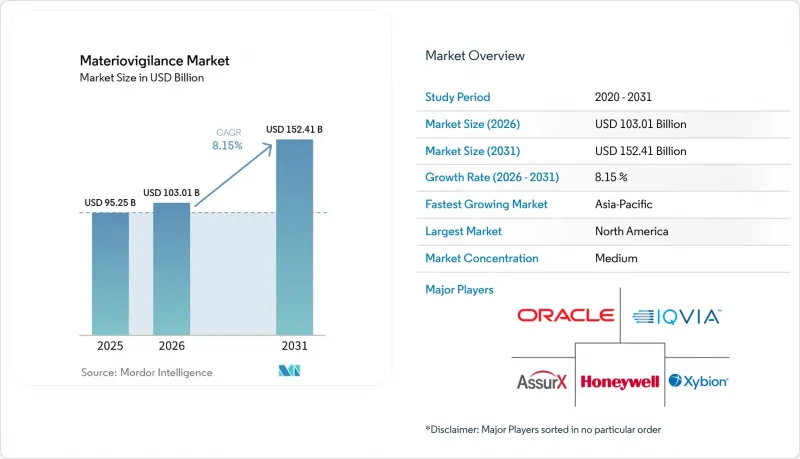
에 따르면 마테리오비질런스 시장 규모는 2025년 952억 5,000만 달러, 2026년 1,030억 1,000만 달러에서 2031년까지 1,524억 1,000만 달러로 확대될 것으로 예측되며, 2026년부터 2031년까지 연평균 성장률(CAGR)은 8.15%가 될 전망입니다.
세계 마테리오비질런스 시장의 동향 및 인사이트
의료기기 사고 보고 의무 확대
사건 보고 의무화는 단순한 규정 준수 차원의 안전 조치에서, 재료 감시 시장의 핵심 수요 요인으로 자리 잡고 있습니다. 유럽연합 집행위원회는 2026년 5월 28일부터 이해관계자 등록, UDI 및 의료기기 등록, 인증 기관 및 인증, 시장 감시를 포괄하는 4가지 EUDAMED 모듈을 의무화했습니다. 이러한 요건에 따라 제조업체, 지정 대리인, 수입업체 및 인증 기관은 공통된 디지털 보고 체계로의 전환이 요구되고 있습니다. FDA의 품질 관리 시스템 규정은 2026년 2월 2일에 발효되었으며, ISO 13485:2016이 21 CFR Part 820에 통합되었습니다. 소규모 제조업체의 경우 규정 준수를 위한 전담 인력이 부족할 가능성이 있어, 외부 보고 플랫폼 및 관리형 서비스에 대한 수요가 증가하고 있습니다. 의료기기 감시 시장은 의료기기의 수요 주기나 광범위한 경제 상황에 관계없이 지속되는 이러한 의무 덕분에 혜택을 보고 있습니다.
불만, 감시 및 PMS 데이터의 클라우드 통합
감시 기록은 보고 거점 간에 항상 최신 상태로 유지되고, 연동되며, 접근 가능해야 하므로 클라우드 도입은 규제 준수를 위한 준비를 지원합니다. 물질 감시 시장에서는 불만 데이터, 현장 안전 시정 조치, 임상 후속 조치 기록 및 위험 문서를 하나의 관리된 워크플로우로 통합하는 플랫폼이 선호됩니다. 이러한 구조를 통해 사건 접수, 시정 조치 및 감시 팀 간의 수작업 인계 과정을 줄일 수 있습니다. 또한, 이는 현재 ISO 13485:2016을 반영하고 있는 FDA의 QMSR(품질 관리 시스템 규정)에서 요구하는 문서화된 품질 시스템도 지원합니다. 보고 분류 체계, 규제 규칙 및 정기 안전성 보고서 템플릿이 동일한 환경 내에서 구성되어 있다면, 공급업체는 고객 유지율을 높일 수 있습니다. 다만, 환자 식별자 및 관련 안전성 데이터를 국내 또는 지역 경계 내에 유지해야 하는 지역에서는 클라우드 통합의 가치가 제한적입니다.
분산된 보고 분류 체계와 국경을 초월한 규정
의료기기 감시 시장은 분류, 제출 언어, 데이터 항목, 제출 기한이 서로 다른 각국의 보고 규정을 아우르며 운영되어야 합니다. 2025년 조사에 따르면, 유럽연합(EU)의 EudraVigilance 및 EUDAMED 구조와 보다 통합된 미국의 FAERS 및 MAUDE 접근 방식 사이에는 여전히 차이점이 있는 것으로 나타났습니다. 15개 관할 구역에서 의료기기를 판매하는 제조업체는 15가지 형태의 정기 안전성 보고서를 작성해야 하며, 각각 다른 규제 당국에 제출해야 할 수도 있습니다. 이러한 요건으로 인해 전 세계 보고용 소프트웨어의 설계 및 검증에 필요한 노력이 증가합니다. 이러한 부담은 대형 다국적 기업과 같은 규제 대응 역량을 갖추지 못한 중규모 OEM 제조업체에 가장 크게 가중됩니다. 그 결과, 일부 제조업체는 매출이 가장 큰 관할 구역에 감시 활동에 대한 투자를 집중할 가능성이 있으며, 이로 인해 전 세계적인 안전성 기록에 누락이 발생할 우려가 있습니다.
부문 분석
2025년, 유해사건 보고는 의료기기의 시판 후 감시에 있어 여전히 법적으로 의무화된 기반이므로, 재료 감시 시장의 44.31%를 차지했습니다. FDA의 MAUDE 시스템 및 EUDAMED의 감시 프레임워크에서는 관련 사건의 적시 보고가 요구됩니다. 보고 의무를 소홀히 할 경우, 규제 당국의 면밀한 조사나 기타 규정 준수상의 불이익을 초래할 수 있습니다. 시판 후 감시 서비스는 단순한 사후 대응적 불만 처리에 그치지 않고, 체계적인 증거 수집을 지원합니다. 위험 평가 및 관리 서비스는 의료기기의 위험과 이점에 대한 지속적인 재검토를 지원합니다. 재료 안전성 모니터링에서는 생체적합성에 관한 정보와 제품 문제의 초기 징후에도 대응하고 있습니다.
규제 준수 및 보고 서비스는 2031년까지 연평균 성장률(CAGR) 12.65%로 성장할 것으로 예측됩니다. 의료기기 안전성 모니터링 시장은 EUDAMED 요건과 미국의 QMSR이 동시에 도입됨에 따라 형성되고 있습니다. OEM이 개별 사안 처리에서 검사 준비 및 규제 관련 문서 작성으로 업무를 확대할 때, 이 서비스는 보다 광범위한 시장 진입의 발판이 될 가능성이 있습니다. 인도, 호주, 캐나다, 미국 등의 국가에서는 시판 후 감시 시스템이 확립되어 있지만, 그 외 지역에서는 아직 유사한 체제가 정비되고 있는 단계입니다. 이러한 성숙도의 차이로 인해, 여러 관할 구역에 걸쳐 요건을 적용할 수 있는 제공업체에 대한 수요가 발생하고 있습니다. ISO 13485:2016에 기반한 문서 간 연계 또한 통합된 규정 준수 서비스의 필요성을 더욱 부추기고 있습니다.
2025년에는 마테리오비질런스 시장 규모의 66.24%를 클라우드 기반 서비스가 차지했습니다. 이는 대량의 보고 처리, 여러 거점 간의 조정, 그리고 불만 및 감시 정보의 실시간 집계를 지원합니다. 또한 클라우드 플랫폼에는 규제 규칙을 통합할 수 있어, 현재의 워크플로우를 유지하는 데 필요한 전문 지식을 줄일 수 있습니다. 이 기능은 끊임없이 변화하는 미국 및 유럽의 요구 사항을 관리해야 하는 중규모 OEM에게 중요합니다. 온프레미스 방식은 엄격한 데이터 주권 관리를 수행하는 대형 OEM, 공공 기관 및 각국의 보건 당국에게 여전히 중요한 선택지입니다. 또한, 식별 가능한 건강 정보의 해외 또는 지역 외 전송이 규제되는 경우에도 적합합니다.
하이브리드 배포는 2031년까지 연평균 성장률(CAGR) 13.42%로 성장할 것으로 예측됩니다. 이 접근 방식은 클라우드 기반 분석 및 신호 탐지와 기밀성이 높은 환자 식별자의 로컬 저장을 결합한 것입니다. 이는 아시아태평양, 중동 및 유럽의 현지 데이터 규정을 준수하면서 대규모 분석을 수행해야 하는 요구를 충족시킵니다. 하이브리드 구성에서는 새로운 공급자가 로컬 인프라와 분석 시스템 간의 연결을 재검증해야 하므로 전환 비용이 증가할 가능성이 있습니다. AB Cube사의 2026년 로드맵에서는 CasEasy V3 및 Converter V2 등 보안, 내결함성, 미래 대응 능력을 강화하는 기능이 강조되었습니다. 이러한 제품에 대한 투자는 다양한 데이터 관리 요구 사항을 충족할 수 있는 구성을 중시하고 있음을 반영합니다.
지역별 분석
2025년, 북미는 의료기기 모니터링 시장의 38.42% 점유율을 차지했습니다. 이 지역은 확립된 유해 사건 보고 인프라와 미국의 긴밀한 의료기기 생태계의 혜택을 받고 있습니다. FDA의 QMSR은 2026년 2월에 시행되었으며, ISO 13485:2016이 21 CFR Part 820에 통합되었습니다. 미국의 수요에는 엔터프라이즈 품질 관리 플랫폼, AI 기반 신호 분석 도구, CRO(의약품·의료기기 수탁 개발 기관) 서비스 등이 포함됩니다. 또한, FDA의 사이버 보안 지침은 안전성 보고와 연결된 기기 및 소프트웨어 업데이트 기록을 연계하는 시스템에 대한 투자도 촉진하고 있습니다.
유럽은 EU MDR이 27개 회원국 시장에 공통된 규제 기준을 제공하기 때문에 여전히 중요한 지역입니다. 독일, 프랑스, 영국, 이탈리아, 스페인이 이 지역의 수요 대부분을 차지하고 있습니다. EUDAMED의 첫 4개 모듈은 2026년 5월 28일부터 의무화되며, 이로 인해 조정된 디지털 보고의 필요성이 높아질 것입니다. 영국은 브렉시트 이후에도 독자적인 MHRA(의약품·의료기기 규제청) 체계를 유지하고 있어, 두 시스템 모두에서 사업을 전개하는 제조업체에게는 추가적인 제출 요건이 발생하고 있습니다. 독일의 의료기기 제조 거점은 플랫폼 및 서비스 제공업체에 대한 국내 수요를 뒷받침하고 있습니다. 또한 이 지역에서는 개인정보 보호, 보안 및 데이터 전송 관리에 대해서도 엄격한 감시를 받고 있습니다.
아시아태평양은 2031년까지 연평균 성장률(CAGR) 12.33%로 성장할 것으로 예측됩니다. 이 지역의 성장은 중국, 인도, 한국, 일본에서의 보고 요건 강화와 의료기기의 보급 확대를 반영하고 있습니다. 인도는 2026년 2월 공고를 통해 MvPI에 기반한 의료기기 판매 승인 보유자에 대한 보고 규정 준수를 강화했습니다. 일본과 한국은 규제 집행에 중점을 둔 성숙한 시스템을 갖추고 있으므로, 그 기여도는 점진적일 것입니다. 중동 및 아프리카는 의료 분야에 대한 투자와 지역적 파트너십에 힘입어 여전히 초기 단계에 있는 지역입니다. 남미는 브라질의 ANVISA 프레임워크와 아르헨티나의 진화하는 규제 구조에 힘입고 있습니다.
기타 혜택:
- 엑셀 형식의 시장 예측(ME) 시트
- 3개월간의 애널리스트 지원
자주 묻는 질문
목차
제1장 소개
- 조사 가정과 시장 정의
- 조사 범위
제2장 조사 방법
제3장 주요 요약
제4장 시장 구도
- 시장 개요
- 시장 성장 촉진요인
- 시장 성장 억제요인
- 밸류체인 분석
- 규제 상황
- 기술 전망
- Porter's Five Forces 분석
제5장 시장 규모와 성장 예측
- 서비스 유형별
- 배포 방식별
- 디바이스 유형별
- 최종사용자별
- 지역별
- 북미
- 미국
- 캐나다
- 멕시코
- 유럽
- 독일
- 영국
- 프랑스
- 이탈리아
- 스페인
- 기타 유럽 국가
- 아시아태평양
- 중국
- 일본
- 인도
- 호주
- 한국
- 기타 아시아태평양 국가
- 중동 및 아프리카
- GCC
- 남아프리카공화국
- 기타 중동 및 아프리카 국가
- 남미
- 브라질
- 아르헨티나
- 기타 남미 국가
- 북미
제6장 경쟁 구도
- 시장 집중도
- 시장 점유율 분석
- 기업 개요
- AB Cube
- AssurX, Inc.
- Bioexcel Lifesciences Pvt. Ltd.
- Cloudtheapp
- EmpowerReg
- Erythos
- Honeywell International Inc.
- IQVIA Inc.
- Kintavo
- mdi Consultants, Inc.
- Oracle Corporation
- Qserve Group B.V.
- QVigilance
- RealBit S.r.l.
- Remedical
- Sarjen Systems Pvt. Ltd.
- Smarteeva
- Xybion Corporation
- ZEINCRO
제7장 시장 기회와 향후 전망
KSM 26.10.30According to Mordor Intelligence, the materiovigilance market size is projected to expand from USD 95.25 billion in 2025 and USD 103.01 billion in 2026 to USD 152.41 billion by 2031, registering a CAGR of 8.15% between 2026 and 2031.
Global Materiovigilance Market Trends and Insights
Expansion of Mandatory Device Incident Reporting
Mandatory incident reporting is moving from a compliance backstop to a central source of demand in the materiovigilance market. The European Commission made 4 EUDAMED modules compulsory from May 28, 2026, covering actor registration, UDI and device registration, notified bodies and certificates, and market surveillance. These requirements direct manufacturers, authorized representatives, importers, and notified bodies toward a shared digital reporting structure. The FDA Quality Management System Regulation became effective on February 2, 2026, and incorporated ISO 13485:2016 into 21 CFR Part 820. Smaller manufacturers face a greater need for external reporting platforms and managed services because they may lack dedicated regulatory resources. The materiovigilance market benefits from obligations that continue regardless of device demand cycles or broader economic conditions.
Cloud Consolidation of Complaint, Vigilance, and PMS Data
Cloud adoption supports regulatory readiness because surveillance records must remain current, connected, and accessible across reporting locations. The materiovigilance market is favoring platforms that bring complaint data, field safety corrective actions, clinical follow-up records, and risk documentation into one controlled workflow. This arrangement can reduce manual handoffs between case intake, corrective action, and surveillance teams. It also supports the documented quality systems required under the FDA QMSR, which now incorporates ISO 13485:2016. Providers can strengthen client retention when reporting taxonomies, regulatory rules, and periodic safety report templates are configured within the same environment. The value of cloud consolidation is limited in locations where patient identifiers and related safety data must remain within national or regional boundaries.
Fragmented Reporting Taxonomies and Cross-Border Rules
The materiovigilance market must operate across national reporting rules that differ in classifications, filing languages, data fields, and submission deadlines. A 2025 review found continuing differences between the European Union's EudraVigilance and EUDAMED structures and the more centralized U.S. FAERS and MAUDE approach. A manufacturer selling a device in 15 jurisdictions may need 15 differently formatted periodic safety reports and separate regulatory contacts. These requirements raise the effort needed to design and validate global reporting software. The burden falls most heavily on mid-size OEMs that do not have the regulatory affairs capacity of larger multinational companies. As a result, some manufacturers may concentrate surveillance investment in their largest sales jurisdictions, which can leave gaps in global safety records.
Other drivers and restraints analyzed in the detailed report include:
- AI-Assisted Signal Detection From Unstructured Complaints
- Rising Complexity of Connected and Software-Enabled Devices
- Cybersecurity, Privacy, and Data-Residency Exposure
For complete list of drivers and restraints, kindly check the Table Of Contents.
Segment Analysis
Adverse Event Reporting held 44.31% of the materiovigilance market share in 2025 because it remains the legally required base of device post-market surveillance. The FDA MAUDE system and the EUDAMED vigilance framework require timely reporting of relevant events. Missed reporting obligations can lead to inspection scrutiny and other compliance consequences. Post-Market Surveillance services support structured evidence collection rather than only reactive complaint handling. Risk Assessment and Management services support ongoing review of device risks and benefits. Material Safety Monitoring also addresses biocompatibility information and early signs of product issues.
Regulatory Compliance and Reporting is forecast to grow at a 12.65% CAGR through 2031. The materiovigilance market is being shaped by concurrent implementation of EUDAMED requirements and the U.S. QMSR. The service can become a broader entry point when OEMs expand from case processing to inspection preparation and regulatory documentation. Countries such as India, Australia, Canada, and the United States have established post-marketing systems, while other locations are still developing similar structures. This uneven maturity creates demand for providers that can apply requirements across jurisdictions. Documentation linkages under ISO 13485:2016 further support the need for integrated compliance services.
Cloud-Based delivery accounted for 66.24% of the materiovigilance market size in 2025. It supports large reporting volumes, multi-site coordination, and real-time aggregation of complaint and surveillance information. Cloud platforms can also embed regulatory rules that reduce the specialized expertise required to maintain current workflows. This feature is important for mid-size OEMs managing changing U.S. and European requirements. On-Premise delivery remains relevant for large OEMs, public institutions, and national health authorities with strict data-sovereignty controls. It is also relevant where rules restrict transfers of identifiable health information outside a country or region.
Hybrid deployment is forecast to grow at a 13.42% CAGR through 2031. This approach combines cloud-based analytics and signal detection with local storage for sensitive patient identifiers. It responds to the need for analysis at scale while respecting local data controls in Asia-Pacific, the Middle East, and Europe. Hybrid configurations can increase switching costs because a new provider must revalidate connections between local infrastructure and analytical systems. AB Cube's 2026 roadmap highlighted security, resilience, and future-readiness features, including CasEasy V3 and Converter V2. These product investments reflect the emphasis on configurations that can serve different data-control requirements.
Complete Report Scope:
- By Service Type
- Adverse Event Reporting
- Post-Market Surveillance
- Risk Assessment and Management
- Regulatory Compliance and Reporting
- Material Safety Monitoring
- By Delivery Mode
- Cloud-Based
- On-Premise
- Hybrid
- By Device Type
- Diagnostic Devices
- Therapeutic Devices
- Monitoring Devices
- Surgical Devices
- Other Device Types
- By End User
- Original Equipment Manufacturers
- Contract Research Organizations
- Business Process Outsourcing Providers
- Healthcare Institutions
- Regulatory Authorities and Public-Health Programs
- Other End Users
- By Geography
- North America
- United States
- Canada
- Mexico
- Europe
- Germany
- United Kingdom
- France
- Italy
- Spain
- Rest of Europe
- Asia-Pacific
- China
- Japan
- India
- Australia
- South Korea
- Rest of Asia-Pacific
- Middle East and Africa
- GCC
- South Africa
- Rest of Middle East and Africa
- South America
- Brazil
- Argentina
- Rest of South America
- North America
Geography Analysis
North America held 38.42% of the materiovigilance market share in 2025. The region benefits from an established adverse-event reporting infrastructure and a dense U.S. medical-device ecosystem. The FDA QMSR took effect in February 2026 and incorporated ISO 13485:2016 into 21 CFR Part 820. U.S. demand includes enterprise quality management platforms, AI-supported signal tools, and contract research organization services. FDA cybersecurity guidance also supports investment in systems that connect safety reporting with connected-device and software-update records.
Europe remains an important geography because the EU MDR provides a shared regulatory baseline for the 27-member market. Germany, France, the United Kingdom, Italy, and Spain provide much of the region's demand. EUDAMED's first 4 modules become mandatory on May 28, 2026, which increases the need for coordinated digital reporting. The United Kingdom retains a separate MHRA framework after Brexit, creating additional submission requirements for manufacturers operating in both systems. Germany's medical-device manufacturing base supports domestic demand for platform and service providers. The region also faces scrutiny of privacy, security, and data-transfer controls.
Asia-Pacific is forecast to grow at a 12.33% CAGR through 2031. The region's expansion reflects stronger reporting expectations and a growing device base in China, India, South Korea, and Japan. India's February 2026 notice reinforced reporting compliance for medical-device marketing authorization holders under MvPI. Japan and South Korea are mature enforcement-focused systems, so their contribution is more incremental. The Middle East and Africa remain early-stage areas supported by healthcare investment and regional partnerships. South America is supported by Brazil's ANVISA framework and Argentina's evolving regulatory structure.
- AB Cube
- AssurX
- Bioexcel Lifesciences Pvt. Ltd.
- Cloudtheapp
- EmpowerReg
- Erythos
- Honeywell International
- IQVIA
- Kintavo
- mdi Consultants, Inc.
- Oracle
- Qserve Group B.V.
- QVigilance
- RealBit S.r.l.
- Remedical
- Sarjen Systems Pvt. Ltd.
- Smarteeva
- Xybion Corporation
- ZEINCRO
Additional Benefits:
- The market estimate (ME) sheet in Excel format
- 3 months of analyst support
TABLE OF CONTENTS
1 Introduction
- 1.1 Study Assumptions and Market Definition
- 1.2 Scope of the Study
2 Research Methodology
3 Executive Summary
4 Market Landscape
- 4.1 Market Overview
- 4.2 Market Drivers
- 4.2.1 Expansion of Mandatory Device Incident Reporting
- 4.2.2 Cloud Consolidation of Complaint, Vigilance, and PMS Data
- 4.2.3 AI-Assisted Signal Detection From Unstructured Complaints
- 4.2.4 Rising Complexity of Connected and Software-Enabled Devices
- 4.2.5 Localization of Surveillance Programs in Emerging Device Markets
- 4.2.6 Continuous Evidence Linkage Across PMS, PMCF, Risk, and CAPA
- 4.3 Market Restraints
- 4.3.1 Fragmented Reporting Taxonomies and Cross-Border Rules
- 4.3.2 Cybersecurity, Privacy, and Data-Residency Exposure
- 4.3.3 Scarcity of Device-Specific Regulatory and Clinical Expertise
- 4.3.4 Weak Causality and Denominator Data in Voluntary Reporting
- 4.4 Value Chain Analysis
- 4.5 Regulatory Landscape
- 4.6 Technological Outlook
- 4.7 Porter's Five Forces Analysis
- 4.7.1 Threat of New Entrants
- 4.7.2 Bargaining Power of Suppliers
- 4.7.3 Bargaining Power of Buyers
- 4.7.4 Threat of Substitutes
- 4.7.5 Competitive Rivalry
5 Market Size & Growth Forecasts (Value, USD)
- 5.1 By Service Type
- 5.1.1 Adverse Event Reporting
- 5.1.2 Post-Market Surveillance
- 5.1.3 Risk Assessment and Management
- 5.1.4 Regulatory Compliance and Reporting
- 5.1.5 Material Safety Monitoring
- 5.2 By Delivery Mode
- 5.2.1 Cloud-Based
- 5.2.2 On-Premise
- 5.2.3 Hybrid
- 5.3 By Device Type
- 5.3.1 Diagnostic Devices
- 5.3.2 Therapeutic Devices
- 5.3.3 Monitoring Devices
- 5.3.4 Surgical Devices
- 5.3.5 Other Device Types
- 5.4 By End User
- 5.4.1 Original Equipment Manufacturers
- 5.4.2 Contract Research Organizations
- 5.4.3 Business Process Outsourcing Providers
- 5.4.4 Healthcare Institutions
- 5.4.5 Regulatory Authorities and Public-Health Programs
- 5.4.6 Other End Users
- 5.5 By Geography
- 5.5.1 North America
- 5.5.1.1 United States
- 5.5.1.2 Canada
- 5.5.1.3 Mexico
- 5.5.2 Europe
- 5.5.2.1 Germany
- 5.5.2.2 United Kingdom
- 5.5.2.3 France
- 5.5.2.4 Italy
- 5.5.2.5 Spain
- 5.5.2.6 Rest of Europe
- 5.5.3 Asia-Pacific
- 5.5.3.1 China
- 5.5.3.2 Japan
- 5.5.3.3 India
- 5.5.3.4 Australia
- 5.5.3.5 South Korea
- 5.5.3.6 Rest of Asia-Pacific
- 5.5.4 Middle East and Africa
- 5.5.4.1 GCC
- 5.5.4.2 South Africa
- 5.5.4.3 Rest of Middle East and Africa
- 5.5.5 South America
- 5.5.5.1 Brazil
- 5.5.5.2 Argentina
- 5.5.5.3 Rest of South America
- 5.5.1 North America
6 Competitive Landscape
- 6.1 Market Concentration
- 6.2 Market Share Analysis
- 6.3 Company Profiles (includes Global Level Overview, Market Level Overview, Core Segments, Financials as available, Strategic Information, Market Rank/Share, Products and Services, Recent Developments)
- 6.3.1 AB Cube
- 6.3.2 AssurX, Inc.
- 6.3.3 Bioexcel Lifesciences Pvt. Ltd.
- 6.3.4 Cloudtheapp
- 6.3.5 EmpowerReg
- 6.3.6 Erythos
- 6.3.7 Honeywell International Inc.
- 6.3.8 IQVIA Inc.
- 6.3.9 Kintavo
- 6.3.10 mdi Consultants, Inc.
- 6.3.11 Oracle Corporation
- 6.3.12 Qserve Group B.V.
- 6.3.13 QVigilance
- 6.3.14 RealBit S.r.l.
- 6.3.15 Remedical
- 6.3.16 Sarjen Systems Pvt. Ltd.
- 6.3.17 Smarteeva
- 6.3.18 Xybion Corporation
- 6.3.19 ZEINCRO
7 Market Opportunities and Future Outlook
- 7.1 White-Space and Unmet-Need Assessment


