

|
시장보고서
상품코드
2156894
승용차용 모터 오일 : 시장 점유율 분석, 업계 동향과 통계, 성장 예측(2026-2031년)Passenger Car Motor Oil - Market Share Analysis, Industry Trends & Statistics, Growth Forecasts (2026 - 2031) |
||||||
 Mordor Intelligence
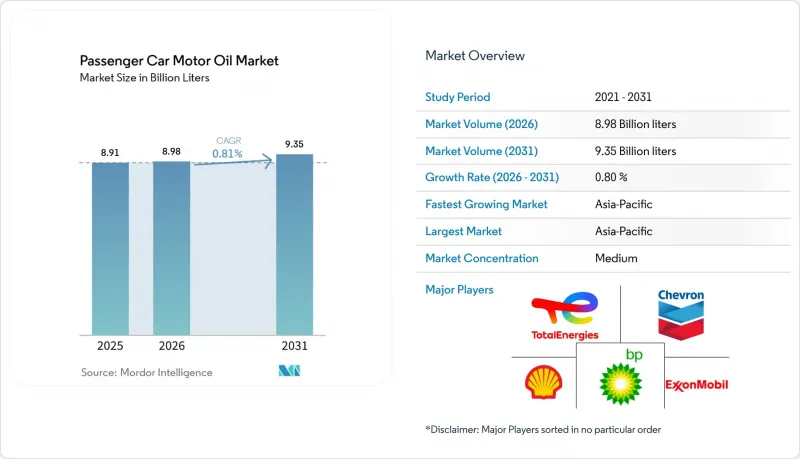
에 따르면 승용차용 엔진오일 시장 규모는 2025년 89억 1,000만 리터에서 2026년에는 89억 8,000만 리터로 확대하며, 2031년까지 93억 5,000만 리터에 달할 것으로 예상되고 있습니다.
예측 기간(2026-2031년) 동안 연평균 성장률(CAGR)은 0.81%에 달할 것으로 전망됩니다.
전 세계 승용차용 엔진오일 시장의 동향 및 인사이트
신흥 경제국에서의 승용차 보유 대수 증가
남아시아 및 동남아시아에서 자동차가 급속히 보급됨에 따라 향후 장기간에 걸쳐 정기적인 오일 교환이 필요한 차량이 증가하고 있습니다. 인도에서는 2025-26 회계연도에 464만 대의 승용차 판매를 기록하여 전년 대비 7.9% 증가했습니다. 인도 승용차 판매 대수의 68%를 다목적 차량(UV)이 차지했으며, SUV는 2026 회계연도 4분기에 20.1%의 성장률을 보였습니다. 인도의 신차들은 바라트 스테이지 VI(BS-VI) 요건에 따라 멀티등급 합성유로의 전환이 진행되고 있으며, 이로 인해 리터당 수명 주기 가치가 향상되고 있습니다. 중국의 승용차 보유 대수는 2억 4,600만 대를 넘어섰으며, 중국 VI-b 규격의 도입으로 저SAPS(황산회분, 인, 황) 0W-20 및 5W-30 제품에 대한 수요가 지원되었습니다. 승용차의 성장과 규제의 강화로 인해 승용차용 엔진오일 시장에서는 윤활유 사용자 수가 증가하고, 더 높은 등급의 배합에 대한 수요가 발생하고 있습니다.
프리미엄 합성유 및 저점도 오일의 채택
5W-XX 제품에서 0W-XX 등급으로의 전환에 따라 승용차용 엔진오일 시장의 가치 구성이 변화하고 있습니다. 국제 윤활유 표준화·승인 위원회(ILSAC)의 GF-7 규격은 2025년 3월 31일에 라이선스가 부여되었으며, 0W-20, 0W-16 및 5W-20이 현재 성능 요건에 따른 주요 등급으로 지정되었습니다. 이러한 등급은 현대식 엔진에서 연비 향상, 저속 조기 점화(LSPI)에 대한 보호, 그리고 타이밍 체인의 마모 방지에 기여합니다. 폭스바겐은 2025년에 TSI 엔진 제품군의 초기 주입 오일을 0W-20으로 전환함에 따라 유럽자동차산업협회(ACEA)의 C5 또는 C6 규격을 충족하는 오일에 대한 정비소의 수요가 증가하고 있습니다. 이러한 제품은 5W-30이나 10W-40 제품에 비해 20-30%의 가격 프리미엄이 책정되어 있습니다. 각 제조사들은 저점도 배합에 필요한 그룹 III, 그룹 IV 및 그룹 V 기유에 대한 투자를 진행하고 있습니다.
배터리식 전기자동차(BEV)의 보급
배터리식 전기자동차(BEV)는 엔진오일 수요를 감소시키지만, 이러한 영향은 주행중인 차량 구성이 변화함에 따라 서서히 나타나고 있습니다. 2025년, 전 세계 전기자동차 판매 대수는 2,000만 대를 넘어 전 세계 신차 판매 대수의 25%를 차지했습니다. 이러한 판매로 인해 하루 평균 약 120만 배럴의 석유 수요가 대체되었습니다. 중국은 전기자동차 신차 판매의 55% 가까이를 차지했고, 유럽은 28%를 차지했습니다. 하이브리드차와 플러그인 하이브리드차에는 여전히 윤활유가 필요하므로 단기적인 수요 감소는 완만하게 나타나고 있습니다.
부문별 분석
2025년, 승용차용 엔진오일 시장에서 합성 오일은 43.13%의 점유율을 차지했습니다. 국제 윤활유 표준화·승인 위원회(ILSAC)의 GF-7 규격 및 유럽 자동차 산업 협회(ACEA)의 C5/C6 규격 요건에 따라 신차 공장 충전 및 승인된 애프터마켓 용도에서 합성유의 역할이 강화되었습니다. 합성 오일은 엄격한 성능 요건이 요구되는 터보차저 장착 차량, 가솔린 직접 분사 차량 및 하이브리드 파워트레인에 대응합니다. 이러한 확고한 입지 덕분에 기술 승인을 획득한 공급업체는 경쟁 우위를 점하고 있습니다. 세미 합성 오일은 2031년까지 연평균 성장률(CAGR) 1.32%로 성장할 것으로 예상되며, 서비스 센터 입장에서는 풀 합성 오일의 가격대를 요구하지 않으면서도 고객이 광물성 오일에서 업그레이드할 수 있도록 하는 현실적인 대안이 되고 있습니다.
광물유는 구형 차량이 대다수를 차지하는 신흥 시장의 애프터마켓 채널에서 여전히 중요한 위치를 차지하고 있습니다. 이러한 차량은 대개 그다지 엄격한 사양을 필요로 하지 않으며, 정비소에서는 계속해서 초기 제품 비용의 저렴함을 우선시하고 있습니다. 바이오 기반 오일은 승용차용 엔진오일 시장에서 여전히 소규모의 신흥 카테고리에 머물러 있습니다. 토탈에너지스는 100% 재생 기유로 제조된 엔진오일을 출시하여 제조사의 승인을 얻은 후, 2024년에 스텔란티스와 공동 브랜드화를 진행했습니다. 2026년 그룹 III의 공급 제약으로 인해 반합성 오일 및 많은 완전 합성 오일 제품에 사용되는 블렌드에 비용 압박이 가해졌습니다. 그 결과, 그룹 I 광물유와의 비용 차이가 확대되고, 배합의 차별화가 진행되면서 첨가제의 화학적 특성과 OEM 승인의 필요성이 더욱 높아지고 있습니다.
지역별 분석
아시아태평양은 2025년 승용차용 엔진오일 시장 점유율의 45.65%를 차지하고 있으며, 2031년까지 연평균 성장률(CAGR) 1.27%로 성장할 것으로 예측됩니다. 중국의 VI-b 기준에 따라 2억 4,600만 대가 넘는 승용차를 대상으로 저SAPS·저점도 합성 오일 처방이 요구되고 있습니다. 인도에서는 2026년 8월에 39만 6,269대의 승용차 신규 등록이 기록되어 전년 동월 대비 16% 증가했습니다. CRISIL은 인도의 승용차 연간 판매 대수가 2027 회계연도에 590만 대에 달할 것으로 예측하고 있습니다. 인도네시아, 태국, 베트남은 여전히 반합성유나 광물유 등급을 사용하는 대규모 차량 보유 대수를 보유하고 있습니다. 지역별 배기가스 규제의 통합 및 인도의 BIS 요건에 따라 제품 사양과 평균 품질이 향상되고 있습니다.
북미에서는 수량 기준으로 합성 윤활유의 보급률이 높아지고 있습니다. 이 지역에서는 전기자동차의 보급과 오일 교환 주기 연장으로 인해 오일 교환 수요가 감소하고 있으며, 윤활유 판매량은 감소 추세를 보이고 있습니다. 신형 엔진에는 인증된 저점도 오일이 요구되므로, ILSAC GF-7 규격의 제품이 애프터마켓 수요의 대부분을 계속 차지하고 있습니다. 멕시코는 Dexos 1 및 Motorcraft 인증 제품의 공장 충전량 측면에서 여전히 중요한 시장으로 남아 있습니다. 중국 자동차 제조사들이 라틴아메리카 전역으로 사업을 확장함에 따라 중국 공급업체들도 멕시코 시장을 목표로 삼고 있습니다.
유럽에서는 생산 대수가 감소하고 있음에도 불구하고 윤활유 수요는 견고합니다. 폭스바겐은 2025년에 TSI 엔진 제품군을 0W-20 공장 충전용 윤활유로 전환했습니다. 2026년 2월, 캐스트롤은 BMW, 메르세데스-벤츠, 포르쉐, 그리고 폭스바겐/아우디의 인증을 받은 ‘EDGE Euro 0W-20 M’을 출시했습니다. 브라질에서는 차량 대수 증가와 정식 애프터마켓 진출 확대가 호재로 작용하고 있지만, 아르헨티나에서는 경제 상황으로 인해 선택적 정비 지출이 억제되고 있습니다. 중동 및 아프리카에서는 위조 제품이 여전히 우려 사항으로 남아 있습니다. 사우디아라비아의 차량 현대화 프로그램에 따라 신형 차량이 도입됨에 따라 합성 등급 제품에 대한 수요가 지원될 것으로 전망됩니다.
기타 혜택:
- 엑셀 형식의 시장 예측(ME) 시트
- 3개월간의 애널리스트 지원
자주 묻는 질문
목차
제1장 서론
- 조사 전제조건과 시장 정의
- 조사 범위
제2장 조사 방법
제3장 개요
제4장 시장 구도
- 시장 개요
- 시장 성장 촉진요인
- 시장 성장 억제요인
- 밸류체인 분석
- Porter's Five Forces 분석
제5장 시장 규모와 성장 예측
- 기유 유형별
- 등급별
- 지역별
- 아시아태평양
- 중국
- 인도
- 일본
- 한국
- ASEAN 국가
- 기타 아시아태평양 국가
- 북미
- 미국
- 캐나다
- 멕시코
- 유럽
- 독일
- 영국
- 프랑스
- 이탈리아
- 북유럽 국가
- 기타 유럽 국가
- 남미
- 브라질
- 아르헨티나
- 기타 남미 국가
- 중동 및 아프리카
- 사우디아라비아
- 남아프리카공화국
- 기타 중동 및 아프리카 국가
- 아시아태평양
제6장 경쟁 구도
- 시장 집중도
- 전략적 동향
- 시장 점유율·순위 분석
- 기업 개요
- BP p.l.c.
- Chevron Corporation
- ENEOS Corporation
- Exxon Mobil Corporation
- FUCHS
- Gulf Oil International Ltd
- Idemitsu Kosan Co., Ltd.
- Indian Oil Corporation Limited
- LIQUI MOLY GmbH
- Motul S.A.
- PETRONAS Lubricants International
- Shell plc
- Sinopec Lubricant Company
- TotalEnergies
- Valvoline Global Operations
제7장 시장 기회와 향후 전망
KSA 26.10.29According to Mordor Intelligence, the passenger car motor oil market size is expected to increase from 8.91 billion liters in 2025 to 8.98 billion liters in 2026 and reach 9.35 billion liters by 2031, at a CAGR of 0.81% during the forecast period (2026-2031).
Global Passenger Car Motor Oil Market Trends and Insights
Expansion of the Passenger Vehicle Parc in Emerging Economies
Rapid motorization in South and Southeast Asia is adding vehicles that will require regular oil changes for many years. India recorded passenger vehicle sales of 4.64 million units in FY2025-26, an increase of 7.9% from the previous year. Utility vehicles represented 68% of India's passenger vehicle sales, while SUVs grew 20.1% during Q4 FY2026. Newer Indian vehicles are moving toward multigrade synthetic products under Bharat Stage VI (BS-VI) requirements, which raises lifetime value per liter. China's passenger car stock exceeded 246 million vehicles, and the rollout of China VI-b supported demand for low-SAPS (Sulfated Ash, Phosphorus, and Sulfur) 0W-20 and 5W-30 products. Passenger vehicle growth and tighter specifications are creating demand for both more lubricant users and higher-grade formulations in the Passenger Car Motor Oil Market.
Premium Synthetic and Low-Viscosity Oil Adoption
The transition from 5W-XX products to 0W-XX grades is changing the value mix in the Passenger Car Motor Oil Market. The International Lubricant Standardization and Approval Committee (ILSAC) GF-7 was licensed on March 31, 2025, identifying 0W-20, 0W-16, and 5W-20 as key grades for current performance requirements. These grades support fuel economy, protection against Low Speed Pre-Ignition (LSPI), and timing-chain wear in modern engines. Volkswagen moved its TSI engine family to 0W-20 service fills in 2025, increasing workshop demand for oils that meet European Automobile Manufacturers' Association (ACEA) C5 or C6 specifications. Such products carry a 20-30% price premium over 5W-30 and 10W-40 products. Manufacturers are directing investment toward Group III, Group IV, and Group V base stocks required for low-viscosity formulations.
Battery Electric Vehicle Penetration
Battery electric vehicles (BEVs) reduce the need for engine oil, though this effect emerges gradually as the installed vehicle base changes. Global electric car sales exceeded 20 million units in 2025, representing 25% of new car sales worldwide. These sales displaced an estimated 1.2 million barrels of oil per day. China accounted for nearly 55% of new electric car sales, while Europe accounted for 28%. Hybrid and plug-in hybrid vehicles still require lubricants, which moderates the near-term decline in demand.
Other drivers and restraints analyzed in the detailed report include:
- Growth of Organized Aftermarket and Quick-Lube Networks
- Increasing Hybrid Vehicle Lubricant Requirements
- Extended Manufacturer-Recommended Drain Intervals
For complete list of drivers and restraints, kindly check the Table Of Contents.
Segment Analysis
Synthetic oils held 43.13% of the Passenger Car Motor Oil Market share in 2025. The International Lubricant Standardization and Approval Committee (ILSAC) GF-7 and the Association des Constructeurs Europeens d'Automobiles (ACEA) C5/C6 requirements have strengthened their role in new-vehicle factory fill and approved aftermarket applications. Synthetic formulations serve turbocharged, gasoline direct injection, and hybrid powertrains with demanding performance requirements. Their established position gives suppliers with technical approvals an advantage. Semi-synthetic oils are forecast to grow at a 1.32% CAGR through 2031, offering service centers a practical path to upgrade customers from mineral oils without requiring the full-synthetic price point.
Mineral oils remain relevant in developing-market aftermarket channels with older vehicle fleets. These vehicles often have less demanding specifications, and workshops continue to prioritize lower initial product costs. Bio-based oils remain a smaller emerging category in the Passenger Car Motor Oil Market. TotalEnergies launched an engine oil made from 100% regenerated base oils that received manufacturer approval and was co-branded with Stellantis in 2024. Group III supply constraints in 2026 added cost pressure to blends used in semi-synthetic and many full-synthetic products. The resulting cost difference from Group I mineral oils increases formulation differentiation and reinforces the need for additive chemistry and OEM approvals.
Complete Report Scope:
- By Base-Stock Type
- Mineral
- Synthetic
- Semi-Synthetic
- Bio-Based
- By Grade
- 0W-XX
- 5W-XX
- 10W-XX
- 15W-XX
- Monogrades
- Other Grades
- By Geography
- Asia-Pacific
- China
- India
- Japan
- South Korea
- ASEAN Countries
- Rest of Asia-Pacific
- North America
- United States
- Canada
- Mexico
- Europe
- Germany
- United Kingdom
- France
- Italy
- NORDIC Countries
- Rest of Europe
- South America
- Brazil
- Argentina
- Rest of South America
- Middle East and Africa
- Saudi Arabia
- South Africa
- Rest of Middle East and Africa
- Asia-Pacific
Geography Analysis
Asia-Pacific held 45.65% of the Passenger Car Motor Oil market share in 2025 and is forecast to grow at a 1.27% CAGR through 2031. China's VI-b standards require low-SAPS, low-viscosity synthetic formulations across a passenger car base exceeding 246 million vehicles. India recorded 396,269 passenger vehicle registrations in August 2026, a 16% year-over-year increase. CRISIL expects India's annual passenger vehicle sales to reach 5.9 million in FY2027. Indonesia, Thailand, and Vietnam have large vehicle fleets that still use semi-synthetic and mineral grades. Regional emissions alignment and India's BIS requirements are raising product specifications and average quality.
North America has a high penetration of synthetic lubricants by volume. The region is experiencing lower lubricant sales volumes as electric vehicle adoption and longer drain intervals reduce demand for oil changes. ILSAC GF-7 products continue to account for aftermarket demand, as newer engines require approved low-viscosity oils. Mexico remains an important market for factory-fill volumes of Dexos1- and Motorcraft-approved products. Chinese suppliers are also targeting Mexico as Chinese automakers expand across Latin America.
Europe supports lubricant demand despite lower output volumes. Volkswagen transitioned its TSI engine family to 0W-20 factory-fill lubricants in 2025. In February 2026, Castrol launched EDGE Euro 0W-20 M, with approvals from BMW, Mercedes-Benz, Porsche, and Volkswagen/Audi. Brazil benefits from fleet expansion and increased participation in the formal aftermarket, while Argentina's economic conditions constrain discretionary maintenance spending. In the Middle East and Africa, counterfeit products remain an ongoing concern. Saudi Arabia's fleet modernization programs are expected to support demand for synthetic-grade products as newer vehicles enter service.
- BP p.l.c.
- Chevron Corporation
- ENEOS Corporation
- Exxon Mobil Corporation
- FUCHS
- Gulf Oil International Ltd
- Idemitsu Kosan Co., Ltd.
- Indian Oil Corporation Limited
- LIQUI MOLY GmbH
- Motul S.A.
- PETRONAS Lubricants International
- Shell plc
- Sinopec Lubricant Company
- TotalEnergies
- Valvoline Global Operations
Additional Benefits:
- The market estimate (ME) sheet in Excel format
- 3 months of analyst support
TABLE OF CONTENTS
1 Introduction
- 1.1 Study Assumptions and Market Definition
- 1.2 Scope of the Study
2 Research Methodology
3 Executive Summary
4 Market Landscape
- 4.1 Market Overview
- 4.2 Market Drivers
- 4.2.1 Expansion of the Passenger Vehicle Parc in Emerging Economies
- 4.2.2 Premium Synthetic and Low-Viscosity Oil Adoption
- 4.2.3 Growth of Organized Aftermarket and Quick-Lube Networks
- 4.2.4 Increasing Hybrid Vehicle Lubricant Requirements
- 4.2.5 VIN-Linked Digital Fitment and Misfill Reduction
- 4.3 Market Restraints
- 4.3.1 Battery Electric Vehicle Penetration
- 4.3.2 Extended Manufacturer-Recommended Drain Intervals
- 4.3.3 Counterfeit Lubricants and Product-Authentication Costs
- 4.4 Value Chain Analysis
- 4.5 Porter's Five Forces Analysis
- 4.5.1 Bargaining Power of Suppliers
- 4.5.2 Bargaining Power of Buyers
- 4.5.3 Threat of New Entrants
- 4.5.4 Threat of Substitutes
- 4.5.5 Rivalry Among Existing Competitors
5 Market Size and Growth Forecasts (Volume)
- 5.1 By Base-Stock Type
- 5.1.1 Mineral
- 5.1.2 Synthetic
- 5.1.3 Semi-Synthetic
- 5.1.4 Bio-Based
- 5.2 By Grade
- 5.2.1 0W-XX
- 5.2.2 5W-XX
- 5.2.3 10W-XX
- 5.2.4 15W-XX
- 5.2.5 Monogrades
- 5.2.6 Other Grades
- 5.3 By Geography
- 5.3.1 Asia-Pacific
- 5.3.1.1 China
- 5.3.1.2 India
- 5.3.1.3 Japan
- 5.3.1.4 South Korea
- 5.3.1.5 ASEAN Countries
- 5.3.1.6 Rest of Asia-Pacific
- 5.3.2 North America
- 5.3.2.1 United States
- 5.3.2.2 Canada
- 5.3.2.3 Mexico
- 5.3.3 Europe
- 5.3.3.1 Germany
- 5.3.3.2 United Kingdom
- 5.3.3.3 France
- 5.3.3.4 Italy
- 5.3.3.5 NORDIC Countries
- 5.3.3.6 Rest of Europe
- 5.3.4 South America
- 5.3.4.1 Brazil
- 5.3.4.2 Argentina
- 5.3.4.3 Rest of South America
- 5.3.5 Middle East and Africa
- 5.3.5.1 Saudi Arabia
- 5.3.5.2 South Africa
- 5.3.5.3 Rest of Middle East and Africa
- 5.3.1 Asia-Pacific
6 Competitive Landscape
- 6.1 Market Concentration
- 6.2 Strategic Moves
- 6.3 Market Share (%)/Ranking Analysis
- 6.4 Company Profiles (includes Global Overview, Market Overview, Core Segments, Financials as available, Strategic Information, Products and Services, and Recent Developments)
- 6.4.1 BP p.l.c.
- 6.4.2 Chevron Corporation
- 6.4.3 ENEOS Corporation
- 6.4.4 Exxon Mobil Corporation
- 6.4.5 FUCHS
- 6.4.6 Gulf Oil International Ltd
- 6.4.7 Idemitsu Kosan Co., Ltd.
- 6.4.8 Indian Oil Corporation Limited
- 6.4.9 LIQUI MOLY GmbH
- 6.4.10 Motul S.A.
- 6.4.11 PETRONAS Lubricants International
- 6.4.12 Shell plc
- 6.4.13 Sinopec Lubricant Company
- 6.4.14 TotalEnergies
- 6.4.15 Valvoline Global Operations
7 Market Opportunities and Future Outlook
- 7.1 White-Space and Unmet-Need Assessment


