

|
시장보고서
상품코드
2157030
API 부정사용 탐지 : 시장 점유율 분석, 업계 동향과 통계, 성장 예측(2026-2031년)API Abuse Detection - Market Share Analysis, Industry Trends & Statistics, Growth Forecasts (2026 - 2031) |
||||||
 Mordor Intelligence
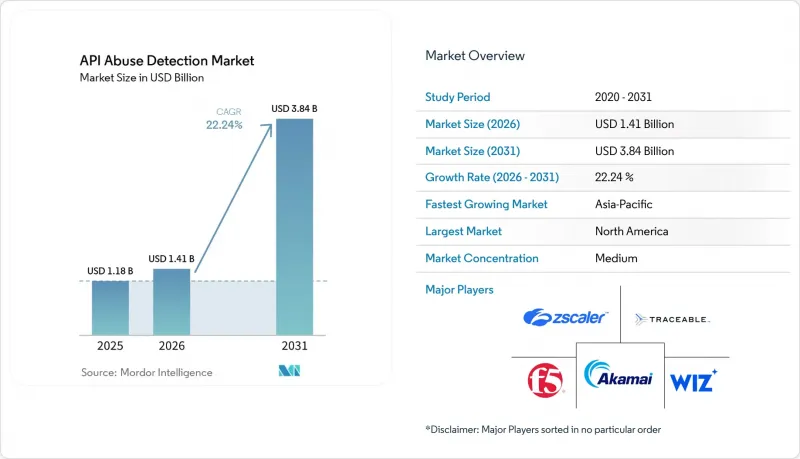
에 따르면 API 부정 이용 탐지 시장 규모는 2025년 11억 8,000만 달러에서 2026년에는 14억 1,000만 달러로 확대하며, 2026-2031년에 CAGR 22.24%로 추이하며, 2031년에는 38억 4,000만 달러에 달할 것으로 예측됩니다.
전 세계 API 부정 사용 탐지 시장의 동향 및 인사이트
API를 활용한 디지털 거래의 확대
현재 기업은 파트너사의 API나 개발자용 마켓플레이스를 활용하여 직접적인 수익을 창출하고 있습니다. 따라서 API 악용 사례가 발생하면 수익이 단절되거나 파트너사에 대한 서비스 제공 의무를 이동하지 못할 우려가 있습니다. Salt Security의 보고서에 따르면 2026년에는 66%의 조직이 지난 12개월 동안 API 수를 50% 이상 늘렸습니다. 제품 팀이 새로운 서비스를 출시하는 한편, 보안 팀은 계속 늘어나는 API 환경을 모니터링하고 관리해야 합니다. 이 때문에 API 악용 탐지 시장에서 수익 확보와 서비스 수준 계약(SLA)은 조달시 중요한 요소로 대두되고 있습니다. 금융 서비스, 물류, 미디어 분야의 각 조직은 API를 통한 수익 창출이 이미 비즈니스 모델의 일부가 되었으므로 이러한 위험에 직면해 있습니다.
증가하는 크레덴셜 스태핑 및 계정 탈취의 자동화
크레덴셜 스태핑은 더 이상 예측 가능한 IP 로테이션이나 호출량 패턴에만 의존하는 것이 아닙니다. 2025년 오픈 뱅킹에 관한 조사에 따르면 속도 제한 강화와 이상 탐지를 통해 기준 사례와 비교하여 운영상의 테일 손실이 20-30% 감소한 것으로 나타났습니다. PCI DSS 4.0.1은 2025년 3월 31일부터 의무화되어, 인터넷에 공개된 결제 시스템에 대해 자동화된 인증 정보 공격에 대한 대책을 요구했습니다. 비밀번호 없는 인증 및 토큰 기반 인증의 보급에 따라 로그인 엔드포인트뿐만 아니라 API 세션 전체를 평가할 필요성이 높아지고 있습니다. 행동 프로파일링을 활용함으로써, 부정 활동과 유효한 인증 정보를 통한 정당한 이용을 구별할 수 있게 됩니다. 이 요건으로 인해 기존의 웹 애플리케이션 방화벽과 전용 API 악용 탐지 플랫폼 사이에 존재하던 실무상의 격차가 해소됩니다.
API 소유권의 분산과 불완전한 자산 인벤토리
자산 가시성은 여전히 API 악용 탐지 분야에서 근본적인 제약 요인으로 남아 있습니다. 2025년 하반기 기준으로, 보안 팀의 19%는 자사의 API 인벤토리 정확성에 대해 "매우 자신 있다"고 응답한 반면, 25%는 "별로 자신 없다" 또는 "전혀 자신 없다"고 응답했습니다. 소유권은 대개 제품 엔지니어링, 플랫폼, 데이터 및 파트너 협업 팀에 분산되어 있습니다. 완전한 등록 리스트이라 하더라도 단일 책임 소유자가 존재하지 않는 경우가 있습니다. 그 결과, API 발견 작업은 플랫폼 판매의 일부가 되어 거래의 복잡성을 가중시키는 요인이 되고 있습니다. 아카마이는 관측된 API를 소스 저장소 및 최근 커미터와 연결하기 위한 ‘코드에서 런타임으로의 매핑’ 기능을 갖춘 ‘Security Posture Center’를 도입했습니다. 런타임 제어를 통해 공개된 모든 인터페이스를 포괄할 수 있게 되려면, API 악용 탐지 시장이 이러한 탐지 격차를 해소해야 합니다.
부문 분석
2025년, API 악용 탐지 시장에서 솔루션 점유율은 68.12%를 차지했습니다. 기업의 구매 담당자들은 SIEM 및 SOAR 커넥터, 행동 기준선 설정, 정책 적용, 통합된 인벤토리 관리 기능을 갖춘 플랫폼을 원하고 있으며, 이러한 기능은 서비스 계약만으로는 재현하기 어렵습니다. 솔루션 범주에는 런타임 보호, 포지션 관리, 디스커버리 및 비즈니스 로직 이상 탐지가 포함되어 있으며, 구매자는 단일 조달 프로세스를 통해 API의 공격 표면을 포괄할 수 있습니다. Cequence Security는 자사 플랫폼이 하루 100억 건 이상의 API 상호작용을 보호하고 있다고 밝혔습니다. 이러한 운영 규모는 주요 고객들이 신뢰할 수 있는 처리 능력과 성능에 미치는 영향이 적다는 점을 우선시하는 이유를 보여줍니다.
서비스 시장은 2031년까지 연평균 성장률(CAGR) 25.03%로 확대될 것으로 예측됩니다. 관리형 보안 서비스 모델을 통해 조직은 모니터링 업무를 전문 보안 운영 팀에 위탁할 수 있는 반면, 전문 서비스는 DevSecOps 통합 및 정책 설계를 지원합니다. 이러한 접근 방식은 전담 API 보안 팀을 보유하지 않은 중견 기업에 효과적이며, 42Crunch는 2025년 11월 툴 다운로드 수가 200만 건을 돌파하며 Microsoft Security Store를 통해 접근성을 확대했습니다. 이 회사의 프리미엄 모델은 개발자용 툴와 자문 서비스가 플랫폼의 보급을 어떻게 촉진할 수 있는지를 보여줍니다. API 악용 탐지 업계는 이러한 채널을 활용하여 고객이 구매한 소프트웨어를 운영할 수 있도록 지원하고 있습니다.
2025년, API 악용 탐지 시장 중 클라우드 배포가 61.33%를 차지했습니다. 클라우드 플랫폼은 API 트래픽에 따라 확장 가능하며, 클라우드 ID 서비스와 연동할 수 있습니다. 한편, 하이브리드 배포는 2031년까지 연평균 성장률(CAGR) 24.40%로 성장할 것으로 예측됩니다. 이는 프라이빗 데이터센터, 퍼블릭 클라우드, 코로케이션 시설을 포괄하며, 조직이 온프레미스에서 내부 서비스 메시 트래픽을 검사하는 동시에 퍼블릭 API를 클라우드를 통한 제어 기능을 통해 라우팅할 수 있도록 해야 할 필요성을 반영합니다. 이러한 구분을 통해 데이터 상주 요건, 지연 시간, 주권과 관련된 요구 사항을 충족할 수 있습니다. 또한 단일 호스팅 모델이 모든 워크로드에 충분하다고 간주하는 것을 피할 수 있습니다.
데이터 규제로 인해 API 트래픽이 외부 검사 서비스로 유입될 수 없는 경우, 온프레미스 배포는 여전히 유효합니다. 방위 관련 기업, 중앙은행 인프라, 중요 인프라 운영 사업자가 그 대표적인 예이며, F5는 2026년, 외부 클라우드 연결 없이 API 가시성을 확보해야 하는 환경을 위해 ‘API Security Local Edition’을 출시했습니다. 이번 출시는 규제 대상 기업에게 온프레미스 및 하이브리드 모델이 여전히 견고한 선택지인 반면, 일부 조직이 완전한 온프레미스형 툴에서 하이브리드 아키텍처로 전환하고 있음을 보여줍니다. 이러한 전환은 단순히 기존 수입원을 대체하는 것이 아니라, 공급자의 서비스 범위를 확대할 가능성이 있습니다. API 악용 탐지 시장은 이러한 혼합 인프라 옵션에 적응해 가고 있습니다.
지역별 분석
2025년, 북미는 API 악용 탐지 시장의 36.19% 점유율을 차지했습니다. 이 지역은 디지털 상거래 인프라, 규제 대상 금융 기관, 그리고 성숙한 기업의 보안 조달 체제가 융합되어 있는 반면, 미국의 소비자 대상 플랫폼은 자동화된 인증 정보 공격과 개인정보 보호에 관한 규제 당국의 압박에 직면해 있습니다. 캐나다의 시장 동향은 은행 업무의 현대화와 미국 기업의 조달 주기에 대한 부합에서 기인한 반면, 남미는 여전히 도입이 진행 중인 신흥 지역입니다. 브라질의 ‘오픈 파이낸스’ 프레임워크는 오픈 뱅킹의 상호 운용성을 지원하며, 핀테크 API 보호에 대한 관심을 더욱 높이고 있습니다.
유럽에서는 규제 의무가 조달의 핵심을 이루고 있으며, 수요 추세가 다른 지역과 다릅니다. 또한 BaFin은 2025년 1월 17일부터 DORA 통지 및 제3자 ICT 등록 처리를 시작했습니다. BAFIN.DE 독일의 NIS2 법은 2025년 12월에 시행되어 복원력에 관한 의무가 확대되었습니다. 반면, 영국, 프랑스, 베네룩스 국가에서는 금융 서비스의 중앙 집중화와 DevSecOps의 정착이 긍정적인 요인으로 작용하고 있습니다. EU의 오픈 뱅킹 프레임워크 또한 BFSI 분야의 보안 수요를 지원하며, 예측 기간 중 API 악용 탐지 시장에 안정적인 기반을 제공하고 있습니다.
아시아태평양은 2031년까지 연평균 성장률(CAGR) 23.60%로 확대될 것으로 예측됩니다. 아카마이(Akamai)의 조사에 따르면 2025년 시점에 중국, 인도, 일본, 호주의 조사 대상 조직 중 85%가 지난 12개월 동안 API 보안 사고를 경험한 것으로 나타났습니다. 동 조사에 따르면 사고 1건당 평균 추정 비용이 58만 달러를 넘는 것으로 보고되었습니다. IIJ는 2025년 6월, 일본 증권 거래 시스템을 위한 ‘Raptor Behavioral Detection Solution’을 출시했습니다. 중동 및 아프리카는 도입 초기 단계에 있는 지역이지만, UAE와 사우디아라비아에서는 디지털 인프라 구축 프로그램을 통한 지원이 진행되고 있습니다. 남아프리카공화국, 나이지리아, 이집트의 모바일 결제 API는 탐지 툴에 대한 수요의 초기 원천이 되고 있습니다.
기타 혜택:
- 엑셀 형식의 시장 예측(ME) 시트
- 3개월간의 애널리스트 지원
자주 묻는 질문
목차
제1장 서론
- 조사 전제조건과 시장 정의
- 조사 범위
제2장 조사 방법
제3장 개요
제4장 시장 구도
- 시장 개요
- 거시경제 요인의 영향
- 시장 성장 촉진요인
- 시장 성장 억제요인
- 밸류체인 분석
- 규제 상황
- 기술 전망
- Porter's Five Forces 분석
- 주요 사용 사례의 분석
제5장 시장 규모와 성장 예측
- 컴포넌트별
- 배포별
- 조직 규모별
- API 유형별
- 산업 분야별
- 지역별
- 북미
- 미국
- 캐나다
- 멕시코
- 남미
- 브라질
- 아르헨티나
- 기타 남미 국가
- 유럽
- 독일
- 영국
- 프랑스
- 이탈리아
- 베네룩스
- 기타 유럽 국가
- 아시아태평양
- 중국
- 일본
- 인도
- 한국
- 호주
- 기타 아시아태평양 국가
- 중동 및 아프리카
- 중동
- 아랍에미리트
- 사우디아라비아
- 기타 중동 국가
- 아프리카
- 남아프리카공화국
- 나이지리아
- 이집트
- 기타 아프리카 국가
- 중동
- 북미
제6장 경쟁 구도
- 시장 집중도
- 전략적 동향
- 시장 점유율 분석
- 기업 개요
- 42Crunch
- Akamai Technologies, Inc.
- Akto Security Inc.
- AppSentinels, Inc.
- APISec.ai, Inc.
- Arkose Labs Inc.
- Cequence Security, Inc.
- Cloudflare, Inc.
- Data Theorem, Inc.
- F5, Inc.
- Fastly, Inc.
- FireTail, Inc.
- Imperva, Inc.
- Indusface Private Limited
- Levo, Inc.
- Noname Security, Inc.
- Salt Security, Inc.
- SecureBlink, Inc.
- Traceable, Inc.
- Wallarm, Inc.
- Kong Inc.
- Wiz, Inc.
- Zimperium, Inc.
- Zscaler, Inc.
- Radware Ltd.
제7장 시장 기회와 향후 동향
- 화이트 스페이스 및 미충족 수요 평가
- 향후 전망
According to Mordor Intelligence, the API abuse detection market size is expected to grow from USD 1.18 billion in 2025 to USD 1.41 billion in 2026, and is forecast to reach USD 3.84 billion by 2031, at a 22.24% CAGR over 2026-2031.
Global API Abuse Detection Market Trends and Insights
Expansion of API-Enabled Digital Transactions
Organizations now use partner APIs and developer marketplaces to generate direct revenue. An API abuse event can therefore interrupt revenue and breach partner service commitments. Salt Security reported that, in 2026, 66% of organizations had increased their API count by more than 50% over the previous 12 months. Security teams must instrument a growing API estate while product teams release new services. This makes revenue assurance and service-level agreements relevant to procurement in the API abuse detection market. Financial services, logistics, and media organizations face this exposure, with API monetization already part of their operating models.
Rising Credential Stuffing and Account-Takeover Automation
Credential stuffing no longer depends only on predictable IP rotation or call-volume patterns. A 2025 open-banking study found that stronger rate limits and anomaly detection reduced operational tail losses by 20-30% against baseline cases. PCI DSS 4.0.1 became mandatory on March 31, 2025, requiring internet-facing payment systems to address automated credential attacks. Passwordless and token-based authentication increase the need to assess complete API sessions rather than only login endpoints. Behavioral profiling helps distinguish compromised activity from approved use with valid credentials. This requirement narrows the practical gap between traditional web application firewalls and dedicated API abuse detection platforms.
Fragmented API Ownership and Incomplete Asset Inventory
Asset visibility remains a basic limitation for API abuse detection. In the second half of 2025, 19% of security teams were very confident in the accuracy of their API inventory, while 25% were not very or not at all confident. Ownership is often divided among product engineering, platform, data, and partner integration teams. A complete register may not have a single accountable owner. Discovery is consequently becoming part of platform sales and can increase deal complexity. Akamai introduced Security Posture Center capabilities with code-to-runtime mapping to connect observed APIs with source repositories and recent committers. The API abuse detection market must address this discovery gap before runtime controls can cover all exposed interfaces.
Other drivers and restraints analyzed in the detailed report include:
- Regulatory Pressure for API Inventory and Resilience
- Growth of Cloud-Native and Microservices Architectures
- False Positives in Legitimate High-Volume Automation
For complete list of drivers and restraints, kindly check the Table Of Contents.
Segment Analysis
Solutions accounted for 68.12% of the API abuse detection market share in 2025. Enterprise buyers seek platforms with SIEM and SOAR connectors, behavioral baselining, policy enforcement, and centralized inventory management, functions that are difficult to reproduce through a services contract alone. The solutions category includes runtime protection, posture management, discovery, and business-logic anomaly detection, enabling buyers to cover the API attack surface through one procurement process. Cequence Security stated that its platform protects more than 10 billion daily API interactions. That operating scale shows why large customers prioritize reliable processing and low performance impact.
Services are projected to expand at a 25.03% CAGR through 2031. Managed security service models allow organizations to outsource monitoring to specialized security operations teams while professional services support DevSecOps integration and policy design. This approach is relevant to mid-sized businesses without a dedicated API security team, and 42Crunch surpassed 2 million tool downloads in November 2025 and expanded access through the Microsoft Security Store. Its freemium model shows how developer tools and advisory services can drive broader platform adoption. The API abuse detection industry uses these channels to help customers operationalize software after purchase.
Cloud deployment accounted for 61.33% of the API abuse detection market in 2025. Cloud platforms can scale with API traffic and connect with cloud identity services, while hybrid deployment is projected to grow at a 24.40% CAGR through 2031. It reflects the need to cover private data centers, public clouds, and colocation facilities, and to enable organizations to inspect internal service-mesh traffic on-premises while routing public APIs through cloud-delivered controls. This split can meet data residency, latency, and sovereignty needs. It also avoids treating one hosting model as sufficient for every workload.
On-premises deployment remains relevant where data rules prevent API traffic from entering an external inspection service. Defense contractors, central bank infrastructure, and critical infrastructure operators are key examples, and F5 launched the API Security Local Edition in 2026 for environments that require API visibility without external cloud connectivity. The release shows that on-premises and hybrid models remain durable for regulated enterprises, while some organizations are moving from fully local tools to hybrid architectures. That transition can broaden coverage for providers rather than simply replace an existing revenue source. The API abuse detection market is adapting to these mixed infrastructure choices.
Complete Report Scope:
- By Component
- Solutions
- Services
- By Deployment
- Cloud
- On-Premises
- Hybrid
- By Organization Size
- Large Enterprises
- Small and Medium-Sized Enterprises
- By API Type
- REST APIs
- GraphQL APIs
- SOAP APIs
- gRPC and Other APIs
- By Industry Vertical
- Government and Public Administration
- Industrial Manufacturing
- Retail and E-Commerce
- Transportation and Logistics
- Energy and Utilities
- Oil and Gas
- IT and Telecommunication
- Media and Entertainment
- Education and Research Institutions
- Healthcare and Life Sciences
- Banking, Financial Services, and Insurance (BFSI)
- Other Industry Verticals
- By Geography
- North America
- United States
- Canada
- Mexico
- South America
- Brazil
- Argentina
- Rest of South America
- Europe
- Germany
- United Kingdom
- France
- Italy
- BENELUX
- Rest of Europe
- Asia-Pacific
- China
- Japan
- India
- South Korea
- Australia
- Rest of Asia-Pacific
- Middle East and Africa
- Middle East
- United Arab Emirates
- Saudi Arabia
- Rest of Middle East
- Africa
- South Africa
- Nigeria
- Egypt
- Rest of Africa
- Middle East
- North America
Geography Analysis
North America held 36.19% of the API abuse detection market share in 2025. The region combines digital commerce infrastructure, regulated financial institutions, and mature enterprise security procurement, while U.S. consumer-facing platforms also face enforcement pressure around automated credential attacks and privacy. Canada's position follows banking modernization and alignment with U.S. enterprise procurement cycles, and South America remains an emerging area for adoption. Brazil's Open Finance framework has supported interoperability in open banking and drawn additional attention to fintech API protection.
Europe has a distinct demand profile because regulatory obligations are central to procurement, and BaFin began processing DORA notifications and third-party ICT registers on January 17, 2025. BAFIN.DE Germany's NIS2 legislation entered into force in December 2025 and widened resilience obligations, while the United Kingdom, France, and BENELUX benefit from financial services concentration and established DevSecOps adoption. EU open banking frameworks also sustain security demand in BFSI, providing a stable base for the API abuse detection market through the forecast period.
Asia-Pacific is projected to expand at a 23.60% CAGR through 2031. Akamai found that, in 2025, 85% of surveyed organizations in China, India, Japan, and Australia had experienced an API security incident in the prior 12 months. The same study reported an average estimated incident cost above USD 580,000 per event. IIJ launched its Raptor Behavioral Detection Solution for Japanese securities trading systems in June 2025. The Middle East and Africa are earlier-stage regions, with the UAE and Saudi Arabia supported by digital infrastructure programs. Mobile payment APIs in South Africa, Nigeria, and Egypt are an initial source of demand for detection tools.
- 42Crunch
- Akamai Technologies, Inc.
- Akto Security Inc.
- AppSentinels, Inc.
- APISec.ai, Inc.
- Arkose Labs Inc.
- Cequence Security, Inc.
- Cloudflare, Inc.
- Data Theorem, Inc.
- F5, Inc.
- Fastly, Inc.
- FireTail, Inc.
- Imperva, Inc.
- Indusface Private Limited
- Levo, Inc.
- Noname Security, Inc.
- Salt Security, Inc.
- SecureBlink, Inc.
- Traceable, Inc.
- Wallarm, Inc.
- Kong Inc.
- Wiz, Inc.
- Zimperium, Inc.
- Zscaler, Inc.
- Radware Ltd.
Additional Benefits:
- The market estimate (ME) sheet in Excel format
- 3 months of analyst support
TABLE OF CONTENTS
1 INTRODUCTION
- 1.1 Study Assumptions and Market Definition
- 1.2 Scope of the Study
2 RESEARCH METHODOLOGY
3 EXECUTIVE SUMMARY
4 MARKET LANDSCAPE
- 4.1 Market Overview
- 4.2 Impact of Macroeconomic Factors
- 4.3 Market Drivers
- 4.3.1 Expansion of API-Enabled Digital Transactions
- 4.3.2 Rising Credential Stuffing and Account-Takeover Automation
- 4.3.3 Regulatory Pressure for API Inventory and Resilience
- 4.3.4 Growth of Cloud-Native and Microservices Architectures
- 4.3.5 AI-Assisted Reconnaissance and Business-Logic Probing
- 4.3.6 API Abuse Detection Embedded in Fraud and Bot-Management Programs
- 4.4 Market Restraints
- 4.4.1 Fragmented API Ownership and Incomplete Asset Inventory
- 4.4.2 False Positives in Legitimate High-Volume Automation
- 4.4.3 Encrypted East-West Traffic and Observability Gaps
- 4.4.4 Integration and Skills Burden Across DevSecOps Toolchains
- 4.5 Value Chain Analysis
- 4.6 Regulatory Landscape
- 4.6.1 GDPR and Data Protection Requirements
- 4.6.2 PCI DSS 4.0.1 and Payment API Controls
- 4.6.3 DORA and Third-Party ICT Resilience
- 4.6.4 NIS2 and Critical-Entity Cybersecurity Duties
- 4.6.5 HIPAA and Protected Health Information
- 4.7 Technological Outlook
- 4.7.1 Behavioral Analytics and Entity Profiling
- 4.7.2 Positive Security Models and Schema Validation
- 4.7.3 GraphQL and gRPC Protection
- 4.7.4 Runtime Application Self-Protection and Service-Mesh Enforcement
- 4.7.5 AI-Agent, LLM and MCP API Protection
- 4.8 Porter's Five Forces Analysis
- 4.8.1 Threat of New Entrants
- 4.8.2 Bargaining Power of Suppliers
- 4.8.3 Bargaining Power of Buyers
- 4.8.4 Threat of Substitutes
- 4.8.5 Competitive Rivalry
- 4.9 Primary Abuse Use Case Analysis
- 4.9.1 Identity, Account and Session Abuse Detection
- 4.9.2 Business-Logic and Transaction Abuse Detection
- 4.9.3 Data Extraction, Scraping and Enumeration Detection
- 4.9.4 Resource Consumption and Availability Abuse Detection
- 4.9.5 Malicious Payload and API Exploit Detection
5 MARKET SIZE AND GROWTH FORECASTS (VALUES)
- 5.1 By Component
- 5.1.1 Solutions
- 5.1.2 Services
- 5.2 By Deployment
- 5.2.1 Cloud
- 5.2.2 On-Premises
- 5.2.3 Hybrid
- 5.3 By Organization Size
- 5.3.1 Large Enterprises
- 5.3.2 Small and Medium-Sized Enterprises
- 5.4 By API Type
- 5.4.1 REST APIs
- 5.4.2 GraphQL APIs
- 5.4.3 SOAP APIs
- 5.4.4 gRPC and Other APIs
- 5.5 By Industry Vertical
- 5.5.1 Government and Public Administration
- 5.5.2 Industrial Manufacturing
- 5.5.3 Retail and E-Commerce
- 5.5.4 Transportation and Logistics
- 5.5.5 Energy and Utilities
- 5.5.6 Oil and Gas
- 5.5.7 IT and Telecommunication
- 5.5.8 Media and Entertainment
- 5.5.9 Education and Research Institutions
- 5.5.10 Healthcare and Life Sciences
- 5.5.11 Banking, Financial Services, and Insurance (BFSI)
- 5.5.12 Other Industry Verticals
- 5.6 By Geography
- 5.6.1 North America
- 5.6.1.1 United States
- 5.6.1.2 Canada
- 5.6.1.3 Mexico
- 5.6.2 South America
- 5.6.2.1 Brazil
- 5.6.2.2 Argentina
- 5.6.2.3 Rest of South America
- 5.6.3 Europe
- 5.6.3.1 Germany
- 5.6.3.2 United Kingdom
- 5.6.3.3 France
- 5.6.3.4 Italy
- 5.6.3.5 BENELUX
- 5.6.3.6 Rest of Europe
- 5.6.4 Asia-Pacific
- 5.6.4.1 China
- 5.6.4.2 Japan
- 5.6.4.3 India
- 5.6.4.4 South Korea
- 5.6.4.5 Australia
- 5.6.4.6 Rest of Asia-Pacific
- 5.6.5 Middle East and Africa
- 5.6.5.1 Middle East
- 5.6.5.1.1 United Arab Emirates
- 5.6.5.1.2 Saudi Arabia
- 5.6.5.1.3 Rest of Middle East
- 5.6.5.2 Africa
- 5.6.5.2.1 South Africa
- 5.6.5.2.2 Nigeria
- 5.6.5.2.3 Egypt
- 5.6.5.2.4 Rest of Africa
- 5.6.5.1 Middle East
- 5.6.1 North America
6 COMPETITIVE LANDSCAPE
- 6.1 Market Concentration
- 6.2 Strategic Moves
- 6.3 Market Share Analysis
- 6.4 Company Profiles (includes Global Level Overview, Market Level Overview, Core Segments, Financials as available, Strategic Information, Market Rank/Share, Products and Services, Recent Developments)
- 6.4.1 42Crunch
- 6.4.2 Akamai Technologies, Inc.
- 6.4.3 Akto Security Inc.
- 6.4.4 AppSentinels, Inc.
- 6.4.5 APISec.ai, Inc.
- 6.4.6 Arkose Labs Inc.
- 6.4.7 Cequence Security, Inc.
- 6.4.8 Cloudflare, Inc.
- 6.4.9 Data Theorem, Inc.
- 6.4.10 F5, Inc.
- 6.4.11 Fastly, Inc.
- 6.4.12 FireTail, Inc.
- 6.4.13 Imperva, Inc.
- 6.4.14 Indusface Private Limited
- 6.4.15 Levo, Inc.
- 6.4.16 Noname Security, Inc.
- 6.4.17 Salt Security, Inc.
- 6.4.18 SecureBlink, Inc.
- 6.4.19 Traceable, Inc.
- 6.4.20 Wallarm, Inc.
- 6.4.21 Kong Inc.
- 6.4.22 Wiz, Inc.
- 6.4.23 Zimperium, Inc.
- 6.4.24 Zscaler, Inc.
- 6.4.25 Radware Ltd.
7 MARKET OPPORTUNITIES AND FUTURE TRENDS
- 7.1 White-Space and Unmet-Need Assessment
- 7.2 Future Outlook


