

|
시장보고서
상품코드
2157040
클라우드 보안 시정 자동화 : 시장 점유율 분석, 업계 동향과 통계, 성장 예측(2026-2031년)Cloud Security Remediation Automation - Market Share Analysis, Industry Trends & Statistics, Growth Forecasts (2026 - 2031) |
||||||
 Mordor Intelligence
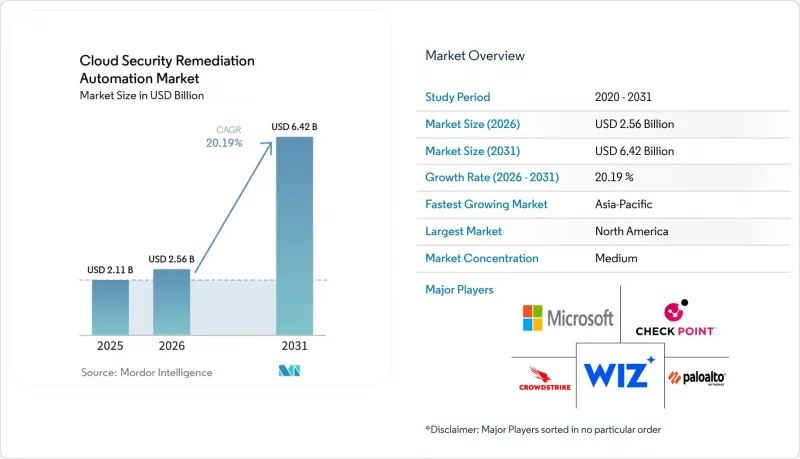
에 따르면 클라우드 보안 시정 조치 자동화 시장 규모는 2025년 21억 1,000만 달러, 2026년 25억 6,000만 달러에서 2031년까지 64억 2,000만 달러로 확대될 것으로 예측되고 있으며, 2026-2031년까지 연평균 성장률(CAGR)은 20.19%에 달할 전망입니다.
글로벌 클라우드 보안 시정 조치 자동화 시장의 동향 및 인사이트
클라우드 네이티브 워크로드의 확대와 멀티클라우드의 복잡화
컨테이너화된 워크로드와 멀티클라우드 아키텍처의 보급으로 인해 팀이 모니터링하고 수정해야 하는 구성 요소의 수가 증가하고 있습니다. Thales사의 조사에 따르면 2025년 시점에 평균적인 기업은 온프레미스 인프라를 유지하면서 2.1개의 퍼블릭 클라우드 공급자를 관리하고 있었습니다. 또한 같은 조사에서 응답자의 55%가 클라우드 환경은 온프레미스 인프라보다 보안 확보가 어렵다고 생각하는 것으로 나타났습니다. 기업은 평균 85개의 SaaS 애플리케이션을 이용하고 있으며, 이로 인해 환경 전반에 걸친 접근 제어 및 가시성의 격차가 확대되고 있습니다. 연결된 제공업체 환경에서 개별적인 수동 검토가 아닌 일관된 정책 적용이 요구됨에 따라 클라우드 보안 수정 자동화 시장에 대한 수요가 높아질 것입니다. 방치된 문제의 경우, 자동 수정이 실행되기 전에 거버넌스로의 에스컬레이션이 필요할 수 있으므로, 명확한 책임 소재는 여전히 중요합니다.
AI를 활용한 위험 우선순위 지정 및 시정
AI를 활용한 워크플로우를 통해 보안 팀은 클라우드상의 탐지 항목을 우선순위화하고, 개발자를 위한 시정 조치를 준비할 수 있게 되었습니다. Sysdig사의 보고에 따르면 해당사의 AI 기반 안내형 시정 기능을 이용하는 고객은 시정 소요 시간을 90% 이상 단축할 수 있었다고 합니다. 이 회사의 접근 방식은 실행 시점의 컨텍스트와 심각도 점수를 결합하여 개발자가 실행해야 할 지침을 생성합니다. AWS는 2026년 8월, ‘Automated Security Response on AWS’를 확장하여 맞춤형 시정 조치를 위한 AI 툴키트을 추가했습니다. 이번 릴리스에서는 Amazon Inspector, Amazon GuardDuty, Amazon Macie의 탐지 결과를 대상으로 하며, 생성된 시정 조치에 대한 보안 대책도 포함되어 있습니다. 보안 팀이 인력을 증원하지 않고도 누적된 문제를 더 많이 해결할 수 있게 된다면, 클라우드 보안 시정 조치 자동화 시장은 그 혜택을 누리게 될 것입니다.
경고 피로와 클라우드 보안 기술 인력 부족
알림의 양과 제한된 클라우드 보안 전문 지식이 여전히 자동 시정 조치 도입을 지연시키고 있습니다. Check Point의 조사에 따르면 2025년에는 71%의 조직이 10유형 이상의 클라우드 보안 툴을 사용하고 있었습니다. 응답자의 절반 이상이 하루에 500건에 가까운 경보를 처리하고 있었으며, 62%는 침해 탐지 후 시정 조치를 취하는 데 24시간 이상이 소요되었습니다. ARMO의 보고서에 따르면 조사 대상인 보안 운영 팀은 매월 평균 4,080건의 클라우드 보안 경보를 처리하는 반면, 연간 평균 7건의 실제 사고만을 식별하고 있습니다. 따라서 클라우드 보안 시정 조치 자동화 시장은 중요도가 낮은 탐지 결과를 억제하고, 대응이 필요한 문제를 우선순위로 삼을 수 있음을 입증해야 합니다. 전담 클라우드 보안 리더가 없는 팀의 경우, 이러한 플랫폼을 활용하기 위한 신뢰할 수 있는 프로세스를 확립하는 데 더 오랜 시간이 걸릴 수 있습니다.
부문 분석
2025년, 소프트웨어는 클라우드 보안 시정 조치 자동화 시장의 66.43% 점유율을 차지했습니다. 이러한 상황은 구성별 맞춤형 시정 지침을 생성하는 플랫폼에 대한 기업의 지출을 반영한 것입니다. Policy-as-code 엔진은 일반적인 권장 사항을 제공하는 대신, JSON이나 YAML 형식의 수정안을 제안할 수 있습니다. Wiz는 2026년 3월, ‘Green Agent’를 퍼블릭 프리뷰로 출시했습니다. 이는 해당 기업의 ‘Security Graph’, 코드에서 클라우드로의 추적, ID 소유권 및 시정 이력을 활용하여 환경별 계획을 수립하기 위한 것입니다. NIST 사이버 보안 프레임워크 2.0에서는 ‘대응(Respond)’ 기능에 대한 자동화된 정책 검증이 허용되고 있습니다. 이에 따라 각 소프트웨어 제공업체들은 시정 로직의 정확성과 관련성을 놓고 경쟁하고 있습니다.
이 서비스 시장 규모는 2026-2031년까지 연평균 성장률(CAGR) 23.11%로 확대될 것으로 예측됩니다. 사내 대응 능력이 제한적인 조직은 트리아지, 조사 및 수정 실행을 매니지드 서비스 제공업체에 위탁하고 있습니다. 매니지드 CNAPP를 통한 시정 조치에서는 일반적으로 서비스 수준이 단순히 문제 식별에 소요되는 시간뿐만 아니라, 시정에 소요되는 평균 시간(MTTR)과도 연동됩니다. 이러한 접근 방식을 통해 제공업체의 책임은 보안 조치의 완료와 직결됩니다. Sysdig는 2026년 8월, 클라우드 위험을 조사하고 우선순위를 지정하며 수정 조치를 생성하는 에이전트를 탑재한 ‘Secure AI’를 출시했습니다. 클라우드 보안 수정 자동화 업계는 자동화된 워크플로우와 인간의 감독을 결합한 서비스에 의해 지원되고 있습니다.
2025년, 퍼블릭 클라우드는 클라우드 보안 시정 자동화 시장의 47.52%를 차지했습니다. 클라우드 네이티브 워크로드는 보안 툴이 공급자의 제어 계층과 연동될 수 있는 하이퍼스케일러 플랫폼에 집중되어 있습니다. AWS는 2026년 8월, ‘Automated Security Response on AWS’에 AI 툴키트 기능을 추가했습니다. 이 업데이트를 통해 Amazon Inspector, Amazon GuardDuty, Amazon Macie의 탐지 결과에 대한 자동 수정 조치가 확대되었습니다. 여러 클라우드 공급자를 이용하는 조직에게는 서로 다른 API 간에 정책 정의를 표준화할 수 있는 툴도 필요합니다. 이러한 요구 사항은 퍼블릭 클라우드 환경에서 벤더 중립적인 기능을 지원합니다.
하이브리드 클라우드는 2026-2031년까지 연평균 성장률(CAGR) 22.38%로 성장할 것으로 예측됩니다. 금융 서비스 및 의료 기관에서는 기밀 데이터를 온프레미스에 보관하면서, 연결된 클라우드 서비스가 분석 및 통신을 지원해야 하는 경우 하이브리드 설계를 채택하고 있습니다. 독일의 BSI는 2026년에 ‘C5:2026’ 기준을 발표하고, NIS2 및 ‘유럽 클라우드 서비스 사이버 보안 인증 체계’에 따라 클라우드 규정 준수 요건을 업데이트했습니다. 이러한 요건은 하이퍼스케일러와 주권 클라우드 환경 모두에서 운영되는 워크로드에 대한 지속적인 증거 생성을 지원하기 위한 것입니다. 네트워크 분리가 요구되는 정부 및 국방 분야에서는 여전히 프라이빗 클라우드 배포이 일반적입니다. 하이브리드 아키텍처를 위한 클라우드 보안 시정 조치 자동화 시장의 규모는 서로 연결되어 있지만 거버넌스가 다른 인프라 전반에 걸친 통제 조치를 검증해야 할 필요성에 의해 지원되고 있습니다.
지역별 분석
2025년, 북미는 클라우드 보안 시정 조치 자동화 시장의 37.58% 점유율을 차지했습니다. 이 지역에는 클라우드 네이티브 기업과 금융 부문의 클라우드 활동이 집중되어 있습니다. NIST 사이버 보안 프레임워크 2.0, HIPAA 및 SEC의 사이버 보안 공개 요건이 보안 통제 및 보고에 대한 구매자의 기대치를 형성하고 있습니다. 또한 북미 기업은 에이전트 기반 시정 기능을 조기에 도입했습니다. 이러한 운영 요건은 시정의 속도와 통제에 대한 전 세계적인 평가에 계속해서 영향을 미치고 있습니다. 구매자가 시정 요구 사항을 현행 규제 및 운영 요건과 조화시킬 수 있으므로 이 지역의 클라우드 보안 시정 자동화 시장은 여전히 확고한 입지를 다지고 있습니다.
유럽에서는 클라우드 운영에 적용되는 여러 가지 규정 준수 프레임워크가 존재하므로 독특한 수요 양상을 보입니다. 독일의 IT 보안 시장 규모는 2025년에 111억 유로(129억 1,000만 달러)에 달했습니다. 같은 해 보안 소프트웨어 및 클라우드 플랫폼 시장 규모는 48억 유로(55억 8,000만 달러)에 달했습니다. NIS2의 감사 요건, DORA에 의한 감독, 그리고 BSI C5:2026 기준에 따라 지속적인 증거 및 시정 조치 기록에 대한 수요가 증가하고 있습니다. 또한 툴이 각국의 데이터 경계 내에서 작동해야 할 가능성이 있으므로 주권 클라우드 요건도 조달 동향에 영향을 미치고 있습니다. 유럽의 클라우드 보안 시정 조치 자동화 시장 규모는 이러한 거버넌스 요건을 지원하는 벤더의 역량에 좌우됩니다.
아시아태평양은 2026-2031년까지 연평균 성장률(CAGR) 25.76%로 성장할 것으로 예측됩니다. 인도, 한국, 호주, 그리고 일본은 각국의 서로 다른 규정 준수 요건을 충족하면서 클라우드 배포을 확대하고 있습니다. 이러한 상황에서 여러 프레임워크와 현지 운영 환경에 걸쳐 정책을 적용할 수 있는 툴이 주목받고 있습니다. Sysdig의 보고서에 따르면 2026년에는 전 세계 보안 팀의 70% 이상이 클라우드 워크로드에 대해 행동 분석을 활용하고 있었습니다. 사우디아라비아와 아랍에미리트(UAE)도 국가 차원의 디지털 전환 프로그램을 통해 클라우드 보안에 대한 투자를 확대하고 있습니다. 남미와 아프리카는 여전히 규모가 작은 지역이지만, 브라질과 남아프리카공화국에서는 금융 부문의 감독 및 데이터 보호 요건을 통해 수요가 형성되고 있습니다.
기타 혜택:
- 엑셀 형식의 시장 예측(ME) 시트
- 3개월간의 애널리스트 지원
자주 묻는 질문
목차
제1장 서론
- 조사 전제조건과 시장 정의
- 조사 범위
제2장 조사 방법
제3장 개요
제4장 시장 구도
- 시장 개요
- 시장 성장 촉진요인
- 시장 성장 억제요인
- 거시경제 요인의 영향
- 밸류·공급망 분석
- 규제 상황
- 기술 전망
- Porter's Five Forces 분석
제5장 시장 규모와 성장 예측
- 구성 요소별
- 클라우드 환경별
- 조직 규모별
- 산업 분야별
- 지역별
- 북미
- 미국
- 캐나다
- 멕시코
- 남미
- 브라질
- 아르헨티나
- 기타 남미 국가
- 유럽
- 독일
- 영국
- 프랑스
- 이탈리아
- 스페인
- 기타 유럽 국가
- 아시아태평양
- 중국
- 일본
- 인도
- 한국
- 호주
- 기타 아시아태평양 국가
- 중동
- 사우디아라비아
- 아랍에미리트
- 기타 중동 국가
- 아프리카
- 남아프리카공화국
- 나이지리아
- 기타 아프리카 국가
- 북미
제6장 경쟁 구도
- 시장 집중도
- 전략적 동향
- 시장 점유율 분석
- 기업 개요
- Palo Alto Networks, Inc.
- Wiz, Inc.
- Microsoft Corporation
- CrowdStrike Holdings, Inc.
- Check Point Software Technologies Ltd.
- Orca Security Ltd.
- Google LLC
- Amazon Web Services, Inc.
- IBM Corporation
- Cisco Systems, Inc.
- Fortinet, Inc.
- Trend Micro Incorporated
- Qualys, Inc.
- Rapid7, Inc.
- Tenable Holdings, Inc.
- SentinelOne, Inc.
- Aqua Security Software Ltd.
- Sysdig, Inc.
- Zscaler, Inc.
- Sophos Limited
- Datadog, Inc.
- VMware, Inc.
- AccuKnox, Inc.
- Upwind Security, Inc.
- Mondoo, Inc.
제7장 시장 기회와 향후 전망
KSA 26.10.30According to Mordor Intelligence, the cloud security remediation automation market size is projected to expand from USD 2.11 billion in 2025 and USD 2.56 billion in 2026 to USD 6.42 billion by 2031, registering a CAGR of 20.19% between 2026 to 2031.
Global Cloud Security Remediation Automation Market Trends and Insights
Cloud-Native Workload Expansion and Multicloud Complexity
Containerized workloads and multicloud architectures are expanding the number of configurations that teams must monitor and correct. Thales found that the average enterprise managed 2.1 public cloud providers while retaining on-premises infrastructure in 2025. The study also found that 55% of respondents considered cloud environments harder to secure than on-premises infrastructure. Enterprises used an average of 85 SaaS applications, which increased access-control and visibility gaps across their environments. Cloud security remediation automation market demand rises when connected provider environments require consistent policy enforcement rather than separate manual reviews. Clear ownership remains important because an unattended finding can still require governance escalation before an automated fix is executed.
AI-Assisted Risk Prioritization and Remediation
AI-assisted workflows are helping security teams prioritize cloud findings and prepare remediation actions for developers. Sysdig reported that customers using its AI-powered guided remediation feature reduced remediation time by more than 90%. Its approach combined runtime context and severity scoring to produce instructions for developer action. AWS expanded Automated Security Response on AWS in August 2026 to include an AI Toolkit for custom remediation. The release covered findings from Amazon Inspector, Amazon GuardDuty, and Amazon Macie, and included safeguards for generated remediation actions. The cloud security remediation automation market benefits when a fixed security team can address more of its backlog without a matching rise in headcount.
Alert Fatigue and Cloud-Security Skills Shortage
Alert volume and limited cloud security expertise continue to slow the use of automated remediation. Check Point found that 71% of organizations used more than 10 cloud security tools in 2025. More than half of respondents faced nearly 500 alerts each day, and 62% took more than 24 hours to remediate breaches after detection. ARMO reported that surveyed security operations teams processed an average of 4,080 cloud security alerts each month while identifying an average of 7 true incidents annually. The cloud security remediation automation market must therefore show that it can suppress low-value findings and prioritize issues that need a response. Teams without dedicated cloud security leadership may take longer to establish reliable processes for using these platforms.
Other drivers and restraints analyzed in the detailed report include:
- Continuous Compliance and Audit-Evidence Requirements
- CNAPP Convergence Across Code, Cloud, and Runtime
- Remediation Safety, Change-Control, and Rollback Risk
For complete list of drivers and restraints, kindly check the Table Of Contents.
Segment Analysis
Software held 66.43% of cloud security remediation automation market share in 2025. This position reflected enterprise spending on platforms that generate configuration-specific remediation guidance. Policy-as-code engines can propose JSON or YAML changes instead of providing generic recommendations. Wiz introduced Green Agent in public preview in March 2026 to use its Security Graph, code-to-cloud tracing, identity ownership, and remediation history for environment-specific plans. NIST Cybersecurity Framework 2.0 recognizes automated policy verification within the Respond function. Software providers are therefore competing on the accuracy and relevance of remediation logic.
Services are projected to grow at a 23.11% CAGR from 2026 to 2031. Organizations with limited internal capability are outsourcing triage, investigation, and fix execution to managed service providers. Managed CNAPP remediation commonly links service levels to mean time to remediate rather than only time to identify an issue. That approach ties provider accountability to the completion of a security action. Sysdig launched Secure AI in August 2026 with agents that investigate, prioritize, and generate fixes for cloud risks. The cloud security remediation automation industry is supported by services that combine automated workflows with human oversight.
Public cloud accounted for 47.52% of cloud security remediation automation market share in 2025. Cloud-native workloads are concentrated on hyperscaler platforms where security tools can connect with provider control planes. AWS added AI Toolkit capabilities to Automated Security Response on AWS in August 2026. The update extended automated remediation to findings from Amazon Inspector, Amazon GuardDuty, and Amazon Macie. Organizations using more than 1 cloud provider also need tools that can normalize policy definitions across different APIs. This requirement supports vendor-neutral capabilities in the public cloud environment.
Hybrid cloud is projected to grow at a 22.38% CAGR from 2026 to 2031. Financial services and healthcare organizations use hybrid designs when sensitive data must remain on-premises while connected cloud services support analytics and communications. Germany's BSI published C5:2026 criteria in 2026, updating cloud compliance requirements in line with NIS2 and the European Cybersecurity Certification Scheme for Cloud Services. These requirements support continuous evidence generation for workloads operating across hyperscaler and sovereign cloud environments. Private cloud adoption remains more common in government and defense environments with network-isolation requirements. The cloud security remediation automation market size for hybrid architectures is supported by the need to verify controls across connected but differently governed infrastructure.
Complete Report Scope:
- By Componnent
- Software
- Services
- By Cloud Environment
- Public Cloud
- Private Cloud
- Hybrid Cloud
- Multi-Cloud
- By Organization Size
- Large Enterprises
- Small and Medium Enterprises
- By Industry Vertical
- Government and Public Administration
- Industrial Manufacturing
- Retail and E-Commerce
- Transportation and Logistics
- Energy and Utilities
- Oil and Gas
- IT and Telecommunication
- Media and Entertainment
- Education and Research Institutions
- Healthcare and Life Sciences
- Banking, Financial Services, and Insurance (BFSI)
- Other Industry Verticals
- By Geography
- North America
- United States
- Canada
- Mexico
- South America
- Brazil
- Argentina
- Rest of South America
- Europe
- Germany
- United Kingdom
- France
- Italy
- Spain
- Rest of Europe
- Asia-Pacific
- China
- Japan
- India
- South Korea
- Australia
- Rest of Asia-Pacific
- Middle East
- Saudi Arabia
- United Arab Emirates
- Rest of Middle East
- Africa
- South Africa
- Nigeria
- Rest of Africa
- North America
Geography Analysis
North America held 37.58% of the cloud security remediation automation market share in 2025. The region has a high concentration of cloud-native enterprises and financial-sector cloud activity. NIST Cybersecurity Framework 2.0, HIPAA, and SEC cybersecurity disclosure requirements shape buyer expectations for security controls and reporting. North American enterprises also adopted agentic remediation capabilities early. Their operating requirements continue to influence global evaluations of remediation speed and control. The cloud security remediation automation market remains well-established in the region because buyers can align remediation needs with active regulatory and operational requirements.
Europe has a distinct demand profile due to the multiple compliance frameworks that apply to cloud operations. Germany's IT security sector reached EUR 11.1 billion (USD 12.91 billion) in 2025. Security software and cloud platforms reached EUR 4.8 billion (USD 5.58 billion) during the year. NIS2 audit requirements, DORA supervision, and BSI C5:2026 criteria are increasing the demand for continuous evidence and remediation records. Sovereign cloud requirements also shape procurement because tools may need to operate within national data boundaries. The cloud security remediation automation market size in Europe is tied to vendors' ability to support these governance requirements.
Asia-Pacific is projected to grow at a 25.76% CAGR from 2026 to 2031. India, South Korea, Australia, and Japan are expanding cloud adoption while managing different national compliance requirements. This setting supports tools that can apply policies across several frameworks and local operating environments. Sysdig reported that more than 70% of security teams globally used behavioral analytics for cloud workloads in 2026. Saudi Arabia and the United Arab Emirates are also increasing cloud security investment through national digital transformation programs. South America and Africa remain smaller regions, but Brazil and South Africa are building demand through financial-sector oversight and data-protection requirements.
- Palo Alto Networks, Inc.
- Wiz, Inc.
- Microsoft Corporation
- CrowdStrike Holdings, Inc.
- Check Point Software Technologies Ltd.
- Orca Security Ltd.
- Google LLC
- Amazon Web Services, Inc.
- IBM Corporation
- Cisco Systems, Inc.
- Fortinet, Inc.
- Trend Micro Incorporated
- Qualys, Inc.
- Rapid7, Inc.
- Tenable Holdings, Inc.
- SentinelOne, Inc.
- Aqua Security Software Ltd.
- Sysdig, Inc.
- Zscaler, Inc.
- Sophos Limited
- Datadog, Inc.
- VMware, Inc.
- AccuKnox, Inc.
- Upwind Security, Inc.
- Mondoo, Inc.
Additional Benefits:
- The market estimate (ME) sheet in Excel format
- 3 months of analyst support
TABLE OF CONTENTS
1 INTRODUCTION
- 1.1 Study Assumptions and Market Definition
- 1.2 Scope of the Study
2 RESEARCH METHODOLOGY
3 EXECUTIVE SUMMARY
4 MARKET LANDSCAPE
- 4.1 Market Overview
- 4.2 Market Drivers
- 4.2.1 Cloud-Native Workload Expansion and Multicloud Complexity
- 4.2.2 Continuous Compliance and Audit-Evidence Requirements
- 4.2.3 CNAPP Convergence Across Code, Cloud, and Runtime
- 4.2.4 AI-Assisted Risk Prioritization and Remediation
- 4.2.5 Cyber-Insurance Security Scorecards
- 4.2.6 Mid-Market Adoption of No-Code Remediation
- 4.3 Market Restraints
- 4.3.1 Alert Fatigue and Cloud-Security Skills Shortage
- 4.3.2 Remediation Safety, Change-Control, and Rollback Risk
- 4.3.3 SaaS and PaaS API-Depth Limitations
- 4.3.4 Sovereign-Cloud and Data-Residency Constraints
- 4.4 Impact of Macroeconomic Factors
- 4.5 Value / Supply-Chain Analysis
- 4.6 Regulatory Landscape
- 4.6.1 GDPR and NIS2
- 4.6.2 Digital Operational Resilience Act
- 4.6.3 HIPAA Security Rule
- 4.6.4 PCI DSS 4.0.1
- 4.6.5 NIST Cybersecurity Framework 2.0
- 4.7 Technological Outlook
- 4.7.1 Policy-as-Code and Infrastructure-as-Code Remediation
- 4.7.2 Graph-Based Attack-Path Prioritization
- 4.7.3 Agentless and Agent-Based Coverage
- 4.7.4 Generative AI and Deterministic Remediation
- 4.7.5 Kubernetes and Serverless Security Controls
- 4.8 Porter's Five Forces Analysis
- 4.8.1 Threat of New Entrants
- 4.8.2 Bargaining Power of Suppliers
- 4.8.3 Bargaining Power of Buyers
- 4.8.4 Threat of Substitutes
- 4.8.5 Competitive Rivalry
5 MARKET SIZE AND GROWTH FORECASTS (VALUE)
- 5.1 By Componnent
- 5.1.1 Software
- 5.1.2 Services
- 5.2 By Cloud Environment
- 5.2.1 Public Cloud
- 5.2.2 Private Cloud
- 5.2.3 Hybrid Cloud
- 5.2.4 Multi-Cloud
- 5.3 By Organization Size
- 5.3.1 Large Enterprises
- 5.3.2 Small and Medium Enterprises
- 5.4 By Industry Vertical
- 5.4.1 Government and Public Administration
- 5.4.2 Industrial Manufacturing
- 5.4.3 Retail and E-Commerce
- 5.4.4 Transportation and Logistics
- 5.4.5 Energy and Utilities
- 5.4.6 Oil and Gas
- 5.4.7 IT and Telecommunication
- 5.4.8 Media and Entertainment
- 5.4.9 Education and Research Institutions
- 5.4.10 Healthcare and Life Sciences
- 5.4.11 Banking, Financial Services, and Insurance (BFSI)
- 5.4.12 Other Industry Verticals
- 5.5 By Geography
- 5.5.1 North America
- 5.5.1.1 United States
- 5.5.1.2 Canada
- 5.5.1.3 Mexico
- 5.5.2 South America
- 5.5.2.1 Brazil
- 5.5.2.2 Argentina
- 5.5.2.3 Rest of South America
- 5.5.3 Europe
- 5.5.3.1 Germany
- 5.5.3.2 United Kingdom
- 5.5.3.3 France
- 5.5.3.4 Italy
- 5.5.3.5 Spain
- 5.5.3.6 Rest of Europe
- 5.5.4 Asia-Pacific
- 5.5.4.1 China
- 5.5.4.2 Japan
- 5.5.4.3 India
- 5.5.4.4 South Korea
- 5.5.4.5 Australia
- 5.5.4.6 Rest of Asia-Pacific
- 5.5.5 Middle East
- 5.5.5.1 Saudi Arabia
- 5.5.5.2 United Arab Emirates
- 5.5.5.3 Rest of Middle East
- 5.5.6 Africa
- 5.5.6.1 South Africa
- 5.5.6.2 Nigeria
- 5.5.6.3 Rest of Africa
- 5.5.1 North America
6 COMPETITIVE LANDSCAPE
- 6.1 Market Concentration
- 6.2 Strategic Moves
- 6.3 Market Share Analysis
- 6.4 Company Profiles (includes Global Level Overview, Market Level Overview, Core Segments, Financials as available, Strategic Information, Market Rank/Share, Products and Services, Recent Developments)
- 6.4.1 Palo Alto Networks, Inc.
- 6.4.2 Wiz, Inc.
- 6.4.3 Microsoft Corporation
- 6.4.4 CrowdStrike Holdings, Inc.
- 6.4.5 Check Point Software Technologies Ltd.
- 6.4.6 Orca Security Ltd.
- 6.4.7 Google LLC
- 6.4.8 Amazon Web Services, Inc.
- 6.4.9 IBM Corporation
- 6.4.10 Cisco Systems, Inc.
- 6.4.11 Fortinet, Inc.
- 6.4.12 Trend Micro Incorporated
- 6.4.13 Qualys, Inc.
- 6.4.14 Rapid7, Inc.
- 6.4.15 Tenable Holdings, Inc.
- 6.4.16 SentinelOne, Inc.
- 6.4.17 Aqua Security Software Ltd.
- 6.4.18 Sysdig, Inc.
- 6.4.19 Zscaler, Inc.
- 6.4.20 Sophos Limited
- 6.4.21 Datadog, Inc.
- 6.4.22 VMware, Inc.
- 6.4.23 AccuKnox, Inc.
- 6.4.24 Upwind Security, Inc.
- 6.4.25 Mondoo, Inc.
7 MARKET OPPORTUNITIES AND FUTURE OUTLOOK
- 7.1 White-Space and Unmet-Need Assessment
- 7.1.1 Cloud Evidence Residency as a Managed Service
- 7.1.2 Identity-Centric Retainers for Multi-Cloud Estates
- 7.1.3 Incident Response for Containers and Serverless Workloads
- 7.1.4 Outcome-Based Pricing Linked to Containment and Recovery
- 7.1.5 Regional-Language and In-Country Response Coverage
- 7.1.6 Cloud Incident Readiness for Small and Medium Enterprises


