

|
시장보고서
상품코드
2157076
북미의 eSIM 하드웨어 : 시장 점유율 분석, 업계 동향과 통계, 성장 예측(2026-2031년)North America Esim Hardware - Market Share Analysis, Industry Trends & Statistics, Growth Forecasts (2026 - 2031) |
||||||
 Mordor Intelligence
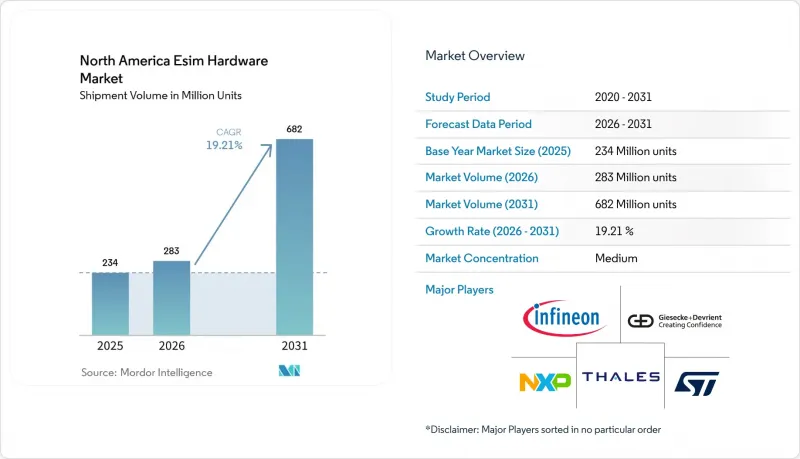
에 따르면 북미 eSIM 하드웨어 시장의 출하대수 기반 시장 규모는 2025년 2억 3,400만 대로부터 2026년에는 2억 8,300만 대로 확대하며, 2026-2031년에 CAGR 19.21%로 추이하며, 2031년에는 6억 8,200만 대에 달할 것으로 예측됩니다.
북미 eSIM 하드웨어 시장의 동향 및 인사이트
아이폰을 중심으로 한 eSIM 전용 플래그십 모델로의 전환
애플은 2025년 9월, 미국, 캐나다, 멕시코에서 아이폰 17 시리즈를 eSIM 전용 모델로 출시했습니다. 또한 아이폰 17 Air는 물리적 SIM 트레이를 전혀 탑재하지 않은 최초의 아이폰으로 전 세계에 판매되었습니다. 이 결정에 따라 북미 3개 시장 모두에서 공통된 단말기 설계 요건이 채택되게 되었습니다. 통신사업자들은 프리미엄 단말기 사용자를 위해 호환 가능한 원격 프로비저닝 시스템이 필요하므로 북미 eSIM 하드웨어 시장은 그 혜택을 누리고 있습니다. 또한 이 방침에 따라 스마트폰 부품 및 프로필 관리에 대한 기술 기준도 높아지고 있습니다. 이를 통해 삼성을 비롯한 프리미엄 OEM 각사는 북미용 모델에서 eSIM 지원을 신속하게 확대할 수 있게 되었습니다. 반면, 저가형 안드로이드 브랜드의 경우 eSIM 지원하드웨어의 대량 공급이 여전히 제한적이기 때문에 프리미엄 단말기와 저가형 단말기 간에 eSIM 보급 상황에 차이가 나타나고 있습니다. 애플의 단말기 전략으로 인해 프로비저닝 기능은 얼리 어답터를 위한 기능이 아니라 통신사업자에게 있으며, 기본적인 요건이 되었습니다. 통신사업자는 eSIM 전용 단말기를 지원하기 위해 GSMA 인증을 받은 SM-DP+ 및 SM-DS 인프라를 지원해야 합니다. 이러한 요건으로 인해 모바일 가상 네트워크 사업자(MVNO)에게는 더 큰 투자 압박이 가해질 가능성이 있습니다. 따라서 북미의 eSIM 하드웨어 시장은 하드웨어 수요 증가와 통신사업자의 지원 범위 확대라는 혜택을 누리게 될 것입니다. 그 결과, 현재의 프리미엄 eUICC 조달과 저가 단말기에서의 향후 채택 사이에 격차가 발생할 것입니다. 이러한 시차로 인해 일부 단말기 사용자층에서는 물리적 SIM과의 호환성이 계속해서 필요할 가능성이 있습니다. 2026년 시점에 미국, 캐나다, 멕시코 전역에서 물리적 SIM 전용 옵션을 유지하고 있는 해당 지역의 플래그십 스마트폰 OEM은 존재하지 않았습니다.
5G 고정 무선 액세스 및 사설 네트워크의 확대
사설 5G 네트워크는 기존의 소비자 대상 통신사업자 채널 이외의 영역에서 eSIM 하드웨어의 수요 기반을 창출합니다. 기업 도입을 위해서는 연결된 컨트롤러, 센서, 게이트웨이 및 관련 엔드포인트가 필요합니다. 이러한 디바이스는 구성 요소가 기기에 납땜되어 있으므로 일반적으로 MFF2 또는 통합형 iUICC 설계를 채택하고 있습니다. 북미의 eSIM 하드웨어 시장은 기업이 공장, 캠퍼스, 물류 업무를 위해 하드웨어를 조달하는 분야에서 성장이 예상됩니다. 사설 네트워크 구매자는 표준 소비자용 활성화 프로세스와는 다른 가입자 시스템도 관리합니다. 이로 인해 eSIM 운영 체제 공급업체가 기업의 시스템 통합 프로젝트에 직접 참여할 가능성이 있습니다. 버라이즌은 2026년 6월, 에릭슨의 사설 5G를 국제적인 기업 캠퍼스로 확대했습니다. 이 기업 모델에서는 조달 결정의 일부가 통신사업자에서 장비 제조사나 사설 네트워크 사업자로 이전됩니다. 이에 따라 원격 수명주기관리 및 여러 인증 정보를 지원할 수 있는 구성 요소가 중요시됩니다. 또한 제조사 입장에서는 기기의 초기 설계 단계에서 연결 기능을 통합해야 할 이유가 됩니다. 산업용 하드웨어의 수명 주기는 스마트폰의 교체 주기보다 길어지고 있습니다. 이 때문에 수요는 매년 출시되는 단말기의 영향력을 덜 받게 됩니다. 그 결과, 북미의 eSIM 하드웨어 시장은 여러 최종 용도에 걸친 프라이빗 네트워크에 대한 투자 결정과 밀접하게 연관되어 있습니다. 또한 이러한 도입으로 인해 검증된 프로비저닝 기능 및 보안 기능의 중요성도 높아지고 있습니다.
레거시 및 차세대 IoT 사양의 파편화
SGP.02, SGP.22 및 SGP.32는 M2M, 소비자 및 IoT 애플리케이션에서 계속 사용되고 있습니다. 이로 인해 커넥티드 디바이스 프로그램에서 조달 및 통합 경로가 분절되고 있습니다. 대기업은 차량 군, 스마트 미터, 산업용 센서 네트워크에 SGP.02 지원 기기를 도입하고 있습니다. 이러한 기기들은 하드웨어를 교체하지 않는 한 SGP.32로 직접 전환할 수 없습니다. 5년 이상의 교체 주기는 이러한 전환을 지연시킬 가능성이 있습니다. 따라서 북미의 eSIM 하드웨어 시장은 새로운 SGP.32 프로그램과 레거시 호환 교체 수요를 모두 충족해야 합니다. ST마이크로일렉트로닉스와 COMPRION은 2026년 9월에 SGP.32 상호운용성 참조 환경을 발표했습니다. 두 회사의 이러한 노력은 구성 요소 수준의 프로토콜 인증이 여전히 중요한 요건임을 보여줍니다. 기업은 새로운 프로비저닝 기법을 검증하는 동안, 병행하여 기존 방식의 구매를 계속할 가능성이 있습니다. 이러한 접근 방식은 프로젝트의 복잡성을 증가시키고, 대규모 하드웨어 도입 결정을 지연시킬 우려가 있습니다. 또한 벤더와 디바이스 제조사 입장에서는 수요 예측이 더욱 어려워지는 요인이 될 것입니다. 이러한 제약으로 인해 수요가 사라지는 것은 아니지만, SGP.32로의 완전한 전환이 가져올 것으로 예상되던 시장 통합의 속도는 둔화될 것입니다. 북미의 eSIM 하드웨어 시장은 기존에 설치된 기기가 교체되는 속도에 계속해서 좌우될 것입니다.
부문 분석
5G는 2025년에 북미 eSIM 하드웨어 시장 점유율의 45.86%를 차지할 것으로 예상되며, 2031년까지 연평균 성장률(CAGR) 19.87%로 확대될 전망입니다. 이러한 우위는 5G 스마트폰의 보급이 정착된 점과 산업용 및 자동차용 프로그램에서의 활용 확대가 반영된 결과입니다. 또한 5G용 북미 eSIM 하드웨어 시장 규모는 관리형 기기 인증 정보가 필요한 사설 네트워크로부터도 혜택을 받고 있습니다. AT&T는 2026년 7월, FirstNet을 위해 전국 규모의 전용 5G 독립형(SA) 코어 네트워크를 가동했습니다. 이 서비스는 27,500개 이상의 공공안전 기관과 550만 건의 연결을 지원하고 있습니다. 이 프로그램에는 20억 달러의 추가 투자가 포함되어 있습니다. 이에 따라 공공안전 분야의 조달에서 4G 및 LTE SIM 모듈에서 5G eSIM 하드웨어로의 전환이 촉진되고 있습니다.
4G 및 LTE eSIM 하드웨어는 통신 범위가 제한된 장소의 기업 IoT에 여전히 중요합니다. 이러한 모듈은 5G의 성능이나 비용 구조를 필요로 하지 않는 기존 기기에 사용됩니다. NB-IoT 및 LTE-M은 저전력 추적 및 스마트 계량기 용도에 대응합니다. 이러한 낮은 전력 요구 사항은 기기가 빈번한 유지보수 없이 장기간 작동해야 하는 경우에 유용합니다. 5G 슬라이싱에서는 기기가 개별 서비스 수준의 인증 정보를 관리해야 할 수 있습니다. 따라서 여러 개의 활성 프로필 기능을 갖춘 eSIM 운영 체제가 유리합니다. 인피니언의 ‘OPTIGA Connect Consumer OC1230’은 GSMA SGP.22 v3를 준수하는 28nm eSIM 솔루션입니다. 이 제품은 여러 통신사 인증 정보를 동시에 처리하는 ‘Multiple Enabled Profile’ 기능을 지원합니다.
2025년에는 MFF2가 폼팩터 출하 대수의 33.53%를 차지했으나, 시스템 인 패키지(SiP) 및 통합형 iUICC는 2031년까지 연평균 성장률(CAGR) 20.17%로 확대될 것으로 예측됩니다. MFF2는 영구적으로 고정된 부품이 필요한 상황에서 널리 사용되고 있습니다. 산업용 및 자동차용 기기는 진동, 습도, 온도 변화에 노출될 가능성이 있습니다. 납땜된 인터페이스는 일반적인 물리적 고장 지점을 줄일 수 있습니다. 따라서 북미 eSIM 하드웨어 시장에서는 가혹한 작동 조건을 위해 설계된 기기에서 MFF2에 대한 수요가 지속되고 있습니다. 또한 MFF2는 탈착식 카드가 제공하는 유연성보다 기기의 장기적인 신뢰성을 우선시하는 제조사에게도 적합합니다.
웨어러블, 히어러블 및 소형 IoT 기기에서는 통합형 설계가 주목받고 있습니다. 이러한 카테고리에서는 실리콘 면적, 무게, 배터리 용량 및 연결 기능 간의 균형을 맞추는 것이 요구됩니다. 웨이퍼 레벨 CSP는 소형 소비자용 기기를 지원하는 반면, 플러그인형 eSIM은 교체용이나 모바일 가상 네트워크 사업자(MVNO) 환경에서 여전히 중요한 역할을 수행하고 있습니다. ST마이크로일렉트로닉스는 2026년 6월에 ST54M을 발표했습니다. 이 싱글 다이 디바이스는 NFC, 보안 요소, eSIM 및 포스트 양자 암호화 가속기를 통합하고 있습니다. Valid사는 2026년 8월, 인피니언의 TEGRION SLx22를 기반으로 한 SGP.32 IoT eUICC에 대해 GSMA eSA 인증을 획득했습니다.
기타 혜택:
- 엑셀 형식의 시장 예측(ME) 시트
- 3개월간의 애널리스트 지원
자주 묻는 질문
목차
제1장 서론
- 조사 전제조건과 시장 정의
- 조사 범위
제2장 조사 방법
제3장 개요
제4장 시장 구도
- 시장 개요
- 거시경제 요인이 시장에 미치는 영향
- 시장 성장 촉진요인
- 시장 성장 억제요인
- 업계 밸류체인 분석
- 규제 상황
- 기술 전망
- Porter's Five Forces 분석
제5장 시장 규모와 성장 예측
- 네트워크 유형별
- 폼팩터별
- 디바이스 유형별
- 용도별
- 지역별
- 미국
- 캐나다
- 멕시코
제6장 경쟁 구도
- 시장 집중도
- 전략적 동향
- 시장 점유율 분석
- 기업 개요
- Thales S.A.
- Giesecke+Devrient GmbH
- IDEMIA France SAS
- Infineon Technologies AG
- STMicroelectronics N.V.
- NXP Semiconductors N.V.
- Qualcomm Technologies, Inc.
- Kigen Limited
- Valid Solucoes S.A.
- Sierra Wireless, Inc.
- Semtech Corporation
- Telit Cinterion Deutschland GmbH
- KORE Group Holdings, Inc.
- Workz Group Limited
- Soracom, Inc.
- Apple Inc.
- Samsung Electronics Co., Ltd.
- AT&T Inc.
- Verizon Communications Inc.
- T-Mobile US, Inc.
- Rogers Communications Inc.
- BCE Inc.
- America Movil, S.A.B. de C.V.
제7장 시장 기회와 향후 전망
KSAAccording to Mordor Intelligence, the North America esim hardware market size in terms of shipment volume is expected to grow from 234 million units in 2025 to 283 million units in 2026 and is forecast to reach 682 million units by 2031 at 19.21% CAGR over 2026-2031.
North America Esim Hardware Market Trends and Insights
IPhone-Led Migration to eSIM-Only Flagships
Apple made the iPhone 17 series eSIM-only across the United States, Canada, and Mexico in September 2025. The iPhone 17 Air also became the first iPhone sold globally without a physical SIM tray exception. This decision moved all 3 North American markets to a common device design requirement. The North America eSIM hardware market benefits because carriers need compatible remote provisioning systems for premium device users. The policy also raises the technical standard for smartphone components and profile management. It creates a faster path for Samsung and other premium OEMs to expand eSIM support in North American models. Budget Android brands still have limited eSIM hardware availability at volume, so adoption remains uneven between premium and lower-priced devices. Apple's device direction makes provisioning capability a basic carrier requirement rather than a feature reserved for early adopters. Carriers must support GSMA-certified SM-DP+ and SM-DS infrastructure to serve eSIM-only handsets. This requirement can place greater investment pressure on mobile virtual network operators. The North America eSIM hardware market therefore gains from hardware demand and from wider carrier readiness. The resulting divide is between premium eUICC procurement today and later adoption in lower-priced devices. That lag can preserve physical-SIM compatibility needs in parts of the handset base. No flagship smartphone OEM in the region retained a physical-SIM-only option across the United States, Canada, and Mexico in 2026.
5G Fixed-Wireless Access and Private Network Expansion
Private 5G networks create an eSIM hardware demand base outside traditional consumer carrier channels. Enterprise installations require connected controllers, sensors, gateways, and related endpoints. These devices commonly use MFF2 or integrated iUICC designs because the components are soldered into equipment. The North America eSIM hardware market gains where enterprises procure hardware for factory, campus, and logistics operations. Private network buyers also manage subscriber systems that differ from standard consumer activation processes. This can bring eSIM operating-system vendors directly into enterprise integration projects. Verizon extended Ericsson Private 5G to international enterprise campuses in June 2026. The enterprise model shifts part of the procurement decision from carriers to equipment makers and private-network operators. It favors components that can support remote lifecycle management and multiple credentials. It also gives manufacturers a reason to package connectivity features during the original device design stage. Industrial hardware cycles are longer than smartphone replacement cycles. This can make demand less exposed to annual handset launches. The North America eSIM hardware market is consequently linked to private network investment decisions across several end uses. These deployments also increase the relevance of tested provisioning and security capabilities.
Legacy and Next-Generation IoT Specification Fragmentation
SGP.02, SGP.22, and SGP.32 remain in use for M2M, consumer, and IoT applications. This creates separate procurement and integration paths for connected-device programs. Large enterprises have installed SGP.02 devices in fleets, smart meters, and industrial sensor networks. Those devices cannot move directly to SGP.32 without replacing hardware. Refresh cycles of 5 years or more can delay that transition. The North America eSIM hardware market must therefore serve both new SGP.32 programs and legacy-compatible replacement demand. STMicroelectronics and COMPRION introduced an SGP.32 interoperability reference environment in September 2026. Their work shows that component-level protocol qualification remains an active requirement. Enterprises may maintain parallel purchases while they validate newer provisioning methods. This approach increases project complexity and can delay larger hardware commitments. It also makes demand forecasting less direct for vendors and device makers. The constraint does not eliminate demand, but it slows the consolidation that a complete SGP.32 transition could provide. The North America eSIM hardware market remains exposed to the pace at which installed equipment is replaced.
Other drivers and restraints analyzed in the detailed report include:
- Automotive Embedded Connectivity for Software Updates
- GSMA SGP.32 for Headless IoT Deployments
- Carrier Resistance to Losing SIM-Lock Economics
For complete list of drivers and restraints, kindly check the Table Of Contents.
Segment Analysis
5G held 45.86% of the North America eSIM hardware market share in 2025 and is projected to expand at a 19.87% CAGR through 2031. Its lead reflects established 5G smartphone adoption and wider use in industrial and automotive programs. The North America eSIM hardware market size for 5G also benefits from private networks that require managed device credentials. ATandT activated a nationwide dedicated 5G Standalone core for FirstNet in July 2026. The service supports more than 27,500 public-safety agencies and 5.5 million connections. The program includes a USD 2 billion incremental investment. It supports a shift from 4G and LTE SIM modules toward 5G eSIM hardware in public-safety procurement.
4G and LTE eSIM hardware remains important for enterprise IoT in places with coverage constraints. These modules serve established devices that do not need the performance or cost profile of 5G. NB-IoT and LTE-M support low-power tracking and smart-meter uses. Their lower power requirements are useful when devices must operate for long periods without frequent maintenance. 5G slicing can require devices to manage separate service-level credentials. This favors eSIM operating systems with multiple active profile capabilities. Infineon's OPTIGA Connect Consumer OC1230 is a 28 nm eSIM solution compliant with GSMA SGP.22 v3. It supports Multiple Enabled Profile functionality for simultaneous carrier credentials.
MFF2 held 33.53% of form-factor volume in 2025, while System-in-Package and Integrated iUICC are projected to expand at a 20.17% CAGR through 2031. MFF2 is widely used where a permanently bonded component is required. Industrial and automotive equipment can be exposed to vibration, humidity, and temperature changes. A soldered interface can reduce a common physical failure point. The North America eSIM hardware market, therefore, retains MFF2 demand in equipment designed for difficult operating conditions. MFF2 also suits manufacturers that prioritize long-term device reliability over removable card flexibility.
Integrated designs are gaining attention in wearables, hearables, and compact IoT devices. These categories must balance silicon area, weight, battery capacity, and connectivity features. Wafer-Level CSP supports smaller consumer devices, while Plug-In eSIM remains relevant in replacement and mobile virtual network operator settings. STMicroelectronics introduced the ST54M in June 2026. The single-die device combines NFC, a secure element, eSIM, and a post-quantum cryptography accelerator. Valid received GSMA eSA certification for an SGP.32 IoT eUICC based on Infineon's TEGRION SLx22 in August 2026.
Complete Report Scope:
- By Network Type
- 4G/LTE
- 5G
- NB-IoT/LTE-M
- By Form Factor
- MFF2
- Wafer-Level CSP
- Plug-In eSIM
- System-in-Package and Integrated iUICC
- By Device Type
- Smartphones and Feature Phones
- Tablets and Laptops
- Wearables
- M2M and IoT Modules
- By Application
- Consumer Electronics
- Automotive and Transportation
- Industrial and Manufacturing
- Logistics and Asset Tracking
- Other Applications (Energy and Utilities and Healthcare and Medical Devices)
- By Geography
- United States
- Canada
- Mexico
List of Companies Covered in this Report:
- Thales S.A.
- Giesecke+Devrient GmbH
- IDEMIA France SAS
- Infineon Technologies AG
- STMicroelectronics N.V.
- NXP Semiconductors N.V.
- Qualcomm Technologies, Inc.
- Kigen Limited
- Valid Solucoes S.A.
- Sierra Wireless, Inc.
- Semtech Corporation
- Telit Cinterion Deutschland GmbH
- KORE Group Holdings, Inc.
- Workz Group Limited
- Soracom, Inc.
- Apple Inc.
- Samsung Electronics Co., Ltd.
- AT&T Inc.
- Verizon Communications Inc.
- T-Mobile US, Inc.
- Rogers Communications Inc.
- BCE Inc.
- America Movil, S.A.B. de C.V.
Additional Benefits:
- The market estimate (ME) sheet in Excel format
- 3 months of analyst support
TABLE OF CONTENTS
1 INTRODUCTION
- 1.1 Study Assumptions and Market Definition
- 1.2 Scope of the Study
2 RESEARCH METHODOLOGY
3 EXECUTIVE SUMMARY
4 MARKET LANDSCAPE
- 4.1 Market Overview
- 4.2 Impact of Macroeconomic Factors on the Market
- 4.3 Market Drivers
- 4.3.1 iPhone-Led Migration to eSIM-Only Flagships
- 4.3.2 Expansion of 5G Fixed-Wireless Access and Private Networks
- 4.3.3 Automotive Embedded Connectivity for Over-the-Air Updates
- 4.3.4 GSMA SGP.32 Enabling Mass-Scale Headless IoT Deployments
- 4.3.5 Carrier-Grade eSIM Provisioning for Public-Safety Networks
- 4.3.6 Insurance-Linked Asset Tracking Adoption
- 4.4 Market Restraints
- 4.4.1 Fragmented Legacy and Next-Generation IoT Specifications
- 4.4.2 Carrier Reluctance to Surrender SIM-Lock Economics
- 4.4.3 Remote Profile-Swap Cybersecurity Exposure
- 4.4.4 Ultra-Thin Wearable Space and Power Constraints
- 4.5 Industry Value Chain Analysis
- 4.6 Regulatory Landscape
- 4.7 Technological Outlook
- 4.8 Porter's Five Forces Analysis
- 4.8.1 Bargaining Power of Semiconductor Suppliers
- 4.8.2 Bargaining Power of Device OEMs and Module Buyers
- 4.8.3 Threat of New Entrants
- 4.8.4 Threat of Substitutes
- 4.8.5 Competitive Rivalry
5 MARKET SIZE AND GROWTH FORECASTS (VOLUME)
- 5.1 By Network Type
- 5.1.1 4G/LTE
- 5.1.2 5G
- 5.1.3 NB-IoT/LTE-M
- 5.2 By Form Factor
- 5.2.1 MFF2
- 5.2.2 Wafer-Level CSP
- 5.2.3 Plug-In eSIM
- 5.2.4 System-in-Package and Integrated iUICC
- 5.3 By Device Type
- 5.3.1 Smartphones and Feature Phones
- 5.3.2 Tablets and Laptops
- 5.3.3 Wearables
- 5.3.4 M2M and IoT Modules
- 5.4 By Application
- 5.4.1 Consumer Electronics
- 5.4.2 Automotive and Transportation
- 5.4.3 Industrial and Manufacturing
- 5.4.4 Logistics and Asset Tracking
- 5.4.5 Other Applications (Energy and Utilities and Healthcare and Medical Devices)
- 5.5 By Geography
- 5.5.1 United States
- 5.5.2 Canada
- 5.5.3 Mexico
6 COMPETITIVE LANDSCAPE
- 6.1 Market Concentration
- 6.2 Strategic Moves
- 6.3 Market Share Analysis
- 6.4 Company Profiles (includes Global Level Overview, Market Level Overview, Core Segments, Financials as available, Strategic Information, Market Rank/Share, Products and Services, Recent Developments)
- 6.4.1 Thales S.A.
- 6.4.2 Giesecke+Devrient GmbH
- 6.4.3 IDEMIA France SAS
- 6.4.4 Infineon Technologies AG
- 6.4.5 STMicroelectronics N.V.
- 6.4.6 NXP Semiconductors N.V.
- 6.4.7 Qualcomm Technologies, Inc.
- 6.4.8 Kigen Limited
- 6.4.9 Valid Solucoes S.A.
- 6.4.10 Sierra Wireless, Inc.
- 6.4.11 Semtech Corporation
- 6.4.12 Telit Cinterion Deutschland GmbH
- 6.4.13 KORE Group Holdings, Inc.
- 6.4.14 Workz Group Limited
- 6.4.15 Soracom, Inc.
- 6.4.16 Apple Inc.
- 6.4.17 Samsung Electronics Co., Ltd.
- 6.4.18 AT&T Inc.
- 6.4.19 Verizon Communications Inc.
- 6.4.20 T-Mobile US, Inc.
- 6.4.21 Rogers Communications Inc.
- 6.4.22 BCE Inc.
- 6.4.23 America Movil, S.A.B. de C.V.
7 MARKET OPPORTUNITIES AND FUTURE OUTLOOK
- 7.1 White-Space and Unmet-Need Assessment


