

|
시장보고서
상품코드
2157086
비전 유도 용접 로봇 : 시장 점유율 분석, 업계 동향과 통계, 성장 예측(2026-2031년)Vision-Guided Welding Robots - Market Share Analysis, Industry Trends & Statistics, Growth Forecasts (2026 - 2031) |
||||||
 Mordor Intelligence
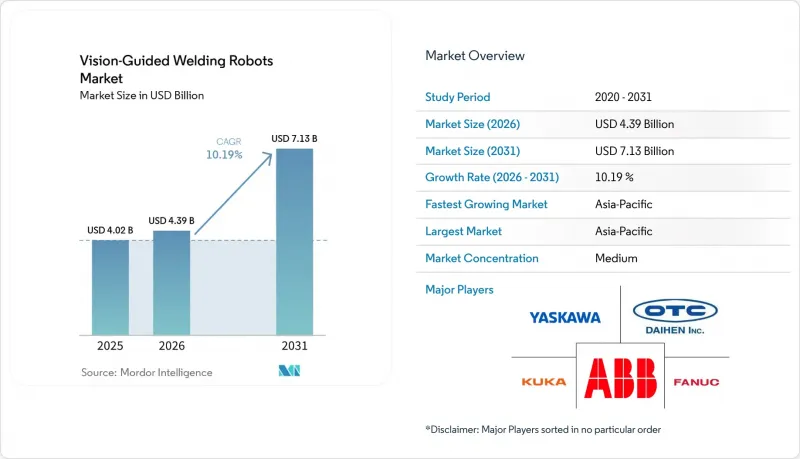
에 따르면 비전 유도형 용접 로봇 시장 규모는 2025년 40억 2,000만 달러에서 2026년에는 43억 9,000만 달러로 확대하며, 2031년까지 71억 3,000만 달러에 달할 것으로 예측되고 있으며, 2026-2031년까지 연평균 성장률(CAGR)은 10.19%에 달할 전망입니다.
전 세계 비전 유도형 용접 로봇 시장의 동향 및 인사이트
숙련된 용접공 부족과 생산량 압박
숙련된 용접공의 부족으로 인해 자동 용접은 단순한 효율화 차원의 문제가 아니라 생산 능력의 문제로 대두되고 있습니다. 미국 용접 종사자의 상당수가 정년 퇴직을 눈앞에 두고 있는 반면, 업계에서는 생산 능력을 유지하기 위해 새로운 전문가들의 대대적인 유입이 요구되고 있습니다. 인프라, 자동차, 제조 분야의 활동에서 용접 능력에 대한 수요가 계속해서 증가하고 있음에도 불구하고 미국의 현역 용접 종사자들은 고령화가 진행되고 있습니다. 제조업체는 비전 유도형 셀을 활용함으로써 수동 패스 스티칭에 대한 의존도를 낮추고, 교대 근무를 넘나들며 재현성 있는 작업을 유지할 수 있습니다. 따라서 공장에서 신뢰할 수 있는 생산량을 필요로 하거나, 충분한 수의 인증 용접공을 확보할 수 없는 경우, 비전 유도형 용접 로봇 시장이 혜택을 보게 될 것입니다.
EV 배터리 케이스 및 경량 소재 용접
전기자동차용 배터리 케이스에는 열입력량, 접합 위치 및 밀봉 성능의 정확한 제어가 요구됩니다. 알루미늄제 배터리 부품은 동등한 강철 부품에 비해 최대 50% 가볍지만, 알루미늄의 열적 특성으로 인해 신중한 용접 작업이 필요합니다. 비전 가이드 방식의 레이저 용접 및 저항 용접은 차종마다 배터리 설계나 재료 조합이 다른 경우에도 이음매의 위치 결정을 지원할 수 있습니다. 알루미늄 배터리 케이스 가공에서 파이버 레이저 시스템은 기존의 MIG 용접에 비해 열입력을 줄일 수 있습니다. 또한 ‘셀-투-팩(cell-to-pack)’ 방식의 배터리 설계에서는 모델 라인마다 이음매 경로가 다를 가능성이 있으며, 고정 지그의 가치가 떨어집니다. 이러한 요구 사항은 고정밀 접합, 기공률 제어 및 케이스의 밀봉성이 생산상의 우선순위가 되는 비전 가이드식 용접 로봇 시장을 지원하고 있습니다.
높은 셀 투자 및 통합 비용
비전 유도식 용접 셀을 도입하려면 로봇, 지그, 센서, 보정, 엔지니어링, 안전 인터록 및 교육에 대한 투자가 필요할 수 있습니다. 비전 시스템을 통합한 턴키식의 다관절로봇 셀에는 막대한 초기 비용이 소요될 수 있습니다. 이러한 비용으로 인해 처리량이 낮은 용접 작업의 경우 투자 회수 기간이 길어질 가능성이 있습니다. 또한 통합을 위해서는 로봇 소프트웨어, 센서 인터페이스, 용접 전원 및 PLC 안전 시스템 간의 호환성도 필요합니다. 소규모 제조업체의 경우, 이러한 작업을 관리할 전담 자동화 팀이 없는 경우가 많습니다. 모듈식 셀이나 유연한 자금 조달 수단을 통해 이러한 장벽이 해소되기 전까지는 비전 유도형 용접 로봇 시장은 대량 생산을 하는 공장을 제외하고는 보급 속도가 둔화될 것으로 예상됩니다.
부문 분석
2025년, 관절형 로봇은 비전 유도형 용접 로봇 시장 점유율의 48.11%를 차지했습니다. 6축 동작, 적재 중량 범위, 그리고 자동차 화이트 바디 및 구조 부재 제조 분야에서 쌓아온 오랜 실적이 이러한 위상을 지원하고 있습니다. 이미 관절식 셀을 사용하고 있는 제조업체는 대부분의 경우, 갱신 주기에서 동일한 레이아웃을 확장할 수 있습니다. 이러한 도입 실적을 바탕으로 새로운 로봇 유형에 맞춰 지그, 안전 구역 및 자재 취급 시스템을 재설계해야 할 필요성이 줄어듭니다. 협동 로봇은 많은 용도에서 그 다음으로 큰 기존 카테고리가 되었습니다. 이들은 최대 처리량보다는 부품군 간 재배치의 가치가 높은 상황에서 사용됩니다.
이동형 및 자율형 용접 로봇은 2031년까지 연평균 성장률(CAGR) 17.32%로 확대될 것으로 예측됩니다. 이들은 고정 셀 내에 들어가지 않는 대형, 중량물 또는 복잡한 공작물의 위치까지 로봇을 이동시킵니다. 이러한 접근 방식은 조선, 에너지 인프라 및 대형 구조물 제조 분야에서 효과적입니다. 파낙은 2026년 5월, 구조물 및 조선 용도를 위한 11kg의 협동 로봇 ‘CRX-3iA’를 출시했습니다. 한 명의 작업자가 용접 비드 사이로 제품을 운반할 수 있습니다. 또한 로봇 암이 사람 근처에서 작동하는 경우, 이동식 시스템은 ISO 10218-1의 요구 사항을 충족해야 합니다.
2025년에는 2D 비전 시스템이 시장의 53.45%를 차지했습니다. 저렴한 비용, 간편한 조작, 그리고 제어된 조명 조건 하에서 확립된 역할이 지속적인 활용을 지원하고 있습니다. 대량 생산을 하는 자동차 차체 공장에서는 패널의 형상이 예측 가능하고 카메라의 명암비를 관리할 수 있는 2D 시스템이 채택되고 있습니다. 이러한 시스템은 저항 스폿 용접 및 많은 아크 용접 라인에 최적입니다. 2D 시스템을 활용한 비전 유도형 용접 로봇 시장 규모는 여전히 표준화된 생산 환경에 의존하고 있습니다. 반면, 접합부의 형상, 재료의 계면, 표면의 반사율로 인해 2D 대비가 신뢰할 수 없게 되는 상황에서는 3D 시스템의 도입이 확대되고 있습니다.
멀티모달 비전 시스템은 2031년까지 연평균 성장률(CAGR) 14.65%로 확대될 것으로 예측됩니다. 이러한 시스템은 단일 카메라나 센서만으로는 충분한 제어가 어려운 용도를 위해 여러 가지 감지 기법을 결합하고 있습니다. 주요 용도로는 배터리 용접, 항공우주 분야의 티타늄 접합, 그리고 전자기기 조립이 있습니다. 코그넥스(Cognex)는 2026년 5월, 고속 에지 검사를 위한 고성능 AI 비전 시스템 ‘In-Sight 3900’을 출시했습니다. 이 시스템은 실시간 생산 검사에 필요한 엣지 처리 인프라를 지원합니다. 멀티모달 시스템으로의 전환은 이음매의 형상, 용융 풀의 상태, 스패터를 동시에 추적해야 할 필요성을 반영한 것입니다.
지역별 분석
아시아태평양은 지역별 총량에서 가장 큰 점유율을 차지하고 있으며, 예측 기간 중 급속한 성장이 예상됩니다. 중국은 전 세계에서 가동중인 산업용 로봇의 절반 이상을 차지하고 있으며, 로봇 도입 대수가 증가했습니다. 중국의 로봇 도입은 자동차 업계를 앞서 전기·전자 업계가 주도하고 있습니다. 일본은 자동차 및 전자기기 생산 거점을 통해 고사양 시스템에 대한 수요를 지원하고 있습니다. 한국은 세계 최고의 로봇 밀도를 자랑하며, 반도체 및 자동차 공급망에서 비전 통합형 스폿 용접을 채택하고 있습니다.
인도에서는 산업용 로봇 도입 대수가 증가하여 세계 유수의 국가로 자리매김하고 있으며, 예측 기간 중 중요한 지역적 기회로 부상하고 있습니다. 인도에서 지속적으로 성장하고 있는 자동차, 전자, 금속 가공 및 일반 제조업은 비전 유도 용접 시스템을 포함한 산업용 로봇의 추가 도입을 촉진할 것으로 예상됩니다. 아시아는 전 세계 로봇 도입 대수의 대부분을 차지하고 있으며, 제조업체들이 노동력 부족 해소, 생산 일관성 향상 및 대량 생산 체제 지원을 목적으로 자동화를 확대함에 따라 이 지역의 도입 대수는 증가하고 있습니다. 중국, 일본, 한국, 인도는 확고한 제조 거점과 첨단 자동화 기술에 대한 투자 확대를 통해 계속해서 지역내 수요를 주도하고 있습니다.
캐나다와 멕시코는 자동차 공급망을 통해 북미의 수요를 지원하고 있습니다. 멕시코에서는 단기적인 불확실성을 반영하여 산업용 로봇 도입 대수가 감소했습니다. 유럽에서는 자동차 화이트 바디 용접 분야에서 여전히 독일, 이탈리아, 스웨덴이 중심을 이루고 있습니다. 유럽의 산업용 로봇 도입 대수는 감소했으나, 독일에서는 고사양 셀에 대한 수요가 유지되었습니다. 남미에서는 농업기계 및 석유 및 가스 분야의 수요가 있습니다. 중동 및 아프리카에서는 사우디아라비아, 아랍에미리트, 남아프리카공화국에서 수요가 있으며, 에너지, 인프라, 광산 기계, 대규모 구조물 공사에 적합한 자율형 시스템이 요구되고 있습니다.
기타 혜택:
- 엑셀 형식의 시장 예측(ME) 시트
- 3개월간 애널리스트의 지원
자주 묻는 질문
목차
제1장 서론
- 조사 전제조건과 시장 정의
- 조사 범위
제2장 조사 방법
제3장 개요
제4장 시장 구도
- 시장 개요
- 시장 성장 촉진요인
- 시장 성장 억제요인
- 거시경제 요인이 시장에 미치는 영향
- 업계의 가치와 밸류체인 분석
- 규제 상황
- 기술 전망
- Porter's Five Forces 분석
제5장 시장 규모와 성장 예측
- 로봇 유형별
- 비전 기술별
- 용접 프로세스별
- 페이로드 용량별
- 용도별
- 최종사용자 산업별
- 지역별
- 북미
- 미국
- 캐나다
- 멕시코
- 남미
- 브라질
- 아르헨티나
- 기타 남미 국가
- 유럽
- 독일
- 영국
- 프랑스
- 이탈리아
- 스페인
- 기타 유럽 국가
- 아시아태평양
- 중국
- 일본
- 인도
- 한국
- ASEAN
- 기타 아시아태평양 국가
- 중동 및 아프리카
- 중동
- 사우디아라비아
- 아랍에미리트
- 기타 중동 국가
- 아프리카
- 남아프리카공화국
- 나이지리아
- 기타 아프리카 국가
- 중동
- 북미
제6장 경쟁 구도
- 시장 집중도
- 전략적 동향
- 시장 점유율 분석
- 기업 개요
- ABB Ltd.
- FANUC Corporation
- Yaskawa Electric Corporation
- KUKA AG
- OTC DAIHEN Inc.
- Kawasaki Heavy Industries, Ltd.
- Panasonic Holdings Corporation
- Comau S.p.A.
- Lincoln Electric Holdings, Inc.
- Trumpf GmbH and Co. KG
- Fronius International GmbH
- Cognex Corporation
- KEYENCE CORPORATION
- SICK AG
- Servo-Robot Inc.
- ESAB Corporation
- Novarc Technologies Inc.
- Inrotech A/S
- Universal Robots A/S
- Nachi-Fujikoshi Corporation
제7장 시장 기회와 향후 전망
KSA 26.10.30According to Mordor Intelligence, the vision-guided welding robots market size is projected to expand from USD 4.02 billion in 2025 to USD 4.39 billion in 2026, and to USD 7.13 billion by 2031, registering a CAGR of 10.19% between 2026 and 2031.
Global Vision-Guided Welding Robots Market Trends and Insights
Skilled Welder Shortages and Throughput Pressure
The shortage of skilled welders makes automated welding a capacity issue rather than solely an efficiency decision. A substantial portion of the US welding workforce is nearing retirement, while the industry requires a significant influx of new professionals to maintain capacity. The active US welder workforce is aging, even as infrastructure, vehicle, and fabrication activities continue to require welding capacity. Manufacturers can use vision-guided cells to reduce dependence on manual path teaching and maintain repeatable work across shifts. The vision-guided welding robots market therefore benefits when factories need reliable output but cannot recruit enough certified welders.
EV Battery Enclosure and Lightweight-Material Welding
Electric vehicle battery enclosures require accurate control of heat input, joint position, and sealing performance. Aluminum battery components can be up to 50% lighter than comparable steel components, but they require careful welding due to aluminum's thermal behavior. Vision-guided laser and resistance welding can support seam positioning where battery designs and material combinations change across vehicle programs. Fiber laser systems can reduce heat input compared with traditional MIG welding in aluminum battery enclosure work. Cell-to-pack battery designs also reduce the value of fixed tooling because seam paths can vary across model lines. These requirements support the Vision-guided welding robots market, where precision joining, porosity control, and enclosure sealing are production priorities.
High Cell Investment and Integration Costs
A vision-guided welding cell may require investment in the robot, fixturing, sensors, calibration, engineering, safety interlocks, and training. Turnkey articulated robot cells with integrated vision systems can involve substantial upfront costs. These costs can extend payback periods for lower-throughput welding operations. Integration also requires compatibility among robot software, sensor interfaces, welding power sources, and PLC safety systems. Smaller fabricators often lack dedicated automation teams to manage this work. The Vision-guided welding robots market faces slower adoption outside high-volume plants until modular cells and flexible financing reduce these barriers.
Other drivers and restraints analyzed in the detailed report include:
- Industry 4.0 Traceability and Closed-Loop Quality Control
- Falling Vision-Sensor and Edge-Compute Costs
- Shortage of Robot-Programming and Welding-Integration Skills
For complete list of drivers and restraints, kindly check the Table Of Contents.
Segment Analysis
Articulated robots held 48.11% of the Vision-guided welding robots market share in 2025. Their six-axis movement, payload range, and long use in automotive body-in-white and structural fabrication support this position. Manufacturers that already use articulated cells can often expand the same layout during replacement cycles. This installed base reduces the need to redesign fixtures, safety areas, and material handling around a new robot type. Collaborative robots are the next large conventional category in many applications. They are used where redeployment across part families is more valuable than maximum throughput.
Mobile and autonomous welding robots are projected to expand at a 17.32% CAGR through 2031. They move the robot to large, heavy, or complex workpieces that cannot enter a fixed cell. This approach is relevant in shipbuilding, energy infrastructure, and large structural fabrication. FANUC launched the CRX-3iA in May 2026 as an 11-kg collaborative robot for structural and shipbuilding applications. One operator can carry the product between weld seams. Mobile systems must also meet the requirements of ISO 10218-1 when robotic arms operate near people.
2D vision systems held 53.45% of the market in 2025. Their cost, simpler operation, and established role in controlled lighting conditions support continued use. High-volume automotive body shops use 2D systems in which panel geometry is predictable, and camera contrast can be managed. These systems are well-suited to resistance spot welding and many arc welding lines. The Vision-guided welding robots market size for 2D systems remains tied to standardized production environments. 3D systems are gaining use where joint geometry, material interfaces, and surface reflectivity make 2D contrast less reliable.
Multimodal vision systems are projected to expand at a 14.65% CAGR through 2031. These systems combine sensing methods for applications where a single camera or sensor cannot provide sufficient control. Battery welding, titanium aerospace joining, and electronics assembly are key uses. Cognex launched the In-Sight 3900 high-performance AI vision system in May 2026 for high-speed edge inspection. The system supports the edge-processing infrastructure needed for real-time production inspection. The shift toward multimodal systems reflects the need to track seam geometry, weld-pool conditions, and spatter simultaneously.
Complete Report Scope:
- By Robot Type
- Articulated Robots
- Collaborative Robots
- Cartesian / Gantry Robots
- SCARA Robots
- Mobile / Autonomous Welding Robots
- Other Robot Types
- By Vision Technology
- 2D Vision Systems
- 3D Vision Systems
- Multimodal Vision Systems
- By Welding Process
- Arc Welding
- Resistance Spot Welding
- Laser Welding
- TIG and Plasma Welding
- Other Welding Processes
- By Payload Capacity
- Up to 10 kg
- 10-20 kg
- 20-50 kg
- Above 50 kg
- By Application
- Body and Structural Welding
- Component and Subassembly Welding
- Pipe and Tube Welding
- Sheet Metal Welding
- Heavy Fabrication Welding
- Precision / Micro-Welding
- Other Applications
- By End-User Industry
- Automotive and Transportation
- Metals and Machinery
- Electrical and Electronics
- Aerospace and Defense
- Shipbuilding, Energy, and Infrastructure
- Contract Manufacturing and Job Shops
- Other End-User Industries
- By Geography
- North America
- United States
- Canada
- Mexico
- South America
- Brazil
- Argentina
- Rest of South America
- Europe
- Germany
- United Kingdom
- France
- Italy
- Spain
- Rest of Europe
- Asia-Pacific
- China
- Japan
- India
- South Korea
- ASEAN
- Rest of Asia-Pacific
- Middle East and Africa
- Middle East
- Saudi Arabia
- United Arab Emirates
- Rest of the Middle East
- Africa
- South Africa
- Nigeria
- Rest of Africa
- Middle East
- North America
Geography Analysis
Asia-Pacific accounted for the largest share of the regional total and is projected to grow rapidly through the forecast period. China accounted for more than half of the global operational industrial robot fleet and saw increased robot installations. Electrical and electronics-led robot installations in China, ahead of automotive. Japan supports demand for high-specification systems through its automotive and electronics production base. South Korea has the highest robot density globally and uses vision-integrated spot welding in semiconductor and automotive supply chains.
India recorded an increase in industrial robot installations and ranked among the leading countries globally, making it an important regional opportunity through the forecast period. The country's expanding automotive, electronics, metal fabrication, and general manufacturing industries are expected to support further adoption of industrial robots, including vision-guided welding systems. Asia accounted for the majority of global robot installations, with regional installations increasing as manufacturers expanded automation to address labor constraints, improve production consistency, and support high-volume manufacturing operations. China, Japan, South Korea, and India continue to drive regional demand through their established manufacturing bases and growing investments in advanced automation technologies.
Canada and Mexico support North American demand through automotive supply chains. Mexico recorded a decline in industrial robot installations, reflecting near-term uncertainty. Europe remains centered on Germany, Italy, and Sweden for automotive body-in-white welding. European industrial robot installations declined, although Germany retained demand for high-specification cells. South America has a demand for agricultural equipment and oil and gas applications. The Middle East and Africa have demand in Saudi Arabia, the United Arab Emirates, and South Africa, with autonomous systems suited to energy, infrastructure, mining equipment, and large structural work.
- ABB Ltd.
- FANUC Corporation
- Yaskawa Electric Corporation
- KUKA AG
- OTC DAIHEN Inc.
- Kawasaki Heavy Industries, Ltd.
- Panasonic Holdings Corporation
- Comau S.p.A.
- Lincoln Electric Holdings, Inc.
- Trumpf GmbH and Co. KG
- Fronius International GmbH
- Cognex Corporation
- KEYENCE CORPORATION
- SICK AG
- Servo-Robot Inc.
- ESAB Corporation
- Novarc Technologies Inc.
- Inrotech A/S
- Universal Robots A/S
- Nachi-Fujikoshi Corporation
Additional Benefits:
- The market estimate (ME) sheet in Excel format
- 3 months of analyst support
TABLE OF CONTENTS
1 INTRODUCTION
- 1.1 Study Assumptions and Market Definition
- 1.2 Scope of the Study
2 RESEARCH METHODOLOGY
3 EXECUTIVE SUMMARY
4 MARKET LANDSCAPE
- 4.1 Market Overview
- 4.2 Market Drivers
- 4.2.1 Skilled Welder Shortages and Throughput Pressure
- 4.2.2 EV Battery Enclosure and Lightweight-Material Welding
- 4.2.3 Industry 4.0 Traceability and Closed-Loop Quality Control
- 4.2.4 Falling Vision-Sensor and Edge-Compute Costs
- 4.2.5 Vision-Guided Automation for High-Mix, Low-Volume Fabrication
- 4.2.6 Autonomous Welding of Large and Unstructured Workpieces
- 4.3 Market Restraints
- 4.3.1 High Cell Investment and Integration Costs
- 4.3.2 Shortage of Robot-Programming and Welding-Integration Skills
- 4.3.3 Optical Interference from Arc Glare, Spatter, Smoke, and Reflective Metals
- 4.3.4 Inconsistent Fit-Up and Limited Training Data for Adaptive Welding Models
- 4.4 Impact of Macroeconomic Factors on the Market
- 4.5 Industry Value and Supply-Chain Analysis
- 4.6 Regulatory Landscape
- 4.7 Technological Outlook
- 4.8 Porter's Five Forces Analysis
- 4.8.1 Threat of New Entrants
- 4.8.2 Bargaining Power of Suppliers
- 4.8.3 Bargaining Power of Buyers
- 4.8.4 Threat of Substitutes
- 4.8.5 Intensity of Competitive Rivalry
5 MARKET SIZE AND GROWTH FORECASTS (VALUE)
- 5.1 By Robot Type
- 5.1.1 Articulated Robots
- 5.1.2 Collaborative Robots
- 5.1.3 Cartesian / Gantry Robots
- 5.1.4 SCARA Robots
- 5.1.5 Mobile / Autonomous Welding Robots
- 5.1.6 Other Robot Types
- 5.2 By Vision Technology
- 5.2.1 2D Vision Systems
- 5.2.2 3D Vision Systems
- 5.2.3 Multimodal Vision Systems
- 5.3 By Welding Process
- 5.3.1 Arc Welding
- 5.3.2 Resistance Spot Welding
- 5.3.3 Laser Welding
- 5.3.4 TIG and Plasma Welding
- 5.3.5 Other Welding Processes
- 5.4 By Payload Capacity
- 5.4.1 Up to 10 kg
- 5.4.2 10-20 kg
- 5.4.3 20-50 kg
- 5.4.4 Above 50 kg
- 5.5 By Application
- 5.5.1 Body and Structural Welding
- 5.5.2 Component and Subassembly Welding
- 5.5.3 Pipe and Tube Welding
- 5.5.4 Sheet Metal Welding
- 5.5.5 Heavy Fabrication Welding
- 5.5.6 Precision / Micro-Welding
- 5.5.7 Other Applications
- 5.6 By End-User Industry
- 5.6.1 Automotive and Transportation
- 5.6.2 Metals and Machinery
- 5.6.3 Electrical and Electronics
- 5.6.4 Aerospace and Defense
- 5.6.5 Shipbuilding, Energy, and Infrastructure
- 5.6.6 Contract Manufacturing and Job Shops
- 5.6.7 Other End-User Industries
- 5.7 By Geography
- 5.7.1 North America
- 5.7.1.1 United States
- 5.7.1.2 Canada
- 5.7.1.3 Mexico
- 5.7.2 South America
- 5.7.2.1 Brazil
- 5.7.2.2 Argentina
- 5.7.2.3 Rest of South America
- 5.7.3 Europe
- 5.7.3.1 Germany
- 5.7.3.2 United Kingdom
- 5.7.3.3 France
- 5.7.3.4 Italy
- 5.7.3.5 Spain
- 5.7.3.6 Rest of Europe
- 5.7.4 Asia-Pacific
- 5.7.4.1 China
- 5.7.4.2 Japan
- 5.7.4.3 India
- 5.7.4.4 South Korea
- 5.7.4.5 ASEAN
- 5.7.4.6 Rest of Asia-Pacific
- 5.7.5 Middle East and Africa
- 5.7.5.1 Middle East
- 5.7.5.1.1 Saudi Arabia
- 5.7.5.1.2 United Arab Emirates
- 5.7.5.1.3 Rest of the Middle East
- 5.7.5.2 Africa
- 5.7.5.2.1 South Africa
- 5.7.5.2.2 Nigeria
- 5.7.5.2.3 Rest of Africa
- 5.7.5.1 Middle East
- 5.7.1 North America
6 COMPETITIVE LANDSCAPE
- 6.1 Market Concentration
- 6.2 Strategic Moves
- 6.3 Market Share Analysis
- 6.4 Company Profiles (includes Global Level Overview, Market Level Overview, Core Segments, Financials as available, Strategic Information, Market Rank/Share, Products and Services, Recent Developments)
- 6.4.1 ABB Ltd.
- 6.4.2 FANUC Corporation
- 6.4.3 Yaskawa Electric Corporation
- 6.4.4 KUKA AG
- 6.4.5 OTC DAIHEN Inc.
- 6.4.6 Kawasaki Heavy Industries, Ltd.
- 6.4.7 Panasonic Holdings Corporation
- 6.4.8 Comau S.p.A.
- 6.4.9 Lincoln Electric Holdings, Inc.
- 6.4.10 Trumpf GmbH and Co. KG
- 6.4.11 Fronius International GmbH
- 6.4.12 Cognex Corporation
- 6.4.13 KEYENCE CORPORATION
- 6.4.14 SICK AG
- 6.4.15 Servo-Robot Inc.
- 6.4.16 ESAB Corporation
- 6.4.17 Novarc Technologies Inc.
- 6.4.18 Inrotech A/S
- 6.4.19 Universal Robots A/S
- 6.4.20 Nachi-Fujikoshi Corporation
7 MARKET OPPORTUNITIES AND FUTURE OUTLOOK
- 7.1 White-Space and Unmet-Need Assessment


