

|
시장보고서
상품코드
2121524
디메틸테레프탈레이트(DMT) : 시장 점유율 분석, 산업 동향 및 통계 데이터, 성장 예측(2026-2031년)Dimethyl Terephthalate (DMT) - Market Share Analysis, Industry Trends & Statistics, Growth Forecasts (2026 - 2031) |
||||||
 Mordor Intelligence
에 의하면, 디메틸테레프탈레이트(DMT : 테레프탈산 디메틸) 시장 규모는 2025년 764.22 킬로톤에서 2026년에는 740.22 킬로톤으로 축소될 전망이며, 2026-2031년 -3.14%의 연평균 복합 성장률(CAGR)을 나타내며 2031년에는 631.08 킬로톤에 이를 것으로 예측됩니다.
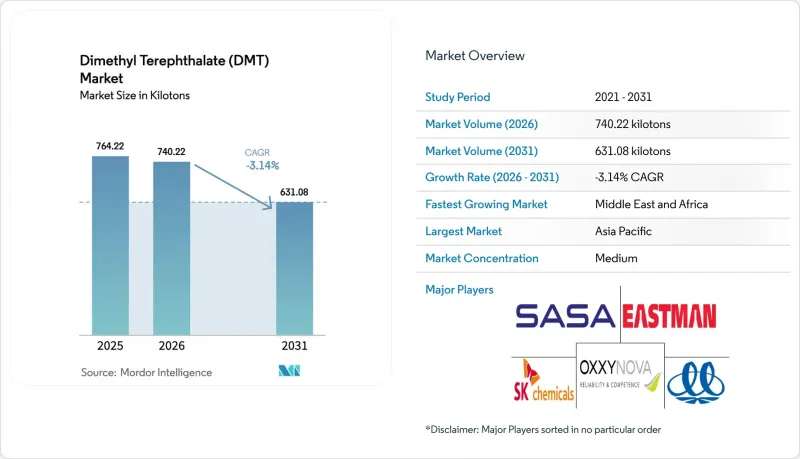
본 보고서는 형태(플레이크(고체) DMT, 액체 DMT), 용도(폴리에스터 섬유, 폴리에스터 필름, PET 수지, 기타 용도) 및 지역(아시아태평양, 북미, 유럽, 남미, 중동 및 아프리카)별로 분류되어 있습니다. 시장 예측은 수량(톤) 단위로 표시되어 있습니다.
세계 디메틸테레프탈레이트(DMT) 시장 동향 및 인사이트
PET·PBT 수요 회복
브랜드 소유주들이 순환형 소재 사용 목표를 채택함에 따라 PET 포장에 대한 수요는 안정화되고 있습니다. 한편, 난연성이 요구되는 정밀 성형이 필요한 자동차용 커넥터 분야에서는 PBT 출하량이 증가하고 있습니다. 이스트만(Eastman)과 램프키(Lampkey)의 제휴를 통해 불투명 및 착색된 PET 폐기물의 100%가 킹스포트의 분자 재활용 시설로 원료로 확보되고 있으며, 이는 순환형 루프가 PET 시장의 안정성을 뒷받침하고 있음을 보여줍니다. PET 수요의 점진적인 증가는 경량화로 인해 감소한 수지 사용량을 부분적으로 상쇄하여, 특수 필름용 DMT 계열 중간체에 대한 원료 수요를 유지하고 있습니다. 이와 병행하여, 전기자동차 아키텍처에서 PBT 사양 채택이 확대되면서 DMT 공중합체 화학 분야에 틈새 시장 기회가 창출되고 있습니다. 이러한 동향들이 합쳐져 디메틸테레프탈레이트 시장의 연평균 성장률(CAGR)을 약 0.8% 끌어올리고 있습니다.
아시아의 폴리에스터 섬유 소비
2025년 5월, 의류 수출이 회복됨에 따라 중국의 폴리에스테르 공장 가동률은 90%에 달했습니다. 한편, 인도와 아세안(ASEAN) 국가들은 니어쇼어링 수주를 확보하기 위해 방적 능력을 증강했습니다. 이 지역에 위치한 소규모 에스테르 교환 플랜트는 PTA 직접 에스테르화 설비로 개조할 자금이 부족하여 여전히 DMT에 의존하고 있습니다. 하지만 장쑤성, 절강성, 푸젠성에서 건설 중인 주요 PTA 메가 프로젝트로 인해 비용 격차가 확대되면서, 원료가 DMT에서 꾸준히 유출될 것으로 보입니다. 대량 생산되는 PTA 섬유와 소규모 공장의 DMT 기반이 양극화됨에 따라 연평균 성장률(CAGR) 측면에서 0.6%의 완충 효과가 발생하겠지만, 장기적인 감소 추세를 반전시키기는 어려울 것입니다.
PTA의 DMT에 대한 비용 우위
연간 300만 톤을 초과하는 단일 라인 PTA 플랜트는 타의 추종을 불허하는 단가를 실현하고 있어, DMT 루트를 한계적인 존재로 몰아넣고 있습니다. 중국석유화학(Sinopec)의 장쑤 콤플렉스는 이러한 규모의 경제성을 구현하고 있으며, 테이진(Teijin)은 사내 DMT 생산 능력을 일시 중단함으로써 175억 엔의 영업이익 증가를 실현했습니다. PTA의 끊임없는 비용 우위로 인해 재생 원료 수요 증가라는 호재가 있음에도 불구하고, 디메틸테레프탈레이트 시장의 연평균 성장률(CAGR)은 2.1포인트 하락했습니다.
부문 분석
2025년, 고체 플레이크 제품은 디메틸테레프탈레이트 시장에서 72.44%의 점유율을 차지했으나, 2031년까지 연평균 성장률(CAGR) -2.43%로 축소될 것으로 예측되어, 액상 등급을 능가하는 성과를 보이고 있습니다. 증기압이 낮아 VOC(휘발성 유기 화합물) 손실을 최소화할 수 있고, 플레이크는 철도 차량이나 FIBC 벌크백으로 운송하기 편리하기 때문에 용융 공급 시스템을 갖추지 않은 소규모 폴리에스터 공장에서 그 역할이 강화되고 있습니다. 대조적으로, 액체 DMT는 운송비와 안전 비용이 높기 때문에 직접 배관을 통해 포장 공정을 생략할 수 있는 통합형 복합 시설에서만 채택이 제한되고 있습니다. 재생 DMT의 생산 능력이 증대됨에 따라, 결정화 루프에서는 본질적으로 고체 제품이 생성되므로 플레이크의 우위는 더욱 공고해질 것입니다. 그러나 PTA로의 대체가 진행됨에 따라 플레이크 생산량도 결국 감소하게 될 것이며, 2028년까지 메탄올 분해법이 충분한 규모에 도달할 경우에만 이 부문은 안정될 전망입니다. 이러한 시나리오에서 고체 플레이크 디메틸테레프탈레이트(DMT) 시장 규모는 450킬로톤 수준에서 정점을 찍을 가능성이 있습니다.
액상 등급은 새로운 PTA 생산 라인의 가동으로 인해 인접한 용융 공급 수요가 사라지게 되어, 더 급격한 감소를 겪게 될 것입니다. 핫멜트 저장 탱크에 대한 규제 당국의 감시가 설비 투자의 장벽이 되는 한편, 물류 사업자들도 노후화된 가열 탱크 차량의 퇴역을 추진하고 있습니다. 두 형태 모두의 생산 능력을 갖춘 제조업체들은 현물 판매를 위해 생산을 플레이크 형태로 점점 더 전환하고 있으며, 액상 DMT는 자사 내 중합 공정에 대한 후방 통합에 활용되고 있습니다. 이러한 동향을 고려할 때, 2031년까지 액체 시장 점유율은 하락할 것으로 예상되며, 축소되는 디메틸테레프탈레이트 시장에서도 플레이크가 트랜스에스테르화의 표준 원료로서의 입지를 공고히할 것입니다.
지역별 분석
아시아태평양은 중국, 인도, 동남아시아에 뿌리내린 폴리에스터 섬유 클러스터에 힘입어 2025년에도 디메틸테레프탈레이트 시장 점유율의 51.85%를 유지했습니다. 중국 동부 해안의 대규모 PTA 설비 확장으로 인해 DMT에 대한 원료 수요는 점차 대체되고 있지만, 공장에서 구식 생산 라인을 가동하고 있는 지역이나 국내 메탄올 분해 파일럿 플랜트에서 재생 플레이크를 소비하고 있는 지역에서는 여전히 트랜스에스테르화가 이루어지고 있습니다. 인도에서는 중규모 사업자들이 자본 집약적인 PTA 개조를 미루고 있어 DMT의 잠재 수요가 유지되고 있으며, 시장은 견조한 모습을 보이고 있습니다. 인도네시아와 태국에서 진행 중인 재활용 프로젝트도 현지 수요를 회복시킬 가능성이 있지만, 2028년 이후의 일정은 여전히 불투명합니다. 이러한 요인들이 복합적으로 작용하여, 절대 생산량은 최대치를 기록할 것으로 보이지만 디메틸테레프탈레이트 시장의 축소에 크게 기여하고 있습니다.
북미에는 버진 DMT 생산 능력이 제한적이지만, 이스트먼의 킹스포트 공장과 계획 중인 롱뷰 공장을 핵심으로 화학 재활용의 중심지가 되고 있습니다. 이 공장들에서는 혼합 색상의 PET 폐기물을 r-DMT로 전환하여 식품 접촉용 수지 및 특수 코폴리머를 공급하고 있습니다. 그러나 멕시코만 연안 지역의 잇따른 가동 중단으로 인해 메탄올 공급은 여전히逼迫한 상태이며, 사업자들은 원료 가격 급등 위험에 노출되어 있습니다. 캐나다와 멕시코는 주로 미국으로부터의 수입 및 때때로 아시아태평양에서 들어오는 현물 화물에 의존하고 있어, 물류 비용이 차익 거래 결정에 영향을 미치고 있습니다.
인드라마(Indrama)가 로테르담의 PTA·PET 복합 시설 폐쇄 의향을 발표한 후, 유럽에서는 가장 급격한 구조적 위축이 나타났습니다. 2022년 옥시노바(Oxinova)의 독일 DMT 공장 폐쇄로 인해 해당 지역의 생산량은 더욱 감소했습니다. 그러나 유럽은 향후 현지 DMT 부문을 보호할 가능성이 있는 규제 조치의 선구자이기도 합니다. 유기 화학제품에 대한 CBAM(탄소 국경 조정 조치) 확대 전망과 중국산 PET에 대한 반덤핑 관세가 맞물리면서, 남아 있는 생산자들에게 틈새 시장에서의 경쟁 기회를 제공할 가능성이 있습니다. 이스트먼의 노르망디 프로젝트는 재생 가능 전력과 원료 공급업체와의 근접성을 활용하고 있으며, 유럽의 디메틸테레프탈레이트 시장에 진출한 기업들이 친환경 에너지, 순환형 원료, 특수 등급을 결합함으로써 여전히 번영할 수 있는 모델을 구현하고 있습니다.
남미, 중동 및 아프리카는 규모는 작지만 전략적으로 중요한 지역으로 남아 있습니다. 저비용 원료에 힘입은 중동의 PTA 증설은 특수 폴리에스터 코폴리머용 DMT 수요를 소폭 견인하고 있습니다. 아프리카의 초기 단계에 있는 포장 부문은 걸프 국가 공급업체로부터 병용 수지를 수입하고 있으며, 때때로 현지 PBT 컴파운드 제조를 위해 DMT를 조달하고 있습니다. 브라질, 아르헨티나 및 남미 인근 시장에는 국내 DMT 생산 거점이 없어 아시아태평양에서의 선적에 의존하고 있으므로, 운송량 변동이나 통화 약세의 영향을 받기 쉬운 상황입니다.
기타 혜택:
- Excel 형식 시장 예측(ME) 시트
- 3개월간의 애널리스트 지원
자주 묻는 질문
목차
제1장 서론
제2장 분석 방법
제3장 주요 요약
제4장 시장 구도
제5장 시장 규모·성장률 예측
제6장 경쟁 구도
제7장 시장 기회와 향후 전망
LSH 26.09.02According to Mordor Intelligence, the dimethyl terephthalate market size is expected to decline from 764.22 kilotons in 2025 to 740.22 kilotons in 2026 and is forecast to reach 631.08 kilotons by 2031 at -3.14% CAGR over 2026-2031.
This report is Segmented by Form (Flake (Solid) DMT and Liquid DMT), Application (Polyester Fiber, Polyester Film, PET Resin, and Other Applications), and Geography (Asia-Pacific, North America, Europe, South America, and Middle East and Africa). The Market Forecasts are Provided in Terms of Volume (Tons).
Global Dimethyl Terephthalate (DMT) Market Trends and Insights
PET and PBT Demand Resurgence
PET packaging demand is stabilizing as brand owners adopt circular-content targets, while PBT gains volume in automotive connectors that require flame-retardant precision molding. Eastman's partnership with Rumpke guarantees 100% of opaque and colored PET waste as feedstock for its Kingsport molecular-recycling unit, exemplifying how circular loops underpin PET stability. Incremental PET growth partially offsets resin intensity lost to lightweighting, preserving feedstock pull for DMT-based intermediates in specialty films. In tandem, PBT's specification wins in electric-vehicle architectures create niche opportunities for DMT copolymer chemistry. Together, these trends add a modest 0.8 percentage-point uplift to the dimethyl terephthalate market CAGR.
Polyester-Fiber Consumption in Asia
China's polyester plants ran at 90% utilization in May 2025 as apparel exports rebounded, while India and ASEAN nations ramped spinning capacity to capture near-shoring orders. Smaller trans-esterification units in these regions still rely on DMT because retrofit capital for PTA direct-esterification is scarce. Nevertheless, headline PTA mega-projects under construction in Jiangsu, Zhejiang, and Fujian will widen the cost gap, steadily siphoning feedstock away from DMT. The dichotomy between high-volume PTA fiber and DMT's foothold in smaller mills results in a 0.6 percentage-point CAGR cushion that is unlikely to reverse the long-run decline.
Cost Advantage of PTA Over DMT
Single-train PTA plants exceeding 3 million t per year deliver unbeatable unit costs, pushing DMT routes to the margin. Sinopec's Jiangsu complex exemplifies this scale economy, while Teijin realized JPY 17.5 billion operating-income gains after mothballing internal DMT capacity. The relentless PTA cost edge removes 2.1 percentage points from the dimethyl terephthalate market CAGR despite recycled-content tailwinds.
Other drivers and restraints analyzed in the detailed report include:
- Packaging Lightweighting Initiatives
- Chemical-Recycling Routes Supplying r-DMT
- Tightened Methanol VOC Regulations
For complete list of drivers and restraints, kindly check the Table Of Contents.
Segment Analysis
Solid-flake product commanded 72.44% of dimethyl terephthalate market share in 2025 and is projected to shrink at a -2.43% CAGR through 2031, outperforming liquid grades. Lower vapor pressure minimizes VOC losses, and flake moves conveniently in railcars and FIBC bulk bags, reinforcing its role in smaller polyester mills that lack molten-feed systems. Liquid DMT, in contrast, incurs higher freight and safety costs, limiting uptake to integrated complexes where direct piping eliminates packaging steps. As recycled DMT capacity ramps, crystallization loops inherently yield solid output, further anchoring flake's predominance. However, even flake volumes ultimately contract alongside PTA substitution, leaving the segment to stabilize only if methanolysis achieves scale by 2028. In that scenario, the dimethyl terephthalate market size for solid flake could plateau near 450 kilotons.
Liquid grades face steeper declines because new PTA lines eradicate adjacent molten-feed demand. Regulatory scrutiny of hot-melt storage tanks raises capex hurdles, while logistics providers seek to retire aging heated-tank fleets. Producers with dual-form capability increasingly tilt output toward flake for spot sales, relegating liquid DMT to captive polymerization back-integration. Given these dynamics, liquid's share is expected to fall by 2031, cementing flake as the default trans-esterification feed even in a shrinking dimethyl terephthalate market.
Complete Report Scope:
- By Form
- Flake (Solid) DMT
- Liquid DMT
- By Application
- Polyester Fiber
- Polyester Film
- PET Resin
- Other Applications (Including PBT)
- By Geography
- Asia-Pacific
- China
- India
- Japan
- South Korea
- ASEAN Countries
- Rest of Asia-Pacific
- North America
- United States
- Canada
- Mexico
- Europe
- Germany
- United Kingdom
- France
- Italy
- NORDIC Countries
- Rest of Europe
- South America
- Brazil
- Argentina
- Rest of South America
- Middle East and Africa
- Saudi Arabia
- South Africa
- Rest of Middle-East and Africa
- Asia-Pacific
Geography Analysis
Asia-Pacific retained 51.85% of dimethyl terephthalate market share in 2025, driven by entrenched polyester fiber clusters across China, India, and Southeast Asia. Mega PTA build-outs along China's east coast are displacing DMT feed, yet pockets of trans-esterification persist where mills operate legacy lines or consume recycled flake from domestic methanolysis pilots. India shows resilience as mid-scale players defer capital-intensive PTA retrofits, keeping an addressable DMT pool alive. Emerging recycling projects in Indonesia and Thailand could also regenerate local demand, although timelines beyond 2028 remain tentative. Collectively, these factors deliver the highest absolute volume but contribute materially to the dimethyl terephthalate market decline.
North America hosts limited virgin DMT capacity but has become the epicenter of chemical recycling, anchored by Eastman's Kingsport and planned Longview sites. These plants convert mixed-color PET waste into r-DMT, supplying food-contact resin and specialty copolymers. Methanol supply, however, remains tight after recurring outages along the Gulf Coast, exposing operators to feedstock spikes. Canada and Mexico rely on imports, primarily from the United States and occasional Asia-Pacific spot cargoes, with logistics costs influencing arbitrage decisions.
Europe experienced the sharpest structural retreat after Indorama announced intentions to shutter its Rotterdam PTA-PET complex. Oxxynova's German DMT plant closure in 2022 further depleted regional output. Yet Europe also pioneers regulatory levers that may eventually shield local DMT segments. The prospective CBAM expansion to organic chemicals, together with anti-dumping duties on Chinese PET, could grant residual producers a niche competitive window. Eastman's Normandy project leverages renewable electricity and proximity to feedstock suppliers, embodying a model where European dimethyl terephthalate market participants can still thrive by combining green energy, circular feed, and specialty grades.
South America and the Middle East and Africa remain small but strategically important. Middle East PTA additions, supported by low-cost feedstock, generate modest DMT pull for specialty polyester copolymers. Africa's nascent packaging sector imports bottle-grade resin from Gulf suppliers, occasionally sourcing DMT for local PBT compounding. Brazil, Argentina, and neighboring markets in South America lack domestic DMT assets; they depend on Asia-Pacific shipments, leaving volumes sensitive to freight swings and currency depreciation.
- Aadhunik Industries
- Capot Chemical Co., Ltd.
- Eastman Chemical Company
- Fiber Intermediate Products Company
- Jinan MTL Chemical Co., Ltd.
- Loop Industries
- Mogilevkhimvolokno
- Nanjing Ningshengyang Chemical Co., Ltd.
- Nova International
- OXXYNOVA GmbH
- Reliance Industries Limited
- Sarna Chemicals
- SASA
- SK chemicals
- Teijin Limited
- Yangzhou Juhechang Technology Co., Ltd
Additional Benefits:
- The market estimate (ME) sheet in Excel format
- 3 months of analyst support
TABLE OF CONTENTS
1 Introduction
- 1.1 Study Assumptions and Market Definition
- 1.2 Scope of the Study
2 Research Methodology
3 Executive Summary
4 Market Landscape
- 4.1 Market Overview
- 4.2 Market Drivers
- 4.2.1 PET and PBT Demand Resurgence
- 4.2.2 Polyester-Fibre Consumption in Asia
- 4.2.3 Packaging-Light-Weighting Initiatives
- 4.2.4 Chemical-Recycling Routes Supplying r-DMT
- 4.2.5 EU Carbon-Border-Pricing Favouring Local DMT
- 4.3 Market Restraints
- 4.3.1 Cost Advantage of PTA Over DMT
- 4.3.2 Volatile P-Xylene and Methanol Pricing
- 4.3.3 Tightened Methanol Voc Regulations
- 4.4 Value Chain Analysis
- 4.5 Porter's Five Forces
- 4.5.1 Bargaining Power of Suppliers
- 4.5.2 Bargaining Power of Buyers
- 4.5.3 Threat of New Entrants
- 4.5.4 Threat of Substitutes
- 4.5.5 Intensity of Rivalry
5 Market Size and Growth Forecasts(Volume)
- 5.1 By Form
- 5.1.1 Flake (Solid) DMT
- 5.1.2 Liquid DMT
- 5.2 By Application
- 5.2.1 Polyester Fiber
- 5.2.2 Polyester Film
- 5.2.3 PET Resin
- 5.2.4 Other Applications (Including PBT)
- 5.3 By Geography
- 5.3.1 Asia-Pacific
- 5.3.1.1 China
- 5.3.1.2 India
- 5.3.1.3 Japan
- 5.3.1.4 South Korea
- 5.3.1.5 ASEAN Countries
- 5.3.1.6 Rest of Asia-Pacific
- 5.3.2 North America
- 5.3.2.1 United States
- 5.3.2.2 Canada
- 5.3.2.3 Mexico
- 5.3.3 Europe
- 5.3.3.1 Germany
- 5.3.3.2 United Kingdom
- 5.3.3.3 France
- 5.3.3.4 Italy
- 5.3.3.5 NORDIC Countries
- 5.3.3.6 Rest of Europe
- 5.3.4 South America
- 5.3.4.1 Brazil
- 5.3.4.2 Argentina
- 5.3.4.3 Rest of South America
- 5.3.5 Middle East and Africa
- 5.3.5.1 Saudi Arabia
- 5.3.5.2 South Africa
- 5.3.5.3 Rest of Middle-East and Africa
- 5.3.1 Asia-Pacific
6 Competitive Landscape
- 6.1 Market Concentration
- 6.2 Strategic Moves
- 6.3 Market Share Analysis
- 6.4 Company Profiles (includes Global-level Overview, Market-level Overview, Core Segments, Financials as available, Strategic Information, Market Rank/Share, Products and Services and Recent Developments)
- 6.4.1 Aadhunik Industries
- 6.4.2 Capot Chemical Co., Ltd.
- 6.4.3 Eastman Chemical Company
- 6.4.4 Fiber Intermediate Products Company
- 6.4.5 Jinan MTL Chemical Co., Ltd.
- 6.4.6 Loop Industries
- 6.4.7 Mogilevkhimvolokno
- 6.4.8 Nanjing Ningshengyang Chemical Co., Ltd.
- 6.4.9 Nova International
- 6.4.10 OXXYNOVA GmbH
- 6.4.11 Reliance Industries Limited
- 6.4.12 Sarna Chemicals
- 6.4.13 SASA
- 6.4.14 SK chemicals
- 6.4.15 Teijin Limited
- 6.4.16 Yangzhou Juhechang Technology Co., Ltd
7 Market Opportunities and Future Outlook
- 7.1 White-space and Unmet-need Assessment


