|
시장보고서
상품코드
1762529
유세포분석 서비스 시장 : 업계 동향과 세계 예측 - 서비스별, 시설수별, 주요 기업별, 주요 지역별Flow Cytometry Services Market: Industry Trends and Global Forecasts - Distribution by Service, Number of Facilities, Key Players, and Key Geographical Regions |
||||||

유세포분석 서비스 시장 : 개요
세계의 유세포분석 서비스 시장 규모는 올해 27억 6,000만 달러에 달했습니다. 이 시장은 2035년까지의 예측 기간 중 9.73%의 CAGR로 확대할 것으로 예측됩니다.
시장 세분화에서는 시장 규모와 기회 분석을 다음과 같은 매개 변수로 구분합니다.
서비스
- 일반적인 유세포분석 서비스 유형
- 분석법 개발
- 소모품 제조
- 분석에 기반한 유세포분석 서비스의 유형
- PBMC 분석
- 전혈 세포 분석
- 골수액 분석
- 줄기세포 분석
- 희귀세포 검출
- 세포 프로파일링 및 서브셋화
- 세포내 염색
- 기타
주요 지역
- 북미
- 유럽
- 아시아태평양
- 기타 지역
유세포분석 서비스 시장 : 성장과 동향
유세포분석은 질병 진단 및 의약품 개발의 분석 기법으로 오랜 기간 중 큰 주목을 받아왔습니다. 생물학 및 의학 분야에서 유세포분석은 세포나 입자가 액체에 부유한 상태에서 레이저 빔을 통과할 때, 그 다양한 물리적, 화학적 특성을 측정하는 기술로 알려져 있습니다. 또한 웨스턴블롯팅이나 면역조직화학과 같은 기존 기술에는 여러 가지 한계가 있으므로 이해관계자들은 임상적 목적을 위해 유세포분석과 같은 혁신적인 기술을 선택하게 되었습니다. 기존의 방법은 특이도나 민감도가 낮고, 잘못된 결과를 초래할 수 있습니다. 주목할 만한 점은 유세포분석 기술은 이러한 문제를 극복할 수 있는 잠재력을 가지고 있다는 점입니다.
또한 암 및 면역 질환에 대한 의료비 부담 증가, 면역학 및 생의학 연구의 발전으로 인해 유세포분석의 채택이 증가할 것으로 예측됩니다. 그 결과, 유세포분석 서비스 프로바이더에 대한 의존도가 높아지고, 프로세스 비용 최적화, 프로세스 관련 복잡성 극복, 프로세스 일정 개선이 기대됩니다.
유세포분석 서비스 시장 : 주요 인사이트
이 보고서는 세계 유세포분석 서비스 시장의 현황을 조사하고 업계의 잠재적인 성장 기회를 파악합니다. 주요 조사 결과는 다음과 같습니다.
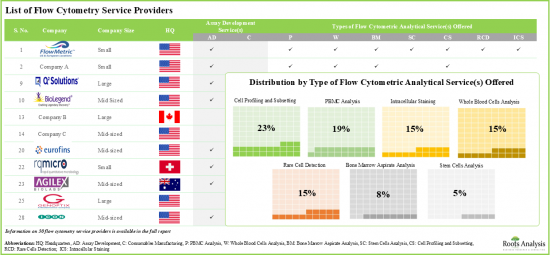
- 30개 업체가 다양한 유형의 유세포분석 서비스를 제공한다고 주장하고 있으며, 대부분 분석 기반의 유세포분석 서비스를 제공합니다.
- 현재 시장 상황에서는 다양한 유세포분석 서비스를 제공하는 기존 기업과 신규 기업 모두 존재합니다.
- 2000년 이후 설립된 주요 유세포분석 서비스 프로바이더로는 Neo Genomics, Q2 Solutions, Cell Carta, ICON Speciality Labs 등이 있습니다.
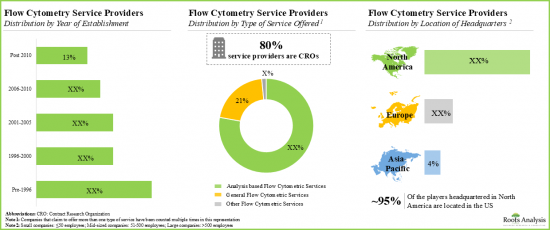
- 70% 이상의 이해관계자가 분석 기반 유세포분석 서비스를 제공한다고 주장하고 있으며, 21%의 기업이 일반 유세포분석 서비스를 제공한다고 답했습니다.
- 미국에 본사를 둔 진입기업의 약 75%는 중견기업이며, 이들 중 대다수(약 80%)는 분석 기반 유세포분석 서비스를 제공한다고 주장하고 있습니다.
- 또한 여러 업체가 여러 용도에서 사용되는 연구용 유세포 측정기 및 임상용 유세포 측정기를 포함하여 다양한 유형의 유세포 측정기를 생산하고 있습니다.
- 생산되는 유세포분석기의 50% 이상이 연구용 유세포분석기이며, 이러한 시스템을 개발하는 업체로는 Becton Dickinson, Sysmex Partec 등이 있습니다.
- 대부분의 유량계(60%)는 셀 기반 기술을 사용하여 제조되지만, 비드 기반 유량 기술도 일부 기업에서 채택하고 있습니다.
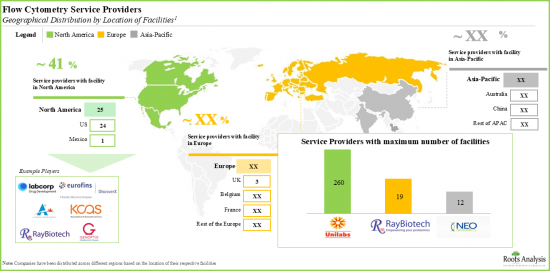
- 100개 이상의 시설을 보유한 유세포분석 서비스 프로바이더는 전 세계 다양한 지역에서 서비스를 제공하고 있으며, 이들 시설의 대부분은 신흥 지역에 설립되어 있습니다.
- 북미가 유세포분석기 제조 시장을 독점하고 있으며, 이 지역에 기반을 둔 Agilent, Beckman Coulter, Thermofisher Scientific 등이 대표적인 기업입니다.
- 경쟁 우위를 추구하기 위해 이해관계자들은 기존 역량을 적극적으로 확장하고, 각자의 제품을 강화하며, 진화하는 업계 벤치마크를 준수하고 있습니다.
- 지난 수년간 이 분야의 제휴 활동이 크게 증가했으며, 그 중 대부분은 M&A와 관련이 있습니다.
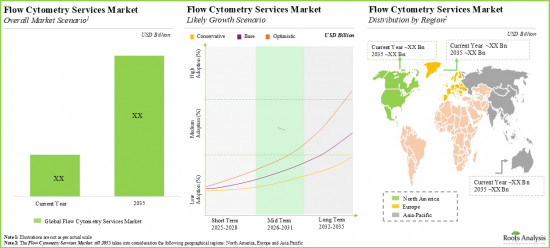
- 시장은 2035년까지 연평균 9.73% 성장할 것으로 예상되며, 향후 기회는 주요 지역에 분산될 것으로 예측됩니다.
유세포분석 서비스 시장의 참여 기업 예
- FlowMetric Life Sciences
- Flow Contract Sites Laboratory
- Bio-Legend
- Q2 Solutions
- ProImmune
- MLM Medical Labs
- Unilabs
- Firalis
- Agilex Biolabs
목차
제1장 서문
제2장 개요
제3장 서론
- 챕터 개요
- 유세포분석의 서론
- 유세포분석과 기존 분석 기술의 비교
- 유세포분석기, 세포 분석기, 세포 선별기의 차이
- 유세포분석 기기
- 유세포분석 서비스
- 유세포분석의 응용
- 향후 전망
제4장 시장 구도
- 챕터 개요
- 유세포분석 서비스 프로바이더 : 시장 구도
제5장 기업 경쟁력 분석
제6장 기업 개요 : 북미의 유세포분석 서비스 프로바이더
- 챕터 개요
- FlowMetric Life Sciences
- Flow Contract Sites Laboratory
- Bio-Legend
- Q2 Solutions
제7장 기업 개요 : 유럽 및 아시아태평양의 유세포분석 서비스 프로바이더
- 챕터 개요
- ProImmune
- MLM Medical Labs
- Unilabs
- Firalis
- Agilex Biolabs
제8장 파트너십과 협업
제9장 효율성 비율 교모듈
- 챕터 개요
- 주요 파라미터
- 조사 방법
- 유세포분석 효율 비교 분석
- 종합적 효율 비교 분석
- 각각의 효율 비교 분석
- 결론
제10장 시장 예측
- 챕터 개요
- 예측 조사 방법과 주요 전제조건
- 유세포분석 서비스 시장(-2035년)
- 유세포분석 서비스 시장(-2035년) : 주요 지역별 분석
- 결론
제11장 결론
제12장 부록 1 : 표형식 데이터
제13장 부록 2 : 기업·단체 리스트
KSA 25.07.10FLOW CYTOMETRY SERVICES MARKET: OVERVIEW
As per Roots Analysis, the global flow cytometry services market valued at USD 2.76 billion in the current year is anticipated to grow at a CAGR of 9.73% during the forecast period, till 2035.
The market sizing and opportunity analysis has been segmented across the following parameters:
Service
- Type of General Flow Cytometric Services
- Assay Development
- Consumables Manufacturing
- Type of Analysis based Flow Cytometric Services
- PBMC Analysis
- Whole Blood Cells Analysis
- Bone Marrow Aspirate Analysis
- Stem Cells Analysis
- Rare Cells Detection
- Cell Profiling and Subsetting
- Intracellular Staining
- Other Type of Flow Cytometric Services
Key Geographical Regions
- North America
- Europe
- Asia Pacific
- Rest of the World
FLOW CYTOMETRY SERVICES MARKET: GROWTH AND TRENDS
Over time, flow cytometry has gained considerable attention as an analytical method in disease diagnosis and drug development. In biology and medicine, flow cytometry is known as a technique which is used to measure various physical and chemical characteristics of cells or particles as they pass through a laser beam when suspended in a fluid. Further, given the various limitations of conventional techniques, such as western blotting and immunohistochemistry, stakeholders are increasingly opting for innovative technologies, such as flow cytometry for clinical purposes. Conventional methods have low specificity and sensitivity, which may produce false results. Notably, flow cytometry techniques have the potential to overcome a number of these challenges.
Additionally, owing to the growing healthcare burden related to cancer and immunological disease conditions, and developments in immunological and biomedical research, the adoption of flow cytometry is expected to increase. This in turn will increase dependency on flow cytometry services providers to optimize process costs, overcome complexities associated with the process and improve process timelines.
FLOW CYTOMETRY SERVICES MARKET: KEY INSIGHTS
The report delves into the current state of the global flow cytometry services market and identifies potential growth opportunities within industry. Some key findings from the report include:
- 30 companies claim to offer various types of flow cytometry services; majority of these offer analysis-based flow cytometric services.
- The current market landscape features the presence of both well-established and new firms offering a wide range of flow cytometry services; a relatively large proportion of the players are based in North America.
- Examples of large flow cytometry services providers established post 2000 include Neo Genomics, Q2 Solutions, Cell Carta and ICON Speciality Labs.
- More than 70% of stakeholders claim to offer analysis-based flow cytometric services, followed by 21% of players offering general flow cytometric services.
- Close to 75% of players who are headquartered in the US are mid-sized players; the majority (around 80%) of these players claim to provide analysis-based flow cytometry services.
- Several players are also engaged in the manufacturing of different types of flow cytometers, including research flow cytometers and clinical flow cytometers for use across multiple application areas.
- More than 50% of the flow cytometers being manufactured are research flow cytometers; examples of players developing such systems include Becton Dickinson and Sysmex Partec.
- A large proportion (60%) of flow cytometers are manufactured using the cell-based technique; however, bead-based flow technique is also being employed by several players.
- With more than 100 facilities, flow cytometry service providers offer services across various regions around the world; majority of these facilities are established in emerging geographies.
- North America dominates the flow cytometry manufacturing market; examples of players based in this region include Agilent, Beckman Coulter and Thermofisher Scientific.
- In pursuit of a competitive edge, stakeholders are actively expanding their existing capabilities to enhance their respective offerings and comply with the evolving industry benchmarks.
- Over the past few years, there has been a significant increase in partnership activity in this domain; majority of the instances were related to mergers and acquisitions.
- The market is anticipated to grow at an annualized rate of ~9.73% till 2035; the future opportunity is expected to be well distributed across key geographical regions.
Example Players in the Flow Cytometry Services Market
- FlowMetric Life Sciences
- Flow Contract Sites Laboratory
- Bio-Legend
- Q2 Solutions
- ProImmune
- MLM Medical Labs
- Unilabs
- Firalis
- Agilex Biolabs
FLOW CYTOMETRY SERVICES MARKET: RESEARCH COVERAGE
- Market Sizing and Opportunity Analysis: The report features an in-depth analysis of the flow cytometry services market, focusing on key market segments, including [A] service, [B] number of facilities, [C] key players and [D] key geographical regions.
- Market Landscape: A comprehensive evaluation of the flow cytometry service providers, based on several relevant parameters, such as [A] year of establishment, [B] company size, [C] location of headquarters, [D] location of flow cytometry facilities, [E] type of service(s) offered. Additionally, a comprehensive evaluation of manufacturers and the respective flow cytometry equipment developed / being developed by them.
- Company Competitiveness Analysis: A comprehensive competitive analysis of service providers in the flow cytometry industry, examining factors, such as [A] service strength and [B] supplier strength.
- Company Profiles: In-depth profiles of the companies offering services related to flow cytometry, focusing on [A] overview of the company, [B] financial information (if available), [C] service portfolio, [D] types of services offered, [E] location of flow cytometry facilities and [F] recent developments and an informed future outlook.
- Partnerships and Collaborations: An insightful analysis of the deals inked by stakeholders in the flow cytometry services market, based on several parameters, such as [A] year of partnership, [B] type of partnership, [C] type of partner, [D] type of service offered, [E] most active players (in terms of number of partnerships signed) and [F] geography.
KEY QUESTIONS ANSWERED IN THIS REPORT
- How many companies are currently engaged in this market?
- Which are the leading companies in this market?
- What factors are likely to influence the evolution of this market?
- What is the current and future market size?
- What is the CAGR of this market?
- How is the current and future market opportunity likely to be distributed across key market segments?
REASONS TO BUY THIS REPORT
- The report provides a comprehensive market analysis, offering detailed revenue projections of the overall market and its specific sub-segments. This information is valuable to both established market leaders and emerging entrants.
- Stakeholders can leverage the report to gain a deeper understanding of the competitive dynamics within the market. By analyzing the competitive landscape, businesses can make informed decisions to optimize their market positioning and develop effective go-to-market strategies.
- The report offers stakeholders a comprehensive overview of the market, including key drivers, barriers, opportunities, and challenges. This information empowers stakeholders to stay abreast of market trends and make data-driven decisions to capitalize on growth prospects.
ADDITIONAL BENEFITS
- Complimentary PPT Insights Packs
- Complimentary Excel Data Packs for all Analytical Modules in the Report
- 15% Free Content Customization
- Detailed Report Walkthrough Session with Research Team
- Free Updated report if the report is 6-12 months old or older
TABLE OF CONTENTS
1. PREFACE
- 1.1. Scope of the Report
- 1.2. Research Methodology
- 1.2.1. Research Assumptions
- 1.2.2. Project Methodology
- 1.2.3. Forecast Methodology
- 1.2.4. Robust Quality Control
- 1.2.5. Key Considerations
- 1.2.5.1. Demographics
- 1.2.5.2. Economic Factors
- 1.2.5.3. Government Regulations
- 1.2.5.4. Supply Chain
- 1.2.5.5. COVID Impact / Related Factors
- 1.2.5.6. Market Access
- 1.2.5.7. Healthcare Policies
- 1.2.5.8. Industry Consolidation
- 1.3 Key Questions Answered
- 1.4. Chapter Outlines
2. EXECUTIVE SUMMARY
3. INTRODUCTION
- 3.1. Chapter Overview
- 3.2. Introduction to Flow Cytometry
- 3.3. Flow Cytometry Versus Conventional Analytical Techniques
- 3.4. Difference between Flow Cytometer, Cell Analyzer and Cell Sorter
- 3.5. Flow Cytometry Instrumentation
- 3.5.1. Flow Cytometry: Cell Analyzing and Counting Methodology
- 3.5.2. Flow Cytometry: Software and Automation Support
- 3.6. Flow Cytometry Services
- 3.7. Application of Flow Cytometry
- 3.8. Future Perspectives
4. MARKET LANDSCAPE
- 4.1. Chapter Overview
- 4.2. Flow Cytometry Service Providers: Overall Market Landscape
- 4.2.1. Analysis by Year of Establishment
- 4.2.2. Analysis by Company Size
- 4.2.3. Analysis by Location of Headquarters
- 4.2.4. Analysis by Location of Flow Cytometry Facilities
- 4.2.5. Analysis by Type of Service(s) Offered
- 4.2.6. Analysis by Type of General Flow Cytometric Services Offered
- 4.2.7. Analysis by Type(s) of Analysis-based Flow Cytometric Services Offered
- 4.2.8. Analysis by Flow Cytometry Instrument Providers
5. COMPANY COMPETITIVENESS ANALYSIS
- 5.1. Chapter Overview
- 5.2. Methodology
- 5.3. Key Parameters
- 5.4. Competitiveness Analysis: Flow Cytometry Service Providers
- 5.4.1. Companies offering Flow Cytometry Service Providers in North America
- 5.4.2. Companies offering Flow Cytometry Service Providers in Europe and Asia-Pacific
6. COMPANY PROFILES: FLOW CYTOMETRY SERVICE PROVIDERS IN NORTH AMERICA
- 6.1. Chapter Overview
- 6.2. FlowMetric Life Sciences
- 6.2.1. Company Overview
- 6.2.2. FlowMetric Life Sciences: Flow Cytometry Services Portfolio
- 6.2.3. FlowMetric Life Sciences: Recent Developments and Future Outlook
- 6.3. Flow Contract Sites Laboratory
- 6.3.1. Company Overview
- 6.3.2. Flow Contract Sites Laboratory: Flow Cytometry Services Portfolio
- 6.3.3. Flow Contract Sites Laboratory: Recent Developments and Future Outlook
- 6.4. Bio-Legend
- 6.4.1. Company Overview
- 6.4.2. Bio-Legend: Flow Cytometry Services Portfolio
- 6.4.3. Bio-Legend: Recent Developments and Future Outlook
- 6.5. Q2 Solutions
- 6.5.1. Company Overview
- 6.5.2. Q2 Solutions: Flow Cytometry Services Portfolio
- 6.5.3. Q2 Solutions: Recent Developments and Future Outlook
7. COMPANY PROFILES: FLOW CYTOMETRY SERVICE PROVIDERS IN EUROPE AND ASIA-PACIFIC
- 7.1. Chapter Overview
- 7.2. ProImmune
- 7.2.1. Company Overview
- 7.2.2. ProImmune: Flow Cytometry Services Portfolio
- 7.2.3. ProImmune: Recent Developments and Future Outlook
- 7.3. MLM Medical Labs
- 7.3.1. Company Overview
- 7.3.2. MLM Medical Labs: Flow Cytometry Services Portfolio
- 7.3.3. MLM Medical Labs: Recent Developments and Future Outlook
- 7.4. Unilabs
- 7.4.1. Company Overview
- 7.4.2. Unilabs: Flow Cytometry Services Portfolio
- 7.4.3. Unilabs Recent Developments and Future Outlook
- 7.5. Firalis
- 7.5.1. Company Overview
- 7.5.2. Firalis: Flow Cytometry Services Portfolio
- 7.5.3. Firalis: Recent Developments and Future Outlook
- 7.6. Agilex Biolabs
- 7.6.1. Company Overview
- 7.6.2. Agilex Biolabs: Flow Cytometry Services Portfolio
- 7.6.3. Agilex Biolabs: Recent Developments and Future Outlook
8. PARTNERSHIPS AND COLLABORATIONS
- 8.1. Chapter Overview
- 8.2. Partnership Models
- 8.3. Flow Cytometry Service Providers: Partnerships and Collaborations
- 8.3.1. Analysis by Year of Partnership
- 8.3.2. Analysis by Type of Partnership
- 8.3.3. Analysis by Type of Collaborator
- 8.4. Flow Cytometry Service Providers: Information on Type of Service(s) Offered
- 8.4.1. Analysis by Type of Service(s)
- 8.4.2. Analysis by Type of Partnership and Type of Service(s)
- 8.4.3. Most Active Players: Analysis by Number of Partnerships
- 8.5. Top Partners
- 8.6. Geographical Analysis
- 8.7. Intercontinental and Intracontinental Agreements
9. EFFICIENCY COMPARISON MODULE
- 9.1. Chapter Overview
- 9.2. Key Parameters
- 9.3. Methodology
- 9.4. Flow Cytometry Efficiency Comparison Analysis
- 9.5. Inclusive Efficiency Comparison Analysis
- 9.6. Respective Efficiency Comparison Analysis
- 9.6.1. Flow Cytometry and Immunohistochemistry
- 9.6.2. Flow Cytometry and Cytogenetics Testing
- 9.6.3. Flow Cytometry and Fluorescence Microscopy
- 9.6.4. Flow Cytometry and ELISA
- 9.6.5. Flow Cytometry and Western Blotting
- 9.6.6. Flow Cytometry and Hematology Cell Analyzer
- 9.6.7. Flow Cytometry and Dynabead Method
- 9.7. Concluding Remarks
10. MARKET FORECAST
- 10.1. Chapter Overview
- 10.2. Forecast Methodology and Key Assumptions
- 10.3. Flow Cytometry Services Market, Till 2035
- 10.4. Flow Cytometry Services Market, Till 2035: Analysis by Key Geographical Region
- 10.4.1. Flow Cytometry Services Market in North America, Till 2035
- 10.4.2. Flow Cytometry Services Market in Europe, Till 2035
- 10.4.3. Flow Cytometry Services Market in Asia-Pacific, Till 2035
- 10.5. Conclusion