|
시장보고서
상품코드
1762534
자동 세포 처리 시스템 시장 업계 동향과 세계 예측 - 세포치료 처리 스텝별, 사업 규모별, 최종사용자별, 주요 지역별Automated Cell Processing System Market: Industry Trends and Global Forecasts - Distribution by Cell Therapy Processing Step, Scale of Operation, End User and Key Geographical Regions |
||||||

자동 세포 처리 시스템 시장 : 개요
세계의 자동 세포 처리 시스템 시장 규모는 올해 2억 2,000만 달러에 달했습니다. 이 시장은 예측 기간 중 16%의 CAGR로 확대할 것으로 예측됩니다.
시장 규모 및 기회 분석은 다음과 같은 매개 변수로 세분화됩니다.
세포치료 처리 단계
- 아페레시스
- 분리
- 확대
- 수확
- 충전/마무리
- 냉동 보존
- 해동
사업 규모
- 전임상/임상 업무
- 상업 조직
최종사용자
- 병원/의료센터/클리닉/연구기관/학술단체/학술기관
- 세포치료제 제조업체/개발사
주요 지역
- 북미
- 유럽
- 아시아태평양
- 라틴아메리카
- 중동 및 북아프리카
자동 세포 처리 시스템 시장 : 성장과 동향
최근 수년간 생명공학 산업의 수많은 획기적인 발전으로 인해 세포치료제 후보물질의 수가 증가하고 있습니다. 실제로 현재 2,000개 이상의 세포 및 유전자 치료 후보물질이 수많은 질병 적응증 치료를 위해 연구되고 있습니다. 또한 FDA가 승인한 치료법의 결과는 종양성 질환, 희귀질환, 만성질환 치료에서 세포치료의 큰 잠재력을 보여주었습니다. 따라서 이 치료법은 최근 수년간 헬스케어 업계 관계자들로부터 큰 관심을 받고 있습니다. 그러나 기존의 세포치료제 제조 공정은 노동집약적이고 시간이 많이 소요되어 제조비용이 높다는 단점이 있었습니다. 또한 이러한 수작업에 의한 세포치료제 제조 공정은 배치 간 편차가 발생할 수 있습니다. 그 결과, 보다 정교하고 시간 효율적인 제조 솔루션이 새롭게 요구되고 있습니다.
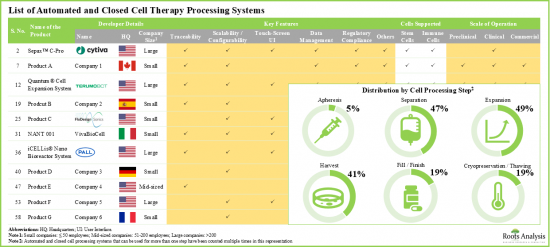
수년 동안 여러 가지 진보적이고 혁신적인 자동화 툴와 기술이 개발되어 왔습니다. 이러한 자동화된 폐쇄형 세포 처리 시스템은 첨단 세포치료제 제조와 관련된 비용을 크게 절감할 수 있는 것으로 입증되었습니다. 이러한 자동화 시스템 중 하나인 GMP-In-A Box는 처리량 증가, 배치 간 유휴 시간 단축, 수작업 감소 등 여러 가지 이점을 제공합니다. 이러한 자동화의 장점으로 인해 세포 처리 시스템 시장은 향후 유리한 성장을 이룰 것으로 보입니다.
자동 세포 처리 시스템 시장 : 주요 인사이트
이 보고서는 자동 세포 처리 시스템 시장의 현황을 조사하고 업계내 잠재적인 성장 기회를 파악합니다. 이 보고서의 주요 조사 결과는 다음과 같습니다.
- 현재 세포치료제 개발, 생산, 동결보존의 다양한 단계를 자동화하기 위해 60개 이상의 혁신적인 자동화 및 폐쇄 시스템이 각 사별로 개발되고 있습니다.
- 시장 상황은 단편화되어 있으며, 기존 진입자와 신규 시장 진출기업 모두 서로 다른 운영 규모에 걸쳐 세포를 처리하기 위해 명확한 특징을 가진 새로운 기술 개발에 참여하고 있습니다.
- 2010년 이후 자동화된 폐쇄형 세포 처리 시스템 개발에 주력하는 스타트업이 다수 설립되어 대기업과 중소기업 모두 이 새로운 분야에 관심을 보이고 있습니다.
- 사용 가능한 대부분의 시스템은 현재 규제 요건을 준수합니다. 예를 들어 BATON, NANT 001, 로봇 세포배양 시스템, 볼타루프 등이 있습니다.
- 이 분야에 대한 이해관계자들의 관심이 높아진 것은 최근 제휴 활동에도 반영되어 있습니다. 최근 제휴는 대부분 신기술에 초점을 맞춘 것으로, 국제적인 진출기업과 국내 기업 모두 적극적으로 참여하고 있습니다.
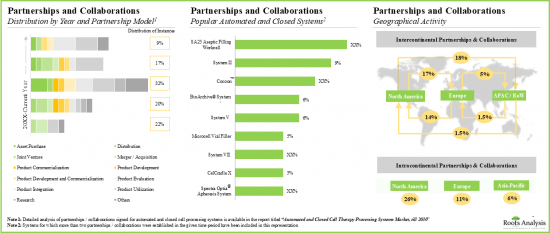
- 이 분야의 파트너십 수는 CAGR 24%로 증가하고 있으며, 이러한 파트너십의 70% 이상이 2018년 이후 체결된 것으로 나타났습니다.
- SA25 무균 충전 작업 셀(vanrx pharma systems)의 활용 또는 통합에 초점을 맞춘 몇 가지 거래가 세포치료제 충전/마무리를 위해 체결되었습니다.
- 경쟁 우위를 추구하기 위해 장비 개발자는 현재 각 제품 및 제휴 제품에 고급 기능을 통합하는 데 주력하고 있습니다.
- 주요 제약회사를 포함하여 세포치료제 개발에 참여하는 300개 이상의 이해관계자를 평가한 결과, 이 분야의 장비 프로바이더들에게 몇 가지 전략적 파트너십의 가능성이 있는 것으로 나타났습니다.
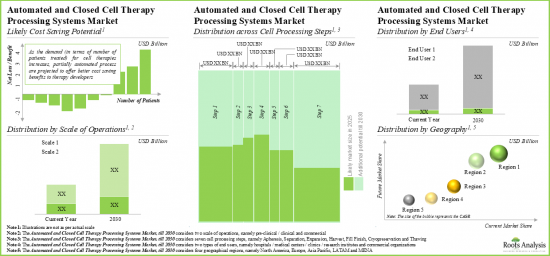
- 다양한 처리 공정의 비용 절감 가능성을 고려할 때, 자동화 및 폐쇄형 세포치료 시스템 시장은 향후 10년간 연평균 16%의 성장률을 보일 것으로 예측됩니다.
자동 세포 처리 시스템 시장의 참여 기업 예
- AstraZeneca
- Baxter
- Bayer
- Cytiva(Acquired by Danaher Corporation)
- Cellular Therapeutics
- Lonza
- Merck
- Pall(Acquired by Danaher Corporation)
- Terumo BCT
- ThermoGenesis
목차
제1장 서문
제2장 개요
제3장 서론
- 문맥과 배경
- 세포치료
- 세포치료 제조
- 세포 치료제의 제조에 관련된 주요 과제
- 자동화 및 폐쇄형 세포 처리 시스템의 개요
- 주요 성장 원동력과 장애
- 최근 동향과 향후 동향
제4장 경쟁 구도
- 챕터 개요
- 자동화 및 폐쇄형 세포치료 처리 시스템 : 시장 구도
- 자동화 및 폐쇄형 세포치료 처리 시스템 : 개발자 상황
제5장 제품 경쟁력 분석
- 챕터 개요
- 전제/주요 파라미터
- 조사 방법
- 제품 경쟁력 분석
제6장 기업 개요
- 챕터 개요
- Cytiva
- Pall
- Terumo BCT
- ThermoGenesis
제7장 파트너십
- 챕터 개요
- 파트너십 모델
- 자동화 및 폐쇄형 세포치료 처리 시스템 : 최근 파트너십
제8장 자동화 및 폐쇄형 세포치료 처리 시스템 분야에서의 대형 제약회사 구상
- 챕터 개요
- 대형 제약회사별 구상
- AbbVie 구상
- Bristol Myers Squibb 구상
- Gilead Sciences가 임하는 구상
- GlaxoSmithKline 구상
- Johnson & Johnson 구상
- Novartis 구상
- Roche 구상
- Sanofi 구상
- Takeda Pharmaceutical 구상
- 대형 제약회사 구상의 요약
제9장 파트너 후보
- 챕터 개요
- 범위와 조사 방법
- 자동화·폐쇄형 세포치료 처리 시스템 : 세포치료 개발의 잠재적 전략적 파트너
- 자동화·폐쇄형 세포치료 처리 시스템 : 세포치료 제조의 잠재적 전략적 파트너
제10장 사례 연구 : 부분 자동화 시스템과 완전 자동화 시스템을 사용한 비용편익 분석
제11장 시장 규모의 평가와 기회 분석
- 챕터 개요
- 주요 전제와 조사 방법
- 자동화 및 폐쇄형 세포치료 처리 시스템 시장 전체(-2035년)
제12장 결론
제13장 인터뷰/앙케이트 기록
제14장 부록 1 : 표형식 데이터
제15장 부록 2 : 기업·단체 리스트
KSA 25.07.10AUTOMATED CELL PROCESSING SYSTEM MARKET: OVERVIEW
As per Roots Analysis, the global automated cell processing system market valued at USD 220 million in the current year is projected to grow at a CAGR of 16% during the forecast period.
The market sizing and opportunity analysis has been segmented across the following parameters:
Cell Therapy Processing Step
- Apheresis
- Separation
- Expansion
- Harvest
- Fill / Finish
- Cryopreservation
- Thawing
Scale of Operation
- Pre-clinical / Clinical Operations
- Commercial Organizations
End User
- Hospitals / Medical Centers / Clinics / Research Institutes / Academic Institutes
- Cell Therapy Manufacturers / Developers
Key Geographical Regions
- North America
- Europe
- Asia-Pacific
- Latin America
- Middle East and North Africa
AUTOMATED CELL PROCESSING SYSTEM MARKET: GROWTH AND TRENDS
Recently there has been a rise in the number of cell therapies candidates, driven by numerous developmental breakthroughs in the biotechnology industry. In fact, more than 2,000 cell and gene therapy candidates are currently being investigated for the treatment of a myriad of disease indications. Further, the results of FDA approved therapies demonstrated the vast potential of cellular therapies in the treatment of oncological disorders, rare diseases, and chronic diseases. Thus, this therapeutic modality has garnered considerable attention from players engaged in the healthcare industry in the past few years. However, the conventional cell therapy manufacturing process is labor-intensive and time-consuming which results in high cost of production. Moreover, this manual process of cell therapy manufacturing leads to batch-to-batch variation. Consequently, there is an emerging and pressing need for more sophisticated and time efficient solutions for production.
Over the years, several advanced and innovative automation tools and technologies have been developed. These automated and closed cell processing systems have been demonstrated to hold the potential for significant reduction in the cost associated with the manufacturing of advanced cell therapies. One such automated system, namely GMP-In-A Box, offers several advantages, including increased throughput, decreased idle time between batch runs and reduced manual labor. Owing to such benefits of automation, the cell processing systems market is poised to witness lucrative growth in the coming future.
AUTOMATED CELL PROCESSING SYSTEM MARKET: KEY INSIGHTS
The report delves into the current state of the automated cell processing system market and identifies potential growth opportunities within industry. Some key findings from the report include:
- Presently, over 60 innovative, automated and closed systems have been developed by different companies in order to automate various stages of cell therapy development, production, and cryopreservation.
- The market landscape is fragmented, featuring both established players and new entrants, engaged in developing novel technologies with distinct features, for processing cells across different scales of operation.
- Since 2010, many startups, focused on developing automated and closed cell processing systems, have been established; this upcoming domain has captured the interest of both big and small players.
- Majority of the available systems are compliant with the current regulatory requirements; examples include BATON, NANT 001, robotic cell culture systems and the volta loop.
- The increasing interest of stakeholders in this field is also reflected in the recent partnership activity; most recent deals are focused on novel technologies and involve the active participation of both international and indigenous players.
- The number of partnerships in this domain have increased at a CAGR of 24%; more than 70% of these partnerships have been signed since 2018.
- Several deals focused on utilization or integration of SA25 aseptic filling work cell (vanrx pharma systems) were signed for fill / finish of cell therapy products.
- In pursuit of a competitive advantage, equipment developers are presently focusing on the integration of advanced features into their respective products and affiliated offerings.
- An evaluation of more than 300+ stakeholders engaged in the development of cell therapies, including big pharma players, reveals several likely strategic partnership opportunities for equipment providers in this field.
- Given their cost saving potential across different processing steps, we expect the automated and closed cell therapy systems market to grow at an annualized rate of 16% over the next decade.
Example Players in the Automated Cell Processing System Market
- AstraZeneca
- Baxter
- Bayer
- Cytiva (Acquired by Danaher Corporation)
- Cellular Therapeutics
- Lonza
- Merck
- Pall (Acquired by Danaher Corporation)
- Terumo BCT
- ThermoGenesis
AUTOMATED CELL PROCESSING SYSTEM MARKET: RESEARCH COVERAGE
- Market Sizing and Opportunity Analysis: The report features an in-depth analysis of the global automated cell processing system market, focusing on key market segments, including [A] cell therapy processing step, [B] scale of operation, [C] end user and [D] key geographical regions.
- Market Landscape: A comprehensive evaluation of the automated and closed systems, based on several relevant parameters, such as [A] cell therapy processing step, [B] their key features, [C] product specifications, [D] type of cells supported, [E] type of cell culture, [F] scale of operation, [G] application, [H] end users, [I] key support services offered and [J] regulatory certification / accreditations obtained.
- Product Competitiveness Analysis: A comprehensive competitive analysis of automated and closed systems, examining factors, such as [A] supplier power and [B] portfolio-related parameters.
- Company Profiles: In-depth profiles of key players that are engaged in offering automated and closed cell therapy processing systems, focusing on [A] overview of the company, [B] financial information (if available), [C] detailed description of the system(s) they offer and [D] recent developments and an informed future outlook.
- Partnerships and Collaborations: An insightful analysis of the deals inked by stakeholders in the automated cell processing system market, based on several parameters, such as [A] year of partnership, [B] type of partnership, [C] type of therapy, [D] type of cell processing step, [E] key automated and closed cell processing systems, [F] partner's focus area, [G] most active players (in terms of number of partnerships signed), and [H] geographical location of collaborators.
- Big Pharma Initiatives: A comprehensive evaluation of recent initiatives undertaken by big pharma players engaged in the automated cell processing system market.
KEY QUESTIONS ANSWERED IN THIS REPORT
- How many companies are currently engaged in this market?
- Which are the leading companies in this market?
- What factors are likely to influence the evolution of this market?
- What is the current and future market size?
- What is the CAGR of this market?
- How is the current and future market opportunity likely to be distributed across key market segments?
REASONS TO BUY THIS REPORT
- The report provides a comprehensive market analysis, offering detailed revenue projections of the overall market and its specific sub-segments. This information is valuable to both established market leaders and emerging entrants.
- Stakeholders can leverage the report to gain a deeper understanding of the competitive dynamics within the market. By analyzing the competitive landscape, businesses can make informed decisions to optimize their market positioning and develop effective go-to-market strategies.
- The report offers stakeholders a comprehensive overview of the market, including key drivers, barriers, opportunities, and challenges. This information empowers stakeholders to stay abreast of market trends and make data-driven decisions to capitalize on growth prospects.
ADDITIONAL BENEFITS
- Complimentary PPT Insights Packs
- Complimentary Excel Data Packs for all Analytical Modules in the Report
- 15% Free Content Customization
- Detailed Report Walkthrough Session with Research Team
- Free Updated report if the report is 6-12 months old or older
TABLE OF CONTENTS
1. PREFACE
- 1.1. Scope of the Report
- 1.2. Research Methodology
- 1.2.1. Research Assumptions
- 1.2.2. Project Methodology
- 1.2.3. Forecast Methodology
- 1.2.4. Robust Quality Control
- 1.2.5. Key Considerations
- 1.2.5.1. Demographics
- 1.2.5.2. Economic Factors
- 1.2.5.3. Government Regulations
- 1.2.5.4. Supply Chain
- 1.2.5.6. COVID Impact / Related Factors
- 1.2.5.7. Market Access
- 1.2.5.8. Healthcare Policies
- 1.2.5.9. Industry Consolidation
- 1.3 Key Questions Answered
- 1.4. Chapter Outlines
2. EXECUTIVE SUMMARY
3. INTRODUCTION
- 3.1. Context and Background
- 3.2. Cell Therapies
- 3.3. Cell Therapy Manufacturing
- 3.4. Key Challenges Associated with Manufacturing Cell Therapies
- 3.5. Overview of Automated and Closed Cell Processing Systems
- 3.5.1. Need for Automated and Closed Cell Processing in Cell Therapy Manufacturing
- 3.5.2. Advantages and Affiliated Challenges
- 3.6. Key Growth Drivers and Roadblocks
- 3.7. Recent Developments and Upcoming Trends
4. COMPETITIVE LANDSCAPE
- 4.1. Chapter Overview
- 4.2. Automated and Closed Cell Therapy Processing Systems: Overall Market Landscape
- 4.2.1. Analysis by Cell Processing Step
- 4.2.2. Analysis by Types of Cells
- 4.2.3. Analysis by Type of Culture
- 4.2.4. Analysis by Scale of Operation
- 4.2.5. Analysis by Key Features
- 4.2.6. Analysis by Application Area
- 4.2.7. Analysis by Regulatory Certifications / Accreditations
- 4.2.8. Analysis by End User
- 4.3. Automated and Closed Cell Therapy Processing Systems: Developer Landscape
- 4.3.1. Analysis by Year of Establishment
- 4.3.2. Analysis by Company Size
- 4.3.3. Analysis by Type of Support Service(s) Offered
- 4.3.4. Analysis by Location of Headquarters
5. PRODUCT COMPETITIVENESS ANALYSIS
- 5.1. Chapter Overview
- 5.2. Assumptions / Key Parameters
- 5.3. Methodology
- 5.4. Product Competitiveness Analysis
- 5.4.1. Automated and Closed Cell Processing Systems for Apheresis
- 5.4.2. Automated and Closed Cell Processing Systems for Separation
- 5.4.3. Automated and Closed Cell Processing Systems for Expansion
- 5.4.4. Automated and Closed Cell Processing Systems for Harvest
- 5.4.5. Automated and Closed Cell Processing Systems for Fill Finish
- 5.4.6. Automated and Closed Cell Processing Systems for Cryopreservation
- 5.4.7. Automated and Closed Cell Processing Systems for Thawing
6. COMPANY PROFILES
- 6.1. Chapter Overview
- 6.2. Cytiva
- 6.2.1. Company Overview
- 6.2.2. Product Portfolio
- 6.2.3. Recent Developments and Future Outlook
- 6.3. Pall
- 6.3.1. Company Overview
- 6.3.2. Product Portfolio
- 6.3.3. Recent Developments and Future Outlook
- 6.4. Terumo BCT
- 6.4.1. Company Overview
- 6.4.2. Product Portfolio
- 6.4.3. Financial Information
- 6.4.4. Recent Developments and Future Outlook
- 6.5 ThermoGenesis
- 6.5.1. Company Overview
- 6.5.2. Product Portfolio
- 6.5.3. Financial Information
- 6.5.4. Recent Developments and Future Outlook
7. PARTNERSHIPS
- 7.1. Chapter Overview
- 7.2. Partnership Models
- 7.3. Automated and Closed Cell Therapy Processing Systems: Recent Partnerships
- 7.3.1. Analysis by Year of Partnership
- 7.3.2. Analysis by Type of Partnership
- 7.3.3. Analysis by Type of Therapy
- 7.3.4. Analysis by Cell Processing Step
- 7.3.5. Analysis by Type of Automated and Closed Cell Processing Systems
- 7.3.6. Analysis by Partner's Focus Area
- 7.3.7. Most Active Players: Analysis by Number of Partnerships
- 7.3.8. Geographical Analysis
- 7.3.8.1. Country-Wise Distribution
- 7.3.8.2. Intercontinental and Intracontinental Agreements
8. BIG PHARMA INITIATIVES IN AUTOMATED AND CLOSED CELL THERAPY PROCESSING SYSTEMS DOMAIN
- 8.1. Chapter Overview
- 8.2. Initiatives Undertaken by Big Pharma Players
- 8.2.1. Initiatives Undertaken by AbbVie
- 8.2.2. Initiatives Undertaken by Bristol Myers Squibb
- 8.2.3. Initiatives Undertaken by Gilead Sciences
- 8.2.4. Initiatives Undertaken by GlaxoSmithKline
- 8.2.5. Initiatives Undertaken by Johnson & Johnson
- 8.2.6. Initiatives Undertaken by Novartis
- 8.2.7. Initiatives Undertaken by Roche
- 8.2.8. Initiatives Undertaken by Sanofi
- 8.2.9. Initiatives Undertaken by Takeda Pharmaceutical
- 8.2.10. Summary of Big Pharma Initiatives
9. LIKELY PARTNER
- 9.1. Chapter Overview
- 9.2. Scope and Methodology
- 9.3. Automated and Closed Cell Therapy Processing Systems: Potential Strategic Partners for Cell Therapy Development
- 9.3.1. Dendritic Cell Therapy
- 9.3.2. Stem Cell Therapy
- 9.3.3. T-cell Therapy
- 9.3.4. Natural Killer Cell Therapy
- 9.4. Automated and Closed Cell Therapy Processing Systems: Potential Strategic Partners for Cell Therapy Manufacturing
- 9.4.1. Dendritic Cell Therapy
- 9.4.2. Stem Cell Therapy,
- 9.4.3. T-cell Therapy
- 9.4.4. Natural Killer Cell Therapy
10. CASE STUDY: COST BENEFIT ANALYSIS USING PARTIALLY AUTOMATED AND FULLY AUTOMATED SYSTEMS
- 10.1. Chapter Overview
- 10.2. Comparative Analysis of Manual, Partially Automated and Fully Automated Cell Processing Systems
- 10.3. Likely Cost Saving Potential for Kymriah(R)
- 10.4. Likely Cost Saving Potential for Yescarata(R)
- 10.5. Cost Saving Potential of Fully Automated Processing Systems: Regional Trends
- 10.6. Concluding Remarks
11. MARKET SIZING AND OPPORTUNITY ANALYSIS
- 11.1. Chapter Overview
- 11.2. Key Assumptions and Methodology
- 11.3. Overall Automated and Closed Cell Therapy Processing Systems Market, Till 2035
- 11.3.1. Overall Automated and Closed Cell Therapy Processing Systems Market: Distribution by Cell Therapy Processing Step
- 11.3.1.1. Automated and Closed Cell Therapy Processing Systems Market for Apheresis, Till 2035
- 11.3.1.2. Automated and Closed Cell Therapy Processing Systems Market for Separation, Till 2035
- 11.3.1.3. Automated and Closed Cell Therapy Processing Systems Market for Expansion, Till 2035
- 11.3.1.4. Automated and Closed Cell Therapy Processing Systems Market for Harvest, Till 2035
- 11.3.1.5. Automated and Closed Cell Therapy Processing Systems Market for Fill / Finish, Till 2035
- 11.3.1.6. Automated and Closed Cell Therapy Processing Systems Market for Cryopreservation, Till 2035
- 11.3.1.7. Automated and Closed Cell Therapy Processing Systems Market for Thawing, Till 2035
- 11.3.2. Automated and Closed Cell Therapy Processing Systems Market: Distribution by Scale of Operation
- 11.3.2.1. Automated and Closed Cell Therapy Processing Systems Market for Pre-clinical / Clinical Operations, Till 2035
- 11.3.2.2. Automated and Closed Cell Therapy Processing Systems Market for Commercial Operations, Till 2035
- 11.3.3. Automated and Closed Cell Therapy Processing Systems Market: Distribution by End User
- 11.3.3.1. Automated and Closed Cell Therapy Processing Systems Market for Hospitals / Medical Centers / Clinics / Research Institutes / Academic Institutes, Till 2035
- 11.3.3.2. Automated and Closed Cell Therapy Processing Systems Market for Cell Therapy Manufacturers / Developers, Till 2035
- 11.3.4. Automated and Closed Cell Therapy Processing Systems Market: Distribution by Key Geographic Regions
- 11.3.4.1. Automated and Closed Cell Therapy Processing Systems Market in North America, Till 2035
- 11.3.4.2. Automated and Closed Cell Therapy Processing Systems Market in Europe, Till 2035
- 11.3.4.3. Automated and Closed Cell Therapy Processing Systems Market in Asia-Pacific, Till 2035
- 11.3.4.4. Automated and Closed Cell Therapy Processing Systems Market in Latin America (LATAM), Till 2035
- 11.3.4.5. Automated and Closed Cell Therapy Processing Systems Market in Middle East North America (MENA), Till 2035
- 11.3.1. Overall Automated and Closed Cell Therapy Processing Systems Market: Distribution by Cell Therapy Processing Step
12. CONCLUSION
- 12.1. Chapter Overview
- 12.2. Key Takeaways