

|
시장보고서
상품코드
1891238
무세포 단백질 발현 시장 - 무세포 발현 키트 및 서비스 프로바이더 : 업계 동향과 세계 예측(-2035년) - 무세포 시스템 유형별, 숙주 생물별, 발현 방법별, 최종사용자별, 주요 지역별Cell Free Protein Expression Market - Cell free Expression Kits and Service Providers: Industry Trends and Global Forecasts, Till 2035 - Distribution by Type of Cell Free System, Host Organism, Expression Method, End-User and Key Geographical Regions |
||||||

무세포 단백질 발현 시장
세계의 무세포 단백질 발현 시장 규모는 2035년까지의 예측 기간에 CAGR 6.9%로 성장하며, 현재 3억 2,200만 달러에서 2035년까지 6억 2,700만 달러에 달할 것으로 추정되고 있습니다.
무세포 시스템 시장
시장 규모 및 기회 분석은 다음 매개 변수를 기반으로 세분화됩니다.
무세포 시스템 유형별
- 조세포 용해액 기반 시스템
- 재구성 시스템
숙주 생물별
- 미생물 무세포 단백질 발현 시스템
- 포유류 무세포 단백질 발현 시스템
- 식물 유래 무세포 단백질 발현 시스템
- 기타
표현 방법별
- 전사-번역 연쇄법
- 번역법
최종사용자별
- 제약회사 및 생명공학 기업
- 학술-연구기관
- 기타
지역적 지역
- 북미
- 유럽
- 아시아태평양
- 기타 지역
무세포 발현 시스템 시장 : 성장과 동향
최근 무세포 발현 시스템은 기존의 세포 기반 단백질 생산 방법을 대체할 수 있는 실용적인 대안으로 인식되고 있습니다. 기존의 바이오 제조는 세포 증식을 위한 적절한 항상성을 유지하기 위해 생세포와 특정 환경을 필요로 하는 복잡한 과정으로 인식되고 있습니다. 또한 세포 기반 바이오 제조는 생물제제의 효율적인 생산에 근본적인 제약을 가져옵니다. 한편, 무세포 단백질 발현 시스템은 세포 용해액을 통해 생세포의 전사 및 번역 메커니즘을 이용하는 in vitro 플랫폼으로 다양한 생물제제, 특히 단백질의 생산을 가능하게 합니다. 여러 기업이 단백질의 일종인 효소의 무세포 발현용 키트를 개발하고 있습니다. 특히 바이오 생산 기업인 Enzymit은 무세포 기술을 이용해 저렴한 가격의 효소를 생산하고 있습니다.
일반적으로 무세포 단백질 발현 시스템은 기존 방법에 비해 많은 이점을 제공합니다. 예를 들어 합성용으로 조정된 컴포넌트를 변형하여 다양한 표적 분자를 생성할 수 있는 능력, 수율 증가, 개발 기간 단축, 생산 비용 절감 등을 들 수 있습니다. 세포를 사용하지 않는 단백질 발현은 무세포 시스템 또는 시판되는 무세포 발현 키트를 사용하여 수행됩니다.
무세포 단백질 발현 시스템은 세포 기반 시스템에서 생산이 어려운 독성 단백질, 막 단백질, 번역 후 변형된 단백질 등 다양한 복잡한 단백질의 합성을 촉진하는 능력을 보여주고 있습니다. 생물제제에 대한 수요가 증가함에 따라 무세포 발현 기술은 바이오의약품 분야 관계자들의 주요 관심 분야로 부상하고 있습니다.
무세포 단백질 발현 시장 : 주요 연구 결과
이 보고서는 무세포 단백질 발현 시스템 시장의 현황을 상세하게 분석하고 업계의 잠재적인 성장 기회를 파악합니다. 보고서의 주요 조사 결과는 다음과 같습니다.
- 현재 전 세계 35개 이상의 기업이 다양한 생체분자 합성을 위한 무세포 발현 서비스를 제공한다고 주장하고 있습니다.
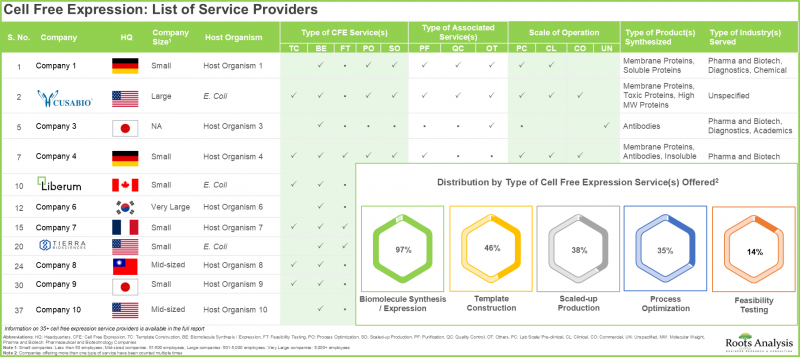
- 현재 시장 상황은 분산화되어 있으며, 신규 진출기업과 기존 기업 모두 다양한 산업의 요구에 대응하고 있습니다. 이들 기업의 대부분은 미국에 본사를 두고 있습니다.
- 이 분야에서의 경쟁 우위 구축을 위해 이해관계자들은 기존 역량을 적극적으로 강화하는 한편, 새로운 역량을 추가하여 각자의 서비스 포트폴리오를 확장하고 있습니다.
- 현재 시중에는 90여 종 이상의 무세포 발현 키트가 유통되고 있으며, 다양한 유형의 생체분자 합성에 활용되고 있습니다. 이 키트들은 무세포 발현을 위해 다양한 유형의 숙주 생물을 이용하고 있습니다.
- 무세포 발현 키트는 다양한 유형의 생물제제를 합성하기 위해 광범위한 무세포 발현 시스템을 활용하고 있습니다. 그 중 대부분은 단백질을 함유하고 있으며, 그 다음으로 올리고뉴클레오티드 등이 그 뒤를 잇고 있습니다.
- 발현이 어려운 생체분자에 대한 수요가 증가함에 따라 무세포 발현에 대한 필요성이 증가하고 있으며, 이해관계자들은 제품 라인 강화에 박차를 가하고 있습니다.
- 2015년 이후, 이 분야에서 창출된 지적 재산을 보호하기 위해 다양한 이해관계자들이 430건 이상의 특허를 출원 및 승인했습니다.
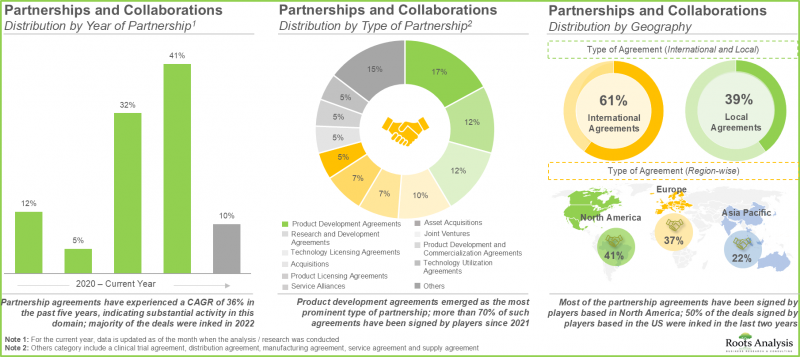
- 이 분야에 대한 관심 증가는 제휴 활동 증가에서 알 수 있으며, 제품 개발 계약이 가장 일반적입니다.
- 이 분야의 기회를 인식한 여러 투자자들이 지난 6년간 다양한 펀딩 라운드에서 80억 달러 이상을 투자했습니다.
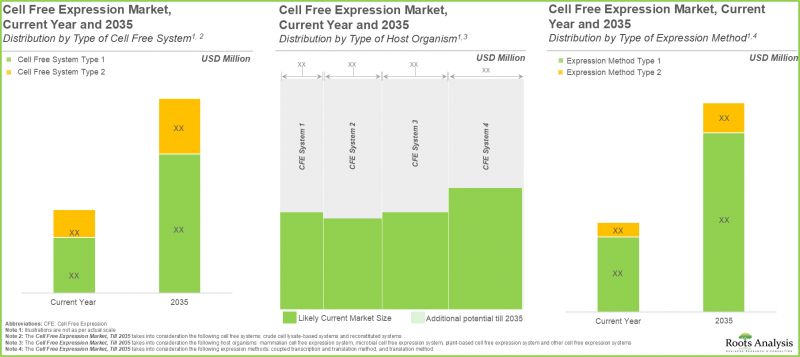
- 무세포 발현 시장은 2035년까지 연평균 복합 성장률(CAGR) 6.9%를 보일 것으로 예측되며, 이 기회는 다양한 유형의 무세포 시스템, 숙주 생물, 발현 방식에 광범위하게 분산될 것으로 예측됩니다.
- 이 분야의 성장은 주로 생물제제에 대한 수요 증가에 의해 주도될 것으로 예측됩니다. 북미는 2035년까지 시장의 50% 이상을 차지할 것으로 예측됩니다.
무세포 단백질 발현 시장 : 주요 부문
조세포 용해액 기반 시스템이 현재 무세포 시스템 시장 점유율의 대부분을 차지하고 있습니다.
무세포 시스템의 유형에 따라 시장은 조세포 용해액 기반 시스템과 재구성 시스템으로 구분됩니다. 시장 점유율의 대부분은 조세포 용해액 기반 시스템(90%)이 차지하고 있으며, 이러한 추세는 앞으로도 변함없이 유지될 것으로 예측됩니다. 재구성 시스템 부문은 예측 기간 중 CAGR 10.3%를 보일 것으로 예측됩니다.
조세포 용해액 기반 시스템은 향후 무세포 시스템 시장 점유율의 대부분을 차지할 것으로 예측됩니다.
발현 방법의 유형에 따라 세포 없는 시스템 시장은 결합형 전사-번역법과 번역법으로 구분됩니다. 조세포 용해액 기반 시스템이 시장 점유율의 95% 이상을 차지할 것으로 예상되며, 예측 기간 중 CAGR 6.6%를 보일 것으로 예측됩니다.
현재 미생물 유래 무세포 발현 시스템이 가장 큰 시장 점유율을 차지하고 있습니다.
무세포 단백질 발현 시스템의 유형에 따라 미생물 유래, 포유류 유래, 식물 유래, 기타 무세포 단백질 발현 시스템으로 구분됩니다. 미생물 유래 무세포 단백질 발현 시스템이 약 60% 시장 점유율을 차지할 것으로 예상되며, 포유류 유래 무세포 단백질 발현 시스템(25%), 식물 유래 무세포 단백질 발현 시스템(10%)이 그 뒤를 이을 것으로 전망됩니다.
향후 무세포 시스템 시장에서 제약 및 생명공학 기업이 가장 큰 점유율을 차지할 것으로 예측됩니다.
최종사용자별로 무세포 시스템 시장은 학술연구 기관, 제약 및 생명공학 기업, 기타 최종사용자로 분류됩니다. 시장 점유율의 대부분은 제약 및 생명공학 기업(65%)이 차지하고 있으며, CAGR 7.9%를 보일 것으로 예측됩니다.
북미는 향후 무세포 시스템 시장을 주도할 것으로 예측됩니다.
지역별로 단일 세포 시퀀싱 시장은 북미, 유럽, 아시아태평양 및 기타 지역으로 분류됩니다. 북미가 시장 점유율의 50% 이상을 차지하고 있으며, 유럽(31%), 아시아태평양(12%)이 그 뒤를 잇고 있습니다.
무세포 단백질 발현 시장의 대표적인 기업 사례
- BioLinker
- Biotechrabbit
- CellFreeSciences
- Creative Biolabs
- CUSABIO
- Daicel Arbor Biosciences
- LenioBio
- Promega
- Thermo Fisher Scientific
- Touchlight
무세포 단백질 발현 시스템 시장 : 조사 범위
- 시장 규모 및 기회 분석 : 이 보고서는 무세포 단백질 시스템 시장에 대해(A) 무세포 시스템 유형,(B) 숙주 생물,(C) 발현 방식,(D) 최종사용자,(E) 주요 지역 등 주요 시장 부문에 초점을 맞춘 상세한 분석을 담고 있습니다.
- 시장 상황1: 무세포 단백질 발현 서비스 프로바이더에 대한 상세한 평가는 다음과 같은 관련 매개 변수를 기반으로 수행됩니다. (A) 설립 연도,(B) 기업 규모,(C) 본사 소재지,(D) 무세포 서비스 유형,(E) 관련 서비스 유형,(F) 숙주 생물 유형,(G) 합성 제품 유형,(H) 사업 규모,(I) 대상 산업 유형. 합성되는 제품의 유형,(H) 사업 규모,(I) 대상 산업의 유형 등 여러 관련 파라미터를 기반으로 합니다.
- 시장 상황 2 : 무세포 단백질 발현 키트의 현재 시장 상황에 대해 다음과 같은 관련 매개 변수를 기반으로 상세한 평가를 수행합니다 :(A) 무세포 시스템 유형,(B) 숙주 생물 유형,(C) 발현 방법 유형,(D) 합성되는 제품 유형,(E) 사용된 템플릿 유형,(F). 호환 가능한 프로모터 유형,(G) 반응 형식 유형,(H) 설립 연도,(I) 기업 규모(직원 수),(J) 본사 소재지,(K) 주요 기업.
- 기업 경쟁력 분석 : 무세포 발현 서비스 제공 기업에 대한 종합적인 경쟁력 분석. 구체적으로,(A) 공급 능력 및(B) 서비스 능력 등의 요소를 고려합니다.
- 제품 경쟁 분석 : 다양한 관련 매개변수, 즉(A) 개발력 및(B) 제품 경쟁에 기반한 무세포 발현 키트의 제품 경쟁 분석.
- 기업 개요: 이 분야에서 활동하는 주요 진출 기업의 상세한 프로파일. 현재 무세포 시스템 시장에 참여하고 있는 기업을 중심으로(A) 설립연도,(B) 본사 소재지,(C) 무세포 발현 서비스 포트폴리오,(D) 최근 동향,(E) 향후 전망에 대해 알아봅니다.
- 제휴/협력 관계: 무세포 시스템 시장과 관련된 이해관계자들 간에 체결된 제휴/협력 관계에 대해(A) 제휴 연도,(B) 제휴 형태,(C) 파트너 유형,(D) 가장 활발히 참여하는 기업 등 다양한 관련 파라미터를 기반으로 인사이트 분석을 제공합니다.
- 자금조달 및 투자 분석 : 개발기업이 조달한 다양한 자금조달 및 투자에 대해(A) 자금조달 연도,(B) 투자금액,(C) 자금조달 유형,(D) 지역별 분포,(E) 가장 활발한 진입기업 등 관련 매개변수에 따라 종합적으로 검증합니다.
- 특허 분석 : 무세포 시스템과 관련하여 출원 및 등록된 각종 특허에 대해(A) 공개 연도,(B) 특허 유형,(C) 출원 연도,(D) 특허 관할권,(E) 주요 개인 양수인 등의 파라미터를 고려하여 상세하게 분석합니다.
목차
제1장 서문
제2장 개요
제3장 서론
- 챕터 개요
- 무세포 시스템 입문
- 무세포 바이오 제조의 개요
- 무세포 바이오 제조의 응용
- 향후 전망
제4장 시장 구도 : 무세포 단백질 발현 서비스 프로바이더
- 챕터 개요
- 무세포 단백질 발현 서비스 프로바이더 : 시장 구도
제5장 시장 구도 : 무세포 발현 키트
- 챕터 개요
- 무세포 단백질 발현 키트 : 시장 구도
- 세포 유리 발현 키트 프로바이더 현황
제6장 무세포 단백질 발현 서비스 프로바이더 : 기업 경쟁력 분석
- 챕터 개요
- 전제와 주요 파라미터
- 조사 방법
- 기업 경쟁력 분석 : 무세포 단백질 발현 서비스 프로바이더
제7장 무세포 발현 키트 : 제품 경쟁력 분석
- 챕터 개요
- 전제와 주요 파라미터
- 조사 방법
- 제품 경쟁력 분석 : 무세포 발현 키트
제8장 기업 개요 : 무세포 단백질 발현 서비스 프로바이더
- 챕터 개요
- BioLinker
- CUSABIO
- LenioBio
- Touchlight
제9장 기업 개요 : 무세포 단백질 발현 키트 프로바이더
- 챕터 개요
- biotechrabbit
- CellFree Sciences
- Creative Biolabs
- Diacel Arbor Biosciences
- Promega
- Thermo Fisher Scientific
제10장 파트너십과 협업
- 챕터 개요
- 파트너십 모델
- 무세포 시스템 : 파트너십과 협업
제11장 자금조달과 투자 분석
- 챕터 개요
- 자금조달의 유형
- 무세포 시스템 : 자금조달과 투자 분석
제12장 특허 분석
- 챕터 개요
- 범위와 조사 방법
- 무세포 시스템 : 특허 분석
- 무세포 시스템 : 특허 벤치마킹 분석
- 무세포 시스템 : 특허 평가
- 주요 특허 : 인용수별 분석
제13장 시장 예측과 기회 분석
- 챕터 개요
- 주요 전제와 예측 조사 방법
- 2035년까지의 세계 무세포 단백질 발현 시장
제14장 이그제큐티브 인사이트
제15장 결론
제16장 부록 1 : 표형식 데이터
제17장 부록 2 : 기업·단체 리스트
KSA 25.12.29Cell Free Protein Expression Market
As per Roots Analysis, the global cell free expression market size is estimated to grow from USD 322 million in the current year to USD 627 million by 2035, at a CAGR of 6.9% during the forecast period, till 2035.
Cell Free Systems Market
The market sizing and opportunity analysis has been segmented across the following parameters:
Type of Cell Free System
- Crude Cell Lysate-Based Systems
- Reconstituted Systems
Type of Host Organism
- Microbial Cell Free Expression Systems
- Mammalian Cell Free Expression Systems
- Plant-based Cell Free Expression Systems
- Other Cell Free Expression Systems
Type of Expression Method
- Coupled Transcription and Translation Method
- Translation Method
End-user
- Pharmaceutical and Biotechnology Companies
- Academic and Research Institutes
- Other End-Users
Geographical Regions
- North America
- Europe
- Asia-Pacific
- Rest of the World
Cell Free Expression Systems Market: Growth and Trends
Over the years cell-free expression systems have become a viable alternative to the traditional cell-based protein production method. Traditional biomanufacturing is recognized as a complicated procedure that necessitates living cells and particular environments to sustain adequate homeostasis for cell proliferation. Additionally, cell-based biomanufacturing presents fundamental constraints on the efficient generation of biologics. Alternatively, cell-free protein expression systems are in vitro platforms that utilize the transcription and translation mechanisms of living cells, achieved through cell lysates, to produce different kinds of biologics, especially proteins. Several players have developed kits for the cell-free expression of enzymes, which are a category of proteins. Notably, Enzymit, a bioproduction company, employs cell-free technology to produce affordable enzymes.
In general, cell-free protein expression systems provide numerous benefits compared to the conventional method, such as the capacity to generate a wide variety of target molecules by modifying components tailored for their synthesis, increased yield, reduced development periods, and lower production costs. Protein expression without cells is conducted using cell-free systems or commercially available cell-free expression kits.
Cell-free protein expression systems have shown the ability to facilitate the synthesis of various complex proteins, such as toxic proteins, membrane proteins, and other proteins modified post-translationally, which are often difficult to produce with cell-based systems. With the increasing need for biologic products, cell-free expression has emerged as a major sector of interest for those involved in the biopharmaceutical sector.
Cell Free Protein Expression Market: Key Insights
The report delves into the current state of the cell free protein expression system market and identifies potential growth opportunities within industry. Some key findings from the report include:
- Presently, more than 35 players across the globe claim to offer cell free expression services for synthesis of a variety of biomolecules.
- The current market landscape is fragmented, featuring the presence of both new entrants and established players catering to needs of various industries; majority of these players are based in the US.
- In pursuit of building a competitive edge in this field, stakeholders are actively upgrading their existing capabilities and adding new competencies in order to enhance their respective service portfolios.
- More than 90 cell free expression kits are currently available in the market for the synthesis of different types of biomolecules; these kits utilize different types of host organisms for cell free expression.
- Cell free expression kits utilize a range of cell free expression systems for the synthesis of different types of biologics; majority of these include proteins, followed by oligonucleotides and others.
- Owing to the rise in demand for difficult to express biomolecules, the requirement of cell free expression is increasing, prompting the stakeholders to upgrade their product offerings.
- Since 2015, more than 430 patents have been filed / granted by various stakeholders in order to protect the intellectual property generated within this field.
- The growing interest is evident from the rise in partnership activity; product development agreements have been the most common.
- Several investors having realized the opportunity within this domain, have invested more than USD 8 billion across various funding rounds in the past six years.
- The cell free expression market is likely to grow at a CAGR of 6.9%, till 2035; this opportunity is expected to be well distributed across different types of cell free systems, host organisms and expression methods.
- Growth in this domain is anticipated to be primarily driven by the rising demand for biologics; North America is expected to capture larger share (over 50%) of the market by 2035.
Cell Free Protein Expression Market: Key Segments
Crude Cell Lysate-based Systems Capture Majority of the Current Cell Free Systems Market Share
In terms of type of cell-free system, the market is segmented across Crude Cell Lysate-Based Systems and Reconstituted Systems. Majority of the market share is captured by Crude Cell Lysate-based Systems (90%) and this trend is unlikely to change in the future. Reconstituted systems segment is likely to grow at a CAGR of 10.3% during the forecast period.
Crude Cell Lysate-based Systems is Likely to Capture Majority of the Cell Free Systems Market Share in the Future
In terms of type of expression method, the cell free systems market is segmented across coupled transcription and translation method and translation method. Over 95% of the market share is likely to be captured by crude cell lysate-based systems, growing at a CAGR of 6.6% during the forecast period.
Currently, Microbial Cell-free Expression Systems Hold the Highest Cell Free Systems Market Share
In terms of type of cell-free expression system, the cell free systems market is segmented across microbial, mammalian, plant-based and other cell-free expression systems. Around 60% of the market share is likely to be captured by microbial cell free expression systems, followed by mammalian cell free expression systems (25%) and plant-based cell free expression systems (10%).
Pharmaceutical and Biotechnology Companies are Anticipated to Hold Maximum Cell Free Systems Market Share in the Future
In terms of end-users, the cell free system market is segmented across academic and research institutes, pharmaceutical and biotechnology companies, and other end-users. Majority of the market share is likely to held by pharmaceutical and biotechnology companies (65%), growing at a CAGR of 7.9%.
North America is Likely to Propel the Cell Free Systems Market in the Future
In terms of geographical regions, the single-cell sequencing market is segmented across North America, Europe, Asia-Pacific and Rest of the World. Over 50% of the market share is captured by North America, followed by Europe (31%) and Asia-Pacific (12%).
Example Players in the Cell Free Protein Expression Market
- BioLinker
- Biotechrabbit
- CellFreeSciences
- Creative Biolabs
- CUSABIO
- Daicel Arbor Biosciences
- LenioBio
- Promega
- Thermo Fisher Scientific
- Touchlight
Cell Free Protein Expression Systems Market: Research Coverage
- Market Sizing and Opportunity Analysis: The report features an in-depth analysis of the cell free protein systems market, focusing on key market segments, including [A] type of cell free system, [B] type of host mechanism, [C] type of expression method, [D] end-user, and [E] key geographical regions.
- Market Landscape 1: A detailed assessment of cell free protein expression service providers, based on several relevant parameters, such as [A] year of establishment, [B] company size, [C] location of headquarters, [D] type of cell free service(s) offered, [E] type of associated service(s) offered, [F] type of host organism, [G] type of product(s) synthesized, [H] scale of operation and [I] type of industry served.
- Market Landscape 2: A detailed assessment of the current market landscape of cell free protein expression kits, based on several relevant parameters, such as [A] type of cell free system, [B] type of host organism, [C] type of expression method, [D] type of product(s) synthesized, [E] type of template(s) used, [F] type of compatible promoter(s), [G] type of reaction format, [H] year of establishment, [I] company size (in terms of employee count), [J] location of headquarters and [K] leading players.
- Company Competitiveness Analysis: A comprehensive competitive analysis of cell free expression service providers, examining factors, such as [A] supplier strength and [B] service strength.
- Product Competitiveness Analysis: A product competitiveness analysis of cell free expression kits based on various relevant parameters, namely [A] developer power and [B] product competitiveness.
- Company Profiles: In-depth profiles of prominent players engaged in this domain, that are currently involved in cell free systems market, focusing on [A] year of establishment, [B] location of headquarters, [C] cell free expression service portfolio, [D] recent developments and [E] an informed future outlook.
- Partnerships and Collaborations An insightful analysis of the partnerships and collaborations inked between stakeholders engaged in the cell free systems market based on various relevant parameters, including [A] year of partnership, [B] type of partnership, [C] type of partner and [D] most active players.
- Funding and Investment Analysis: A comprehensive examination of various funding and investments raised by developers, based on relevant parameters, including [A] such as year of funding, [B] amount invested [C] type of funding, [D] regional distribution, and [E] most active players.
- Patent Analysis: An in-depth analysis of various patents that have been filed / granted for cell free systems, taking into consideration parameters, such as [A] publication year, [B] type of patent, [C] application year, [D] patent jurisdiction, [E] leading individual assignees.
Key Questions Answered in this Report
- How many companies are currently engaged in this market?
- Which are the leading companies in this market?
- What is the current global capacity of developers?
- What factors are likely to influence the evolution of this market?
- What is the current and future market size?
- What is the CAGR of this market?
- How is the current and future market opportunity likely to be distributed across key market segments?
Reasons to Buy this Report
- The report provides a comprehensive market analysis, offering detailed revenue projections of the overall market and its specific sub-segments. This information is valuable to both established market leaders and emerging entrants.
- Stakeholders can leverage the report to gain a deeper understanding of the competitive dynamics within the market. By analyzing the competitive landscape, businesses can make informed decisions to optimize their market positioning and develop effective go-to-market strategies.
- The report offers stakeholders a comprehensive overview of the market, including key drivers, barriers, opportunities, and challenges. This information empowers stakeholders to stay abreast of market trends and make data-driven decisions to capitalize on growth prospects.
Additional Benefits
- Complimentary PPT Insights Packs
- Complimentary Excel Data Packs for all Analytical Modules in the Report
- 15% Free Content Customization
- Detailed Report Walkthrough Session with Research Team
- Free Updated report if the report is 6-12 months old or older
TABLE OF CONTENTS
1. PREFACE
- 1.1. Introduction
- 1.2. Key Market Insights
- 1.3. Scope of the Report
- 1.4. Research Methodology
- 1.5. Frequently Asked Questions
- 1.6. Chapter Outlines
2. EXECUTIVE SUMMARY
3. INTRODUCTION
- 3.1. Chapter Overview
- 3.2. Introduction to Cell Free Systems
- 3.3. Overview of Cell Free Biomanufacturing
- 3.3.1. Advantages
- 3.3.2. Challenges
- 3.4. Applications of Cell Free Biomanufacturing
- 3.4.1. Applications in Healthcare Domain
- 3.4.2. Applications in Other Domains
- 3.5. Future Perspectives
4. MARKET LANDSCAPE: CELL FREE EXPRESSION SERVICE PROVIDERS
- 4.1. Chapter Overview
- 4.2. Cell Free Expression Service Providers: Overall Market Landscape
- 4.2.1. Analysis by Year of Establishment
- 4.2.2. Analysis by Company Size
- 4.2.3. Analysis by Location of Headquarters
- 4.2.4. Analysis by Type of Cell Free Expression Service(s) Offered
- 4.2.5. Analysis by Type of Associated Service(s) Offered
- 4.2.6. Analysis by Type of Host Organism
- 4.2.7. Analysis by Type of Product(s) Synthesized
- 4.2.8. Analysis by Scale of Operation
- 4.2.9. Analysis by Type of Industry Served
5. MARKET LANDSCAPE: CELL FREE EXPRESSION KITS
- 5.1. Chapter Overview
- 5.2. Cell Free Expression Kits: Overall Market Landscape
- 5.2.1. Analysis by Type of Cell Free System
- 5.2.2. Analysis by Type of Host Organism
- 5.2.3. Analysis by Type of Expression Method
- 5.2.4. Analysis by Type of Product(s) Synthesized
- 5.2.5. Analysis by Type of Template(s) Used
- 5.2.6. Analysis by Type of Compatible Promoter(s)
- 5.2.7. Analysis by Type of Reaction Format
- 5.2.8. Analysis by Yield of Positive Control
- 5.2.9. Analysis by Reaction Volume
- 5.2.10. Analysis by Reaction Temperature
- 5.2.11. Analysis by Incubation Time
- 5.2.12. Analysis by Number of Reactions per Kit
- 5.2.13. Analysis by Kit Price
- 5.3. Cell Free Expression Kit Providers Landscape
- 5.3.1. Analysis by Year of Establishment
- 5.3.2. Analysis by Company Size
- 5.3.3. Analysis by Location of Headquarters
- 5.3.4. Most Active Players: Analysis by Number of Cell free Expression Kits Developed
6. CELL FREE EXPRESSION SERVICE PROVIDERS: COMPANY COMPETITIVENESS ANALYSIS
- 6.1. Chapter Overview
- 6.2. Assumptions and Key Parameters
- 6.3. Methodology
- 6.4. Company Competitiveness Analysis: Cell Free Expression Service Providers
- 6.4.1. Company Competitiveness Analysis: Small Service Providers
- 6.4.2. Company Competitiveness Analysis: Mid-sized Service Providers
- 6.4.3. Company Competitiveness Analysis: Large and Very Service Providers
7. CELL FREE EXPRESSION KITS: PRODUCT COMPETITIVENESS ANALYSIS
- 7.1. Chapter Overview
- 7.2. Assumptions and Key Parameters
- 7.3. Methodology
- 7.4. Product Competitiveness Analysis: Cell Free Expression Kits
- 7.4.1. Product Competitiveness Analysis: Cell Free Expression Kits Developed by Players based in North America
- 7.4.2. Product Competitiveness Analysis: Cell Free Expression Kits Developed by Players based in Europe
- 7.4.3. Product Competitiveness Analysis: Cell Free Expression Kits Developed by Players based in Asia-Pacific and Rest of the World
8. COMPANY PROFILES: CELL FREE EXPRESSION SERVICE PROVIDERS
- 8.1. Chapter Overview
- 8.2. BioLinker
- 8.2.1. Company Overview
- 8.2.2. Cell Free Expression Service Portfolio
- 8.2.3. Recent Developments and Future Outlook
- 8.3. CUSABIO
- 8.3.1. Company Overview
- 8.3.2. Cell Free Expression Service Portfolio
- 8.3.3. Recent Developments and Future Outlook
- 8.4. LenioBio
- 8.4.1. Company Overview
- 8.4.2. Cell Free Expression Service Portfolio
- 8.4.3. Recent Developments and Future Outlook
- 8.5. Touchlight
- 8.5.1. Company Overview
- 8.5.2. Cell Free Expression Service Portfolio
- 8.5.3. Recent Developments and Future Outlook
9. COMPANY PROFILES: CELL FREE EXPRESSION KIT PROVIDERS
- 9.1. Chapter Overview
- 9.2. biotechrabbit
- 9.2.1. Company Overview
- 9.2.2. Cell Free Expression Kit Portfolio
- 9.2.3 Recent Developments and Future Outlook
- 9.3. CellFree Sciences
- 9.3.1. Company Overview
- 9.3.2. Cell Free Expression Kit Portfolio
- 9.3.3 Recent Developments and Future Outlook
- 9.4. Creative Biolabs
- 9.4.1. Company Overview
- 9.4.2. Cell Free Expression Kit Portfolio
- 9.4.3 Recent Developments and Future Outlook
- 9.5. Diacel Arbor Biosciences
- 9.5.1. Company Overview
- 9.5.2. Cell Free Expression Kit Portfolio
- 9.5.3 Recent Developments and Future Outlook
- 9.6. Promega
- 9.6.1. Company Overview
- 9.6.2. Cell Free Expression Kit Portfolio
- 9.6.3 Recent Developments and Future Outlook
- 9.7. Thermo Fisher Scientific
- 9.7.1. Company Overview
- 9.7.2. Cell Free Expression Kit Portfolio
- 9.7.3. Recent Developments and Future Outlook
10. PARTNERSHIPS AND COLLABORATIONS
- 10.1. Chapter Overview
- 10.2. Partnership Models
- 10.3. Cell free System: Partnerships and Collaborations
- 10.3.1 Analysis by Year of Partnership
- 10.3.2. Analysis by Type of Partnership
- 10.3.3. Analysis by Year and Type of Partnership
- 10.3.4. Analysis by Focus Area
- 10.3.5. Analysis by Type of Partner
- 10.3.6. Most Active Players: Analysis by Number of Partnerships
- 10.3.7. Local and International Agreements
- 10.3.8. Intercontinental and Intracontinental Agreements
11. FUNDING AND INVESTMENT ANALYSIS
- 11.1. Chapter Overview
- 11.2. Types of Funding
- 11.3. Cell free System: Funding and Investment Analysis
- 11.3.1. Analysis of Instances by Year of Investment
- 11.3.2. Analysis of Amount Invested by Year of Investment
- 11.3.3. Analysis of Instances by Type of Funding
- 11.3.4. Analysis of Amount Invested by Type of Funding
- 11.3.5. Analysis by Instances of Type of Investor
- 11.3.6. Most Active Players: Analysis by Number of Instances
- 11.3.7. Most Active Players: Analysis by Amount Invested
- 11.3.8. Analysis of Amount Invested by Geography
- 11.3.8.1. Analysis by Region
- 11.3.8.2. Analysis by Country
12. PATENT ANALYSIS
- 12.1. Chapter Overview
- 12.2. Scope and Methodology
- 12.3. Cell free System: Patent Analysis
- 12.3.1. Analysis by Patent Publication Year
- 12.3.2. Analysis by Patent Application Year
- 12.3.3. Analysis by Annual Number of Granted Patents and Patent Applications
- 12.3.4. Analysis by Patent Jurisdiction
- 12.3.5. Analysis by CPC Symbols
- 12.3.6. Analysis by Type of Applicant
- 12.3.7. Leading Industry Players: Analysis by Number of Patents
- 12.3.8. Leading Non-Industry Players: Analysis by Number of Patents
- 12.3.9. Leading Individual Assignees: Analysis by Number of Patents
- 12.4. Cell free System: Patent Benchmarking Analysis
- 12.4.1. Analysis by Patent Characteristics
- 12.5. Cell free System: Patent Valuation
- 12.6. Leading Patents: Analysis by Number of Citations
13. MARKET FORECAST AND OPPORTUNITY ANALYSIS
- 13.1. Chapter Overview
- 13.2. Key Assumptions and Forecast Methodology
- 13.3. Global Cell Free Expression Market, Till 2035
- 13.3.1. Cell Free Expression Market: Distribution by Type of Cell Free System
- 13.3.1.1. Cell Free Expression Market for Crude Cell Lysate-based Systems, Till 2035
- 13.3.1.2. Cell Free Expression Market for Reconstituted Systems, Till 2035
- 13.3.2. Cell Free Expression Market: Distribution by Type of Host Organism
- 13.3.2.1. Cell Free Expression Market for Microbial Cell Free Expression Systems, Till 2035
- 13.3.2.2. Cell Free Expression Market for Mammalian Cell Free Expression Systems, Till 2035
- 13.3.2.3. Cell Free Expression Market for Plant-based Cell Free Expression Systems, Till 2035
- 13.3.2.4. Cell Free Expression Market for Other Cell Free Expression Systems, Till 2035
- 13.3.3. Cell Free Expression Market: Distribution by Type of Expression Method
- 13.3.3.1. Cell Free Expression Market for Coupled Transcription and Translation Method, Till 2035
- 13.3.3.2. Cell Free Expression Market for Translation Method, Till 2035
- 13.3.4. Cell Free Expression Market: Distribution by End-User
- 13.3.4.1. Cell Free Expression Market for Pharmaceutical and Biotechnology Companies, Till 2035
- 13.3.4.2. Cell Free Expression Market for Academic and Research Institutes, Till 2035
- 13.3.4.3. Cell Free Expression Market for Other End-Users, Till 2035
- 13.3.5. Cell Free Expression Market: Distribution by Key Geographical Regions
- 13.3.5.1. Cell Free Expression Market in North America, Till 2035
- 13.3.5.2. Cell Free Expression Market in Europe, Till 2035
- 13.3.5.3. Cell Free Expression Market in Asia-Pacific, Till 2035
- 13.3.5.4. Cell Free Expression Market in Rest of the World, Till 2035
- 13.3.1. Cell Free Expression Market: Distribution by Type of Cell Free System
14. EXECUTIVE INSIGHTS
- 14.1. Chapter Overview
- 14.2. Company A
- 14.2.1. Company Snapshot
- 14.2.2. Interview Transcript
- 14.3. Company B
- 14.3.1. Company Snapshot
- 14.3.2. Interview Transcript


