

|
시장보고서
상품코드
2015373
거대 언어 모델(LLM) 시장(-2040년) : 업계 동향과 세계 예측Large Language Model (LLM) Market, till 2040: Industry Trends and Global Forecasts |
||||||

거대 언어 모델(LLM) 시장 전망
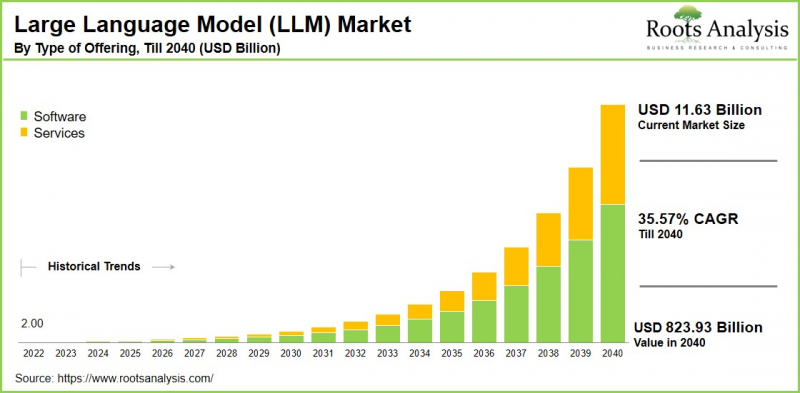
세계의 거대 언어 모델(LLM) 시장 규모는 현재 116억 3,000만 달러에서 2040년까지 8,239억 3,000만 달러에 달할 것으로 추정되며, 2040년까지 CAGR로 35.57%의 확대가 전망되고 있습니다.
거대 언어 모델(LLM)은 번역, 음성 인식, 컨텐츠 생성 등 다양한 자연 언어 처리(NLP) 작업을 수행하도록 설계된 고급 딥러닝 알고리즘입니다. 방대한 데이터세트를 통해 학습된 이 모델들은 뛰어난 문맥 이해력과 생성 능력을 발휘합니다. LLM 시장은 산업 전반의 AI 도입 가속화와 멀티모달/에이전트 AI 시스템의 지속적인 혁신으로 인해 급속한 성장세를 보이고 있습니다. 오픈소스 모델 외에도 구글의 Gemini, Anthropic의 Claude, OpenAI의 GPT와 같은 클로즈드 소스 플랫폼도 이 분야를 크게 발전시키고 있습니다.
이러한 모델은 수동 개입을 최소화하면서 자율적으로 적응하고 학습할 수 있는 정도가 높아져 시간과 리소스 요구 사항을 줄일 수 있습니다. 또한 자가 학습 및 전이 학습 기술의 발전으로 기업의 자동화 능력이 강화되고 있습니다. IBM, Microsoft, OpenAI 등 주요 기술 제공업체들은 AI 포트폴리오를 확장하기 위해 LLM 개발 및 전략적 제휴에 적극적으로 투자하고 있습니다. 기업이 다양한 용도에 LLM을 계속 통합함에 따라 시장은 예측 기간 중 지속적이고 기하급수적인 성장을 보일 것으로 예상됩니다.
경영진을 위한 전략적 인사이트
거대 언어 모델(LLM) 시장의 주요 성장 동인
고급 자연 언어 처리 능력에 대한 수요 증가는 거대 언어 모델(LLM) 시장의 주요 촉진요인입니다. 의료, BFSI, IT 및 통신 등의 업계에서는 분석 자동화, 컨텐츠 생성 효율화, 고객 지원 강화, 실용적인 지식 추출을 목적으로 멀티모달 LLM 기술을 점점 더 많이 채택하고 있습니다. AI 기반 자동화에 대한 의존도가 높아짐에 따라 확장성과 적응성이 뛰어난 언어 모델에 대한 요구가 증가하고 있습니다.
또한 주요 기업(Microsoft, Amazon, Baidu, Luma AI, Meta 등)은 LLM의 적용 범위를 넓히기 위해 모델 미세 조정, 도메인 적응, 멀티모달 AI의 혁신에 많은 투자를 하고 있습니다. 또한 클라우드 기반 및 API 기반 플랫폼을 통한 AI의 보급으로 인프라 장벽이 크게 낮아져 스타트업과 중소기업도 고급 모델을 사용할 수 있게 됨에 따라 모든 부문에서 LLM의 광범위한 채택이 가속화되고 있습니다.
LLM 시장: 업계내 기업 경쟁 상황
거대 언어 모델(LLM) 시장은 맞춤형 AI 솔루션과 제품을 개발할 수 있는 전문성을 갖춘 각 지역의 크고 작은 기업으로 구성되어 있습니다. 시장 진입 기업은 경쟁 우위를 강화하기 위해 투자, 파트너십, 제휴, 지속적인 기술 혁신을 포함한 전략적 노력을 적극적으로 추진하고 있습니다. 예를 들어 최근 Snowflake와 Anthropic은 2억 달러 규모의 전략적 파트너십을 확대하여 Snowflake 플랫폼에서 활동하는 12,600개 이상의 고객에게 Anthropic의 Claude 모델에 대한 폭넓은 액세스를 제공하고 AI 에이전트를 공동의 글로벌 시장 진출 전략을 시작했습니다. 이러한 협업과 더불어 여러 기업이 높은 분석 능력과 추론 능력을 갖춘 차세대 거대 언어 모델(LLM)의 도입에 집중하고 있습니다. 이러한 전략적 제휴와 제품 혁신은 장기적인 경쟁력 유지와 시장의 지속적인 성장을 촉진하는 데 있으며, 매우 중요한 역할을 할 것으로 예상됩니다.
세계의 거대 언어 모델(LLM) 시장에 대해 조사했으며, 시장 규모 추정과 기회 분석, 경쟁 상황, 기업 개요 등의 정보를 전해드립니다.
목차
제1장 프로젝트 개요
제2장 조사 방법
제3장 시장 역학
제4장 거시경제 지표
제5장 개요
제6장 서론
제7장 규제 시나리오
제8장 주요 기업의 종합적 데이터베이스
제9장 경쟁 구도
제10장 화이트 스페이스 분석
제11장 기업 경쟁력 분석
제12장 스타트업 에코시스템 분석
제13장 기업 개요
제14장 메가트렌드 분석
제15장 미충족 수요 분석
제16장 특허 분석
제17장 최근 발전
제18장 세계의 거대 언어 모델(LLM) 시장
제19장 시장 기회 : 제공 유형별
제20장 시장 기회 : 배포 유형별
제21장 시장 기회 : 아키텍처 유형별
제22장 시장 기회 : 모델 유형별
제23장 시장 기회 : 모델 사이즈 유형별
제24장 시장 기회 : 응용 분야별
제25장 시장 기회 : 최종 용도 산업별
제26장 북미의 거대 언어 모델(LLM)의 시장 기회
제27장 유럽의 거대 언어 모델(LLM)의 시장 기회
제28장 아시아태평양의 거대 언어 모델(LLM)의 시장 기회
제29장 라틴아메리카의 거대 언어 모델(LLM)의 시장 기회
제30장 중동 및 아프리카의 거대 언어 모델(LLM)의 시장 기회
제31장 시장 집중도 분석 : 주요 기업별
제32장 인접 시장 분석
제33장 주요 성공 전략
제34장 Porter's Five Forces 분석
제35장 SWOT 분석
제36장 밸류체인의 분석
제37장 Roots의 전략적 제안
제38장 1차 조사로부터의 인사이트
제39장 리포트 결론
제40장 표형식 데이터
제41장 기업과 조직 리스트
KSA 26.05.08Large Language Model Market Outlook
As per Roots Analysis, the global large language model (LLM) market size is estimated to grow from USD 11.63 billion in the current year to USD 823.93 billion by 2040, at a CAGR of 35.57% during the forecast period, till 2040.
A large language model (LLM) is an advanced deep learning algorithm designed to perform a wide range of natural language processing (NLP) tasks, including translation, speech recognition, and content generation. Trained on extensive datasets, these models demonstrate strong contextual understanding and generative capabilities. The LLM market is witnessing rapid expansion, driven by the accelerating adoption of artificial intelligence across industries and continuous innovation in multimodal and agentic AI systems. Both open-source models, and closed-source platforms like Google's Gemini, Anthropic's Claude, and OpenAI's GPT are significantly advancing the field.
These models increasingly enable autonomous adaptation and learning with minimal manual intervention, thereby reducing time and resource requirements. Further, advancements in self-supervised and transfer learning techniques are strengthening enterprise automation capabilities. Leading technology providers, including IBM, Microsoft, and OpenAI, are actively investing in LLM development and strategic collaborations to expand their AI portfolios. As enterprises continue to integrate LLMs across diverse applications, the market is projected to experience sustained and exponential growth throughout the forecast period.
Strategic Insights for Senior Leaders
Key Drivers Propelling Growth of Large Language Model Market
The growing demand for advanced natural language processing capabilities is a key driver of the large language model (LLM) market. Industries such as healthcare, BFSI, and IT & telecommunications increasingly adopt multimodal LLM technologies to automate analytics, streamline content generation, enhance customer support, and extract actionable insights. This expanding reliance on AI-driven automation is fueling the need for highly scalable and adaptable language models.
Further, leading technology companies (including Microsoft, Amazon, Baidu, Luma AI, and Meta), are making substantial investments in model fine-tuning, domain adaptation, and multimodal AI innovation to broaden LLM applications. Further, the democratization of AI through cloud-based and API-driven platforms has significantly lowered infrastructure barriers, enabling startups and small enterprises to access advanced models, thereby accelerating widespread LLM adoption across sectors.
LLM Market: Competitive Landscape of Companies in this Industry
The large language model market comprises a mix of small and large companies equipped with expertise to develop tailored AI solutions and products across various regions. To strengthen their competitive positioning, market participants are actively pursuing strategic initiatives, including investments, partnerships, collaborations, and continuous technological advancements. For instance, recently, Snowflake and Anthropic expanded their USD 200 million strategic partnership to launch a joint global go-to-market initiative aimed at deploying AI agents and providing broader access to Anthropic's Claude model for over 12,600 customers operating on the Snowflake platform. In addition to collaborative efforts, several companies are focusing on the introduction of next-generation large language models equipped with enhanced analytical and reasoning capabilities. Such strategic alliances and product innovations are expected to play a pivotal role in sustaining long-term competitiveness and driving continued market growth.
Emerging Trends in Large Language Model Industry
The large language model (LLM) industry is undergoing rapid transformation, marked by several emerging trends that are reshaping the competitive and technological landscape. Key developments include the rise of multimodal models capable of processing text, images, audio, and video within a unified framework. Additionally, there is a growing adoption of agentic AI systems that can autonomously execute complex tasks. There is also increasing emphasis on domain-specific fine-tuning and verticalized LLMs tailored for sectors such as healthcare, finance, and legal services.
Additionally, advancements in model efficiency, including parameter optimization and edge deployment capabilities, are enabling cost-effective and scalable implementation. Collectively, these trends are accelerating enterprise integration, enhancing automation capabilities, and driving sustained innovation across the global AI landscape.
Regional Analysis: North America lead the Large Language Model Market
According to our analysis, in the current year, the large language model market in North America captures the largest share. This is due to the substantial investments in AI integration across multiple industries, a robust cloud computing infrastructure, and the strong presence of well-established technology providers. The region also benefits from supportive government policies and the widespread adoption of LLM-powered applications, including content generation, intelligent chatbots, and automated customer service solutions.
In contrast, the Asia-Pacific region is projected to grow at a higher CAGR during the forecast period. This accelerated expansion is primarily driven by rising investments in artificial intelligence across the technology sectors of countries such as Japan, China, and South Korea.
Key Challenges in Large Language Model Market
The large language model (LLM) market faces several critical challenges that may influence its pace of adoption and long-term scalability. The deployment of LLMs on cloud-based infrastructures raises concerns regarding data privacy, and unauthorized access, necessitating robust security frameworks to safeguard sensitive information. In addition, the rising global demand for multilingual LLMs presents significant scalability challenges, particularly in delivering reliable, high-performance inference at scale while managing substantial computational and infrastructure requirements. Furthermore, evolving global AI regulations and increasing compliance complexities related to data usage, safety standards, and explainability may create regulatory uncertainty. Adhering to these regulatory frameworks can also increase operational and compliance costs for both vendors and end users, potentially impacting overall market growth.
Large Language Model Market: Key Market Segmentation
By Type of Offering
- Software
- Services
By Type of Deployment
- Cloud-Based
- Edge Deployment
- On-Premises
By Type of Architecture
- Autoregressive Language Models
- Autoencoding Language Models
- Hybrid Language Models
- Others
By Type of Model
- Language Representation Model
- Multimodal Model
- Pre-trained & Fine-tuned Model
- Zero-shot Model
By Type of Model Size
- <100 Billion Parameters
- >100 Billion to 500 Billion Parameters
- Above 500 Billion Parameters
- Others
By Application Area
- Customer Services
- Content Generation
- Code Generation
- Chatbots & Virtual Assistants
- Natural Language Processing (NLP)
- Speech Recognition and Generation
- Text Summarization
- Others
By End Use Industry
- BFSI
- Finance
- Healthcare
- IT & Telecomm
- Retail and E-Commerce
- Media and Entertainment
- Others
By Geographical Regions
- North America
- US
- Canada
- Mexico
- Rest of North America
- Europe
- Austria
- Belgium
- Denmark
- France
- Germany
- Ireland
- Italy
- Netherlands
- Norway
- Russia
- Spain
- Sweden
- Switzerland
- UK
- Rest of Europe
- Asia-Pacific
- Australia
- China
- India
- Japan
- New-Zealand
- Singapore
- South Korea
- Rest of Asia-Pacific
- Latin America
- Brazil
- Chile
- Colombia
- Venezuela
- Rest of Latin America
- Middle East and Africa (MEA)
- Egypt
- Iran
- Iraq
- Israel
- Kuwait
- Saudi Arabia
- UAE
- Rest of MEA
Example Players in Large Language Model Market
- Alibaba
- Amazon
- Adobe
- Anthropic
- Bacancy Technology
- Baidu
- Cohere
- DeepSeek
- Falcon
- Huawei
- IBM
- Meta
- Microsoft
- Mistral AI
- NVIDIA
- OpenAI
- Oracle
- Stability AI
- Snowflake
- Tencent
- Yandex
Large language model Market: Report Coverage
The report on the large language model market features insights into various sections, including:
- Market Sizing and Opportunity Analysis: An in-depth analysis of the large language model market, focusing on key market segments, including [A] type of offering, [B] type of deployment, [C] type of architecture, [D] type of model, [E] type of model size, [F] application area, [G] end use industry, [H] geographical regions, and [I] leading players.
- Competitive Landscape: A comprehensive analysis of the companies engaged in the large language model market, based on several relevant parameters, such as [A] year of establishment, [B] company size, [C] location of headquarters and [D] ownership structure.
- Company Profiles: Elaborate profiles of prominent players engaged in the large language model market, providing details on [A] location of headquarters, [B] company size, [C] company mission, [D] company footprint, [E] management team, [F] contact details, [G] financial information, [H] operating business segments, [I] product / technology portfolio, [J] recent developments, and an informed future outlook.
- Megatrends: An evaluation of ongoing megatrends in the large language model industry.
- Patent Analysis: An insightful analysis of patents filed / granted in the large language model domain, based on relevant parameters, including [A] type of patent, [B] patent publication year, [C] patent age and [D] leading players.
- Recent Developments: An overview of the recent developments made in the large language model market, along with analysis based on relevant parameters, including [A] year of initiative, [B] type of initiative, [C] geographical distribution and [D] most active players.
- Porter's Five Forces Analysis: An analysis of five competitive forces prevailing in the large language model market, including threats of new entrants, bargaining power of buyers, bargaining power of suppliers, threats of substitute products and rivalry among existing competitors.
- SWOT Analysis: An insightful SWOT framework, highlighting the strengths, weaknesses, opportunities and threats in the domain. Additionally, it provides Harvey ball analysis, highlighting the relative impact of each SWOT parameter.
Key Questions Answered in this Report
- What is the current and future market size?
- Who are the leading companies in this market?
- What are the growth drivers that are likely to influence the evolution of this market?
- What are the key partnership and funding trends shaping this industry?
- Which region is likely to grow at higher CAGR till 2040?
- How is the current and future market opportunity likely to be distributed across key market segments?
Reasons to Buy this Report
- Detailed Market Analysis: The report provides a comprehensive market analysis, offering detailed revenue projections of the overall market and its specific sub-segments. This information is valuable to both established market leaders and emerging entrants.
- In-depth Analysis of Trends: Stakeholders can leverage the report to gain a deeper understanding of the competitive dynamics within the market. Each report maps ecosystem activity across partnerships, funding, and patent landscapes to reveal growth hotspots and white spaces in the industry.
- Opinion of Industry Experts: The report features extensive interviews and surveys with key opinion leaders and industry experts to validate market trends mentioned in the report.
- Decision-ready Deliverables: The report offers stakeholders with strategic frameworks (Porter's Five Forces, value chain, SWOT), and complimentary Excel / slide packs with customization support.
Additional Benefits
- Complimentary Dynamic Excel Dashboards for Analytical Modules
- Exclusive 15% Free Content Customization
- Personalized Interactive Report Walkthrough with Our Expert Research Team
- Free Report Updates for Versions Older than 6-12 Months
TABLE OF CONTENTS
1. PROJECT OVERVIEW
- 1.1. Context
- 1.2. Project Objectives
2. RESEARCH METHODOLOGY
- 2.1. Chapter Overview
- 2.2. Research Assumptions
- 2.3. Database Building
- 2.3.1. Data Collection
- 2.3.2. Data Validation
- 2.3.3. Data Analysis
- 2.4. Project Methodology
- 2.4.1. Secondary Research
- 2.4.1.1. Annual Reports
- 2.4.1.2. Academic Research Papers
- 2.4.1.3. Company Websites
- 2.4.1.4. Investor Presentations
- 2.4.1.5. Regulatory Filings
- 2.4.1.6. White Papers
- 2.4.1.7. Industry Publications
- 2.4.1.8. Conferences and Seminars
- 2.4.1.9. Government Portals
- 2.4.1.10. Media and Press Releases
- 2.4.1.11. Newsletters
- 2.4.1.12. Industry Databases
- 2.4.1.13. Roots Proprietary Databases
- 2.4.1.14. Paid Databases and Sources
- 2.4.1.15. Social Media Portals
- 2.4.1.16. Other Secondary Sources
- 2.4.2. Primary Research
- 2.4.2.1. Introduction
- 2.4.2.2. Types
- 2.4.2.2.1. Qualitative
- 2.4.2.2.2. Quantitative
- 2.4.2.3. Advantages
- 2.4.2.4. Techniques
- 2.4.2.4.1. Interviews
- 2.4.2.4.2. Surveys
- 2.4.2.4.3. Focus Groups
- 2.4.2.4.4. Observational Research
- 2.4.2.4.5. Social Media Interactions
- 2.4.2.5. Stakeholders
- 2.4.2.5.1. Company Executives (CXOs)
- 2.4.2.5.2. Board of Directors
- 2.4.2.5.3. Company Presidents and Vice Presidents
- 2.4.2.5.4. Key Opinion Leaders
- 2.4.2.5.5. Research and Development Heads
- 2.4.2.5.6. Technical Experts
- 2.4.2.5.7. Subject Matter Experts
- 2.4.2.5.8. Scientists
- 2.4.2.5.9. Doctors and Other Healthcare Providers
- 2.4.2.6. Ethics and Integrity
- 2.4.2.6.1. Research Ethics
- 2.4.2.6.2. Data Integrity
- 2.4.3. Analytical Tools and Databases
- 2.4.1. Secondary Research
3. MARKET DYNAMICS
- 3.1. Forecast Methodology
- 3.1.1. Top-Down Approach
- 3.1.2. Bottom-Up Approach
- 3.1.3. Hybrid Approach
- 3.2. Market Assessment Framework
- 3.2.1. Total Addressable Market (TAM)
- 3.2.2. Serviceable Addressable Market (SAM)
- 3.2.3. Serviceable Obtainable Market (SOM)
- 3.2.4. Currently Acquired Market (CAM)
- 3.3. Forecasting Tools and Techniques
- 3.3.1. Qualitative Forecasting
- 3.3.2. Correlation
- 3.3.3. Regression
- 3.3.4. Time Series Analysis
- 3.3.5. Extrapolation
- 3.3.6. Convergence
- 3.3.7. Forecast Error Analysis
- 3.3.8. Data Visualization
- 3.3.9. Scenario Planning
- 3.3.10. Sensitivity Analysis
- 3.4. Key Considerations
- 3.4.1. Demographics
- 3.4.2. Market Access
- 3.4.3. Reimbursement Scenarios
- 3.4.4. Industry Consolidation
- 3.5. Robust Quality Control
- 3.6. Key Market Segmentations
- 3.7. Limitations
4. MACRO-ECONOMIC INDICATORS
- 4.1. Chapter Overview
- 4.2. Market Dynamics
- 4.2.1. Time Period
- 4.2.1.1. Historical Trends
- 4.2.1.2. Current and Forecasted Estimates
- 4.2.2. Currency Coverage
- 4.2.2.1. Overview of Major Currencies Affecting the Market
- 4.2.2.2. Impact of Currency Fluctuations on the Industry
- 4.2.3. Foreign Exchange Impact
- 4.2.3.1. Evaluation of Foreign Exchange Rates and Their Impact on Market
- 4.2.3.2. Strategies for Mitigating Foreign Exchange Risk
- 4.2.4. Recession
- 4.2.4.1. Historical Analysis of Past Recessions and Lessons Learnt
- 4.2.4.2. Assessment of Current Economic Conditions and Potential Impact on the Market
- 4.2.5. Inflation
- 4.2.5.1. Measurement and Analysis of Inflationary Pressures in the Economy
- 4.2.5.2. Potential Impact of Inflation on the Market Evolution
- 4.2.6. Interest Rates
- 4.2.6.1. Overview of Interest Rates and Their Impact on the Market
- 4.2.6.2. Strategies for Managing Interest Rate Risk
- 4.2.7. Commodity Flow Analysis
- 4.2.7.1. Type of Commodity
- 4.2.7.2. Origins and Destinations
- 4.2.7.3. Values and Weights
- 4.2.7.4. Modes of Transportation
- 4.2.8. Global Trade Dynamics
- 4.2.8.1. Import Scenario
- 4.2.8.2. Export Scenario
- 4.2.9. War Impact Analysis
- 4.2.9.1. Russian-Ukraine War
- 4.2.9.2. Israel-Hamas War
- 4.2.10. COVID Impact / Related Factors
- 4.2.10.1. Global Economic Impact
- 4.2.10.2. Industry-specific Impact
- 4.2.10.3. Government Response and Stimulus Measures
- 4.2.10.4. Future Outlook and Adaptation Strategies
- 4.2.11. Other Indicators
- 4.2.11.1. Fiscal Policy
- 4.2.11.2. Consumer Spending
- 4.2.11.3. Gross Domestic Product (GDP)
- 4.2.11.4. Employment
- 4.2.11.5. Taxes
- 4.2.11.6. R&D Innovation
- 4.2.11.7. Stock Market Performance
- 4.2.11.8. Supply Chain
- 4.2.11.9. Cross-Border Dynamics
- 4.2.1. Time Period
- 4.3. Concluding Remarks
5. EXECUTIVE SUMMARY
6. INTRODUCTION
- 6.1. Chapter Overview
- 6.2. Overview of Large Language Model (LLM) Market
- 6.2.1. Type of Offering
- 6.2.2. Type of Deployment
- 6.2.3. Type of Architecture
- 6.2.4. Type of Model
- 6.2.5. Type of Model Size
- 6.2.6. By Application Area
- 6.2.7. By End Use Industry
- 6.3. Future Perspective
7. REGULATORY SCENARIO
8. COMPREHENSIVE DATABASE OF LEADING PLAYERS
9. COMPETITIVE LANDSCAPE
- 9.1. Chapter Overview
- 9.2. Large Language Model (LLM) Market: Overall Market Landscape
- 9.2.1. Analysis by Year of Establishment
- 9.2.2. Analysis by Company Size
- 9.2.3. Analysis by Location of Headquarters
- 9.2.4. Analysis by Type of Company
- 9.3. Key Findings
10. WHITE SPACE ANALYSIS
11. COMPANY COMPETITIVENESS ANALYSIS
12. STARTUP ECOSYSTEM ANALYSIS
- 12.1. Large Language Model (LLM) Market: Startup Ecosystem Analysis
- 12.1.1. Analysis by Year of Establishment
- 12.1.2. Analysis by Company Size
- 12.1.3. Analysis by Location of Headquarters
- 12.1.4. Analysis by Ownership Type
- 12.2. Key Findings
13. COMPANY PROFILES
- 13.1. Chapter Overview
- 13.2. ADMET
- 13.2.1. Company Overview
- 13.2.2. Company Mission
- 13.2.3. Company Footprint
- 13.2.4. Management Team
- 13.2.5. Contact Details
- 13.2.6. Financial Performance
- 13.2.7. Operating Business Segments
- 13.2.8. Service / Product Portfolio (project specific)
- 13.2.9. MOAT Analysis
- 13.2.10. Recent Developments and Future Outlook
- similar details are presented for other below mentioned companies (based on information in the public domain)
- 13.3. Ametek
- 13.4. Applied Test Systems
- 13.5. Hegewald & Peschke
- 13.6. Instron
- 13.7. Mitutoyo
- 13.8. MTS Systems
- 13.9. Shimadzu
- 13.10. Tinius Olsen
- 13.11. Zwick Roell
14. MEGA TRENDS ANALYSIS
15. UNMET NEED ANALYSIS
16. PATENT ANALYSIS
17. RECENT DEVELOPMENTS
- 17.1. Chapter Overview
- 17.2. Recent Funding
- 17.3. Recent Partnerships
- 17.4. Other Recent Initiatives
18. GLOBAL LARGE LANGUAGE MODEL (LLM) MARKET
- 18.1. Chapter Overview
- 18.2. Key Assumptions and Methodology
- 18.3. Trends Disruption Impacting Market
- 18.4. Demand Side Trends
- 18.5. Supply Side Trends
- 18.6. Global Large Language Model (LLM) Market, Historical Trends (Since 2022) and Forecasted Estimates (Till 2040)
- 18.7. Multivariate Scenario Analysis
- 18.7.1. Conservative Scenario
- 18.7.2. Optimistic Scenario
- 18.8. Investment Feasibility Index
- 18.9. Key Market Segmentations
19. MARKET OPPORTUNITIES BASED ON TYPE OF OFFERING
- 19.1. Chapter Overview
- 19.2. Key Assumptions and Methodology
- 19.3. Revenue Shift Analysis
- 19.4. Market Movement Analysis
- 19.5. Penetration-Growth (P-G) Matrix
- 19.6. Large Language Model (LLM) Market for Software: Historical Trends (Since 2022) and Forecasted Estimates (Till 2040)
- 19.7. Large Language Model (LLM) Market for Services: Historical Trends (Since 2022) and Forecasted Estimates (Till 2040)
- 19.8. Data Triangulation and Validation
- 19.8.1. Secondary Sources
- 19.8.2. Primary Sources
- 19.8.3. Statistical Modeling
20. MARKET OPPORTUNITIES BASED ON TYPE OF DEPLOYMENT
- 20.1. Chapter Overview
- 20.2. Key Assumptions and Methodology
- 20.3. Revenue Shift Analysis
- 20.4. Market Movement Analysis
- 20.5. Penetration-Growth (P-G) Matrix
- 20.6. Large Language Model (LLM) Market for Cloud-Based: Historical Trends (Since 2022) and Forecasted Estimates (Till 2040)
- 20.7. Large Language Model (LLM) Market for Edge Deployment: Historical Trends (Since 2022) and Forecasted Estimates (Till 2040)
- 20.8. Large Language Model (LLM) Market for On-Premises: Historical Trends (Since 2022) and Forecasted Estimates (Till 2040)
- 20.9. Data Triangulation and Validation
- 20.9.1. Secondary Sources
- 20.9.2. Primary Sources
- 20.9.3. Statistical Modeling
21. MARKET OPPORTUNITIES BASED ON TYPE OF ARCHITECTURE
- 21.1. Chapter Overview
- 21.2. Key Assumptions and Methodology
- 21.3. Revenue Shift Analysis
- 21.4. Market Movement Analysis
- 21.5. Penetration-Growth (P-G) Matrix
- 21.6. Large Language Model (LLM) Market for Autoregressive Language Models: Historical Trends (Since 2022) and Forecasted Estimates (Till 2040)
- 21.7. Large Language Model (LLM) Market for Autoencoding Language Models: Historical Trends (Since 2022) and Forecasted Estimates (Till 2040)
- 21.8. Large Language Model (LLM) Market for Hybrid Language Models: Historical Trends (Since 2022) and Forecasted Estimates (Till 2040)
- 21.9. Large Language Model (LLM) Market for Others: Historical Trends (Since 2022) and Forecasted Estimates (Till 2040)
- 21.10. Data Triangulation and Validation
- 21.10.1. Secondary Sources
- 21.10.2. Primary Sources
- 21.10.3. Statistical Modeling
22. MARKET OPPORTUNITIES BASED ON TYPE OF MODEL
- 22.1. Chapter Overview
- 22.2. Key Assumptions and Methodology
- 22.3. Revenue Shift Analysis
- 22.4. Market Movement Analysis
- 22.5. Penetration-Growth (P-G) Matrix
- 22.6. Large Language Model (LLM) Market for Language Representation Model: Historical Trends (Since 2022) and Forecasted Estimates (Till 2040)
- 22.7. Large Language Model (LLM) Market for Multimodal Model: Historical Trends (Since 2022) and Forecasted Estimates (Till 2040)
- 22.8. Large Language Model (LLM) Market for Pre-Trained & Fine-Tuned Model: Historical Trends (Since 2022) and Forecasted Estimates (Till 2040)
- 22.9. Large Language Model (LLM) Market for Zero-Shot Model: Historical Trends (Since 2022) and Forecasted Estimates (Till 2040)
- 22.10. Data Triangulation and Validation
- 22.10.1. Secondary Sources
- 22.10.2. Primary Sources
- 22.10.3. Statistical Modeling
23. MARKET OPPORTUNITIES BASED ON TYPE OF MODEL SIZE
- 23.1. Chapter Overview
- 23.2. Key Assumptions and Methodology
- 23.3. Revenue Shift Analysis
- 23.4. Market Movement Analysis
- 23.5. Penetration-Growth (P-G) Matrix
- 23.6. Large Language Model (LLM) Market for <100 Billion Parameters: Historical Trends (Since 2022) and Forecasted Estimates (Till 2040)
- 23.7. Large Language Model (LLM) Market for >100 Billion to 500 Billion Parameters: Historical Trends (Since 2022) and Forecasted Estimates (Till 2040)
- 23.8. Large Language Model (LLM) Market for Above 500 Billion Parameters: Historical Trends (Since 2022) and Forecasted Estimates (Till 2040)
- 23.9. Large Language Model (LLM) Market for Others: Historical Trends (Since 2022) and Forecasted Estimates (Till 2040)
- 23.10. Data Triangulation and Validation
- 23.10.1. Secondary Sources
- 23.10.2. Primary Sources
- 23.10.3. Statistical Modeling
24. MARKET OPPORTUNITIES BASED ON APPLICATION AREA
- 24.1. Chapter Overview
- 24.2. Key Assumptions and Methodology
- 24.3. Revenue Shift Analysis
- 24.4. Market Movement Analysis
- 24.5. Penetration-Growth (P-G) Matrix
- 24.6. Large Language Model (LLM) Market for Customer Services: Historical Trends (Since 2022) and Forecasted Estimates (Till 2040)
- 24.7. Large Language Model (LLM) Market for Content Generation: Historical Trends (Since 2022) and Forecasted Estimates (Till 2040)
- 24.8. Large Language Model (LLM) Market for Code Generation: Historical Trends (Since 2022) and Forecasted Estimates (Till 2040)
- 24.9. Large Language Model (LLM) Market for Chatbots & Virtual Assistants: Historical Trends (Since 2022) and Forecasted Estimates (Till 2040)
- 24.10. Large Language Model (LLM) Market for Natural Language Processing (NLP): Historical Trends (Since 2022) and Forecasted Estimates (Till 2040)
- 24.11. Large Language Model (LLM) Market for Speech Recognition and Generation: Historical Trends (Since 2022) and Forecasted Estimates (Till 2040)
- 24.12. Large Language Model (LLM) Market for Text Summarization: Historical Trends (Since 2022) and Forecasted Estimates (Till 2040)
- 24.13. Large Language Model (LLM) Market for Others: Historical Trends (Since 2022) and Forecasted Estimates (Till 2040)
- 24.14. Data Triangulation and Validation
- 24.14.1. Secondary Sources
- 24.14.2. Primary Sources
- 24.14.3. Statistical Modeling
25. MARKET OPPORTUNITIES BASED ON END USE INDUSTRY
- 25.1. Chapter Overview
- 25.2. Key Assumptions and Methodology
- 25.3. Revenue Shift Analysis
- 25.4. Market Movement Analysis
- 25.5. Penetration-Growth (P-G) Matrix
- 25.6. Large Language Model (LLM) Market for BFSI: Historical Trends (Since 2022) and Forecasted Estimates (Till 2040)
- 25.7. Large Language Model (LLM) Market for Finance: Historical Trends (Since 2022) and Forecasted Estimates (Till 2040)
- 25.8. Large Language Model (LLM) Market for Healthcare: Historical Trends (Since 2022) and Forecasted Estimates (Till 2040)
- 25.9. Large Language Model (LLM) Market for IT & Telecomm: Historical Trends (Since 2022) and Forecasted Estimates (Till 2040)
- 25.10. Large Language Model (LLM) Market for Retail and E-Commerce: Historical Trends (Since 2022) and Forecasted Estimates (Till 2040)
- 25.11. Large Language Model (LLM) Market for Media and Entertainment: Historical Trends (Since 2022) and Forecasted Estimates (Till 2040)
- 25.12. Large Language Model (LLM) Market for Text Summarization: Historical Trends (Since 2022) and Forecasted Estimates (Till 2040)
- 25.13. Large Language Model (LLM) Market for Others: Historical Trends (Since 2022) and Forecasted Estimates (Till 2040)
- 24.14. Data Triangulation and Validation
- 24.14.1. Secondary Sources
- 24.14.2. Primary Sources
- 24.14.3. Statistical Modeling
26. MARKET OPPORTUNITIES FOR LARGE LANGUAGE MODEL (LLM) IN NORTH AMERICA
- 26.1. Chapter Overview
- 26.2. Key Assumptions and Methodology
- 26.3. Revenue Shift Analysis
- 26.4. Market Movement Analysis
- 26.5. Penetration-Growth (P-G) Matrix
- 26.6. Large Language Model (LLM) Market in North America: Historical Trends (Since 2022) and Forecasted Estimates (Till 2040)
- 26.6.1. Large Language Model (LLM) Market in the US: Historical Trends (Since 2022) and Forecasted Estimates (Till 2040)
- 26.6.2. Large Language Model (LLM) Market in Canada: Historical Trends (Since 2022) and Forecasted Estimates (Till 2040)
- 26.6.3. Large Language Model (LLM) Market in Mexico: Historical Trends (Since 2022) and Forecasted Estimates (Till 2040)
- 26.6.4. Large Language Model (LLM) Market in Other North American Countries: Historical Trends (Since 2022) and Forecasted Estimates (Till 2040)
- 26.7. Data Triangulation and Validation
27. MARKET OPPORTUNITIES FOR LARGE LANGUAGE MODEL (LLM) IN EUROPE
- 27.1. Chapter Overview
- 27.2. Key Assumptions and Methodology
- 27.3. Revenue Shift Analysis
- 27.4. Market Movement Analysis
- 27.5. Penetration-Growth (P-G) Matrix
- 27.6. Large Language Model (LLM) Market in Europe: Historical Trends (Since 2022) and Forecasted Estimates (Till 2040)
- 27.6.1. Large Language Model (LLM) Market in Austria: Historical Trends (Since 2022) and Forecasted Estimates (Till 2040)
- 27.6.2. Large Language Model (LLM) Market in Belgium: Historical Trends (Since 2022) and Forecasted Estimates (Till 2040)
- 27.6.3. Large Language Model (LLM) Market in Denmark: Historical Trends (Since 2022) and Forecasted Estimates (Till 2040)
- 27.6.4. Large Language Model (LLM) Market in France: Historical Trends (Since 2022) and Forecasted Estimates (Till 2040)
- 27.6.5. Large Language Model (LLM) Market in Germany: Historical Trends (Since 2022) and Forecasted Estimates (Till 2040)
- 27.6.6. Large Language Model (LLM) Market in Ireland: Historical Trends (Since 2022) and Forecasted Estimates (Till 2040)
- 27.6.7. Large Language Model (LLM) Market in Italy: Historical Trends (Since 2022) and Forecasted Estimates (Till 2040)
- 27.6.8. Large Language Model (LLM) Market in the Netherlands: Historical Trends (Since 2022) and Forecasted Estimates (Till 2040)
- 27.6.9. Large Language Model (LLM) Market in Norway: Historical Trends (Since 2022) and Forecasted Estimates (Till 2040)
- 27.6.10. Large Language Model (LLM) Market in Russia: Historical Trends (Since 2022) and Forecasted Estimates (Till 2040)
- 27.6.11. Large Language Model (LLM) Market in Spain: Historical Trends (Since 2022) and Forecasted Estimates (Till 2040)
- 27.6.12. Large Language Model (LLM) Market in Sweden: Historical Trends (Since 2022) and Forecasted Estimates (Till 2040)
- 27.6.13. Large Language Model (LLM) Market in Switzerland: Historical Trends (Since 2022) and Forecasted Estimates (Till 2040)
- 27.6.14. Large Language Model (LLM) Market in the UK: Historical Trends (Since 2022) and Forecasted Estimates (Till 2040)
- 27.6.15. Large Language Model (LLM) Market in Other European Countries: Historical Trends (Since 2022) and Forecasted Estimates (Till 2040)
- 27.7. Data Triangulation and Validation
28. MARKET OPPORTUNITIES FOR LARGE LANGUAGE MODEL (LLM) IN ASIA-PACIFIC
- 28.1. Chapter Overview
- 28.2. Key Assumptions and Methodology
- 28.3. Revenue Shift Analysis
- 28.4. Market Movement Analysis
- 28.5. Penetration-Growth (P-G) Matrix
- 28.6. Large Language Model (LLM) Market in Asia: Historical Trends (Since 2022) and Forecasted Estimates (Till 2040)
- 28.6.1. Large Language Model (LLM) Market in China: Historical Trends (Since 2022) and Forecasted Estimates (Till 2040)
- 28.6.2. Large Language Model (LLM) Market in India: Historical Trends (Since 2022) and Forecasted Estimates (Till 2040)
- 28.6.3. Large Language Model (LLM) Market in Japan: Historical Trends (Since 2022) and Forecasted Estimates (Till 2040)
- 28.6.4. Large Language Model (LLM) Market in Singapore: Historical Trends (Since 2022) and Forecasted Estimates (Till 2040)
- 28.6.5. Large Language Model (LLM) Market in South Korea: Historical Trends (Since 2022) and Forecasted Estimates (Till 2040)
- 28.6.6. Large Language Model (LLM) Market in Other Asian Countries: Historical Trends (Since 2022) and Forecasted Estimates (Till 2040)
- 28.7. Data Triangulation and Validation
29. MARKET OPPORTUNITIES FOR LARGE LANGUAGE MODEL (LLM) IN LATIN AMERICA
- 29.1. Chapter Overview
- 29.2. Key Assumptions and Methodology
- 29.3. Revenue Shift Analysis
- 29.4. Market Movement Analysis
- 29.5. Penetration-Growth (P-G) Matrix
- 29.6. Large Language Model (LLM) Market in Latin America: Historical Trends (Since 2022) and Forecasted Estimates (Till 2040)
- 29.6.1. Large Language Model (LLM) Market in Argentina: Historical Trends (Since 2022) and Forecasted Estimates (Till 2040)
- 29.6.2. Large Language Model (LLM) Market in Brazil: Historical Trends (Since 2022) and Forecasted Estimates (Till 2040)
- 29.6.3. Large Language Model (LLM) Market in Chile: Historical Trends (Since 2022) and Forecasted Estimates (Till 2040)
- 29.6.4. Large Language Model (LLM) Market in Colombia Historical Trends (Since 2022) and Forecasted Estimates (Till 2040)
- 29.6.5. Large Language Model (LLM) Market in Venezuela: Historical Trends (Since 2022) and Forecasted Estimates (Till 2040)
- 29.6.6. Large Language Model (LLM) Market in Other Latin American Countries: Historical Trends (Since 2022) and Forecasted Estimates (Till 2040)
- 29.7. Data Triangulation and Validation
30. MARKET OPPORTUNITIES FOR LARGE LANGUAGE MODEL (LLM) IN MIDDLE EAST AND AFRICA (MEA)
- 30.1. Chapter Overview
- 30.2. Key Assumptions and Methodology
- 30.3. Revenue Shift Analysis
- 30.4. Market Movement Analysis
- 30.5. Penetration-Growth (P-G) Matrix
- 30.6. Large Language Model (LLM) Market in Middle East and North Africa (MENA): Historical Trends (Since 2022) and Forecasted Estimates (Till 2040)
- 30.6.1. Large Language Model (LLM) Market in Egypt: Historical Trends (Since 2022) and Forecasted Estimates (Till 205)
- 30.6.2. Large Language Model (LLM) Market in Iran: Historical Trends (Since 2022) and Forecasted Estimates (Till 2040)
- 30.6.3. Large Language Model (LLM) Market in Iraq: Historical Trends (Since 2022) and Forecasted Estimates (Till 2040)
- 30.6.4. Large Language Model (LLM) Market in Israel: Historical Trends (Since 2022) and Forecasted Estimates (Till 2040)
- 30.6.5. Large Language Model (LLM) Market in Kuwait: Historical Trends (Since 2022) and Forecasted Estimates (Till 2040)
- 30.6.6. Large Language Model (LLM) Market in Saudi Arabia: Historical Trends (Since 2022) and Forecasted Estimates (Till 2040)
- 30.6.7. Large Language Model (LLM) Market in United Arab Emirates (UAE): Historical Trends (Since 2022) and Forecasted Estimates (Till 2040)
- 30.6.8. Large Language Model (LLM) Market in Other MEA Countries: Historical Trends (Since 2022) and Forecasted Estimates (Till 2040)
- 30.7. Data Triangulation and Validation
31. MARKET CONCENTRATION ANALYSIS: DISTRIBUTION BY LEADING PLAYERS
32. ADJACENT MARKET ANALYSIS
33. KEY WINNING STRATEGIES
34. PORTER'S FIVE FORCES ANALYSIS
35. SWOT ANALYSIS
36. VALUE CHAIN ANALYSIS
37. ROOTS STRATEGIC RECOMMENDATIONS
- 37.1. Chapter Overview
- 37.2. Key Business-related Strategies
- 37.2.1. Research & Development
- 37.2.2. Product Manufacturing
- 37.2.3. Commercialization / Go-to-Market
- 37.2.4. Sales and Marketing
- 37.3. Key Operations-related Strategies
- 37.3.1. Risk Management
- 37.3.2. Workforce
- 37.3.3. Finance
- 37.3.4. Others


