|
시장보고서
상품코드
2106268
바이오의약품 수탁제조 시장(제7판) : 제공 서비스, 제조 바이오의약품, 사용 발현계, 사업 규모, 기업 규모, 치료 영역, 지역별 동향 및 예측(-2035년)Biopharmaceutical Contract Manufacturing Market (7th Edition): by Type of Service Offered, Biologic Manufactured, Expression System Used, Scale of Operation, Company Size, Therapeutic Area, and Geographical Regions - Trends and Forecast Till 2035 |
||||||

바이오의약품 위탁 제조 시장 : 개요
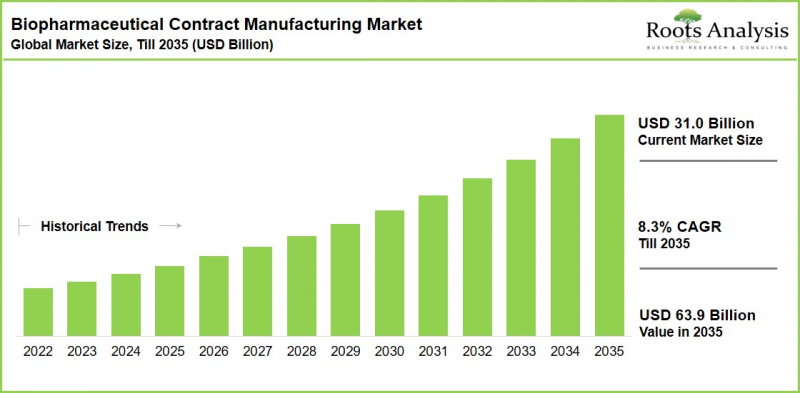
Roots Analysis의 조사에 따르면 세계의 바이오의약품 수탁제조 시장 규모는 2026년 310억 달러에서 2035년에는 639억 달러로 성장하며, 예측 기간 전체로 CAGR 8.3%를 기록할 것으로 추정되고 있습니다.
바이오의약품 수탁제조 시장 : 성장 및 동향
만성질환 및 복합 질환으로 인한 전 세계적 부담 증가에 더해, 모노클로널 항체, 세포·유전자 치료, 핵산계 의약품 등 첨단 치료법의 도입 확대에 따라 바이오의약품에 대한 수요는 지속적으로 증가하고 있습니다. 암, 자가면역질환, 감염증, 희귀질환 등의 적응증 분야에서 의약품 개발 파이프라인이 확대되는 가운데, 제약사들은 가속화되는 생산 수요에 대응하기 위해 제조 업무를 외부 전문 업체에 위탁하는 경향이 강해지고 있습니다.
분석 시험, 독성 시험, 충전·포장 공정은 여전히 가장 빈번하게 외부에 위탁되는 서비스로 꼽히지만, 다운스트림 공정 개발 서비스에 대한 수요도 꾸준히 증가하고 있습니다. 확대되는 사업 기회를 활용하기 위해 중소규모 서비스 제공업체들은 자사의 역량을 확충하고, 대기업과의 전략적 제휴를 맺어 보다 포괄적인 엔드투엔드 솔루션을 제공할 수 있도록 하고 있습니다.
여러 요인이 경쟁 구도를 적극적으로 재편하고 있습니다. 연속 바이오 공정 및 고강도 바이오 공정은 신규 기술 단계에서 업계 표준으로 급속히 전환되고 있습니다. 이는 제조사들이 생산성 향상과 단위당 제조 비용 절감을 통해 가격 압박을 상쇄하려 하기 때문입니다. 동시에, 의약품 수입에 대한 관세 리스크 등 지정학적·무역적 동향을 반영하여 여러 CDMO가 미국내 생산 능력을 확장하거나 신규로 구축하는 움직임을 보이고 있습니다. 이를 통해 국경을 넘는 공급망에 대한 의존도를 낮추려 하고 있습니다.
바이오의약품 업계 전반에서 아웃소싱이 점점 더 널리 받아들여지고 전략적으로 선호되는 비즈니스 모델로 자리 잡음에 따라 수탁제조 시장은 지속적이고 장기적인 성장이 예상됩니다.
성장의 원동력: 시장 확대를 지원하는 요인
바이오의약품 수탁제조 시장은 복잡한 바이오의약품 및 맞춤형 의료에 대한 수요 증가, 그리고 사내에서 확보하기 어려운 전문적인 기술 노하우에 대한 필요성에 의해 주도되고 있습니다. 위탁 제조업체는 바이오기술 기업 및 제약 기업에 일회용 바이오리액터, 연속 관류 시스템, AI를 활용한 공정 자동화 등 첨단 바이오 공정 기술을 제공합니다. 이를 통해 위탁 기업은 대규모 초기 설비 투자를 하지 않고도 첨단인 제조 기술을 활용할 수 있습니다.
또한 CDMO가 제공하는 운영상의 유연성 덕분에 바이오의약품 기업은 수요 변동에 따라 생산 규모를 확대·축소할 수 있을 뿐만 아니라, 자체 제조에 수반되는 전반적인 비용 부담을 줄일 수 있습니다. 이러한 비용 효율화를 통해 의뢰 기업은 연구개발에 투입할 자금을 확보할 수 있으며, 아웃소싱 모델의 장기적인 전략적 가치를 높이는 동시에 예측 기간 중 시장 전체의 성장 궤도를 강화하게 됩니다.
바이오의약품 수탁제조 시장의 세분화
시장 규모 및 시장 기회 분석은 다음 구분에 따라 세분화되어 있습니다.
제공되는 서비스별
- 원료의약품(API) 제조
- 제제(FDF) 제조
제조되는 바이오의약품별
- 항체
- 단백질/펩티드
- 백신
- 세포 치료
- 유전자 치료
- 기타
사용되는 발현 시스템별
- 포유류 발현 시스템
- 미생물 발현 시스템
- 기타
제조 규모별
- 전임상/임상 규모
- 상업적 규모
기업 규모별
- 소규모 기업
- 중규모 기업
- 대기업 및 초대기업
치료 분야별
- 암 질환
- 심혈관계 질환
- 대사성 질환
- 감염병
- 자가면역 질환
- 신경계 질환
- 유전성 질환
- 기타 질환
지역별
- 북미
- 미국
- 캐나다
- 유럽
- 독일
- 영국
- 프랑스
- 이탈리아
- 스페인
- 기타 유럽
- 아시아태평양
- 중국
- 일본
- 한국
- 호주
바이오의약품 수탁제조 시장 : 주요 부문
원료의약품(API)이 시장을 주도
Roots Analysis의 시장 평가 및 상세한 임상 파이프라인 분석에 따르면 원료의약품(API) 제조 부문은 현재 전체 시장 매출의 약 60%를 차지하고 있습니다. 이러한 가장 큰 점유율은 바이오의약품 개발 기업 사이에서 상류 공정 제조를 외부에 위탁하는 경향이 강해지고 있음을 반영합니다. 설비 투자 부담이 경감되고, 최첨단 바이오 공정 기술에 대한 접근이 신속해지며, 전문 인력을 보다 효율적으로 활용할 수 있게 되는 등의 요인이 맞물려, 예측 기간 중 이 부문의 주도적 위상은 계속해서 공고해질 것입니다.
제조되는 바이오의약품 유형별로는 항체가 계속해서 주류를 차지하고 있습니다.
이 회사의 시장 분석 및 상세한 임상 파이프라인 분석에 따르면 항체는 전체 시장 매출의 약 60%를 차지하고 있습니다. 이러한 성장은 암, 자가면역 질환, 감염증, 그리고 점점 다양해지는 희귀 질환의 치료에서 항체가 중심적인 역할을 수행하고 있다는 점에 기인합니다. 앞으로 동종 이식 접근법과 자동화의 발전으로 현재의 확장성 제약이 해소됨에 따라 세포 치료 부문은 비교적 높은 연평균 성장률(CAGR)을 기록할 전망입니다.
포유류 발현 시스템이 시장을 독점
이 보고서에 따르면 포유류 발현 시스템은 전체 시장의 80% 이상의 점유율을 차지하고 있습니다. 이는 인간의 단백질 접힘 및 번역 후 변형 과정을 충실하게 재현할 수 있으며, 복잡한 바이오의약품에서 더 높은 제품 품질, 수율 및 확장성을 실현할 수 있기 때문입니다. 이 부문은 예측 기간 중 약 8.6%의 CAGR로 성장할 것으로 예상되며, 다른 여러 플랫폼 유형을 능가하는 성장률을 보일 것으로 전망됩니다.
이 보고서는 전 세계 바이오의약품 수탁제조 시장을 조사하여 시장 개요, 배경, 시장 영향 요인 분석, 시장 규모 추이 및 전망, 각종 분류·지역/주요 국가별 상세 분석, 경쟁 구도, 주요 기업 개요 등을 종합하고 있습니다.
목차
제1장 서문
제2장 조사 방법
제3장 시장 역학
제4장 거시경제 지표
제5장 개요
제6장 서론
제7장 시장 구도
제8장 지역별 능력 분석
제9장 기업 개요
제10장 주요 바이오의약품 분야
제11장 사례 연구 : 바이오시밀러의 아웃소싱
제12장 사례 연구 : 저분자 의약품과 고분자 의약품/치료법의 비교
제13장 사례 연구 : 자사 제조
제14장 제조 대 구입 의사결정 프레임워크
제15장 제휴·협력 관계
제16장 자금조달과 투자 분석
제17장 M&A
제18장 최근 확장
제19장 대형 제약회사 구상
제20장 생산능력 분석
제21장 수요 분석
제22장 총소유 비용
제23장 SWOT 분석
제24장 세계의 바이오의약품 수탁제조 시장
제25장 바이오의약품 수탁제조 시장 : 제공 서비스별
제26장 바이오의약품 수탁제조 시장 : 제조 바이오의약품별
제27장 바이오의약품 수탁제조 시장 : 사용 발현계별
제28장 바이오의약품 수탁제조 시장 : 사업 규모별
제29장 바이오의약품 수탁제조 시장 : 기업 규모별
제30장 바이오의약품 수탁제조 시장 : 치료 영역별
제31장 바이오의약품 수탁제조 시장 : 주요 지역별
제32장 바이오의약품 수탁제조 시장 : 북미
제33장 바이오의약품 수탁제조 시장 : 유럽
제34장 바이오의약품 수탁제조 시장 : 아시아태평양
제35장 바이오의약품 수탁제조 시장 : 세계의 기타 지역
제36장 사례 연구 : 가상 제약 기업
제37장 바이오의약품 CMO 시장의 향후 전망
제38장 결론
제39장 이그제큐티브 인사이트
제40장 부록 I : 표형식 데이터
제41장 부록 II : 기업 및 조직 리스트
KSABIOPHARMACEUTICAL CONTRACT MANUFACTURING MARKET: OVERVIEW
As per Roots Analysis, the global biopharmaceutical contract manufacturing market is estimated to grow from USD 31.0 billion in 2026 to USD 63.9 billion by 2035, registering a CAGR of 8.3% across the forecast period.
Biopharmaceutical Contract Manufacturing Market: Growth and Trends
The growing global burden of chronic and complex diseases, along with the increasing adoption of advanced therapies such as monoclonal antibodies, cell and gene therapies, and nucleic acid-based drugs, continues to drive demand for biologics. As drug development pipelines expand across oncology, autoimmune, infectious, and rare-disease indications, pharmaceutical companies are increasingly outsourcing manufacturing operations to third-party specialists to meet accelerating production needs.
Analytical testing, toxicity testing, and fill / finish operations remain among the most frequently outsourced services, while demand for downstream process development services is also rising steadily. To leverage the expanding opportunity, smaller and mid-sized service providers are broadening their capabilities and forming strategic partnerships with larger players, enabling them to offer more comprehensive, end-to-end solutions.
Several forces are actively reshaping the competitive landscape. Continuous and intensified bioprocessing is rapidly moving from an emerging concept to standard industry practice, as manufacturers seek to offset pricing pressure through higher productivity and lower per-unit production costs. In parallel, geopolitical and trade dynamics including tariff exposure on pharmaceutical imports are prompting several CDMOs to expand or establish manufacturing capacity directly within the United States, reducing dependence on cross-border supply chains.
As outsourcing becomes an increasingly accepted and strategically favored business model across the biopharmaceutical industry, the contract manufacturing market is positioned for sustained, long-term growth.
Growth Drivers: Factors Fueling Market Expansion
The biopharmaceutical contract manufacturing market is being propelled by the growing demand for complex biologics and personalized medicine, and the need for specialized technical expertise that is often unavailable in-house. Contract manufacturers provide biotech and pharma companies with direct access to advanced bioprocessing technologies, including single-use bioreactors, continuous perfusion systems, and AI-enabled process automation, without requiring substantial upfront capital investments.
Additionally, the operational flexibility offered by CDMOs allows biopharmaceutical companies to scale production up or down in response to shifting demand, while reducing the overall cost burden associated with in-house manufacturing. This cost efficiency frees up capital that sponsors can redirect toward research and development, reinforcing the long-term strategic value of the outsourcing model and strengthening the growth trajectory of the broader market during the forecast period.
Market Challenges: Critical Barriers Hindering Progress
Despite favourable growth prospects, the market faces several challenges that could impede market growth. Some of the challenges include high capital requirements for specialized bioprocessing infrastructure, stringent and evolving regulatory expectations across geographies. Further, the technical complexity of scaling up novel modalities such as cell and gene therapies all add cost and time to manufacturing programs. Furthermore, escalating trade tensions and tariff exposure on pharmaceutical imports are compelling several manufacturers to re-evaluate their geographic footprint, creating near-term uncertainty around capacity planning and cost structures. Addressing these regulatory, technical, and geopolitical challenges will be critical for stakeholders seeking to capture the full commercial opportunity within this space.
Biopharmaceutical Contract Manufacturing Market: Key Insights
The report delves into the current state of the biopharmaceutical contract manufacturing market and identifies potential growth opportunities for distribution partners, channel intermediaries, and service integrators. Some key findings include:
- Biopharmaceutical CDMOs predominantly engage with pharmaceutical companies through direct commercial relationships and long-term supply agreements. This agreement limits the visibility that traditional distributors have into this segment, despite distributors' established reach into cold-chain logistics and specialty biologics handling.
- Specialty logistics and cold-chain service providers are emerging as critical enablers of biologic supply chains, given the temperature-sensitive nature of antibodies, cell therapies, and gene therapies that dominate CDMO output.
- Distributors and logistics partners seeking entry into this space must demonstrate validated cold-chain infrastructure and GMP-aligned handling protocols, reflecting the stringent quality requirements attached to biologic drug substances and drug products.
- The rapid expansion of commercial-scale manufacturing facilities across China and South Korea is increasing demand for regional distribution and supply chain partners capable of navigating local regulatory requirements and ensuring efficient logistics.
- Rising onshoring activity in the US, driven in part by tariff exposure on imported pharmaceutical products, is prompting CDMOs to reassess supplier and distribution networks closer to end markets, favouring partners with domestic infrastructure.
- Consolidation among large CDMOs through mergers and acquisitions is raising barriers to entry for smaller regional players, while creating openings for niche distributors and logistics providers with modality-specific or geography-specific expertise.
- Distributors and channel partners increasingly compete on value-added services including regulatory documentation support, temperature-controlled transport, and inventory management for high-value biologics rather than on logistics cost alone.
- The growing pipeline of ADCs, cell and gene therapies, and GLP-1-class biologics is expected to sustain elevated demand for specialized outsourcing and distribution infrastructure.
Recent Deal Activity Signalling Investor Momentum
- May 2026: Bristol Myers Squibb entered a licensing agreement with Jiangsu Hengrui Pharmaceuticals, gaining global rights to several early-stage oncology, hematology, and immunology programs outside Greater China, while Hengrui secured reciprocal rights to select BMS programs within the region.
- March 2026: Servier announced plans to acquire Day One Biopharmaceuticals, strengthening its rare oncology portfolio.
- January 2026: Mendra raised USD 82 million in Series A funding to build a portfolio of rare-disease assets.
- January 2026: Samsung Biologics agreed to acquire GSK's Human Genome Sciences facility in Rockville, Maryland, establishing a direct US manufacturing footprint.
- October 2025: Novartis (Switzerland) completed the acquisition of Tourmaline Bio (US), reflecting continued cross-border consolidation in the biologics space.
Collectively, these transactions underscore sustained investor and strategic-acquirer confidence in biologics manufacturing capacity, specifically onshoring and rare-disease / oncology pipelines themes directly relevant to distributors and investors evaluating exposure to this market.
Biopharmaceutical Contract Manufacturing Market Segments
The market sizing and opportunity analysis has been segmented across the following parameters:
By Type of Service Offered
- Drug Substance (API) Manufacturing
- Drug Product (FDF) Manufacturing
By Type of Biologic Manufactured
- Antibodies
- Proteins / Peptides
- Vaccines
- Cell Therapies
- Gene Therapies
- Other Biologics
By Type of Expression System Used
- Mammalian Expression Systems
- Microbial Expression Systems
- Other Expression Systems
By Scale of Operation
- Preclinical / Clinical Scale
- Commercial Scale
By Company Size
- Small Companies
- Mid-Sized Companies
- Large and Very Large Companies
By Therapeutic Area
- Oncological Disorders
- Cardiovascular Disorders
- Metabolic Disorders
- Infectious Diseases
- Autoimmune Disorders
- Neurological Disorders
- Genetic Disorders
- Other Disorders
By Geographical Regions
- North America
- US
- Canada
- Europe
- Germany
- UK
- France
- Italy
- Spain
- Rest of Europe
- Asia-Pacific
- China
- Japan
- South Korea
- Australia
Biopharmaceutical Contract Manufacturing Market: Key Segments
Drug Substance (API) Leads the Market
Based on Roots Analysis market assessment and detailed clinical pipeline analysis, The drug substance (API) manufacturing segment currently secures approximately 60% of overall market revenue. This highest share reflects the growing preference among biologic developers to outsource upstream production. Lower capital investment requirements, faster access to cutting-edge bioprocessing technology, and more efficient utilization of specialized resources continue to reinforce this segment's leading position through the forecast period.
Antibodies Continue to Dominate the Types of Biologics Manufactured
According to our market analysis and detailed clinical pipeline analysis, antibodies account for around 60% of overall market revenue. This growth is underpinned by their central role in treating cancer, autoimmune disorders, infectious diseases, and a growing range of rare diseases. Looking ahead, cell therapies segment is likely to register a comparatively higher CAGR, as allogeneic approaches and increased automation help address current scalability constraints.
Mammalian Expression Systems Dominate the Market
Based on the Roots Analysis market report, mammalian expression systems hold over 80% of the overall market share, owing to their ability to closely replicate human protein-folding and post-translational modification processes, resulting in higher product quality, yield, and scalability for complex biologics. This segment is projected to grow at a CAGR of approximately 8.6% over the forecast period, outpacing several other platform types.
Commercial Scale Operations Lead the Market
Based on the Roots Analysis market report, commercial-scale manufacturing holds close to 90% of the overall market, reflecting the large volume of approved biologics currently in production. Preclinical and clinical-scale outsourcing, while smaller in current share, is expected to expand at a comparatively faster pace as a growing wave of biopharmaceuticals advances through the development pipeline toward eventual market approval.
Asia-Pacific Dominates the Market and Registers Higher CAGR
Asia-Pacific currently holds close to 40% of global market revenue share. This highest share is supported by considerably lower labor and raw material costs and comparatively lower facility construction costs relative to Western markets. China leads the region driven by the consistent support of substantial government investment through initiatives such as Healthy China 2030, alongside deep expertise in monoclonal antibody and biosimilar production.
Large and Very Large Companies Hold the Highest Market Share
Companies with large and very large operational scale currently account for nearly 60% of overall market revenue. This highest share reflects their established infrastructure, deep regulatory expertise, and long-standing sponsor relationships. Smaller and mid-sized players continue to expand their footprint through partnerships and targeted capability investments in order to compete for a growing share of outsourced work.
Example Players in Biopharmaceutical Contract Manufacturing Market
- AbbVie
- Agilent Technologies
- Boehringer Ingelheim
- Catalent
- Cipla
- Eurofins
- Fresenius Kabi
- Lonza
- Novartis
- Sandoz
- WACKER
- WuXi Biologics
A complete list of companies captured is available in the full report.
Expert Interview and Industry Insights
The opinions and insights presented in this study were shaped by discussions with multiple stakeholders across the value chain. The research report features detailed transcripts of interviews held with the following industry participants:
- Chief Executive Officer, Mid-Sized Company, Scotland
- Chief Executive Officer and Co-Founder, Small Company, Slovenia
- Former Chief Technical Officer, Large Company, US
- President, Mid-Sized Company, China
- Former Senior Director of Global Strategic Marketing, Large Company, US
- Former Senior Director of Commercial Strategy and Market Insights, Large Company, US
- Former Global Head of Sales and Marketing and Head of Business Development, Large Company, US
- Business Development Manager, Small Company, Spain
- Manager, Marketing and Sales, Mid-Sized Company, Germany
BIOPHARMACEUTICAL CONTRACT MANUFACTURING MARKET: RESEARCH COVERAGE
- Market Sizing and Opportunity Analysis: An in-depth analysis of the market focusing on key segments, including type of service offered, type of biologic manufactured, type of expression system used, scale of operation, company size, therapeutic area, and geographical regions.
- CDMO Landscape: A detailed assessment of active contract manufacturers, featuring information on year of establishment, company size, location of headquarters, and range of services offered.
- Company Profiles: In-depth profiles of prominent players engaged in biopharmaceutical contract manufacturing, covering year of establishment, headquarters location, company size, service portfolio, and key recent initiatives.
- Case Study I (Outsourcing of Biosimilars): A focused assessment of the biosimilars manufacturing landscape, covering development stages, regulatory requirements, outsourcing drivers, market impact, contract manufacturing service providers, and the key challenges associated with outsourcing biosimilar production.
- Case Study II (Comparison of Small and Large Molecule Drugs / Therapies): A concise comparison of small and large molecule drugs, highlighting their key characteristics, manufacturing processes, specifications, and associated manufacturing challenges.
- Case Study III (In-House Manufacturing): A concise assessment of in-house manufacturing and outsourcing strategies for biologics, covering their key benefits, risks, outsourcing trends, and manufacturing approaches to support informed make-versus-buy decisions.
- Make versus Buy Decision-Making Framework: A concise framework that evaluates in-house manufacturing versus outsourcing for biopharmaceutical production, using predefined assumptions, key parameters, and scenario-based analyses to support strategic manufacturing decisions.
- Partnerships and Collaborations: An analysis of partnerships and collaborations that have been inked by biopharmaceutical excipient manufacturers, based on several relevant parameters, such as such as year of partnership, type of partnership, type of excipient, and most active players.
- Funding and Investments Analysis: A detailed analysis of the funding and investments made in this domain, based on several relevant parameters, such as year of funding, type of funding, amount invested, purpose of funding, geography, most active players and leading investors.
- Recent Expansions Analysis: A comprehensive assessment of recent expansion initiatives undertaken by biopharmaceutical contract manufacturers. The chapter analyzes expansion trends by type, quarter, investment, and facility location, while identifying the most active companies based on the number of expansions and capital invested, providing insights into evolving manufacturing capacity and strategic growth priorities.
- Big Pharma Initiatives: An analysis of initiatives undertaken by leading pharmaceutical companies in the biopharmaceutical contract manufacturing market, based on several relevant parameters, such as year of initiative, type of initiative, quarter, partnership type, acquisition type, mergers and acquisitions, expansions, and the most active big pharma players (based on the number of initiatives, partnerships, mergers and acquisitions, and expansions).
- Capacity Analysis: A comprehensive assessment of the global installed capacity for biopharmaceutical contract manufacturing across company sizes, expression systems, and major geographic regions, including North America, Europe, Asia-Pacific, and the Rest of the World, providing insights into regional manufacturing capabilities and capacity distribution.
- Demand Analysis: A comprehensive evaluation of demand across different manufacturing scales and examines the increasing requirements for emerging biologics, including antibody-drug conjugates (ADCs) and cell therapies, to identify future outsourcing and manufacturing opportunities.
- Total Cost of Ownership Analysis: A comprehensive evaluation of the total cost of ownership (TCO) for biopharmaceutical contract manufacturing organizations over a 20-year period. Based on predefined assumptions, key parameters, and a sample dataset, the chapter analyzes capital expenditure (CAPEX) and operational expenditure (OPEX) for mid-sized and large/very large manufacturing facilities, providing stakeholders with insights into long-term investment requirements and cost optimization strategies.
- SWOT Analysis: A strategic assessment of the biopharmaceutical contract manufacturing market, evaluating its key strengths, weaknesses, opportunities, and threats. The chapter compares the relative impact of each SWOT factor and provides actionable insights into the market's competitive position, growth potential, and strategic challenges.
Key Questions Answered in this Report
- Which are the leading companies in the biopharmaceutical contract manufacturing market?
- Which region dominates the market, and which is growing the fastest?
- What are the key trends observed in this market?
- What factors are likely to influence the evolution of this market?
- What are the primary challenges faced by biopharmaceutical CDMOs?
- What is the current and future market size?
- What is the CAGR of this market through 2035?
- How is current and future market opportunity distributed across key segments?
- What opportunities exist for distributors and logistics partners entering this space?
Reasons to Buy this Report
This report is designed to give distributors, channel partners, and investors a decisive analytical edge in a fast-consolidating market. Its core differentiators include:
- Top-Down and Bottom-Up Triangulated Forecasting: Market estimates are built using a hybrid methodology that cross-validates top-down macro assessments against bottom-up, company-level capacity and demand data, minimizing forecast bias.
- Distribution and Channel-Partner Lens: Unlike conventional CDMO capability reports, this study explicitly maps the cold-chain, logistics, and value-added service opportunities available to distribution partners entering the biologics supply chain.
- 500+ Pages Across 35 Chapters: Comprehensive coverage spanning market sizing, competitive benchmarking, patent landscape, clinical trial activity, funding and M&A analysis, and regulatory / reimbursement mapping across 25+ countries.
- Primary Research-Backed Insights: Findings are validated through direct interviews with CEOs, CTOs, and commercial leaders across small, mid-sized, and large CDMOs, ensuring insights reflect real operating conditions rather than desk research alone.
- Actionable Segmentation: Seven-parameter segmentation (service type, biologic type, expression system, scale, company size, therapeutic area, geography) enables precise opportunity sizing for any go-to-market or investment thesis.
Additional Benefits
- Complementary PPT Insights Pack
- Complementary Excel Data Packs for all Analytical Modules in the Report
- 15% Free Content Customization
- Detailed Report Walkthrough Session with Research Team
- Free Updated report if the report is 6-12 months old or older
TABLE OF CONTENTS
1. PREFACE
- 1.1. Introduction
- 1.2. Market Share Insights
- 1.3. Key Market Insights
- 1.4. Report Coverage
- 1.5. Key Questions Answered
- 1.6. Chapter Outlines
2. RESEARCH METHODOLOGY
- 2.1. Chapter Overview
- 2.2. Research Assumptions
- 2.2.1. Market Landscape and Market Trends
- 2.2.2. Market Forecast and Opportunity Analysis
- 2.2.3. Comparative Analysis
- 2.3. Database Building
- 2.3.1. Data Collection
- 2.3.2. Data Validation
- 2.3.3. Data Analysis
- 2.4. Project Methodology
- 2.4.1. Secondary Research
- 2.4.1.1. Annual Reports
- 2.4.1.2. Academic Research Papers
- 2.4.1.3. Company Websites
- 2.4.1.4. Investor Presentations
- 2.4.1.5. Regulatory Filings
- 2.4.1.6. White Papers
- 2.4.1.7. Industry Publications
- 2.4.1.8. Conferences and Seminars
- 2.4.1.9. Government Portals
- 2.4.1.10. Media and Press Releases
- 2.4.1.11. Newsletters
- 2.4.1.12. Industry Databases
- 2.4.1.13. Roots Proprietary Databases
- 2.4.1.14. Paid Databases and Sources
- 2.4.1.15. Social Media Portals
- 2.4.1.16. Other Secondary Sources
- 2.4.2. Primary Research
- 2.4.2.1. Types of Primary Research
- 2.4.2.1.1. Qualitative Research
- 2.4.2.1.2. Quantitative Research
- 2.4.2.1.3. Hybrid Approach
- 2.4.2.2. Advantages of Primary Research
- 2.4.2.3. Techniques for Primary Research
- 2.4.2.3.1. Interviews
- 2.4.2.3.2. Surveys
- 2.4.2.3.3. Focus Groups
- 2.4.2.3.4. Observational Research
- 2.4.2.3.5. Social Media Interactions
- 2.4.2.4. Key Opinion Leaders Considered in Primary Research
- 2.4.2.4.1. Company Executives (CXOs)
- 2.4.2.4.2. Board of Directors
- 2.4.2.4.3. Company Presidents and Vice Presidents
- 2.4.2.4.4. Research and Development Heads
- 2.4.2.4.5. Technical Experts
- 2.4.2.4.6. Subject Matter Experts
- 2.4.2.4.7. Scientists
- 2.4.2.4.8. Doctors and Other Healthcare Providers
- 2.4.2.5. Ethics and Integrity
- 2.4.2.5.1. Research Ethics
- 2.4.2.5.2. Data Integrity
- 2.4.2.1. Types of Primary Research
- 2.4.3. Analytical Tools and Databases
- 2.4.1. Secondary Research
- 2.5. Robust Quality Control
3. MARKET DYNAMICS
- 3.1. Chapter Overview
- 3.2. Forecast Methodology
- 3.2.1. Top-down Approach
- 3.2.2. Bottom-up Approach
- 3.2.3. Hybrid Approach
- 3.3. Market Assessment Framework
- 3.3.1. Total Addressable Market (TAM)
- 3.3.2. Serviceable Addressable Market (SAM)
- 3.3.3. Serviceable Obtainable Market (SOM)
- 3.3.4. Currently Acquired Market (CAM)
- 3.4. Forecasting Tools and Techniques
- 3.4.1. Qualitative Forecasting
- 3.4.2. Correlation
- 3.4.3. Regression
- 3.4.4. Extrapolation
- 3.4.5. Convergence
- 3.4.6. Sensitivity Analysis
- 3.4.7. Scenario Planning
- 3.4.8. Data Visualization
- 3.4.9. Time Series Analysis
- 3.4.10. Forecast Error Analysis
- 3.5. Key Considerations
- 3.5.1. Demographics
- 3.5.2. Government Regulations
- 3.5.3. Reimbursement Scenarios
- 3.5.4. Market Access
- 3.5.5. Supply Chain
- 3.5.6. Industry Consolidation
- 3.5.7. Pandemic / Unforeseen Disruptions Impact
- 3.6. Limitations
4. MACRO-ECONOMIC INDICATORS
- 4.1. Chapter Overview
- 4.2. Market Dynamics
- 4.2.1. Time Period
- 4.2.1.1. Historical Trends
- 4.2.1.2. Current and Forecasted Estimates
- 4.2.2. Currency Coverage
- 4.2.2.1. Major Currencies Affecting the Market
- 4.2.2.2. Factors Affecting Currency Fluctuations on the Industry
- 4.2.2.3. Impact of Currency Fluctuations on the Industry
- 4.2.3. Foreign Currency Exchange Rate
- 4.2.3.1. Impact of Foreign Exchange Rate Volatility on the Market
- 4.2.3.2. Strategies for Mitigating Foreign Exchange Risk
- 4.2.4. Recession
- 4.2.4.1. Assessment of Current Economic Conditions and Potential Impact on the Market
- 4.2.4.2. Historical Analysis of Past Recessions and Lessons Learnt
- 4.2.5. Inflation
- 4.2.5.1. Measurement and Analysis of Inflationary Pressures in the Economy
- 4.2.5.2. Potential Impact of Inflation on the Market Evolution
- 4.2.6. Interest Rates
- 4.2.6.1. Interest Rates and Their Impact on the Market
- 4.2.6.2. Strategies for Managing Interest Rate Risk
- 4.2.7. Commodity Flow Analysis
- 4.2.7.1. Type of Commodity
- 4.2.7.2. Origins and Destinations
- 4.2.7.3. Values and Weights
- 4.2.7.4. Modes of Transportation
- 4.2.8. Global Trade Dynamics
- 4.2.8.1. Import Scenario
- 4.2.8.2. Export Scenario
- 4.2.8.3. Trade Policies
- 4.2.8.4. Strategies for Mitigating the Risks Associated with Trade Barriers
- 4.2.8.5. Impact of Trade Barriers on the Market
- 4.2.9. War Impact Analysis
- 4.2.9.1. Russian-Ukraine War
- 4.2.9.2. Israel-Hamas War
- 4.2.10. COVID Impact / Related Factors
- 4.2.10.1. Global Economic Impact
- 4.2.10.2. Industry-specific Impact
- 4.2.10.3. Government Response and Stimulus Measures
- 4.2.10.4. Future Outlook and Adaptation Strategies
- 4.2.11. Other Indicators
- 4.2.11.1. Fiscal Policy
- 4.2.11.2. Consumer Spending
- 4.2.11.3. Gross Domestic Product
- 4.2.11.4. Employment
- 4.2.11.5. Taxes
- 4.2.11.6. Stock Market Performance
- 4.2.11.7. Cross Border Dynamics
- 4.2.1. Time Period
- 4.3. Conclusion
5. EXECUTIVE SUMMARY
- 5.1. Executive Summary: Market Landscape
- 5.2. Executive Summary: Market Trends
- 5.3. Executive Summary: Market Forecast and Opportunity Analysis
6. INTRODUCTION
- 6.1. Chapter Overview
- 6.2. Overview of Biopharmaceuticals
- 6.3. Expression Systems for Biopharmaceuticals
- 6.3.1. Insect Expression Systems
- 6.3.2. Mammalian Expression Systems
- 6.3.3. Microbial Expression Systems
- 6.3.3.1. Bacterial Expression Systems
- 6.3.3.2. Fungal Expression Systems
- 6.3.3.3. Yeast Expression Systems
- 6.3.4. Plant Expression Systems
- 6.3.5. Mammalian versus Microbial Expression Systems
- 6.4. Manufacturing Process of Biopharmaceuticals
- 6.4.1. Upstream Processing
- 6.4.2. Fermentation
- 6.4.3. Downstream Processing
- 6.5. Overview of Contract Manufacturing
- 6.6. Need for Outsourcing Biopharmaceutical Manufacturing Operations
- 6.6.1. Commonly Outsourced Manufacturing Operations for Biopharmaceuticals
- 6.6.2. Advantages of Outsourcing Biopharmaceutical Manufacturing Operations
- 6.6.3. Risks and Challenges Associated with Outsourcing Biopharmaceutical Manufacturing Operations
- 6.7. Key Considerations While Selecting a Contract Manufacturing Partner
- 6.8. Future Perspectives
7. MARKET LANDSCAPE
- 7.1. Chapter Overview
- 7.2. Biopharmaceutical Contract Manufacturers: Overall Market Landscape
- 7.2.1. Analysis by Year of Establishment
- 7.2.2. Analysis by Company Size
- 7.2.3. Analysis by Location of Headquarters
- 7.2.4. Analysis by Company Size and Location of Headquarters
- 7.3. Biopharmaceutical Contract Manufacturers: Analysis of Key Players
- 7.3.1. Analysis by Compliance
- 7.3.2. Analysis by Type of Service Offered
- 7.3.3. Analysis by Type of Biologic Manufactured
- 7.3.4. Analysis by Scale of Operation
- 7.3.5. Analysis by Type of Expression System Used
- 7.3.6. Analysis by Type of Primary Container Offered
8. REGIONAL CAPABILITY ANALYSIS
- 8.1. Chapter Overview
- 8.2. Key Assumptions and Parameters
- 8.3. Overview of Biopharmaceutical Contract Manufacturing Facilities
- 8.3.1. Analysis by Type of Service Offered
- 8.3.2. Analysis by Scale of Operation
- 8.4. Regional Capability Analysis: Biopharmaceutical Contract Manufacturing Facilities in North America
- 8.5. Regional Capability Analysis: Biopharmaceutical Contract Manufacturing Facilities in Europe
- 8.6. Regional Capability Analysis: Biopharmaceutical Contract Manufacturing Facilities in Asia-Pacific
- 8.7. Regional Capability Analysis: Biopharmaceutical Contract Manufacturing Facilities in Rest of the World
9. COMPANY PROFILES
- 9.1. Chapter Overview
- 9.2. Biopharmaceutical Contract Manufacturers headquartered in North America
- 9.2.1. AbbVie
- 9.2.1.1. Company Overview
- 9.2.1.2. Service Portfolio
- 9.2.2. Agilent Technologies
- 9.2.3. Catalent
- 9.2.1. AbbVie
- 9.3. Biopharmaceutical Contract Manufacturers headquartered in Europe
- 9.3.1. Boehringer Ingelheim
- 9.3.1.1. Company Overview
- 9.3.1.2. Service Portfolio
- 9.3.2. Eurofins
- 9.3.3. Fresenius Kabi
- 9.3.4. Lonza
- 9.3.5. Novartis
- 9.3.6. Sandoz
- 9.3.7. WACKER
- 9.3.1. Boehringer Ingelheim
- 9.4. Biopharmaceutical Contract Manufacturers headquartered in Asia-Pacific
- 9.4.1. Cipla
- 9.4.1.1. Company Overview
- 9.4.1.2. Service Portfolio
- 9.4.2. Wuxi Biologics
- 9.4.1. Cipla
10. PROMINENT BIOPHARMACEUTICAL SECTORS
- 10.1. Chapter Overview
- 10.2. Bispecific Antibodies
- 10.2.1. Approved and Clinical Bispecific Antibody Therapeutics: Overall Market Landscape
- 10.2.2. Bispecific Antibodies Market: Pipeline Analysis
- 10.2.2.1. Analysis by Phase of Development
- 10.2.2.2. Analysis by Target Indication
- 10.2.3. Preclinical Bispecific Antibody Therapeutics: Overall Market Landscape
- 10.2.3.1. Analysis by Stage of Development
- 10.2.3.2. Key Considerations for Manufacturing and Associated Challenges
- 10.2.4. Role of CMOs in Offering Services for Bispecific Antibodies
- 10.3. Antibody Drug Conjugates (ADCs)
- 10.3.1. Components of ADCs
- 10.3.1.1. Antibody
- 10.3.1.2. Cytotoxin
- 10.3.1.3. Linker
- 10.3.2. Antibody Drug Conjugates (ADCs): Pipeline Analysis
- 10.3.2.1. Analysis by Stage of Development
- 10.3.2.2. Analysis by Target Indication
- 10.3.2.3. Most Active Player: Analysis by Number of Therapies
- 10.3.3. Antibody Drug Conjugate Developers
- 10.3.4. Manufacturing Process
- 10.3.5. Technical Challenges Related to Antibody Drug Conjugates Manufacturing
- 10.3.6. Role of CMOs in Offering Services for ADCs
- 10.3.1. Components of ADCs
- 10.4. Cell Therapies
- 10.4.1. Cell Therapies: Overall Market Landscape
- 10.4.2. Overview of Cell Therapy Manufacturing
- 10.4.3. Cell Therapy Manufacturing Models
- 10.4.3.1. Centralized Manufacturing
- 10.4.3.2. Decentralized Manufacturing
- 10.4.4. Scalability of Cell Therapy Manufacturing Processes
- 10.4.4.1. Scale-up
- 10.4.4.2. Scale-out
- 10.4.5. Types of Cell Therapy Manufacturers
- 10.4.6. Key Challenges for Manufacturing Cell Therapies
- 10.4.7. Key Factors Influencing Cell Therapy Manufacturing
- 10.4.7.1. Cell Characterization
- 10.4.7.2. Cost of Goods
- 10.4.8. Automation of Cell Therapy Manufacturing
- 10.4.9. Cell Therapies: Pipeline Analysis
- 10.4.9.1. Analysis by Type of Cell Manufactured
- 10.4.9.2. Analysis by Type of Immune Cell Offered
- 10.5. Gene Therapies
- 10.5.1. Gene Therapies: Pipeline Analysis
- 10.5.1.1. Analysis by Stage of Development
- 10.5.1.2. Analysis by Type of Vector Used
- 10.5.1.3. Analysis by Therapeutic Area
- 10.5.2. Role of CMOs in Offering Services for Cell / Gene Therapies
- 10.5.1. Gene Therapies: Pipeline Analysis
- 10.6. Viral Vectors
- 10.6.1. Viral Vectors: Pipeline Analysis
- 10.6.1.1. Analysis by Location of Vector Manufacturing Facility
- 10.6.1.2. Analysis by Type of Viral Vector Manufactured
- 10.6.1. Viral Vectors: Pipeline Analysis
- 10.7. Plasmid DNA
- 10.7.1. Plasmid DNA: Pipeline Analysis
- 10.7.1.1. Analysis by Location of Manufacturing Facilities
- 10.7.2. Role of CMOs in Offering Services for Plasmid DNA / Viral Vectors
- 10.7.1. Plasmid DNA: Pipeline Analysis
11. CASE STUDY: OUTSOURCING OF BIOSIMILARS
- 11.1. Chapter Overview
- 11.2. Overview of Biosimilars
- 11.3. Development Stages of Biosimilars
- 11.4. Regulatory Requirements for Licensing of Biosimilars
- 11.5. Need for Outsourcing Manufacturing Operations
- 11.6. Impact of Biosimilars on the Global Contract Manufacturing Market
- 11.6.1. Biosimilars: Historical Trend of FDA Approvals
- 11.7. Biosimilars Contract Manufacturing Service Providers
- 11.8. Challenges Associated with Outsourcing of Biosimilar Manufacturing Operations
12. CASE STUDY: COMPARISON OF SMALL AND LARGE MOLECULE DRUGS / THERAPIES
- 12.1. Chapter Overview
- 12.2. Small Molecule and Large Molecule Drugs / Therapies
- 12.2.1. Comparison of General Characteristics
- 12.2.2. Comparison of Key Specifications
- 12.2.3. Comparison of Manufacturing Process
- 12.2.4. Comparison of Key Manufacturing Challenges
13. CASE STUDY: IN-HOUSE MANUFACTURING
- 13.1. Chapter Overview
- 13.2. In-House Manufacturing
- 13.2.1. Benefits Associated with In-House Manufacturing
- 13.2.2. Risks Associated with In-House Manufacturing
- 13.3. Outsourcing Trends in the Biopharmaceutical Industry
- 13.3.1. Types of Outsourcing Partners
- 13.4. Manufacturing Approaches Used for Approved Biologics
- 13.5. Choosing the Right Strategy: In-House Manufacturing versus Outsourcing
14. MAKE VERSUS BUY DECISION MAKING FRAMEWORK
- 14.1. Chapter Overview
- 14.2. Key Assumptions and Parameters
- 14.3. Biopharmaceutical Contract Manufacturers: Make versus Buy Decision Making
- 14.3.1. Scenario 1
- 14.3.2. Scenario 2
- 14.3.3. Scenario 3
- 14.3.4. Scenario 4
- 14.4. Conclusion
15. PARTNERSHIPS AND COLLABORATIONS
- 15.1. Chapter Overview
- 15.2. Partnership Models
- 15.3. Biopharmaceutical Contract Manufacturers: Partnerships and Collaborations
- 15.3.1. Cumulative Trend of Partnerships
- 15.3.2. Analysis by Type of Partnership
- 15.3.3. Analysis by Quarter and Type of Partnership
- 15.3.4. Analysis by Type of Biologic Manufactured
- 15.3.5. Analysis by Scale of Operation
- 15.3.6. Analysis by Therapeutic Area
- 15.3.7. Most Active Players: Analysis by Number of Partnerships
- 15.3.8. Analysis by Geography
- 15.3.8.1. Local and International Agreements
- 15.3.8.2. Intracontinental and Intercontinental Agreements
16. FUNDING AND INVESTMENTS ANALYSIS
- 16.1. Chapter Overview
- 16.2. Funding Models
- 16.3. Biopharmaceutical Contract Manufacturers: Funding and Investments
- 16.3.1. Cumulative Trend of Funding
- 16.3.2. Cumulative Trend of Amount Invested
- 16.3.3. Analysis of Instances by Type of Funding
- 16.3.4. Analysis by Quarter and Type of Funding
- 16.3.5. Analysis of Amount Invested by Type of Funding
- 16.3.6. Analysis of Amount Invested by Quarter and Type of Funding
- 16.3.7. Analysis by Geography
- 16.3.8. Most Active Players: Analysis by Number of Funding Instances
- 16.3.9. Most Active Players: Analysis by Amount Invested
17. MERGERS AND ACQUISITIONS
- 17.1. Chapter Overview
- 17.2. Types of Mergers and Acquisitions
- 17.3. Biopharmaceutical Contract Manufacturers: Mergers and Acquisitions
- 17.3.1. Cumulative Trend of Mergers and Acquisitions
- 17.3.2. Analysis by Type of Agreement
- 17.3.3. Analysis by Geography
- 17.3.3.1. Local and International Agreements
- 17.3.3.2. Intracontinental and Intercontinental Agreements
- 17.3.4. Most Active Players: Analysis by Number of Agreements
- 17.3.5. Ownership Change Matrix
- 17.3.6. Analysis by Key Value Drivers
18. RECENT EXPANSIONS
- 18.1. Chapter Overview
- 18.2. Type of Expansions
- 18.3. Biopharmaceutical Contract Manufacturers: Recent Expansions
- 18.3.1. Cumulative Trend of Expansions
- 18.3.2. Analysis by Type of Expansion
- 18.3.3. Analysis by Quarter and Type of Expansion
- 18.3.4. Analysis by Location of Facility (Region)
- 18.3.5. Analysis by Location of Facility (Country)
- 18.3.6. Analysis by Type of Expansion and Location of Facility (Region)
- 18.3.7. Analysis of Amount Invested by Year of Expansion
- 18.3.8. Analysis of Amount Invested by Type of Expansion
- 18.3.9. Most Active Players: Analysis by Number of Expansions
- 18.3.10. Most Active Players: Analysis by Amount Invested
19. BIG PHARMA INITIATIVES
- 19.1. Chapter Overview
- 19.2. Biopharmaceutical Contract Manufacturers: Big Pharma Players
- 19.3. Biopharmaceutical Contract Manufacturers: Initiatives Undertaken by Big Pharma Players
- 19.3.1. Cumulative Trend of Big Pharma Initiatives
- 19.3.2. Analysis by Type of Initiative
- 19.3.3. Analysis by Quarter and Type of Initiative
- 19.3.4. Analysis of Big Pharma Players by Number of Initiatives
- 19.3.5. Analysis by Type of Partnership
- 19.3.6. Analysis of Big Pharma Players by Number of Partnerships
- 19.3.7. Analysis by Type of Acquisition
- 19.3.8. Analysis of Big Pharma Players by Number of Mergers and Acquisitions
- 19.3.9. Analysis of Big Pharma Players by Number of Expansions
- 19.3.10. Big Pharma Initiatives Summary
20. CAPACITY ANALYSIS
- 20.1. Chapter Overview
- 20.2. Key Assumptions and Methodology
- 20.3. Biopharmaceutical Contract Manufacturing: Global Installed Capacity
- 20.3.1. Analysis by Company Size
- 20.3.2. Analysis by Type of Expression System Used
- 20.3.3. Analysis by Geography
- 20.3.3.1. Analysis of Biopharmaceutical Contract Manufacturing Capacity in North America
- 20.3.3.2. Analysis of Biopharmaceutical Contract Manufacturing Capacity in Europe
- 20.3.3.3. Analysis of Biopharmaceutical Contract Manufacturing Capacity in Asia-Pacific
- 20.3.3.4. Analysis of Biopharmaceutical Contract Manufacturing Capacity in Rest of the World
- 20.4. Concluding Remarks
21. DEMAND ANALYSIS
- 21.1. Chapter Overview
- 21.2. Key Assumptions and Methodology
- 21.3. Global Demand for Biopharmaceutical Contract Manufacturing
- 21.4. Global Demand for Biopharmaceutical Contract Manufacturing: Analysis by Scale of Operation
- 21.5. Global Demand for Emerging Novel Biologics
- 21.5.1. Global Demand for ADC Therapeutics
- 21.5.2. Global Demand for Cell Therapy Manufacturing
22. TOTAL COST OF OWNERSHIP
- 22.1. Chapter Overview
- 22.2. Key Parameters
- 22.3. Assumptions and Methodology
- 22.4. Total Cost of Ownership (Sample Dataset)
- 22.5. Total Cost of Ownership for Mid-sized Biopharmaceutical Contract Manufacturing Organizations, Y0-Y20
- 22.5.1. Total Cost of Ownership for Mid-sized Biopharmaceutical Contract Manufacturing Organizations: Analysis by CAPEX, Y0
- 22.5.2. Total Cost of Ownership for Mid-sized Biopharmaceutical Contract Manufacturing Organizations: Analysis by OPEX, Y1-Y20
- 22.6. Total Cost of Ownership for Large / Very Large Biopharmaceutical Contract Manufacturing Organizations, Y0-Y20
- 22.6.1. Total Cost of Ownership for Large / Very Large Biopharmaceutical Contract Manufacturing Organizations: Analysis by CAPEX, Y0
- 22.6.2. Total Cost of Ownership for Large / Very Large Biopharmaceutical Contract Manufacturing Organizations: Analysis by OPEX, Y1-Y20
23. SWOT ANALYSIS
- 23.1. Chapter Overview
- 23.2. Strengths
- 23.3. Weaknesses
- 23.4. Opportunities
- 23.5. Threats
- 23.6. Comparison of SWOT Factors
- 23.7. Conclusion
24. GLOBAL BIOPHARMACEUTICAL CONTRACT MANUFACTURING MARKET
- 24.1. Chapter Overview
- 24.2. Assumptions and Methodology
- 24.3. Global Biopharmaceutical Contract Manufacturing Market, Historical Trends (since 2022) and Forecasted Estimates (till 2035)
- 24.3.1. Roots Analysis Perspective on Market Growth
- 24.3.2. Scenario Analysis
- 24.3.2.1. Conservative Scenario
- 24.3.2.2. Optimistic Scenario
- 24.4. Key Market Segmentations
25. BIOPHARMACEUTICAL CONTRACT MANUFACTURING MARKET, BY TYPE OF SERVICE OFFERED
- 25.1. Chapter Overview
- 25.2. Key Assumptions and Methodology
- 25.3. Biopharmaceutical Contract Manufacturing Market: Distribution by Type of Service Offered
- 25.3.1. Drug Substance (API) Manufacturing: Historical Trends (since 2022) and Forecasted Estimates (till 2035)
- 25.3.2. Drug Product (FDF) Manufacturing: Historical Trends (since 2022) and Forecasted Estimates (till 2035)
- 25.4. Data Triangulation and Validation
26. BIOPHARMACEUTICAL CONTRACT MANUFACTURING MARKET, BY TYPE OF BIOLOGIC MANUFACTURED
- 26.1. Chapter Overview
- 26.2. Key Assumptions and Methodology
- 26.3. Biopharmaceutical Contract Manufacturing Market: Distribution by Type of Biologic Manufactured
- 26.3.1. Antibodies: Historical Trends (since 2022) and Forecasted Estimates (till 2035)
- 26.3.2. Proteins / Peptides: Historical Trends (since 2022) and Forecasted Estimates (till 2035)
- 26.3.3. Vaccines: Historical Trends (since 2022) and Forecasted Estimates (till 2035)
- 26.3.4. Cell Therapies: Historical Trends (since 2022) and Forecasted Estimates (till 2035)
- 26.3.5. Gene Therapies: Historical Trends (since 2022) and Forecasted Estimates (till 2035)
- 26.3.6. Other Biologics: Historical Trends (since 2022) and Forecasted Estimates (till 2035)
- 26.4. Data Triangulation and Validation
27. BIOPHARMACEUTICAL CONTRACT MANUFACTURING MARKET, BY TYPE OF EXPRESSION SYSTEM USED
- 27.1. Chapter Overview
- 27.2. Key Assumptions and Methodology
- 27.3. Biopharmaceutical Contract Manufacturing Market: Distribution by Type of Expression System Used
- 27.3.1. Mammalian Expression Systems: Historical Trends (since 2022) and Forecasted Estimates (till 2035)
- 27.3.2. Microbial Expression Systems: Historical Trends (since 2022) and Forecasted Estimates (till 2035)
- 27.3.3. Other Expression Systems: Historical Trends (since 2022) and Forecasted Estimates (till 2035)
- 27.4. Data Triangulation and Validation
28. BIOPHARMACEUTICAL CONTRACT MANUFACTURING MARKET, BY SCALE OF OPERATION
- 28.1. Chapter Overview
- 28.2. Key Assumptions and Methodology
- 28.3. Biopharmaceutical Contract Manufacturing Market: Distribution by Scale of Operation
- 28.3.1. Preclinical / Clinical Scale: Historical Trends (since 2022) and Forecasted Estimates (till 2035)
- 28.3.2. Commercial Scale: Historical Trends (since 2022) and Forecasted Estimates (till 2035)
- 28.4. Data Triangulation and Validation
29. BIOPHARMACEUTICAL CONTRACT MANUFACTURING MARKET, BY COMPANY SIZE
- 29.1. Chapter Overview
- 29.2. Key Assumptions and Methodology
- 29.3. Biopharmaceutical Contract Manufacturing Market: Distribution by Company Size
- 29.3.1. Small Companies: Historical Trends (since 2022) and Forecasted Estimates (till 2035)
- 29.3.2. Mid-sized Companies: Historical Trends (since 2022) and Forecasted Estimates (till 2035)
- 29.3.3. Large and Very Large Companies: Historical Trends (since 2022) and Forecasted Estimates (till 2035)
- 29.4. Data Triangulation and Validation
30. BIOPHARMACEUTICAL CONTRACT MANUFACTURING MARKET, BY THERAPEUTIC AREA
- 30.1. Chapter Overview
- 30.2. Key Assumptions and Methodology
- 30.3. Biopharmaceutical Contract Manufacturing Market: Distribution by Therapeutic Area
- 30.3.1. Oncological Disorders: Historical Trends (since 2022) and Forecasted Estimates (till 2035)
- 30.3.2. Cardiovascular Disorders: Historical Trends (since 2022) and Forecasted Estimates (till 2035)
- 30.3.3. Metabolic Disorders: Historical Trends (since 2022) and Forecasted Estimates (till 2035)
- 30.3.4. Infectious Diseases: Historical Trends (since 2022) and Forecasted Estimates (till 2035)
- 30.3.5. Autoimmune Disorders: Historical Trends (since 2022) and Forecasted Estimates (till 2035)
- 30.3.6. Neurological Disorders: Historical Trends (since 2022) and Forecasted Estimates (till 2035)
- 30.3.7. Genetic Disorders: Historical Trends (since 2022) and Forecasted Estimates (till 2035)
- 30.3.8. Other Disorders: Historical Trends (since 2022) and Forecasted Estimates (till 2035)
- 30.4. Data Triangulation and Validation
31. BIOPHARMACEUTICAL CONTRACT MANUFACTURING MARKET, BY KEY GEOGRAPHICAL REGIONS
- 31.1. Chapter Overview
- 31.2. Key Assumptions and Methodology
- 31.3. Biopharmaceutical Contract Manufacturing Market: Distribution by Key Geographical Regions
- 31.3.1. North America: Historical Trends (since 2022) and Forecasted Estimates (till 2035)
- 31.3.1.1. US: Historical Trends (since 2022) and Forecasted Estimates (till 2035)
- 31.3.1.2. Canada: Historical Trends (since 2022) and Forecasted Estimates (till 2035)
- 31.3.1.3. Puerto Rico: Historical Trends (since 2022) and Forecasted Estimates (till 2035)
- 31.3.2. Europe: Historical Trends (since 2022) and Forecasted Estimates (till 2035)
- 31.3.2.1. Germany: Historical Trends (since 2022) and Forecasted Estimates (till 2035)
- 31.3.2.2. UK: Historical Trends (since 2022) and Forecasted Estimates (till 2035)
- 31.3.2.3. France: Historical Trends (since 2022) and Forecasted Estimates (till 2035)
- 31.3.2.4. Spain: Historical Trends (since 2022) and Forecasted Estimates (till 2035)
- 31.3.2.5. Italy: Historical Trends (since 2022) and Forecasted Estimates (till 2035)
- 31.3.2.6. Rest of Europe: Historical Trends (since 2022) and Forecasted Estimates (till 2035)
- 31.3.3. Asia-Pacific: Historical Trends (since 2022) and Forecasted Estimates (till 2035)
- 31.3.3.1. China: Historical Trends (since 2022) and Forecasted Estimates (till 2035)
- 31.3.3.2. South Korea: Historical Trends (since 2022) and Forecasted Estimates (till 2035)
- 31.3.3.3. Japan: Historical Trends (since 2022) and Forecasted Estimates (till 2035)
- 31.3.3.4. Singapore: Historical Trends (since 2022) and Forecasted Estimates (till 2035)
- 31.3.3.5. Rest of Asia-Pacific: Historical Trends (since 2022) and Forecasted Estimates (till 2035)
- 31.3.4. Rest of the World: Historical Trends (since 2022) and Forecasted Estimates (till 2035)
- 31.3.4.1. Israel: Historical Trends (since 2022) and Forecasted Estimates (till 2035)
- 31.3.4.2. Argentina: Historical Trends (since 2022) and Forecasted Estimates (till 2035)
- 31.3.4.3. Africa: Historical Trends (since 2022) and Forecasted Estimates (till 2035)
- 31.3.1. North America: Historical Trends (since 2022) and Forecasted Estimates (till 2035)
- 31.4. Market Dynamics Assessment
- 31.4.1. Market Movement Analysis
- 31.4.2. Penetration Growth (P-G) Matrix
- 31.5. Data Triangulation and Validation
32. BIOPHARMACEUTICAL CONTRACT MANUFACTURING MARKET: NORTH AMERICA
- 32.1. Biopharmaceutical Contract Manufacturing Market in North America: Distribution by Type of Service Offered
- 32.1.1. Biopharmaceutical Contract Manufacturing Market in North America for Drug Substance (API) Manufacturing: Historical Trends (since 2022) and Forecasted Estimates (till 2035)
- 32.1.2. Biopharmaceutical Contract Manufacturing Market in North America for Drug Product (FDF) Manufacturing: Historical Trends (since 2022) and Forecasted Estimates (till 2035)
- 32.2. Biopharmaceutical Contract Manufacturing Market in North America: Distribution by Type of Biologic Manufactured
- 32.2.1. Biopharmaceutical Contract Manufacturing Market in North America for Antibodies: Historical Trends (since 2022) and Forecasted Estimates (till 2035)
- 32.2.2. Biopharmaceutical Contract Manufacturing Market in North America for Proteins / Peptides: Historical Trends (since 2022) and Forecasted Estimates (till 2035)
- 32.2.3. Biopharmaceutical Contract Manufacturing Market in North America for Vaccines: Historical Trends (since 2022) and Forecasted Estimates (till 2035)
- 32.2.4. Biopharmaceutical Contract Manufacturing Market in North America for Cell Therapies: Historical Trends (since 2022) and Forecasted Estimates (till 2035)
- 32.2.5. Biopharmaceutical Contract Manufacturing Market in North America for Gene Therapies: Historical Trends (since 2022) and Forecasted Estimates (till 2035)
- 32.2.6. Biopharmaceutical Contract Manufacturing Market in North America for Other Biologics: Historical Trends (since 2022) and Forecasted Estimates (till 2035)
- 32.3. Biopharmaceutical Contract Manufacturing Market in North America: Distribution by Type of Expression System Used
- 32.3.1. Biopharmaceutical Contract Manufacturing Market in North America for Mammalian Expression Systems: Historical Trends (since 2022) and Forecasted Estimates (till 2035)
- 32.3.2. Biopharmaceutical Contract Manufacturing Market in North America for Microbial Expression Systems: Historical Trends (since 2022) and Forecasted Estimates (till 2035)
- 32.3.3. Biopharmaceutical Contract Manufacturing Market in North America for Other Expression Systems: Historical Trends (since 2022) and Forecasted Estimates (till 2035)
- 32.4. Biopharmaceutical Contract Manufacturing Market: Distribution by Scale of Operation
- 32.4.1. Biopharmaceutical Contract Manufacturing Market in North America for Preclinical / Clinical Scale: Historical Trends (since 2022) and Forecasted Estimates (till 2035)
- 32.4.2. Biopharmaceutical Contract Manufacturing Market in North America for Commercial Scale: Historical Trends (since 2022) and Forecasted Estimates (till 2035)
- 32.5. Biopharmaceutical Contract Manufacturing Market: Distribution by Company Size
- 32.5.1. Biopharmaceutical Contract Manufacturing Market in North America for Small Companies: Historical Trends (since 2022) and Forecasted Estimates (till 2035)
- 32.5.2. Biopharmaceutical Contract Manufacturing Market in North America for Mid-sized Companies: Historical Trends (since 2022) and Forecasted Estimates (till 2035)
- 32.5.3. Biopharmaceutical Contract Manufacturing Market in North America for Large and Very Large Companies: Historical Trends (since 2022) and Forecasted Estimates (till 2035)
- 32.6. Biopharmaceutical Contract Manufacturing Market: Distribution by Therapeutic Area
- 32.6.1. Biopharmaceutical Contract Manufacturing Market in North America for Oncological Disorders: Historical Trends (since 2022) and Forecasted Estimates (till 2035)
- 32.6.2. Biopharmaceutical Contract Manufacturing Market in North America for Cardiovascular Disorders: Historical Trends (since 2022) and Forecasted Estimates (till 2035)
- 32.6.3. Biopharmaceutical Contract Manufacturing Market in North America for Metabolic Disorders: Historical Trends (since 2022) and Forecasted Estimates (till 2035)
- 32.6.4. Biopharmaceutical Contract Manufacturing Market in North America for Infectious Diseases: Historical Trends (since 2022) and Forecasted Estimates (till 2035)
- 32.6.5. Biopharmaceutical Contract Manufacturing Market in North America for Autoimmune Disorders: Historical Trends (since 2022) and Forecasted Estimates (till 2035)
- 32.6.6. Biopharmaceutical Contract Manufacturing Market in North America for Neurological Disorders: Historical Trends (since 2022) and Forecasted Estimates (till 2035)
- 32.6.7. Biopharmaceutical Contract Manufacturing Market in North America for Genetic Disorders: Historical Trends (since 2022) and Forecasted Estimates (till 2035)
- 32.6.8. Biopharmaceutical Contract Manufacturing Market in North America for Other Disorders: Historical Trends (since 2022) and Forecasted Estimates (till 2035)
33. BIOPHARMACEUTICAL CONTRACT MANUFACTURING MARKET: EUROPE
- 33.1. Biopharmaceutical Contract Manufacturing Market in Europe: Distribution by Type of Service Offered
- 33.1.1. Biopharmaceutical Contract Manufacturing Market in Europe for Drug Substance (API) Manufacturing: Historical Trends (since 2022) and Forecasted Estimates (till 2035)
- 33.1.2. Biopharmaceutical Contract Manufacturing Market in Europe for Drug Product (FDF) Manufacturing: Historical Trends (since 2022) and Forecasted Estimates (till 2035)
- 33.2. Biopharmaceutical Contract Manufacturing Market in Europe: Distribution by Type of Biologic Manufactured
- 33.2.1. Biopharmaceutical Contract Manufacturing Market in Europe for Antibodies: Historical Trends (since 2022) and Forecasted Estimates (till 2035)
- 33.2.2. Biopharmaceutical Contract Manufacturing Market in Europe for Proteins / Peptides: Historical Trends (since 2022) and Forecasted Estimates (till 2035)
- 33.2.3. Biopharmaceutical Contract Manufacturing Market in Europe for Vaccines: Historical Trends (since 2022) and Forecasted Estimates (till 2035)
- 33.2.4. Biopharmaceutical Contract Manufacturing Market in Europe for Cell Therapies: Historical Trends (since 2022) and Forecasted Estimates (till 2035)
- 33.2.5. Biopharmaceutical Contract Manufacturing Market in Europe for Gene Therapies: Historical Trends (since 2022) and Forecasted Estimates (till 2035)
- 33.2.6. Biopharmaceutical Contract Manufacturing Market in Europe for Other Biologics: Historical Trends (since 2022) and Forecasted Estimates (till 2035)
- 33.3. Biopharmaceutical Contract Manufacturing Market in Europe: Distribution by Type of Expression System Used
- 33.3.1. Biopharmaceutical Contract Manufacturing Market in Europe for Mammalian Expression Systems: Historical Trends (since 2022) and Forecasted Estimates (till 2035)
- 33.3.2. Biopharmaceutical Contract Manufacturing Market in Europe for Microbial Expression Systems: Historical Trends (since 2022) and Forecasted Estimates (till 2035)
- 33.3.3. Biopharmaceutical Contract Manufacturing Market in Europe for Other Expression Systems: Historical Trends (since 2022) and Forecasted Estimates (till 2035)
- 33.4. Biopharmaceutical Contract Manufacturing Market: Distribution by Scale of Operation
- 33.4.1. Biopharmaceutical Contract Manufacturing Market in Europe for Preclinical / Clinical Scale: Historical Trends (since 2022) and Forecasted Estimates (till 2035)
- 33.4.2. Biopharmaceutical Contract Manufacturing Market in Europe for Commercial Scale: Historical Trends (since 2022) and Forecasted Estimates (till 2035)
- 33.5. Biopharmaceutical Contract Manufacturing Market: Distribution by Company Size
- 33.5.1. Biopharmaceutical Contract Manufacturing Market in Europe for Small Companies: Historical Trends (since 2022) and Forecasted Estimates (till 2035)
- 33.5.2. Biopharmaceutical Contract Manufacturing Market in Europe for Mid-sized Companies: Historical Trends (since 2022) and Forecasted Estimates (till 2035)
- 33.5.3. Biopharmaceutical Contract Manufacturing Market in Europe for Large and Very Large Companies: Historical Trends (since 2022) and Forecasted Estimates (till 2035)
- 33.6. Biopharmaceutical Contract Manufacturing Market: Distribution by Therapeutic Area
- 33.6.1. Biopharmaceutical Contract Manufacturing Market in Europe for Oncological Disorders: Historical Trends (since 2022) and Forecasted Estimates (till 2035)
- 33.6.2. Biopharmaceutical Contract Manufacturing Market in Europe for Cardiovascular Disorders: Historical Trends (since 2022) and Forecasted Estimates (till 2035)
- 33.6.3. Biopharmaceutical Contract Manufacturing Market in Europe for Metabolic Disorders: Historical Trends (since 2022) and Forecasted Estimates (till 2035)
- 33.6.4. Biopharmaceutical Contract Manufacturing Market in Europe for Infectious Diseases: Historical Trends (since 2022) and Forecasted Estimates (till 2035)
- 33.6.5. Biopharmaceutical Contract Manufacturing Market in Europe for Autoimmune Disorders: Historical Trends (since 2022) and Forecasted Estimates (till 2035)
- 33.6.6. Biopharmaceutical Contract Manufacturing Market in Europe for Neurological Disorders: Historical Trends (since 2022) and Forecasted Estimates (till 2035)
- 33.6.7. Biopharmaceutical Contract Manufacturing Market in Europe for Genetic Disorders: Historical Trends (since 2022) and Forecasted Estimates (till 2035)
- 33.6.8. Biopharmaceutical Contract Manufacturing Market in Europe for Other Disorders: Historical Trends (since 2022) and Forecasted Estimates (till 2035)
34. BIOPHARMACEUTICAL CONTRACT MANUFACTURING MARKET: ASIA-PACIFIC
- 34.1. Biopharmaceutical Contract Manufacturing Market in Asia-Pacific: Distribution by Type of Service Offered
- 34.1.1. Biopharmaceutical Contract Manufacturing Market in Asia-Pacific for Drug Substance (API) Manufacturing: Historical Trends (since 2022) and Forecasted Estimates (till 2035)
- 34.1.2. Biopharmaceutical Contract Manufacturing Market in Asia-Pacific for Drug Product (FDF) Manufacturing: Historical Trends (since 2022) and Forecasted Estimates (till 2035)
- 34.2. Biopharmaceutical Contract Manufacturing Market in Asia-Pacific: Distribution by Type of Biologic Manufactured
- 34.2.1. Biopharmaceutical Contract Manufacturing Market in Asia-Pacific for Antibodies: Historical Trends (since 2022) and Forecasted Estimates (till 2035)
- 34.2.2. Biopharmaceutical Contract Manufacturing Market in Asia-Pacific for Proteins / Peptides: Historical Trends (since 2022) and Forecasted Estimates (till 2035)
- 34.2.3. Biopharmaceutical Contract Manufacturing Market in Asia-Pacific for Vaccines: Historical Trends (since 2022) and Forecasted Estimates (till 2035)
- 34.2.4. Biopharmaceutical Contract Manufacturing Market in Asia-Pacific for Cell Therapies: Historical Trends (since 2022) and Forecasted Estimates (till 2035)
- 34.2.5. Biopharmaceutical Contract Manufacturing Market in Asia-Pacific for Gene Therapies: Historical Trends (since 2022) and Forecasted Estimates (till 2035)
- 34.2.6. Biopharmaceutical Contract Manufacturing Market in Asia-Pacific for Other Biologics: Historical Trends (since 2022) and Forecasted Estimates (till 2035)
- 34.3. Biopharmaceutical Contract Manufacturing Market in Asia-Pacific: Distribution by Type of Expression System Used
- 34.3.1. Biopharmaceutical Contract Manufacturing Market in Asia-Pacific for Mammalian Expression Systems: Historical Trends (since 2022) and Forecasted Estimates (till 2035)
- 34.3.2. Biopharmaceutical Contract Manufacturing Market in Asia-Pacific for Microbial Expression Systems: Historical Trends (since 2022) and Forecasted Estimates (till 2035)
- 34.3.3. Biopharmaceutical Contract Manufacturing Market in Asia-Pacific for Other Expression Systems: Historical Trends (since 2022) and Forecasted Estimates (till 2035)
- 34.4. Biopharmaceutical Contract Manufacturing Market: Distribution by Scale of Operation
- 34.4.1. Biopharmaceutical Contract Manufacturing Market in Asia-Pacific for Preclinical / Clinical Scale: Historical Trends (since 2022) and Forecasted Estimates (till 2035)
- 34.4.2. Biopharmaceutical Contract Manufacturing Market in Asia-Pacific for Commercial Scale: Historical Trends (since 2022) and Forecasted Estimates (till 2035)
- 34.5. Biopharmaceutical Contract Manufacturing Market: Distribution by Company Size
- 34.5.1. Biopharmaceutical Contract Manufacturing Market in Asia-Pacific for Small Companies: Historical Trends (since 2022) and Forecasted Estimates (till 2035)
- 34.5.2. Biopharmaceutical Contract Manufacturing Market in Asia-Pacific for Mid-sized Companies: Historical Trends (since 2022) and Forecasted Estimates (till 2035)
- 34.5.3. Biopharmaceutical Contract Manufacturing Market in Asia-Pacific for Large and Very Large Companies: Historical Trends (since 2022) and Forecasted Estimates (till 2035)
- 34.6. Biopharmaceutical Contract Manufacturing Market: Distribution by Therapeutic Area
- 34.6.1. Biopharmaceutical Contract Manufacturing Market in Asia-Pacific for Oncological Disorders: Historical Trends (since 2022) and Forecasted Estimates (till 2035)
- 34.6.2. Biopharmaceutical Contract Manufacturing Market in Asia-Pacific for Cardiovascular Disorders: Historical Trends (since 2022) and Forecasted Estimates (till 2035)
- 34.6.3. Biopharmaceutical Contract Manufacturing Market in Asia-Pacific for Metabolic Disorders: Historical Trends (since 2022) and Forecasted Estimates (till 2035)
- 34.6.4. Biopharmaceutical Contract Manufacturing Market in Asia-Pacific for Infectious Diseases: Historical Trends (since 2022) and Forecasted Estimates (till 2035)
- 34.6.5. Biopharmaceutical Contract Manufacturing Market in Asia-Pacific for Autoimmune Disorders: Historical Trends (since 2022) and Forecasted Estimates (till 2035)
- 34.6.6. Biopharmaceutical Contract Manufacturing Market in Asia-Pacific for Neurological Disorders: Historical Trends (since 2022) and Forecasted Estimates (till 2035)
- 34.6.7. Biopharmaceutical Contract Manufacturing Market in Asia-Pacific for Genetic Disorders: Historical Trends (since 2022) and Forecasted Estimates (till 2035)
- 34.6.8. Biopharmaceutical Contract Manufacturing Market in Asia-Pacific for Other Disorders: Historical Trends (since 2022) and Forecasted Estimates (till 2035)
35. BIOPHARMACEUTICAL CONTRACT MANUFACTURING MARKET: REST OF THE WORLD
- 35.1. Biopharmaceutical Contract Manufacturing Market in Rest of the world: Distribution by Type of Service Offered
- 35.1.1. Biopharmaceutical Contract Manufacturing Market in Rest of the world for Drug Substance (API) Manufacturing: Historical Trends (since 2022) and Forecasted Estimates (till 2035)
- 35.1.2. Biopharmaceutical Contract Manufacturing Market in Rest of the world for Drug Product (FDF) Manufacturing: Historical Trends (since 2022) and Forecasted Estimates (till 2035)
- 35.2. Biopharmaceutical Contract Manufacturing Market in Rest of the world: Distribution by Type of Biologic Manufactured
- 35.2.1. Biopharmaceutical Contract Manufacturing Market in Rest of the world for Antibodies: Historical Trends (since 2022) and Forecasted Estimates (till 2035)
- 35.2.2. Biopharmaceutical Contract Manufacturing Market in Rest of the world for Proteins / Peptides: Historical Trends (since 2022) and Forecasted Estimates (till 2035)
- 35.2.3. Biopharmaceutical Contract Manufacturing Market in Rest of the world for Vaccines: Historical Trends (since 2022) and Forecasted Estimates (till 2035)
- 35.2.4. Biopharmaceutical Contract Manufacturing Market in Rest of the world for Cell Therapies: Historical Trends (since 2022) and Forecasted Estimates (till 2035)
- 35.2.5. Biopharmaceutical Contract Manufacturing Market in Rest of the world for Gene Therapies: Historical Trends (since 2022) and Forecasted Estimates (till 2035)
- 35.2.6. Biopharmaceutical Contract Manufacturing Market in Rest of the world for Other Biologics: Historical Trends (since 2022) and Forecasted Estimates (till 2035)
- 35.3. Biopharmaceutical Contract Manufacturing Market in Rest of the world: Distribution by Type of Expression System Used
- 35.3.1. Biopharmaceutical Contract Manufacturing Market in Rest of the world for Mammalian Expression Systems: Historical Trends (since 2022) and Forecasted Estimates (till 2035)
- 35.3.2. Biopharmaceutical Contract Manufacturing Market in Rest of the world for Microbial Expression Systems: Historical Trends (since 2022) and Forecasted Estimates (till 2035)
- 35.3.3. Biopharmaceutical Contract Manufacturing Market in Rest of the world for Other Expression Systems: Historical Trends (since 2022) and Forecasted Estimates (till 2035)
- 35.4. Biopharmaceutical Contract Manufacturing Market: Distribution by Scale of Operation
- 35.4.1. Biopharmaceutical Contract Manufacturing Market in Rest of the world for Preclinical / Clinical Scale: Historical Trends (since 2022) and Forecasted Estimates (till 2035)
- 35.4.2. Biopharmaceutical Contract Manufacturing Market in Rest of the world for Commercial Scale: Historical Trends (since 2022) and Forecasted Estimates (till 2035)
- 35.5. Biopharmaceutical Contract Manufacturing Market: Distribution by Company Size
- 35.5.1. Biopharmaceutical Contract Manufacturing Market in Rest of the world for Small Companies: Historical Trends (since 2022) and Forecasted Estimates (till 2035)
- 35.5.2. Biopharmaceutical Contract Manufacturing Market in Rest of the world for Mid-sized Companies: Historical Trends (since 2022) and Forecasted Estimates (till 2035)
- 35.5.3. Biopharmaceutical Contract Manufacturing Market in Rest of the world for Large and Very Large Companies: Historical Trends (since 2022) and Forecasted Estimates (till 2035)
- 35.6. Biopharmaceutical Contract Manufacturing Market: Distribution by Therapeutic Area
- 35.6.1. Biopharmaceutical Contract Manufacturing Market in Rest of the world for Oncological Disorders: Historical Trends (since 2022) and Forecasted Estimates (till 2035)
- 35.6.2. Biopharmaceutical Contract Manufacturing Market in Rest of the world for Cardiovascular Disorders: Historical Trends (since 2022) and Forecasted Estimates (till 2035)
- 35.6.3. Biopharmaceutical Contract Manufacturing Market in Rest of the world for Metabolic Disorders: Historical Trends (since 2022) and Forecasted Estimates (till 2035)
- 35.6.4. Biopharmaceutical Contract Manufacturing Market in Rest of the world for Infectious Diseases: Historical Trends (since 2022) and Forecasted Estimates (till 2035)
- 35.6.5. Biopharmaceutical Contract Manufacturing Market in Rest of the world for Autoimmune Disorders: Historical Trends (since 2022) and Forecasted Estimates (till 2035)
- 35.6.6. Biopharmaceutical Contract Manufacturing Market in Rest of the world for Neurological Disorders: Historical Trends (since 2022) and Forecasted Estimates (till 2035)
- 35.6.7. Biopharmaceutical Contract Manufacturing Market in Rest of the world for Genetic Disorders: Historical Trends (since 2022) and Forecasted Estimates (till 2035)
- 35.6.8. Biopharmaceutical Contract Manufacturing Market in Rest of the world for Other Disorders: Historical Trends (since 2022) and Forecasted Estimates (till 2035)
- *Detailed information on Chapters 32-35 is available in the Excel Data Packs shared along with the report**
36. CASE STUDY: VIRTUAL PHARMACEUTICAL COMPANIES
- 36.1. Chapter Overview
- 36.2. Historical Evolution of the Virtual Business Model
- 36.3. Virtual Pharmaceutical Companies as a Subset of the Overall Biopharmaceutical Industry
- 36.4. Advantages Associated with Outsourcing Operations to Virtual Service Providers
- 36.5. Key Challenges Associated with Outsourcing Operations to Virtual Service Providers
37. FUTURE OF THE BIOPHARMACEUTICAL CMO MARKET
- 37.1. Chapter Overview
- 37.2. Outsourcing Activities to Witness Significant Growth in the Coming Years
- 37.3. Shift from One-time Contracts to Strategic Partnerships
- 37.4. Integration / Adoption of New and Innovative Technologies
- 37.4.1. Single-use Bioreactors
- 37.4.2. Novel Bioprocess Techniques
- 37.4.3. Bioprocess Automation
- 37.5. Focus on Prominent Therapeutic Areas
- 37.6. Growing Biosimilars Market to Contribute to the Growth of the Contract Services Segment
- 37.7. Capability Expansion by CMOs to become One-Stop-Shops
- 37.8. Offshoring Outsourcing Activities to Maximize Profits and Expand Existing Capacities
- 37.9. Increase in Financial Inflow and Outsourcing Budgets
- 37.10. Challenges Faced by Sponsors and Service Providers
- 37.10.1. Concerns Related to Single-use Systems
- 37.10.2. Issues Related to Capacity Fluctuations
- 37.11. Concluding Remarks
38. CONCLUSION
39. EXECUTIVE INSIGHTS
- 39.1. Chapter Overview
- 39.2. RoslinCT
- 39.2.1. Company Snapshot
- 39.2.2. Interview Transcript: Peter Coleman, Chief Executive Officer
- 39.3. JAFRAL Biosolutions
- 39.3.1. Company Snapshot
- 39.3.2. Interview Transcript: Frenk Smrekar, Chief Executive Officer and Co-Founder
- 39.4. Discovery Life Sciences
- 39.4.1. Company Snapshot
- 39.4.2. Interview Transcript: Dominic Clarke, Former Chief Technical Officer, Cell and Gene Therapy
- 39.5. Bioworkshops
- 39.5.1. Company Snapshot
- 39.5.2. Interview Transcript: Nick Kotlarski, President and Chief Operating Officer
- 39.6. Aldevron
- 39.6.1. Company Snapshot
- 39.6.2. Interview Transcript: Jeff Briganti, Former Senior Director of Global Strategic Marketing
- 39.7. Resilience
- 39.7.1. Company Snapshot
- 39.7.2. Interview Transcript: Tarek Abdel-Gawad, Former Senior Director of Commercial Strategy and Market Insights
- 39.8. Minaris Regenerative Medicine
- 39.8.1. Company Snapshot
- 39.8.2. Interview Transcript: Luc St-Onge, Former Global Head of Sales and Marketing and Head of Business Development (Germany)
- 39.9. 53Biologics
- 39.9.1. Company Snapshot
- 39.9.2. Interview Transcript: Francisco Manuel Reyes Sosa, Business Development Manager
- 39.10. Richter-Helm BioLogics
- 39.10.1. Company Snapshot
- 39.10.2. Interview Transcript Antje Weingarth, Manager Marketing and Sales