|
시장보고서
상품코드
2106282
심부전 치료제 시장 : 심부전 유형, 치료법, 분자 유형, 투여 경로, 지역별 동향 및 판매 예측(-2035년)Heart Failure Drugs Market by Type of Heart Failure, Type of Therapy, Type of Molecule, Route of Administration, Geographical Regions, Sales Forecast - Trends and Forecast Till 2035 |
||||||

심부전 치료제 시장 : 개요
Roots Analysis 조사에 의하면, 세계의 심부전 치료제 시장 규모는 올해 91억 9,000만 달러에서 2035년에는 123억 1,000만 달러로 성장할 것으로 추정되며, 2035년까지 예측 기간 중에는 현저한 CAGR을 나타낼 전망입니다.(이 시장 규모는 주로 심부전을 적응증으로 하는 치료제 봐를 대상으로 한 것입니다) .
심부전 치료제 시장 : 성장과 동향
심부전은 신체의 대사 수요를 충족시키기에 충분한 양의 혈액을 심장이 펌프질할 수 없게 되는 것이 특징인 진행성 심혈관 질환입니다. 이 질환의 유병률이 증가함에 따라, 제약사들은 체액 저류 관리, 심기능 향상, 혈압 조절, 질환 진행의 근본 원인 해결을 목적으로 한 광범위한 치료법 개발에 주력하고 있습니다. 미국 심부전 학회(Heart Failure Society of America)에 따르면, 현재 20세 이상의 미국인 중 약 670만 명이 심부전을 앓고 있으며, 이 수치는 2040년까지 1,030만 명으로 증가할 것으로 예측됩니다.
수년에 걸친 의약품 개발의 현저한 진보로 인해, 심부전 관리에 활용할 수 있는 치료 선택의 폭은 넓어졌습니다. 미국 식품의약국(FDA)은 안지오텐신 전환 효소(ACE) 억제제, 이뇨제, 안지오텐신 수용체 차단제(ARB), 알도스테론 차단제, 베타 차단제 등 여러 약물 군을 승인했습니다. 또한 지속적인 임상 연구와 기술 혁신을 통해 차세대 치료제와 선천성 심장병용 의료기기도 등장하며, 치료 패러다임을 변화시키고 있습니다. 특히, 안지오텐신 수용체·네프릴라이신 억제제(ARNI), 나트륨-글루코스 공동수송체 2(SGLT2) 억제제, 미네랄코르티코이드 수용체 길항제는 심근 리모델링, 체액 과다, 신경체액성 조절 이상과 관련된 여러 경로를 표적으로 삼아 보다 폭넓은 치료 효과를 가져옵니다.
심부전 치료제 시장은 제약 기업의 막대한 연구개발 투자에 힘입어 꾸준한 성장을 이어가고 있습니다. 새로운 작용기전을 가진 의약품, 병용 요법, 첨단 약물 전달 기술 분야의 지속적인 혁신이 치료 선택지를 확대함과 동시에 환자의 치료 성과 향상에 기여하고 있습니다. 이러한 첨단 치료법을 뒷받침하는 임상적 근거가 더욱 축적됨에 따라, 그 도입은 가속화될 것으로 예상되며, 예측 기간 동안 지속적인 시장 확대를 향한 큰 성장 기회가 창출될 것으로 보입니다.
심부전 치료제 시장의 세분화
시장 규모 및 기회 분석은 다음 매개변수를 기준으로 분류됩니다.
심부전 유형별
- 만성 심부전
- 기타
치료법별
- 단일 요법
- 병용 요법
분자 유형별
- 저분자 화합물
- 생물학적 제제
투여 경로별
- 경구
- 심근 내
- 피하
- 정맥 내
- 관상동맥 내
지역별
- 북미
- 미국
- 캐나다
- 유럽
- 독일
- 프랑스
- 영국
- 이탈리아
- 스페인
- 아시아태평양
- 중국
- 일본
- 인도
- 한국
- 기타 지역
심부전 치료제 시장 : 주요 부문 분석
심부전 유형별로는 현재 만성 심부전 부문이 압도적 다수를 차지하며, 총 매출의 95% 이상을 차지할 것으로 예측됩니다. 이러한 우위는 주로 만성 심부전의 높은 유병률, 평생에 걸친 질환 관리의 필요성, 증상 조절 및 질환 진행 방지를 위해 약물 요법이 지속적으로 필요하다는 점에 기인합니다. 또한, 이 부문은 예측 기간 동안 꾸준한 성장이 예상됩니다. 특히, 2021년에 심부전 치료용 단독 요법으로 승인된 엠파글리플로진(Jardiance)은 2025년에 약 44억 달러의 매출을 기록하며, 만성 심부전 치료제의 높은 상업적 잠재력을 보여주고 있습니다.
시장 전망에 따르면, 북미는 올해 전 세계 심부전 치료제 시장의 40% 이상을 차지하며 최대 지역 시장으로서의 지위를 유지할 것으로 예측됩니다. 이 지역은 확립된 의료 인프라, 높은 질환 인지도, 유리한 보험 환급 제도, 심혈관 연구에 대한 막대한 투자 등의 혜택을 누리고 있습니다. 특히 미국은 혁신 주도형 규제 정책, 견고한 바이오의약품 생태계, 고도로 숙련된 인재 확보를 바탕으로 심부전 치료제 개발의 주요 거점으로 부상하고 있습니다. 이러한 강점을 통해 치료제의 초기 개발 단계부터 상용화에 이르는 과정이 효율적으로 진행되고 있습니다.
시장 점유율 측면에서는 북미가 주도적인 위치를 차지할 것으로 예상되지만, 2035년까지는 아시아태평양이 가장 높은 성장률을 나타낼 것으로 전망됩니다. 이 지역의 성장은 급속한 인구 고령화, 심혈관 질환 유병률 증가, 의료 접근성 확대, 의약품 혁신에 대한 투자 증가에 의해 견인될 것으로 전망됩니다.
아랍에미리트(UAE)에서는 Emirates Drug Establishment가 최근 의약품 168개 품목의 소매 가격을 인하하는 조치를 시행함에 따라 시장 접근성이 개선될 것으로 전망됩니다. 이번 가격 조정에는 만성 심근부전 치료에 사용되는 첨단 치료제도 포함되어 있어, 혁신적인 심부전 치료제에 대한 환자의 접근성이 확대될 것으로 기대됩니다.
분자 유형별로는 저분자 화합물이 올해도 시장의 95% 이상을 차지하며, 계속해서 주요 분자 카테고리가 될 전망입니다. 이러한 주도적인 지위는 확립된 효능, 경구 투여에 따른 이점, 심부전 관리의 표준 치료법으로 널리 사용되고 있다는 점에 의해 뒷받침되고 있습니다. 베타 차단제, ACE 억제제, ARB, SGLT2 억제제 등의 주요 약물군은 좌심실 박출률이 저하된 심부전(HFrEF)과 좌심실 박출률이 유지된 심부전(HFpEF) 모두에서 사망률 감소 및 환자 치료 성과 개선이라는 중요한 임상적 이점을 보여주고 있습니다.
한편, 생물학적 제제 부문은 예측 기간 동안 연평균 성장률(CAGR) 52.0%라는 매우 높은 성장률로 확대될 것으로 예측됩니다. 이러한 성장은 정밀 의학에 대한 관심 증가에 의해 주도될 것으로 보입니다. 생물학적 제제는 심부전 진행에 관여하는 유전적, 분자적, 염증성 기전을 표적으로 삼을 가능성이 있습니다. 또한, 기존 치료법으로는 충분히 대응하지 못하고 있는 임상적 요구를 충족시킬 수 있다는 점과 높은 가격 책정이 가능하다는 점도 향후 시장 확대를 뒷받침할 것으로 전망됩니다.
본 보고서에서는 전 세계 심부전 치료제 시장을 조사했으며,, 시장 개요, 배경, 시장 영향요인 분석, 시장 규모 추이 및 전망, 각종 분류·지역/주요 국가별 상세 분석, 경쟁 구도, 주요 기업 프로파일 등을 정리했습니다.
목차
제1장 배경
제2장 조사 방법
제3장 시장 역학
제4장 거시경제 지표
제5장 주요 요약
제6장 서론
제7장 시장 구도
제8장 기업 개요
제9장 임상시험 분석
제10장 약제 개발 실패 분석
제11장 시장 영향 분석
제12장 세계의 심부전 시장
제13장 심부전 시장 : 심부전 유형별
제14장 심부전 시장 : 치료법별
제15장 심부전 시장 : 분자 유형별
제16장 심부전 시장 : 투여 경로별
제17장 심부전 시장 : 지역별
제18장 시장 기회 분석 : 북미
제19장 시장 기회 분석 : 유럽
제20장 시장 기회 분석 : 아시아태평양
제21장 시장 기회 분석 : 세계 기타 지역
제22장 심부전 시장 : 치료제 판매 예측
제23장 결론
제24장 주요 인사이트
제25장 부록 I : 표 형식 데이터
제26장 부록 II : 기업 및 조직 리스트
LSH 26.08.19HEART FAILURE DRUGS MARKET: OVERVIEW
As per Roots Analysis, the global heart failure drugs market is estimated to grow from USD 9.19 billion in the current year to USD 12.31 billion by 2035, at a notable CAGR during the forecast period, till 2035 (this represents the opportunity only for those drugs that are primarily indicated for heart failure).
HEART FAILURE DRUGS MARKET: GROWTH AND TRENDS
Heart failure is a progressive cardiovascular disorder characterized by the heart's inability to pump an adequate volume of blood to meet the body's metabolic demands. The rising prevalence of this condition has prompted pharmaceutical companies to develop a broad range of therapeutic interventions aimed at managing fluid retention, enhancing cardiac function, regulating blood pressure, and addressing the underlying causes of disease progression. According to the Heart Failure Society of America, approximately 6.7 million Americans aged 20 years and older are currently living with heart failure, a figure projected to increase to 10.3 million by 2040.
Over the years, significant advancements in drug development have expanded the range of treatment options available for heart failure management. Several therapeutic classes have received approval from the U.S. Food and Drug Administration, including angiotensin-converting enzyme (ACE) inhibitors, diuretics, angiotensin receptor blockers (ARBs), aldosterone antagonists, and beta-blockers. Continued clinical research and technological innovation have further introduced next-generation therapies and congenital heart defect devices that are transforming treatment paradigms. Notably, angiotensin receptor-neprilysin inhibitors (ARNIs), sodium-glucose cotransporter-2 (SGLT2) inhibitors, and mineralocorticoid receptor antagonists provide broader therapeutic benefits by targeting multiple pathways associated with cardiac remodeling, fluid overload, and neurohormonal dysregulation.
The heart failure therapeutics market continues to demonstrate steady growth, supported by substantial investments in research and development by pharmaceutical companies. Ongoing innovation in novel drug mechanisms, combination therapies, and advanced drug-delivery technologies is expanding the treatment landscape and improving patient outcomes. As clinical evidence supporting these advanced therapies continues to strengthen, their adoption is expected to accelerate, creating significant opportunities for sustained market expansion over the forecast period.
Growth Drivers: Strategic Enablers of Market Expansion
The growth of the heart failure therapeutics market is being driven by the convergence of demographic trends and continued innovation in treatment approaches. The expanding geriatric population, coupled with the rising prevalence of age-associated risk factors such as hypertension, obesity, coronary artery disease, and diabetes, has led to a substantial increase in the incidence of heart failure worldwide.
As the prevalence of the condition rises significantly among individuals aged 70 years and above, the demand for more effective treatment options continues to grow. In response, pharmaceutical companies have introduced innovative drug classes, including sodium-glucose cotransporter-2 (SGLT2) inhibitors and angiotensin receptor-neprilysin inhibitors (ARNIs), which have demonstrated strong clinical efficacy in improving patient outcomes. These therapies are associated with reduced mortality rates and lower risks of heart failure-related hospitalizations, while the combined use of SGLT2 inhibitors and ARNIs has shown enhanced therapeutic benefits. Consequently, the increasing adoption of these advanced therapies is expected to support sustained growth of the heart failure therapeutics market over the coming years.
Market Challenges: Critical Barriers Impeding Progress
Despite the growing demand for innovative heart failure therapies, the market continues to face several challenges that may impede its growth trajectory. The development of therapies for this indication is associated with high attrition rates, primarily driven by inadequate clinical efficacy, limited target specificity, and safety concerns that frequently emerge during the clinical development process.. Additionally, the approval rate of new molecular entities (NMEs) for cardiovascular indications remains relatively low, increasing both the complexity and cost of bringing novel therapies to market. These challenges are further compounded by the substantial financial requirements associated with large-scale clinical trials, stringent regulatory pathways, and patient recruitment difficulties. At the same time, limited funding support from government agencies and private investors can restrict the progression of promising research programs, creating barriers to innovation and slowing the development of next-generation heart failure treatments. Consequently, these factors continue to pose significant challenges for stakeholders operating within the heart failure therapeutics market.
HEART FAILURE DRUGS MARKET: KEY INSIGHTS
The report delves into the current state of the heart failure drugs market and identifies potential growth opportunities within industry. Some key findings from the report include:
1. Owing to the rising disease prevalence and lack of selective treatment approaches, several researchers and industry stakeholders are prioritizing the development of heart failure drugs.
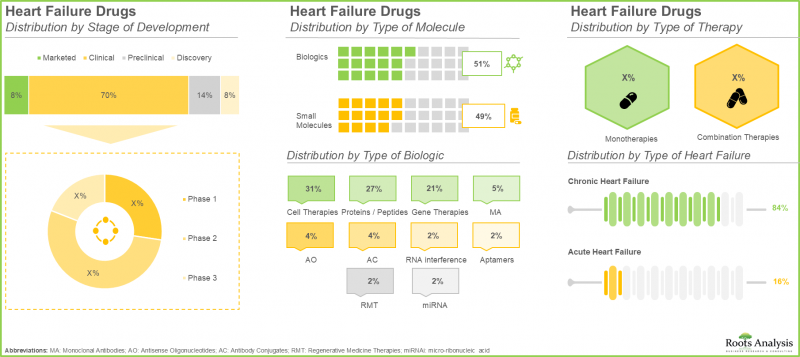
2. More than 120 drugs are currently approved / being investigated across various stages of development for the treatment and management of heart failure; of these, over 90% are under clinical development.
3. Majority (51%) of the heart failure drugs are biologics; of these, 75% of the drugs are being investigated for chronic heart failure under different stages of clinical development.
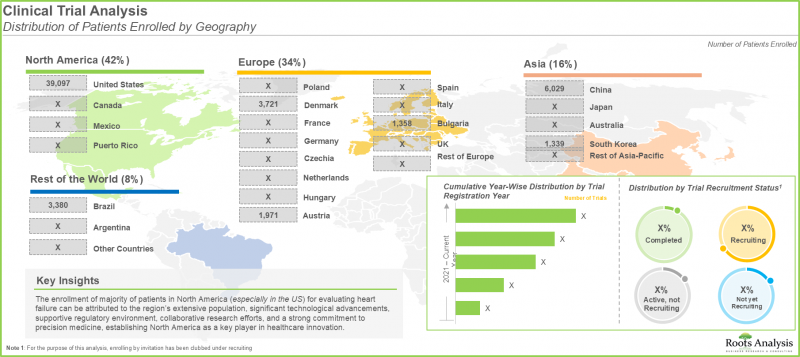
4. Clinical trials investigating drugs targeting heart failure are distributed across different geographical regions; maximum patient enrollment was observed in North America (42%), followed by Europe (34%).
5. Around 45% of the discontinued therapies were industry sponsored; of these, more than 35% of the trials were for heart failure with preserved ejection fraction.
6. The heart failure drugs market is anticipated to grow at a notable CAGR owing to the ability to improve patient outcomes through novel therapeutic mechanisms (such as SGLT2 inhibitors and other emerging classes).
7. The heart failure drugs market in North America is expected to capture maximum share by 2035, driven by a robust pharmaceutical ecosystem, high R&D investments, and accelerated regulatory approvals.
8. Driven by the growing adoption of heart failure drugs in the US, the market is poised to grow at a relatively higher CAGR over the forecast period.
Heart Failure Drugs Market Segments
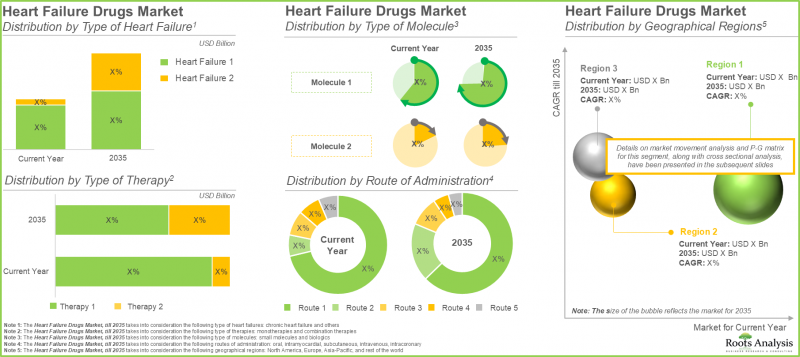
The market sizing and opportunity analysis has been segmented across the following parameters:
By Type of Heart Failure
- Chronic Heart Failure
- Others
By Type of Therapy
- Monotherapies
- Combination Therapies
By Type of Molecule
- Small Molecules
- Biologics
Route of Administration
- Oral
- Intramyocardial
- Subcutaneous
- Intravenous
- Intracoronary
By Geographical Regions
- North America
- US
- Canada
- Europe
- Germany
- France
- UK
- Italy
- Spain
- Asia-Pacific
- China
- Japan
- India
- South Korea
- Rest of the World
HEART FAILURE DRUGS MARKET: KEY SEGMENT INSIGHTS
Which Type of Heart Failure Represents the Largest Share of the Heart Failure Drugs Market?
Currently, the chronic heart failure segment is expected to account for the overwhelming majority of the heart failure drugs market, capturing more than 95% of total revenue. This dominance is primarily attributed to the high prevalence of chronic heart failure, its lifelong disease management requirements, and the continuous need for pharmacological intervention to control symptoms and prevent disease progression. The segment is also expected to witness steady growth throughout the forecast period. Notably, Empagliflozin (Jardiance), a monotherapy approved for heart failure treatment in 2021, generated approximately USD 4.4 billion in sales in 2025, underscoring the strong commercial potential of chronic heart failure therapeutics.
Regional Analysis: Which Regions are Expected to Exhibit the Strongest Growth?
North America: Maintaining Market Leadership
According to market projections, North America is expected to retain its position as the largest regional market, accounting for over 40% of the global heart failure drugs market in the current year. The region benefits from a well-established healthcare infrastructure, high disease awareness, favorable reimbursement frameworks, and significant investment in cardiovascular research. In particular, the United States has emerged as a leading hub for heart failure drug development, supported by innovation-driven regulatory policies, a robust biopharmaceutical ecosystem, and access to a highly skilled workforce. These advantages facilitate the efficient progression of therapies from early-stage development through commercialization.
Asia-Pacific: Fastest-Growing Regional Market
While North America is expected to dominate in terms of market share, Asia-Pacific is projected to register the highest growth rate through 2035. Growth in the region is anticipated to be driven by a rapidly aging population, increasing prevalence of cardiovascular disorders, expanding healthcare access, and rising investments in pharmaceutical innovation.
UAE Market Outlook
In the United Arab Emirates, market accessibility is expected to improve following recent initiatives by the Emirates Drug Establishment to reduce the retail prices of 168 pharmaceutical products. The price revisions include advanced therapies used in the treatment of chronic heart muscle failure, thereby supporting broader patient access to innovative heart failure medications.
Which Molecule Type is Expected to Dominate the Heart Failure Drugs Market?
Small molecules are projected to remain the dominant molecule category, accounting for more than 95% of the market in the current year. Their leadership position is supported by their established efficacy, advantages associated with oral drug administration, and widespread use as the standard of care in heart failure management. Key therapeutic classes, including beta-blockers, ACE inhibitors, ARBs, and SGLT2 inhibitors, have demonstrated significant clinical benefits in reducing mortality and improving patient outcomes across both heart failure with reduced ejection fraction (HFrEF) and preserved ejection fraction (HFpEF) populations.
Conversely, the biologics segment is anticipated to expand at a substantially higher CAGR of 52.0% during the forecast period. This growth is expected to be driven by increasing interest in precision medicine approaches, with biologics offering the potential to target genetic, molecular, and inflammatory mechanisms underlying heart failure progression. Their ability to address unmet clinical needs and command premium pricing is likely to support future market expansion.
Which Route of Administration Accounts for the Largest Market Share?
Based on market forecasts, oral therapies currently contribute more than 95% of total market revenue. The widespread adoption of oral formulations can be attributed to their convenience, strong patient adherence, suitability for long-term disease management, and ease of self-administration in outpatient settings.
Meanwhile, therapies administered through the intramyocardial route are expected to experience the fastest growth, registering a CAGR of 34.9% through 2035. This growth is driven by the route's ability to deliver therapeutic agents directly to cardiac tissue, potentially enhancing treatment efficacy and improving cardiac function in patients with advanced heart failure.
Among Monotherapies and Combination Therapies, Which Segment Holds the Largest Share?
Monotherapies currently account for the majority of market revenue, reflecting their long-standing role as first-line treatment options within established clinical guidelines. Their broad adoption is supported by favorable cost-effectiveness profiles, well-documented clinical outcomes, and higher patient adherence compared to more complex treatment regimens.
However, the combination therapy segment is expected to witness stronger growth, with a projected CAGR of 34.4% over the forecast period. Increasing adoption of multidrug treatment strategies, including quadruple therapy regimens comprising ARNIs, beta-blockers, mineralocorticoid receptor antagonists (MRAs), and SGLT2 inhibitors, is expected to drive this expansion. These combination approaches offer synergistic therapeutic effects, leading to improved clinical outcomes, reduced mortality and hospitalization rates, and enhanced disease management compared to standalone therapies.
Example Players in Heart Failure Drugs Market
- AstraZeneca
- Boehringer Ingelheim
- Bristol Myers Squibb
- Corteria Pharmaceuticals
- Cytokinetics
- Eli Lilly
- Hyloris Pharmaceuticals
- Jiangsu Hengrui Pharmaceuticals
- Novo Nordisk
- Sardocor
- StemCardia
- Tasly Pharmaceuticals
- Tenaya Therapeutics
Primary Research Overview
The opinions and insights presented in this study were influenced by discussions conducted with multiple stakeholders. The research report features detailed transcripts of the following third-party discussions:
- Professor of Medical Cardiology, Very Large Organization, United Kingdom, Europe
- Professor and Head of Advanced Heart Failure Wing, Very Large Organization, United States, North America
- Clinical Associate Professor and Director of Clinical Research, Large Organization, United States, North America
- Doctor of Medicine, Very Large Organization, United States, North America
- Professor, Very Large Organization, United States, North America
- Professor of Medicine and Heart Failure Specialist (Former Chair of Division for Circulatory Failure), Very Large Organization, United States, North America
- Senior Consultant Cardiologist, Large Organization, India, Asia
- Chair of DIGIT-HF trial, Very Large Organization, Germany, Europe
- Cardiologist and Clinical Researcher, Very Large Organization, United States, North America
HEART FAILURE DRUGS MARKET: RESEARCH COVERAGE
- Market Sizing and Opportunity Analysis: The report features an in-depth analysis of the heart failure drugs market, focusing on key market segments, including [A] type of heart failure, [B] type of therapy, [C] type of molecule, [D] route of administration, [E] geographical regions, and [F] sales forecast.
- Market Landscape: A detailed assessment of the overall heart failure drugs market landscape, featuring information on several relevant parameters, such as [A] stage of development, [B] type of molecule, [C] type of biologic, [D] type of therapy, [E] mechanism of action, [F] route of administration, [G] target patient population, [H] type of heart failure, [I] year of establishment, [J] company size, [K] location of headquarters and [L] most active players.
- Company Profiles: In-depth profiles of key drug developers in the heart failure drugs market, focusing on [A] company overview, [B] financial information, [C] drug portfolio, [D] recent developments and [E] an informed future outlook.
- Clinical Trial Analysis: An analysis of completed and ongoing clinical trials related to heart failure drugs, based on several relevant parameters, such as [A] trial registration year, [B] enrolled patient population, [C] trial phase, [D] trial status, [E] type of sponsor / collaborator, [F] patient gender, [G] study design (type of trial masking, type of intervention model, trial purpose and design allocation), [H] leading industry and non-industry players (based on number of clinical trials) and [I] geography.
- Drug Failure Analysis: An insightful drug failure analysis, based on several parameters, such as [A] trial phase, [B] trial status, [C] reason of drug discontinuation, [D] study start year, [E] year of discontinuation, [F] type of molecule, and [G] route of administration.
- Market Impact Analysis: The report analyzes various factors such as drivers, restraints, opportunities, and challenges affecting market growth.
KEY QUESTIONS ANSWERED IN THIS REPORT
- Which are the leading companies in the heart failure drugs market?
- Which region dominates the heart failure drugs market?
- What are the key trends observed in the heart failure drugs market?
- What factors are likely to influence the evolution of this market?
- What are the primary challenges faced by heart failure drug developers?
- What is the current and future market size?
- What is the CAGR of this market?
- How is the current and future market opportunity likely to be distributed across key market segments?
REASONS TO BUY THIS REPORT
- The report provides a comprehensive market analysis, offering detailed revenue projections of the overall market and its specific sub-segments. This information is valuable to both established market leaders and emerging entrants.
- The report offers stakeholders a comprehensive overview of the market, including key drivers, barriers, opportunities, and challenges. This information empowers stakeholders to stay abreast of market trends and make data-driven decisions to capitalize on growth prospects.
- The report can aid businesses in identifying future opportunities in any sector. It also helps in understanding if those opportunities are worth pursuing.
- The report helps in identifying customer demand by understanding the needs, preferences, and behavior of the target audience in order to tailor products or services effectively.
- The report equips new entrants with requisite information regarding a particular market to help them build successful business strategies.
- The report allows for more effective communication with the audience and in building strong business relations.
ADDITIONAL BENEFITS
- Complementary Excel Data Packs for all Analytical Modules in the Report
- 15% Free Content Customization
- Detailed Report Walkthrough Session with Research Team
- Free Updated report if the report is 6-12 months old or older
TABLE OF CONTENTS
1. BACKGROUND
- 1.1. Context
- 1.2. Project Objectives
2. RESEARCH METHODOLOGY
- 2.1. Chapter Overview
- 2.2. Research Assumptions
- 2.2.1. Market Landscape and Market Trends
- 2.2.2. Market Forecast and Opportunity Analysis
- 2.2.3. Comparative Analysis
- 2.3. Database Building
- 2.3.1. Data Collection
- 2.3.2. Data Validation
- 2.3.3. Data Analysis
- 2.4. Project Methodology
- 2.4.1. Secondary Research
- 2.4.1.1. Annual Reports
- 2.4.1.2. Academic Research Papers
- 2.4.1.3. Company Websites
- 2.4.1.4. Investor Presentations
- 2.4.1.5. Regulatory Filings
- 2.4.1.6. White Papers
- 2.4.1.7. Industry Publications
- 2.4.1.8. Conferences and Seminars
- 2.4.1.9. Government Portals
- 2.4.1.10. Media and Press Releases
- 2.4.1.11. Newsletters
- 2.4.1.12. Industry Databases
- 2.4.1.13. Roots Proprietary Databases
- 2.4.1.14. Paid Databases and Sources
- 2.4.1.15. Social Media Portals
- 2.4.1.16. Other Secondary Sources
- 2.4.2. Primary Research
- 2.4.2.1. Types of Primary Research
- 2.4.2.1.1. Qualitative Research
- 2.4.2.1.2. Quantitative Research
- 2.4.2.1.3. Hybrid Approach
- 2.4.2.2. Advantages of Primary Research
- 2.4.2.3. Techniques for Primary Research
- 2.4.2.3.1. Interviews
- 2.4.2.3.2. Surveys
- 2.4.2.3.3. Focus Groups
- 2.4.2.3.4. Observational Research
- 2.4.2.3.5. Social Media Interactions
- 2.4.2.4. Key Opinion Leaders Considered in Primary Research
- 2.4.2.4.1. Company Executives (CXOs)
- 2.4.2.4.2. Board of Directors
- 2.4.2.4.3. Company Presidents and Vice Presidents
- 2.4.2.4.4. Research and Development Heads
- 2.4.2.4.5. Technical Experts
- 2.4.2.4.6. Subject Matter Experts
- 2.4.2.4.7. Scientists
- 2.4.2.4.8. Doctors and Other Healthcare Providers
- 2.4.2.5. Ethics and Integrity
- 2.4.2.5.1. Research Ethics
- 2.4.2.5.2. Data Integrity
- 2.4.2.1. Types of Primary Research
- 2.4.3. Analytical Tools and Databases
- 2.4.1. Secondary Research
- 2.5. Robust Quality Control
3. MARKET DYNAMICS
- 3.1. Chapter Overview
- 3.2. Forecast Methodology
- 3.2.1. Top-down Approach
- 3.2.2. Bottom-up Approach
- 3.2.3. Hybrid Approach
- 3.3. Market Assessment Framework
- 3.3.1. Total Addressable Market (TAM)
- 3.3.2. Serviceable Addressable Market (SAM)
- 3.3.3. Serviceable Obtainable Market (SOM)
- 3.3.4. Currently Acquired Market (CAM)
- 3.4. Forecasting Tools and Techniques
- 3.4.1. Qualitative Forecasting
- 3.4.2. Correlation
- 3.4.3. Regression
- 3.4.4. Extrapolation
- 3.4.5. Convergence
- 3.4.6. Sensitivity Analysis
- 3.4.7. Scenario Planning
- 3.4.8. Data Visualization
- 3.4.9. Time Series Analysis
- 3.4.10. Forecast Error Analysis
- 3.5. Key Considerations
- 3.5.1. Demographics
- 3.5.2. Government Regulations
- 3.5.3. Reimbursement Scenarios
- 3.5.4. Market Access
- 3.5.5. Supply Chain
- 3.5.6. Industry Consolidation
- 3.5.7. Pandemic / Unforeseen Disruptions Impact
- 3.6. Limitations
4. MACRO-ECONOMIC INDICATORS
- 4.1. Chapter Overview
- 4.2. Market Dynamics
- 4.2.1. Time Period
- 4.2.1.1. Historical Trends
- 4.2.1.2. Current and Forecasted Estimates
- 4.2.2. Currency Coverage
- 4.2.2.1. Major Currencies Affecting the Market
- 4.2.2.2. Factors Affecting Currency Fluctuations on the Industry
- 4.2.2.3. Impact of Currency Fluctuations on the Industry
- 4.2.3. Foreign Currency Exchange Rate
- 4.2.3.1. Impact of Foreign Exchange Rate Volatility on the Market
- 4.2.3.2. Strategies for Mitigating Foreign Exchange Risk
- 4.2.4. Recession
- 4.2.4.1. Assessment of Current Economic Conditions and Potential Impact on the Market
- 4.2.4.2. Historical Analysis of Past Recessions and Lessons Learnt
- 4.2.5. Inflation
- 4.2.5.1. Measurement and Analysis of Inflationary Pressures in the Economy
- 4.2.5.2. Potential Impact of Inflation on the Market Evolution
- 4.2.6. Interest Rates
- 4.2.6.1. Interest Rates and Their Impact on the Market
- 4.2.6.2. Strategies for Managing Interest Rate Risk
- 4.2.7. Commodity Flow Analysis
- 4.2.7.1. Type of Commodity
- 4.2.7.2. Origins and Destinations
- 4.2.7.3. Values and Weights
- 4.2.7.4. Modes of Transportation
- 4.2.8. Global Trade Dynamics
- 4.2.8.1. Import Scenario
- 4.2.8.2. Export Scenario
- 4.2.8.3. Trade Policies
- 4.2.8.4. Strategies for Mitigating the Risks Associated with Trade Barriers
- 4.2.8.5. Impact of Trade Barriers on the Market
- 4.2.9. War Impact Analysis
- 4.2.9.1. Russian-Ukraine War
- 4.2.9.2. Israel-Hamas War
- 4.2.10. COVID Impact / Related Factors
- 4.2.10.1. Global Economic Impact
- 4.2.10.2. Industry-specific Impact
- 4.2.10.3. Government Response and Stimulus Measures
- 4.2.10.4. Future Outlook and Adaptation Strategies
- 4.2.11. Other Indicators
- 4.2.11.1. Fiscal Policy
- 4.2.11.2. Consumer Spending
- 4.2.11.3. Gross Domestic Product
- 4.2.11.4. Employment
- 4.2.11.5. Taxes
- 4.2.11.6. Stock Market Performance
- 4.2.11.7. Cross Border Dynamics
- 4.2.1. Time Period
- 4.3. Conclusion
5. EXECUTIVE SUMMARY
- 5.1. Executive Summary: Market Landscape
- 5.2. Executive Summary: Market Trends
- 5.3. Executive Summary: Market Forecast and Opportunity Analysis
6. INTRODUCTION
- 6.1. Overview of Heart Failure
- 6.2. Stages of Heart Failure
- 6.3. Factors Contributing to Heart Failure
- 6.4. Heart Failure Treatment and Management
- 6.5. Future Perspectives
7. MARKET LANDSCAPE
- 7.1. Methodology and Key Parameters
- 7.2. Heart Failure Drugs: Overall Market Landscape
- 7.2.1. Analysis by Stage of Development
- 7.2.2. Analysis by Type of Molecule
- 7.2.3. Analysis by Type of Biologic
- 7.2.4. Analysis by Type of Therapy
- 7.2.5. Analysis by Mechanism of Action
- 7.2.6. Analysis by Route of Administration
- 7.2.7. Analysis by Target Patient Population
- 7.2.8. Analysis by Type of Heart Failure
- 7.3. Heart Failure Drug Developers: Market Landscape
- 7.3.1. Analysis by Year of Establishment
- 7.3.2. Analysis by Company Size
- 7.3.3. Analysis by Location of Headquarters
- 7.3.4. Most Active Players: Analysis by Number of Drugs Developed
8. COMPANY PROFILES
- 8.1. Chapter Overview
- 8.2. AstraZeneca
- 8.2.1. Company Overview
- 8.2.2. Heart Failure Drugs Portfolio
- 8.2.3. Key Initiatives
- 8.3. Boehringer Ingelheim
- 8.4. Bristol Myers Squibb
- 8.5. Corteria Pharmaceuticals
- 8.6. Cytokinetics
- 8.7. Eli Lilly
- 8.8. Hyloris Pharmaceuticals
- 8.9. Suncadia Pharmaceuticals
- 8.10. Novo Nordisk
- 8.11. Sardocor
- 8.12. StemCardia
- 8.13. Tasly Pharmaceuticals
- 8.14. Tenaya Therapeutics
9. CLINICAL TRIAL ANALYSIS
- 9.1. Methodology and Key Parameters
- 9.2. Heart Failure Drugs: Clinical Trial Analysis
- 9.2.1. Analysis by Trial Registration Year
- 9.2.2. Analysis by Trial Status
- 9.2.3. Analysis by Trial Registration Year and Trial Status
- 9.2.4. Analysis by Patients Enrolled by Trial Phase
- 9.2.5. Analysis by Patients Enrolled by Trial Registration Year
- 9.2.6. Analysis by Trial Phase
- 9.2.7. Analysis by Type of Sponsor / Collaborator
- 9.2.8. Analysis by Patient Gender
- 9.2.9. Analysis by Study Design
- 9.2.10. Analysis by Target Patient Population
- 9.2.11. Most Active Industry Players: Analysis by Number of Clinical Trials
- 9.2.12. Most Active Non-Industry Players: Analysis by Number of Clinical Trials
- 9.2.13. Geographical Distribution of Trials and Number of Patients Enrolled
- 9.2.14. Analysis of Clinical Trials by Trial Status and Geography
- 9.2.15. Analysis of Patients Enrolled by Trial Status and Geography
10. DRUG FAILURE ANALYSIS
- 10.1. Methodology and Key Parameters
- 10.2. Heart Failure Drugs: Drug Failure Analysis
- 10.2.1. Analysis by Trial Phase
- 10.2.2. Analysis by Trial Status
- 10.2.3. Analysis by Reason of Drug Discontinuation
- 10.2.4. Analysis by Study Start Year and Year of Discontinuation
- 10.2.5. Analysis by Type of Heart Failure
- 10.2.6. Analysis by Type of Sponsor
- 10.2.7. Analysis by Geographical Region
11. MARKET IMPACT ANALYSIS
- 11.1. Market Drivers
- 11.2. Market Restraints
- 11.3. Market Opportunities
- 11.4. Market Challenges
12. GLOBAL HEART FAILURE MARKET
- 12.1. Key Assumptions and Methodology
- 12.2. Global Heart Failure Drugs Market, Historical Trends (Since 2021) and Forecasted Estimates (Till 2035)
- 12.3. Multivariate Scenario Analysis
- 12.3.1. Global Heart Failure Drugs Market, Forecasted Estimates (Till 2035), Conservative Scenario
- 12.3.2. Global Heart Failure Drugs Market, Forecasted Estimates (Till 2035), Optimistic Scenario
- 12.4. Key Market Segments
13. HEART FAILURE MARKET, BY TYPE OF HEART FAILURE
- 13.1. Key Assumptions and Methodology
- 13.2. Heart Failure Drugs Market: Distribution by Type of Heart Failure
- 13.2.1. Heart Failure Drugs Market for Chronic Heart Failure: Historical Trends (Since 2021) and Forecasted Estimates (Till 2035)
- 13.2.2. Heart Failure Drugs Market for Others: Historical Trends (Since 2021) and Forecasted Estimates (Till 2035)
- 13.3. Data Triangulation and Validation
14. HEART FAILURE MARKET, BY TYPE OF THERAPY
- 14.1. Key Assumptions and Methodology
- 14.2. Heart Failure Drugs Market: Distribution by Type of Therapy
- 14.2.1. Heart Failure Drugs Market for Monotherapies: Historical Trends (Since 2021) and Forecasted Estimates (Till 2035)
- 14.2.2. Heart Failure Drugs Market for Combination Therapies: Historical Trends (Since 2021) and Forecasted Estimates (Till 2035)
- 14.3. Data Triangulation and Validation
15. HEART FAILURE MARKET, BY TYPE OF MOLECULE
- 15.1. Key Assumptions and Methodology
- 15.2. Heart Failure Drugs Market: Distribution by Type of Molecule
- 15.2.1. Heart Failure Drugs Market for Small Molecules: Historical Trends (Since 2021) and Forecasted Estimates (Till 2035)
- 15.2.2. Heart Failure Drugs Market for Biologics: Historical Trends (Since 2021) and Forecasted Estimates (Till 2035)
- 15.3. Data Triangulation and Validation
16. HEART FAILURE MARKET, BY ROUTE OF ADMINISTRATION
- 16.1. Key Assumptions and Methodology
- 16.2. Heart Failure Drugs Market: Distribution by Route of Administration
- 16.2.1. Heart Failure Drugs Market for Oral Route: Historical Trends (Since 2021) and Forecasted Estimates (Till 2035)
- 16.2.2. Heart Failure Drugs Market for Subcutaneous Route: Historical Trends (Since 2021) and Forecasted Estimates (Till 2035)
- 16.2.3. Heart Failure Drugs Market for Intramyocardial Route: Historical Trends (Since 2021) and Forecasted Estimates (Till 2035)
- 16.2.4. Heart Failure Drugs Market for Intravenous Route: Historical Trends (Since 2021) and Forecasted Estimates (Till 2035)
- 16.2.5. Heart Failure Drugs Market for Intracoronary Route: Historical Trends (Since 2021) and Forecasted Estimates (Till 2035)
- 16.3. Data Triangulation and Validation
17. HEART FAILURE MARKET, BY GEOGRAPHICAL REGIONS
- 17.1. Heart Failure Drugs Market: Distribution by Geographical Regions
- 17.1.1. Heart Failure Drugs Market in North America: Historical Trends (Since 2021) and Forecasted Estimates (Till 2035)
- 17.1.1.1. Heart Failure Drugs Market in the US: Historical Trends (Since 2021) and Forecasted Estimates (Till 2035)
- 17.1.1.2. Heart Failure Drugs Market in Canada: Historical Trends (Since 2021) and Forecasted Estimates (Till 2035)
- 17.1.2. Heart Failure Drugs Market in Europe: Historical Trends (Since 2021) and Forecasted Estimates (Till 2035)
- 17.1.2.1. Heart Failure Drugs Market in Germany: Historical Trends (Since 2021) and Forecasted Estimates (Till 2035)
- 17.1.2.2. Heart Failure Drugs Market in France: Historical Trends (Since 2021) and Forecasted Estimates (Till 2035)
- 17.1.2.3. Heart Failure Drugs Market in UK: Historical Trends (Since 2021) and Forecasted Estimates (Till 2035)
- 17.1.2.4. Heart Failure Drugs Market in Italy: Historical Trends (Since 2021) and Forecasted Estimates (Till 2035)
- 17.1.2.5. Heart Failure Drugs Market in Spain: Historical Trends (Since 2021) and Forecasted Estimates (Till 2035)
- 17.1.2.6. Heart Failure Drugs Market in Rest of Europe: Historical Trends (Since 2021) and Forecasted Estimates (Till 2035)
- 17.1.3. Heart Failure Drugs Market in Asia-Pacific: Historical Trends (Since 2021) and Forecasted Estimates (Till 2035)
- 17.1.3.1. Heart Failure Drugs Market in China: Historical Trends (Since 2021) and Forecasted Estimates (Till 2035)
- 17.1.3.2. Heart Failure Drugs Market in Japan: Historical Trends (Since 2021) and Forecasted Estimates (Till 2035)
- 17.1.3.3. Heart Failure Drugs Market in India: Historical Trends (Since 2021) and Forecasted Estimates (Till 2035)
- 17.1.3.4. Heart Failure Drugs Market in South Korea: Historical Trends (Since 2021) and Forecasted Estimates (Till 2035)
- 17.1.3.5. Heart Failure Drugs Market in Rest of Asia-Pacific: Historical Trends (Since 2021) and Forecasted Estimates (Till 2035)
- 17.1.4. Heart Failure Drugs Market in Rest of the World: Historical Trends (Since 2021) and Forecasted Estimates (Till 2035)
- 17.1.1. Heart Failure Drugs Market in North America: Historical Trends (Since 2021) and Forecasted Estimates (Till 2035)
- 17.2. Data Triangulation and Validation
18. MARKET OPPORTUNITY ANALYSIS: NORTH AMERICA
- 18.1. Heart Failure Drugs Market in North America: Distribution by Type of Heart Failure
- 18.1.1. Heart Failure Drugs Market in North America for Chronic Heart Failure, Historical Trends (Since 2021) and Forecasted Estimates (Till 2035)
- 18.1.2. Heart Failure Drugs Market in North America for Others, Historical Trends (Since 2021) and Forecasted Estimates (Till 2035)
- 18.2. Heart Failure Drugs Market in North America: Distribution by Type of Therapy
- 18.2.1. Heart Failure Drugs Market in North America for Monotherapies, Historical Trends (Since 2021) and Forecasted Estimates (Till 2035)
- 18.2.2. Heart Failure Drugs Market in North America for Combination Therapies, Historical Trends (Since 2021) and Forecasted Estimates (Till 2035)
- 18.3. Heart Failure Drugs Market in North America: Distribution by Type of Molecule
- 18.3.1. Heart Failure Drugs Market in North America for Small Molecules, Historical Trends (Since 2021) and Forecasted Estimates (Till 2035)
- 18.3.2. Heart Failure Drugs Market in North America for Biologics, Historical Trends (Since 2021) and Forecasted Estimates (Till 2035)
- 18.4. Heart Failure Drugs Market in North America: Distribution by Route of Administration
- 18.4.1. Heart Failure Drugs Market in North America for Oral Route, Historical Trends (Since 2021) and Forecasted Estimates (Till 2035)
- 18.4.2. Heart Failure Drugs Market in North America for Subcutaneous Route, Historical Trends (Since 2021) and Forecasted Estimates (Till 2035)
- 18.4.3. Heart Failure Drugs Market in North America for Intramyocardial Route, Historical Trends (Since 2021) and Forecasted Estimates (Till 2035)
- 18.4.4. Heart Failure Drugs Market in North America for Intravenous Route, Historical Trends (Since 2021) and Forecasted Estimates (Till 2035)
- 18.4.5. Heart Failure Drugs Market in North America for Intracoronary Route, Historical Trends (Since 2021) and Forecasted Estimates (Till 2035)
19. MARKET OPPORTUNITY ANALYSIS: EUROPE
- 19.1. Heart Failure Drugs Market in Europe: Distribution by Type of Heart Failure
- 19.1.1. Heart Failure Drugs Market in Europe for Chronic Heart Failure, Historical Trends (Since 2021) and Forecasted Estimates (Till 2035)
- 19.1.2. Heart Failure Drugs Market in Europe for Others, Historical Trends (Since 2021) and Forecasted Estimates (Till 2035)
- 19.2. Heart Failure Drugs Market in Europe: Distribution by Type of Therapy
- 19.2.1. Heart Failure Drugs Market in Europe for Monotherapies, Historical Trends (Since 2021) and Forecasted Estimates (Till 2035)
- 19.2.2. Heart Failure Drugs Market in Europe for Combination Therapies, Historical Trends (Since 2021) and Forecasted Estimates (Till 2035)
- 19.3. Heart Failure Drugs Market in Europe: Distribution by Type of Molecule
- 19.3.1. Heart Failure Drugs Market in Europe for Small Molecules, Historical Trends (Since 2021) and Forecasted Estimates (Till 2035)
- 19.3.2. Heart Failure Drugs Market in Europe for Biologics, Historical Trends (Since 2021) and Forecasted Estimates (Till 2035)
- 19.4. Heart Failure Drugs Market in Europe: Distribution by Route of Administration
- 19.4.1. Heart Failure Drugs Market in Europe for Oral Route, Historical Trends (Since 2021) and Forecasted Estimates (Till 2035)
- 19.4.2. Heart Failure Drugs Market in Europe for Subcutaneous Route, Historical Trends (Since 2021) and Forecasted Estimates (Till 2035)
- 19.4.3. Heart Failure Drugs Market in Europe for Intramyocardial Route, Historical Trends (Since 2021) and Forecasted Estimates (Till 2035)
- 19.4.4. Heart Failure Drugs Market in Europe for Intravenous Route, Historical Trends (Since 2021) and Forecasted Estimates (Till 2035)
- 19.4.5. Heart Failure Drugs Market in Europe for Intracoronary Route, Historical Trends (Since 2021) and Forecasted Estimates (Till 2035)
20. MARKET OPPORTUNITY ANALYSIS: ASIA-PACIFIC
- 20.1. Heart Failure Drugs Market in Asia-Pacific: Distribution by Type of Heart Failure
- 20.1.1. Heart Failure Drugs Market in Asia-Pacific for Chronic Heart Failure, Historical Trends (Since 2021) and Forecasted Estimates (Till 2035)
- 20.1.2. Heart Failure Drugs Market in Asia-Pacific for Others, Historical Trends (Since 2021) and Forecasted Estimates (Till 2035)
- 20.2. Heart Failure Drugs Market in Asia-Pacific: Distribution by Type of Therapy
- 20.2.1. Heart Failure Drugs Market in Asia-Pacific for Monotherapies, Historical Trends (Since 2021) and Forecasted Estimates (Till 2035)
- 20.2.2. Heart Failure Drugs Market in Asia-Pacific for Combination Therapies, Historical Trends (Since 2021) and Forecasted Estimates (Till 2035)
- 20.3. Heart Failure Drugs Market in Asia-Pacific: Distribution by Type of Molecule
- 20.3.1. Heart Failure Drugs Market in Asia-Pacific for Small Molecules, Historical Trends (Since 2021) and Forecasted Estimates (Till 2035)
- 20.3.2. Heart Failure Drugs Market in Asia-Pacific for Biologics, Historical Trends (Since 2021) and Forecasted Estimates (Till 2035)
- 20.4. Heart Failure Drugs Market in Asia-Pacific: Distribution by Route of Administration
- 20.4.1. Heart Failure Drugs Market in Asia-Pacific for Oral Route, Historical Trends (Since 2021) and Forecasted Estimates (Till 2035)
- 20.4.2. Heart Failure Drugs Market in Asia-Pacific for Subcutaneous Route, Historical Trends (Since 2021) and Forecasted Estimates (Till 2035)
- 20.4.3. Heart Failure Drugs Market in Asia-Pacific for Intramyocardial Route, Historical Trends (Since 2021) and Forecasted Estimates (Till 2035)
- 20.4.4. Heart Failure Drugs Market in Asia-Pacific for Intravenous Route, Historical Trends (Since 2021) and Forecasted Estimates (Till 2035)
- 20.4.5. Heart Failure Drugs Market in Asia-Pacific for Intracoronary Route, Historical Trends (Since 2021) and Forecasted Estimates (Till 2035)
21. MARKET OPPORTUNITY ANALYSIS: REST OF THE WORLD
- 21.1. Heart Failure Drugs Market in Rest of the World: Distribution by Type of Heart Failure
- 21.1.1. Heart Failure Drugs Market in Rest of the World for Chronic Heart Failure, Historical Trends (Since 2021) and Forecasted Estimates (Till 2035)
- 21.1.2. Heart Failure Drugs Market in Rest of the World for Others, Historical Trends (Since 2021) and Forecasted Estimates (Till 2035)
- 21.2. Heart Failure Drugs Market in Rest of the World: Distribution by Type of Therapy
- 21.2.1. Heart Failure Drugs Market in Rest of the World for Monotherapies, Historical Trends (Since 2021) and Forecasted Estimates (Till 2035)
- 21.2.2. Heart Failure Drugs Market in Rest of the World for Combination Therapies, Historical Trends (Since 2021) and Forecasted Estimates (Till 2035)
- 21.3. Heart Failure Drugs Market in Rest of the World: Distribution by Type of Molecule
- 21.3.1. Heart Failure Drugs Market in Rest of the World for Small Molecules, Historical Trends (Since 2021) and Forecasted Estimates (Till 2035)
- 21.3.2. Heart Failure Drugs Market in Rest of the World for Biologics, Historical Trends (Since 2021) and Forecasted Estimates (Till 2035)
- 21.4. Heart Failure Drugs Market in Rest of the World: Distribution by Route of Administration
- 21.4.1. Heart Failure Drugs Market in Rest of the World for Oral Route, Historical Trends (Since 2021) and Forecasted Estimates (Till 2035)
- 21.4.2. Heart Failure Drugs Market in Rest of the World for Subcutaneous Route, Historical Trends (Since 2021) and Forecasted Estimates (Till 2035)
- 21.4.3. Heart Failure Drugs Market in Rest of the World for Intramyocardial Route, Historical Trends (Since 2021) and Forecasted Estimates (Till 2035)
- 21.4.4. Heart Failure Drugs Market in Rest of the World for Intravenous Route, Historical Trends (Since 2021) and Forecasted Estimates (Till 2035)
- 21.4.5. Heart Failure Drugs Market in Rest of the World for Intracoronary Route, Historical Trends (Since 2021) and Forecasted Estimates (Till 2035)
22. HEART FAILURE MARKET, SALES FORECAST OF DRUGS
- 22.1. Approved and Phase III Heart Failure Drugs: Sales Forecast
- 22.1.1. Empagliflozin / Jardiance: Sales Forecast
- 22.1.2. Farxiga / Dapagliflozin: Sales Forecast
- 22.1.3. Kerendia / Finerenone: Sales Forecast
- 22.1.4. Furoscix / Furosemide: Sales Forecast
- 22.1.5. Injectafer / Ferinject: Sales Forecast
- 22.1.6. Verquvo / Vericiguat: Sales Forecast
- 22.1.7. Sotagliflozin / Inpefa: Sales Forecast
- 22.1.8. Baxdrostat: Sales Forecast
- 22.1.9. Balcinrenone / Dapagliflozin: Sales Forecast
- 22.1.10. Vicadrostat / BI 690517: Sales Forecast
- 22.1.11. Ziltivekimab: Sales Forecast
- 22.1.12. Revascor / Rexlemestrocel L: Sales Forecast
- 22.1.13. Maridebart cafraglutid: Sales Forecast
- 22.1.14. Omecamtiv Mecarbil: Sales Forecast
- 22.1.15. Ferric Derisomaltose: Sales Forecast
- 22.1.16. JRM-001: Sales Forecast
- 22.1.17. Enavogliflozin / Envlo: Sales Forecast
23. CONCLUDING REMARKS
24. EXECUTIVE INSIGHTS
- 24.1. Chapter Overview
- 24.2. Company A
- 24.2.1. Company Snapshot
- 24.2.2. Interview Transcript: Professor of Medical Cardiology
- 24.3. Company B
- 24.3.1. Company Snapshot
- 24.3.2. Interview Transcript: Professor and Head of Advanced Heart Failure Wing
- 24.4. Company C
- 24.4.1. Company Snapshot
- 24.4.2. Interview Transcript: Clinical Associate Professor & Director of Clinical Research
- 24.5. Company D
- 24.5.1. Company Snapshot
- 24.5.2. Interview Transcript: Doctor of Medicine
- 24.6. Company E
- 24.6.1. Company Snapshot
- 24.6.2. Interview Transcript: Professor
- 24.7. Company F
- 24.7.1. Company Snapshot
- 24.7.2. Interview Transcript: Professor of Medicine and Heart Failure Specialist (Former Chair of Division for Circulatory Failure)
- 24.8. Company G
- 24.8.1. Company Snapshot
- 24.8.2. Interview Transcript: Senior Consultant Cardiologist
- 24.9. Company H
- 24.9.1. Company Snapshot
- 24.9.2. Interview Transcript: Professor and Chair of DIGIT-HF trial
- 24.10. Company I
- 24.10.1. Company Snapshot
- 24.10.2. Interview Transcript: Cardiologist