|
시장보고서
상품코드
1900736
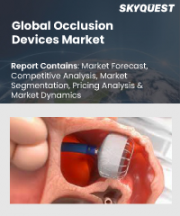
폐색 기기 시장 규모, 점유율, 성장 분석 : 제품별, 용도별, 최종사용자별, 지역별 - 업계 예측(2026-2033년)Occlusion Devices Market Size, Share, and Growth Analysis, By Product (Occlusion Removal Devices, Embolization Devices), By Application (Neurology, Cardiology), By End User, By Region - Industry Forecast 2026-2033 |
||||||

세계의 폐색 기기 시장 규모는 2024년에 30억 9,000만 달러로 평가되었으며, 2025년 32억 5,000만 달러에서 2033년까지 48억 3,000만 달러로 성장할 전망입니다. 예측 기간(2026-2033년) 동안 CAGR은 5.1%로 예측됩니다.
세계 폐색기기 시장은 심혈관질환, 신경혈관질환, 말초혈관질환의 증가에 힘입어 견조한 성장세를 이어가고 있습니다. 색전 기기, 지지 기기 등 다양한 유형의 폐색 기기가 효과적인 치료에 필수적입니다. 고령화 사회의 진전과 최소침습 수술 기술의 발전도 시장 성장을 더욱 가속화하고 있습니다. 특히 외래 수술 센터의 혈관 내 치료의 보급 확대와 외래 서비스 수요 증가로 인해 이러한 기기에 대한 수요가 증가하고 있습니다. 북미는 심혈관질환의 높은 유병률과 주요 산업 기업의 존재로 인해 시장 점유율을 주도하고 있지만, 유럽과 아시아태평양도 의료 인프라 개선과 환자 인식의 증가로 인해 빠른 성장을 보이고 있습니다. 전반적으로 시장은 지속적인 성장이 예상됩니다.
세계 폐색 기기 시장 촉진요인
심혈관질환, 신경혈관 질환, 말초혈관 질환의 유병률 증가는 세계 폐색 기기 시장의 성장을 촉진하는 주요 요인으로 작용하고 있습니다. 이러한 질환에는 혈류 회복과 합병증 예방을 위한 폐색 기기를 포함한 효과적인 치료 솔루션이 필요합니다. 고령화, 생활습관 악화 등의 요인으로 인해 전 세계적으로 이러한 질환에 대한 부담이 증가함에 따라 폐색기기에 대한 수요는 지속적으로 증가하고 있습니다. 이러한 추세는 다양한 환자군의 건강 문제를 해결하고 치료 결과를 개선하기 위한 혁신적인 의료기술의 필요성을 강조하고 있습니다.
세계 폐색 기기 시장 억제요인
세계 폐색 기기 시장은 환자의 안전과 제품의 효능을 최우선으로 하는 엄격한 규제 승인 절차로 인해 심각한 도전에 직면해 있습니다. 규제 당국 등으로부터 필요한 승인을 취득하는 것은 시간과 비용 측면에서 부담이 큰 작업일 수 있습니다. 이러한 규제의 엄격한 성격과 특정 품질 기준을 준수해야 하는 요구사항이 결합되어 시장 진입 기업, 특히 중소기업에 장벽이 되고 있습니다. 이러한 장애물은 시장 진입과 사업 확장에 걸림돌이 될 수 있으며, 궁극적으로 업계 내 경쟁 상황과 혁신에 영향을 미칠 수 있습니다.
세계 폐색 기기 시장 동향
전 세계 폐색 기기 시장에서는 환자의 편안함과 안전성을 향상시키는 혁신적인 솔루션에 대한 수요가 증가함에 따라 생체흡수성 기기의 채택이 두드러진 추세입니다. 체내에서 자연 용해되도록 설계된 이 기기는 제거를 위한 추가 수술이 필요하지 않아 장기적인 합병증 위험을 크게 줄일 수 있습니다. 의료가 환자 중심의 맞춤형 치료 옵션으로 진화하는 가운데, 제조업체들은 생체흡수성 재료의 개선과 유효성 및 안전성 확보를 위해 연구개발에 많은 투자를 하고 있습니다. 이러한 첨단 최소침습적 치료법에 대한 관심이 높아지면서 시장의 경쟁 구도가 재편되고 있습니다.
자주 묻는 질문
목차
소개
- 조사 목적
- 조사 범위
- 정의
조사 방법
- 정보 조달
- 2차와 1차 데이터 방법
- 시장 규모 예측
- 시장 가정과 제한
주요 요약
- 세계 시장 전망
- 공급과 수요 동향 분석
- 부문별 기회 분석
시장 역학과 전망
- 시장 규모
- 시장 역학
- 성장 촉진요인과 기회
- 성장 억제요인과 과제
- Porters 분석
주요 시장 인사이트
- 핵심성공요인
- 경쟁 정도
- 주요 투자 기회
- 시장 생태계
- 시장 매력 지수(2025년)
- PESTEL 분석
- 거시경제 지표
- 밸류체인 분석
- 가격 분석
- 규제 상황
- 사례 연구
- 기술적 진보
세계의 폐색 기기 시장 규모 : 제품별 & CAGR(2026-2033년)
- 폐색 제거 기기
- 풍선 폐색 기기
- 스텐트 리트리버
- 코일 회수 기기
- 흡입 및 흡인 기기
- 색전 기기
- 색전 코일
- 액체 색전제
- 난관 폐색 기기
- 서포트 기기
- 마이크로카테터
- 가이드와이어
세계의 폐색 기기 시장 규모 : 용도별 & CAGR(2026-2033년)
- 신경학
- 심장병학
- 말초혈관질환
- 비뇨기과
- 종양학
- 부인과
세계의 폐색 기기 시장 규모 : 최종사용자별 & CAGR(2026-2033년)
- 병원
- 진단 센터
- 외과 센터
- 외래 진료 센터
- 연구소·학술기관
세계의 폐색 기기 시장 규모 : 지역별 & CAGR(2026-2033년)
- 북미
- 미국
- 캐나다
- 유럽
- 독일
- 스페인
- 프랑스
- 영국
- 이탈리아
- 기타 유럽
- 아시아태평양
- 중국
- 인도
- 일본
- 한국
- 기타 아시아태평양
- 라틴아메리카
- 브라질
- 기타 라틴아메리카
- 중동 및 아프리카
- GCC 국가
- 남아프리카공화국
- 기타 중동 및 아프리카
경쟁 정보
- 상위 5개사의 비교
- 주요 기업의 시장 포지셔닝(2025년)
- 주요 시장 기업이 채용한 전략
- 최근의 시장 동향
- 기업의 시장 점유율 분석(2025년)
- 주요 기업 개요
- 기업 상세
- 제품 포트폴리오 분석
- 기업 부문별 점유율 분석
- 매출 전년비 비교(2023-2025년)
주요 기업 개요
- Boston Scientific Corporation(United States)
- Medtronic PLC(Ireland)
- Terumo Corporation(Japan)
- Stryker Corporation(United States)
- Penumbra, Inc.(United States)
- Abbott Laboratories(United States)
- Edwards Lifesciences Corporation(United States)
- Johnson & Johnson(United States)
- Merit Medical Systems, Inc.(United States)
- Lepu Medical Technology Co., Ltd.(China)
- Asahi Intecc Co., Ltd.(Japan)
- AngioDynamics, Inc.(United States)
- Cardinal Health, Inc.(United States)
- Avinger, Inc.(United States)
- B. Braun Melsungen AG(Germany)
- C.R. Bard, Inc.(United States)
- Cook Medical Incorporated(United States)
- Acrostak International Distribution Sarl(Switzerland)
결론과 제안
KSM 26.01.21Global Occlusion Devices Market size was valued at USD 3.09 Billion in 2024 and is poised to grow from USD 3.25 Billion in 2025 to USD 4.83 Billion by 2033, growing at a CAGR of 5.1% during the forecast period (2026-2033).
The global occlusion devices market is undergoing robust expansion, primarily driven by the rise in cardiovascular diseases, neurovascular conditions, and peripheral vascular issues. Various types of occlusion devices, such as embolization and support devices, are essential for effective treatment. Market growth is further propelled by an aging population and advancements in minimally invasive surgical techniques. The increasing adoption of endovascular procedures and rising preference for outpatient services, particularly in ambulatory surgical centers, are enhancing demand for these devices. North America dominates the market share due to a high prevalence of cardiovascular diseases and the presence of major industry players, while Europe and Asia-Pacific are also experiencing rapid growth owing to improved healthcare infrastructure and growing patient awareness. Overall, the market is poised for sustained growth.
Top-down and bottom-up approaches were used to estimate and validate the size of the Global Occlusion Devices market and to estimate the size of various other dependent submarkets. The research methodology used to estimate the market size includes the following details: The key players in the market were identified through secondary research, and their market shares in the respective regions were determined through primary and secondary research. This entire procedure includes the study of the annual and financial reports of the top market players and extensive interviews for key insights from industry leaders such as CEOs, VPs, directors, and marketing executives. All percentage shares split, and breakdowns were determined using secondary sources and verified through Primary sources. All possible parameters that affect the markets covered in this research study have been accounted for, viewed in extensive detail, verified through primary research, and analyzed to get the final quantitative and qualitative data.
Global Occlusion Devices Market Segments Analysis
Global Occlusion Devices Market is segmented by Product, Application, End User and region. Based on Product, the market is segmented into Occlusion Removal Devices, Embolization Devices and Support Devices. Based on Application, the market is segmented into Neurology, Cardiology, Peripheral Vascular Diseases, Urology,oncologyand Gynecology. Based on End User, the market is segmented into Hospitals, Diagnostic Centers,, Surgical Centers, Ambulatory Care Centers and Research Laboratories & Academic Institutes. Based on region, the market is segmented into North America, Europe, Asia Pacific, Latin America and Middle East & Africa.
Driver of the Global Occlusion Devices Market
The increasing prevalence of cardiovascular diseases, neurovascular disorders, and peripheral vascular diseases serves as a major catalyst for the growth of the global occlusion devices market. These medical conditions necessitate effective treatment solutions, including occlusion devices, aimed at restoring blood flow and averting further complications. As the global burden of these disorders rises, driven by factors such as an aging population and deteriorating lifestyle choices, the demand for occlusion devices continues to expand. This trend underscores the urgent need for innovative medical technologies to address these health challenges and improve patient outcomes across diverse populations.
Restraints in the Global Occlusion Devices Market
The Global Occlusion Devices market faces significant challenges due to rigorous regulatory approval processes that prioritize patient safety and product effectiveness. Securing necessary approvals, such as those required from regulatory bodies, can be both a lengthy and expensive endeavor. The demanding nature of these regulations, along with the requirement to adhere to specific quality standards, creates obstacles for market participants, especially for small and medium-sized enterprises. These hurdles can hinder their ability to enter the market or expand their operations, ultimately affecting the competitive landscape and innovation within the industry.
Market Trends of the Global Occlusion Devices Market
The Global Occlusion Devices market is witnessing a notable trend towards the adoption of bioresorbable devices, driven by an increasing demand for innovative solutions that enhance patient comfort and safety. These devices, designed to naturally dissolve within the body, eliminate the need for additional surgical procedures for removal, significantly reducing the risk of long-term complications. As healthcare continues to evolve towards more patient-centric and personalized treatment options, manufacturers are heavily investing in research and development to improve bioresorbable materials and ensure their efficacy and safety. This growing emphasis on advanced, less invasive interventions is reshaping the competitive landscape of the market.
Table of Contents
Introduction
- Objectives of the Study
- Scope of the Report
- Definitions
Research Methodology
- Information Procurement
- Secondary & Primary Data Methods
- Market Size Estimation
- Market Assumptions & Limitations
Executive Summary
- Global Market Outlook
- Supply & Demand Trend Analysis
- Segmental Opportunity Analysis
Market Dynamics & Outlook
- Market Overview
- Market Size
- Market Dynamics
- Drivers & Opportunities
- Restraints & Challenges
- Porters Analysis
- Competitive rivalry
- Threat of substitute
- Bargaining power of buyers
- Threat of new entrants
- Bargaining power of suppliers
Key Market Insights
- Key Success Factors
- Degree of Competition
- Top Investment Pockets
- Market Ecosystem
- Market Attractiveness Index, 2025
- PESTEL Analysis
- Macro-Economic Indicators
- Value Chain Analysis
- Pricing Analysis
- Regulatory Landscape
- Case Studies
- Technological Advancement
Global Occlusion Devices Market Size by Product & CAGR (2026-2033)
- Market Overview
- Occlusion Removal Devices
- Balloon Occlusion Devices
- Stent Retrievers
- Coil Retrievers
- Suction & Aspiration Devices
- Embolization Devices
- Embolic Coils
- Liquid Embolic Agents
- Tubal Occlusion Devices
- Support Devices
- Microcatheters
- Guidewires
Global Occlusion Devices Market Size by Application & CAGR (2026-2033)
- Market Overview
- Neurology
- Cardiology
- Peripheral Vascular Diseases
- Urology
- Oncology
- Gynecology
Global Occlusion Devices Market Size by End User & CAGR (2026-2033)
- Market Overview
- Hospitals
- Diagnostic Centers,
- Surgical Centers
- Ambulatory Care Centers
- Research Laboratories & Academic Institutes
Global Occlusion Devices Market Size & CAGR (2026-2033)
- North America (Product, Application, End User)
- US
- Canada
- Europe (Product, Application, End User)
- Germany
- Spain
- France
- UK
- Italy
- Rest of Europe
- Asia Pacific (Product, Application, End User)
- China
- India
- Japan
- South Korea
- Rest of Asia-Pacific
- Latin America (Product, Application, End User)
- Brazil
- Rest of Latin America
- Middle East & Africa (Product, Application, End User)
- GCC Countries
- South Africa
- Rest of Middle East & Africa
Competitive Intelligence
- Top 5 Player Comparison
- Market Positioning of Key Players, 2025
- Strategies Adopted by Key Market Players
- Recent Developments in the Market
- Company Market Share Analysis, 2025
- Company Profiles of All Key Players
- Company Details
- Product Portfolio Analysis
- Company's Segmental Share Analysis
- Revenue Y-O-Y Comparison (2023-2025)
Key Company Profiles
- Boston Scientific Corporation (United States)
- Company Overview
- Business Segment Overview
- Financial Updates
- Key Developments
- Medtronic PLC (Ireland)
- Company Overview
- Business Segment Overview
- Financial Updates
- Key Developments
- Terumo Corporation (Japan)
- Company Overview
- Business Segment Overview
- Financial Updates
- Key Developments
- Stryker Corporation (United States)
- Company Overview
- Business Segment Overview
- Financial Updates
- Key Developments
- Penumbra, Inc. (United States)
- Company Overview
- Business Segment Overview
- Financial Updates
- Key Developments
- Abbott Laboratories (United States)
- Company Overview
- Business Segment Overview
- Financial Updates
- Key Developments
- Edwards Lifesciences Corporation (United States)
- Company Overview
- Business Segment Overview
- Financial Updates
- Key Developments
- Johnson & Johnson (United States)
- Company Overview
- Business Segment Overview
- Financial Updates
- Key Developments
- Merit Medical Systems, Inc. (United States)
- Company Overview
- Business Segment Overview
- Financial Updates
- Key Developments
- Lepu Medical Technology Co., Ltd. (China)
- Company Overview
- Business Segment Overview
- Financial Updates
- Key Developments
- Asahi Intecc Co., Ltd. (Japan)
- Company Overview
- Business Segment Overview
- Financial Updates
- Key Developments
- AngioDynamics, Inc. (United States)
- Company Overview
- Business Segment Overview
- Financial Updates
- Key Developments
- Cardinal Health, Inc. (United States)
- Company Overview
- Business Segment Overview
- Financial Updates
- Key Developments
- Avinger, Inc. (United States)
- Company Overview
- Business Segment Overview
- Financial Updates
- Key Developments
- B. Braun Melsungen AG (Germany)
- Company Overview
- Business Segment Overview
- Financial Updates
- Key Developments
- C.R. Bard, Inc. (United States)
- Company Overview
- Business Segment Overview
- Financial Updates
- Key Developments
- Cook Medical Incorporated (United States)
- Company Overview
- Business Segment Overview
- Financial Updates
- Key Developments
- Acrostak International Distribution Sarl (Switzerland)
- Company Overview
- Business Segment Overview
- Financial Updates
- Key Developments