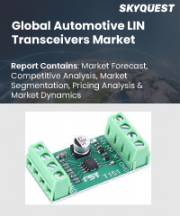
|
시장보고서
상품코드
1897311
자동차용 LIN 트랜시버 시장 규모, 점유율, 성장 분석 : 제품 유형별, 전압별, 용도별, 통신 프로토콜별, 연결성별, 지역별 - 업계 예측(2026-2033년)Automotive LIN Transceivers Market Size, Share, and Growth Analysis, By Product Type, By Voltage, By Application, By Communication Protocol, By Connectivity, By Region - Industry Forecast 2026-2033 |
||||||

자동차용 LIN 트랜시버 시장 규모는 2024년에 53억 4,000만 달러로 평가되었으며, 2025년 57억 1,000만 달러에서 2033년까지 97억 4,000만 달러로 성장할 전망입니다. 예측 기간(2026-2033년) 동안 CAGR은 6.9%로 예측됩니다.
자동차용 LIN 트랜시버 시장은 자동차 전장 분야 전체에서 괄목할 만한 성장세를 보이고 있으며, 그 주요 요인은 차량용 첨단 통신 시스템 및 전장품에 대한 수요 증가에 기인하고 있습니다. 전기자동차 및 하이브리드 차량으로의 전환은 이러한 추세를 더욱 가속화시키고 있으며, 복잡한 전기 시스템을 효과적으로 관리하기 위해서는 고급 LIN 트랜시버가 필수적입니다. 높은 비용과 업계 표준화 부족 등의 과제는 여전히 존재하지만, 시장 성장세는 견고하게 유지되고 있습니다. 주요 동향으로는 차선이탈 경보 및 자동 브레이크 시스템과 같은 첨단 안전 기능에 LIN 트랜시버를 통합하는 것을 들 수 있습니다. 또한, LIN 트랜시버 기술에는 혁신의 여지가 충분하기 때문에 제조업체는 OEM(Original Equipment Manufacturer)과 협력하여 특정 자동차 용도에 맞는 솔루션을 개발할 수 있습니다.
자동차용 LIN 트랜시버 시장 촉진요인
파워 윈도우, 스마트 미러, 자동 공조 제어 등 자동차의 편의 및 편의 기능에 대한 수요가 증가함에 따라 효과적인 통신 및 네트워크 시스템의 필요성이 크게 증가하고 있습니다. LIN 트랜시버는 이러한 시스템에서 중요한 역할을 수행하며, 차량 내 중요하지 않은 기능을 관리하기 위한 비용 효율적이고 신뢰할 수 있는 솔루션을 제공합니다. 이 트랜시버는 전조등, 방향지시등과 같은 기본 기능을 제어하는 조명 제어 모듈 등 다양한 구성품의 작동에 필수적입니다. 따라서 자동차 시스템 내에서 원활한 통신을 가능하게 하는 데 있어 그 중요성이 점점 더 커지고 있습니다.
자동차용 LIN 트랜시버 시장 억제요인
자동차용 LIN 트랜시버 시장은 LIN 트랜시버의 고유한 설계 특성으로 인해 제약을 받고 있습니다. LIN 트랜시버는 저속, 저대역폭 통신이 가능하기 때문에 이러한 한계는 특히 고속 성능이 필수적인 시나리오에서 다양한 자동차 시스템으로의 적용을 제한합니다. 예를 들어, LIN 버스는 빠르고 안정적인 통신이 필요한 파워트레인 제어 및 안전 시스템과 같은 중요한 기능을 충분히 지원하지 못할 수 있습니다. 그 결과, 이러한 첨단 자동차 분야에서 LIN 트랜시버에 대한 의존도가 높아져 더 큰 데이터 처리량과 신뢰성을 필요로 하는 최신 차량 아키텍처로의 채택과 통합에 영향을 미칠 수 있습니다.
자동차용 LIN 트랜시버 시장 동향
자동차용 LIN 트랜시버 시장은 첨단 운전자 보조 시스템(ADAS)의 도입 확대를 배경으로 괄목할만한 성장세를 보이고 있습니다. 주차 보조, 사각지대감지, 후방 카메라 등 첨단 기능이 차량에 점점 더 많이 탑재됨에 따라, 이러한 구성요소 간의 안정적이고 비용 효율적인 통신 솔루션에 대한 수요가 급증하고 있습니다. 단순성과 효율성으로 유명한 LIN 트랜시버는 이러한 시스템에서 원활한 연결성을 보장하는 데 필수적인 요소로 자리 잡고 있습니다. 이러한 추세는 차량의 안전성과 기능성을 향상시키기 위한 종합적인 전환을 반영하고 있으며, 현대 차량의 자동화 및 스마트 기능을 지원하는 데 있어 LIN 기술이 중요한 역할을 하고 있음을 보여줍니다.
자주 묻는 질문
목차
소개
- 조사 목적
- 조사 범위
- 정의
조사 방법
- 정보 조달
- 2차와 1차 데이터 방법
- 시장 규모 예측
- 시장 가정과 제한
주요 요약
- 세계 시장 전망
- 공급과 수요 동향 분석
- 부문별 기회 분석
시장 역학과 전망
- 시장 규모
- 시장 역학
- 성장 촉진요인과 기회
- 성장 억제요인과 과제
- Porters 분석
주요 시장 인사이트
- 핵심성공요인
- 경쟁 정도
- 주요 투자 기회
- 시장 생태계
- 시장 매력 지수(2025년)
- PESTEL 분석
- 거시경제 지표
- 밸류체인 분석
- 가격 분석
세계의 자동차용 LIN 트랜시버 시장 규모 : 제품 유형별 & CAGR(2026-2033년)
- 저속 LIN 트랜시버
- 고속 LIN 트랜시버
세계의 자동차용 LIN 트랜시버 시장 규모 : 전압별 & CAGR(2026-2033년)
- 3.3V LIN 트랜시버
- 5V LIN 트랜시버
세계의 자동차용 LIN 트랜시버 시장 규모 : 용도별 & CAGR(2026-2033년)
- 차체 제어 모듈
- 인포테인먼트 시스템
- 공조 시스템
- 파워트레인 시스템
- 섀시 시스템
- 첨단 운전자 보조 시스템(ADAS)
세계의 자동차용 LIN 트랜시버 시장 규모 : 통신 프로토콜별 & CAGR(2026-2033년)
- LIN 2.0 프로토콜
- LIN 2.1 프로토콜
- LIN 2.2 프로토콜
세계의 자동차용 LIN 트랜시버 시장 규모 : 연결성별 & CAGR(2026-2033년)
- 유선 연결
- 무선 연결
세계의 자동차용 LIN 트랜시버 시장 규모 & CAGR(2026-2033년)
- 북미
- 미국
- 캐나다
- 유럽
- 독일
- 스페인
- 프랑스
- 영국
- 이탈리아
- 기타 유럽
- 아시아태평양
- 중국
- 인도
- 일본
- 한국
- 기타 아시아태평양
- 라틴아메리카
- 브라질
- 기타 라틴아메리카
- 중동 및 아프리카
- GCC 국가
- 남아프리카공화국
- 기타 중동 및 아프리카
경쟁 정보
- 상위 5개사의 비교
- 주요 기업의 시장 포지셔닝(2025년)
- 주요 시장 기업이 채용한 전략
- 최근의 시장 동향
- 기업의 시장 점유율 분석(2025년)
- 주요 기업 개요
- 기업 상세
- 제품 포트폴리오 분석
- 기업 부문별 점유율 분석
- 매출 전년비 비교(2023-2025년)
주요 기업 개요
- Texas Instruments(USA)
- Infineon Technologies(Germany)
- Renesas Electronics Corporation(Japan)
- STMicroelectronics(Switzerland)
- Microchip Technology(USA)
- Analog Devices, Inc.(USA)
- ON Semiconductor(USA)
- ROHM Semiconductor(Japan)
- Toshiba Electronic Devices & Storage Corporation(Japan)
- Melexis(Belgium)
- Elmos Semiconductor SE(Germany)
- Silicon Labs(USA)
- Allegro MicroSystems(USA)
- Diodes Incorporated(USA)
- Semtech Corporation(USA)
- Vishay Intertechnology(USA)
결론과 제안
KSM 26.01.14Automotive LIN Transceivers Market size was valued at USD 5.34 Billion in 2024 and is poised to grow from USD 5.71 Billion in 2025 to USD 9.74 Billion by 2033, growing at a CAGR of 6.9% during the forecast period (2026-2033).
The automotive LIN transceivers market is experiencing significant growth within the broader automotive electronics sector, largely driven by the rising demand for advanced communication systems and electronics in vehicles. The shift toward electric and hybrid vehicles enhances this trend, necessitating sophisticated LIN transceivers to effectively manage intricate electrical systems. While challenges such as high costs and a lack of industry standardization persist, market growth remains robust. Key trends highlight the integration of LIN transceivers into advanced safety features like lane departure warnings and autonomous braking systems. Additionally, there are ample opportunities for innovation in LIN transceiver technology, enabling manufacturers to create tailored solutions for specific automotive applications in collaboration with original equipment manufacturers.
Top-down and bottom-up approaches were used to estimate and validate the size of the Automotive LIN Transceivers market and to estimate the size of various other dependent submarkets. The research methodology used to estimate the market size includes the following details: The key players in the market were identified through secondary research, and their market shares in the respective regions were determined through primary and secondary research. This entire procedure includes the study of the annual and financial reports of the top market players and extensive interviews for key insights from industry leaders such as CEOs, VPs, directors, and marketing executives. All percentage shares split, and breakdowns were determined using secondary sources and verified through Primary sources. All possible parameters that affect the markets covered in this research study have been accounted for, viewed in extensive detail, verified through primary research, and analyzed to get the final quantitative and qualitative data.
Automotive LIN Transceivers Market Segments Analysis
Global Automotive LIN Transceivers Market is segmented by Product Type, Voltage, Application, Communication Protocol, Connectivity and region. Based on Product Type, the market is segmented into Low-speed LIN Transceivers and High-speed LIN Transceivers. Based on Voltage, the market is segmented into 3.3V LIN Transceivers and 5V LIN Transceivers. Based on Application, the market is segmented into Body Control Modules, Infotainment Systems, Climate Control Systems, Powertrain Systems, Chassis Systems and Advanced Driver Assistance Systems (ADAS). Based on Communication Protocol, the market is segmented into LIN 2.0 Protocol, LIN 2.1 Protocol and LIN 2.2 Protocol. Based on Connectivity, the market is segmented into Wired Connectivity and Wireless Connectivity. Based on region, the market is segmented into North America, Europe, Asia Pacific, Latin America and Middle East & Africa.
Driver of the Automotive LIN Transceivers Market
The rising demand for enhanced comfort and convenience features in automobiles, including power windows, smart mirrors, and automatic climate control, significantly boosts the need for effective communication and networking systems. LIN transceivers play a crucial role in these systems, offering a cost-effective and dependable solution for managing non-critical functions within vehicles. These transceivers are instrumental in the operation of various components, such as the lighting control module, which governs essential features like headlamps and turn signals. Consequently, their importance in facilitating seamless communication within automotive systems underscores their growing significance in the industry.
Restraints in the Automotive LIN Transceivers Market
The automotive LIN transceivers market encounters constraints due to the inherent design of LIN transceivers, which facilitate low-speed and low-bandwidth communication. This limitation restricts their application across various automotive systems, particularly in scenarios where high-speed performance is essential. For instance, the LIN bus may not adequately support critical functions such as powertrain control and safety systems that demand rapid and dependable communication. As a result, the reliance on LIN transceivers in these advanced automotive areas is hindered, potentially impacting their adoption and integration into modern vehicle architectures that require greater data throughput and reliability.
Market Trends of the Automotive LIN Transceivers Market
The automotive LIN transceivers market is witnessing a significant upward trend driven by the growing implementation of advanced driver assistance systems (ADAS). As vehicles increasingly rely on sophisticated features like parking assist, blind-spot detection, and rearview cameras, the demand for reliable and cost-effective communication solutions between these components has surged. LIN transceivers, known for their simplicity and efficiency, are becoming integral to ensuring seamless connectivity in these systems. This trend reflects an overarching shift towards enhanced vehicle safety and functionality, highlighting the crucial role of LIN technology in supporting the automation and smart features of modern vehicles.
Table of Contents
Introduction
- Objectives of the Study
- Scope of the Report
- Definitions
Research Methodology
- Information Procurement
- Secondary & Primary Data Methods
- Market Size Estimation
- Market Assumptions & Limitations
Executive Summary
- Global Market Outlook
- Supply & Demand Trend Analysis
- Segmental Opportunity Analysis
Market Dynamics & Outlook
- Market Overview
- Market Size
- Market Dynamics
- Drivers & Opportunities
- Restraints & Challenges
- Porters Analysis
- Competitive rivalry
- Threat of substitute
- Bargaining power of buyers
- Threat of new entrants
- Bargaining power of suppliers
Key Market Insights
- Key Success Factors
- Degree of Competition
- Top Investment Pockets
- Market Ecosystem
- Market Attractiveness Index, 2025
- PESTEL Analysis
- Macro-Economic Indicators
- Value Chain Analysis
- Pricing Analysis
Global Automotive LIN Transceivers Market Size by Product Type & CAGR (2026-2033)
- Market Overview
- Low-speed LIN Transceivers
- High-speed LIN Transceivers
Global Automotive LIN Transceivers Market Size by Voltage & CAGR (2026-2033)
- Market Overview
- 3.3V LIN Transceivers
- 5V LIN Transceivers
Global Automotive LIN Transceivers Market Size by Application & CAGR (2026-2033)
- Market Overview
- Body Control Modules
- Infotainment Systems
- Climate Control Systems
- Powertrain Systems
- Chassis Systems
- Advanced Driver Assistance Systems (ADAS)
Global Automotive LIN Transceivers Market Size by Communication Protocol & CAGR (2026-2033)
- Market Overview
- LIN 2.0 Protocol
- LIN 2.1 Protocol
- LIN 2.2 Protocol
Global Automotive LIN Transceivers Market Size by Connectivity & CAGR (2026-2033)
- Market Overview
- Wired Connectivity
- Wireless Connectivity
Global Automotive LIN Transceivers Market Size & CAGR (2026-2033)
- North America (Product Type, Voltage, Application, Communication Protocol, Connectivity)
- US
- Canada
- Europe (Product Type, Voltage, Application, Communication Protocol, Connectivity)
- Germany
- Spain
- France
- UK
- Italy
- Rest of Europe
- Asia Pacific (Product Type, Voltage, Application, Communication Protocol, Connectivity)
- China
- India
- Japan
- South Korea
- Rest of Asia-Pacific
- Latin America (Product Type, Voltage, Application, Communication Protocol, Connectivity)
- Brazil
- Rest of Latin America
- Middle East & Africa (Product Type, Voltage, Application, Communication Protocol, Connectivity)
- GCC Countries
- South Africa
- Rest of Middle East & Africa
Competitive Intelligence
- Top 5 Player Comparison
- Market Positioning of Key Players, 2025
- Strategies Adopted by Key Market Players
- Recent Developments in the Market
- Company Market Share Analysis, 2025
- Company Profiles of All Key Players
- Company Details
- Product Portfolio Analysis
- Company's Segmental Share Analysis
- Revenue Y-O-Y Comparison (2023-2025)
Key Company Profiles
- Texas Instruments (USA)
- Company Overview
- Business Segment Overview
- Financial Updates
- Key Developments
- Infineon Technologies (Germany)
- Company Overview
- Business Segment Overview
- Financial Updates
- Key Developments
- Renesas Electronics Corporation (Japan)
- Company Overview
- Business Segment Overview
- Financial Updates
- Key Developments
- STMicroelectronics (Switzerland)
- Company Overview
- Business Segment Overview
- Financial Updates
- Key Developments
- Microchip Technology (USA)
- Company Overview
- Business Segment Overview
- Financial Updates
- Key Developments
- Analog Devices, Inc. (USA)
- Company Overview
- Business Segment Overview
- Financial Updates
- Key Developments
- ON Semiconductor (USA)
- Company Overview
- Business Segment Overview
- Financial Updates
- Key Developments
- ROHM Semiconductor (Japan)
- Company Overview
- Business Segment Overview
- Financial Updates
- Key Developments
- Toshiba Electronic Devices & Storage Corporation (Japan)
- Company Overview
- Business Segment Overview
- Financial Updates
- Key Developments
- Melexis (Belgium)
- Company Overview
- Business Segment Overview
- Financial Updates
- Key Developments
- Elmos Semiconductor SE (Germany)
- Company Overview
- Business Segment Overview
- Financial Updates
- Key Developments
- Silicon Labs (USA)
- Company Overview
- Business Segment Overview
- Financial Updates
- Key Developments
- Allegro MicroSystems (USA)
- Company Overview
- Business Segment Overview
- Financial Updates
- Key Developments
- Diodes Incorporated (USA)
- Company Overview
- Business Segment Overview
- Financial Updates
- Key Developments
- Semtech Corporation (USA)
- Company Overview
- Business Segment Overview
- Financial Updates
- Key Developments
- Vishay Intertechnology (USA)
- Company Overview
- Business Segment Overview
- Financial Updates
- Key Developments