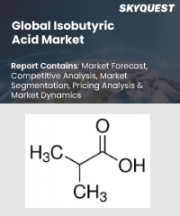
|
시장보고서
상품코드
1904321
이소부티르산 시장 규모, 점유율, 성장 분석 : 등급별, 유형별, 순도별, 최종 용도별, 지역별 - 업계 예측(2026-2033년)Isobutyric Acid Market Size, Share, and Growth Analysis, By Grade (Industrial Grade, Reagent Grade), By Type (Synthetic, Renewable), By Purity, By End Use, By Region - Industry Forecast 2026-2033 |
||||||

이소부티르산 시장 규모는 2024년에 2억 2,000만 달러로 평가되었으며, 2025년 2억 3,000만 달러에서 2033년까지 4억 4,000만 달러로 성장할 전망입니다. 예측 기간(2026-2033년) 동안 CAGR은 8.2%로 예측됩니다.
이소부티르산의 수요 확대는 다양한 산업 분야의 광범위한 응용 분야에 의해 주도되고 있습니다. 의약품 분야에서는 의약품 유효성분의 중간체 및 의약품 제제의 용매로 활용되고 있습니다. 식음료 분야에서는 캔디, 구운 과자 등의 제품에 향료로 사용되고 있습니다. 또한, 사료 첨가제로서 동물의 영양을 강화하고 사료의 기호성과 가치를 향상시킵니다. 그 장점에 대한 인식이 높아지고 제조 공정의 발전이 시장 성장을 주도하고 있습니다. 특히 아시아태평양은 수많은 화학 제조시설이 존재하기 때문에 중요한 거점이 되고 있습니다. 원자재 가격 변동과 환경 규제와 같은 이슈가 장벽이 될 수 있지만, 시장 전체는 이해관계자들에게 유망하고 큰 기회를 제공하고 있습니다.
이소부티르산 시장 촉진요인
이소부티르산 시장 확대를 이끄는 중요한 요인은 식음료 분야의 향료 수요 증가입니다. 이소부티르산은 인기 있는 향료 첨가제로서 다양한 식품의 풍미 프로파일을 향상시키고 독특한 감각적 경험을 제공합니다. 소비자들이 더 다양한 맛과 향을 추구하는 경향이 강화되면서 세계 식품 산업의 성장과 함께 이소부티르산의 수요는 계속 증가하고 있습니다. 이러한 추세는 다양하고 혁신적인 식경험을 원하는 소비자의 기호에 부응하는 데 있어 이소부티르산이 중요한 역할을 하고 있음을 입증합니다.
이소부티르산 시장 억제요인
세계 이소부티르산 시장이 직면한 가장 큰 도전은 원료 가격의 불안정성입니다. 이소부티르산 생산은 석유화학 기반 원료에 크게 의존하고 있으며, 이러한 가격 변동은 전체 생산 비용의 증가로 이어집니다. 이러한 가격 변동은 제조업체들이 비용 관리와 효과적인 가격 전략을 수립하는 데 어려움을 겪게 되고, 결국 업계 내 시장 확대와 수익성을 저해할 수 있습니다. 원자재 비용의 변동성 속에서 기업은 이러한 재정적 불확실성을 극복해야 하며, 일관된 성장을 유지하고 시장에서 효과적으로 경쟁하는 것이 더욱 어려워집니다.
이소부티르산 시장 동향
이소부티르산 시장에서는 지속가능성에 대한 관심이 높아지고 바이오 기반 대체품에 대한 수요가 증가함에 따라 두드러진 추세를 보이고 있습니다. 환경 문제에 대한 관심이 높아지면서 각 산업계는 탄소발자국을 줄이고 친환경적인 방법을 채택하는 것을 우선순위로 삼고 있습니다. 이러한 변화는 지속가능한 원료에서 추출한 재생 가능한 이소부티르산을 생산하려는 움직임을 촉진하고 있습니다. 기업들은 지속가능한 화학제품을 원하는 소비자의 기호에 맞춰 혁신적인 바이오 기반 공정과 기술을 탐구하기 위해 연구개발에 적극적으로 투자하고 있습니다. 결과적으로 이러한 추세는 화학 산업 전반에 걸쳐 친환경 대안을 수용하고 지속가능한 미래를 위한 광범위한 노력을 반영하고 있습니다.
자주 묻는 질문
목차
소개
- 조사 목적
- 조사 범위
- 정의
조사 방법
- 정보 조달
- 2차와 1차 데이터 방법
- 시장 규모 예측
- 시장 가정과 제한
주요 요약
- 세계 시장 전망
- 공급과 수요 동향 분석
- 부문별 기회 분석
시장 역학과 전망
- 시장 규모
- 시장 역학
- 성장 촉진요인과 기회
- 성장 억제요인과 과제
- Porters 분석과 영향
주요 시장 인사이트
- 핵심성공요인
- 경쟁 정도
- 주요 투자 기회
- 시장 생태계
- 시장 매력 지수(2025년)
- PESTEL 분석
- 거시경제 지표
- 밸류체인 분석
- 가격 분석
- 규제 상황
- 원재료 분석
- 사례 연구
- 특허 분석
이소부티르산 시장 규모 : 등급별 & CAGR(2026-2033년)
- 산업용 등급
- 시약 등급
이소부티르산 시장 규모 : 유형별 & CAGR(2026-2033년)
- 재생
- 합성
이소부티르산 시장 규모 : 순도별 & CAGR(2026-2033년)
- 98% 이상
- 98%까지
이소부티르산 시장 규모 : 최종 용도별 & CAGR(2026-2033년)
- 사료
- 식품·향료
- 화학 중간체
- 의약품
- 기타
이소부티르산 시장 규모 : 지역별 & CAGR(2026-2033년)
- 북미
- 미국
- 캐나다
- 유럽
- 영국
- 독일
- 스페인
- 프랑스
- 이탈리아
- 기타 유럽
- 아시아태평양
- 중국
- 인도
- 일본
- 한국
- 기타 아시아태평양
- 라틴아메리카
- 브라질
- 기타 라틴아메리카
- 중동 및 아프리카
- GCC 국가
- 남아프리카공화국
- 기타 중동 및 아프리카
경쟁 정보
- 상위 5개사의 비교
- 주요 기업의 시장 포지셔닝(2025년)
- 주요 시장 기업이 채용한 전략
- 최근의 시장 동향
- 기업의 시장 점유율 분석(2025년)
- 주요 기업 개요
- 기업 상세
- 제품 포트폴리오 분석
- 기업 부문별 점유율 분석
- 매출 전년비 비교(2021-2023년)
주요 기업 개요
- OQ Chemicals GmbH(Germany)
- Eastman Chemical Company(US)
- Tokyo Chemical Industry Co., Ltd.(Japan)
- Snowco(China)
- Shanghai Aladdin Biochemical Technology Co., Ltd.(China)
- Afyren(France)
- Lygos, Inc.(US)
- Dow Inc.(US)
- Jiangsu Dynamic Chemical Co., Ltd.(China)
- Weifang Qiyi Chemical Co., Ltd.(China)
- Yufeng International Group Co., Ltd.(China)
- Nanjing Chemical Material Corp.(China)
- FUJIFILM Wako Pure Chemical Corporation(Japan)
- Hubei Jusheng Technology Co., Ltd.(China)
- BASF SE(Germany)
- Perstorp Holding AB(Sweden)
- Sasol Ltd.(South Africa)
- Chemos GmbH & Co. KG(Germany)
- ISCA UK Ltd.(United Kingdom)
- Zhengzhou Yibang Industry Co., Ltd.(China)
결론과 제안
KSM 26.01.22Isobutyric Acid Market size was valued at USD 0.22 Billion in 2024 and is poised to grow from USD 0.23 Billion in 2025 to USD 0.44 Billion by 2033, growing at a CAGR of 8.2% during the forecast period (2026-2033).
The growing demand for isobutyric acid is driven by its wide-ranging applications across various industries. In pharmaceuticals, it serves as an intermediate for active pharmaceutical ingredients and as a solvent in drug formulations. The food and beverage sector employs isobutyric acid as a flavoring agent in products such as candies and baked goods. Furthermore, it enhances animal nutrition as a feed additive, improving feed palatability and value. Rising awareness of its benefits and advancements in production processes are propelling market growth. Notably, the Asia Pacific region is becoming a vital hub due to numerous chemical manufacturing facilities. Although challenges like fluctuating raw material costs and environmental regulations may pose hurdles, the overall market remains promising for stakeholders, offering significant opportunities.
Top-down and bottom-up approaches were used to estimate and validate the size of the Isobutyric Acid market and to estimate the size of various other dependent submarkets. The research methodology used to estimate the market size includes the following details: The key players in the market were identified through secondary research, and their market shares in the respective regions were determined through primary and secondary research. This entire procedure includes the study of the annual and financial reports of the top market players and extensive interviews for key insights from industry leaders such as CEOs, VPs, directors, and marketing executives. All percentage shares split, and breakdowns were determined using secondary sources and verified through Primary sources. All possible parameters that affect the markets covered in this research study have been accounted for, viewed in extensive detail, verified through primary research, and analyzed to get the final quantitative and qualitative data.
Isobutyric Acid Market Segments Analysis
Global Isobutyric Acid Market is segmented by Grade, Type, purity, End Use and Region. Based on Grade, the market is segmented into Industrial Grade, Reagent Grade. Based on Type, the market is segmented into Synthetic, Renewable. Based on Purity, the market is segmented into Above 98%, Below 98%. Based on End Use, the market is segmented into Animal Feed, Food and Flavour, Chemical Intermediate, Pharmaceutical, Others. Based on Region, the market is segmented into North America, Europe, Asia Pacific, Latin America and Middle East & and Africa.
Driver of the Isobutyric Acid Market
A significant factor propelling the expansion of the isobutyric acid market is the rising demand for flavoring agents within the food and beverage sector. Isobutyric acid serves as a popular flavoring additive, enhancing taste profiles and delivering distinct sensory experiences in a variety of food products. As consumers increasingly seek out a broader spectrum of flavors and tastes, alongside the ongoing growth of the global food industry, the need for isobutyric acid continues to escalate. This trend underscores the important role isobutyric acid plays in meeting consumer preferences for diverse and innovative culinary experiences.
Restraints in the Isobutyric Acid Market
A significant challenge facing the global isobutyric acid market is the instability of raw material prices. The production of isobutyric acid heavily relies on petrochemical-based feedstocks, and any variations in these prices can lead to increased overall production costs. This price volatility creates difficulties for manufacturers in managing expenses and developing effective pricing strategies, which can ultimately hinder market expansion and profitability within the industry. As raw material costs fluctuate, businesses must navigate these financial uncertainties, making it harder to maintain consistent growth and compete effectively in the marketplace.
Market Trends of the Isobutyric Acid Market
The isobutyric acid market is experiencing a notable trend driven by an increasing emphasis on sustainability and the demand for bio-based alternatives. As environmental concerns heighten, industries are prioritizing reducing carbon footprints and adopting eco-friendly practices. This shift has spurred a movement towards the production of renewable isobutyric acid sourced from sustainable feedstocks. Businesses are actively investing in research and development to explore innovative bio-based processes and technologies, aiming to align with consumer preferences for sustainable chemicals. Consequently, this trend reflects a broader commitment within the chemical sector to embrace greener alternatives and foster a more sustainable future.
Table of Contents
Introduction
- Objectives of the Study
- Scope of the Report
- Definitions
Research Methodology
- Information Procurement
- Secondary & Primary Data Methods
- Market Size Estimation
- Market Assumptions & Limitations
Executive Summary
- Global Market Outlook
- Supply & Demand Trend Analysis
- Segmental Opportunity Analysis
Market Dynamics & Outlook
- Market Overview
- Market Size
- Market Dynamics
- Driver & Opportunities
- Restraints & Challenges
- Porters Analysis & Impact
- Competitive rivalry
- Threat of substitute
- Bargaining power of buyers
- Threat of new entrants
- Bargaining power of suppliers
Key Market Insights
- Key Success Factors
- Degree of Competition
- Top Investment Pockets
- Market Ecosystem
- Market Attractiveness Index, 2025
- PESTEL Analysis
- Macro-Economic Indicators
- Value Chain Analysis
- Pricing Analysis
- Regulatory Landscape
- Raw Material Analysis
- Case Studies
- Patent Analysis
Isobutyric Acid Market Size by Grade & CAGR (2026-2033)
- Market Overview
- Industrial Grade
- Reagent Grade
Isobutyric Acid Market Size by Type & CAGR (2026-2033)
- Market Overview
- Renewable
- Synthetic
Isobutyric Acid Market Size by Purity & CAGR (2026-2033)
- Market Overview
- Above 98%
- Up to 98%
Isobutyric Acid Market Size by End Use & CAGR (2026-2033)
- Market Overview
- Animal Feed
- Food and Flavour
- Chemical Intermediate
- Pharmaceutical
- Others
Isobutyric Acid Market Size & CAGR (2026-2033)
- North America, (Grade, Type, Purity, End Use)
- US
- Canada
- Europe, (Grade, Type, Purity, End Use se)
- UK
- Germany
- Spain
- France
- Italy
- Rest of Europe
- Asia-Pacific, (Grade, Type, Purity, End Use)
- China
- India
- Japan
- South Korea
- Rest of Asia Pacific
- Latin America, (Grade, Type, Purity, End Use)
- Brazil
- Rest of Latin America
- Middle East & Africa, (Grade, Type, Purity, End Use)
- GCC Countries
- South Africa
- Rest of Middle East & Africa
Competitive Intelligence
- Top 5 Player Comparison
- Market Positioning of Key Players, 2025
- Strategies Adopted by Key Market Players
- Recent Developments in the Market
- Company Market Share Analysis, 2025
- Company Profiles of All Key Players
- Company Details
- Product Portfolio Analysis
- Company's Segmental Share Analysis
- Revenue Y-O-Y Comparison (2021-2023)
Key Company Profiles
- OQ Chemicals GmbH (Germany)
- Company Overview
- Business Segment Overview
- Financial Updates
- Key Developments
- Eastman Chemical Company (US)
- Company Overview
- Business Segment Overview
- Financial Updates
- Key Developments
- Tokyo Chemical Industry Co., Ltd. (Japan)
- Company Overview
- Business Segment Overview
- Financial Updates
- Key Developments
- Snowco (China)
- Company Overview
- Business Segment Overview
- Financial Updates
- Key Developments
- Shanghai Aladdin Biochemical Technology Co., Ltd. (China)
- Company Overview
- Business Segment Overview
- Financial Updates
- Key Developments
- Afyren (France)
- Company Overview
- Business Segment Overview
- Financial Updates
- Key Developments
- Lygos, Inc. (US)
- Company Overview
- Business Segment Overview
- Financial Updates
- Key Developments
- Dow Inc. (US)
- Company Overview
- Business Segment Overview
- Financial Updates
- Key Developments
- Jiangsu Dynamic Chemical Co., Ltd. (China)
- Company Overview
- Business Segment Overview
- Financial Updates
- Key Developments
- Weifang Qiyi Chemical Co., Ltd. (China)
- Company Overview
- Business Segment Overview
- Financial Updates
- Key Developments
- Yufeng International Group Co., Ltd. (China)
- Company Overview
- Business Segment Overview
- Financial Updates
- Key Developments
- Nanjing Chemical Material Corp. (China)
- Company Overview
- Business Segment Overview
- Financial Updates
- Key Developments
- FUJIFILM Wako Pure Chemical Corporation (Japan)
- Company Overview
- Business Segment Overview
- Financial Updates
- Key Developments
- Hubei Jusheng Technology Co., Ltd. (China)
- Company Overview
- Business Segment Overview
- Financial Updates
- Key Developments
- BASF SE (Germany)
- Company Overview
- Business Segment Overview
- Financial Updates
- Key Developments
- Perstorp Holding AB (Sweden)
- Company Overview
- Business Segment Overview
- Financial Updates
- Key Developments
- Sasol Ltd. (South Africa)
- Company Overview
- Business Segment Overview
- Financial Updates
- Key Developments
- Chemos GmbH & Co. KG (Germany)
- Company Overview
- Business Segment Overview
- Financial Updates
- Key Developments
- ISCA UK Ltd. (United Kingdom)
- Company Overview
- Business Segment Overview
- Financial Updates
- Key Developments
- Zhengzhou Yibang Industry Co., Ltd. (China)
- Company Overview
- Business Segment Overview
- Financial Updates
- Key Developments