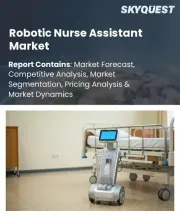
|
시장보고서
상품코드
2048923
로봇 간호 도우미 시장 규모, 점유율, 성장 분석 : 유형별, 기능별, 기술별, 이동성별, 도입 형태별, 최종사용자별, 지역별 - 업계 예측(2026-2033년)Robotic Nurse Assistant Market Size, Share, and Growth Analysis, By Type, By Functionality, By Technology, By Mobility, By Deployment Mode, By End User, By Region - Industry Forecast 2026-2033 |
||||||

세계의 로봇 간호 도우미 시장 규모는 2024년 21억 달러, 2025년 24억 3,000만 달러에서 2033년까지 79억 2,000만 달러로 확대되어 예측 기간(2026-2033년)에 CAGR 15.9%를 보일 전망입니다.
세계 로봇 간호 도우미 시장은 만성질환 증가, 고령화, 의료 인력 부족을 배경으로 괄목할 만한 성장을 거듭하고 있으며, 확장성 있는 케어 솔루션에 대한 수요가 증가하고 있습니다. 자율적이든 반자율적이든, 이러한 로봇 비서는 투약, 활력징후 모니터링, 이동 지원 및 환자 치료를 향상시키는 다양한 업무를 지원합니다. 이러한 기술은 의료진의 번아웃을 줄이고 감염 위험을 줄임으로써 의료 서비스 제공 능력을 향상시킬 수 있습니다. AI와 센서 기술의 급속한 발전은 안전성을 높이고, 전자건강기록(EHR)과의 통합을 촉진하며, 병원의 시간을 절약할 수 있습니다. 또한, 지원적인 규제 프레임워크와 상환 모델이 도입을 촉진하고 있으며, 특히 홈케어, 재활 및 지방의 원격 간호 분야에서 생산 규모 확대와 비용 절감을 위한 투자를 유도하고 있습니다.
세계 로봇 간호 도우미 시장의 성장 요인
세계 로봇 간호 도우미 시장은 고령화에 따른 돌봄 수요 증가로 인해 크게 견인되고 있습니다. 고령화 사회에서는 지속적인 모니터링, 일상생활 지원, 만성질환 관리가 필요합니다. 이러한 로봇 시스템은 일상적이고 육체적으로 힘든 업무를 효율적으로 처리하고, 의료진이 보다 복잡한 치료 요구에 집중할 수 있도록 함으로써 워크플로우의 효율성을 높이고 간병인의 번아웃을 줄여줍니다. 낙상 방지, 복약 알림 등의 기능은 환자의 안전에 기여하고 의료기관의 자동화 솔루션 도입에 대한 신뢰도를 높이고 있습니다. 의료진에게 로봇 간호 도우미은 인적 자원을 줄이면서 양질의 진료를 제공할 수 있다는 점에서 의료진에게 더욱 매력적입니다.
세계 로봇 간호 도우미 시장 성장 억제요인
세계 로봇 간호 도우미 시장은 도입에 필요한 막대한 초기 투자(하드웨어 조달, 시설 개보수, 직원 교육 비용 등)로 인해 큰 제약에 직면해 있습니다. 지속적인 유지보수, 소프트웨어 업데이트, 기존 시스템과의 원활한 통합이 필요하기 때문에 총소유비용이 증가하기 때문에 이러한 재정적 문제로 인해 의료 서비스 제공업체가 도입을 망설이는 경우가 많습니다. 또한, 소규모 병원이나 클리닉의 경우 한정된 예산을 필수 임상 인력 배치 및 기타 긴급한 우선순위에 할당하는 경우가 많기 때문에 도입 과정이 지연되는 경향이 있습니다. 관리자들은 투자 회수 기간에 대해 신중한 태도를 보이는 경우가 많으며, 이 기술의 신속하고 광범위한 도입에 소극적인 경향이 있습니다.
세계 로봇 간호 도우미 시장 동향
세계 로봇 간호 도우미 시장에서는 로봇 솔루션이 기존 간호 업무를 보완하는 '노동력 증강'으로의 큰 변화를 볼 수 있습니다. 이러한 로봇이 일상적인 업무를 처리함으로써 의료진은 보다 복잡한 임상 및 대인 업무에 집중할 수 있게 되어 환자 치료의 질을 향상시킬 수 있습니다. 의료 서비스 제공업체는 필수적인 치료 관계를 유지하면서 로봇 비서를 진료팀에 원활하게 통합하기 위해 다학제적 교육 및 관리 전략을 우선순위에 두고 있습니다. 이러한 추세는 협력적인 워크플로우를 촉진하고, 인체공학적 설계와 사용자 친화적인 인터페이스를 강조함으로써 궁극적으로 임상의의 도입을 촉진할 것입니다. 의료 기관이 발전함에 따라 새로운 역량 프레임워크와 인증 경로가 등장하고 있으며, 이는 자동화뿐만 아니라 간호 현장에서 인간의 감독도 중요하다는 것을 강조하고 있습니다.
자주 묻는 질문
목차
서론
조사 방법
주요 요약
시장 역학과 전망
주요 시장 인사이트
세계의 로봇 간호 도우미 시장 규모 : 유형별
세계의 로봇 간호 도우미 시장 규모 : 기능성별
세계의 로봇 간호 도우미 시장 규모 : 기술별
세계의 로봇 간호 도우미 시장 규모 : 모빌리티별
세계의 로봇 간호 도우미 시장 규모 : 도입 모드별
세계의 로봇 간호 도우미 시장 규모 : 최종사용자별
세계의 로봇 간호 도우미 시장 규모 : 지역별
경쟁 정보
주요 기업 개요
결론과 제안
LSH 26.06.11Global Robotic Nurse Assistant Market size was valued at USD 2.10 Billion in 2024 and is poised to grow from USD 2.43 Billion in 2025 to USD 7.92 Billion by 2033, growing at a CAGR of 15.9% during the forecast period (2026-2033).
The global robotic nurse assistant market is experiencing significant growth driven by the increasing prevalence of chronic diseases, an aging population, and shortages in healthcare workforce, creating a pressing need for scalable care solutions. These robotic assistants, whether autonomous or semi-autonomous, aid in medication delivery, vital sign monitoring, mobility assistance, and various tasks that enhance patient care. By alleviating clinician burnout and lowering infection risks, these technologies improve care capacity. Rapid advancements in AI and sensor technologies enhance safety and facilitate electronic health record (EHR) integration, leading to time savings in hospitals. Moreover, supportive regulatory frameworks and reimbursement models are encouraging adoption, attracting investments to scale up production and decrease costs, particularly in home care, rehabilitation, and rural tele-nursing sectors.
Top-down and bottom-up approaches were used to estimate and validate the size of the Global Robotic Nurse Assistant market and to estimate the size of various other dependent submarkets. The research methodology used to estimate the market size includes the following details: The key players in the market were identified through secondary research, and their market shares in the respective regions were determined through primary and secondary research. This entire procedure includes the study of the annual and financial reports of the top market players and extensive interviews for key insights from industry leaders such as CEOs, VPs, directors, and marketing executives. All percentage shares split, and breakdowns were determined using secondary sources and verified through Primary sources. All possible parameters that affect the markets covered in this research study have been accounted for, viewed in extensive detail, verified through primary research, and analyzed to get the final quantitative and qualitative data.
Global Robotic Nurse Assistant Market Segments Analysis
Global robotic nurse assistant market is segmented by type, functionality, technology, mobility, deployment mode, end user and region. Based on type, the market is segmented into autonomous robotic nurse assistants, semi-autonomous robotic nurse assistants and collaborative robotic nurse assistants (Cobots). Based on functionality, the market is segmented into patient monitoring assistance, medication delivery & dispensing assistance, patient handling & mobility assistance, disinfection & sanitization assistance, telepresence & communication assistance, logistics & material transport assistance, rehabilitation & elderly care assistance and others. Based on technology, the market is segmented into artificial intelligence-based robots, machine learning-enabled robots, sensor & vision-based robots, cloud-connected robotic systems and iot-integrated robotic systems. Based on mobility, the market is segmented into mobile robotic nurse assistants and stationary robotic nurse assistants. Based on deployment mode, the market is segmented into on-premise systems and cloud-integrated systems. Based on end user, the market is segmented into hospitals, clinics, elderly care centers & nursing homes, rehabilitation centers, home healthcare settings and ambulatory surgical centers. Based on region, the market is segmented into North America, Europe, Asia Pacific, Latin America and Middle East & Africa.
Driver of the Global Robotic Nurse Assistant Market
The Global Robotic Nurse Assistant market is significantly driven by the increasing care demands of an aging population, which requires ongoing monitoring, support with daily activities, and management of chronic conditions. These robotic systems efficiently handle routine and physically taxing tasks, allowing healthcare professionals to concentrate on more complex care needs, thereby enhancing workflow efficiency and alleviating caregiver burnout. Features such as fall prevention and medication reminders contribute to patient safety and bolster the confidence of healthcare institutions in adopting automated solutions. The capacity to deliver high-quality care with reduced human resources further enhances the appeal of robotic nursing assistants for healthcare providers.
Restraints in the Global Robotic Nurse Assistant Market
The Global Robotic Nurse Assistant market faces significant restraints primarily due to the substantial initial investment needed for implementation, which includes hardware procurement, facility upgrades, and staff training expenses. These financial challenges often deter healthcare providers, as the total cost of ownership expands with ongoing maintenance, software updates, and the requirement for seamless integration with current systems. Additionally, smaller hospitals and clinics frequently allocate their limited budgets toward essential clinical staffing and other urgent priorities, resulting in slower procurement processes. Administrators often exhibit caution regarding the timeline for return on investment, leading to a reluctance to rapidly and broadly adopt this technology.
Market Trends of the Global Robotic Nurse Assistant Market
The Global Robotic Nurse Assistant market is witnessing a significant shift towards workforce augmentation, where robotic solutions complement traditional caregiving roles. By handling routine tasks, these robots enable healthcare staff to focus more on complex clinical and interpersonal duties, leading to enhanced patient care. Healthcare providers are prioritizing interdisciplinary training and management strategies to seamlessly integrate robotic assistants into care teams while maintaining essential therapeutic relationships. This trend promotes collaborative workflows and emphasizes ergonomic design and user-friendly interfaces, ultimately enhancing clinician adoption. As institutions evolve, new competency frameworks and certification pathways emerge, highlighting the importance of human oversight alongside automation in the caregiving landscape.
Table of Contents
Introduction
- Objectives of the Study
- Market Definition & Scope
Research Methodology
- Research Process
- Secondary & Primary Data Methods
- Market Size Estimation Methods
Executive Summary
- Global Market Outlook
- Key Market Highlights
- Segmental Overview
- Competition Overview
Market Dynamics & Outlook
- Macro-Economic Indicators
- Drivers & Opportunities
- Restraints & Challenges
- Supply Side Trends
- Demand Side Trends
- Porters Analysis & Impact
- Competitive Rivalry
- Threat of Substitute
- Bargaining Power of Buyers
- Threat of New Entrants
- Bargaining Power of Suppliers
Key Market Insights
- Key Success Factors
- Market Impacting Factors
- Top Investment Pockets
- Ecosystem Mapping
- Market Attractiveness Index 2025
- PESTEL Analysis
- Regulatory Landscape
Global Robotic Nurse Assistant Market Size by Type & CAGR (2026-2033)
- Market Overview
- Autonomous Robotic Nurse Assistants
- Semi-Autonomous Robotic Nurse Assistants
- Collaborative Robotic Nurse Assistants (Cobots)
Global Robotic Nurse Assistant Market Size by Functionality & CAGR (2026-2033)
- Market Overview
- Patient Monitoring Assistance
- Medication Delivery & Dispensing Assistance
- Patient Handling & Mobility Assistance
- Disinfection & Sanitization Assistance
- Telepresence & Communication Assistance
- Logistics & Material Transport Assistance
- Rehabilitation & Elderly Care Assistance
- Others
Global Robotic Nurse Assistant Market Size by Technology & CAGR (2026-2033)
- Market Overview
- Artificial Intelligence-Based Robots
- Machine Learning-Enabled Robots
- Sensor & Vision-Based Robots
- Cloud-Connected Robotic Systems
- IoT-Integrated Robotic Systems
Global Robotic Nurse Assistant Market Size by Mobility & CAGR (2026-2033)
- Market Overview
- Mobile Robotic Nurse Assistants
- Stationary Robotic Nurse Assistants
Global Robotic Nurse Assistant Market Size by Deployment Mode & CAGR (2026-2033)
- Market Overview
- On-Premise Systems
- Cloud-Integrated Systems
Global Robotic Nurse Assistant Market Size by End User & CAGR (2026-2033)
- Market Overview
- Hospitals
- Clinics
- Elderly Care Centers & Nursing Homes
- Rehabilitation Centers
- Home Healthcare Settings
- Ambulatory Surgical Centers
Global Robotic Nurse Assistant Market Size & CAGR (2026-2033)
- North America (Type, Functionality, Technology, Mobility, Deployment Mode, End User)
- US
- Canada
- Europe (Type, Functionality, Technology, Mobility, Deployment Mode, End User)
- Germany
- Spain
- France
- UK
- Italy
- Rest of Europe
- Asia Pacific (Type, Functionality, Technology, Mobility, Deployment Mode, End User)
- China
- India
- Japan
- South Korea
- Rest of Asia-Pacific
- Latin America (Type, Functionality, Technology, Mobility, Deployment Mode, End User)
- Mexico
- Brazil
- Rest of Latin America
- Middle East & Africa (Type, Functionality, Technology, Mobility, Deployment Mode, End User)
- GCC Countries
- South Africa
- Rest of Middle East & Africa
Competitive Intelligence
- Top 5 Player Comparison
- Market Positioning of Key Players, 2025
- Strategies Adopted by Key Market Players
- Recent Developments in the Market
- Company Market Share Analysis, 2025
- Company Profiles of All Key Players
- Company Details
- Product Portfolio Analysis
- Company's Segmental Share Analysis
- Revenue Y-O-Y Comparison (2023-2025)
Key Company Profiles
- Intuitive Surgical
- Company Overview
- Business Segment Overview
- Financial Updates
- Key Developments
- Stryker Corporation
- Company Overview
- Business Segment Overview
- Financial Updates
- Key Developments
- Omnicell, Inc.
- Company Overview
- Business Segment Overview
- Financial Updates
- Key Developments
- Aethon, Inc.
- Company Overview
- Business Segment Overview
- Financial Updates
- Key Developments
- Diligent Robotics
- Company Overview
- Business Segment Overview
- Financial Updates
- Key Developments
- Panasonic Holdings Corporation
- Company Overview
- Business Segment Overview
- Financial Updates
- Key Developments
- Toyota Motor Corporation
- Company Overview
- Business Segment Overview
- Financial Updates
- Key Developments
- Cyberdyne Inc.
- Company Overview
- Business Segment Overview
- Financial Updates
- Key Developments
- SoftBank Robotics Group Corp.
- Company Overview
- Business Segment Overview
- Financial Updates
- Key Developments
- FANUC Corporation
- Company Overview
- Business Segment Overview
- Financial Updates
- Key Developments
- ABB Ltd.
- Company Overview
- Business Segment Overview
- Financial Updates
- Key Developments
- KUKA AG
- Company Overview
- Business Segment Overview
- Financial Updates
- Key Developments
- Samsung Electronics Co., Ltd.
- Company Overview
- Business Segment Overview
- Financial Updates
- Key Developments
- Medtronic plc
- Company Overview
- Business Segment Overview
- Financial Updates
- Key Developments
- Becton, Dickinson and Company
- Company Overview
- Business Segment Overview
- Financial Updates
- Key Developments
- Swisslog Healthcare
- Company Overview
- Business Segment Overview
- Financial Updates
- Key Developments
- Ava Robotics
- Company Overview
- Business Segment Overview
- Financial Updates
- Key Developments
- Vecna Technologies, Inc.
- Company Overview
- Business Segment Overview
- Financial Updates
- Key Developments
- Relay Robotics, Inc.
- Company Overview
- Business Segment Overview
- Financial Updates
- Key Developments
- OhmniLabs, Inc.
- Company Overview
- Business Segment Overview
- Financial Updates
- Key Developments