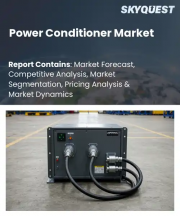
|
시장보고서
상품코드
2078694
파워 컨디셔너 시장 규모, 점유율 및 성장 분석 : 유형별, 상별, 정격 출력별, 최종사용자별, 용도별, 지역별 - 업계 예측(2026-2033년)Power Conditioner Market Size, Share, and Growth Analysis, By Type (Constant Voltage Power Conditioners, Voltage Regulator Power Conditioners), By Phase, By Power Rating, By End User, By Application, By Region - Industry Forecast 2026-2033 |
||||||

세계의 파워 컨디셔너 시장 규모는 2024년에 72억 달러로 평가되었고, 2025년 75억 1,000만 달러에서 2033년까지 105억 2,000만 달러로 성장하여 예측 기간(2026-2033년)에 CAGR 4.3%를 기록할 전망입니다.
세계 파워 컨디셔너 시장은 주로 전력 품질의 불안정에 대한 현대 전자기기의 민감도가 높아지고 있는 추세에 힘입어 성장하고 있습니다. 이에 따라 산업용 및 데이터센터를 포함한 다양한 분야에서 전압을 조절하고, 노이즈를 제거하며, 주파수를 안정화시키는 장치가 필요해지고 있습니다. 시스템이 더욱 소형화되고 디지털 제어가 확산됨에 따라, 수동적인 서지 보호에서 첨단 능동형 컨디셔닝 솔루션으로의 전환이 가속화되고 있습니다. 재생에너지원의 도입 확대와 비선형 부하 증가는 고조파 왜곡과 전압 변동을 악화시키고 있어, 시설 관리자들은 고성능 파워 컨디셔너에 투자할 수밖에 없는 상황입니다. 또한, 하이퍼스케일 데이터센터의 성장과 전기차(EV) 충전 인프라에서 발생하는 수요가 시장 기회를 더욱 확대시키고 있으며, 신뢰성과 운영 효율성을 확보하는 데 있어 액티브 컨디셔너가 수행하는 중요한 역할이 부각되고 있습니다.
세계 파워 컨디셔너 시장의 성장 요인
변동성이 큰 재생에너지원을 전력망에 통합하는 움직임이 확대되면서, 파워 컨디셔너에 대한 수요가 크게 증가하고 있습니다. 이러한 필수 장치는 변동을 제어하고, 전압과 주파수를 안정화하며, 잠재적인 장애로부터 민감한 장비를 보호함으로써 전력 품질을 향상시킵니다. 재생에너지 발전이 확대되는 가운데, 계통 운영 사업자와 최종 사용자 모두 시스템의 안정성을 유지하고 지속적인 운영을 보장하기 위해 신뢰성이 높은 전력 조정 솔루션을 우선시하고 있습니다. 이러한 수요 증가에 따라 첨단 전력 조절 기술에 대한 투자가 활발해지고 있습니다. 각 제조업체들은 호환성과 내결함성을 높인 모듈식 시스템을 개발하는 등 적극적으로 혁신을 추진하고 있으며, 이를 통해 변화하는 에너지 정세의 영향을 받는 산업, 상업, 유틸리티 각 부문에서 시장 침투가 촉진되고 있습니다.
세계 전력 조절 장치 시장의 제약 요인
세계 파워 컨디셔너 시장은 첨단 파워 컨디셔너 장비와 그 설치에 따른 높은 초기 비용으로 인해 큰 제약에 직면해 있습니다. 이로 인해 예산을 중시하는 구매자, 특히 재정적 여유가 제한적인 중소기업의 도입이 저해되고 있습니다. 또한, 맞춤형 통합의 필요성, 인프라 개선의 가능성, 전문적인 설치 작업 등이 복잡성 증가와 전반적인 재정적 부담 증가로 이어지고 있다는 인식이 확산되고 있습니다. 의사결정자가 초기 비용에 대한 투자수익률(ROI)을 평가할 때, 많은 경우 구매를 미루거나 더 단순한 대안을 선택하는 경향이 있으며, 이것이 결국 시장 성장을 저해하고 있습니다. 전력 조정 솔루션의 장기적인 운영상의 이점은 분명함에도 불구하고, 이러한 재정적 제약으로 인해 가격에 민감한 시장 부문에서의 신속한 진전이 저해되고 있습니다.
세계 파워 컨디셔너 시장 동향
세계의 파워 컨디셔너 시장은 그리드 에지 통합의 부상으로 인해 큰 변화를 겪고 있습니다. 분산형 발전 및 지역 밀착형 에너지 자원에 대한 수요가 증가함에 따라, 양방향 에너지 흐름을 관리하고 정밀한 전자 기기를 보호하기 위한 첨단 전력 변환 시스템의 필요성이 점점 더 중요해지고 있습니다. 전력 회사, 마이크로그리드 개발업체, 상업 부문 등 주요 이해관계자들은 원활한 독립 운전을 가능하게 하고 견고한 성능을 보장하는 소형이며 상호 운용성이 뛰어난 솔루션을 원하고 있습니다. 모듈식 설계와 통신 지원 유닛에 대한 집중 투자는 도입의 유연성을 뒷받침하고 원격 자산 관리를 강화합니다. 이러한 동향은 점점 더 분산화되는 에너지 환경의 요구 사항을 충족하는 종합적인 솔루션을 제공하기 위해, 확장성이 뛰어나고 현장에서 업그레이드가 가능한 플랫폼 및 시스템 통합사업자와의 협력이 중요함을 여실히 보여주고 있습니다.
자주 묻는 질문
목차
서론
조사 방법
주요 요약
시장 역학과 전망
주요 시장 인사이트
세계의 파워 컨디셔너 시장 규모 : 유형별
세계의 파워 컨디셔너 시장 규모 : 단계별
세계의 파워 컨디셔너 시장 규모 : 정격 출력별
세계의 파워 컨디셔너 시장 규모 : 최종사용자별
세계의 파워 컨디셔너 시장 규모 : 용도별
세계의 파워 컨디셔너 시장 규모 : 지역별
경쟁 정보
주요 기업 개요
결론과 제안
LSH 26.07.09Global Power Conditioner Market size was valued at USD 7.2 Billion in 2024 and is poised to grow from USD 7.51 Billion in 2025 to USD 10.52 Billion by 2033, growing at a CAGR of 4.3% during the forecast period (2026-2033).
The global power conditioner market is primarily driven by the increasing sensitivity of modern electronics to power quality disturbances, necessitating devices that regulate voltage, filter noise, and stabilize frequency across various sectors including industrial applications and data centers. As systems become more compact and digitally controlled, the transition from passive surge protection to sophisticated active conditioning solutions has accelerated. Increased integration of renewable energy sources and the rise of non-linear loads exacerbate harmonic distortion and voltage fluctuations, compelling facility managers to invest in advanced power conditioners. Additionally, the growth of hyperscale data centers and the demand from electric vehicle charging infrastructure further enhance market opportunities, highlighting the critical role of active conditioners in ensuring reliability and operational efficiency.
Top-down and bottom-up approaches were used to estimate and validate the size of the Global Power Conditioner market and to estimate the size of various other dependent submarkets. The research methodology used to estimate the market size includes the following details: The key players in the market were identified through secondary research, and their market shares in the respective regions were determined through primary and secondary research. This entire procedure includes the study of the annual and financial reports of the top market players and extensive interviews for key insights from industry leaders such as CEOs, VPs, directors, and marketing executives. All percentage shares split, and breakdowns were determined using secondary sources and verified through Primary sources. All possible parameters that affect the markets covered in this research study have been accounted for, viewed in extensive detail, verified through primary research, and analyzed to get the final quantitative and qualitative data.
Global Power Conditioner Market Segments Analysis
Global power conditioner market is segmented by type, phase, power rating, end user, application and region. Based on type, the market is segmented into Constant Voltage Power Conditioners, Voltage Regulator Power Conditioners, Isolation Transformer Power Conditioners, Ferroresonant Power Conditioners, Active Power Conditioners and Others. Based on phase, the market is segmented into Single Phase and Three Phase. Based on power rating, the market is segmented into Up to 10 kVA, 10-50 kVA, 50-150 kVA and Above 150 kVA. Based on end user, the market is segmented into Industrial, Commercial and Residential. Based on application, the market is segmented into Manufacturing Facilities, Data Centers, Healthcare Facilities, Telecommunications, Energy & Utilities, Commercial Buildings, Defense & Aerospace and Others. Based on region, the market is segmented into North America, Europe, Asia Pacific, Latin America and Middle East & Africa.
Driver of the Global Power Conditioner Market
The growing integration of variable renewable energy sources within electricity grids significantly drives the demand for power conditioners. These essential devices enhance power quality by managing fluctuations, stabilizing voltage and frequency, and safeguarding sensitive equipment from potential disruptions. As renewable energy generation expands, both grid operators and end users prioritize reliable power conditioning solutions to uphold system stability and ensure continuous operations. This increasing need leads to heightened investments in advanced power conditioning technologies. Manufacturers are actively innovating by creating modular systems that offer enhanced compatibility and resilience, thereby facilitating greater market penetration across industrial, commercial, and utility sectors impacted by the evolving energy landscape.
Restraints in the Global Power Conditioner Market
The Global Power Conditioner market faces significant constraints due to the high initial costs linked to sophisticated power conditioning equipment and its installation, which discourages adoption among budget-conscious buyers, especially small and medium-sized enterprises with limited financial flexibility. Additionally, the necessity for customized integration, potential infrastructure enhancements, and professional setup contributes to a perceived increase in complexity and overall financial commitment. As decision-makers evaluate the return on investment relative to upfront costs, many tend to delay their purchases or choose more straightforward options, which ultimately hinders market growth. These financial limitations create obstacles to swift advancements in price-sensitive market segments, even though the long-term operational advantages of power conditioning solutions are evident.
Market Trends of the Global Power Conditioner Market
The Global Power Conditioner market is experiencing a significant transformation driven by the rise of grid edge integration. As the demand for distributed generation and localized energy resources grows, the need for advanced power conditioning systems to manage bi-directional energy flows and protect sensitive electronic equipment is becoming essential. Key stakeholders, including utilities, microgrid developers, and commercial sectors, are seeking compact and interoperable solutions that facilitate seamless islanding and ensure robust performance. The focus on modular designs and communication-ready units supports flexibility in deployment and enhances remote asset management. This trend underscores the importance of scalable, field-upgradable platforms and collaboration with system integrators to provide comprehensive solutions that meet the requirements of an increasingly decentralized energy landscape.
Table of Contents
Introduction
- Objectives of the Study
- Market Definition & Scope
Research Methodology
- Research Process
- Secondary & Primary Data Methods
- Market Size Estimation Methods
Executive Summary
- Global Market Outlook
- Key Market Highlights
- Segmental Overview
- Competition Overview
Market Dynamics & Outlook
- Macro-Economic Indicators
- Drivers & Opportunities
- Restraints & Challenges
- Supply Side Trends
- Demand Side Trends
- Porters Analysis & Impact
- Competitive Rivalry
- Threat of Substitute
- Bargaining Power of Buyers
- Threat of New Entrants
- Bargaining Power of Suppliers
Key Market Insights
- Key Success Factors
- Market Impacting Factors
- Top Investment Pockets
- Ecosystem Mapping
- Market Attractiveness Index 2025
- PESTEL Analysis
- Regulatory Landscape
Global Power Conditioner Market Size by Type & CAGR (2026-2033)
- Market Overview
- Constant Voltage Power Conditioners
- Voltage Regulator Power Conditioners
- Isolation Transformer Power Conditioners
- Ferroresonant Power Conditioners
- Active Power Conditioners
- Others
Global Power Conditioner Market Size by Phase & CAGR (2026-2033)
- Market Overview
- Single Phase
- Three Phase
Global Power Conditioner Market Size by Power Rating & CAGR (2026-2033)
- Market Overview
- Up to 10 kVA
- 10-50 kVA
- 50-150 kVA
- Above 150 kVA
Global Power Conditioner Market Size by End User & CAGR (2026-2033)
- Market Overview
- Industrial
- Commercial
- Residential
Global Power Conditioner Market Size by Application & CAGR (2026-2033)
- Market Overview
- Manufacturing Facilities
- Data Centers
- Healthcare Facilities
- Telecommunications
- Energy & Utilities
- Commercial Buildings
- Defense & Aerospace
- Others
Global Power Conditioner Market Size & CAGR (2026-2033)
- North America (Type, Phase, Power Rating, End User, Application)
- US
- Canada
- Europe (Type, Phase, Power Rating, End User, Application)
- Germany
- Spain
- France
- UK
- Italy
- Rest of Europe
- Asia Pacific (Type, Phase, Power Rating, End User, Application)
- China
- India
- Japan
- South Korea
- Rest of Asia-Pacific
- Latin America (Type, Phase, Power Rating, End User, Application)
- Mexico
- Brazil
- Rest of Latin America
- Middle East & Africa (Type, Phase, Power Rating, End User, Application)
- GCC Countries
- South Africa
- Rest of Middle East & Africa
Competitive Intelligence
- Top 5 Player Comparison
- Market Positioning of Key Players, 2025
- Strategies Adopted by Key Market Players
- Recent Developments in the Market
- Company Market Share Analysis, 2025
- Company Profiles of All Key Players
- Company Details
- Product Portfolio Analysis
- Company's Segmental Share Analysis
- Revenue Y-O-Y Comparison (2023-2025)
Key Company Profiles
- Schneider Electric SE
- Company Overview
- Business Segment Overview
- Financial Updates
- Key Developments
- Eaton Corporation plc
- Company Overview
- Business Segment Overview
- Financial Updates
- Key Developments
- ABB Ltd.
- Company Overview
- Business Segment Overview
- Financial Updates
- Key Developments
- Siemens AG
- Company Overview
- Business Segment Overview
- Financial Updates
- Key Developments
- Emerson Electric Co.
- Company Overview
- Business Segment Overview
- Financial Updates
- Key Developments
- Mitsubishi Electric Corporation
- Company Overview
- Business Segment Overview
- Financial Updates
- Key Developments
- Fuji Electric Co., Ltd.
- Company Overview
- Business Segment Overview
- Financial Updates
- Key Developments
- Toshiba Infrastructure Systems & Solutions Corporation
- Company Overview
- Business Segment Overview
- Financial Updates
- Key Developments
- Legrand SA
- Company Overview
- Business Segment Overview
- Financial Updates
- Key Developments
- Delta Electronics, Inc.
- Company Overview
- Business Segment Overview
- Financial Updates
- Key Developments
- Socomec SAS
- Company Overview
- Business Segment Overview
- Financial Updates
- Key Developments
- SolaHD (Emerson Electric Co.)
- Company Overview
- Business Segment Overview
- Financial Updates
- Key Developments
- Advanced Energy Industries, Inc.
- Company Overview
- Business Segment Overview
- Financial Updates
- Key Developments
- AMETEK, Inc.
- Company Overview
- Business Segment Overview
- Financial Updates
- Key Developments
- MTE Corporation
- Company Overview
- Business Segment Overview
- Financial Updates
- Key Developments
- Active Power, Inc.
- Company Overview
- Business Segment Overview
- Financial Updates
- Key Developments
- Piller Power Systems GmbH
- Company Overview
- Business Segment Overview
- Financial Updates
- Key Developments
- Cyber Power Systems, Inc.
- Company Overview
- Business Segment Overview
- Financial Updates
- Key Developments
- Controlled Power Company
- Company Overview
- Business Segment Overview
- Financial Updates
- Key Developments
- Hubbell Incorporated
- Company Overview
- Business Segment Overview
- Financial Updates
- Key Developments