|
시장보고서
상품코드
2080024
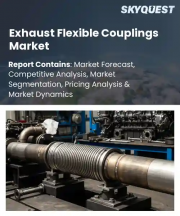
배기용 플렉서블 커플링 시장 규모, 점유율 및 성장 분석 : 제품 유형별, 차종별, 재질별, 용도별, 판매 채널별, 최종사용자별, 지역별 - 업계 예측(2026-2033년)Exhaust Flexible Couplings Market Size, Share, and Growth Analysis, By Product Type, By Vehicle Type, By Material Type, By Application, By Sales Channel, By End User, By Region - Industry Forecast 2026-2033 |
||||||

세계의 배기용 플렉서블 커플링 시장 규모는 2024년에 6억 8,740만 달러로 평가되며, 2025년 7억 2,108만 달러에서 2033년까지 10억 5,728만 달러로 확대할 전망이며, 예측 기간(2026-2033년)에 CAGR 4.9%로 성장할 것으로 전망되고 있습니다.
엔진, 터빈, 압축기를 배기 시스템로 연결하는 동시에 진동을 흡수하고 위치 편차를 보정하는 중요한 연결 부품인 배기용 플렉서블 커플링 시장은 인상적인 성장을 달성하고 있습니다. 자동차, 발전, 항공우주 등 주요 산업 분야에서는 고온 덕트의 보호와 유지보수를 통해 가동 중단 시간을 최소화하는 것이 최우선 과제로 꼽히고 있습니다. 배기가스 규제의 강화는 그동안 커플링 기술의 발전을 촉진해 왔습니다. 초기 엘라스토머 재질 제품에서, 더 높은 압력을 견딜 수 있는 내구성이 뛰어난 스테인리스강재질이나 세라믹 강화형으로 진화해 왔습니다. 또한 재생에너지 프로젝트, 특히 풍력 터빈 및 태양열 이용 분야의 증가에 따라 혁신적인 배기 인터페이스에 대한 수요가 높아지고 있습니다. 터빈 출력이 증가함에 따라 각 제조사들은 피로 파손을 줄이는 커플링 개발에 주력하고 있으며, 시장 규모가 8억 5,000만 달러를 넘어설 것으로 예상되는 이 시장에는 큰 비즈니스 기회가 숨겨져 있습니다.
세계 배기용 플렉서블 커플링 시장의 성장 요인
전 세계 배기용 플렉서블 커플링 시장은 자동화 기계에 따른 변동하는 토크와 고속 회전에 대응하기 위해 제조업체들이 플렉서블 커플링 솔루션을 점점 더 많이 채택함에 따라 인상적인 성장을 달성하고 있습니다. 이러한 혁신을 통해 동력 전달이 더욱 효율화되고, 유지보수로 인한 가동 중단 시간이 최소화되며, 결과적으로 전반적인 생산 효율이 향상되고 가동 중단이 감소합니다. 각 업계에서 자동화 프로세스가 진전됨에 따라 특히 자동차 조립, 식품 가공, 제약 등의 분야에서 신뢰성이 높은 유연한 배기 커플링 장치에 대한 수요가 확대되고 있습니다. 또한 신뢰성 향상은 규제가 엄격한 환경에서 까다로운 안전 규정을 준수하는 데 기여하고 있으며, 이는 시장 확대를 더욱 촉진하고 있습니다.
세계 배기용 플렉서블 커플링 시장의 제약 요인
전 세계 배기용 플렉서블 커플링 시장은 고품질 배기용 플렉서블 커플링의 높은 비용이라는 큰 과제에 직면해 있습니다. 이는 자금력이 제한적인 중소기업에게 장벽이 될 수 있습니다. 이러한 기업은 장기적인 이점보다 당장의 예산 문제를 우선시하는 경우가 많으며, 잠재적인 단점이 있음에도 불구하고 더 저렴한 강성 커플링 솔루션을 선택하는 경향이 있습니다. 그 결과, 이러한 가격 민감성이 첨단 커플링 기술의 보급을 저해하여 시장 침투율 하락으로 이어지고 있습니다. 각 제조사들은 예산을 중시하는 구매자들에게 가격이 비싸더라도 궁극적으로 신뢰성이 더 높은 커플링 제품에 투자하도록 설득하기 어렵고, 그 결과 시장 전체의 성장과 혁신이 제한되고 있습니다.
세계 배기용 플렉서블 커플링 시장의 동향
전 세계 배기용 플렉서블 커플링 시장에서는 경량 소재의 채택과 첨단 설계 혁신을 향한 뚜렷한 추세가 나타나고 있습니다. 각 제조사들은 연비 효율을 높이는 동시에 차량 중량을 최소화하기 위해 고강도 합금과 복합 소재를 점점 더 많이 활용하고 있습니다. 이러한 변화를 통해 진동 감쇠 및 내열성과 같은 중요한 특성을 유지하면서도, 더욱 슬림하고 컴팩트한 커플링 설계를 구현할 수 있게 되었습니다. 엄격한 배기가스 규제와 효율 향상 요구에 부응하기 위해, 각 OEM(원청 브랜드 제조업체) 업체들은 파워트레인 부품의 경량화를 최우선 과제로 삼고 있습니다. 그 결과, 각 공급업체들은 내구성이 뛰어나면서도 전동화 및 하이브리드 플랫폼에서 진행되는 광범위한 차량 경량화 노력에 필수적인 차세대 커플링 개발을 서둘러야 하는 상황에 놓여 있습니다.
자주 묻는 질문
목차
서론
조사 방법
개요
시장 역학과 전망
주요 시장 인사이트
세계의 배기용 플렉서블 커플링 시장 규모 : 제품 유형별
세계의 배기용 플렉서블 커플링 시장 규모 : 차종별
세계의 배기용 플렉서블 커플링 시장 규모 : 소재 유형별
세계의 배기용 플렉서블 커플링 시장 규모 : 용도별
세계의 배기용 플렉서블 커플링 시장 규모 : 판매 채널별
세계의 배기용 플렉서블 커플링 시장 규모 : 최종사용자별
세계의 배기용 플렉서블 커플링 시장 규모 : 지역별
경쟁 정보
주요 기업 개요
결론과 제안
KSA 26.07.10Global Exhaust Flexible Couplings Market size was valued at USD 687.4 Million in 2024 and is poised to grow from USD 721.08 Million in 2025 to USD 1057.28 Million by 2033, growing at a CAGR of 4.9% during the forecast period (2026-2033).
The market for exhaust flexible couplings, vital connectors that link engines, turbines, and compressors to exhaust systems while absorbing vibrations and accommodating misalignments, is witnessing significant growth. Key industries such as automotive, power generation, and aerospace prioritize the protection of high-temperature ducts and minimizing maintenance downtime. Stricter emission standards have historically propelled advancements in coupling technology, evolving from early elastomeric types to more durable stainless-steel and ceramic-reinforced versions capable of handling higher pressures. Additionally, the rise in renewable energy projects, particularly in wind turbine and solar-thermal applications, has intensified the demand for innovative exhaust interfaces. As turbine capacities increase, manufacturers are focusing on couplings that mitigate fatigue failure, suggesting immense opportunities in a market projected to exceed $850 million in value.
Top-down and bottom-up approaches were used to estimate and validate the size of the Global Exhaust Flexible Couplings market and to estimate the size of various other dependent submarkets. The research methodology used to estimate the market size includes the following details: The key players in the market were identified through secondary research, and their market shares in the respective regions were determined through primary and secondary research. This entire procedure includes the study of the annual and financial reports of the top market players and extensive interviews for key insights from industry leaders such as CEOs, VPs, directors, and marketing executives. All percentage shares split, and breakdowns were determined using secondary sources and verified through Primary sources. All possible parameters that affect the markets covered in this research study have been accounted for, viewed in extensive detail, verified through primary research, and analyzed to get the final quantitative and qualitative data.
Global Exhaust Flexible Couplings Market Segments Analysis
Global exhaust flexible couplings market is segmented by product type, vehicle type, material type, application, sales channel, end user and region. Based on product type, no specific sub-segments were identified. Based on vehicle type, no specific sub-segments were identified. Based on material type, no specific sub-segments were identified. Based on application, no specific sub-segments were identified. Based on sales channel, no specific sub-segments were identified. Based on end user, no specific sub-segments were identified. Based on region, the market is segmented into North America, Europe, Asia Pacific, Latin America and Middle East & Africa.
Driver of the Global Exhaust Flexible Couplings Market
The Global Exhaust Flexible Couplings market is experiencing significant growth as manufacturers increasingly adopt flexible coupling solutions to manage varying torque and higher speeds associated with automated machinery. This innovation leads to more efficient power transmission and minimizes maintenance downtime, ultimately boosting overall production efficiency and reducing operational disruptions. As industries enhance their automated processes, there is an expanding demand for dependable flexible exhaust coupling devices, particularly in sectors such as automotive assembly, food processing, and pharmaceuticals. Furthermore, the improvements in reliability contribute to compliance with stringent safety regulations in heavily regulated environments, further driving market expansion.
Restraints in the Global Exhaust Flexible Couplings Market
The Global Exhaust Flexible Couplings market faces significant challenges due to the high cost of premium exhaust flex couplings, which can deter small and medium-sized enterprises with limited financial resources. These organizations often prioritize immediate budget considerations over long-term benefits, leading them to opt for more affordable rigid coupling solutions despite their potential drawbacks. Consequently, this price sensitivity hampers the faster adoption of advanced coupling technologies, resulting in lower market penetration rates. Manufacturers find it difficult to persuade budget-conscious buyers to invest in more expensive, but ultimately more reliable, coupling alternatives, thereby limiting overall market growth and innovation.
Market Trends of the Global Exhaust Flexible Couplings Market
The Global Exhaust Flexible Couplings market is experiencing a significant trend towards the adoption of lightweight materials and advanced design innovations. Manufacturers are increasingly utilizing high-strength alloys and composites to minimize vehicle weight while enhancing fuel efficiency. This shift enables the creation of slimmer, more compact coupling designs that maintain essential properties such as vibration attenuation and thermal resilience. In response to stringent emissions regulations and a push for improved efficiency, original equipment manufacturers (OEMs) are prioritizing lightweight powertrain components. Consequently, suppliers are compelled to develop next-generation couplings that are not only durable but also integral to broader vehicle lightweighting initiatives in electrified and hybrid platforms.
Table of Contents
Introduction
- Objectives of the Study
- Market Definition & Scope
Research Methodology
- Research Process
- Secondary & Primary Data Methods
- Market Size Estimation Methods
Executive Summary
- Global Market Outlook
- Key Market Highlights
- Segmental Overview
- Competition Overview
Market Dynamics & Outlook
- Macro-Economic Indicators
- Drivers & Opportunities
- Restraints & Challenges
- Supply Side Trends
- Demand Side Trends
- Porters Analysis & Impact
- Competitive Rivalry
- Threat of Substitute
- Bargaining Power of Buyers
- Threat of New Entrants
- Bargaining Power of Suppliers
Key Market Insights
- Key Success Factors
- Market Impacting Factors
- Top Investment Pockets
- Ecosystem Mapping
- Market Attractiveness Index 2025
- PESTEL Analysis
- Regulatory Landscape
Global Exhaust Flexible Couplings Market Size by Product Type & CAGR (2026-2033)
- Market Overview
- Metal Bellows Couplings
- Fabric Expansion Couplings
- Rubber Flexible Couplings
- Others
Global Exhaust Flexible Couplings Market Size by Vehicle Type & CAGR (2026-2033)
- Market Overview
- Passenger Vehicles
- Commercial Vehicles
- Off-Highway Equipment
- Others
Global Exhaust Flexible Couplings Market Size by Material Type & CAGR (2026-2033)
- Market Overview
- Stainless Steel
- Aluminum Alloys
- Elastomers
- Others
Global Exhaust Flexible Couplings Market Size by Application & CAGR (2026-2033)
- Market Overview
- Exhaust Systems
- Turbocharger Connections
- Emission Control Systems
- Others
Global Exhaust Flexible Couplings Market Size by Sales Channel & CAGR (2026-2033)
- Market Overview
- OEM
- Aftermarket
Global Exhaust Flexible Couplings Market Size by End User & CAGR (2026-2033)
- Market Overview
- Automotive Industry
- Industrial Equipment Manufacturers
- Marine Industry
- Others
Global Exhaust Flexible Couplings Market Size & CAGR (2026-2033)
- North America (Product Type, Vehicle Type, Material Type, Application, Sales Channel, End User)
- US
- Canada
- Europe (Product Type, Vehicle Type, Material Type, Application, Sales Channel, End User)
- Germany
- Spain
- France
- UK
- Italy
- Rest of Europe
- Asia Pacific (Product Type, Vehicle Type, Material Type, Application, Sales Channel, End User)
- China
- India
- Japan
- South Korea
- Rest of Asia-Pacific
- Latin America (Product Type, Vehicle Type, Material Type, Application, Sales Channel, End User)
- Mexico
- Brazil
- Rest of Latin America
- Middle East & Africa (Product Type, Vehicle Type, Material Type, Application, Sales Channel, End User)
- GCC Countries
- South Africa
- Rest of Middle East & Africa
Competitive Intelligence
- Top 5 Player Comparison
- Market Positioning of Key Players, 2025
- Strategies Adopted by Key Market Players
- Recent Developments in the Market
- Company Market Share Analysis, 2025
- Company Profiles of All Key Players
- Company Details
- Product Portfolio Analysis
- Company's Segmental Share Analysis
- Revenue Y-O-Y Comparison (2023-2025)
Key Company Profiles
- Trelleborg AB
- Company Overview
- Business Segment Overview
- Financial Updates
- Key Developments
- Senior plc
- Company Overview
- Business Segment Overview
- Financial Updates
- Key Developments
- Hutchinson SA
- Company Overview
- Business Segment Overview
- Financial Updates
- Key Developments
- Witzenmann GmbH
- Company Overview
- Business Segment Overview
- Financial Updates
- Key Developments
- BOA Group
- Company Overview
- Business Segment Overview
- Financial Updates
- Key Developments
- EagleBurgmann Germany GmbH & Co. KG
- Company Overview
- Business Segment Overview
- Financial Updates
- Key Developments
- Metraflex Company
- Company Overview
- Business Segment Overview
- Financial Updates
- Key Developments
- Kadant Inc.
- Company Overview
- Business Segment Overview
- Financial Updates
- Key Developments
- Pacific Hoseflex Pty Ltd.
- Company Overview
- Business Segment Overview
- Financial Updates
- Key Developments
- Penflex Corporation
- Company Overview
- Business Segment Overview
- Financial Updates
- Key Developments
- Flexider S.r.l.
- Company Overview
- Business Segment Overview
- Financial Updates
- Key Developments
- Unaflex Inc.
- Company Overview
- Business Segment Overview
- Financial Updates
- Key Developments
- Tofle Co., Ltd.
- Company Overview
- Business Segment Overview
- Financial Updates
- Key Developments
- Ayvaz A.S.
- Company Overview
- Business Segment Overview
- Financial Updates
- Key Developments
- Technoflex Corporation
- Company Overview
- Business Segment Overview
- Financial Updates
- Key Developments
- Duraflex Inc.
- Company Overview
- Business Segment Overview
- Financial Updates
- Key Developments
- Mason Industries, Inc.
- Company Overview
- Business Segment Overview
- Financial Updates
- Key Developments
- Flexicraft Industries
- Company Overview
- Business Segment Overview
- Financial Updates
- Key Developments
- Radcoflex Australia Pty Ltd.
- Company Overview
- Business Segment Overview
- Financial Updates
- Key Developments
- Hyspan Precision Products, Inc.
- Company Overview
- Business Segment Overview
- Financial Updates
- Key Developments