|
시장보고서
상품코드
2091671
낸드플래시메모리 시장 규모, 점유율 및 성장 분석 : 메모리 유형별, 기술별, 용도별, 최종사용자 산업별, 스토리지 용량별, 판매 채널별, 지역별 - 업계 예측(2026-2033년)Nand Flash Memory Market Size, Share, and Growth Analysis, By Memory Type, By Technology, By Application, By End User Industry, By Storage Capacity, By Sales Channel, By Region - Industry Forecast 2026-2033 |
||||||

세계의 낸드플래시메모리 시장 규모는 2024년에 874억 달러로 평가되며, 2025년 985억 9,000만 달러에서 2033년까지 2,584억 1,000만 달러로 확대할 전망이며, 예측 기간(2026-2033년)에 CAGR 12.8%로 성장할 것으로 전망되고 있습니다.
전 세계 NAND 플래시메모리 시장은 CE(Consumer Electronics), 기업 서버, 자동차 시스템 등 다양한 분야에서 고밀도 스토리지에 대한 수요가 증가함에 따라 견고한 성장을 이어가고 있습니다. 이러한 성장은 데이터 집약형 디지털 환경으로의 전환이 진행되고 있는 데 기인하며, 이에 따라 더 대용량이고 고속인 접속이 요구되고 있습니다. 시장 확대의 주요 요인으로는 대용량 스토리지 솔루션이 필요한 인공지능(AI) 및 엣지 컴퓨팅 애플리케이션의 급증 등을 꼽을 수 있습니다. 3D 적층 NAND 기술을 탑재한 NVMe SSD를 도입함으로써, AI 환경에서 효율적인 데이터 관리가 가능해졌습니다. 또한 5G 인프라 및 자율주행차에 eMMC 및 UFS 모듈을 통합함에 따라 지속적인 데이터 처리의 필요성이 더욱 부각되고 있습니다. 경쟁이 치열한 환경 속에서 각 제조사는 생산 공정의 최적화를 도모하고, 효율화를 위해 AI를 활용하며, 시장 역학에 신속하게 대응함으로써 전략적인 가격 책정과 업무 개선을 실현하고 있습니다.
전 세계 NAND 플래시메모리 시장은 메모리 유형별, 기술별, 용도별, 최종사용자 산업별, 저장 용량별, 판매 채널별 및 지역별로 세분화됩니다. 메모리 유형에 따라 시장은 SLC NAND, MLC NAND, TLC NAND 및 기타로 분류됩니다. 기술별로는 2D NAND와 3D NAND로 분류됩니다. 용도별로는 솔리드 스테이트 드라이브(SSD), 스마트폰, 메모리 카드, 기타로 분류됩니다. 최종사용자 산업별로는 CE(Consumer Electronics), 기업 스토리지, 자동차, 기타로 분류됩니다. 저장 용량에 따라 시장은 '256.GB 이하', '257.GB-1.TB', '1.TB 이상'으로 분류됩니다. 판매 채널에 따라 시장은 'OEM'과 '애프터마켓'으로 분류됩니다. 지역에 따라 시장은 '북미', '유럽', '아시아태평양', '라틴아메리카', '중동 및 아프리카'로 분류됩니다.
세계 NAND 플래시메모리 시장의 성장 요인
스마트폰, 태블릿, 웨어러블 기술의 보급이 계속됨에 따라 대용량이면서 저전력인 스토리지 솔루션에 대한 끊임없는 수요가 발생하고 있으며, NAND 플래시가 이상적인 선택지로 떠오르고 있습니다. 각 제조사들은 신제품이 출시될 때마다 더 대용량의 메모리 모듈을 탑재하는 경향이 강해지고 있습니다. 이와 동시에 소비자들은 고성능화 및 고품질의 사진과 동영상 등 더욱 풍부한 미디어 경험을 원하고 있습니다. 이에 따라 엔지니어들은 속도, 내구성, 합리적인 가격의 균형을 효과적으로 맞춘 NAND 솔루션을 선호하게 되었습니다. 그 결과, 생산량이 증가했고, 다이 스태킹 기술도 끊임없이 발전하며, 역동적인 시장이 형성되고 있습니다. 전반적으로 NAND 플래시는 모바일 생태계에서 여전히 매우 중요한 역할을 수행하고 있으며, 꾸준한 시장 성장과 혁신을 주도하고 있습니다.
세계 NAND 플래시메모리 시장의 제약 요인
세계 NAND 플래시메모리 시장은 첨단 리소그래피 장비와 고순도 실리콘 웨이퍼에 의존하는 제조 공정의 복잡성으로 인해 큰 제약에 직면해 있습니다. 반도체 제조 시설에는 막대한 설비 투자가 필요하며, 공급망 혼란의 영향을 받기 쉬우므로 이러한 중요한 원자재를 항상 쉽게 조달할 수 있는 것은 아닙니다. 확장 계획이 지연되거나 중단될 경우, 병목 현상이 발생하여 하류 고객에게 완성된 칩의 출하가 지연될 가능성이 있습니다. 그 결과, OEM(원청 브랜드 제조업체)은 기존 재고에 의존하거나, 제품 출시를 연기하거나, 경우에 따라는 대체 기술을 검토하기도 합니다. 이러한 상황은 투자자들에게 불확실성을 초래하고, 시장 전체의 성장을 저해하게 됩니다.
세계 NAND 플래시메모리 시장의 동향
전 세계 NAND 플래시메모리 시장에서는 칩 아키텍처와 제조 공정 모두에 인공지능(AI)을 통합하는 뚜렷한 추세가 나타나고 있습니다. 이러한 AI를 활용한 설계 최적화를 통해 마모 경향 예측 모델링이 강화되고, 동적인 오류 보정이 가능해지며, 실시간 성능 조정이 가능해집니다. 이러한 발전은 시장 출시까지 걸리는 시간을 단축할 뿐만 아니라, 소비자용, 자동차용, 산업용 애플리케이션 전반에 걸쳐 수율의 일관성을 높이고 제품의 수명을 연장하고 있습니다. 기업이 AI 기능을 활용함으로써 새로운 폼팩터에 신속하게 적응하고 경쟁 환경에서 차별화를 꾀할 수 있게 되었으며, 끊임없이 진화하는 데이터 중심 환경에서 NAND 플래시메모리가 다목적이자 견고한 솔루션으로서의 역할을 더욱 공고히 하고 있습니다.
자주 묻는 질문
목차
서론
조사 방법
개요
시장 역학과 전망
주요 시장 인사이트
세계의 낸드플래시메모리 시장 규모 : 메모리 유형별
세계의 낸드플래시메모리 시장 규모 : 기술별
세계의 낸드플래시메모리 시장 규모 : 용도별
세계의 낸드플래시메모리 시장 규모 : 최종사용자 산업별
세계의 낸드플래시메모리 시장 규모 : 스토리지 용량별
세계의 낸드플래시메모리 시장 규모 : 판매 채널별
세계의 낸드플래시메모리 시장 규모 : 지역별
경쟁 정보
주요 기업 개요
결론과 제안
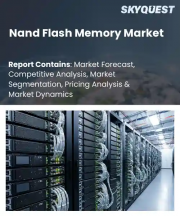
KSA 26.07.27Global Nand Flash Memory Market size was valued at USD 87.4 Billion in 2024 and is poised to grow from USD 98.59 Billion in 2025 to USD 258.41 Billion by 2033, growing at a CAGR of 12.8% during the forecast period (2026-2033).
The global NAND flash memory market is experiencing robust growth driven by an increasing demand for high-density storage across various sectors, including consumer electronics, enterprise servers, and automotive systems. This rise stems from the ongoing shift towards a data-intensive digital landscape, necessitating larger capacity and enhanced access speeds. Significant contributors to market expansion include the surge in artificial intelligence and edge-computing applications, which require high-capacity storage solutions. The adoption of NVMe SSDs equipped with 3D-stacked NAND technology enables efficient data management in AI environments. Additionally, the integration of eMMC and UFS modules in 5G infrastructure and autonomous vehicles further emphasizes the necessity for continuous data processing. As competition increases, manufacturers are optimizing production practices, utilizing AI for efficiency, and adapting quickly to market dynamics, leading to strategic pricing and operational improvements.
Top-down and bottom-up approaches were used to estimate and validate the size of the Global Nand Flash Memory market and to estimate the size of various other dependent submarkets. The research methodology used to estimate the market size includes the following details: The key players in the market were identified through secondary research, and their market shares in the respective regions were determined through primary and secondary research. This entire procedure includes the study of the annual and financial reports of the top market players and extensive interviews for key insights from industry leaders such as CEOs, VPs, directors, and marketing executives. All percentage shares split, and breakdowns were determined using secondary sources and verified through Primary sources. All possible parameters that affect the markets covered in this research study have been accounted for, viewed in extensive detail, verified through primary research, and analyzed to get the final quantitative and qualitative data.
Global Nand Flash Memory Market Segments Analysis
The global nand flash memory market is segmented by memory type, technology, application, end user industry, storage capacity, sales channel and region. Based on memory type, the market is segmented into SLC NAND, MLC NAND, TLC NAND and Others. Based on technology, the market is segmented into 2D NAND and 3D NAND. Based on application, the market is segmented into Solid State Drives, Smartphones, Memory Cards and Others. Based on end user industry, the market is segmented into Consumer Electronics, Enterprise Storage, Automotive and Others. Based on storage capacity, the market is segmented into Up to 256.GB, 257.GB-1.TB and Above 1.TB. Based on sales channel, the market is segmented into OEM and Aftermarket. Based on region, the market is segmented into North America, Europe, Asia Pacific, Latin America and Middle East & Africa.
Driver of the Global Nand Flash Memory Market
The ongoing proliferation of smartphones, tablets, and wearable technology is driving an insatiable demand for high-capacity, low-power storage solutions, making NAND flash an ideal choice. Manufacturers are increasingly integrating larger memory modules into each new device iteration. In parallel, consumers seek enhanced performance and richer media experiences, such as high-quality photos and videos. This drives engineers to favor NAND solutions that effectively balance speed, durability, and affordability. Consequently, production volumes rise, and advancements in die stacking techniques are continuously refined, fostering a dynamic market. Overall, NAND flash remains pivotal to mobile ecosystems, fueling consistent market growth and innovation.
Restraints in the Global Nand Flash Memory Market
The global NAND flash memory market faces significant restrictions due to the intricate nature of its production processes, which rely on advanced lithography equipment and highly pure silicon wafers. These crucial inputs are not always readily available, as the semiconductor manufacturing facilities require substantial capital investment and are susceptible to disruptions in the supply chain. When expansion efforts stall or are halted, bottlenecks can form, leading to delays in the distribution of finished chips to downstream customers. Consequently, original equipment manufacturers (OEMs) may rely on existing inventory and delay product launches, possibly even exploring alternative technologies. This situation introduces uncertainty for investors and hinders overall market growth.
Market Trends of the Global Nand Flash Memory Market
The Global NAND Flash Memory market is witnessing a significant trend towards the integration of artificial intelligence in both chip architecture and production processes. This AI-driven design optimization enhances predictive modeling of wear tendencies, enables dynamic error correction, and allows for real-time performance tuning. Such advancements are not only reducing time-to-market but also improving yield consistency and extending product lifespan across consumer, automotive, and industrial applications. As companies harness AI capabilities, they can swiftly adapt to emerging form factors and differentiate themselves in a competitive landscape, reinforcing NAND flash memory's role as a versatile and resilient solution in an ever-evolving data-centric environment.
Table of Contents
Introduction
- Objectives of the Study
- Market Definition & Scope
Research Methodology
- Research Process
- Secondary & Primary Data Methods
- Market Size Estimation Methods
Executive Summary
- Global Market Outlook
- Key Market Highlights
- Segmental Overview
- Competition Overview
Market Dynamics & Outlook
- Macro-Economic Indicators
- Drivers & Opportunities
- Restraints & Challenges
- Supply Side Trends
- Demand Side Trends
- Porters Analysis & Impact
- Competitive Rivalry
- Threat of Substitute
- Bargaining Power of Buyers
- Threat of New Entrants
- Bargaining Power of Suppliers
Key Market Insights
- Key Success Factors
- Market Impacting Factors
- Top Investment Pockets
- Ecosystem Mapping
- Market Attractiveness Index 2025
- PESTEL Analysis
- Regulatory Landscape
Global Nand Flash Memory Market Size by Memory Type & CAGR (2026-2033)
- Market Overview
- SLC NAND
- MLC NAND
- TLC NAND
- Others
Global Nand Flash Memory Market Size by Technology & CAGR (2026-2033)
- Market Overview
- 2D NAND
- 3D NAND
Global Nand Flash Memory Market Size by Application & CAGR (2026-2033)
- Market Overview
- Solid State Drives
- Smartphones
- Memory Cards
- Others
Global Nand Flash Memory Market Size by End User Industry & CAGR (2026-2033)
- Market Overview
- Consumer Electronics
- Enterprise Storage
- Automotive
- Others
Global Nand Flash Memory Market Size by Storage Capacity & CAGR (2026-2033)
- Market Overview
- Up to 256.GB
- 257.GB-1.TB
- Above 1.TB
Global Nand Flash Memory Market Size by Sales Channel & CAGR (2026-2033)
- Market Overview
- OEM
- Aftermarket
Global Nand Flash Memory Market Size & CAGR (2026-2033)
- North America (Memory Type, Technology, Application, End User Industry, Storage Capacity, Sales Channel)
- US
- Canada
- Europe (Memory Type, Technology, Application, End User Industry, Storage Capacity, Sales Channel)
- Germany
- Spain
- France
- UK
- Italy
- Rest of Europe
- Asia Pacific (Memory Type, Technology, Application, End User Industry, Storage Capacity, Sales Channel)
- China
- India
- Japan
- South Korea
- Rest of Asia-Pacific
- Latin America (Memory Type, Technology, Application, End User Industry, Storage Capacity, Sales Channel)
- Mexico
- Brazil
- Rest of Latin America
- Middle East & Africa (Memory Type, Technology, Application, End User Industry, Storage Capacity, Sales Channel)
- GCC Countries
- South Africa
- Rest of Middle East & Africa
Competitive Intelligence
- Top 5 Player Comparison
- Market Positioning of Key Players, 2025
- Strategies Adopted by Key Market Players
- Recent Developments in the Market
- Company Market Share Analysis, 2025
- Company Profiles of All Key Players
- Company Details
- Product Portfolio Analysis
- Company's Segmental Share Analysis
- Revenue Y-O-Y Comparison (2023-2025)
Key Company Profiles
- Samsung Electronics Co., Ltd.
- Company Overview
- Business Segment Overview
- Financial Updates
- Key Developments
- Kioxia Holdings Corporation
- Company Overview
- Business Segment Overview
- Financial Updates
- Key Developments
- SK hynix Inc.
- Company Overview
- Business Segment Overview
- Financial Updates
- Key Developments
- Micron Technology, Inc.
- Company Overview
- Business Segment Overview
- Financial Updates
- Key Developments
- Western Digital Corporation
- Company Overview
- Business Segment Overview
- Financial Updates
- Key Developments
- Solidigm, Inc.
- Company Overview
- Business Segment Overview
- Financial Updates
- Key Developments
- Yangtze Memory Technologies Co., Ltd.
- Company Overview
- Business Segment Overview
- Financial Updates
- Key Developments
- Macronix International Co., Ltd.
- Company Overview
- Business Segment Overview
- Financial Updates
- Key Developments
- Winbond Electronics Corporation
- Company Overview
- Business Segment Overview
- Financial Updates
- Key Developments
- Powerchip Semiconductor Manufacturing Corporation
- Company Overview
- Business Segment Overview
- Financial Updates
- Key Developments
- Intel Corporation
- Company Overview
- Business Segment Overview
- Financial Updates
- Key Developments
- Phison Electronics Corporation
- Company Overview
- Business Segment Overview
- Financial Updates
- Key Developments
- Silicon Motion Technology Corporation
- Company Overview
- Business Segment Overview
- Financial Updates
- Key Developments
- Kingston Technology Company, Inc.
- Company Overview
- Business Segment Overview
- Financial Updates
- Key Developments
- ADATA Technology Co., Ltd.
- Company Overview
- Business Segment Overview
- Financial Updates
- Key Developments
- Longsys Electronics Co., Ltd.
- Company Overview
- Business Segment Overview
- Financial Updates
- Key Developments
- Transcend Information, Inc.
- Company Overview
- Business Segment Overview
- Financial Updates
- Key Developments
- Greenliant Systems Ltd.
- Company Overview
- Business Segment Overview
- Financial Updates
- Key Developments
- Netac Technology Co., Ltd.
- Company Overview
- Business Segment Overview
- Financial Updates
- Key Developments
- Biwin Storage Technology Co., Ltd.
- Company Overview
- Business Segment Overview
- Financial Updates
- Key Developments