
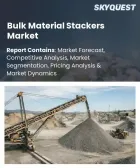
|
시장보고서
상품코드
2140895
벌크 매트리얼 스태커 시장 규모, 점유율 및 성장 분석 : 스태커 유형별, 용량별, 용도별, 최종사용자별, 운영 형태별, 지역별 - 업계 예측(2026-2033년)Bulk Material Stackers Market Size, Share, and Growth Analysis, By Stacker Type (Fixed Stackers, Rail-Mounted Stackers), By Capacity, By Application, By End User, By Operation, By Region - Industry Forecast 2026-2033 |
||||||

세계의 벌크 매트리얼 스태커 시장 규모는 2024년에 58억 4,000만 달러로 평가되며, 2025년 61억 8,000만 달러에서 2033년까지 97억 9,000만 달러로 확대하며, 예측 기간(2026-2033년)에 CAGR 5.9%로 성장할 것으로 전망되고 있습니다.
전 세계 벌크 자재 스태커 시장은 석탄, 철광석, 골재, 시멘트 등 벌크 상품의 효율적인 운송 및 보관을 목적으로 설계된 장비에 초점을 맞추고 있습니다. 이 장비의 중요한 역할은 광업, 발전, 건설 등의 산업 분야에서 토지 이용을 최소화하고 배출을 최적화함으로써 비용 효율성과 처리 능력을 향상시킬 수 있으므로 효율적인 자재 취급에 대한 수요가 증가하고 있다는 점에서 강조되고 있습니다. 이 시장은 항만, 발전소, 대규모 건설 현장의 물류 수요 급증에 더해, 분진 배출을 최소화해야 한다는 규제적 압박에 힘입어 자동화 및 원격 감시를 통해 큰 변화를 겪어 왔습니다. IoT 연결 및 첨단 자동화 기술의 통합은 효율성 향상과 운영 비용 절감으로 이어질 뿐만 아니라, 제조업체가 확대되는 시장에서 수주를 확보하는 데에도 큰 힘이 되고 있습니다.
전 세계 벌크 자재 스태커 시장 촉진요인
고속도로, 항만, 광산 시설 등의 대규모 인프라 프로젝트 증가로 인해 효율적인 벌크 자재 취급 솔루션에 대한 수요가 크게 증가하고 있습니다. 스태커는 골재의 신속한 적재 및 위치 변경을 가능하게 하는 데 있으며, 매우 중요한 역할을 수행하며, 이를 통해 업무가 합리화되고 처리 시간과 인건비가 모두 절감됩니다. 프로젝트 효율화와 비용 절감에 대한 관심이 높아지는 가운데, 각 제조사는 특정 운영 요건에 맞춰 스태커 설계를 혁신하고 있으며, 대규모 건설 및 토목 공사에 주력하는 지역에서 시장 수용 범위를 넓히고 있습니다. 또한 가혹한 환경에서도 효과적으로 작동하는 능력 덕분에 다양한 프로젝트 현장에서의 범용성이 향상되고 있습니다.
전 세계 벌크 자재 스태커 시장의 제약 요인
벌크 자재 스태커와 관련된 막대한 초기 비용에 더해, 설치 및 통합에 드는 비용은 많은 사업자에게 큰 재정적 부담이 될 수 있습니다. 프로젝트 예산이 제한된 상황에서는 의사결정권자들이 설비 투자를 연기하거나 축소하기로 선택하고, 수작업 운반이나 기존 컨베이어와 같은 더 저렴한 대안에 의존하는 경우가 많습니다. 이러한 비용 절감 솔루션에 대한 선호는 첨단 적재 기술이 제공하는 잠재적인 운영상 이점에도 불구하고 그 도입을 지연시키고 있습니다. 또한 변동이 심한 상품 시장에서 투자 수익률(ROI)을 예측하기 어렵다는 점은 기업이 새로운 적재 설비에 대한 투자를 더욱 주저하게 만드는 요인이 되어, 시장 전체의 성장세에 부정적인 영향을 미치고 있습니다.
전 세계 벌크 자재 스태커 시장의 동향
전 세계 벌크 자재 적재기 시장은 자동화와 첨단 기술의 끊임없는 통합에 힘입어 급속히 진화하고 있습니다. 기업은 업무를 최적화하고 자재 취급의 효율성과 안전성을 높이기 위해 로봇 공학 및 AI를 활용한 시스템 도입을 점점 더 확대하고 있습니다. 스마트 센서와 예측 분석의 도입은 적재 공정에 혁명을 일으켜 가동 중지 시간을 최소화하고, 작업자가 수작업에 대한 의존도를 낮추면서도 더 높은 처리 능력을 달성할 수 있게 해줍니다. 공급망에서 신속한 처리 시간에 대한 수요가 높아지는 가운데, 자동화는 중요한 경쟁적 차별화 요인으로 부각되고 있으며, 장비 설계의 지속적인 혁신을 촉진하고 전 세계 산업 분야에 영향을 미치고 있습니다.
자주 묻는 질문
목차
서론
조사 방법
개요
시장 역학과 전망
주요 시장 인사이트
세계의 벌크 매트리얼 스태커 시장 규모 : 스태커 유형별
세계의 벌크 매트리얼 스태커 시장 규모 : 용량별
세계의 벌크 매트리얼 스태커 시장 규모 : 용도별
세계의 벌크 매트리얼 스태커 시장 규모 : 최종사용자별
세계의 벌크 매트리얼 스태커 시장 규모 : 조작별
세계의 벌크 매트리얼 스태커 시장 규모 : 지역별
경쟁 정보
주요 기업 개요
결론과 제안
KSA 26.10.16Global Bulk Material Stackers Market size was valued at USD 5.84 Billion in 2024 and is poised to grow from USD 6.18 Billion in 2025 to USD 9.79 Billion by 2033, growing at a CAGR of 5.9% during the forecast period (2026-2033).
The global bulk material stacker market focuses on equipment designed for the efficient transportation and storage of loose commodities like coal, iron ore, aggregates, and cement. Its essential role is underscored by the increasing demand for efficient material handling across industries such as mining, power generation, and construction, where minimized land use and optimized discharge enhance cost efficiency and throughput. The market has witnessed significant transformation through automation and remote monitoring, driven by a surge in logistical needs at ports, power plants, and large-scale construction sites, alongside regulatory pressures to minimize dust emissions. The integration of IoT connectivity and advanced automation technologies is not only enhancing efficiency and reducing operational costs but also empowering manufacturers to secure contracts in expanding markets.
Top-down and bottom-up approaches were used to estimate and validate the size of the Global Bulk Material Stackers market and to estimate the size of various other dependent submarkets. The research methodology used to estimate the market size includes the following details: The key players in the market were identified through secondary research, and their market shares in the respective regions were determined through primary and secondary research. This entire procedure includes the study of the annual and financial reports of the top market players and extensive interviews for key insights from industry leaders such as CEOs, VPs, directors, and marketing executives. All percentage shares split, and breakdowns were determined using secondary sources and verified through Primary sources. All possible parameters that affect the markets covered in this research study have been accounted for, viewed in extensive detail, verified through primary research, and analyzed to get the final quantitative and qualitative data.
Global Bulk Material Stackers Market Segments Analysis
Global bulk material stackers market is segmented by stacker type, capacity, application, end user, operation and region. Based on stacker type, the market is segmented into Fixed Stackers, Rail-Mounted Stackers and Mobile Stackers. Based on capacity, the market is segmented into Up to 2,000 TPH, 2,001-5,000 TPH and Above 5,000 TPH. Based on application, the market is segmented into Mining, Ports & Terminals, Cement Plants and Power Plants. Based on end user, the market is segmented into Mining Companies, Bulk Material Handling Facilities and Industrial Plants. Based on operation, the market is segmented into Manual, Semi-Automatic and Fully Automatic. Based on region, the market is segmented into North America, Europe, Asia Pacific, Latin America and Middle East & Africa.
Driver of the Global Bulk Material Stackers Market
The increasing number of large-scale infrastructure projects, including highways, ports, and mining facilities, has significantly driven the demand for efficient bulk material handling solutions. Stackers play a crucial role in facilitating quick loading and repositioning of aggregates, which streamlines operations and reduces both turnaround times and labor costs. As the focus on project efficiency and cost savings intensifies, manufacturers are innovating stacker designs to align with specific operational requirements, promoting broader market acceptance in regions committed to extensive construction and civil engineering initiatives. Furthermore, their capability to function effectively in challenging environments enhances their versatility across a wide range of project sites.
Restraints in the Global Bulk Material Stackers Market
The considerable upfront costs associated with bulk material stackers, along with installation and integration expenses, can pose a significant financial burden for many operators. In situations where project budgets are limited, decision-makers may choose to delay or reduce their investment in equipment, often turning to less expensive options like manual handling or traditional conveyors. This inclination towards cost-saving solutions slows the adoption of advanced stacking technologies, hindered by the potential operational advantages they offer. Moreover, the unpredictability of return on investment in volatile commodity markets can further discourage companies from investing in new stacking equipment, impacting overall market momentum.
Market Trends of the Global Bulk Material Stackers Market
The Global Bulk Material Stackers market is evolving rapidly, driven by the relentless integration of automation and advanced technologies. Companies are increasingly adopting robotics and AI-driven systems to optimize operations, enhancing efficiency and safety in material handling. The incorporation of smart sensors and predictive analytics is revolutionizing loading processes, minimizing downtime, and enabling operators to achieve greater throughput with reduced reliance on manual efforts. As the demand for quicker turnaround times in supply chains intensifies, automation stands out as a crucial competitive differentiator, prompting continuous innovation in equipment design and influencing industrial sectors worldwide.
Table of Contents
Introduction
- Objectives of the Study
- Market Definition & Scope
Research Methodology
- Research Process
- Secondary & Primary Data Methods
- Market Size Estimation Methods
Executive Summary
- Global Market Outlook
- Key Market Highlights
- Segmental Overview
- Competition Overview
Market Dynamics & Outlook
- Macro-Economic Indicators
- Drivers & Opportunities
- Restraints & Challenges
- Supply Side Trends
- Demand Side Trends
- Porters Analysis & Impact
- Competitive Rivalry
- Threat of Substitute
- Bargaining Power of Buyers
- Threat of New Entrants
- Bargaining Power of Suppliers
Key Market Insights
- Key Success Factors
- Market Impacting Factors
- Top Investment Pockets
- Ecosystem Mapping
- Market Attractiveness Index 2025
- PESTEL Analysis
- Regulatory Landscape
Global Bulk Material Stackers Market Size by Stacker Type & CAGR (2026-2033)
- Market Overview
- Fixed Stackers
- Rail-Mounted Stackers
- Mobile Stackers
Global Bulk Material Stackers Market Size by Capacity & CAGR (2026-2033)
- Market Overview
- Up to 2000 TPH
- 2001-5000 TPH
- Above 5000 TPH
Global Bulk Material Stackers Market Size by Application & CAGR (2026-2033)
- Market Overview
- Mining
- Ports & Terminals
- Cement Plants
- Power Plants
Global Bulk Material Stackers Market Size by End User & CAGR (2026-2033)
- Market Overview
- Mining Companies
- Bulk Material Handling Facilities
- Industrial Plants
Global Bulk Material Stackers Market Size by Operation & CAGR (2026-2033)
- Market Overview
- Manual
- Semi-Automatic
- Fully Automatic
Global Bulk Material Stackers Market Size & CAGR (2026-2033)
- North America (Stacker Type, Capacity, Application, End User, Operation)
- US
- Canada
- Europe (Stacker Type, Capacity, Application, End User, Operation)
- Germany
- Spain
- France
- UK
- Italy
- Rest of Europe
- Asia Pacific (Stacker Type, Capacity, Application, End User, Operation)
- China
- India
- Japan
- South Korea
- Rest of Asia-Pacific
- Latin America (Stacker Type, Capacity, Application, End User, Operation)
- Mexico
- Brazil
- Rest of Latin America
- Middle East & Africa (Stacker Type, Capacity, Application, End User, Operation)
- GCC Countries
- South Africa
- Rest of Middle East & Africa
Competitive Intelligence
- Top 5 Player Comparison
- Market Positioning of Key Players, 2025
- Strategies Adopted by Key Market Players
- Recent Developments in the Market
- Company Market Share Analysis, 2025
- Company Profiles of All Key Players
- Company Details
- Product Portfolio Analysis
- Company's Segmental Share Analysis
- Revenue Y-O-Y Comparison (2023-2025)
Key Company Profiles
- FLSmidth & Co. A/S
- Company Overview
- Business Segment Overview
- Financial Updates
- Key Developments
- TAKRAF GmbH
- Company Overview
- Business Segment Overview
- Financial Updates
- Key Developments
- thyssenkrupp AG
- Company Overview
- Business Segment Overview
- Financial Updates
- Key Developments
- Metso Corporation
- Company Overview
- Business Segment Overview
- Financial Updates
- Key Developments
- Tenova S.p.A.
- Company Overview
- Business Segment Overview
- Financial Updates
- Key Developments
- Sandvik AB
- Company Overview
- Business Segment Overview
- Financial Updates
- Key Developments
- AUMUND Fordertechnik GmbH
- Company Overview
- Business Segment Overview
- Financial Updates
- Key Developments
- SKE Industries
- Company Overview
- Business Segment Overview
- Financial Updates
- Key Developments
- Bedeschi S.p.A.
- Company Overview
- Business Segment Overview
- Financial Updates
- Key Developments
- NEPEAN Conveyors Pty Ltd.
- Company Overview
- Business Segment Overview
- Financial Updates
- Key Developments
- Kawasaki Heavy Industries, Ltd.
- Company Overview
- Business Segment Overview
- Financial Updates
- Key Developments
- Elecon Engineering Company Limited
- Company Overview
- Business Segment Overview
- Financial Updates
- Key Developments
- L&T Construction
- Company Overview
- Business Segment Overview
- Financial Updates
- Key Developments
- FL Smidth Mining
- Company Overview
- Business Segment Overview
- Financial Updates
- Key Developments
- RUD Ketten Rieger & Dietz GmbH u. Co. KG
- Company Overview
- Business Segment Overview
- Financial Updates
- Key Developments
- Bruks Siwertell Group
- Company Overview
- Business Segment Overview
- Financial Updates
- Key Developments
- Motridal S.p.A.
- Company Overview
- Business Segment Overview
- Financial Updates
- Key Developments
- Beumer Group GmbH & Co. KG
- Company Overview
- Business Segment Overview
- Financial Updates
- Key Developments
- SANY Group
- Company Overview
- Business Segment Overview
- Financial Updates
- Key Developments
- XCMG Group
- Company Overview
- Business Segment Overview
- Financial Updates
- Key Developments


