

|
시장보고서
상품코드
1927575
자동 테스트, 소프트웨어 구성 분석, SBOM 툴 : AI 강화형 분석이 정착Automated Testing, Software Composition Analysis & SBOM Tools: AI-Augmented Analysis Takes Hold |
||||||

AI가 소프트웨어 개발에 미치는 영향은 엔지니어링 조직이 코드를 설계, 구축, 유지보수하는 방식을 재구성하고 있습니다. 생성형 AI와 코파일럿은 소프트웨어 개발을 효과적으로 가속화하지만, 동시에 새로운 취약점과 프로젝트 리스크를 초래할 수 있습니다. 이에 따라 효과적인 보안 및 품질 확보를 위한 자동화된 테스트 및 분석 툴에 대한 수요가 크게 증가하고 있습니다. 소프트웨어 구성 분석(SCA), 정적 분석, 동적 테스트 솔루션은 엔지니어링 조직이 신뢰성, 안전성, 표준 준수를 희생하지 않고 AI를 활용한 생산성 향상을 안전하게 실현할 수 있는 중요한 가드레일 역할을 하고 있습니다.
자동 테스트 툴에 대한 수요에는 여러 가지 요인이 있으며, 벤더는 이 모든 요인을 주의 깊게 모니터링하고 이해해야 합니다. 규제 압력, 진화하는 산업 표준, 변화하는 소프트웨어 개발 철학, AI, 그리고 안전에 중요한 기능에서 소프트웨어의 역할 확대는 소프트웨어 검증 및 검증(V&V) 시장에 다양한 형태로 영향을 미치고 있으며, 이에 따라 적응형 제품 설계와 R&D 투자가 필요합니다.
이 보고서에서는 자동화 소프트웨어 테스트 툴, 보안 테스트 툴, SCA 툴의 각 시장과 관련된 툴, 동향, 전략적 인사이트에 대해 상세하게 분석합니다. 2024-2029년 시장 규모를 툴 유형별(정적 분석, 동적 및 모델 기반 테스트, SCA), 지역별(북미, 남미, 유럽, 중동 및 아프리카, 아시아태평양), 기업/임베디드 용도별, 개별 수직 시장별로 예측했습니다. 이 보고서는 장기적인 성장을 위한 전략적 의사결정에 도움을 주기 위해 VDC의 Voice of the Engineer 조사를 기반으로 한 최종사용자 인사이트와 벤더의 시장 점유율을 포함한 경쟁 구도 분석도 포함하고 있습니다.
이 보고서가 다루는 주요 질문
- AI가 가속화하는 소프트웨어 테스트 및 분석 수요를 이끄는 요인은 무엇인가?
- AI 코드 생성은 소프트웨어 개발을 어떻게 변화시키고, 어떤 위험을 초래하는가?
- 툴의 성장에 가장 유망한 수직 시장은 어디인가?
- 주요 코딩 표준의 변경은 언제 이루어질까요?
- 엔지니어링 조직은 AI 활용도에 따라 테스트 전략을 어떻게 변경하고 있는가?
- 어떤 프로그래밍 언어가 성장하고 있는가? 또한 임베디드 분야에서 Rust의 실제 채택률은 어느 정도일까요?
- 최근 인수합병이 테스트 및 SCA 툴경쟁 구도를 어떻게 형성했는가?
이 보고서에 수록된 조직
- AdaCore
- ANSYS
- Battery Ventures
- Black Duck Software
- Checkmarx
- Cursor
- DeepCode AI
- DXC Technology
- Eggplant
- ESI Group
- Finite State
- GitHub
- GitLab
- Hugging Face
- IBM
- JFrog
- Keysight
- LDRA
- MathWorks
- Mend
- MergeBase
- Microsoft
- NVIDIA
- OpenText
- Parasoft
- Perforce
- Phylum
- QA Systems
- Snyk
- Sonatype
- Tasking
- TrustInSoft
- Veracode
- Windsurf
- 기타
주요 조사 결과
- SCA 및 자동화 소프트웨어 보안 테스트 툴 세계 시장 규모는 2029년 49억 달러를 돌파할 것으로 예측됩니다.
- 항공우주 및 방위 분야는 세계 방위비 지출의 대폭적인 증가와 유럽 자동차 산업의 둔화로 인해 자동차 분야를 제치고 가장 큰 수직 시장으로 부상했습니다.
- EU의 사이버 복원력법(Cyber Resilience Act)의 시행으로 엔지니어링 팀 전체에 SBOM(소프트웨어 구성 요소) 생성 및 관리 기능을 제공하는 SCA 툴에 대한 수요가 지속적으로 증가하고 있습니다.
- DevOps가 소프트웨어 개발을 계속 변화시키고 있는 가운데, 플랫폼 제공 및 다른 툴와의 긴밀한 통합에 대한 수요가 증가하고 있습니다.
- AI 생성 코드를 사용하는 조직은 아직 AI 코드 생성을 고려하거나 통합하지 않은 조직에 비해 테스트 툴의 보안 기능을 매우 높게 평가했습니다.
- 소프트웨어 개발 방법론의 진화에 따라 최종사용자의 요구가 변화함에 따라 벤더 만족도 평가도 계속 변동하고 있습니다.
보고서 발췌
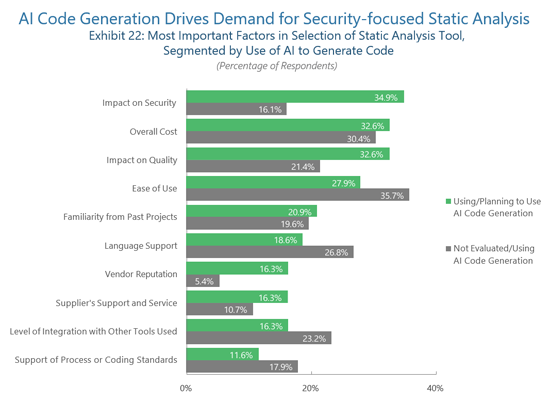
현재 프로젝트에서 AI를 이용한 코드 생성을 수행하는 엔지니어들은 정적 분석 툴을 다른 관점에서 평가하고 있으며, 보안과 품질 보증을 상대적으로 높게 평가했습니다. AI 생성 코드는 새로운 복잡한 취약점을 야기할 수 있으므로 AI 코드 생성을 활용하는 엔지니어링 조직은 기계 생성 소프트웨어를 효과적으로 검증할 수 있는 툴을 우선시해야 합니다. 반면, AI 코드 생성을 활용하지 않는 엔지니어링 조직은 비용 측면에서는 AI 도입 조직과 같은 의견이지만, 사용 편의성, 언어 지원, 타 툴과의 통합 수준을 중요하게 여기는 것으로 나타났습니다. 이 데이터는 팀이 사내 코드에 의존하고 전체 툴체인에서 자동화를 덜 활용하는 전통적 개발 접근 방식을 반영하지만, 동시에 소프트웨어 개발 조직 전반에서 AI 생성 코드에 대한 신중한 태도를 보여줍니다. 또한 AI 코드 생성을 이용하는 조직은 벤더의 브랜드 평가를 매우 중요하게 여기는 것으로 나타났습니다. 엔지니어링 조직은 AI 도입에 따른 리스크를 상쇄하기 위해 고품질의 툴을 제공한 경험이 있는 조직이 제공하는 검증된 솔루션을 선호합니다.
AI 도입이 진행됨에 따라 보안을 중시하는 툴의 중요성은 더욱 커질 것입니다. 개발 주기 초기에 AI 생성의 취약점과 리스크를 식별하기 위해 특별히 설계된 정적 분석 툴은 예측 기간 중 시장 점유율을 확대할 것입니다.
목차
이 리포트 내용
어떤 질문이 다루어지고 있는가?
누가 이 리포트를 읽어야 하는가?
이 리포트에서 언급되고 있는 조직
개요
- 주요 조사 결과
세계 시장 : 개요
- 정적 해석 툴
- 동적/모델 기반 테스트
- 보안 중시 정적 해석
- 소프트웨어 구성 분석
- 플랫폼 솔루션
- 합병과 인수
- 언어의 사용
- 소프트웨어 테스트를 위한 생성형 AI
지역 동향과 예측
수직 시장 동향과 예측
최종사용자 인사이트
- 정적 해석 툴의 선택에서 가장 중요한 요소 : 코드 생성에서 AI의 사용 상황별
- AI에 의한 코드 생성의 이용 상황별로 본 동적 테스트 툴의 선택에서 가장 중요한 요소
- 정적 해석 및 동적 테스트 툴 구입에 관한 전형적인 의사결정자
- 클라우드에서 정적 해석, 동적 테스트, SCA의 사용률
- 정적 해석 벤더의 퍼포먼스 평가
- 동적/모델 기반 테스트 벤더의 퍼포먼스 평가
- SCA 벤더의 퍼포먼스 평가
경쟁 구도
벤더 및 기술 프로바이더의 개요
- AdaCore
- Black Duck
- Checkmarx
- IBM
- Keysight
- LDRA
- MathWorks
- Mend
- OpenText
- Parasoft
- Perforce
- QA Systems
- Snyk
- Sonatype
- TrustInSoft
저자 소개
VDC Research
KSA 26.02.24Inside this Report
AI's impact on software development is reshaping how engineering organizations design, build, and maintain code. Generative AI and copilots effectively accelerate software development, but they also introduce novel sources of vulnerability and project risk. As a result, demand for automated testing and analysis tools with effective security and quality enforcement has grown significantly. Software composition analysis (SCA), static analysis, and dynamic testing solutions now function as critical guardrails that help engineering organizations safely access AI-enabled productivity gains without sacrificing reliability, safety, or standards compliance.
Several factors are shaping demand for automated test tools, all of which must be closely monitored and understood by tool vendors. Regulatory pressures, evolving industry standards, shifting software development philosophies, artificial intelligence, and software's growing role in safety-critical functions are all influencing the market for software verification and validation in different ways, necessitating adaptive product design and R&D investment.
This report includes an in-depth analysis of the tools, trends, and strategic considerations relevant to the market for both automated software and security testing tools as well as SCA tools. It includes market sizing and forecasts from 2024 to 2029 with segmentations by tool type (static analysis, dynamic and model-based testing, SCA), region (Americas, EMEA, APAC), enterprise versus embedded use, and individual vertical markets. To better inform strategic decisions that will yield long-term growth, this report also includes end-user insights from VDC's Voice of the Engineer survey and an analysis of the competitive landscape, which includes vendor market shares.
What Questions are Addressed?
- What factors are driving demand for AI-accelerated software testing and analysis?
- How has AI code generation changed software development and what risks does it introduce?
- Which vertical markets present the best opportunity for tool growth?
- When are changes to key coding standards taking place?
- Why are engineering organizations changing their testing strategies based on their AI usage?
- Which coding languages are growing and what is the true adoption rate of Rust in embedded?
- How have recent acquisitions shaped the competitive landscape for test and SCA tools?
Who Should Read this Report?
This report should be read by individuals making strategic decisions for marketing, product development, or competitive tactics. It is intended for senior decision makers who influence the development, sales, and use of test automation tools, including:
- CEO or other C-level executives
- Corporate development and M&A teams
- Marketing executives
- Business development and sales leaders
- Product development and product strategy leaders
- Channel management and channel strategy leaders
Organizations Listed in this Report
- AdaCore
- ANSYS
- Battery Ventures
- Black Duck Software
- Checkmarx
- Cursor
- DeepCode AI
- DXC Technology
- Eggplant
- ESI Group
- Finite State
- GitHub
- GitLab
- Hugging Face
- IBM
- JFrog
- Keysight
- LDRA
- MathWorks
- Mend
- MergeBase
- Microsoft
- NVIDIA
- OpenText
- Parasoft
- Perforce
- Phylum
- QA Systems
- Snyk
- Sonatype
- Tasking
- TrustInSoft
- Veracode
- Windsurf
- and others
Executive Summary
AI is transforming the software development lifecycle (SDLC) and the tools that developers need throughout it. Engineering organizations across vertical markets have adopted copilot-style coding assistants to automate coding tasks and help developers accelerate releases. Automated software development introduces risk, however. AI code generation engineers use several different codebases (most of which are open source), creating code fragments that may introduce license compliance or security risk. In response, demand for security-focused SCA and automated testing solutions is rising. Engineering organizations are actively counterbalancing AI-generated risk with security-oriented software testing, making software analysis and testing key components of the AI-augmented SDLC.
Test and SCA vendors have also capitalized on AI-powered productivity gains. Automatic triaging, hotspot analysis, test case generation, and remediation are points of parity in the enterprise/IT software tooling market. Embedded systems engineers have historically resisted heavy AI augmentations within testing tools. As solution vendors increasingly add predictable AI features and functionality, however, demand for AI-augmented solutions has grown across organization types. Tool vendors must continue to invest in AI features that accelerate the testing process, going beyond the shift left paradigm.
AI-enabled solutions that are deeply integrated with other tool types and platforms will lead the SCA and automated software testing market throughout the duration of the forecast. Leading vendors have made significant investments in creating solutions behind a single pane of glass that combines static analysis, dynamic test, and SCA. As a result, the market is ripe for consolidation and partnership. Single-solution vendors must seek strong technical partners in SBOM management and static analysis to fill emerging gaps in regulatory compliance and security. The SCA and test market has evolved rapidly over the past three years, necessitating aggressive R&D and partnership efforts from solution vendors as they hope to capture a larger piece of the expanding market.
Key Findings
- Global revenue for SCA and automated software and security testing tools will surpass $4.9B in 2029.
- Aerospace and defense passed automotive as the largest vertical market due to significant increases in defense spending across the globe and a slowdown in the European automotive industry.
- The EU Cyber Resilience Act enforcement will continue to drive demand for SCA tools that offer SBOM generation and management across engineering teams.
- Demand for platform offerings and deep integrations with other tool types is growing as DevOps continues to reshape software development.
- Organizations using AI-generated code place significantly higher value on security features in testing tools than organizations that have not yet considered or integrated AI code generation.
- Vendor satisfaction ratings continue to change as end-user needs evolve alongside software development practices.
Report Excerpt
Engineers who are currently using AI to generate code in their projects evaluate static analysis tools through a different lens than their counterparts, placing proportionally higher value on security and quality assurance. Since AI-generated code can introduce new and potentially complex vulnerabilities, engineering organizations using AI to generate code prioritize tools that can effectively vet machine-generated software. Conversely, engineering organizations not using AI code generation agree with their AI-accelerated peers about cost but favored ease of use, language support, and level of integration with other tools. This data reflects a more conventional development approach where teams rely on in-house code and use less automation across the toolchain, but it also demonstrates the caution toward AI-generated code across software development organizations. Furthermore, organizations using AI code generation valued vendor brand reputation significantly more. To counterbalance AI-introduced risk, engineering organizations prefer proven solutions from organizations with a history of delivering high quality tools.
As AI adoption increases, security-focused tooling will hold greater importance. Static analysis tools specially designed to identify AI-generated vulnerabilities or risks early in the development cycle will gain market share over the forecast period.
Table of Contents
Inside this Report
What Questions are Addressed?
Who Should Read this Report?
Organizations Mentioned in this Report
Executive Summary
- Key Findings
Global Market Overview
- Static Analysis Tools
- Dynamic/Model-based Testing
- Security-focused Static Analysis
- Software Composition Analysis
- Platform Solutions
- Mergers & Acquisitions
- Language Usage
- Generative AI for Software Testing
Regional Trends & Forecast
Vertical Market Trends & Forecast
End-User Insights
- Most Important Factors in Selection of Static Analysis Tool Segmented by Use of AI to Generate Code
- Most Important Factors in Selection of Dynamic Testing Tools Segmented by Use of AI to Generate Code
- Typical Decision Maker for Purchase of Static Analysis & Dynamic Test Tools
- Usage Rates of Static Analysis, Dynamic Test & SCA in the Cloud
- Static Analysis Vendor Performance Ratings
- Dynamic/Model-based Test Vendor Performance Ratings
- SCA Vendor Performance Ratings
Competitive Landscape
Vendor & Technology Provider Profiles
- AdaCore
- Black Duck
- Checkmarx
- IBM
- Keysight
- LDRA
- MathWorks
- Mend
- OpenText
- Parasoft
- Perforce
- QA Systems
- Snyk
- Sonatype
- TrustInSoft
About the
Authors About
VDC Research
List of Exhibits
- Exhibit 1 Global Software and Security Testing Tools Revenue Segmented by Market Type
- Exhibit 2 Global Static Analysis Tools Revenue Segmented by Market Type
- Exhibit 3 Global Dynamic and Model-Based Test Tools Revenue Segmented by Market Type
- Exhibit 4 Global Market for Security-focused Static Analysis Tools Segmented by Market
- Exhibit 5 Global Revenue of Software Composition Analysis Tools & Related Services Segmented by Market Type
- Exhibit 6 Current State of AI and Automation in the SCA Market
- Exhibit 7 Usage of C, Ada, and Rust Code
- Exhibit 8 Current AI/Automation Capabilities and Features of Leading Test Tool Vendors
- Exhibit 9 Americas Market for SCA and Testing Tools Segmented by Tool Type
- Exhibit 10 Europe, Middle East, and Africa Market for SCA and Testing Tools Segmented by Tool Type
- Exhibit 11 Asia-Pacific Market for SCA and Testing Tools Segmented by Tool Type
- Exhibit 12 Worldwide Shipments of Software and Security Testing Tools Segmented by Customer Type
- Exhibit 13 IoT/Embedded Static Analysis Tools Market Segmented by Vertical
- Exhibit 14 IoT/Embedded Dynamic and Model-Based Testing Tools Market Segmented by Vertical
- Exhibit 15 IoT/Embedded SCA Tools Segmented by Vertical
- Exhibit 16 IoT/Embedded Static Analysis Tools, 2024 Market Share
- Exhibit 17 Enterprise/IT Static Analysis Tools, 2024 Market Share
- Exhibit 18 IoT/Embedded Dynamic and Model-based Testing Tools, 2024 Market Share
- Exhibit 19 Enterprise/IT Dynamic and Model-based Testing Tools, 2024 Market Share
- Exhibit 20 IoT/Embedded SCA Tools, 2024 Market Share
- Exhibit 21 Enterprise/IT SCA Tools, 2024 Market Share
- Exhibit 22 Most Important Factors in Selection of Static Analysis Tool Segmented by AI-generated Code Usage
- Exhibit 23 Most Important Factors in Selection of Dynamic Testing Tools Segmented by AI-generated Code Usage
- Exhibit 24 Most Important Factors in Selection of SCA Tool Segmented by AI-generated Code Usage
- Exhibit 25 Typical Decision Maker for Purchase of Static Analysis and Dynamic Test Tools
- Exhibit 26 Usage Rates of Static Analysis, Dynamic Test, and SCA in the Cloud
- Exhibit 27 Static Analysis Vendor Performance Ratings
- Exhibit 28 Dynamic/Model-based Test Vendor Performance Ratings
- Exhibit 29 SCA Vendor Performance Ratings
IoT & Embedded Engineering Survey
- Exhibit 244 Types of Tools Used in Current/Most Recently Completed Project
- Exhibit 254 Types of Static Analysis or SAST Being Used on Current Project
- Exhibit 305 Perceived Investment Value of Dynamic Analysis or DAST Product Used
- Exhibit 309 Perceived Difficulty to Learn the Use of Dynamic Analysis or DAST Product
- Exhibit 340 Perceived Investment Value of Software Composition Analysis or IP Compliance Tool Used
- Exhibit 341 Perceived Impact on the Quality of the End Product Being Engineered from SCA or IP Compliance Tool Used
- Exhibit 343 Perceived Likeliness to Use the Same Brand of SCA or IP Compliance Tool For the Next Project of Similar Type
- Exhibit 385 Consideration/Use of AI-generated Software/Code (e.g., Use of Copilot and/or Prompt-based Code Creation)
- Exhibit 386 Expected Changes in Use of AI-generated Software in the Next Three years
- Exhibit 387 Amount of Trust in AI-generated Software Code (Functionality, Security, IP, etc.)
- Exhibit 388 Current Concerns About AI-generated Software Code
- Exhibit 405 IoT Cloud Platforms-as-a-Service (PaaS) Being Used on Current or Most Recent Project


