|
시장보고서
상품코드
1620191
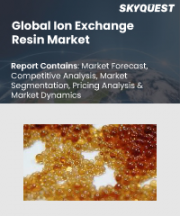
이온교환수지 시장 규모 : 제품 유형별, 최종사용자 산업별, 용도별, 지역별, 범위 및 예측Global Ion Exchange Resin Market Size By Product Type (Cation Exchange Resins, Anion Exchange Resins), By End-User Industry (Healthcare, Food And Beverage), By Application (Sugar Refining, Municipal Water Treatment), By Geographic Scope And Forecast |
||||||

이온교환수지 시장 규모와 예측
이온교환수지 시장 규모는 2024년에 14억 7,000만 달러로 평가되며, 2031년에는 19억 1,000만 달러에 달할 것으로 예측되며, 2024-2031년의 CAGR은 3.32%로 성장합니다. 발전에서 이온교환수지의 사용 증가, 물 절약에 대한 엄격한 규제, 담수의 가용성 감소는 이온교환수지 시장의 성장을 가속하고 있습니다. 이 조사 보고서는 이온교환수지 시장에 대한 전반적인 평가를 제공합니다. 주요 부문, 동향, 시장 성장 촉진요인, 경쟁 환경, 시장에서 중요한 역할을 하는 요인 등을 종합적으로 분석합니다.
세계 이온교환수지 시장의 정의
이온교환수지는 이온 교환 매체로 작용하는 폴리머입니다. 물에 녹지 않고 가교되어 있으며 화학적으로 불활성입니다. 이온교환수지는 노란색 또는 흰색으로 착색된 기능화된 폴리머 마이크로 비드입니다. 그것은 많은 공동/미세 기공을 가진 미세한 네트워크로 구성됩니다. 수지 폴리머 기반은 주변 용액과 성분을 교환하도록 조작됩니다. 이온교환수지는 주로 다양한 최종사용자 산업에서 수처리 및 폐수 처리에 사용됩니다. 이온교환수지는 다양한 산업에서 물 정화 및 연수화에 사용됩니다. 이온교환수지는 물에서 염소, 방사성 원소 및 유기 화합물을 제거 할 수 있으며 다양한 산업 목적으로 사용할 수 있습니다.
이온교환수지는 식품 및 음료, 화학 처리, 발전, 전자, 폐수 처리, 광업 및 기타 산업에서 널리 사용됩니다. 이온교환수지는 일반적으로 반경 0.25 - 0.5mm의 마이크로 비드 형태의 불용성 매트릭스입니다. 비드는 일반적으로 다공성이며 표면과 내부에 많은 표면적을 가지고 있습니다. 이온교환수지에는 여러 유형이 있습니다. 이온교환수지는 다양한 분리, 정제 및 오염 제거 공정에 널리 사용됩니다. 이온교환수지는 공급수에서 박테리아와 같은 미생물을 제거할 수 없습니다.
세계 이온교환수지 시장 개요
수처리 약품에 대한 처리 수요 증가와 산업계에서 발생하는 폐기물의 양이 크게 증가함에 따라 이온교환수지 시장 성장이 증가할 것으로 예상됩니다. 에너지 산업, 발전 산업 및 폐수 처리 공정 산업에서 이온교환수지에 대한 수요 증가는 가까운 미래에 이온교환수지 시장 성장을 가속할 것으로 예상됩니다. 또한 제약 및 전자 산업의 초순수 수요 증가는 이온교환수지 시장 성장을 강화할 것으로 예상됩니다. 칩의 헹굼, 세척 및 에칭 공정에 대량의 초순수가 필요한 반도체 및 마이크로 일렉트로닉스에 대한 수요 증가는 예측 기간 중 이온교환수지 시장의 성장을 가속할 것으로 예상됩니다.
또한 산업 분야에서 물 정화 및 연수화에 대한 인식이 높아짐에 따라 이온교환수지 시장의 성장이 가속화될 것으로 예상됩니다. 이온교환수지는 염소, 유기 화합물, 우라늄, 토륨, 란탄과 같은 방사성 원소를 제거할 수 있으며, 화학 처리, 식품 및 음료, 폐수 처리, 발전, 전자, 광업 등 다양한 분야에 적용되고 있습니다. 가까운 미래에 앞서 언급한 응용 산업이 이온교환수지 시장의 성장을 주도할 것으로 예상됩니다. 이온교환수지는 주로 물 정화 및 연화를 위해 발전 용도에서 주로 사용됩니다.
그러나 유럽위원회와 EPA가 수처리 사용을 제한하는 다양한 정책을 시행하는 등 엄격한 규칙과 규제가 이온교환수지 시장 성장을 저해할 것으로 예상됩니다. 이온교환수지 제조에 사용되는 원자재 가격의 변동은 예측 기간 중 이온교환수지 시장의 성장을 억제할 것으로 예상됩니다.
목차
제1장 세계의 이온교환수지 시장 : 서론
- 시장 개요
- 조사 범위
- 전제조건
제2장 개요
제3장 VERIFIED MARKET RESEARCH의 조사 방법
- 데이터 마이닝
- 검증
- 프라이머리 인터뷰
- 데이터 소스 리스트
제4장 세계의 이온교환수지 시장 전망
- 개요
- 시장 역학
- 촉진요인
- 억제요인
- 기회
- Porter's Five Forces 모델
- 밸류체인 분석
제5장 세계의 이온교환수지 시장 : 제품 유형별
- 개요
- 양이온교환수지
- 음이온교환수지
- 기타
제6장 세계의 이온교환수지 시장 : 용도별
- 개요
- 설탕 정제
- 액체 글루코오스
- 자치체 수처리
- 의약품
- 발전
- 비료
- 전기·전자
- 기타
제7장 세계의 이온교환수지 시장 : 최종사용자 산업별
- 개요
- 헬스케어
- 식품 및 음료
- 상하수도 처리
- 광업
- 전력
- 제지·펄프
- 화학
- 기타
제8장 세계의 이온교환수지 시장 : 지역별
- 개요
- 북미
- 미국
- 캐나다
- 멕시코
- 유럽
- 독일
- 영국
- 프랑스
- 기타 유럽
- 아시아태평양
- 중국
- 일본
- 인도
- 기타 아시아태평양
- 라틴아메리카
- 브라질
- 아르헨티나
- 세계의 기타 지역
제9장 세계의 이온교환수지 시장 : 경쟁 구도
- 개요
- 각사 시장 순위
- 주요 발전 전략
제10장 기업 개요
- Dow Chemicals
- Lanxess
- Purolite Corporation
- Mitsubishi Chemical Corporation
- Thermax Limited
- Finex Oy
- ION Exchange
- Novasep Holding
- SAMYANG CORPORATION
제11장 부록
- 관련 리포트
Ion Exchange Resin Market Size And Forecast
Ion Exchange Resin Market size was valued at USD 1.47 Billion in 2024 and is projected to reach USD 1.91 Billion by 2031 , growing at a CAGR of 3.32% from 2024 to 2031. The increasing use of ion exchange resins in power generation and stringent regulations towards water conservation and the decreasing availability of fresh water is driving the growth of the Ion Exchange Resin Market. The Global Ion Exchange Resin Market report provides a holistic evaluation of the market. The report offers a comprehensive analysis of key segments, trends, drivers, restraints, competitive landscape, and factors that are playing a substantial role in the market.
Global Ion Exchange Resin Market Definition
Ion exchange resins are polymers that act as ion exchange mediums. They are water-insoluble, cross-linked, and chemically inert. Ion exchange resins are colored yellow or white functionalized polymer microbeads. They are made up of a fine network with many cavities/micropores. Resin polymer bases are manipulated to exchange components with surrounding solutions. Ion exchange resins are mostly used for water and wastewater treatment in various end-user industries. A substantial amount of ion exchange resins are used in chemical companies at various process stages Ion exchange resins are used in a variety of industries for water purification and softening. They are capable of eliminating chlorine, a radioactive element, and organic compound from the water which can be further used for various industrial purposes.
Ion exchange resins are widely used in industries such as food and beverage processing, chemical processing, power generation, electronics, wastewater treatment, and mining. It is an insoluble matrix normally in the form of microbeads with a size range of 0.25-0.5 mm radius. The beads are usually porous, with a lot of surface area on and inside of them. There are multiple types of ion-exchange resin. Ion-exchange resins are extensively used in different separation, purification, and decontamination processes. Ion exchange resins do not remove microorganisms like bacteria from feed water; they can sometimes promote bacterial growth.
What's inside a VMR industry report?
Our reports include actionable data and forward-looking analysis that help you craft pitches, create business plans, build presentations and write proposals.
Global Ion Exchange Resin Market Overview
Growing demand for water treatment chemicals coupled with the significant increase in the volume of waste generated from the industry is expected to augment the market growth of ion exchange resins. Growing demand for ion exchange resins from the energy and power generation industries, as well as the wastewater treatment process industries, is expected to drive market growth for ion exchange resins in the near future. Additionally, increasing demand for ultrapure pure water from the pharmaceutical and electronic industry is expected to augment the market growth of ion exchange resins. Increasing demand for semiconductors and microelectronics, which require large amounts of ultrapure water for chip rinsing, washing, and etching processes, is expected to drive Ion Exchange Resin Market growth over the forecast period.
Furthermore, rising awareness of water purification and softening in industrial applications is expected to drive Ion Exchange Resin Market growth in the near future. Ion exchange resins can remove chlorine, organic compounds, and radioactive elements like uranium, thorium, and lanthanum, expanding their application scope in chemical processing, food and beverage, wastewater treatment, power generation, electronics, and mining. In the near future, the aforementioned application industries are expected to drive Ion Exchange Resin Market growth. Ion exchange resins are primarily used in power generation applications for water purification and softening.
However, strict rules and regulations such as the European Commission and EPA have imposed various policies on restricting the use of water treatment is expected to hamper the market growth of the ion exchange resins. The fluctuating price of raw materials used in the manufacture of ion exchange resins is expected to restrain Ion Exchange Resin Market growth over the forecast period.
Global Ion Exchange Resin Market: Segmentation Analysis
The Global Ion Exchange Resin Market is Segmented on the basis of Product Type, End-User Industry, Application, And Geography.
Ion Exchange Resin Market, By Product Type
- Cation Exchange Resins
- Anion Exchange Resins
- Others
Based on Product Type, the market is bifurcated into Cation Exchange Resins, Anion Exchange Resins, and Others. The cationic resin segment dominated the market and is expected to maintain its dominance throughout the forecast period. Cationic resins are used in a variety of applications, including dealkalization, highly saline water treatment, and demineralization. APAC's rapid urbanization has increased the demand for cationic resins for water treatment applications.
Ion Exchange Resin Market, By End-User Industry
- Healthcare
- Food and Beverage
- Water and Wastewater Treatment
- Mining
- Power
- Paper and Pulp
- Chemicals
- Others
Based on End-User Industry, the market is bifurcated into Healthcare, Food and Beverage, Water and Wastewater Treatment, Mining, Power, Paper and Pulp, Chemicals, and Others. Power is anticipated to be the fastest-growing end-use industry of the Ion Exchange Resin Market during the forecast period. These resins are used to remove poisonous and heavy metal ions from hard water by replacing magnesium and calcium ions with sodium ions. The power industry accounted for the largest share of the market and is rapidly expanding in emerging economies such as China, India, and the UAE, fueling demand for ion exchange resins.
Ion Exchange Resin Market, By Application
- Sugar Refining
- Municipal Water Treatment
- Pharmaceuticals
- Power Generation
- Fertilizers
- Electrical and Electronics
- Others
Based on Application, the market is bifurcated into Sugar Refining, Municipal Water Treatment, Pharmaceuticals, Power Generation, Fertilizers, Electrical and Electronics, and Others. Municipal Water Treatment is projected to be the faster-growing application segment of the Ion Exchange Resin Market during the forecast period. Ion exchange resins are widely used in water treatment processes such as deionization, demineralization, separation, purification, and decontamination. They play important roles in a variety of industries, including power and chemical and petrochemical, with power being one of the largest consumers of ion exchange resins. Various countries around the world are looking for more sustainable energy sources, such as nuclear power, and are taking steps to increase such capacity.
Ion Exchange Resin Market, By Geography
- North America
- Europe
- Asia Pacific
- Rest of the world
- On the basis of Regional Analysis, The Global Ion Exchange Resin Market is classified into North America, Europe, Asia Pacific, and the Rest of the world. Asia Pacific region is anticipated to account for the largest share and register the highest CAGR during the forecast period. The region's demand for ion exchange resins is being driven by the region's continuous increase in manufacturing for both domestic and export use. Furthermore, the rising population and expanding end-use industries have spurred innovation and development, transforming APAC into a major global industrial hub. Increased innovation and industry consolidations are expected to drive rapid growth in the region's market.
Key Players
- The "Global Ion Exchange Resin Market" study report will provide valuable insight with an emphasis on the global market including some of the major players such as
- Dow Chemicals, Lanxess, Purolite Corporation, Mitsubishi Chemical Corporation, Thermax Limited, Finex Oy, ION Exchange, Lanxess, Novasep Holding, Samyang Corporation, Samco Technologies, Inc., and Thermo Fisher Scientific.
Our market analysis also entails a section solely dedicated to such major players wherein our analysts provide an insight into the financial statements of all the major players, along with its product benchmarking and SWOT analysis.
TABLE OF CONTENTS
1. INTRODUCTION OF GLOBAL ION EXCHANGE RESIN MARKET
- 1.1. Overview of the Market
- 1.2. Scope of Report
- 1.3. Assumptions
2. EXECUTIVE SUMMARY
3. RESEARCH METHODOLOGY OF VERIFIED MARKET RESEARCH
- 3.1. Data Mining
- 3.2. Validation
- 3.3. Primary Interviews
- 3.4. List of Data Sources
4. GLOBAL ION EXCHANGE RESIN MARKET OUTLOOK
- 4.1. Overview
- 4.2. Market Dynamics
- 4.2.1. Drivers
- 4.2.2. Restraints
- 4.2.3. Opportunities
- 4.3. Porters Five Force Model
- 4.4. Value Chain Analysis
5. GLOBAL ION EXCHANGE RESIN MARKET, BY PRODUCT TYPE
- 5.1. Overview
- 5.2. Cation Exchange Resins
- 5.3. Anion Exchange Resins
- 5.4. Others
6. GLOBAL ION EXCHANGE RESIN MARKET, BY APPLICATION
- 6.1. Overview
- 6.2. Sugar Refining
- 6.3. Liquid Glucose
- 6.4. Municipal Water Treatment
- 6.5. Pharmaceuticals
- 6.6. Power Generation
- 6.7. Fertilizers
- 6.8. Electrical and Electronics
- 6.9. Others
7. GLOBAL ION EXCHANGE RESIN MARKET, BY END-USER INDUSTRY
- 7.1. Overview
- 7.2. Healthcare
- 7.3. Food and Beverage
- 7.4. Water and Wastewater Treatment
- 7.5. Mining
- 7.6. Power
- 7.7. Paper and Pulp
- 7.8. Chemicals
- 7.9. Others
8. GLOBAL ION EXCHANGE RESIN MARKET, BY GEOGRAPHY
- 8.1. Overview
- 8.2. North America
- 8.2.1. U.S.
- 8.2.2. Canada
- 8.2.3. Mexico
- 8.3. Europe
- 8.3.1. Germany
- 8.3.2. U.K.
- 8.3.3. France
- 8.3.4. Rest of Europe
- 8.4. Asia Pacific
- 8.4.1. China
- 8.4.2. Japan
- 8.4.3. India
- 8.4.4. Rest of Asia Pacific
- 8.5. Latin America
- 8.5.1. Brazil
- 8.5.2. Argentina
- 8.6. Rest of the World
9. GLOBAL ION EXCHANGE RESIN MARKET COMPETITIVE LANDSCAPE
- 9.1. Overview
- 9.2. Company Market Ranking
- 9.3. Key Development Strategies
10. COMPANY PROFILES
- 10.1. Dow Chemicals
- 10.1.1 Overview
- 10.1.2 Financial Performance
- 10.1.3 Product Outlook
- 10.1.4 Key Developments
- 10.2. Lanxess
- 10.2.1. Overview
- 10.2.2. Financial Performance
- 10.2.3. Product Outlook
- 10.2.4. Key Developments
- 10.3. Purolite Corporation
- 10.3.1. Overview
- 10.3.2. Financial Performance
- 10.3.3. Product Outlook
- 10.3.4. Key Developments
- 10.4. Mitsubishi Chemical Corporation
- 10.4.1. Overview
- 10.4.2. Financial Performance
- 10.4.3. Product Outlook
- 10.4.4. Key Developments
- 10.5. Thermax Limited
- 10.5.1. Overview
- 10.5.2. Financial Performance
- 10.5.3. Product Outlook
- 10.5.4. Key Developments
- 10.6. Finex Oy
- 10.6.1. Overview
- 10.6.2. Financial Performance
- 10.6.3. Product Outlook
- 10.6.4. Key Developments
- 10.7. ION Exchange
- 10.7.1. Overview
- 10.7.2. Financial Performance
- 10.7.3. Product Outlook
- 10.7.4. Key Developments
- 10.8. Novasep Holding
- 10.8.1. Overview
- 10.8.2. Financial Performance
- 10.8.3. Product Outlook
- 10.8.4. Key Developments
- 10.9. SAMYANG CORPORATION
- 10.9.1. Overview
- 10.9.2. Financial Performance
- 10.9.3. Product Outlook
- 10.9.4. Key Developments
11. Appendix
- 11.1 Related Reports