|
시장보고서
상품코드
1871161
mRNA 치료제 시장 : 기회, 성장 요인, 업계 동향 분석 및 예측(2025-2034년)mRNA Therapeutics Market Opportunity, Growth Drivers, Industry Trend Analysis, and Forecast 2025 - 2034 |
||||||

세계의 mRNA 치료제 시장은 2024년에 155억 달러로 평가되었고, 2034년까지 연평균 복합 성장률(CAGR)은 14.4%를 나타낼 것으로 예측되며 589억 달러에 달할 것으로 예측되고 있습니다.
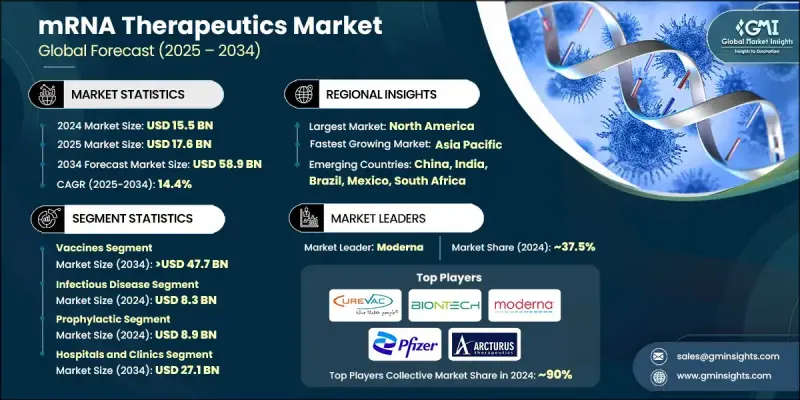
이러한 급성장은 메신저 RNA(mRNA) 플랫폼의 기술적 혁신과 의료 전문가 및 규제 기관의 임상적 잠재력에 대한 신뢰도 증가에 힘입은 바 큽니다. 최근 몇 년간 mRNA가 확장 가능하고 유연하며 매우 효율적인 신약 개발 프로세스를 가능케 하는 능력을 입증했습니다. 지질 나노입자(LNP) 전달 시스템의 주요 발전은 분해 및 면역 반응 문제를 해결함으로써 mRNA 분자의 정밀도, 안전성 및 생체 이용률을 한층 더 향상시켰습니다. 한때 감염병 예방에 집중되었던 mRNA 기술은 이제 심혈관 질환, 자가면역 질환, 희귀 유전 질환을 포함한 만성적이고 복잡한 질환 치료에 점점 더 많이 적용되고 있습니다. 체내에서 특정 단백질을 암호화하는 독특한 능력은 표적화되고 개인화된 치료를 가능하게 하여 현대 의학의 미래를 재편하고 있습니다. 이러한 혁신적인 접근 방식은 mRNA 치료제를 생명공학 부문에서 가장 빠르게 성장하는 부문 중 하나로 자리매김하게 하여 전 세계 제약 및 바이오의약품 산업 전반에 걸쳐 혁신 파이프라인을 가속화하고 있습니다.
| 시장 범위 | |
|---|---|
| 시작 연도 | 2024년 |
| 예측 기간 | 2025-2034년 |
| 시작 금액 | 155억 달러 |
| 예측 금액 | 589억 달러 |
| CAGR | 14.4% |
백신 부문은 2024년 81.9%의 점유율을 기록했으며, 2025년부터 2034년까지 연평균 복합 성장률(CAGR) 14.3%를 기록하며 2034년까지 477억 달러에 달할 것으로 전망됩니다. 이 부문의 성장은 기존 백신 대비 생산 시간을 단축하는 무세포 합성의 효율성에 힘입고 있습니다. 신종 변이체나 병원체에 대한 제형 신속 적응 능력은 mRNA 백신의 높은 다용도성을 보장합니다. 모듈식 생산 설비와 지질 나노입자 시스템의 지속적인 혁신은 제품 안정성, 확장성, 비용 효율성을 더욱 향상시켜 글로벌 접근성을 강화하고 있습니다.
치료제 부문은 암, 자가면역질환, 유전질환 치료에서 mRNA 기술의 역할 확대에 힘입어 2034년까지 연평균 14.6% 성장할 전망입니다. 기존 생물학적 제제와 달리 mRNA 기반 약물은 환자의 DNA를 변형시키지 않고 치료 단백질을 일시적으로 발현시켜 향상된 안전성과 유연성을 제공합니다. 연구 및 임상 시험에 대한 자금 지원 증가로 mRNA 치료제의 개발 파이프라인이 확대되면서, 이 유망한 플랫폼을 활용하려는 제약 및 바이오테크 기업들의 관심을 끌고 있습니다.
북미의 mRNA 치료제 시장은 2024년에 42.4%의 점유율을 차지했습니다. 이 지역의 선도적 지위는 선진적인 연구개발 역량, 강력한 바이오테크 인프라, 그리고 광범위한 제조 및 임상시험 역량을 갖춘 주요 글로벌 기업들의 존재에 기인합니다. 선도적인 병원, 클리닉, 학술 연구 센터를 포함한 북미의 견고한 의료 생태계는 mRNA 기반 제품의 생산과 투여를 모두 지원합니다. 맞춤형 의학에 대한 높은 투자, 콜드 체인 유지 관리를 위한 첨단 물류, 그리고 광범위한 규제 지원은 이 지역의 지배적 위치와 지속적인 시장 성장을 더욱 공고히 했습니다.
세계의 mRNA 치료제 시장에서 활동하는 주요 기업으로는 모더나(Moderna), 화이자(Pfizer), 바이오엔테크(BioNTech), 글락소스미스클라인(GlaxoSmithKline), 큐어백(CureVac), 아스트라제네카(AstraZeneca), 트랜슬레이트 바이오(Translate Bio), 사노피(Sanofi), 아크투루스 테라퓨틱스(Arcturus Therapeutics), 에스리스(Ethris), 키메론 바이오(Chimeron Bio), 티바 바이오텍(Tiba Biotech), 벡스이쿼티(VaxEquity), 이모나 바이오텍(Immorna Biotech), 스테미RNA 테라퓨틱스(StemiRNA Therapeutics) 등이 있습니다. mRNA 치료제 시장의 주요 기업들은 생산 능력 확대, 전달 기술 발전, 글로벌 공급망 강화에 주력하고 있습니다. 제약사와 바이오테크 기업 간의 전략적 파트너십은 연구 결과의 신속한 상용화와 광범위한 임상 시험 수행을 가능하게 합니다. 기업들은 전달 정밀도 향상과 면역원성 감소를 위해 차세대 지질 나노입자 시스템에 막대한 투자를 진행 중입니다. 종양학, 심혈관 질환, 희귀 질환으로의 제품 파이프라인 다각화 역시 장기적 성장을 위한 핵심 전략입니다. 많은 기업들이 비용 절감과 확장성 향상을 위해 모듈식 및 자동화 제조 공정을 도입하고 있습니다.
자주 묻는 질문
목차
제1장 조사 방법과 범위
제2장 주요 요약
제3장 업계 인사이트
- 생태계 분석
- 공급자의 상황
- 각 단계에서의 부가가치
- 밸류체인에 영향을 주는 요인
- 업계에 미치는 영향요인
- 성장 촉진요인
- 전달 기술의 발전
- 백신 이외의 응용 부문의 확대
- 생명공학 연구개발 투자 확대
- 보다 신속하고 확장 가능한 제조 공정
- 업계의 잠재적 억제요인 및 과제
- 면역원성과 안전성에 대한 우려
- 제조 및 확장성에 관한 과제
- 시장 기회
- 단백질 대체 요법으로의 확장
- AI 및 유전체학와의 통합
- 성장 촉진요인
- 성장 가능성 분석
- 규제 상황
- 북미
- 유럽
- 아시아태평양
- 기술 상황
- 현재의 기술 동향
- 신흥기술
- 장래 시장 동향
- 가격 분석
- 임상시험 분석
- Porter's Five Forces 분석
- PESTEL 분석
제4장 경쟁 구도
- 소개
- 기업의 시장 점유율 분석
- 세계
- 북미
- 유럽
- 기업 매트릭스 분석
- 주요 시장 기업의 경쟁 분석
- 경쟁 포지셔닝 매트릭스
- 주요 발전
- 합병 및 인수
- 제휴 및 협력 관계
- 신제품 발매
- 확대 계획
제5장 시장 추계 및 예측 : 제품별(2021-2034년)
- 주요 동향
- 의약품
- 치료용 mRNA 단백질
- 기타 mRNA 기반 의약품
- 백신
- 자기 증폭형 mRNA 백신
- 기존 비증폭 mRNA 백신
제6장 시장 추계 및 예측 : 용도별(2021-2034년)
- 주요 동향
- 감염증
- 종양학
- 희귀 유전성 질환
- 호흡기 질환
- 기타 용도
제7장 시장 추계 및 예측 : 유형별(2021-2034년)
- 주요 동향
- 예방
- 치료
제8장 시장 추계 및 예측 : 최종 용도별(2021-2034년)
- 주요 동향
- 병원 및 진료소
- 제약회사
- 연구기관
- 기타 최종 용도
제9장 시장 추계 및 예측 : 지역별(2021-2034년)
- 주요 동향
- 북미
- 미국
- 캐나다
- 유럽
- 독일
- 영국
- 프랑스
- 스페인
- 이탈리아
- 네덜란드
- 아시아태평양
- 중국
- 인도
- 일본
- 호주
- 한국
- 라틴아메리카
- 브라질
- 멕시코
- 아르헨티나
- 중동 및 아프리카
- 남아프리카
- 사우디아라비아
- 아랍에미리트(UAE)
제10장 기업 프로파일
- CureVac
- BioNtech
- Ethris
- Moderna
- Pfizer
- GlaxoSmithKline
- Translate Bio
- Arcturus Therapeutics
- Sanofi
- AstraZeneca
- Chimeron Bio
- Tiba Biotech
- VaxEquity
- StemiRNA Therapeutics
- Immorna Biotech
The Global mRNA Therapeutics Market was valued at USD 15.5 Billion in 2024 and is estimated to grow at a CAGR of 14.4% to reach USD 58.9 Billion by 2034.
The surge in growth is driven by technological breakthroughs in messenger RNA (mRNA) platforms and the increasing confidence among healthcare professionals and regulators in their clinical potential. Recent years have proven mRNA's ability to enable scalable, flexible, and highly efficient drug development processes. Major advancements in lipid nanoparticle (LNP) delivery systems have further enhanced the precision, safety, and bioavailability of mRNA molecules by addressing degradation and immune response challenges. mRNA technology, once focused on preventing infectious diseases, is now being increasingly applied to treat chronic and complex conditions, including cardiovascular, autoimmune, and rare genetic disorders. Its unique capacity to encode specific proteins inside the body allows for targeted and personalized therapies, reshaping the future of modern medicine. This transformative approach positions mRNA therapeutics as one of the fastest-growing domains in biotechnology, accelerating innovation pipelines across pharmaceutical and biopharmaceutical industries worldwide.
| Market Scope | |
|---|---|
| Start Year | 2024 |
| Forecast Year | 2025-2034 |
| Start Value | $15.5 Billion |
| Forecast Value | $58.9 Billion |
| CAGR | 14.4% |
The vaccines segment held 81.9% share in 2024 and is projected to reach USD 47.7 Billion by 2034, registering a CAGR of 14.3% during 2025-2034. The segment's expansion is supported by the efficiency of cell-free synthesis, which shortens production time compared to traditional vaccines. The ability to rapidly adapt formulations for emerging variants or pathogens makes mRNA vaccines highly versatile. Continuous innovations in modular production setups and lipid nanoparticle systems are further enhancing product stability, scalability, and cost-effectiveness, strengthening their global accessibility.
The therapeutics segment will grow at a CAGR of 14.6% through 2034, driven by mRNA technology's expanding role in the treatment of cancer, autoimmune diseases, and genetic disorders. Unlike conventional biologics, mRNA-based drugs enable temporary expression of therapeutic proteins without modifying the patient's DNA, offering improved safety and flexibility. Increased funding in research and clinical trials has widened the development pipeline for mRNA therapeutics, attracting pharmaceutical and biotech companies eager to capitalize on this promising platform.
North America mRNA Therapeutics Market held a 42.4% share in 2024. The region's leadership is attributed to its advanced R&D capabilities, strong biotech infrastructure, and presence of major global players with extensive manufacturing and clinical trial capacities. North America's robust healthcare ecosystem, which includes leading hospitals, clinics, and academic research centers, supports both the production and administration of mRNA-based products. High investment in personalized medicine, advanced logistics for cold chain maintenance, and widespread regulatory support have further reinforced the region's dominant position and continuous market growth.
Prominent companies active in the Global mRNA Therapeutics Market include Moderna, Pfizer, BioNTech, GlaxoSmithKline, CureVac, AstraZeneca, Translate Bio, Sanofi, Arcturus Therapeutics, Ethris, Chimeron Bio, Tiba Biotech, VaxEquity, Immorna Biotech, and StemiRNA Therapeutics. Key players in the mRNA Therapeutics Market are focusing on expanding production capacity, advancing delivery technologies, and strengthening global supply chains. Strategic partnerships between pharmaceutical and biotech firms are enabling faster research translation and broader clinical trial execution. Companies are heavily investing in next-generation lipid nanoparticle systems to improve delivery precision and reduce immunogenicity. Diversification of product pipelines toward oncology, cardiovascular, and rare diseases is also a central strategy for long-term growth. Many players are adopting modular and automated manufacturing processes to lower costs and enhance scalability.
Table of Contents
Chapter 1 Methodology and Scope
- 1.1 Market scope and definition
- 1.2 Research design
- 1.2.1 Research approach
- 1.2.2 Data collection methods
- 1.3 Data mining sources
- 1.3.1 Global
- 1.3.2 Regional/Country
- 1.4 Base estimates and calculations
- 1.4.1 Base year calculation
- 1.4.2 Key trends for market estimation
- 1.5 Primary research and validation
- 1.5.1 Primary sources
- 1.6 Forecast model
- 1.7 Research assumptions and limitations
Chapter 2 Executive Summary
- 2.1 Industry 360° synopsis
- 2.2 Key market trends
- 2.2.1 Regional trends
- 2.2.2 Product trends
- 2.2.3 Application trends
- 2.2.4 Type trends
- 2.2.5 End use trends
- 2.3 CXO perspectives: Strategic imperatives
- 2.3.1 Key decision points for industry executives
- 2.3.2 Critical success factors for market players
- 2.4 Future outlook and strategic recommendations
Chapter 3 Industry Insights
- 3.1 Industry ecosystem analysis
- 3.1.1 Supplier landscape
- 3.1.2 Value addition at each stage
- 3.1.3 Factors affecting the value chain
- 3.2 Industry impact forces
- 3.2.1 Growth drivers
- 3.2.1.1 Advancements in delivery technologies
- 3.2.1.2 Expanding applications beyond vaccines
- 3.2.1.3 Growing investment in biotechnology research and development
- 3.2.1.4 Faster and scalable manufacturing
- 3.2.2 Industry pitfalls and challenges
- 3.2.2.1 Immunogenicity and safety concerns
- 3.2.2.2 Manufacturing and scalability issues
- 3.2.3 Market opportunities
- 3.2.3.1 Expansion into protein replacement therapies
- 3.2.3.2 Integration with AI and genomics
- 3.2.1 Growth drivers
- 3.3 Growth potential analysis
- 3.4 Regulatory landscape
- 3.4.1 North America
- 3.4.2 Europe
- 3.4.3 Asia Pacific
- 3.5 Technology landscape
- 3.5.1 Current technological trends
- 3.5.2 Emerging technologies
- 3.6 Future market trends
- 3.7 Pricing analysis
- 3.8 Clinical trial analysis
- 3.9 Porter's analysis
- 3.10 PESTEL analysis
Chapter 4 Competitive Landscape, 2024
- 4.1 Introduction
- 4.2 Company market share analysis
- 4.2.1 Global
- 4.2.2 North America
- 4.2.3 Europe
- 4.3 Company matrix analysis
- 4.4 Competitive analysis of major market players
- 4.5 Competitive positioning matrix
- 4.6 Key developments
- 4.6.1 Merger and acquisition
- 4.6.2 Partnership and collaboration
- 4.6.3 New product launches
- 4.6.4 Expansion plans
Chapter 5 Market Estimates and Forecast, By Product, 2021 - 2034 ($ Bn)
- 5.1 Key trends
- 5.2 Drugs
- 5.2.1 Therapeutic mRNA proteins
- 5.2.2 Other mRNA-based drugs
- 5.3 Vaccines
- 5.3.1 Self-amplifying mRNA vaccines
- 5.3.2 Conventional non-amplifying mRNA vaccines
Chapter 6 Market Estimates and Forecast, By Application, 2021 - 2034 ($ Bn)
- 6.1 Key trends
- 6.2 Infectious disease
- 6.3 Oncology
- 6.4 Rare genetic disorders
- 6.5 Respiratory disease
- 6.6 Other applications
Chapter 7 Market Estimates and Forecast, By Type, 2021 - 2034 ($ Bn)
- 7.1 Key trends
- 7.2 Prophylactic
- 7.3 Therapeutic
Chapter 8 Market Estimates and Forecast, By End Use, 2021 - 2034 ($ Bn)
- 8.1 Key trends
- 8.2 Hospitals and clinics
- 8.3 Pharmaceutical companies
- 8.4 Research institutes
- 8.5 Other end use
Chapter 9 Market Estimates and Forecast, By Region, 2021 - 2034 ($ Bn)
- 9.1 Key trends
- 9.2 North America
- 9.2.1 U.S.
- 9.2.2 Canada
- 9.3 Europe
- 9.3.1 Germany
- 9.3.2 UK
- 9.3.3 France
- 9.3.4 Spain
- 9.3.5 Italy
- 9.3.6 Netherlands
- 9.4 Asia Pacific
- 9.4.1 China
- 9.4.2 India
- 9.4.3 Japan
- 9.4.4 Australia
- 9.4.5 South Korea
- 9.5 Latin America
- 9.5.1 Brazil
- 9.5.2 Mexico
- 9.5.3 Argentina
- 9.6 Middle East and Africa
- 9.6.1 South Africa
- 9.6.2 Saudi Arabia
- 9.6.3 UAE
Chapter 10 Company Profiles
- 10.1 CureVac
- 10.2 BioNtech
- 10.3 Ethris
- 10.4 Moderna
- 10.5 Pfizer
- 10.6 GlaxoSmithKline
- 10.7 Translate Bio
- 10.8 Arcturus Therapeutics
- 10.9 Sanofi
- 10.10 AstraZeneca
- 10.11 Chimeron Bio
- 10.12 Tiba Biotech
- 10.13 VaxEquity
- 10.14 StemiRNA Therapeutics
- 10.15 Immorna Biotech