|
시장보고서
상품코드
1871177
차량 ID 관리 시스템 시장 : 기회, 성장 촉진요인, 산업 동향 분석, 예측(2025-2034년)Vehicle Identity Management System Market Opportunity, Growth Drivers, Industry Trend Analysis, and Forecast 2025 - 2034 |
||||||

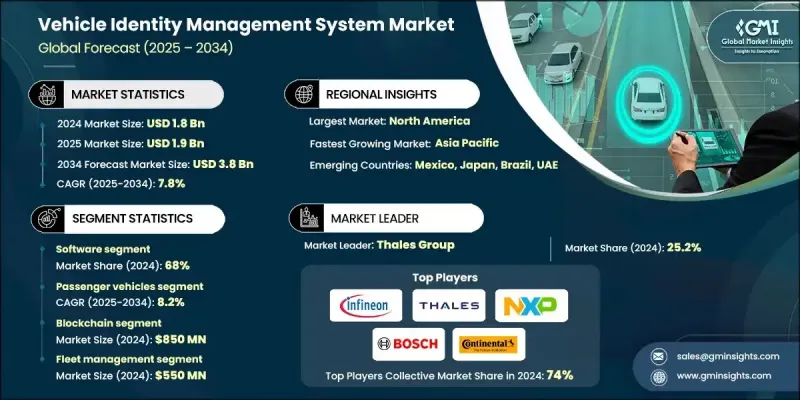
세계의 차량 ID 관리 시스템 시장은 2024년 18억 달러로 평가되었으며, 2034년까지 연평균 복합 성장률(CAGR) 7.8%로 성장해 38억 달러에 이를 것으로 예측됩니다.
시장 성장은 커넥티드카, 전기자동차, 자율주행차의 보급 확대에 더해 안전하고 매끄럽고 지능적인 차내 체험에 대한 수요 증가에 의해 견인되고 있습니다. 디지털 차량 식별, 블록체인을 활용한 인증, 보안 키 관리, IoT 기반 차량 추적 등 급속한 기술 진보로 자동차 제조업체와 서비스 제공업체는 확장성과 조작성이 뛰어난 시스템을 도입할 수 있게 되었습니다. 이러한 혁신은 차량 보안 강화, 업무 효율화, 전반적인 효율 향상을 실현합니다. 암호화 모듈, 디지털 인증서, 보안 하드웨어 및 소프트웨어 플랫폼을 포함한 VIMS 솔루션은 차량 인증, ID 관리, 플릿 모니터링, 액세스 제어 및 규정 준수에 매우 중요합니다. 시장은 커넥티드 모빌리티, 자율주행, 플릿의 디지털화, 엄격한 사이버 보안 규제에 견인되어 활발한 혁신을 경험하고 있습니다. 자동차 제조업체, 플릿 사업자, 스마트 시티 구상은 AI 구동 인증과 차량 텔레매틱스와의 통합에 점점 의존하고, 안전한 차세대 모빌리티 솔루션의 구축을 진행하고 있습니다.
| 시장 범위 | |
|---|---|
| 시작 연도 | 2024년 |
| 예측 연도 | 2025-2034년 |
| 시작 금액 | 18억 달러 |
| 예측 금액 | 38억 달러 |
| CAGR | 7.8% |
소프트웨어 부문은 2024년에 68%의 점유율을 차지했고 2025년부터 2034년까지 CAGR 8%를 보일 것으로 예측됩니다. 디지털 ID 플랫폼, 블록체인 기반 인증 프레임워크, AI 기반 보안 도구, 암호화 프로토콜 등의 소프트웨어 솔루션은 안전한 차량 인증, 무선 업데이트, ID 관리를 실현하는 핵심 기술입니다. 확장성, 상호 운용성, 업데이트 가능한 특성은 OEM, 플릿 사업자, Tier 1 공급업체에게 필수적인 존재가 되었습니다.
승용차 부문은 2024년 69%의 점유율을 차지했으며, 2034년까지 연평균 복합 성장률(CAGR) 8.2%로 성장할 전망입니다. 이 부문은 커넥티드카, 자율주행차, 전기자동차에 대한 소비자 및 규제 당국 수요 증가의 혜택을 받고 있으며, VIMS(차량 ID 관리 시스템)의 통합에 의해 사이버 보안, 안전한 무선 갱신, 차량 네트워크 및 디지털 조종석의 보호가 확보됩니다.
미국 차량 ID 관리 시스템 시장은 2024년 80%의 점유율을 차지했으며, 5억 2,000만 달러 시장 규모를 창출했습니다. 이 나라의 방대한 승용차 및 상용차 기반 외에도 커넥티드카와 전기차의 높은 보급률, 첨단 사이버 보안 규제가 함께 VIMS 제공업체에게 강력한 기회를 창출하고 있습니다. 이 수요를 배경으로 보안 디지털 조종실, 플릿 관리 플랫폼 및 무선 인증 시스템의 신속한 도입이 진행되고 있습니다.
차량 ID 관리 시스템 시장의 주요 기업으로는 Thales Group, DigiCert, NXP Semiconductors, Continental AG, Robert Bosch, Venafi, Infineon Technologies AG, Sectigo Limited, Entrust Corporation, GlobalSign 등이 있습니다. 이 시장의 기업은 시장에서의 발판을 강화하기 위해 여러 전략을 활용하고 있습니다. 인증 및 변조 방지를 강화하기 위해 AI 및 블록체인 기반 보안 솔루션에 많은 투자를 하고 있습니다. 자동차 제조업체, Tier 1 공급업체, 스마트 모빌리티 제공업체와의 전략적 제휴로 서비스 제공 범위와 통합 능력을 확대하고 있습니다. 공급자는 또한 연결 차량, 전기자동차, 자율주행 차량 생태계를 지원하기 때문에 소프트웨어 확장성, 모듈형 솔루션, 무선 업데이트(OTA) 프레임워크에 주력하고 있습니다. 규제 준수와 사이버 보안 표준에 대한 중점적인 노력은 신뢰를 확보하고 배포를 가속화합니다.
자주 묻는 질문
목차
제1장 조사 방법과 범위
제2장 주요 요약
제3장 업계 인사이트
- 업계 생태계 분석
- 공급자의 상황
- 이익률
- 비용 구조
- 각 단계에서의 부가가치
- 밸류체인에 영향을 주는 요인
- 혁신
- 업계에 미치는 영향요인
- 성장 촉진요인
- 차량의 커넥티비티 향상
- 전기자동차(EV) 및 하이브리드차의 성장
- 규제 준수 및 사이버 보안 요건
- 플릿 모빌리티 서비스 확대
- 업계의 잠재적 리스크 및 과제
- 기존 차량과의 통합에 관한 과제
- 데이터 프라이버시와 보안에 대한 우려
- 시장 기회
- 블록체인 및 AI 구동형 아이덴티티 솔루션
- 스마트 시티와 커넥티드 모빌리티의 통합
- 플릿 관리 및 MaaS(mobility-as-a-service)의 통합
- 디지털 조종석, 스마트 차량 인터페이스와의 통합
- 성장 촉진요인
- 성장 가능성 분석
- Porter's Five Forces 분석
- PESTEL 분석
- 기술과 혁신의 상황
- 암호화 처리 성능과 처리량 분석
- 보안 처리 지연과 실시간 대응 능력
- 위협 검출 정밀도와 오감지율
- 전력 소비량과 효율 지표
- 변조 방지 대책과 물리적 보안 평가
- 복잡성과 개발 시간의 통합
- 가격 동향
- 지역별
- 제품별
- 생산 통계
- 생산 거점
- 소비 거점
- 수출입
- 코스트 내역 분석
- 특허 분석
- 지속가능성과 환경적 측면
- 지속가능한 실천
- 폐기물 감축 전략
- 생산에 있어서의 에너지 효율
- 환경에 배려한 대처
- 탄소발자국에 관한 고려 사항
- 위험 평가 프레임워크
- 베스트 케이스 시나리오
제4장 경쟁 구도
- 소개
- 기업의 시장 점유율 분석
- 북미
- 유럽
- 아시아태평양
- 라틴아메리카
- 중동 및 아프리카
- 주요 시장 기업의 경쟁 분석
- 경쟁 포지셔닝 매트릭스
- 전략적 전망 매트릭스
- 주요 발전
- 인수합병
- 제휴 및 협업
- 신제품 발매
- 확대계획과 자금조달
제5장 시장 추계 및 예측 : 컴포넌트별, 2021-2034년
- 주요 동향
- 소프트웨어
- 하드웨어
- 서비스
제6장 시장 추계 및 예측 : 기술별, 2021-2034년
- 주요 동향
- 블록체인
- 클라우드 기반 시스템
- IoT 및 AI의 통합
- 생체 인증 기술 및 스마트 태그
- 디지털 트윈 및 엣지 컴퓨팅
제7장 시장 추계 및 예측 : 차량별, 2021-2034년
- 주요 동향
- 승용차
- SUV
- 세단
- 해치백
- 상용차
- 소형 상용차(LCV)
- 중형 상용차(MCV)
- 대형 상용차(HCV)
- 이륜차
제8장 시장 추계 및 예측 : 용도별, 2021-2034년
- 주요 동향
- 플릿 관리
- 차량 등록 및 소유권 추적
- Vehicle-to-everything(V2X) 통신 보안
- MaaS(mobility-as-a-service) 플랫폼
- 보험 및 금융
- 차량 수명주기 관리
제9장 시장 추계 및 예측 : 최종 용도별, 2021-2034년
- 주요 동향
- OEM
- 플릿 사업자 및 물류회사
- 이동성 서비스 제공업체
- 보험 및 금융기관
- 정부 및 규제기관
제10장 시장 추계 및 예측 : 지역별, 2021-2034년
- 주요 동향
- 주요 동향
- 북미
- 미국
- 캐나다
- 유럽
- 영국
- 독일
- 프랑스
- 이탈리아
- 스페인
- 벨기에
- 네덜란드
- 스웨덴
- 아시아태평양
- 중국
- 인도
- 일본
- 호주
- 싱가포르
- 한국
- 베트남
- 인도네시아
- 라틴아메리카
- 브라질
- 멕시코
- 아르헨티나
- 중동 및 아프리카
- 아랍에미리트(UAE)
- 남아프리카
- 사우디아라비아
제11장 기업 프로파일
- 세계 기업
- Continental AG
- DigiCert
- Entrust Corporation
- GlobalSign
- Infineon Technologies AG
- NXP Semiconductors NV
- Robert Bosch GmbH
- Sectigo Limited
- Thales Group
- Venafi
- 지역 기업
- Aptiv PLC
- DENSO
- HID Global Corporation
- IDEMIA Group
- Lear Corporation
- Magna International
- Marelli Holdings
- Renesas Electronics
- Valeo SE
- ZF Friedrichshafen AG
- 신흥기업
- Airbiquity
- Device Authority
- Karamba Security
- Trillium Secure
- Trustonic
The Global Vehicle Identity Management System Market was valued at USD 1.8 Billion in 2024 and is estimated to grow at a CAGR of 7.8% to reach USD 3.8 Billion by 2034.
Market growth is fueled by the rising adoption of connected, electric, and autonomous vehicles, alongside growing demand for secure, seamless, and intelligent in-vehicle experiences. Rapid technological advancements, including digital vehicle identities, blockchain-enabled authentication, secure key management, and IoT-based vehicle tracking, are empowering automakers and service providers to implement scalable, tamper-resistant systems. These innovations enhance vehicle security, streamline operations, and improve overall efficiency. VIMS solutions, which include cryptographic modules, digital certificates, secure hardware, and software platforms, are critical for vehicle authentication, identity management, fleet oversight, access control, and regulatory compliance. The market is experiencing robust innovation driven by connected mobility, autonomous driving, fleet digitization, and stringent cybersecurity regulations. Automakers, fleet operators, and smart city initiatives increasingly rely on AI-driven authentication and integration with vehicle telematics to build secure, next-generation mobility solutions.
| Market Scope | |
|---|---|
| Start Year | 2024 |
| Forecast Year | 2025-2034 |
| Start Value | $1.8 Billion |
| Forecast Value | $3.8 Billion |
| CAGR | 7.8% |
The software segment accounted for a 68% share in 2024 and is expected to grow at a CAGR of 8% from 2025 to 2034. Software solutions, including digital identity platforms, blockchain-based authentication frameworks, AI-powered security tools, and encryption protocols, are central to enabling secure vehicle authentication, over-the-air updates, and identity management. Their scalability, interoperability, and updatable nature make them indispensable for OEMs, fleet operators, and Tier-1 suppliers.
The passenger vehicles segment held a 69% share in 2024, expected to grow at a CAGR of 8.2% through 2034. This segment benefits from rising consumer and regulatory demand for connected, autonomous, and electric vehicles, where VIMS integration ensures cybersecurity, secure over-the-air updates, and protection of vehicle networks and digital cockpits.
U.S. Vehicle Identity Management System Market held an 80% share, generating USD 520 million in 2024. The country's significant passenger and commercial vehicle base, combined with high adoption of connected and electric vehicles and progressive cybersecurity regulations, creates strong opportunities for VIMS providers. Rapid deployment of secure digital cockpits, fleet management platforms, and over-the-air authentication systems is being driven by this demand.
Key players in the Vehicle Identity Management System Market include Thales Group, DigiCert, NXP Semiconductors, Continental AG, Robert Bosch, Venafi, Infineon Technologies AG, Sectigo Limited, Entrust Corporation, and GlobalSign. Companies in the Vehicle Identity Management System Market are leveraging several strategies to strengthen their market foothold. They are investing heavily in AI and blockchain-driven security solutions to improve authentication and tamper-proofing. Strategic partnerships with automakers, Tier-1 suppliers, and smart mobility providers are expanding their service reach and integration capabilities. Providers are also focusing on software scalability, modular solutions, and over-the-air update frameworks to cater to connected, electric, and autonomous vehicle ecosystems. Emphasis on regulatory compliance and cybersecurity standards ensures trust and accelerates adoption.
Table of Contents
Chapter 1 Methodology & Scope
- 1.1 Market scope and definition
- 1.2 Research design
- 1.2.1 Research approach
- 1.2.2 Data collection methods
- 1.3 Data mining sources
- 1.3.1 Regional/Country
- 1.4 Base estimates and calculations
- 1.4.1 Base year calculation
- 1.4.2 Key trends for market estimation
- 1.5 Primary research and validation
- 1.5.1 Primary sources
- 1.6 Forecast model
- 1.7 Research assumptions and limitations
Chapter 2 Executive Summary
- 2.1 Industry 360° synopsis, 2021 - 2034
- 2.2 Key market trends
- 2.2.1 Regional
- 2.2.2 Component
- 2.2.3 Technology
- 2.2.4 Vehicle
- 2.2.5 Application
- 2.2.6 End use
- 2.3 TAM Analysis, 2025-2034
- 2.4 CXO perspectives: Strategic imperatives
- 2.4.1 Executive decision points
- 2.4.2 Critical success factors
- 2.5 Future outlook and strategic recommendations
Chapter 3 Industry Insights
- 3.1 Industry ecosystem analysis
- 3.1.1 Supplier Landscape
- 3.1.2 Profit Margin
- 3.1.3 Cost structure
- 3.1.4 Value addition at each stage
- 3.1.5 Factor affecting the value chain
- 3.1.6 Disruptions
- 3.2 Industry impact forces
- 3.2.1 Growth drivers
- 3.2.1.1 Rising vehicle connectivity
- 3.2.1.2 Growth of EVS and hybrid vehicles
- 3.2.1.3 Regulatory compliance and cybersecurity mandates
- 3.2.1.4 Expansion of fleet and mobility services
- 3.2.2 Industry pitfalls and challenges
- 3.2.2.1 Integration challenges with legacy vehicles
- 3.2.2.2 Data privacy and security concerns
- 3.2.3 Market opportunities
- 3.2.3.1 Blockchain and ai-driven identity solutions
- 3.2.3.2 Smart city and connected mobility integration
- 3.2.3.3 Fleet management and mobility-as-a-service (MaaS) integration
- 3.2.3.4 Integration with digital cockpits and smart vehicle interfaces
- 3.2.1 Growth drivers
- 3.3 Growth potential analysis
- 3.3.1 ISO 3779 Vehicle Identification Number (VIN) standard
- 3.3.2 UNECE R31Vehicle registration number regulations
- 3.3.3 GDPR Data Privacy for vehicle owner information
- 3.3.4 CCPA Data Privacy for consumer/vehicle data
- 3.3.5 ISO 26262 Functional safety for vehicles integrating VIMS
- 3.4 Porter's analysis
- 3.5 PESTEL analysis
- 3.6 Technology and Innovation Landscape
- 3.6.1 Cryptographic performance & throughput analysis
- 3.6.2 Security processing latency & real-time capability
- 3.6.3 Threat detection accuracy & false positive rates
- 3.6.4 Power consumption & efficiency metrics
- 3.6.5 Tamper resistance & physical security assessment
- 3.6.6 Integration of complexity & development time
- 3.7 Price trends
- 3.7.1 By region
- 3.7.2 By product
- 3.8 Production statistics
- 3.8.1 Production hubs
- 3.8.2 Consumption hubs
- 3.8.3 Export and import
- 3.9 Cost breakdown analysis
- 3.10 Patent analysis
- 3.11 Sustainability and Environmental Aspects
- 3.11.1 Sustainable practices
- 3.11.2 Waste reduction strategies
- 3.11.3 Energy efficiency in production
- 3.11.4 Eco-friendly initiatives
- 3.11.5 Carbon footprint considerations
- 3.12 Risk assessment framework
- 3.13 Best case scenarios
Chapter 4 Competitive Landscape, 2024
- 4.1 Introduction
- 4.2 Company market share analysis
- 4.2.1 North America
- 4.2.2 Europe
- 4.2.3 Asia Pacific
- 4.2.4 Latin America
- 4.2.5 Middle East & Africa
- 4.3 Competitive analysis of major market players
- 4.4 Competitive positioning matrix
- 4.5 Strategic outlook matrix
- 4.6 Key developments
- 4.6.1 Mergers & acquisitions
- 4.6.2 Partnerships & collaborations
- 4.6.3 New product launches
- 4.6.4 Expansion plans and funding
Chapter 5 Market Estimates & Forecast, By Component, 2021 - 2034 ($ Bn)
- 5.1 Key trends
- 5.2 Software
- 5.3 Hardware
- 5.4 Services
Chapter 6 Market Estimates & Forecast, By Technology, 2021 - 2034 ($ Bn)
- 6.1 Key trends
- 6.2 Blockchain
- 6.3 Cloud-Based Systems
- 6.4 IoT and AI Integration
- 6.5 Biometrics and Smart Tags
- 6.6 Digital Twin and Edge Computing
Chapter 7 Market Estimates & Forecast, By Vehicle, 2021 - 2034 ($ Bn)
- 7.1 Key trends
- 7.2 Passenger Vehicles
- 7.2.1 SUV
- 7.2.2 Sedan
- 7.2.3 Hatchback
- 7.3 Commercial Vehicles
- 7.3.1 Light commercial vehicles (LCV)
- 7.3.2 Medium commercial vehicles (MCV)
- 7.3.3 Heavy commercial vehicles (HCV)
- 7.4 Two-wheeler
Chapter 8 Market Estimates & Forecast, By Application, 2021 - 2034 ($ Bn)
- 8.1 Key trends
- 8.2 Fleet management
- 8.3 Vehicle registration and ownership tracking
- 8.4 Vehicle-to-everything (V2X) communication security
- 8.5 Mobility-as-a-service (maas) platforms
- 8.6 Insurance and financing
- 8.7 Vehicle lifecycle management
Chapter 9 Market Estimates & Forecast, By End Use, 2021 - 2034 ($ Bn)
- 9.1 Key trends
- 9.2 OEM
- 9.3 Fleet operators and logistics companies
- 9.4 Mobility service providers
- 9.5 Insurance and financial institutions
- 9.6 Government and regulatory bodies
Chapter 10 Market Estimates & Forecast, By Region, 2021 - 2034 ($ Bn)
- 10.1 Key trends
- 10.2 Key trends
- 10.3 North America
- 10.3.1 US
- 10.3.2 Canada
- 10.4 Europe
- 10.4.1 UK
- 10.4.2 Germany
- 10.4.3 France
- 10.4.4 Italy
- 10.4.5 Spain
- 10.4.6 Belgium
- 10.4.7 Netherlands
- 10.4.8 Sweden
- 10.5 Asia Pacific
- 10.5.1 China
- 10.5.2 India
- 10.5.3 Japan
- 10.5.4 Australia
- 10.5.5 Singapore
- 10.5.6 South Korea
- 10.5.7 Vietnam
- 10.5.8 Indonesia
- 10.6 Latin America
- 10.6.1 Brazil
- 10.6.2 Mexico
- 10.6.3 Argentina
- 10.7 MEA
- 10.7.1 UAE
- 10.7.2 South Africa
- 10.7.3 Saudi Arabia
Chapter 11 Company Profiles
- 11.1 Global players
- 11.1.1 Continental AG
- 11.1.2 DigiCert
- 11.1.3 Entrust Corporation
- 11.1.4 GlobalSign
- 11.1.5 Infineon Technologies AG
- 11.1.6 NXP Semiconductors N.V.
- 11.1.7 Robert Bosch GmbH
- 11.1.8 Sectigo Limited
- 11.1.9 Thales Group
- 11.1.10 Venafi
- 11.2 Regional players
- 11.2.1 Aptiv PLC
- 11.2.2 DENSO
- 11.2.3 HID Global Corporation
- 11.2.4 IDEMIA Group
- 11.2.5 Lear Corporation
- 11.2.6 Magna International
- 11.2.7 Marelli Holdings
- 11.2.8 Renesas Electronics
- 11.2.9 Valeo SE
- 11.2.10 ZF Friedrichshafen AG
- 11.3 Emerging players
- 11.3.1 Airbiquity
- 11.3.2 Device Authority
- 11.3.3 Karamba Security
- 11.3.4 Trillium Secure
- 11.3.5 Trustonic