|
시장보고서
상품코드
1876642
식품 포장 재활용 시장 : 시장 기회, 성장 요인, 업계 동향 분석 및 예측(2025-2034년)Food Packaging Recycling Market Opportunity, Growth Drivers, Industry Trend Analysis, and Forecast 2025 - 2034 |
||||||

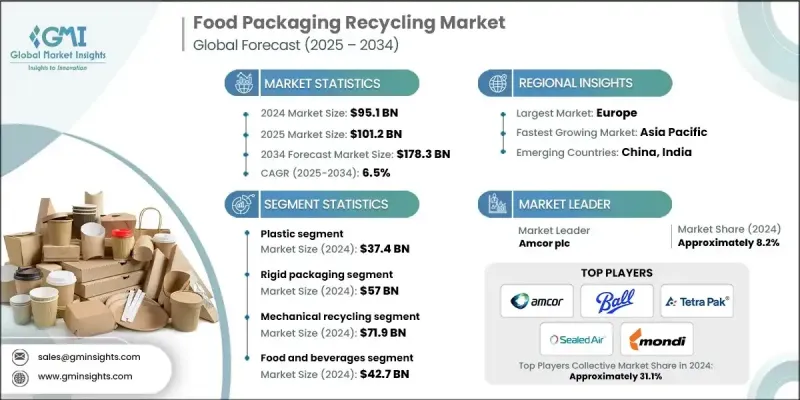
세계의 식품 포장 재활용 시장은 2024년에 951억 달러로 평가되었고, 2034년까지 연평균 복합 성장률(CAGR) 6.5%로 성장할 전망이며, 1,783억 달러에 이를 것으로 예측됩니다.
시장 확대의 배경에는 규제 강화의 압력 및 확대 생산자 책임(EPR) 제도의 도입이 있어, 이들이 제조업체에서 포장재에 대한 재생재의 사용 확대를 촉구하고 있습니다. 기업은 야심찬 지속가능성 목표를 추구하고 있으며, 회수 인프라, 선별 능력, 첨단 재활용 기술에 대한 투자 증가로 이어지고 있습니다. 동시에 환경 문제에 대한 사회의 의식이 높아짐에 따라 재활용 활동 참여가 촉진되어 재생가능한 식품포장 형태 및 개선된 처리 시스템에 대한 수요가 더욱 강해지고 있습니다. 기계적 재활용 및 화학적 재활용에 있어서의 기술 혁신이 진전을 가속시키고 있으며, 다층 구조나 유연성 필름 등 종래는 재활용이 곤란했던 포장 재료의 효율적인 처리를 가능하게 하고 있습니다. 포장 디자인의 간소화와 표준화를 위한 노력도 회수율 향상을 지지하고 있습니다. 그 결과, 기술 도입의 진전, 이해 관계자간의 제휴 강화, 식품 포장 에코시스템에 있어서의 순환형 사회에의 명확한 이행에 의해 시장은 꾸준한 성장을 이루고 있습니다.
| 시장 범위 | |
|---|---|
| 시작 연도 | 2024년 |
| 예측 기간 | 2025-2034년 |
| 시작 시 가치 | 951억 달러 |
| 예측 금액 | 1,783억 달러 |
| CAGR | 6.5% |
플라스틱 분야는 2024년 374억 달러에 이르렀고, 2025-2034년 연평균 복합 성장률(CAGR) 10.9%로 성장할 것으로 예측됩니다. 산업 및 규제 당국이 폐기물을 최소화하기 위해 노력하면서 플라스틱, 종이, 유리 및 금속의 회수율 향상으로 성장이 지원되고 있습니다. 플라스틱은 광범위한 사용과 폐기 처리의 복잡성으로 인해 주요 초점이 되었습니다. 화학적 재활용 및 기계적 재활용에 대한 투자는 PET 및 폴리올레핀을 식품 등급 재료로 가공하는 능력을 향상시킵니다. 종이 및 판지는 강력한 재활용 네트워크와 섬유 기반 대체품 채택 증가에 힘입어 시장 점유율을 계속 확대하고 있습니다.
경질 포장 부문은 2024년에 570억 달러 규모에 이르렀으며, 2034년까지 연평균 복합 성장률(CAGR) 6.5%로 성장할 것으로 예측됩니다. 유리병, 금속캔, PET병, HDPE 용기 등 확립된 재활용 흐름이 단단한 용기의 장점이 되었습니다. 식품 및 음료 제조업체는 세정, 펠레타이징 및 제염 시스템의 강화에 의한 소재 품질의 향상을 배경으로, 지속가능성 기준을 충족시키기 위해, 경질 포장재에의 재생 원료의 채용을 확대하고 있습니다.
북미의 식품 포장 재활용 시장은 2024년 282억 달러 규모를 기록했으며, 예측 기간 동안 강력한 성장이 예상됩니다. 이 지역에서는 지원 규제, 기업의 사회적 책임(CSR) 이니셔티브, 확립된 폐기물 관리 네트워크를 통해 재활용 환경이 강화되고 있습니다. 기계적, 화학적 재활용 능력의 확대 및 재활용 적성 설계(DFR) 기법의 개선은 포장 카테고리 전체, 특히 경질 포장 분야에서 폐쇄 루프 시스템을 추진하고 있습니다.
세계 식품 포장 재활용 시장의 주요 기업으로는 Amcor plc, Mondi Group, Ball Corporation, Tetra Pak, and Sealed Air Corporation 등이 있습니다. 식품 포장 재활용 시장의 기업은 경쟁 우위를 강화하기 위해 여러 전략을 실시했습니다. 많은 기업들이 차세대 재활용 기술에 대한 투자를 확대하고 있으며, 첨단 기계적, 화학적 시스템으로 고품질 출력 및 복잡한 소재의 처리 능력 향상을 실현하고 있습니다. 또한 폐기물 관리 사업자 및 소비재 브랜드와의 제휴를 통해 재료 회수율을 높이는 클로즈드 루프형 공급망의 구축도 진행되고 있습니다. 선별 자동화의 개선 및 회수 네트워크의 확충 등 리사이클 인프라의 확충도 중요한 우선 사항입니다. 기업은 규제 요건과 지속가능성 목표에 부합하면서 재활용성을 높이기 위해 포장 재설계를 추진하고 있습니다.
자주 묻는 질문
목차
제1장 조사 방법
- 시장 범위 및 정의
- 조사 설계
- 조사 접근
- 데이터 수집 방법
- 데이터 마이닝의 출처
- 세계
- 지역별 및 국가별
- 기본 추정치 및 계산
- 기준 연도 계산
- 시장 추정에서의 주요 동향
- 1차 조사 및 검증
- 1차 정보
- 예측 모델
- 조사의 전제조건 및 제한 사항
제2장 주요 요약
제3장 업계 인사이트
- 생태계 분석
- 공급자의 상황
- 이익률
- 각 단계에서의 부가가치
- 밸류체인에 영향을 주는 요인
- 혁신
- 업계에 미치는 영향요인
- 성장 촉진요인
- 확대 생산자 책임(EPR) 정책 도입 확대
- 기업의 지속가능성에 대한 강한 노력 및 재생재 함량에 대한 확고한 헌신
- 환경 영향에 대한 소비자 의식의 고조
- 리사이클 인프라 및 처리 능력의 확충
- 업계의 잠재적 위험 및 과제
- 식품 포장 폐기물 스트림의 오염
- 다층 및 복합재료 포장의 복잡성
- 분별, 수집 및 선별 시스템의 미비
- 시장 기회
- 난처리 포장재의 화학적 재활용 확대를 위한 대처
- 식품 등급 재생 PET(rPET) 및 재생 폴리올레핀을 위한 견고한 공급망 구축
- 재활용 설계에 관한 컨설팅 및 인증 서비스 제공
- 지역 재활용 인프라 투자 및 M&A 동향
- 성장 촉진요인
- 성장 가능성 분석
- 규제 상황
- 북미
- 유럽
- 아시아태평양
- 라틴아메리카
- 중동 및 아프리카
- Porter's Five Forces 분석
- PESTEL 분석
- 가격 동향
- 지역별
- 제품별
- 장래 시장 동향
- 기술 및 혁신 동향
- 현재의 기술 동향
- 신흥 기술
- 특허 상황
- 무역 통계(주 : 무역 통계는 주요 국가에서만 제공됨)
- 주요 수입국
- 주요 수출국
- 지속가능성 및 환경적 측면
- 지속가능한 대처
- 폐기물 감축 전략
- 생산에 있어서 에너지 효율
- 환경에 배려한 대처
- 탄소발자국에 관한 고려 사항
제4장 경쟁 구도
- 서문
- 기업의 시장 점유율 분석
- 지역별
- 북미
- 유럽
- 아시아태평양
- 라틴아메리카
- 중동 및 아프리카
- 지역별
- 기업 매트릭스 분석
- 주요 시장 기업의 경쟁 분석
- 경쟁 포지셔닝 매트릭스
- 주요 발전
- 합병 및 인수
- 제휴 및 협력 관계
- 신제품 발매
- 사업 확대 계획
제5장 시장 추계 및 예측 : 소재 유형별(2021-2034년)
- 주요 동향
- 플라스틱
- PET(폴리에틸렌테레프탈레이트)
- HDPE(고밀도 폴리에틸렌)
- LDPE(저밀도 폴리에틸렌)
- PP(폴리프로필렌)
- 폴리스티렌
- 다층 플라스틱
- 종이 및 판지
- 골판지
- 상자용 판지
- 크래프트지
- 금속
- 알루미늄
- 강철
- 유리
- 생분해성 및 바이오 베이스 소재
- PLA(폴리유산)
- 전분계 플라스틱
- 기타
제6장 시장 추계 및 예측 : 포장 형태별(2021-2034년)
- 주요 동향
- 경질 포장
- 병 및 단지
- 트레이
- 캔
- 상자
- 연포장
- 파우치
- 랩
- 필름
- 작은 주머니
- 기타
제7장 시장 추계 및 예측 : 재활용 프로세스별(2021-2034년)
- 주요 동향
- 기계적 재활용
- 화학적 재활용
- 열분해
- 탈중합
- 생물학적 재활용
- 퇴비화(생분해성 포장용)
- 에너지 회수
- 에너지 회수를 수반하는 소각 처리
- 기타
제8장 시장 추계 및 예측 : 최종 이용 산업별(2021-2034년)
- 주요 동향
- 식품 및 음료
- 유제품
- 베이커리 및 과자류
- 고기, 닭고기 및 해산물
- 레디 투 이트 식사
- 과일 및 야채
- 음료(논알코올 및 알코올)
- 외식 산업
- 퀵 서비스 레스토랑(QSR)
- 카페테리아
- 케이터링 서비스
- 소매 및 전자상거래
- 시설용 이용
- 병원
- 학교
- 정부 시설
- 기타
제9장 시장 추계 및 예측 : 지역별(2021-2034년)
- 주요 동향
- 북미
- 미국
- 캐나다
- 유럽
- 독일
- 영국
- 프랑스
- 이탈리아
- 스페인
- 기타 유럽
- 아시아태평양
- 중국
- 인도
- 일본
- 호주
- 한국
- 기타 아시아태평양
- 라틴아메리카
- 브라질
- 멕시코
- 아르헨티나
- 기타 라틴아메리카
- 중동 및 아프리카
- 사우디아라비아
- 남아프리카
- 아랍에미리트(UAE)
- 기타 중동 및 아프리카
제10장 기업 프로파일
- Amcor plc
- Mondi Group
- Tetra Pak
- Sealed Air Corporation
- Ball Corporation
- Constantia Flexibles
- MULTIVAC Group
- Clear Path Recycling
- Clean Tech Incorporated
- CarbonLite Industries
- BioPak
- EcoEnclose
- Elevate Packaging
- TC Transcontinental Packaging
- International Paper Company
The Global Food Packaging Recycling Market was valued at USD 95.1 billion in 2024 and is estimated to grow at a CAGR of 6.5% to reach USD 178.3 billion by 2034.
Market expansion is fueled by rising regulatory pressure and the implementation of Extended Producer Responsibility programs, which are prompting manufacturers to increase the use of recycled content in their packaging. Companies are pursuing ambitious sustainability commitments, leading to higher investments in collection infrastructure, sorting capabilities, and advanced recycling technologies. At the same time, public awareness of environmental concerns has strengthened participation in recycling efforts, reinforcing demand for recyclable food packaging formats and improved processing systems. Innovations in mechanical and chemical recycling are accelerating progress, enabling previously difficult packaging materials-such as multilayer structures and flexible films-to be recycled more effectively. Efforts to simplify and harmonize packaging designs are also supporting higher recovery rates. As a result, the market is experiencing steady momentum driven by technology adoption, stronger stakeholder collaboration, and a clear shift toward circularity in the food packaging ecosystem.
| Market Scope | |
|---|---|
| Start Year | 2024 |
| Forecast Year | 2025-2034 |
| Start Value | $95.1 Billion |
| Forecast Value | $178.3 Billion |
| CAGR | 6.5% |
The plastic segment reached USD 37.4 billion in 2024 and is expected to grow at a 10.9% CAGR from 2025 to 2034. Growth is supported by the rising recovery of plastics, paper, glass, and metal as industries and regulators work toward minimizing waste. Plastics remain a primary focus due to their widespread use and the complexities of disposal. Investments in both chemical and mechanical recycling are improving the ability to process PET and polyolefins into food-grade materials. Paper and paperboard continue to gain market share, supported by strong recycling networks and increasing adoption of fiber-based alternatives.
The rigid packaging segment was valued at USD 57 billion in 2024 and is anticipated to grow at a 6.5% CAGR through 2034. Rigid formats benefit from well-established recycling streams for glass jars, metal cans, PET bottles, and HDPE containers. Food and beverage producers are incorporating more recycled inputs into rigid packaging to meet sustainability standards, supported by enhanced washing, pelletizing, and decontamination systems that improve material quality.
North America Food Packaging Recycling Market generated USD 28.2 billion in 2024 and is positioned for strong growth over the forecast period. The region is strengthening its recycling landscape through supportive regulations, corporate responsibility initiatives, and established waste management networks. Expanding mechanical and chemical recycling capacity and improved design-for-recyclability practices are advancing closed-loop systems across packaging categories, especially in rigid formats.
Key participants in the Global Food Packaging Recycling Market include Amcor plc, Mondi Group, Ball Corporation, Tetra Pak, and Sealed Air Corporation. Companies in the food packaging recycling market are implementing several strategies to reinforce their competitive advantage. Many firms are scaling investments in next-generation recycling technologies, including advanced mechanical and chemical systems that enable higher-quality output and better processing of complex materials. Organizations are also partnering with waste management providers and consumer goods brands to build closed-loop supply chains that enhance material recovery. Expansion of recycling infrastructure, such as improved sorting automation and upgraded collection networks, is another key priority. Businesses are redesigning packaging to improve recyclability while aligning with regulatory requirements and sustainability goals.
Table of Contents
Chapter 1 Methodology
- 1.1 Market scope and definition
- 1.2 Research design
- 1.2.1 Research approach
- 1.2.2 Data collection methods
- 1.3 Data mining sources
- 1.3.1 Global
- 1.3.2 Regional/Country
- 1.4 Base estimates and calculations
- 1.4.1 Base year calculation
- 1.4.2 Key trends for market estimation
- 1.5 Primary research and validation
- 1.5.1 Primary sources
- 1.6 Forecast model
- 1.7 Research assumptions and limitations
Chapter 2 Executive Summary
- 2.1 Industry 3600 synopsis
- 2.2 Key market trends
- 2.2.1 Regional
- 2.2.2 Material Type
- 2.2.3 Packaging Format
- 2.2.4 Recycling Process
- 2.2.5 End Use Industry
- 2.3 TAM Analysis, 2025-2034
- 2.4 CXO perspectives: Strategic imperatives
- 2.4.1 Executive decision points
- 2.4.2 Critical success factors
- 2.5 Future Outlook and Strategic Recommendations
Chapter 3 Industry Insights
- 3.1 Industry ecosystem analysis
- 3.1.1 Supplier Landscape
- 3.1.2 Profit Margin
- 3.1.3 Value addition at each stage
- 3.1.4 Factor affecting the value chain
- 3.1.5 Disruptions
- 3.2 Industry impact forces
- 3.2.1 Growth drivers
- 3.2.1.1 Increasing implementation of Extended Producer Responsibility (EPR) policies
- 3.2.1.2 Strong corporate sustainability and recycled-content commitments
- 3.2.1.3 Rising consumer awareness of environmental impacts
- 3.2.1.4 Expansion of recycling infrastructure and capacity
- 3.2.2 Industry pitfalls and challenges
- 3.2.2.1 Contamination of food packaging waste streams
- 3.2.2.2 Complexity of multilayer and mixed-material packaging
- 3.2.2.3 Insufficient segregation, collection, and sorting systems
- 3.2.3 Market opportunities
- 3.2.3.1 Scaling chemical recycling to process difficult packaging types
- 3.2.3.2 Developing robust supply chains for food-grade rPET and recycled polyolefins
- 3.2.3.3 Offering design-for-recycling advisory and certification services
- 3.2.3.4 Investment and M&A in regional recycling infrastructure
- 3.2.1 Growth drivers
- 3.3 Growth potential analysis
- 3.4 Regulatory landscape
- 3.4.1 North America
- 3.4.2 Europe
- 3.4.3 Asia Pacific
- 3.4.4 Latin America
- 3.4.5 Middle East & Africa
- 3.5 Porter's analysis
- 3.6 PESTEL analysis
- 3.7 Price trends
- 3.7.1 By region
- 3.7.2 By product
- 3.8 Future market trends
- 3.9 Technology and Innovation landscape
- 3.9.1 Current technological trends
- 3.9.2 Emerging technologies
- 3.10 Patent Landscape
- 3.11 Trade statistics (Note: the trade statistics will be provided for key countries only)
- 3.11.1 Major importing countries
- 3.11.2 Major exporting countries
- 3.12 Sustainability and Environmental Aspects
- 3.12.1 Sustainable Practices
- 3.12.2 Waste Reduction Strategies
- 3.12.3 Energy Efficiency in Production
- 3.12.4 Eco-friendly Initiatives
- 3.13 Carbon Footprint Considerations
Chapter 4 Competitive Landscape, 2024
- 4.1 Introduction
- 4.2 Company market share analysis
- 4.2.1 By region
- 4.2.1.1 North America
- 4.2.1.2 Europe
- 4.2.1.3 Asia Pacific
- 4.2.1.4 LATAM
- 4.2.1.5 MEA
- 4.2.1 By region
- 4.3 Company matrix analysis
- 4.4 Competitive analysis of major market players
- 4.5 Competitive positioning matrix
- 4.6 Key developments
- 4.6.1 Mergers & acquisitions
- 4.6.2 Partnerships & collaborations
- 4.6.3 New Product Launches
- 4.6.4 Expansion Plans
Chapter 5 Market Estimates and Forecast, By Material Type, 2021 - 2034 (USD Billion, Kilo Tons)
- 5.1 Key trends
- 5.2 Plastic
- 5.2.1 PET (Polyethylene Terephthalate)
- 5.2.2 HDPE (High-Density Polyethylene)
- 5.2.3 LDPE (Low-Density Polyethylene)
- 5.2.4 PP (Polypropylene)
- 5.2.5 Polystyrene
- 5.2.6 Multi-layer plastics
- 5.3 Paper & Paperboard
- 5.3.1 Corrugated board
- 5.3.2 Boxboard
- 5.3.3 Kraft paper
- 5.4 Metal
- 5.4.1 Aluminum
- 5.4.2 Steel
- 5.5 Glass
- 5.6 Biodegradable/Bio-based Materials
- 5.6.1 PLA (Polylactic Acid)
- 5.6.2 Starch-based plastics
- 5.7 Others
Chapter 6 Market Estimates and Forecast, By Packaging Format, 2021 - 2034 (USD Billion, Kilo Tons)
- 6.1 Key trends
- 6.2 Rigid Packaging
- 6.2.1 Bottles & Jars
- 6.2.2 Trays
- 6.2.3 Cans
- 6.2.4 Boxes
- 6.3 Flexible Packaging
- 6.3.1 Pouches
- 6.3.2 Wraps
- 6.3.3 Films
- 6.3.4 Sachets
- 6.4 Others
Chapter 7 Market Estimates and Forecast, By Recycling Process, 2021 - 2034 (USD Billion, Kilo Tons)
- 7.1 Key trends
- 7.2 Mechanical Recycling
- 7.3 Chemical Recycling
- 7.3.1 Pyrolysis
- 7.3.2 Depolymerization
- 7.4 Biological Recycling
- 7.4.1 Composting (for biodegradable packaging)
- 7.5 Energy Recovery
- 7.5.1 Incineration with energy capture
- 7.6 Others
Chapter 8 Market Estimates and Forecast, By End Use Industry, 2021 - 2034 (USD Billion, Kilo Tons)
- 8.1 Key trends
- 8.2 Food & Beverage
- 8.2.1 Dairy
- 8.2.2 Bakery & Confectionery
- 8.2.3 Meat, Poultry & Seafood
- 8.2.4 Ready-to-Eat Meals
- 8.2.5 Fruits & Vegetables
- 8.2.6 Beverages (non-alcoholic and alcoholic)
- 8.3 Foodservice
- 8.3.1 Quick Service Restaurants (QSRs)
- 8.3.2 Cafeterias
- 8.3.3 Catering Services
- 8.4 Retail & E-commerce
- 8.5 Institutional Use
- 8.5.1 Hospitals
- 8.5.2 Schools
- 8.5.3 Government Facilities
- 8.6 Others
Chapter 9 Market Estimates and Forecast, By Region, 2021 - 2034 (USD Billion, Kilo Tons)
- 9.1 Key trends
- 9.2 North America
- 9.2.1 U.S.
- 9.2.2 Canada
- 9.3 Europe
- 9.3.1 Germany
- 9.3.2 UK
- 9.3.3 France
- 9.3.4 Italy
- 9.3.5 Spain
- 9.3.6 Rest of Europe
- 9.4 Asia Pacific
- 9.4.1 China
- 9.4.2 India
- 9.4.3 Japan
- 9.4.4 Australia
- 9.4.5 South Korea
- 9.4.6 Rest of Asia Pacific
- 9.5 Latin America
- 9.5.1 Brazil
- 9.5.2 Mexico
- 9.5.3 Argentina
- 9.5.4 Rest of Latin America
- 9.6 Middle East & Africa
- 9.6.1 Saudi Arabia
- 9.6.2 South Africa
- 9.6.3 UAE
- 9.6.4 Rest of Middle East & Africa
Chapter 10 Company Profiles
- 10.1 Amcor plc
- 10.2 Mondi Group
- 10.3 Tetra Pak
- 10.4 Sealed Air Corporation
- 10.5 Ball Corporation
- 10.6 Constantia Flexibles
- 10.7 MULTIVAC Group
- 10.8 Clear Path Recycling
- 10.9 Clean Tech Incorporated
- 10.10 CarbonLite Industries
- 10.11 BioPak
- 10.12 EcoEnclose
- 10.13 Elevate Packaging
- 10.14 TC Transcontinental Packaging
- 10.15 International Paper Company