
|
시장보고서
상품코드
1885796
섬유 재활용 시장 : 시장 기회, 성장 요인, 업계 동향 분석 및 예측(2025-2034년)Textile to Textile Recycling Market Opportunity, Growth Drivers, Industry Trend Analysis, and Forecast 2025 - 2034 |
||||||

세계의 섬유 재활용 시장은 2024년에 28억 달러로 평가되었고, 2034년까지 연평균 복합 성장률(CAGR) 24.9%로 성장할 전망이며, 448억 달러에 이를 것으로 예측되고 있습니다.
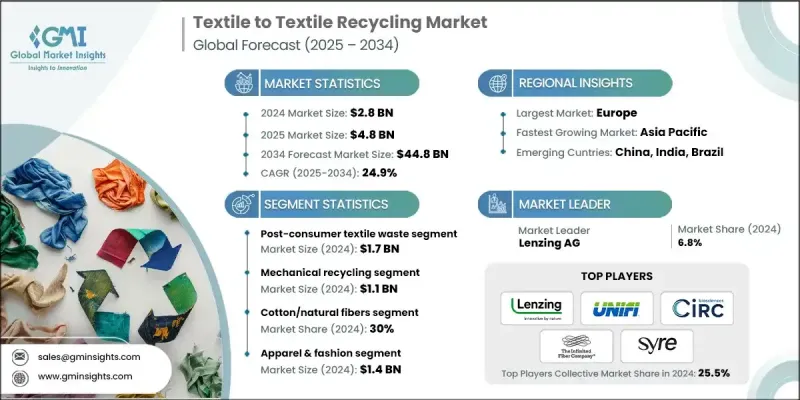
시장 가속은 블록체인을 활용한 디지털 제품 페스포트 및 섬유 식별 기술의 신속한 통합을 통해 추진되고 있습니다. 이들은 추적성을 강화하고 보다 정확한 분별을 가능하게 합니다. 이러한 디지털 시스템을 통해 재활용 업체는 섬유의 유형을 검증하고, 재료의 기원을 추적하며, 라이프사이클 데이터를 정밀하게 모니터링할 수 있으며, 경우에 따라 실시간 의사결정을 지원합니다. 이러한 기술의 채택은 회수 재료의 품질 향상, 오염 감소 및 유럽에서 진화하는 순환 섬유 규제에 대한 적합성을 보장합니다. 지속가능성에 대한 기대가 높아짐에 따라 세계 브랜드는 공급망의 책임을 강화하고 규제 요건을 충족하기 위해 이러한 기술의 도입을 가속화하고 있습니다. 동시에 화학적 및 효소적 재활용 공정은 상업적 성숙도를 높이고 복잡한 섬유 혼합물을 고품질 재생 소재에 적합한 섬유 성분으로 분해하는 능력을 제공합니다. 이러한 혁신 기술은 현재 파일럿 단계에서 산업 규모의 운영으로 전환하고 있으며, 기업은 주요 의류 제조업체와의 제휴를 확보하고 생산 능력을 확대하고 있습니다.
| 시장 범위 | |
|---|---|
| 시작 연도 | 2024년 |
| 예측 연도 | 2025-2034년 |
| 시작 시 가치 | 28억 달러 |
| 예측 금액 | 448억 달러 |
| CAGR | 24.9% |
2024년, 사용한 섬유 폐기물 부문은 17억 달러를 차지했으며, 섬유에서 섬유로 재활용하는 총 원료량의 약 60%를 차지했습니다. 이 압도적인 점유율은 폐기 의류 증가, 회수 경로의 확대, 순환형 패션 시스템을 지원하는 정책 주도 노력의 영향 때문입니다.
의류 및 패션 분야는 2024년에 14억 달러에 달했고, 세계 의류 브랜드에 의한 지속가능성에 대한 강한 대처와 업계 전체에서 주류 및 전문 의류 카테고리에 대한 재생 섬유의 채용 확대가 기여했습니다.
북미의 섬유 재활용 시장은 2024년 7억 4,100만 달러를 창출해 26%의 점유율을 차지했습니다. 확대 생산자 책임 프로그램을 촉진하는 정책의 진전과, 소매업체 및 리사이클 기업 간의 제휴 강화가, 지역 전체에서 보다 견고한 회수, 선별 및 재생 인프라를 지지하고 있습니다.
자주 묻는 질문
목차
제1장 조사 방법 및 범위
제2장 주요 요약
제3장 업계 인사이트
- 생태계 분석
- 공급자의 상황
- 이익률
- 각 단계에서의 부가가치
- 밸류체인에 영향을 주는 요인
- 혁신
- 업계에 미치는 영향요인
- 성장 촉진요인
- 업계의 잠재적 위험 및 과제
- 시장 기회
- 성장 가능성 분석
- 규제 상황
- 북미
- 유럽
- 아시아태평양
- 라틴아메리카
- 중동 및 아프리카(MEA)
- Porter's Five Forces 분석
- PESTEL 분석
- 가격 동향
- 지역별
- 원료원별
- 장래 시장 동향
- 기술 및 혁신 동향
- 현재의 기술 동향
- 신흥 기술
- 특허 상황
- 무역 통계(HS코드)
- 주요 수입국
- 주요 수출국
- 지속가능성 및 환경면
- 지속가능한 대처
- 폐기물 감축 전략
- 생산에 있어서의 에너지 효율
- 환경에 배려한 대처
- 탄소발자국 고려
제4장 경쟁 구도
- 서문
- 기업의 시장 점유율 분석
- 지역별
- 북미
- 유럽
- 아시아태평양
- 라틴아메리카
- 중동 및 아프리카
- 지역별
- 기업 매트릭스 분석
- 주요 시장 기업의 경쟁 분석
- 경쟁 포지셔닝 매트릭스
- 주요 발전
- 합병 및 인수
- 제휴 및 협업
- 신제품 발매
- 확대 계획
제5장 시장 추계 및 예측 : 원료원별(2021-2034년)
- 주요 동향
- 사용한 섬유 폐기물
- 생산 전 산업 폐기물
- 혼합 섬유 폐기물 스트림
제6장 시장 추계 및 예측 : 기술 유형별(2021-2034년)
- 주요 동향
- 기계적 재활용
- 화학적 재활용
- 생물학적 및 효소적 재활용
- 하이브리드 및 복합 기술
제7장 시장 추계 및 예측 : 섬유 유형별(2021-2034년)
- 주요 동향
- 폴리에스테르 및 합성 섬유
- 면 및 천연 섬유
- 혼방 섬유
- 특수 섬유
제8장 시장 추계 및 예측 : 용도별(2021-2034년)
- 주요 동향
- 의류 패션
- 산업용 섬유
- 홈 섬유
- 자동차용 섬유
- 부직포의 용도
제9장 시장 추계 및 예측 : 지역별(2021-2034년)
- 주요 동향
- 북미
- 미국
- 캐나다
- 유럽
- 독일
- 영국
- 프랑스
- 스페인
- 이탈리아
- 기타 유럽
- 아시아태평양
- 중국
- 인도
- 일본
- 호주
- 한국
- 기타 아시아태평양
- 라틴아메리카
- 브라질
- 멕시코
- 아르헨티나
- 기타 라틴아메리카
- 중동 및 아프리카
- 사우디아라비아
- 남아프리카
- 아랍에미리트(UAE)
- 기타 중동 및 아프리카
제10장 기업 프로파일
- Ambercycle Inc
- Boer Group Recycling Solutions BV
- Circ Inc
- Ecotex Germany GmbH
- Evrnu SPC
- FABSCRAP Inc
- Grasim Industries Limited(Birla Cellulose)
- Infinited Fiber Company Oy
- Lenzing AG
- Martex Fiber Southern Corporation
- Procotex Corporation SA
- RE&UP(SANKO Group)
- SYRE AB
- Textile Recycling International Ltd
- Unifi Inc
The Global Textile to Textile Recycling Market was valued at USD 2.8 billion in 2024 and is estimated to grow at a CAGR of 24.9% to reach USD 44.8 billion by 2034.
Market acceleration is driven by the rapid integration of blockchain-enabled digital product passports and embedded fiber identification technologies that enhance traceability and enable more accurate sorting. These digital systems allow recyclers to validate fiber type, track material origins, and monitor lifecycle data with high precision, supporting real-time decision-making in some instances. Their adoption improves the quality of recovered materials, reduces contamination, and ensures alignment with evolving circular textile regulations in Europe. As sustainability expectations grow, global brands are increasingly adopting these technologies to improve supply-chain accountability and meet regulatory expectations. At the same time, chemical and enzymatic recycling processes are achieving greater commercial maturity, offering the ability to break down complex textile blends into fiber components suitable for high-quality regenerated materials. These innovations are now transitioning from pilot stages into industrial-scale operations as companies secure partnerships with major apparel manufacturers and expand production capacity.
| Market Scope | |
|---|---|
| Start Year | 2024 |
| Forecast Year | 2025-2034 |
| Start Value | $2.8 Billion |
| Forecast Value | $44.8 Billion |
| CAGR | 24.9% |
The post-consumer textile waste segment accounted for USD 1.7 billion in 2024, representing roughly 60% of the total feedstock in textile-to-textile recycling. This dominant share is influenced by increased volumes of discarded garments, broader collection channels, and policy-driven initiatives supporting circular fashion systems.
The apparel and fashion segment reached USD 1.4 billion in 2024, benefiting from strong sustainability commitments among global clothing brands and rising incorporation of recycled fibers into mainstream and specialty apparel categories across the industry.
North America Textile to Textile Recycling Market generated USD 741 million in 2024, contributing 26% share. Policy developments encouraging extended producer responsibility programs, along with increased collaboration between retailers and recycling firms, are supporting stronger collection, sorting, and recovery infrastructure throughout the region.
Key companies participating in the Textile to Textile Recycling Market include Ambercycle Inc., Boer Group Recycling Solutions BV, Circ Inc., Ecotex Germany GmbH, Evrnu SPC, FABSCRAP Inc., Grasim Industries Limited (Birla Cellulose), Infinited Fiber Company Oy, Lenzing AG, Martex Fiber Southern Corporation, Procotex Corporation SA, RE&UP (SANKO Group), SYRE AB, Textile Recycling International Ltd, and Unifi Inc. Leading companies are strengthening their presence by investing heavily in advanced recycling technologies capable of processing blended and hard-to-recycle materials into high-quality regenerated fibers. Many firms are scaling production by transitioning from pilot operations to full industrial facilities through joint ventures and long-term collaborations with global apparel manufacturers. Businesses are further integrating digital tracking tools, such as embedded fiber markers and blockchain-enabled data systems, to enhance traceability and meet compliance demands.
Table of Contents
Chapter 1 Methodology & Scope
- 1.1 Market scope and definition
- 1.2 Research design
- 1.2.1 Research approach
- 1.2.2 Data collection methods
- 1.3 Data mining sources
- 1.3.1 Global
- 1.3.2 Regional/Country
- 1.4 Base estimates and calculations
- 1.4.1 Base year calculation
- 1.4.2 Key trends for market estimation
- 1.5 Primary research and validation
- 1.5.1 Primary sources
- 1.6 Forecast model
- 1.7 Research assumptions and limitations
Chapter 2 Executive Summary
- 2.1 Industry 360° synopsis
- 2.2 Key market trends
- 2.2.1 Regional
- 2.2.2 Feedstock source
- 2.2.3 Technology type
- 2.2.4 Fiber type
- 2.2.5 Application
- 2.3 TAM Analysis, 2025-2034
- 2.4 CXO perspectives: Strategic imperatives
- 2.4.1 Executive decision points
- 2.4.2 Critical success factors
- 2.5 Future Outlook and Strategic Recommendations
Chapter 3 Industry Insights
- 3.1 Industry ecosystem analysis
- 3.1.1 Supplier landscape
- 3.1.2 Profit margin
- 3.1.3 Value addition at each stage
- 3.1.4 Factor affecting the value chain
- 3.1.5 Disruptions
- 3.2 Industry impact forces
- 3.2.1 Growth drivers
- 3.2.2 Industry pitfalls and challenges
- 3.2.3 Market opportunities
- 3.3 Growth potential analysis
- 3.4 Regulatory landscape
- 3.4.1 North America
- 3.4.2 Europe
- 3.4.3 Asia Pacific
- 3.4.4 Latin America
- 3.4.5 Middle East & Africa (MEA)
- 3.5 Porter's analysis
- 3.6 PESTEL analysis
- 3.7 Price trends
- 3.7.1 By region
- 3.7.2 By feedstock source
- 3.8 Future market trends
- 3.9 Technology and innovation landscape
- 3.9.1 Current technological trends
- 3.9.2 Emerging technologies
- 3.10 Patent landscape
- 3.11 Trade statistics (HS code)
- 3.11.1 Major importing countries
- 3.11.2 Major exporting countries
- 3.12 Sustainability and environmental aspects
- 3.12.1 Sustainable practices
- 3.12.2 Waste reduction strategies
- 3.12.3 Energy efficiency in production
- 3.12.4 Eco-friendly initiatives
- 3.13 Carbon footprint consideration
Chapter 4 Competitive Landscape, 2024
- 4.1 Introduction
- 4.2 Company market share analysis
- 4.2.1 By region
- 4.2.1.1 North America
- 4.2.1.2 Europe
- 4.2.1.3 Asia Pacific
- 4.2.1.4 LATAM
- 4.2.1.5 MEA
- 4.2.1 By region
- 4.3 Company matrix analysis
- 4.4 Competitive analysis of major market players
- 4.5 Competitive positioning matrix
- 4.6 Key developments
- 4.6.1 Mergers & acquisitions
- 4.6.2 Partnerships & collaborations
- 4.6.3 New product launches
- 4.6.4 Expansion plans
Chapter 5 Market Estimates and Forecast, By Feedstock Source, 2021-2034 (USD Billion & Tons)
- 5.1 Key trends
- 5.2 Post-consumer textile waste
- 5.3 Pre-consumer industrial waste
- 5.4 Mixed textile waste streams
Chapter 6 Market Estimates and Forecast, By Technology Type, 2021-2034 (USD Billion & Tons)
- 6.1 Key trends
- 6.2 Mechanical recycling
- 6.3 Chemical recycling
- 6.4 Biological/enzymatic recycling
- 6.5 Hybrid/combined technologies
Chapter 7 Market Estimates and Forecast, By Fiber Type, 2021-2034 (USD Billion & Tons)
- 7.1 Key trends
- 7.2 Polyester/synthetic fibers
- 7.3 Cotton/natural fibers
- 7.4 Blended textiles
- 7.5 Specialty fibers
Chapter 8 Market Estimates and Forecast, By Application, 2021-2034 (USD Billion & Tons)
- 8.1 Key trends
- 8.2 Apparel & fashion
- 8.3 Industrial textiles
- 8.4 Home textiles
- 8.5 Automotive textiles
- 8.6 Non-woven applications
Chapter 9 Market Estimates and Forecast, By Region, 2021-2034 (USD Billion & Tons)
- 9.1 Key trends
- 9.2 North America
- 9.2.1 U.S.
- 9.2.2 Canada
- 9.3 Europe
- 9.3.1 Germany
- 9.3.2 UK
- 9.3.3 France
- 9.3.4 Spain
- 9.3.5 Italy
- 9.3.6 Rest of Europe
- 9.4 Asia Pacific
- 9.4.1 China
- 9.4.2 India
- 9.4.3 Japan
- 9.4.4 Australia
- 9.4.5 South Korea
- 9.4.6 Rest of Asia Pacific
- 9.5 Latin America
- 9.5.1 Brazil
- 9.5.2 Mexico
- 9.5.3 Argentina
- 9.5.4 Rest of Latin America
- 9.6 Middle East and Africa
- 9.6.1 Saudi Arabia
- 9.6.2 South Africa
- 9.6.3 UAE
- 9.6.4 Rest of Middle East and Africa
Chapter 10 Company Profiles
- 10.1 Ambercycle Inc
- 10.2 Boer Group Recycling Solutions BV
- 10.3 Circ Inc
- 10.4 Ecotex Germany GmbH
- 10.5 Evrnu SPC
- 10.6 FABSCRAP Inc
- 10.7 Grasim Industries Limited (Birla Cellulose)
- 10.8 Infinited Fiber Company Oy
- 10.9 Lenzing AG
- 10.10 Martex Fiber Southern Corporation
- 10.11 Procotex Corporation SA
- 10.12 RE&UP (SANKO Group)
- 10.13 SYRE AB
- 10.14 Textile Recycling International Ltd
- 10.15 Unifi Inc