|
시장보고서
상품코드
1885815
단세포 단백질 가수분해물 시장 : 시장 기회, 성장 요인, 업계 동향 분석 및 예측(2025-2034년)Single-Cell Protein Hydrolysates Market Opportunity, Growth Drivers, Industry Trend Analysis, and Forecast 2025 - 2034 |
||||||

세계의 단세포 단백질 가수분해물 시장은 2024년에 2억 8,840만 달러로 평가되었고, 2034년까지 연평균 복합 성장률(CAGR) 9.5%로 성장할 전망이며, 7억 2,100만 달러에 이를 것으로 예측되고 있습니다.
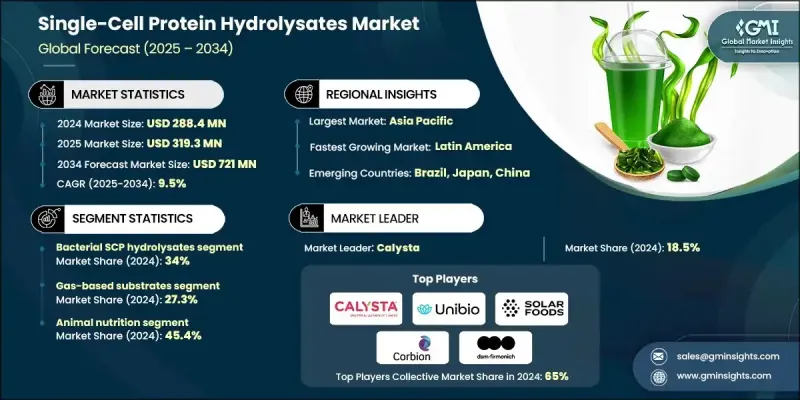
단세포 단백질(SCP) 가수분해물은 높은 소화성, 아미노산 이용 효율, 박테리아, 효모, 곰팡이, 미세조류와 같은 미생물 유래의 기능적 특성으로 인해 지속가능한 단백질 경제의 중요한 구성요소가 되고 있습니다. 그 생산은 환경 부하가 낮고, 폐기물 스트림이나 가스계 원료에 의존하는 경우가 많기 때문에 동물 영양, 인간용 식품 용도, 영양 보조 식품 분야에 있어서 수요가 높아지고 있습니다. 세계적인 단백질 수요가 증가하고 환경 부하가 증가함에 따라 SCP 가수분해물은 수산 양식 사료, 임상 영양, 순환 바이오 이코노미 전략에서 중요성을 증가시키고 있습니다. 산업 배기 가스, 유기 잔류물, 바이오매스 유래 기질 등을 활용한 순환 시스템과의 일관성은 토지 제약, 배출 감축 노력, 식량 안보의 우선 과제에 대한 대응에 공헌합니다. 이러한 요인으로 인해 SCP 가수분해물은 신기술에서 널리 채택되는 상업용 솔루션으로 전환하고 있습니다.
| 시장 범위 | |
|---|---|
| 시작 연도 | 2024년 |
| 예측 연도 | 2025-2034년 |
| 시작 시 가치 | 2억 8,840만 달러 |
| 예측 금액 | 7억 2,100만 달러 |
| CAGR | 9.5% |
박테리아 유래 SCP 가수분해물 부문은 2024년에 34%를 차지하였고, 2034년까지 연평균 복합 성장률(CAGR) 8.9%로 성장할 것으로 예측됩니다. 박테리아 및 효모 플랫폼에서 생산되는 가수분해물은 바이오매스의 신속한 생성, 높은 확장성, 가스계 기질과의 호환성으로 계속해서 확대되고 있습니다. 이들은 장내 기능의 향상에 활용되는 한편, 효모 유래의 가수분해물, 특히 사카로미세스속 유래의 것은 반려동물 먹이나 풍미 증강 용도로 보다 일반적으로 되고 있습니다.
동물영양 분야는 2024년에 45.4%의 점유율을 차지했으며, 2034년까지 연평균 복합 성장률(CAGR) 9.3%로 성장할 것으로 예측됩니다. 성장을 견인하는 것은 수산 양식 분야이며, SCP 원료의 높은 안정성 및 소화성으부터, 종래의 해양 유래 단백질을 대신하는 지속 가능한 선택으로서 주목받고 있습니다. 미생물 단백질 공급업체는 각종 어종을 위한 솔루션을 커스터마이즈하고 있으며, 반려동물 먹이 제조업체는 기호성과 소화기 건강의 개선을 목적으로 효모 및 세균 가수분해물을 배합하고 있습니다. 축산 분야에서도 사료 비용 절감과 기존 첨가물에 대한 의존 저감을 목적으로 SCP 가수분해물의 채용이 진행되고 있습니다.
미국의 단세포 단백질 가수분해물 시장은 2024년에 7,030만 달러에 이르렀고, 2025-2034년 연평균 복합 성장률(CAGR) 9.5%로 성장할 것으로 예측됩니다. 천연가스 및 산업 제품별을 이용한 SCP 가수분해물 생산을 확대하는 여러 혁신 기업에 의해 미국은 사료 및 영양 분야에서의 규모 확대 및 기술 진보의 주요 추진역으로 계속되고 있습니다.
자주 묻는 질문
목차
제1장 조사 방법 및 범위
제2장 주요 요약
제3장 업계 인사이트
- 생태계 분석
- 공급자의 상황
- 이익률
- 각 단계에서의 부가가치
- 밸류체인에 영향을 주는 요인
- 혁신
- 업계에 미치는 영향요인
- 성장 촉진요인
- 지속 가능한 단백질에 대한 수요 증가
- 수산 사료 용도에 있어서의 확대
- 폐기물 바이오매스를 활용한 순환형 생산
- 업계의 잠재적 위험 및 과제
- 복잡한 다운스트림 가공 비용
- 신규 원료의 규제 승인
- 시장 기회
- CO2 발효 기술 및 전력에서 단백질로의 변환 기술
- 스포츠 영양 및 임상 영양 분야의 성장
- 성장 촉진요인
- 성장 가능성 분석
- 규제 상황
- 북미
- 유럽
- 아시아태평양
- 라틴아메리카
- 중동 및 아프리카
- Porter's Five Forces 분석
- PESTEL 분석
- 가격 동향
- 지역별
- 제품 유형별
- 장래 시장 동향
- 기술 및 혁신 동향
- 현재의 기술 동향
- 신흥 기술
- 특허 상황
- 무역 통계(HS코드)(참고 : 무역 통계는 주요 국가에서만 제공됨)
- 주요 수입국
- 주요 수출국
- 지속가능성 및 환경면
- 지속가능한 대처
- 폐기물 감축 전략
- 생산에 있어서의 에너지 효율
- 환경에 배려한 대처
- 탄소발자국 고려
제4장 경쟁 구도
- 서문
- 기업의 시장 점유율 분석
- 지역별
- 북미
- 유럽
- 아시아태평양
- 라틴아메리카
- 중동 및 아프리카
- 지역별
- 기업 매트릭스 분석
- 주요 시장 기업의 경쟁 분석
- 경쟁 포지셔닝 매트릭스
- 주요 발전
- 합병 및 인수
- 제휴 및 협업
- 신제품 발매
- 사업 확대 계획
제5장 시장 추계 및 예측 : 원료별 및 생물종별(2021-2034년)
- 주요 동향
- 세균 유래 SCP 가수분해물
- 메탄 영양균(예 : 캡슐상 메틸로코커스)
- 수소 산화 세균(예 : 구리산화균)
- 독립 영양 세균(예 : 클로스트리듐 및 오토에타노게남)
- 기타 세균(바실러스속, 락토바실러스속, 보라색 비황황균)
- 효모 SCP 가수분해물
- 기존 효모(사카로미세스 세레비시에, 칸디다 유티리스)
- 메틸로트로픽 효모(피키아 파스토리스, 야로위아 리폴리티카)
- 기타 효모(쿠르비오미세스, 로드톨라)
- 균류 SCP 가수분해물
- 사상균(후자리움속, 아스페르길루스속, 리조프스속)
- 기타 균류(네우로스포라속, 트리코델마속)
- 미세조류 및 남조류 SCP 가수분해물
- 시아노박테리아(스피루리나속)
- 녹색 미세조류(클로렐라, 스케네데스무스)
- 기타 미세조류(나노클로롭시스, 유글레나)
- 기타
제6장 시장 추계 및 예측 : 생산 기질 및 원료별(2021-2034년)
- 주요 동향
- 가스계 기질
- 메탄, 메탄올, CO2, H2
- 공업 배기 가스, 바이오가스
- 탄수화물계 기질
- 당밀, 포도당, 전분 가수분해물
- 식품 가공 폐기물(유청, 과피, 양조장 폐기물)
- 리그노셀룰로오스계 바이오매스 및 농업 폐기물
- 밀짚, 바가스, 목재 잔류물
- 사용한 아황산염액
- 동물성 및 공업 제품별
- 생선 및 가금류 폐기물, 가축 분뇨
- 거친 글리세린, 도시 하수
- 기타
제7장 시장 추계 및 예측 : 용도별(2021-2034년)
- 주요 동향
- 동물영양학
- 수산 사료(생선, 새우)
- 가축 사료(가금류, 돼지, 반추 동물)
- 반려동물 먹이(개, 고양이)
- 인간용 식품 및 뉴트라슈티컬
- 단백질 보충제(스포츠, 임상, 노인용)
- 기능성 식품(음료, 바, 스낵)
- 고기 및 유제품의 대체품
- 의약품 및 영양 보조 식품에 대한 용도
- 생물활성 펩티드(항산화, 강압 작용)
- 면역 및 대사 건강
- 화장품 및 공업 용도
- 피부 및 헤어 케어용 바이오 액티브 성분
- 바이오플라스틱 발효, 배양 배지
- 기타
제8장 시장 추계 및 예측 : 지역별(2021-2034년)
- 주요 동향
- 북미
- 미국
- 캐나다
- 유럽
- 독일
- 영국
- 프랑스
- 스페인
- 이탈리아
- 기타 유럽
- 아시아태평양
- 중국
- 인도
- 일본
- 호주
- 한국
- 기타 아시아태평양
- 라틴아메리카
- 브라질
- 멕시코
- 아르헨티나
- 기타 라틴아메리카
- 중동 및 아프리카
- 사우디아라비아
- 남아프리카
- 아랍에미리트(UAE)
- 기타 중동 및 아프리카
제9장 기업 프로파일
- Calysta
- Unibio
- Solar Foods
- KnipBio
- Quorn Foods
- Arbiom
- Corbion
- DSM-Firmenich
- Novozymes(Now part of Novonesis)
- Angel Yeast
- Lesaffre
- Alltech
- Nutreco
- AlgaeCytes
The Global Single-Cell Protein Hydrolysates Market was valued at USD 288.4 million in 2024 and is estimated to grow at a CAGR of 9.5% to reach USD 721 million by 2034.
Single-cell protein (SCP) hydrolysates are becoming a crucial component of the sustainable protein economy, supported by their strong digestibility, amino acid availability, and functional attributes derived from microbial sources such as bacteria, yeast, fungi, and microalgae. Their production is associated with a low environmental footprint, often relying on waste streams or gas-based feedstocks, which enhances their appeal across animal nutrition, human food applications, and nutraceuticals. As global protein requirements increase and environmental pressures intensify, SCP hydrolysates are gaining prominence in aquaculture diets, clinical nutrition, and circular bioeconomy strategies. Their alignment with circular systems, especially using industrial off-gases, organic residues, and biomass-derived substrates, helps address land constraints, emission reduction efforts, and food security priorities. These factors are moving SCP hydrolysates from emerging technologies into widely adopted commercial solutions.
| Market Scope | |
|---|---|
| Start Year | 2024 |
| Forecast Year | 2025-2034 |
| Start Value | $288.4 Million |
| Forecast Value | $721 Million |
| CAGR | 9.5% |
The bacterial SCP hydrolysates segment accounted for 34% in 2024 and is expected to grow at a CAGR of 8.9% by 2034. Hydrolysates produced from bacterial and yeast platforms continue to expand due to rapid biomass generation, strong scalability, and compatibility with gas-based substrates. They are used to enhance gut performance, while yeast-derived hydrolysates, particularly from Saccharomyces species, are becoming more common in pet food and flavor-enhancing applications.
The animal nutrition segment held a 45.4% share in 2024 and is projected to grow at a CAGR of 9.3% through 2034. Growth is led by aquaculture, driven by the stability and digestibility of SCP ingredients, offering a sustainable alternative to conventional marine-based proteins. Providers of microbial proteins are customizing solutions for various species, and manufacturers in the pet food sector are incorporating yeast and bacterial hydrolysates to improve palatability and digestive health. Livestock operations are also adopting SCP hydrolysates to lower feed expenses and reduce dependency on traditional additives.
U.S. Single-Cell Protein Hydrolysates Market reached USD 70.3 million in 2024 and is anticipated to register a CAGR of 9.5% from 2025 to 2034. With multiple innovators expanding SCP hydrolysate production using natural gas and industrial co-products, the United States remains a key driver of scale-up and technological advancement across feed and nutrition applications.
Major companies participating in the Global Single-Cell Protein Hydrolysates Market include Calysta, Unibio, Solar Foods, KnipBio, Quorn Foods, Arbiom, Corbion, DSM-Firmenich, Novozymes (now part of Novonesis), Angel Yeast, Lesaffre, Alltech, Nutreco, and AlgaeCytes. Companies competing in this market are strengthening their positions through large-scale fermentation expansion, cost-optimized bioprocessing, and advanced strain engineering to boost protein yields and enhance nutrient profiles. Many firms are forming supply partnerships with feed manufacturers and food companies to secure long-term contracts while tailoring hydrolysate compositions for species-specific nutritional needs. Sustainability commitments, including the use of waste-derived and gas-fed feedstocks, are helping companies stand out as environmentally aligned suppliers. Product diversification, regulatory compliance strategies, and investments in high-value applications such as clinical nutrition and functional formulations are further supporting stronger global market footholds.
Table of Contents
Chapter 1 Methodology & Scope
- 1.1 Market scope and definition
- 1.2 Research design
- 1.2.1 Research approach
- 1.2.2 Data collection methods
- 1.3 Data mining sources
- 1.3.1 Global
- 1.3.2 Regional/Country
- 1.4 Base estimates and calculations
- 1.4.1 Base year calculation
- 1.4.2 Key trends for market estimation
- 1.5 Primary research and validation
- 1.5.1 Primary sources
- 1.6 Forecast model
- 1.7 Research assumptions and limitations
Chapter 2 Executive Summary
- 2.1 Industry 3600 synopsis
- 2.2 Key market trends
- 2.2.1 Regional
- 2.2.2 Source / Organism Type
- 2.2.3 Production Substrate / Feedstock
- 2.2.4 Application
- 2.3 TAM Analysis, 2025-2034
- 2.4 CXO perspectives: Strategic imperatives
- 2.4.1 Executive decision points
- 2.4.2 Critical success factors
- 2.5 Future Outlook and Strategic Recommendations
Chapter 3 Industry Insights
- 3.1 Industry ecosystem analysis
- 3.1.1 Supplier landscape
- 3.1.2 Profit margin
- 3.1.3 Value addition at each stage
- 3.1.4 Factor affecting the value chain
- 3.1.5 Disruptions
- 3.2 Industry impact forces
- 3.2.1 Growth drivers
- 3.2.1.1 Rising demand for sustainable proteins
- 3.2.1.2 Expansion in aquafeed applications
- 3.2.1.3 Circular production using waste biomass
- 3.2.2 Industry pitfalls and challenges
- 3.2.2.1 Complex downstream processing costs
- 3.2.2.2 Regulatory approvals for novel ingredients
- 3.2.3 Market opportunities
- 3.2.3.1 CO2 fermentation and power-to-protein tech
- 3.2.3.2 Growth in sports and clinical nutrition
- 3.2.1 Growth drivers
- 3.3 Growth potential analysis
- 3.4 Regulatory landscape
- 3.4.1 North America
- 3.4.2 Europe
- 3.4.3 Asia Pacific
- 3.4.4 Latin America
- 3.4.5 Middle East & Africa
- 3.5 Porter's analysis
- 3.6 PESTEL analysis
- 3.7 Price trends
- 3.7.1 By region
- 3.7.2 By Product type
- 3.8 Future market trends
- 3.9 Technology and Innovation landscape
- 3.9.1 Current technological trends
- 3.9.2 Emerging technologies
- 3.10 Patent Landscape
- 3.11 Trade statistics (HS code) ( Note: the trade statistics will be provided for key countries only)
- 3.11.1 Major importing countries
- 3.11.2 Major exporting countries
- 3.12 Sustainability and environmental aspects
- 3.12.1 Sustainable practices
- 3.12.2 Waste reduction strategies
- 3.12.3 Energy efficiency in production
- 3.12.4 Eco-friendly initiatives
- 3.13 Carbon footprint consideration
Chapter 4 Competitive Landscape, 2024
- 4.1 Introduction
- 4.2 Company market share analysis
- 4.2.1 By region
- 4.2.1.1 North America
- 4.2.1.2 Europe
- 4.2.1.3 Asia Pacific
- 4.2.1.4 LATAM
- 4.2.1.5 MEA
- 4.2.1 By region
- 4.3 Company matrix analysis
- 4.4 Competitive analysis of major market players
- 4.5 Competitive positioning matrix
- 4.6 Key developments
- 4.6.1 Mergers & acquisitions
- 4.6.2 Partnerships & collaborations
- 4.6.3 New Product Launches
- 4.6.4 Expansion Plans
Chapter 5 Market Estimates and Forecast, By Source / Organism Type, 2021-2034 (USD Million) (Kilo Tons)
- 5.1 Key trends
- 5.2 Bacterial SCP Hydrolysates
- 5.2.1 Methanotrophs (e.g., Methylococcus capsulatus)
- 5.2.2 Hydrogen-Oxidizing Bacteria (e.g., Cupriavidus necator)
- 5.2.3 Autotrophic Bacteria (e.g., Clostridium autoethanogenum)
- 5.2.4 Other Bacteria (Bacillus, Lactobacillus, Purple Non-Sulfur)
- 5.3 Yeast SCP Hydrolysates
- 5.3.1 Conventional Yeasts (Saccharomyces cerevisiae, Candida utilis)
- 5.3.2 Methylotrophic Yeasts (Pichia pastoris, Yarrowia lipolytica)
- 5.3.3 Other Yeasts (Kluyveromyces, Rhodotorula)
- 5.4 Fungal SCP Hydrolysates
- 5.4.1 Filamentous Fungi (Fusarium, Aspergillus, Rhizopus)
- 5.4.2 Other Fungi (Neurospora, Trichoderma)
- 5.5 Microalgae & Cyanobacteria SCP Hydrolysates
- 5.5.1 Cyanobacteria (Spirulina species)
- 5.5.2 Green Microalgae (Chlorella, Scenedesmus)
- 5.5.3 Other Microalgae (Nannochloropsis, Euglena)
- 5.6 Others
Chapter 6 Market Estimates and Forecast, By Production Substrate / Feedstock, 2021-2034 (USD Million) (Kilo Tons)
- 6.1 Key trends
- 6.2 Gas-Based Substrates
- 6.2.1 Methane, Methanol, CO2, H2
- 6.2.2 Industrial off-gas, Biogas
- 6.3 Carbohydrate-Based Substrates
- 6.3.1 Molasses, Glucose, Starch Hydrolysates
- 6.3.2 Food Processing Waste (whey, peels, brewery waste)
- 6.4 Lignocellulosic Biomass & Agricultural Waste
- 6.4.1 Straw, Bagasse, Wood Residues
- 6.4.2 Spent Sulphite Liquor
- 6.5 Animal & Industrial Byproducts
- 6.5.1 Fish/Poultry Waste, Manure
- 6.5.2 Crude Glycerol, Municipal Wastewater
- 6.6 Others
Chapter 7 Market Estimates and Forecast, By Application, 2021-2034 (USD Million) (Kilo Tons)
- 7.1 Key trends
- 7.2 Animal Nutrition
- 7.2.1 Aquafeed (fish, shrimp)
- 7.2.2 Livestock Feed (poultry, swine, ruminants)
- 7.2.3 Pet Food (dogs, cats)
- 7.3 Human Food & Nutraceuticals
- 7.3.1 Protein Supplements (sports, clinical, elderly)
- 7.3.2 Functional Foods (beverages, bars, snacks)
- 7.3.3 Meat & Dairy Alternatives
- 7.4 Pharmaceutical/Nutraceutical Applications
- 7.4.1 Bioactive Peptides (antioxidant, antihypertensive)
- 7.4.2 Immune & Metabolic Health
- 7.5 Cosmetic & Industrial Uses
- 7.5.1 Skin & Hair Care Bioactives
- 7.5.2 Bioplastic Fermentation, Culture Media
- 7.6 Others
Chapter 8 Market Estimates and Forecast, By Region, 2021-2034 (USD Million) (Kilo Tons)
- 8.1 Key trends
- 8.2 North America
- 8.2.1 U.S.
- 8.2.2 Canada
- 8.3 Europe
- 8.3.1 Germany
- 8.3.2 UK
- 8.3.3 France
- 8.3.4 Spain
- 8.3.5 Italy
- 8.3.6 Rest of Europe
- 8.4 Asia Pacific
- 8.4.1 China
- 8.4.2 India
- 8.4.3 Japan
- 8.4.4 Australia
- 8.4.5 South Korea
- 8.4.6 Rest of Asia Pacific
- 8.5 Latin America
- 8.5.1 Brazil
- 8.5.2 Mexico
- 8.5.3 Argentina
- 8.5.4 Rest of Latin America
- 8.6 Middle East and Africa
- 8.6.1 Saudi Arabia
- 8.6.2 South Africa
- 8.6.3 UAE
- 8.6.4 Rest of Middle East and Africa
Chapter 9 Company Profiles
- 9.1 Calysta
- 9.2 Unibio
- 9.3 Solar Foods
- 9.4 KnipBio
- 9.5 Quorn Foods
- 9.6 Arbiom
- 9.7 Corbion
- 9.8 DSM-Firmenich
- 9.9 Novozymes (Now part of Novonesis)
- 9.10 Angel Yeast
- 9.11 Lesaffre
- 9.12 Alltech
- 9.13 Nutreco
- 9.14 AlgaeCytes