
|
시장보고서
상품코드
1892882
디지털 화물 중개 시장 기회, 성장요인, 업계 동향 분석 및 예측(2026-2035년)Digital Freight Brokerage Market Opportunity, Growth Drivers, Industry Trend Analysis, and Forecast 2026 - 2035 |
||||||

세계의 디지털 화물 중개 시장은 2025년에 49억 달러로 평가되었고, 2035년까지 연평균 복합 성장률(CAGR) 5.8%로 성장하여 86억 달러에 이를 것으로 예측됩니다.
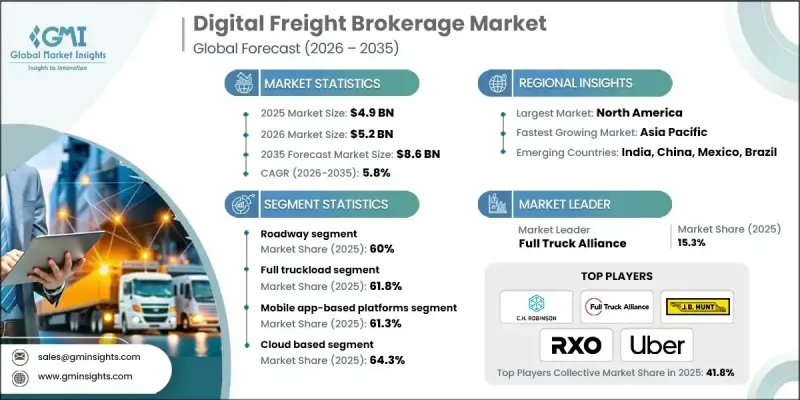
화주들이 자동화된 화물 매칭 시스템과 운송업체의 가용 용량을 실시간으로 확인할 수 있는 디지털 툴에 대한 의존도가 높아짐에 따라 시장 성장이 가속화되고 있습니다. 비용 효율성은 여전히 주요 동기이며, 화주들은 업무 효율화, 수작업 프로세스 최소화, 운송 비용 절감을 위해 온라인 플랫폼을 활용하고 있습니다. 디지털 중개 플랫폼은 화물 배정을 최적화하여 공회전 거리를 줄이고, 자산 활용률 향상, 운송업체 수익 증대, 서비스 전체 신뢰도 향상에 기여합니다. 디지털로 처리되는 국제화물 증가와 컴플라이언스 모니터링 강화의 추진도 자동 할당 기술의 채택을 촉진하고 있습니다. 동시에 업계는 가격 책정 정확도와 노선 수준의 성능 가시성을 향상시키는 AI 기반 예측 모델로 빠르게 전환하고 있습니다. 이러한 예측 기능은 비용 안정화 및 서비스 효율성 강화에 기여하며, 모든 화물 카테고리에서 디지털 중개 도구에 대한 수요를 더욱 증가시키고 있습니다.
| 시장 범위 | |
|---|---|
| 개시 연도 | 2025년 |
| 예측 연도 | 2026-2035년 |
| 개시 연도 시장 규모 | 49억 달러 |
| 예측 금액 | 86억 달러 |
| CAGR | 5.8% |
클라우드 기반 카테고리는 클라우드 지원 화물 시스템으로의 빠른 전환으로 강화되어 2025년 64.3%의 점유율을 차지할 것으로 예측됩니다. 현재 새로운 화물 관리 플랫폼의 대부분은 클라우드 아키텍처에 의존하고 있으며, 물류 업무의 현대화를 가속화하는 세계 클라우드 투자에 의해 뒷받침되고 있습니다.
모바일 앱 기반 플랫폼 부문은 2025년 61.3%의 점유율을 차지했습니다. 스마트폰의 보급과 운전자를 위한 참여 도구가 지속적으로 이용률을 높이고 있으며, 적재 정보에 대한 즉각적인 접근, 서류 관리, 위치 정보 기반 매칭 기능을 실현하고 있습니다.
미국 디지털 화물 중개 시장은 2025년 86.2%의 점유율을 차지하며 17억 6,000만 달러 규모에 달할 것으로 예측됩니다. 강력한 디지털 네트워크, 높은 도로 화물 운송량, 확대되는 라스트마일 수요는 지역 전체에서 플랫폼 도입을 뒷받침하고 있습니다. 개인 트럭 운전사 및 소규모 운송업체는 안정적인 운송 능력을 확보하기 위해 모바일 지원 적재 알림 및 텔레매틱스 연결을 점점 더 많이 활용하고 있습니다.
자주 묻는 질문
목차
제1장 조사 방법
- 시장 범위와 정의
- 조사 설계
- 조사 접근
- 데이터 수집 방법
- 데이터 마이닝 소스
- 세계
- 지역별/국가별
- 기본 추정치와 계산
- 기준연도 계산
- 시장 추정 주요 동향
- 1차 조사와 검증
- 1차 정보
- 예측 모델
- 조사의 전제조건과 제한 사항
제2장 주요 요약
제3장 업계 인사이트
- 생태계 분석
- 공급업체 상황
- 이익률 분석
- 비용 구조
- 각 단계별 부가가치
- 밸류체인에 영향을 미치는 요인
- 파괴적 변화
- 업계에 대한 영향요인
- 성장 촉진요인
- 업계의 잠재적 리스크&과제
- 시장 기회
- 성장 가능성 분석
- 규제 상황
- 북미
- FMCSA 규제
- 캐나다 운송청(CTA) 가이드라인
- 유럽
- EU 운송 규제
- 전자 화물 지침
- 일반 데이터 보호 규칙(GDPR(EU 개인정보보호규정))
- 영국 일반 데이터 보호 규칙(UK GDPR(EU 개인정보보호규정))
- 디지털 타코그래프 규칙
- 아시아태평양
- 도로 화물 운송에 관한 행정 조치
- 사이버 보안법
- 물류 효율화에 관한 시책 시행
- 자동차법 2019
- 운송 사업법
- 스마트 물류 구상
- 라틴아메리카
- 국가 육상 운송 청(ANTT) 규제
- 연방 도로 운송법
- USMCA 규제
- 중동 및 아프리카
- 아랍에미리트 연방 운송법
- 사우디아라비아 운송 및 물류 규제
- 도로 교통법
- 북미
- Porter's Five Forces 분석
- PESTEL 분석
- 기술과 혁신 동향
- 현재 기술 동향
- 신기술
- 비용 내역 분석
- 운송 비용
- 기술 및 플랫폼 비용
- 운영비용
- 규제 및 컴플라이언스 관련 비용
- 연료 및 에너지 비용
- 특허 분석
- 지속가능성과 환경 측면
- 지속가능한 실천
- 폐기물 감축 전략
- 생산 에너지 효율
- 친환경 이니셔티브
- 탄소발자국에 관한 고려사항
- 가격 분석
- 지역별
- 서비스별
- 이용 사례
- 베스트 케이스 시나리오
- 시장 진출 전략
- 지역별 시장 침투 전략
- 신규 참여 기업 주요 규제상 고려사항
- 가격 결정, 서비스, 차별화 전략
제4장 경쟁 구도
- 서론
- 기업의 시장 점유율 분석
- 북미
- 유럽
- 아시아태평양
- 라틴아메리카
- 중동 및 아프리카
- 주요 시장 기업의 경쟁 분석
- 경쟁 포지셔닝 매트릭스
- 전략적 전망 매트릭스
- 주요 발전
- 인수합병(M&A)
- 제휴 및 협업
- 신제품 발매
- 사업 확대 계획과 자금조달
제5장 시장 추산 및 예측 : 운송 수단별, 2022-2035
- 주요 동향
- 도로 운송
- 해상 운송
- 항공 운송
- 철도
제6장 시장 추산 및 예측 : 서비스별, 2022-2035
- 주요 동향
- 풀 트럭 로드(FTL)
- 소량 화물 운송(LTL)
- 인터 모달 운송
제7장 시장 추산 및 예측 : 플랫폼별, 2022-2035
- 주요 동향
- 모바일 앱 기반 플랫폼
- 웹 기반 플랫폼
제8장 시장 추산 및 예측 : 도입 모델별, 2022-2035
- 주요 동향
- 클라우드 기반
- On-Premise
- 하이브리드
제9장 시장 추산 및 예측 : 기업 규모별, 2022-2035
- 주요 동향
- 중소기업(SME)
- 대기업
제10장 시장 추산 및 예측 : 용도별, 2022-2035
- 주요 동향
- 화물 관리
- 운송 회사 및 하주 매칭
- 가격 입찰 및 경매
- 실시간 추적 및 분석
- 자동화된 문서화
- 기타
제11장 시장 추산 및 예측 : 최종 용도별, 2022-2035
- 주요 동향
- 소매업 및 전자상거래
- 자동차
- 제조업
- 소비재
- 헬스케어
- 식품 및 음료
- 기타
제12장 시장 추산 및 예측 : 지역별, 2022-2035
- 주요 동향
- 북미
- 미국
- 캐나다
- 유럽
- 독일
- 영국
- 프랑스
- 이탈리아
- 스페인
- 러시아
- 북유럽 국가
- 네덜란드
- 스웨덴
- 아시아태평양
- 중국
- 인도
- 일본
- 호주
- 한국
- 싱가포르
- 태국
- 인도네시아
- 베트남
- 라틴아메리카
- 브라질
- 멕시코
- 아르헨티나
- 중동 및 아프리카
- 남아프리카공화국
- 사우디아라비아
- 아랍에미리트(UAE)
- 튀르키예
제13장 기업 개요
- 세계 기업
- C.H. Robinson
- Coyote Logistics
- Echo Global Logistics
- Hub Group
- J.B. Hunt
- Landstar System
- Total Quality Logistics
- Uber
- Worldwide Express
- XPO
- 지역 기업-
- Allen Lund
- ArcBest
- BNSF Logistics
- England Logistics
- GlobalTranz Enterprises
- MATSON Logistics
- Schneider
- Transplace
- Werner Enterprises
- 신규 기업/디스럽터
- Armstrong Transport Group
- Ascent Global Logistics
- Expeditors International
- NTG Freight
- Trinity Logistics
The Global Digital Freight Brokerage Market was valued at USD 4.9 billion in 2025 and is estimated to grow at a CAGR of 5.8% to reach USD 8.6 billion by 2035.
Market growth is accelerating as shippers increasingly rely on automated freight-matching systems and digital tools that provide real-time access to carrier capacity. Cost efficiency remains a major motivation, with shippers turning to online platforms to streamline operations, minimize manual processes, and lower transportation expenses. Digital brokerage platforms help reduce empty miles by optimizing load assignments, which enhances asset utilization, raises carrier earnings, and improves overall service dependability. The rise in international shipments processed digitally and the push for stronger compliance oversight have also reinforced the adoption of automated allocation technologies. At the same time, the industry is moving rapidly toward AI-driven forecasting models that improve pricing accuracy and lane-level performance visibility. These predictive capabilities help stabilize costs while strengthening service efficiency, further boosting the demand for digital brokerage tools across all freight categories.
| Market Scope | |
|---|---|
| Start Year | 2025 |
| Forecast Year | 2026-2035 |
| Start Value | $4.9 Billion |
| Forecast Value | $8.6 Billion |
| CAGR | 5.8% |
The cloud-based category accounted for a 64.3% share in 2025, strengthened by the rapid shift toward cloud-enabled freight systems. A significant portion of new freight management platforms now depend on cloud architecture, supported by global cloud investments that are accelerating the modernization of logistics operations.
The mobile app-based platforms segment held a 61.3% share in 2025. Widespread smartphone adoption and driver engagement tools continue to drive usage, allowing instant access to load postings, documents, and location-based matching capabilities.
U.S. Digital Freight Brokerage Market held 86.2% share and generated USD 1.76 billion in 2025. Strong digital networks, high road freight volumes, and expanding last-mile demand support platform adoption throughout the region. Independent truckers and smaller fleets are increasingly using mobile-enabled load notifications and telematics connectivity to secure consistent capacity.
Key companies in the Global Digital Freight Brokerage Market include C.H. Robinson, Coyote Logistics, Echo Global Logistics, Full Truck Alliance, J.B. Hunt, Landstar System, RXO, Total Quality Logistics (TQL), Uber, and XPO. Market leaders are strengthening their competitive positions by investing in AI-based matching engines, predictive analytics, and automated pricing tools that enhance operational accuracy and provide faster load-to-carrier pairing. Companies are expanding cloud-native platforms to improve scalability and reliability for shippers and carriers. Many are integrating telematics data, real-time tracking, and digital documentation to create seamless end-to-end workflows. Strategic partnerships with carriers, logistics service providers, and supply chain software companies also help expand network density and load availability. Businesses are focusing on mobile-first solutions to support driver engagement and speed up transactions. Continuous enhancements in compliance automation, platform security, and user experience further support market differentiation and long-term customer retention.
Table of Contents
Chapter 1 Methodology
- 1.1 Market scope and definition
- 1.2 Research design
- 1.2.1 Research approach
- 1.2.2 Data collection methods
- 1.3 Data mining sources
- 1.3.1 Global
- 1.3.2 Regional/Country
- 1.4 Base estimates and calculations
- 1.4.1 Base year calculation
- 1.4.2 Key trends for market estimation
- 1.5 Primary research and validation
- 1.5.1 Primary sources
- 1.6 Forecast model
- 1.7 Research assumptions and limitations
Chapter 2 Executive Summary
- 2.1 Industry 3600 synopsis, 2022 - 2035
- 2.2 Key market trends
- 2.2.1 Regional
- 2.2.2 Transportation Mode
- 2.2.3 Service
- 2.2.4 Platform
- 2.2.5 Deployment Model
- 2.2.6 Organization Size
- 2.2.7 Application
- 2.2.8 End Use
- 2.3 TAM Analysis, 2026-2035
- 2.4 CXO perspectives: Strategic imperatives
- 2.4.1 Executive decision points
- 2.4.2 Critical success factors
- 2.5 Future outlook and strategic recommendations
Chapter 3 Industry Insights
- 3.1 Industry ecosystem analysis
- 3.1.1 Supplier landscape
- 3.1.2 Profit margin analysis
- 3.1.3 Cost structure
- 3.1.4 Value addition at each stage
- 3.1.5 Factor affecting the value chain
- 3.1.6 Disruptions
- 3.2 Industry impact forces
- 3.2.1.1 Growth drivers
- 3.2.1.2 Growth in E-commerce freight volumes
- 3.2.1.3 Shift toward automated brokerage workflows
- 3.2.1.4 Expansion of visibility and tracking tools
- 3.2.1.5 Integration of telematics and fleet data
- 3.2.2 Industry pitfalls and challenges
- 3.2.2.1 Fragmented carrier ecosystem
- 3.2.2.2 Concerns about data privacy and platform dependence
- 3.2.3 Market opportunities
- 3.2.3.1 Expansion of integrated multimodal platforms
- 3.2.3.2 Adoption of AI based pricing and matching
- 3.2.3.3 Growth of cross border digital corridors
- 3.3 Growth potential analysis
- 3.4 Regulatory landscape
- 3.4.1 North America
- 3.4.1.1 FMCSA Regulations
- 3.4.1.2 Canadian Transportation Agency (CTA) Guidelines
- 3.4.2 Europe
- 3.4.2.1 EU transport regulations
- 3.4.2.2 E-freight directive
- 3.4.2.3 General data protection regulation (GDPR)
- 3.4.2.4 UK GDPR
- 3.4.2.5 Digital tachograph rules
- 3.4.3 Asia Pacific
- 3.4.3.1 Administrative measures for road freight
- 3.4.3.2 Cybersecurity law
- 3.4.3.3 Act on Improvement of Logistics Efficiency
- 3.4.3.4 Motor Vehicles Act 2019
- 3.4.3.5 Transport Business Act
- 3.4.3.6 Smart Logistics Initiative
- 3.4.4 Latin America
- 3.4.4.1 National land transport agency (ANTT) regulations
- 3.4.4.2 Federal road transportation law
- 3.4.4.3 Usmca regulations
- 3.4.5 Middle East & Africa
- 3.4.5.1 UAE federal transport law
- 3.4.5.2 Saudi transport and logistics regulations
- 3.4.5.3 Road traffic act
- 3.4.1 North America
- 3.5 Porter's analysis
- 3.6 PESTEL analysis
- 3.7 Technology and innovation landscape
- 3.7.1 Current technological trends
- 3.7.2 Emerging technologies
- 3.8 Cost breakdown analysis
- 3.8.1 Transportation costs
- 3.8.2 Technology & platform costs
- 3.8.3 Operational costs
- 3.8.4 Regulatory & compliance costs
- 3.8.5 Fuel and energy costs
- 3.9 Patent analysis
- 3.10 Sustainability and environmental aspects
- 3.10.1 Sustainable practices
- 3.10.2 Waste reduction strategies
- 3.10.3 Energy efficiency in production
- 3.10.4 Eco-friendly Initiatives
- 3.10.5 Carbon footprint considerations
- 3.11 Pricing analysis
- 3.11.1 By region
- 3.11.2 By service
- 3.12 Use cases
- 3.13 Best case scenarios
- 3.14 Go-to-Market strategies
- 3.14.1 Region-specific market penetration strategies
- 3.14.2 Key regulatory considerations for new entrants
- 3.14.3 Pricing, service, and differentiation strategies
Chapter 4 Competitive Landscape, 2025
- 4.1 Introduction
- 4.2 Company market share analysis
- 4.2.1 North America
- 4.2.2 Europe
- 4.2.3 Asia Pacific
- 4.2.4 LATAM
- 4.2.5 MEA
- 4.3 Competitive analysis of major market players
- 4.4 Competitive positioning matrix
- 4.5 Strategic outlook matrix
- 4.6 Key developments
- 4.6.1 Mergers & acquisitions
- 4.6.2 Partnerships & collaborations
- 4.6.3 New Product Launches
- 4.6.4 Expansion Plans and funding
Chapter 5 Market Estimates & Forecast, By Transportation Mode, 2022- 2035 (USD Mn)
- 5.1 Key trends
- 5.2 Roadway
- 5.3 Seaway
- 5.4 Airway
- 5.5 Railway
Chapter 6 Market Estimates & Forecast, By Service, 2022 - 2035 (USD Mn)
- 6.1 Key trends
- 6.2 Full Truckload (FTL)
- 6.3 Less than Truckload (LTL)
- 6.4 Intermodal
Chapter 7 Market Estimates & Forecast, By Platform, 2022 - 2035 (USD Mn)
- 7.1 Key trends
- 7.2 Mobile app-based platforms
- 7.3 Web-based platforms
Chapter 8 Market Estimates & Forecast, By Deployment Model, 2022 - 2035 (USD Mn)
- 8.1 Key trends
- 8.2 Cloud-Based
- 8.3 On-Premises
- 8.4 Hybrid
Chapter 9 Market Estimates & Forecast, By Organization Size, 2022 - 2035 (USD Mn)
- 9.1 Key trends
- 9.2 Small & Medium Enterprises (SMEs)
- 9.3 Large Enterprises
Chapter 10 Market Estimates & Forecast, By Application, 2022 - 2035 (USD Mn)
- 10.1 Key trends
- 10.2 Freight management
- 10.3 Carrier & shipper matching
- 10.4 Price bidding & auction
- 10.5 Real-time tracking & analytics
- 10.6 Automated documentation
- 10.7 Others
Chapter 11 Market Estimates & Forecast, By End Use, 2022 - 2035 (USD Mn)
- 11.1 Key trends
- 11.2 Retail & e-commerce
- 11.3 Automotive
- 11.4 Manufacturing
- 11.5 Consumer goods
- 11.6 Healthcare
- 11.7 Food & beverages
- 11.8 Others
Chapter 12 Market Estimates & Forecast, By Region, 2022 - 2035 (USD Mn)
- 12.1 Key trends
- 12.2 North America
- 12.2.1 US
- 12.2.2 Canada
- 12.3 Europe
- 12.3.1 Germany
- 12.3.2 UK
- 12.3.3 France
- 12.3.4 Italy
- 12.3.5 Spain
- 12.3.6 Russia
- 12.3.7 Nordics
- 12.3.8 Netherlands
- 12.3.9 Sweden
- 12.4 Asia Pacific
- 12.4.1 China
- 12.4.2 India
- 12.4.3 Japan
- 12.4.4 Australia
- 12.4.5 South Korea
- 12.4.6 Singapore
- 12.4.7 Thailand
- 12.4.8 Indonesia
- 12.4.9 Vietnam
- 12.5 Latin America
- 12.5.1 Brazil
- 12.5.2 Mexico
- 12.5.3 Argentina
- 12.6 MEA
- 12.6.1 South Africa
- 12.6.2 Saudi Arabia
- 12.6.3 UAE
- 12.6.4 Turkey
Chapter 13 Company Profiles
- 13.1 Global Players
- 13.1.1 C.H. Robinson
- 13.1.2 Coyote Logistics
- 13.1.3 Echo Global Logistics
- 13.1.4 Hub Group
- 13.1.5 J.B. Hunt
- 13.1.6 Landstar System
- 13.1.7 Total Quality Logistics
- 13.1.8 Uber
- 13.1.9 Worldwide Express
- 13.1.10 XPO
- 13.2 Regional Players
- 13.2.1 Allen Lund
- 13.2.2 ArcBest
- 13.2.3 BNSF Logistics
- 13.2.4 England Logistics
- 13.2.5 GlobalTranz Enterprises
- 13.2.6 MATSON Logistics
- 13.2.7 Schneider
- 13.2.8 Transplace
- 13.2.9 Werner Enterprises
- 13.3 Emerging Players / Disruptors
- 13.3.1 Armstrong Transport Group
- 13.3.2 Ascent Global Logistics
- 13.3.3 Expeditors International
- 13.3.4 NTG Freight
- 13.3.5 Trinity Logistics