|
시장보고서
상품코드
1851074
미국의 화물 중개 시장 : 시장 점유율 분석, 산업 동향, 통계, 성장 예측(2025-2030년)United States Freight Brokerage - Market Share Analysis, Industry Trends & Statistics, Growth Forecasts (2025 - 2030) |
||||||
 Mordor Intelligence
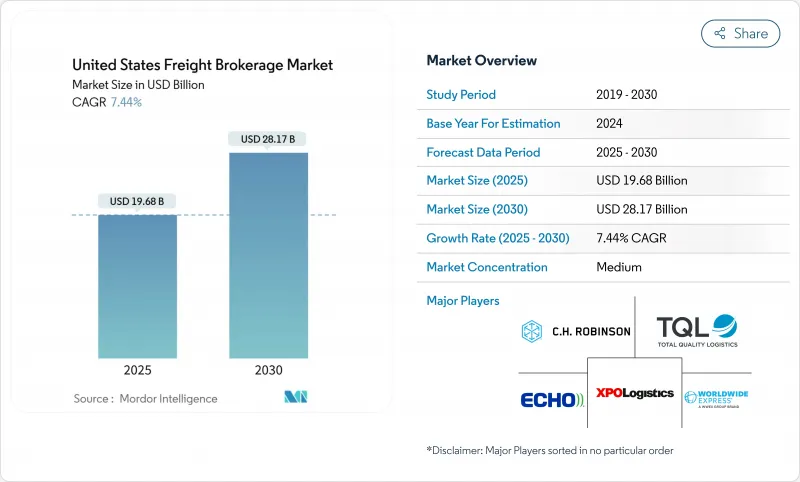
미국의 화물 중개 시장의 2025년 시장 규모는 196억 8,000만 달러로 예상되며, 2030년에는 281억 7,000만 달러에 이르고, 예측 기간 중 CAGR은 7.44%를 기록할 전망입니다.
성장세를 지원하는 것은 디지털 화물 플랫폼의 급속한 보급, 지속적인 전자상거래 수요, 인프라에 대한 연방 정부의 지속적인 투자입니다. 기술을 도입하는 브로커는 거래 시간을 단축하기 위해 자동화를 확대하는 한편, 기존의 중개업자는 규모의 우위성을 위해 합병에 눈을 돌리고 있습니다. 운전자 부족과 스팟 시장에 대한 의존도 증가는 깊은 운송 회사 네트워크와 실시간 가격 책정 엔진을 유지하는 중개업자에게 계속 유리합니다. 동시에, 자산 기반 운송 회사는 마진을 확보하기 위해 중개 데스크를 추가하고 있으며, 순수 브로커는 전문적인 규정 준수, 온도 관리 용량 또는 관리형 전송 계약을 통해 차별화를 도모해야 합니다. 예측 분석, 전자 기록 데이터, 벤처 자금 조달의 융합은 디지털화가 성숙한 기업과 뒤쳐진 기업 사이의 실적 격차를 확대하고 미국의 화물 중개 시장 전체의 경쟁 계층이 재구축될 것으로 예측됩니다.
미국의 화물 중개 시장의 동향과 인사이트
국내 트럭 적재량과 운전사의 부족
드라이버의 교체가 잦아 용량의 부족 현상이 계속되어, 스폿 입찰의 실패 확률이 높아지고 있습니다. 중견 화주는 계약 운송 회사가 입찰을 거부하면 트럭을 확보하기 위해 중개인에 의존합니다. 디지털 적재 게시판은 자동화된 게시물이 긴급화물을 커버하는 데 필요한 시간을 단축하기 때문에 증가하는 적재량을 흡수합니다. 운전자 부족은 장거리 냉장 레인에서 가장 심각하며, 이 하위 시장에서 브로커의 레버리지를 강화하고 있습니다. 운송 회사는 유지 보너스를 상쇄하기 위해 더 높은 운임을 요구하고 있으며, 익숙한 브로커는 트럭을 계속 움직이기 위해 백홀 기회를 묶습니다. 그러므로 용량의 부족은 자산 기반의 플릿이 직접 판매를 확대해도 브로커의 관련성을 유지합니다.
전자상거래 소포량 증가
신속한 온라인 주문으로 화물 프로파일은 더 작고 빈번한 화물로 바뀌고 소형 물품에 대한 운송 능력이 선호됩니다. 2025년에는 주요 LTL 수송업체 전체에서 4.9%-7.9%의 일반 운임 가격 인상이 예정되어 팔레트 스페이스의 제약을 시사했습니다. 2025년 7월에 예정된 밀도 기반 화물 재분류는 경량 전자상거래 소포 비용을 증가시키고 클래스 할당에서 브로커의 전문 지식에 대한 필요성을 강화합니다. 화주가 빠른 비용 시각화를 추구하는 동안 동적 견적을 제공하는 디지털 LTL 포털은 시장 점유율을 확대할 전망입니다. 소포화물을 LTL 운송에 미리 통합할 수 있는 브로커는 1개당 운송 비용을 줄임으로써 부가가치를 획득할 수 있습니다. 따라서 미국의 화물 중개 시장은 미들 마일과 라스트 마일 최적화를 위한 전자상거래의 구조적 변화로부터 이익을 얻고 있습니다.
불안정한 디젤 가격
미국의 평균 디젤 가격은 2024년 갤런당 미화 3.43달러와 4.58달러 사이에서 변동했고 연료 급여 재조정을 뛰어넘어 브로커 스팟 마진을 압박했습니다. 선도적인 브로커는 에너지 요금 부서의 데이터를 포함한 헤지 모델을 도입하여 급여를 예측하기도 하지만, 중소 브로커는 종종 적재 가격을 잘못 설정하여 순수익을 악화시킵니다. 냉동 레인은 리퍼 유닛이 연료를 여분으로 소비하기 때문에 큰 타격을 받고 있습니다. 일부 브로커는 가격 투명성을 유지하면서 마진을 확보하기 위해 실시간 연료 조항이 포함된 '올인' 오퍼를 발표합니다. 변동이 불투명하기 때문에 화주는 연간 운임을 고정하는 것을 원하여, 거래형의 스팟 중개로 기울고 있습니다.
부문 분석
서비스 라인의 미국의 화물 중개 시장 내 규모는 계속 FTL에 편향되어 2024년에는 매출의 63.75%를 차지했지만, LTL 회랑은 2030년까지의 CAGR이 9.0%가 될 전망입니다. 수초 안에 팔레트 수준의 운임을 제시하는 디지털 플랫폼이 수동 전화 및 팩스 워크플로로부터 거래량을 획득했습니다. 2025년 7월에 수행되는 밀도 기반 재분류는 운송인이 경량 벌크 제품의 상위 등급을 피할 수 있도록 포장 치수를 재설계할 수 있는 브로커에게 이익이 될 것으로 예상됩니다.
FTL은 여전히 장거리 산업 화물의 대부분을 차지하고 있지만, 운전자 부족과 장비 제약은 운송인을 LTL의 다거점 혼합으로 향하게 합니다. 소화물에서 LTL로의 혼합 허브는 라스트 마일의 혼잡을 완화하고 단위당 비용을 줄이기 때문에 브로커는 부가 가치가 높은 크로스 독 서비스에서 새로운 마진을 얻을 수 있습니다. 전문 브로커는 또한 LTL과 FTL 간의 격차를 메우기 위해 "부분 트랙로드"서비스를 활용합니다. 그 결과, 멀티 서비스 능력은 이제 화물 중개 시장 전체에서 다양한 RFP를 획득하기 위한 벤치마크가 되고 있습니다.
드라이밴은 2024년에 수익의 44.65%를 차지하였지만, 냉장 유닛은 CAGR 10.1%로 전진하고 있으며, 예측 기간 동안 이 기기 부문의 미국의 화물 중개 시장 내 규모를 끌어 올릴 전망입니다. 식품 및 의약품용 운송인은 온도 확인 및 전자 씰을 요구하며 텔레매틱스가 장착된 캐리어 풀이 있는 브로커가 이를 지원합니다.
서해안에서 특수농산물 수출이 증가하고 중서부와 동부로의 리퍼 백홀 수요가 높아집니다. 브로커는 온도 감시와 구류 완화를 세트로 프리미엄 가격에 통합합니다. 플랫 베드 및 스텝 데크 시설은 봄 건설 기간 동안 급증하는 반면, 탱크로리 브로커는 위험물질 규정 준수 부담으로 인해 틈새 시장으로 남아 있습니다. 따라서 2025년에 멀티모달 계약을 획득하기 위해서는 시설의 유연성이 중심이 됩니다.
미국의 화물 중개 시장 보고서는 서비스별(FTL 등), 기기/트레일러 유형별(드라이밴 등), 운송거리별(장거리 등), 비즈니스 모델별(종래 화물 브로커 등), 최종 사용자별(제조업 등), 고객 규모별(대기업 등), 지역별(북동부 등)으로 분류하고 있습니다. 이 보고서는 위의 모든 부문에 대해 시장 규모 및 예측(달러)을 제공합니다.
기타 혜택
- 엑셀 형식 시장 예측(ME) 시트
- 3개월간의 애널리스트 서포트
목차
제1장 서론
- 조사의 전제조건과 시장의 정의
- 조사 범위
제2장 조사 방법
제3장 주요 요약
제4장 시장 상황
- 시장 개요
- 시장 성장 촉진요인
- 국내 트럭 적재량과 드라이버 부족이 스팟 브로커의 활동을 뒷받침
- 전자상거래 소포량 증가가 LTL 브로커의 보급을 촉진
- 매니지드 운송 및 4PL 솔루션에 대한 화물 수요
- 전자 기록 장치(ELD)의 의무화에 의해 컴플라이언스 대응 가능한 운송 사업자의 브로커에 대한 의존도 상승
- 디지털 화물 매칭 플랫폼을 가속화하는 벤처 캐피탈의 자금 조달
- 인프라 투자 및 고용 촉진법(IIJA)에 의한 건설 관련 화물 흐름의 재활성화
- 시장 성장 억제요인
- 불안정한 디젤 가격이 브로커의 스팟 마진을 압박
- 항만의 혼잡과 섀시 부족이 수송의 신뢰성을 위협
- 화물주 직송의 중개를 확대하는 자산 베이스 캐리어(마진의 압박)
- 브로커 보증 요건과 사기 사례에 대한 연방 정부의 감시 강화
- 가치/공급망 분석
- 주요 정부 규제와 대처(HOS, AB5, 스피드 리미터 NPRM)
- 기술 스냅샷(디지털 화물 중개, IoT, AI, 가시성 API)
- Porter's Five Forces
- 공급기업의 협상력
- 구매자의 협상력
- 신규 참가업체의 위협
- 대체품의 위협
- 경쟁 기업간 경쟁 관계
- 미국 물류 업계의 개요
- 스팟 대 계약 트럭 운임에 대한 인사이트
- 지정학적 이벤트가 시장에 미치는 영향
제5장 시장 규모와 성장 예측
- 서비스별
- 만재트럭(FTL)
- 소화물 혼적 운송(LTL)
- 기타
- 기기/트레일러 유형별
- 드라이밴
- 냉동밴
- 플랫 베드/스텝 데크
- 탱커(벌크 액체 및 화학제품)
- 기타
- 수송 거리별
- 장거리 수송(500마일 이상)
- 지역별(100-500마일)
- 로컬(100마일 미만)
- 비즈니스 모델별
- 종래의 화물 중개
- 자산 기반 화물 중개
- 대리점 모델 화물 중개
- 디지털 화물 중개
- 최종 사용자 업계별
- 제조업 및 자동차
- 건설 및 인프라 프로젝트
- 석유 및 가스, 광업, 화학제품
- 농업과 식음료
- 소매, FMCG, 도매 유통
- 의료 및 의약품
- 전자상거래와 3PL 풀필먼트
- 기타 최종 사용자 산업
- 고객규모별
- 대규모 화주(1억 달러 이상의 화물 이용)
- 중규모 화주(1,000만-1억 달러)
- 소규모 화주(1,000만 달러 미만)
- 지역별
- 북동부
- 중서부
- 남동부
- 남서부
- 서부
제6장 경쟁 구도
- 시장 집중도
- 전략적 움직임(M&A, 자금 조달, 파트너십)
- 시장 점유율 분석
- 기업 프로파일
- CH Robinson Worldwide Inc.
- Total Quality Logistics(TQL)
- XPO Logistics Inc.
- Echo Global Logistics
- Worldwide Express
- Coyote Logistics(UPS)
- Landstar System Inc.
- Schneider FreightPlus
- GlobalTranz(WWEX)
- JB Hunt 3600
- Hub Group
- Uber Freight
- BNSF Logistics
- SunteckTTS
- Arrive Logistics
- Nolan Transportation Group
- Mode Global
- Convoy Inc.
- Red Technologies
- ArcBest Corporation
- Allen Lund Company
- Redwood Logistics
- BlueGrace Logistics
- Trinity Logistics
제7장 시장 기회와 미래 전망
CSM 25.11.20The United States freight brokerage market is valued at USD 19.68 billion in 2025 and is set to reach USD 28.17 billion by 2030, registering a 7.44% CAGR through the forecast period.
Growth momentum is supported by the rapid uptake of digital freight platforms, sustained e-commerce demand, and continued federal investment in infrastructure. Tech-enabled brokers are scaling automation to compress transaction time, while traditional intermediaries look to mergers for scale advantages. Driver shortages and heightened spot-market reliance continue to favor intermediaries that maintain deep carrier networks and real-time pricing engines. At the same time, asset-based carriers are bolting on brokerage desks to protect margins, forcing pure-play brokers to differentiate through specialized compliance, temperature-controlled capacity, or managed-transport contracts. The convergence of predictive analytics, electronic logging data, and venture funding is expected to widen the performance gap between digitally mature and lagging firms, thereby reshaping competitive hierarchies across the United States freight brokerage market.
United States Freight Brokerage Market Trends and Insights
Tight Domestic Truckload Capacity and Driver Shortage
Persistent driver turnover keeps capacity tight and lifts spot tender rejection rates, pushing more loads toward brokers with agile matching engines. Mid-sized shippers increasingly depend on intermediaries to secure trucks when contract carriers reject tenders. Digital load boards capture rising volume because automated postings reduce the time needed to cover urgent freight. Driver scarcity is most acute for long-haul refrigerated lanes, intensifying broker leverage in that sub-market. Carriers are demanding higher rates to offset retention bonuses, and savvy brokers bundle back-haul opportunities to keep trucks moving. Tight capacity, therefore, sustains brokerage relevance even as asset-based fleets expand direct sales.
Heightened E-Commerce Parcel Volumes
Rapid-fire online ordering pivots shipment profiles toward smaller, more frequent loads that favor Less-than-Truckload capacity. General rate increases of 4.9%-7.9% across major LTL carriers in 2025 signal constrained pallet space and bolster broker margins when they secure capacity in advance. Density-based freight re-classification slated for July 2025 will lift costs on lightweight e-commerce parcels, reinforcing the need for brokerage expertise in class assignment. Digital LTL portals offering dynamic quoting stand to gain market share as shippers seek rapid cost visibility. Brokers capable of pre-consolidating parcel freight into LTL moves can capture incremental value by reducing per-unit shipping costs. The United States freight brokerage market thus benefits from the structural e-commerce shift toward middle- and final-mile optimization.
Volatile Diesel Prices
Average U.S. diesel swung between USD 3.43 and USD 4.58 per gallon in 2024, outpacing fuel-surcharge recalibration and compressing broker spot margins. Large brokers deploy hedging models that ingest Energy Information Administration data to anticipate surcharges, but smaller players often misprice loads, eroding net revenue. Refrigerated lanes are hit hard because reefer units consume extra fuel. Some brokers now publish "all-in" offers with real-time fuel clauses to shield margins while maintaining price transparency. Fluctuation uncertainty discourages shippers from locking year-long rates, nudging them to transactional spot brokerage.
Other drivers and restraints analyzed in the detailed report include:
- Shipper Demand for Managed Transportation
- ELD Mandate Compliance Requirements
- Port Congestion and Chassis Shortages
For complete list of drivers and restraints, kindly check the Table Of Contents.
Segment Analysis
The United States freight brokerage market size for service lines continues to skew toward FTL, which generated 63.75% of revenue in 2024, yet the LTL corridor is on track for a 9.0% CAGR through 2030. Digital platforms that quote pallet-level rates within seconds are winning volume from manual call-and-fax workflows. The density-based re-classification in July 2025 will reward brokers able to re-engineer packaging dimensions so that shippers avoid higher classes for light bulky products.
FTL still commands the bulk of long-haul industrial freight, but driver scarcity and equipment constraints are nudging shippers to multistop LTL consolidations. Parcel-to-LTL consolidation hubs reduce last-mile congestion and cut per-unit cost, giving brokers new margins on value-added cross-dock services. Specialized brokers also exploit "partial truckload" offerings to bridge the gap between LTL and FTL. Consequently, multi-service capability is now a benchmark for winning diversified RFPs across the United States freight brokerage market.
Dry vans produced 44.65% of revenue in 2024, but refrigerated units are advancing at 10.1% CAGR, lifting the equipment segment's United States freight brokerage market size over the forecast horizon. Food-grade and pharmaceutical shippers require temperature verification and electronic seals, favoring brokers with telematics-equipped carrier pools.
Rising specialty produce exports out of the West Coast elevate back-haul demand for reefers into the Midwest and East. Brokers bundle harmonized temperature monitoring and detention mitigation into premium pricing. Flatbed and step-deck equipment remains cyclical, spiking during spring construction, while tanker brokerage stays niche due to hazmat compliance burdens. Equipment flexibility, therefore, became central to winning multi-modal contracts in 2025.
The US Freight Brokerage Market Report is Segmented by Service (FTL and More), by Equipment / Trailer Type (Dry Van and More), by Haul Length (Long-Haul and More), by Business Model (Traditional Freight Brokerage and More), by End User (Manufacturing and More), by Customer Size (Large Enterprise and More), and by Geography (Northeast and More). The Report Offers Market Size and Forecasts in Value (USD) for all the Above Segments.
List of Companies Covered in this Report:
- C.H. Robinson Worldwide Inc.
- Total Quality Logistics (TQL)
- XPO Logistics Inc.
- Echo Global Logistics
- Worldwide Express
- Coyote Logistics (UPS)
- Landstar System Inc.
- Schneider FreightPlus
- GlobalTranz (WWEX)
- J.B. Hunt 3600
- Hub Group
- Uber Freight
- BNSF Logistics
- SunteckTTS
- Arrive Logistics
- Nolan Transportation Group
- Mode Global
- Convoy Inc.
- Red Technologies
- ArcBest Corporation
- Allen Lund Company
- Redwood Logistics
- BlueGrace Logistics
- Trinity Logistics
Additional Benefits:
- The market estimate (ME) sheet in Excel format
- 3 months of analyst support
TABLE OF CONTENTS
1 Introduction
- 1.1 Study Assumptions & Market Definition
- 1.2 Scope of the Study
2 Research Methodology
3 Executive Summary
4 Market Landscape
- 4.1 Market Overview
- 4.2 Market Drivers
- 4.2.1 Tight Domestic Truckload Capacity & Driver Shortage Boosting Spot Brokerage Activity
- 4.2.2 Heightened E-Commerce Parcel Volumes Driving LTL Brokerage Penetration
- 4.2.3 Shipper Demand for Managed Transportation & 4PL Solutions
- 4.2.4 Electronic Logging Device (ELD) Mandate Increasing Reliance on Brokers for Compliance-Ready Carriers
- 4.2.5 Venture-Capital Funding Accelerating Digital Freight-Matching Platforms
- 4.2.6 Infrastructure Investment & Jobs Act (IIJA) Re-energising Construction-Related Freight Flows
- 4.3 Market Restraints
- 4.3.1 Volatile Diesel Prices Compressing Spot Margin for Brokers
- 4.3.2 Port Congestion & Chassis Shortages Disrupting Drayage Reliability
- 4.3.3 Asset-Based Carriers Expanding Direct-to-Shipper Brokerage (Margin Squeeze)
- 4.3.4 Increasing Federal Scrutiny on Broker Bond Requirements & Fraud Cases
- 4.4 Value / Supply-Chain Analysis
- 4.5 Key Government Regulations & Initiatives (HOS, AB5, Speed-Limiter NPRM)
- 4.6 Technology Snapshot (Digital Freight Brokerage, IoT, AI, Visibility APIs)
- 4.7 Porter's Five Forces
- 4.7.1 Bargaining Power of Suppliers
- 4.7.2 Bargaining Power of Buyers
- 4.7.3 Threat of New Entrants
- 4.7.4 Threat of Substitutes
- 4.7.5 Competitive Rivalry
- 4.8 US Logistics Industry Overview
- 4.9 Insights on Spot vs. Contract Truck Rates
- 4.10 Impact of Geopolitical Events on the Market
5 Market Size & Growth Forecasts (Value)
- 5.1 By Service
- 5.1.1 Full-Truckload (FTL)
- 5.1.2 Less-than-Truckload (LTL)
- 5.1.3 Others
- 5.2 By Equipment / Trailer Type
- 5.2.1 Dry Van
- 5.2.2 Refrigerated Van
- 5.2.3 Flatbed / Step-Deck
- 5.2.4 Tanker (Bulk Liquid & Chemical)
- 5.2.5 Others
- 5.3 By Haul Length
- 5.3.1 Long-Haul (More than 500 miles)
- 5.3.2 Regional (100-500 miles)
- 5.3.3 Local (Less than 100 miles)
- 5.4 By Business Model
- 5.4.1 Traditional Freight Brokerage
- 5.4.2 Asset-Based Freight Brokerage
- 5.4.3 Agent Model Freight Brokerage
- 5.4.4 Digital Freight Brokerage
- 5.5 By End-User Industry
- 5.5.1 Manufacturing & Automotive
- 5.5.2 Construction & Infrastructure Projects
- 5.5.3 Oil, Gas, Mining & Chemicals
- 5.5.4 Agriculture & Food / Beverage
- 5.5.5 Retail, FMCG & Wholesale Distribution
- 5.5.6 Healthcare & Pharmaceuticals
- 5.5.7 E-commerce & 3PL Fulfilment
- 5.5.8 Other End-User Industry
- 5.6 By Customer Size
- 5.6.1 Large Enterprise Shippers (More than $100 M Freight Spend)
- 5.6.2 Mid-Market Shippers ($10-100 M)
- 5.6.3 Small Businesses (Less than $10 M)
- 5.7 By Geography
- 5.7.1 Northeast
- 5.7.2 Midwest
- 5.7.3 Southeast
- 5.7.4 Southwest
- 5.7.5 West
6 Competitive Landscape
- 6.1 Market Concentration
- 6.2 Strategic Moves (M&A, Funding, Partnerships)
- 6.3 Market Share Analysis
- 6.4 Company Profiles (includes Global-level Overview, Market-level Overview, Core Segments, Financials, Strategic Information, Market Rank/Share, Products & Services, and Recent Developments)
- 6.4.1 C.H. Robinson Worldwide Inc.
- 6.4.2 Total Quality Logistics (TQL)
- 6.4.3 XPO Logistics Inc.
- 6.4.4 Echo Global Logistics
- 6.4.5 Worldwide Express
- 6.4.6 Coyote Logistics (UPS)
- 6.4.7 Landstar System Inc.
- 6.4.8 Schneider FreightPlus
- 6.4.9 GlobalTranz (WWEX)
- 6.4.10 J.B. Hunt 3600
- 6.4.11 Hub Group
- 6.4.12 Uber Freight
- 6.4.13 BNSF Logistics
- 6.4.14 SunteckTTS
- 6.4.15 Arrive Logistics
- 6.4.16 Nolan Transportation Group
- 6.4.17 Mode Global
- 6.4.18 Convoy Inc.
- 6.4.19 Red Technologies
- 6.4.20 ArcBest Corporation
- 6.4.21 Allen Lund Company
- 6.4.22 Redwood Logistics
- 6.4.23 BlueGrace Logistics
- 6.4.24 Trinity Logistics
7 Market Opportunities & Future Outlook
- 7.1 White-Space & Unmet-Need Assessment