
|
시장보고서
상품코드
1913361
클래스 7 트럭 시장 : 시장 기회, 성장 요인, 산업 동향 분석 및 예측(2026-2035년)Class 7 Trucks Market Opportunity, Growth Drivers, Industry Trend Analysis, and Forecast 2026 - 2035 |
||||||

세계의 클래스 7 트럭 시장은 2025년에 653억 달러로 평가되었고, 2035년까지 연평균 복합 성장률(CAGR) 5.2%로 성장할 전망이며, 1,069억 달러에 이를 것으로 예측됩니다.
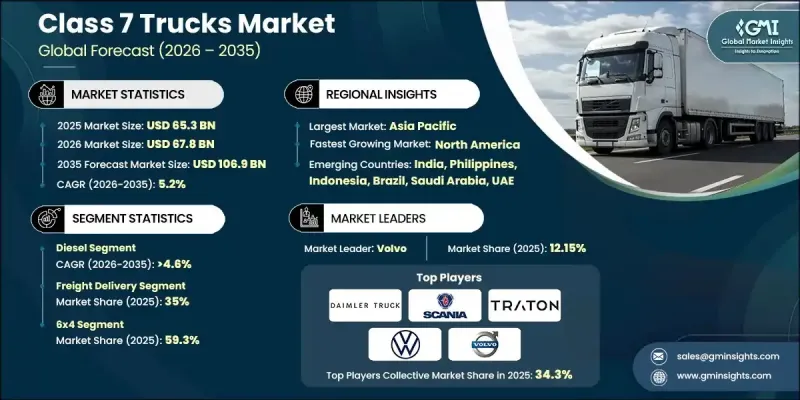
총 중량 26,001-3만 3,000파운드(약 11,800-15,000kg)의 클래스 7 트럭은 더 이상 기본적인 작업 차량으로 간주되지 않고 최적화된 플릿 투자로 취급되는 경향이 강해지고 있습니다. 이 트럭은 도시 지역에서 화물 운송, 지역 배송, 건설 지원, 지자체 업무 및 유틸리티 운영을 지원합니다. 세계 플릿 소유자는 자산 활용률, 운영 효율성 및 수명주기 계획을 개선하기 위해 디지털 모니터링 도구, 안전 기술 및 대체 추진 시스템을 통합합니다. 규제 압력 및 진화하는 물류 모델은 업데이트 사이클을 가속화하고 장기 플릿 전략에 영향을 미칩니다. 배출 가스 기준, 관민 연계, 지속가능성의 의무화가 구매 행동 및 인프라 계획을 재구축하는 한편 신흥 시장에서는 단계적인 규제 도입을 통해 플릿의 근대화가 진행되고 있습니다. 커넥티드 플릿 에코시스템이 성숙함에 따라 운영 가시성과 데이터 구동형 배치가 세계 시장에서 클래스 7 트랙의 성능과 수익성의 핵심이 되고 있습니다.
| 시장 범위 | |
|---|---|
| 시작 연도 | 2025년 |
| 예측 연도 | 2026-2035년 |
| 시작 시 가치 | 653억 달러 |
| 예측 금액 | 1,069억 달러 |
| CAGR | 5.2% |
정부의 정책 및 환경 규제는 세계 각지역에서 클래스 7 트럭 수요에 강하게 영향을 미치고 있습니다. 배출 가스 규제 프레임워크 및 클린 플릿 구상에 의해 기존 차량의 갱신이 가속되고 있는 한편, 개발도상국에서 기준의 진화는 단계적인 플릿의 근대화를 촉진하고 있습니다. 이러한 정책은 파워트레인의 선택, 자본 계획, 장기적인 운용 투자를 형성하는 한편, 커넥티드 플릿 기술은 생산성 및 비용 관리를 급속히 향상시키고 있습니다.
디젤 파워트레인 부문은 2025년에 80.81%의 점유율을 차지했으며, 2035년까지 연평균 복합 성장률(CAGR) 4.6%로 성장할 것으로 예측됩니다. 디젤 엔진은 강력한 토크 공급, 연료 효율, 내구성 및 중형 수송에서 유리한 운영 경제성으로 인해 여전히 선호되는 선택입니다. 연료의 광범위한 가용성은 성숙 시장 및 개발 도상 시장 모두에서 지속적인 채택을 더욱 강화하고 있습니다.
화물 배송 부문은 2025년에 35%의 점유율을 차지하였으며, 2026-2035년 CAGR 5.3%로 성장할 것으로 예측됩니다. 클래스 7 트럭은 적재량, 기동성 및 효율성의 효과적인 균형을 제공하며, 확대되는 상업 활동에 견인되는 중거리 화물 운송 및 고주파 배송 업무에 적합합니다.
아시아태평양의 클래스 7 트럭 시장은 2025년에 65.5%의 점유율을 차지했고, 253억 8,000만 달러의 규모가 되었습니다. 지속적인 인프라 투자, 확대되는 물류 네트워크, 정책 지원에 의한 상용차의 갱신이 성장을 지원하고 있으며, 건설 지원, 지자체 차량, 지역 화물 운송에 대한 수요를 환기하고 있습니다.
자주 묻는 질문
목차
제1장 조사 방법
제2장 주요 요약
제3장 업계 인사이트
- 생태계 분석
- 공급자의 상황
- 이익률 분석
- 비용 구조
- 각 단계에서의 부가가치
- 밸류체인에 영향을 주는 요인
- 혁신
- 업계에 미치는 영향요인
- 성장 촉진요인
- 세계적으로 높아지는 전기 및 하이브리드식 클래스 7 트럭에 대한 수요
- 북미 전역에서의 화물 수송 활동 확대
- 유럽에서의 엄격한 배출 규제 실시
- 아시아태평양의 인프라 개발 활동에 대한 투자 증가
- 중동 및 아프리카에서 광업, 석유 및 가스 분야로부터 클래스 7 트럭 수요 확대
- 업계의 잠재적 위험 및 과제
- 높은 초기 비용 및 유지 관리 비용
- 트럭 운전자 부족
- 시장 기회
- 지자체 및 도시 물류 차량의 전동화
- 신흥 경제국의 인프라 정비 및 건설 활동 확대
- 유연한 소유 형태, 임대 및 TaaS(Truck-as-a-Service) 모델의 성장
- 첨단 텔레매틱스 및 플릿 분석 솔루션 통합
- 성장 촉진요인
- 성장 가능성 분석
- 규제 상황
- 북미
- NEVI/IIJA, 선진적 클린 트럭(ACT) 규제
- 유럽
- 독일 : 전기 이동성법(EmoG)
- 영국 : 클린 차량 개조 인증 제도(CVRAS), 초저 배출 가스 구역(ULEZ)
- 프랑스 : 모빌리티 지향법(LOM법)
- 이탈리아 : 국가 통합 에너지 및 기후 계획(PNIEC)
- 아시아태평양
- 중국 : 신에너지차(NEV) 의무화 정책
- 인도 : FAME II 계획
- 일본 : EV/FCV 도입을 위한 전략적 로드맵
- 호주 : 주 수준의 제로 방출 차량 의무화
- 라틴아메리카
- 브라질 : 국가 전기 이동성 정책(PNME)
- 멕시코 : 도시 제로에미션 차량 도입 프로그램
- 아르헨티나 : 주별 EV 인센티브 규제(부에노스아이레스 주)
- 중동 및 아프리카
- 아랍에미리트(UAE) : EV 충전 인프라 규제(ADDM/DEWA)
- 사우디아라비아 : 전기자동차 도입에 관한 규제 프레임워크(SASO)
- 남아프리카 : 녹색 수송 전략
- 북미
- Porter's Five Forces 분석
- PESTEL 분석
- 기술 및 혁신 동향
- 현재 기술 동향
- 신흥 기술
- 특허 분석
- 가격 분석
- 지역별
- 연료별
- 생산 통계
- 생산 거점
- 소비 거점
- 수출 및 수입
- 비용 내역 분석
- 지속가능성 및 환경 영향 분석
- 지속가능한 실천
- 폐기물 감축 전략
- 생산에 있어서 에너지 효율
- 환경에 배려한 대처
- 탄소발자국에 관한 고려 사항
- 전망 및 기회
- 함대 조달 및 구매 행동 분석
- 클래스 7 트럭 구매 결정 기준
- OEM 선정 및 브랜드 선호 요인
- 연료, 적재량, 가동 시간이 구매 결정에 미치는 영향
- 잔존 가치 및 중고 클래스 7 트랙 시장 시장 역학
- 금융, 임대 및 TaaS(Truck-as-a-Service)의 경제성
- 애프터마켓, 서비스 및 부품의 경제성
- 파워트레인의 이행 및 연료 이행의 경로
제4장 경쟁 구도
- 서문
- 기업의 시장 점유율 분석
- 주요 시장 기업의 경쟁 분석
- 경쟁 포지셔닝 매트릭스
- 전략적 전망 매트릭스
- 주요 발전
- 합병 및 인수
- 제휴 및 협업
- 신제품 발매
- 사업 확대 계획 및 자금 조달
제5장 시장 추계 및 예측 : 연료별(2022-2035년)
- 디젤
- 천연가스
- 하이브리드 전기자동차
- 기타
제6장 시장 추계 및 예측 : 용도별(2022-2035년)
- 화물 배송
- 유틸리티 서비스
- 건설 및 광업
- 기타
제7장 시장 추계 및 예측 : 차축별(2022-2035년)
- 4x2
- 6x4
- 6x2
제8장 시장 추계 및 예측 : 마력별(2022-2035년)
- 300마력 미만
- 300마력-400마력
- 400마력-500마력
- 500마력 이상
제9장 시장 추계 및 예측 : 소유 형태별(2022-2035년)
- 플릿 오퍼레이터
- 독립 사업자
제10장 시장 추계 및 예측 : 송전 방식별(2022-2035년)
- 수동 변속기
- 오토매틱 트랜스미션
제11장 시장 추계 및 예측 : 지역별(2022-2035년)
- 북미
- 미국
- 캐나다
- 유럽
- 독일
- 영국
- 프랑스
- 이탈리아
- 스페인
- 러시아
- 북유럽 국가
- 아시아태평양
- 중국
- 인도
- 일본
- 호주
- 한국
- 필리핀
- 인도네시아
- 라틴아메리카
- 브라질
- 멕시코
- 아르헨티나
- 중동 및 아프리카
- 남아프리카
- 사우디아라비아
- 아랍에미리트(UAE)
제12장 기업 프로파일
- 세계 기업
- Daimler Truck
- Ford Motor Company
- Hino Motors
- Isuzu Motors
- Navistar
- Scania
- TRATON
- Volvo Trucks
- 지역 제조업체
- Ashok Leyland
- BYD
- Eicher Motor
- GMC
- Hyundai
- JAC Motors
- Kenworth
- Kia
- Mack Trucks
- Mahindra & Mahindra
- Mitsubishi Fuso Truck and Bus Corporation
- Peterbilt
- SML Isuzu
- Tata Motors
- 신흥 제조업체
- Dongfeng Motor
- Rivian Automotive
- SAIC Maxus
The Global Class 7 Truck Market was valued at USD 65.3 billion in 2025 and is estimated to grow at a CAGR of 5.2% to reach USD 106.9 billion by 2035.
Class 7 trucks, defined by a GVWR range of 26,001-33,000 lbs, are no longer viewed as basic work vehicles but are increasingly treated as optimized fleet investments. These trucks support urban freight movement, regional distribution, construction assistance, municipal duties, and utility operations. Fleet owners worldwide integrate digital monitoring tools, safety technologies, and alternative propulsion systems to improve asset utilization, operational efficiency, and lifecycle planning. Regulatory pressure and evolving logistics models are accelerating replacement cycles and influencing long-term fleet strategies. Emission standards, public-private coordination, and sustainability mandates are reshaping purchasing behavior and infrastructure planning, while emerging markets continue to modernize fleets through phased regulatory adoption. As connected fleet ecosystems mature, operational visibility and data-driven deployment are becoming central to Class 7 truck performance and profitability across global markets.
| Market Scope | |
|---|---|
| Start Year | 2025 |
| Forecast Year | 2026-2035 |
| Start Value | $65.3 Billion |
| Forecast Value | $106.9 Billion |
| CAGR | 5.2% |
Government policy and environmental regulation strongly influence Class 7 truck demand across global regions. Emission compliance frameworks and clean-fleet initiatives are driving faster turnover of existing vehicles, while evolving standards in developing economies are encouraging gradual fleet modernization. These policies shape powertrain selection, capital planning, and long-term operational investments, while connected fleet technologies are rapidly improving productivity and cost control.
The diesel powertrains segment held 80.81% share in 2025 and is forecast to grow at a CAGR of 4.6% through 2035. Diesel engines remain the preferred choice due to their strong torque delivery, fuel efficiency, durability, and favorable operating economics for medium-duty hauling. Widespread fuel availability further supports continued adoption across both mature and developing markets.
The freight delivery segment held 35% share in 2025 and is projected to grow at a CAGR of 5.3% from 2026 to 2035. Class 7 trucks offer an effective balance of payload capacity, maneuverability, and efficiency, making them suitable for medium-distance goods movement and high-frequency delivery operations driven by expanding commerce activity.
Asia Pacific Class 7 Truck Market held 65.5% share, generating USD 25.38 billion in 2025. Growth is supported by sustained infrastructure investment, expanding logistics networks, and policy-backed commercial vehicle upgrades that stimulate demand across construction support, municipal fleets, and regional freight transport.
Key participants active in the Global Class 7 truck market include Volvo, PACCAR, Daimler Trucks, Isuzu Motors, Traton, Ford, Volkswagen, SCANIA, Peterbilt, and Kenworth. To strengthen their positioning, Class 7 truck manufacturers focus on product portfolio diversification, technology integration, and strategic partnerships. Companies invest heavily in powertrain innovation, connected vehicle platforms, and advanced safety systems to align with regulatory and fleet efficiency expectations. Localization of production and supplier networks helps reduce costs and improve regional responsiveness. Manufacturers also expand aftermarket services, financing solutions, and fleet management support to build long-term customer relationships. Strategic collaborations with technology providers accelerate digital adoption, while continuous platform upgrades allow brands to address evolving logistics and infrastructure demands without sacrificing reliability or total cost of ownership.
Table of Contents
Chapter 1 Methodology
- 1.1 Research approach
- 1.2 Quality commitments
- 1.2.1 GMI AI policy & data integrity commitment
- 1.3 Research trail & confidence scoring
- 1.3.1 Research trail components
- 1.3.2 Scoring components
- 1.4 Data collection
- 1.4.1 Partial list of primary sources
- 1.5 Data mining sources
- 1.5.1 Paid sources
- 1.6 Base estimates and calculations
- 1.6.1 Base year calculation
- 1.7 Forecast model
- 1.8 Research transparency addendum
Chapter 2 Executive Summary
- 2.1 Industry 360° synopsis, 2022 - 2035
- 2.2 Key market trends
- 2.2.1 Regional
- 2.2.2 Fuel
- 2.2.3 Application
- 2.2.4 Axle
- 2.2.5 Horsepower
- 2.2.6 Ownership
- 2.2.7 Transmission
- 2.3 TAM Analysis, 2026-2035
- 2.4 CXO perspectives: Strategic imperatives
- 2.4.1 Executive decision points
- 2.4.2 Critical success factors
- 2.5 Future outlook and strategic recommendations
Chapter 3 Industry Insights
- 3.1 Industry ecosystem analysis
- 3.1.1 Supplier landscape
- 3.1.2 Profit margin analysis
- 3.1.3 Cost structure
- 3.1.4 Value addition at each stage
- 3.1.5 Factor affecting the value chain
- 3.1.6 Disruptions
- 3.2 Industry impact forces
- 3.2.1 Growth drivers
- 3.2.1.1 Increasing demand for electric & hybrid class 7 trucks across the globe
- 3.2.1.2 Growing freight transportation activities across North America
- 3.2.1.3 Implementation of stringent emission regulations in Europe
- 3.2.1.4 Rising investments in infrastructure development activities in Asia Pacific
- 3.2.1.5 Growing demand for class 7 from mining and oil & gas sector in MEA
- 3.2.2 Industry pitfalls and challenges
- 3.2.2.1 High initial and maintenance costs
- 3.2.2.2 Shortage of truck drivers
- 3.2.3 Market opportunities
- 3.2.3.1 Electrification of municipal and urban logistics fleets
- 3.2.3.2 Expansion of infrastructure and construction activities in emerging economies
- 3.2.3.3 Growth of flexible ownership, leasing, and Truck-as-a-Service (TaaS) models
- 3.2.3.4 Integration of advanced telematics and fleet analytics solutions
- 3.2.1 Growth drivers
- 3.3 Growth potential analysis
- 3.4 Regulatory landscape
- 3.4.1 North America
- 3.4.1.1 NEVI / IIJA, Advanced Clean Trucks (ACT) Regulation.
- 3.4.2 Europe
- 3.4.2.1 Germany: Electric Mobility Act (EmoG)
- 3.4.2.2 UK: Clean Vehicle Retrofit Accreditation Scheme (CVRAS), Ultra-Low Emission Zone (ULEZ)
- 3.4.2.3 France: Mobility Orientation Law (LOM Act)
- 3.4.2.4 Italy: National Integrated Plan for Energy and Climate (PNIEC)
- 3.4.3 Asia Pacific
- 3.4.3.1 China: New Energy Vehicle (NEV) Mandate
- 3.4.3.2 India: FAME II Scheme
- 3.4.3.3 Japan: Strategic Roadmap for EV/FCV Deployment
- 3.4.3.4 Australia: State-Level Zero-Emission Vehicle Mandates
- 3.4.4 Latin America
- 3.4.4.1 Brazil: National Electric Mobility Policy (PNME)
- 3.4.4.2 Mexico: Urban Zero-Emission Fleet Programs
- 3.4.4.3 Argentina: Provincial EV Incentive Regulations (Buenos Aires)
- 3.4.5 MEA
- 3.4.5.1 UAE: EV Charging Infrastructure Regulation (ADDM/DEWA)
- 3.4.5.2 Saudi Arabia: EV Deployment Regulatory Framework (SASO)
- 3.4.5.3 South Africa: Green Transport Strategy
- 3.4.1 North America
- 3.5 Porter's analysis
- 3.6 PESTEL analysis
- 3.7 Technology and Innovation landscape
- 3.7.1 Current technological trends
- 3.7.2 Emerging technologies
- 3.8 Patent analysis
- 3.9 Pricing Analysis
- 3.9.1 By region
- 3.9.2 By fuel
- 3.10 Production statistics
- 3.10.1 Production hubs
- 3.10.2 Consumption hubs
- 3.10.3 Export and import
- 3.11 Cost breakdown analysis
- 3.12 Sustainability and environmental impact analysis
- 3.12.1 Sustainable practices
- 3.12.2 Waste reduction strategies
- 3.12.3 Energy efficiency in production
- 3.12.4 Eco-friendly initiatives
- 3.12.5 Carbon footprint considerations
- 3.13 Future outlook & opportunities
- 3.14 Fleet procurement & buying behavior analysis
- 3.14.1 Purchase decision criteria for Class 7 trucks
- 3.14.2 OEM selection and brand preference factors
- 3.14.3 Impact of fuel, payload, and uptime on buying decisions
- 3.15 Residual value & used Class 7 truck market dynamics
- 3.16 Financing, leasing & Truck-as-a-Service (TaaS) economics
- 3.17 Aftermarket, service & parts economics
- 3.18 Powertrain transition & fuel migration pathways
Chapter 4 Competitive Landscape, 2025
- 4.1 Introduction
- 4.2 Company market share analysis
- 4.2.1 North America
- 4.2.2 Europe
- 4.2.3 Asia Pacific
- 4.2.4 Latin America
- 4.2.5 MEA
- 4.3 Competitive analysis of major market players
- 4.4 Competitive positioning matrix
- 4.5 Strategic outlook matrix
- 4.6 Key developments
- 4.6.1 Mergers & acquisitions
- 4.6.2 Partnerships & collaborations
- 4.6.3 New Product Launches
- 4.6.4 Expansion Plans and funding
Chapter 5 Market Estimates & Forecast, By Fuel, 2022 - 2035 ($Bn, Units)
- 5.1 Key trends
- 5.2 Diesel
- 5.3 Natural gas
- 5.4 Hybrid electric
- 5.5 Others
Chapter 6 Market Estimates & Forecast, By Application, 2022 - 2035 ($Bn, Units)
- 6.1 Key trends
- 6.2 Freight delivery
- 6.3 Utility services
- 6.4 Construction & mining
- 6.5 Others
Chapter 7 Market Estimates & Forecast, By Axle, 2022 - 2035 ($Bn, Units)
- 7.1 Key trends
- 7.2 4x2
- 7.3 6x4
- 7.4 6x2
Chapter 8 Market Estimates & Forecast, By Horsepower, 2022 - 2035 ($Bn, Units)
- 8.1 Key trends
- 8.2 Below 300HP
- 8.3 300HP - 400HP
- 8.4 400HP - 500HP
- 8.5 500HP & Above
Chapter 9 Market Estimates & Forecast, By Ownership, 2022 - 2035 ($Bn, Units)
- 9.1 Key trends
- 9.2 Fleet operator
- 9.3 Independent operator
Chapter 10 Market Estimates & Forecast, By Transmission, 2022 - 2035 ($Bn, Units)
- 10.1 Key trends
- 10.2 Manual transmission
- 10.3 Automatic transmission
Chapter 11 Market Estimates & Forecast, By Region, 2022 - 2035 ($Bn, Units)
- 11.1 Key trends
- 11.2 North America
- 11.2.1 US
- 11.2.2 Canada
- 11.3 Europe
- 11.3.1 Germany
- 11.3.2 UK
- 11.3.3 France
- 11.3.4 Italy
- 11.3.5 Spain
- 11.3.6 Russia
- 11.3.7 Nordics
- 11.4 Asia Pacific
- 11.4.1 China
- 11.4.2 India
- 11.4.3 Japan
- 11.4.4 Australia
- 11.4.5 South Korea
- 11.4.6 Philippines
- 11.4.7 Indonesia
- 11.5 Latin America
- 11.5.1 Brazil
- 11.5.2 Mexico
- 11.5.3 Argentina
- 11.6 MEA
- 11.6.1 South Africa
- 11.6.2 Saudi Arabia
- 11.6.3 UAE
Chapter 12 Company Profiles
- 12.1 Global Players
- 12.1.1 Daimler Truck
- 12.1.2 Ford Motor Company
- 12.1.3 Hino Motors
- 12.1.4 Isuzu Motors
- 12.1.5 Navistar
- 12.1.6 Scania
- 12.1.7 TRATON
- 12.1.8 Volvo Trucks
- 12.2 Regional Players
- 12.2.1 Ashok Leyland
- 12.2.2 BYD
- 12.2.3 Eicher Motor
- 12.2.4 GMC
- 12.2.5 Hyundai
- 12.2.6 JAC Motors
- 12.2.7 Kenworth
- 12.2.8 Kia
- 12.2.9 Mack Trucks
- 12.2.10 Mahindra & Mahindra
- 12.2.11 Mitsubishi Fuso Truck and Bus Corporation
- 12.2.12 Peterbilt
- 12.2.13 SML Isuzu
- 12.2.14 Tata Motors
- 12.3 Emerging Players
- 12.3.1 Dongfeng Motor
- 12.3.2 Rivian Automotive
- 12.3.3 SAIC Maxus