|
시장보고서
상품코드
1928864
바이오디젤 및 바이오연료 처리 장비 시장 기회, 성장 동인, 업계 동향 분석 및 예측(2026-2035년)Biodiesel and Biofuels Processing Equipment Market Opportunity, Growth Drivers, Industry Trend Analysis, and Forecast 2026 - 2035 |
||||||

세계의 바이오디젤 및 바이오연료 처리 장비 시장은 2025년에 18억 2,000만 달러로 평가되었고, 2035년까지 연평균 복합 성장률(CAGR) 5.5%로 성장하여 30억 9,000만 달러에 달할 것으로 예측됩니다.
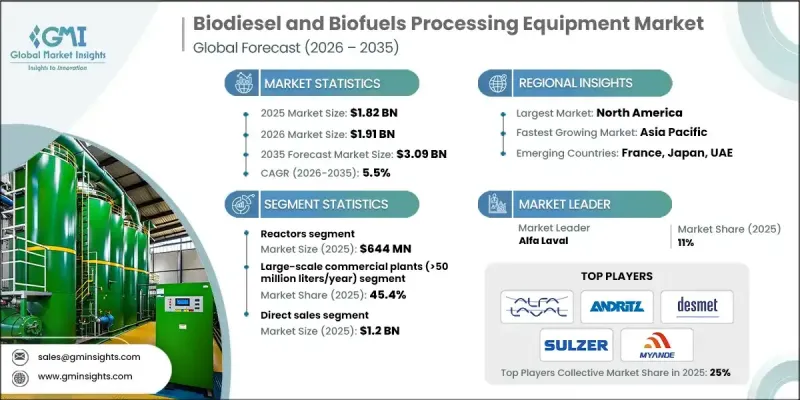
세계 커뮤니티는 넷제로 목표 달성에 대한 압박이 커지면서 에너지 시스템 개발 및 도입 방법을 적극적으로 검토하고 있습니다. 정부, 기업, 투자자들은 화석연료에 대한 의존에서 벗어나 재생에너지와 저탄소 에너지원으로 초점을 옮기고 있습니다. 이러한 전환은 기후 변화 관련 리스크 증가, 업계 전반의 ESG(환경, 사회, 지배구조) 책임성 강화, 재생 가능 연료가 비용과 성능 면에서 경쟁력을 갖출 수 있는 지속적인 기술 발전으로 인해 추진되고 있습니다. 바이오연료는 국가 및 부문별 탈탄소화 전략의 중요한 구성 요소로 자리매김하고 있으며, 특히 즉각적인 대안이 제한되어 있는 분야에서는 더욱 그러합니다. 고에너지 호환 연료를 필요로 하는 산업에서 수요가 가속화되고 있으며, 이는 새로운 생산 시설과 첨단 가공 장비에 대한 투자 확대로 이어지고 있습니다. 제조업체들은 규제상의 혼합 의무와 지속가능성 목표를 충족시키면서 장기적인 연료 공급의 안정성을 지원하는 확장성, 효율성, 신뢰성이 뛰어난 시스템을 우선적으로 도입하고 있습니다.
| 시장 범위 | |
|---|---|
| 개시 연도 | 2025년 |
| 예측 연도 | 2026-2035년 |
| 개시 연도 시장 규모 | 18억 2,000만 달러 |
| 예측 금액 | 30억 9,000만 달러 |
| CAGR | 5.5% |
시장은 높은 처리량과 안정적인 가동 성능을 구현하는 첨단 생산 설비에 대한 투자 증가의 혜택을 계속 누리고 있습니다. 생산자들은 효율성 향상, 생산량 증가, 연속적인 운영을 지원하는 시스템을 점점 더 많이 요구하고 있습니다. 이러한 변화는 운영상의 유연성과 비용 관리를 개선하는 현대화된 설비 구성으로의 광범위한 전환을 반영하고 있으며, 제조업체들이 세계 연료 수요 증가에 효과적으로 대응할 수 있도록 돕고 있습니다.
반응기 부문은 2025년 6억 4,400만 달러 시장 규모를 창출할 것으로 예측됩니다. 이러한 시스템은 생산 시설의 핵심 처리 장치로서 바이오디젤 및 바이오연료 생산에서 여전히 핵심적인 역할을 담당하고 있습니다. 시장 수요는 안정적인 조건, 높은 변환 효율 및 증가된 생산량을 공급하는 솔루션을 선호하고 있습니다. 장비 공급업체들은 연속 운전, 더 나은 공정 제어, 산업 수준의 생산 요건을 충족하기 위한 확장성 향상을 통해 기존 시스템을 뛰어넘는 진보된 설계를 지속적으로 개발하고 있습니다.
연간 생산량 5,000만 리터 이상의 대규모 상업시설은 2025년 45.4%의 점유율을 차지했습니다. 이 플랜트들은 정부의 혼합 의무를 충족시키는 동시에 산업 소비자에게 재생 가능 연료를 공급하는 데 중요한 역할을 하고 있습니다. 연중 연속 운전을 실현하기 위해서는 고도의 엔지니어링, 신뢰할 수 있는 설비, 원자재 조달을 위한 강력한 물류 지원이 필수적입니다. 대량 생산으로 단위당 비용 절감이 가능해지면서 바이오연료는 기존 연료와의 경쟁력이 높아지고 있습니다.
북미 바이오디젤 및 바이오연료 처리 장비 시장은 2025년 77.2%의 점유율을 차지하며 4억 7,510만 달러 규모에 달할 것으로 예측됩니다. 연방 및 주정부 차원의 인센티브는 청정연료 도입을 지속적으로 지원하고 있으며, 생산자들의 생산능력 확대를 촉진하고 있습니다. 상업적 사업자들의 대규모 생산시설의 정비가 진행되는 가운데, 재생가능 연료 기준 대응 및 대체연료 사용에 대한 관심 증가에 따라 설비 수요는 증가 추세에 있습니다.
자주 묻는 질문
목차
제1장 조사 방법과 범위
제2장 주요 요약
제3장 업계 인사이트
제4장 경쟁 구도
제5장 시장 추산 및 예측 : 설비 유형별(2022-2035년)
제6장 시장 추산 및 예측 : 재질별(2022-2035년)
제7장 시장 추산 및 예측 : 용도별(2022-2035년)
제8장 시장 추산 및 예측 : 최종 용도 규모별(2022-2035년)
제9장 시장 추산 및 예측 : 유통 채널별(2022-2035년)
제10장 시장 추산 및 예측 : 지역별(2022-2035년)
제11장 기업 개요
LSH 26.02.27The Global Biodiesel and Biofuels Processing Equipment Market was valued at USD 1.82 billion in 2025 and is estimated to grow at a CAGR of 5.5% to reach USD 3.09 billion by 2035.
Communities worldwide are actively reassessing how energy systems are developed and deployed as pressure increases to achieve net-zero targets. Governments, corporations, and investors are shifting their focus away from fossil fuel dependency and toward renewable and low-carbon energy sources. This transition is driven by increasing climate-related risks, stronger ESG accountability across industries, and continuous technological improvements that allow renewable fuels to compete on cost and performance. Biofuels are positioned as essential components in national and sector-specific decarbonization strategies, especially where immediate alternatives remain limited. Demand is accelerating in industries that require high-energy, compatible fuels, which is leading to greater investment in new production facilities and advanced processing equipment. Manufacturers are prioritizing scalable, efficient, and reliable systems that can support long-term fuel supply stability while meeting regulatory blending mandates and sustainability objectives.
| Market Scope | |
|---|---|
| Start Year | 2025 |
| Forecast Year | 2026-2035 |
| Start Value | $1.82 Billion |
| Forecast Value | $3.09 Billion |
| CAGR | 5.5% |
The market continues to benefit from rising investment in advanced production equipment designed to support higher throughput and consistent operational performance. Producers increasingly demand systems that improve efficiency, enhance output, and support continuous operation. This shift reflects a broader move toward modernized equipment configurations that deliver operational flexibility and improved cost control, allowing manufacturers to respond more effectively to growing global fuel demand.
The reactors segment generated USD 644 million in 2025. These systems remain central to biodiesel and biofuel manufacturing, as they serve as the core processing units within production facilities. Market demand favors solutions that deliver stable conditions, higher conversion efficiency, and increased output volumes. Equipment suppliers continue to develop advanced designs that outperform traditional systems by enabling continuous operation, better process control, and greater scalability to meet industrial-level production requirements.
The large-scale commercial facilities with annual output exceeding 50 million liters accounted for 45.4% share in 2025. These plants play a vital role in meeting government blending mandates while supplying renewable fuels to industrial consumers. Their ability to operate continuously throughout the year requires sophisticated engineering, dependable equipment, and strong logistics support for feedstock sourcing. High-volume production allows these facilities to achieve lower per-unit costs, making biofuels increasingly competitive with conventional fuels.
North America Biodiesel and Biofuels Processing Equipment Market held 77.2% share and generated USD 475.1 million in 2025. Federal and state-level incentives continue to support the adoption of cleaner fuels, encouraging producers to expand capacity. Equipment demand is rising as commercial operators develop large production facilities to comply with renewable fuel standards and respond to increasing interest in alternative fuel applications.
Key companies operating in the Global Biodiesel and Biofuels Processing Equipment Market include Alfa Laval, ANDRITZ, Desmet, Sulzer, Myande, CPM Crown, JBT, SRS International, N&T Engitech, Advance Biofuel, Florida Biodiesel, Springboard Biodiesel, American Crane & Equipment, S. Howes, and Ecolab. Companies in the Global Biodiesel and Biofuels Processing Equipment Market focus on capacity expansion, technology upgrades, and strategic partnerships to strengthen their market position. Many manufacturers invest heavily in research and development to improve the efficiency, durability, and scalability of equipment. Firms also emphasize customization to meet regional regulatory requirements and diverse feedstock conditions. Strategic collaborations with fuel producers help suppliers secure long-term contracts and improve product validation. Expansion into emerging markets allows companies to capture new demand driven by sustainability mandates.
Table of Contents
Chapter 1 Methodology and Scope
- 1.1 Market scope and definition
- 1.2 Research design
- 1.2.1 Research approach
- 1.2.2 Data collection methods
- 1.3 Data mining sources
- 1.3.1 Global
- 1.3.2 Regional/Country
- 1.4 Base estimates and calculations
- 1.4.1 Base year calculation
- 1.4.2 Key trends for market estimation
- 1.5 Primary research and validation
- 1.5.1 Primary sources
- 1.6 Forecast model
- 1.7 Research assumptions and limitations
Chapter 2 Executive Summary
- 2.1 Industry 360° synopsis
- 2.2 Key market trends
- 2.2.1 Regional
- 2.2.2 Equipment Type
- 2.2.3 Material Type
- 2.2.4 Application
- 2.2.5 End use scale
- 2.2.6 Distribution channel
- 2.3 CXO perspectives: Strategic imperatives
- 2.3.1 Key decision points for industry executives
- 2.3.2 Critical success factors for market players
- 2.4 Future outlook and strategic recommendations
Chapter 3 Industry Insights
- 3.1 Industry ecosystem analysis
- 3.1.1 Supplier landscape
- 3.1.2 Profit margin
- 3.1.3 Value addition at each stage
- 3.1.4 Factor affecting the value chain
- 3.2 Industry impact forces
- 3.2.1 Growth drivers
- 3.2.1.1 Global decarbonization & energy transition
- 3.2.1.2 Government blend mandates & policy incentives
- 3.2.1.3 Rising adoption of advanced biofuels (HVO, SAF)
- 3.2.2 Industry pitfalls & challenges
- 3.2.2.1 High capital costs
- 3.2.2.2 Infrastructure & supply chain weaknesses
- 3.2.3 Opportunities
- 3.2.3.1 Expansion of advanced biofuel plants
- 3.2.3.2 Growth in aviation & marine renewable fuels
- 3.2.1 Growth drivers
- 3.3 Growth potential analysis
- 3.4 Future market trends
- 3.5 Technology and innovation landscape
- 3.5.1 Current technological trends
- 3.5.2 Emerging technologies
- 3.6 Price trends
- 3.6.1 By region
- 3.6.2 By equipment type
- 3.7 Regulatory landscape
- 3.7.1 Standards and compliance requirements
- 3.7.2 Regional regulatory frameworks
- 3.7.3 Certification standards
- 3.8 Porter';s analysis
- 3.9 PESTEL analysis
Chapter 4 Competitive Landscape, 2025
- 4.1 Introduction
- 4.2 Company market share analysis
- 4.2.1 By region
- 4.2.1.1 North America
- 4.2.1.2 Europe
- 4.2.1.3 Asia Pacific
- 4.2.1.4 Latin America
- 4.2.1.5 Middle East and Africa
- 4.2.1 By region
- 4.3 Company matrix analysis
- 4.4 Competitive analysis of major market players
- 4.5 Competitive positioning matrix
- 4.6 Key developments
- 4.6.1 Mergers & acquisitions
- 4.6.2 Partnerships & collaborations
- 4.6.3 New product launches
- 4.6.4 Expansion plans
Chapter 5 Market Estimates and Forecast, By Equipment Type, 2022 - 2035 (USD Million) (Thousand Units)
- 5.1 Key trends
- 5.2 Heat exchangers
- 5.2.1 Process cooling/heating heat exchangers
- 5.2.2 Methanol recovery heat exchangers
- 5.2.3 Glycerin processing heat exchangers
- 5.2.4 Tube content per heat exchanger unit
- 5.3 Distillation columns
- 5.3.1 Methanol rectification columns
- 5.3.2 Glycerin purification columns
- 5.3.3 Feedstock pre-treatment columns
- 5.3.4 Tube content per column
- 5.4 Evaporation & concentration systems
- 5.4.1 Methanol flash evaporators
- 5.4.2 Falling film evaporators
- 5.5 Reactors
Chapter 6 Market Estimates and Forecast, By Material Type, 2022 - 2035 (USD Million)
- 6.1 Key trends
- 6.2 Stainless steel 304/304l tubes
- 6.3 Stainless steel 316/316L tubes
- 6.4 Duplex and super duplex stainless-steel tubes
- 6.5 Titanium tubes
- 6.6 Nickel alloys and other materials
Chapter 7 Market Estimates and Forecast, By Application, 2022 - 2035 (USD Million) (Thousand Units)
- 7.1 Key trends
- 7.2 Methanol recovery and purification systems
- 7.3 Glycerin recovery and purification systems
- 7.4 Feedstock pre-treatment and preparation
- 7.5 Transesterification reaction thermal management
- 7.6 Biodiesel/FAMA cooling and finishing
- 7.7 Renewable diesel (HVO/HEFA) high-pressure systems
Chapter 8 Market Estimates and Forecast, By End Use Scale, 2022 - 2035 (USD Million) (Thousand Units)
- 8.1 Key trends
- 8.2 Large-scale commercial plants (>50 million liters/year)
- 8.3 Mid-scale regional plants (10-50 million liters/year)
- 8.4 Small-scale and distributed production (<10 million liters/year)
- 8.5 On-farm and cooperative biodiesel systems
Chapter 9 Market Estimates and Forecast, By Distribution Channel, 2022 - 2035 (USD Million) (Thousand Units)
- 9.1 Key trends
- 9.2 Direct sales
- 9.3 Indirect sales
Chapter 10 Market Estimates and Forecast, By Region, 2022 - 2035 (USD Million) (Thousand Units)
- 10.1 Key trends
- 10.2 North America
- 10.2.1 U.S.
- 10.2.2 Canada
- 10.3 Europe
- 10.3.1 Germany
- 10.3.2 UK
- 10.3.3 France
- 10.3.4 Italy
- 10.3.5 Spain
- 10.4 Asia Pacific
- 10.4.1 China
- 10.4.2 Japan
- 10.4.3 India
- 10.4.4 Australia
- 10.4.5 South Korea
- 10.5 Latin America
- 10.5.1 Brazil
- 10.5.2 Mexico
- 10.5.3 Argentina
- 10.6 Middle East and Africa
- 10.6.1 South Africa
- 10.6.2 Saudi Arabia
- 10.6.3 UAE
Chapter 11 Company Profiles
- 11.1 Advance Biofuel
- 11.2 Alfa Laval
- 11.3 American Crane & Equipment
- 11.4 ANDRITZ
- 11.5 CPM Crown
- 11.6 Desmet
- 11.7 Ecolab
- 11.8 Florida Biodiesel
- 11.9 JBT
- 11.10 Myande
- 11.11 N&T Engitech
- 11.12 S. Howes
- 11.13 Springboard Biodiesel
- 11.14 SRS International
- 11.15 Sulzer