|
시장보고서
상품코드
1936602
오프로드 차량용 시트 시장 기회, 성장 촉진요인, 업계 동향 분석 및 예측(2026-2035년)Off-Road Vehicle Seats Market Opportunity, Growth Drivers, Industry Trend Analysis, and Forecast 2026 - 2035 |
||||||

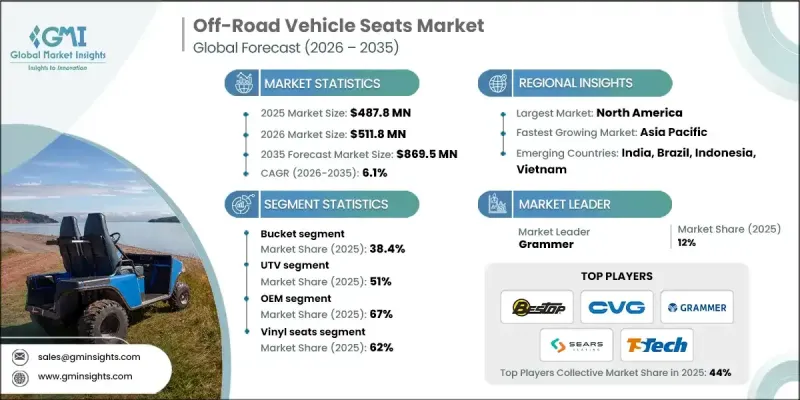
세계의 오프로드 차량용 시트 시장은 2025년에 4억 8,780만 달러로 평가되었으며, 2035년까지 CAGR 6.1%로 성장하여 8억 6,950만 달러에 달할 것으로 예측됩니다.
이 시장은 농업, 건설, 광업 차량용 시트뿐만 아니라 열악한 환경을 위해 설계된 레크리에이션용 오프로드 차량용 시트도 포함됩니다. 시장 수요는 차량 사용 빈도 및 사용 시간, 운전자의 편의성 요구 사항, 산업 및 상업 환경의 엄격한 작업장 안전 규제에 따라 크게 영향을 받습니다. 레크리에이션용 차량, 특히 다목적 차량(유틸리티 차량)은 아웃도어 활동의 인기가 높아지면서 애프터마켓 수요를 지속적으로 견인하고 있습니다. 작업자는 편안함, 지지력, 진동 감소를 우선시하기 때문에 제조업체는 내구성이 뛰어나고 인체공학적인 좌석 솔루션에 중점을 두어 안전성을 높이고 장시간 작업 시 피로를 줄이는 데 주력하고 있습니다. 조절 기능과 쿠션 기능을 갖춘 좌석의 발전은 진화하는 노동 안전 기준과 전문가들의 기대에 부응하고 있습니다.
| 시장 범위 | |
|---|---|
| 시작 연도 | 2025년 |
| 예측 연도 | 2026-2035 |
| 개시 금액 | 4억 8,780만 달러 |
| 예측 금액 | 8억 6,950만 달러 |
| CAGR | 6.1% |
버킷 시트 부문은 2025년 시장의 38.4%를 차지했으며, 2035년까지 연평균 5.6%의 성장률을 기록할 것으로 전망됩니다. 이 시트는 험준한 지형이나 불규칙한 지형에서 오프로드 차량을 운전하는 운전자에게 뛰어난 측면 지지력, 안정성 및 자세 유지를 제공하도록 설계되었습니다. 주로 트랙터, 로더, 유틸리티 차량에 적용되며, 장시간 운전 시 편안함과 안전성이 매우 중요합니다. 각 제조사들은 버킷 시트의 쿠션성, 조절성, 진동 저감 기능 향상에 주력하여 작업자의 생산성 향상과 피로감 감소를 위해 노력하고 있습니다.
UTV 부문은 2025년 51%의 점유율을 차지했으며, 2035년까지 연평균 7.1%의 성장률을 기록할 것으로 전망됩니다. UTV용 시트는 운반, 견인, 작업자 수송 등 다양한 운영 요구에 대응하고 장시간의 편안함, 안전성, 인체공학적 지원을 위해 특별히 설계되었습니다. 농업, 건설, 레크리에이션 용도로 UTV의 보급이 확대됨에 따라 내구성과 강화된 쿠션, 조절 가능한 구성, 안전벨트 등 통합 안전 기능을 갖춘 시트에 대한 수요가 증가하고 있습니다.
미국 오프로드 차량용 시트 시장은 88%의 점유율을 차지하며 2025년 2억 2,140만 달러 규모에 달할 것으로 예상됩니다. 시장 성장은 농업, 건설, 광업, 레크리에이션 차량 부문의 강력한 수요에 힘입어 성장하고 있습니다. 높은 가동률과 장시간의 가동으로 인해 작업자의 안전을 보장하고 편안함을 보장하는 견고하고 진동 감소 기능을 갖춘 인체공학적으로 설계된 좌석 시스템을 채택하고 있습니다. 농업 종사자들은 장시간 작업 시 생산성을 유지하고 피로를 줄이기 위해 내구성과 지지력이 뛰어난 좌석에 크게 의존하고 있습니다.
자주 묻는 질문
목차
제1장 조사 방법
제2장 주요 요약
제3장 업계 인사이트
제4장 경쟁 구도
제5장 시장 추정 및 예측 : 좌석수별, 2022-2035
제6장 시장 추정 및 예측 : 차량별, 2022-2035
제7장 시장 추정 및 예측 : 유통 채널별, 2022-2035
제8장 시장 추정 및 예측 : 재료별, 2022-2035
제9장 시장 추정 및 예측 : 최종 용도별, 2022-2035
제10장 시장 추정 및 예측 : 작동 기구별, 2022-2035
제11장 시장 추정 및 예측 : 지역별, 2022-2035
제12장 기업 개요
KSM 26.03.05The Global Off-Road Vehicle Seats Market was valued at USD 487.8 million in 2025 and is estimated to grow at a CAGR of 6.1% to reach USD 869.5 million by 2035.
The market caters to seating for agricultural, construction, and mining vehicles, as well as recreational off-road applications designed for rugged environments. Market demand is strongly influenced by the intensity and duration of vehicle usage, operator comfort requirements, and strict workplace safety regulations across industrial and commercial settings. Recreational vehicles, particularly utility vehicles, continue to drive aftermarket demand as the popularity of outdoor activities grows. Operators prioritize comfort, support, and vibration reduction, prompting manufacturers to focus on durable, ergonomic seating solutions that enhance safety and reduce fatigue over long operational hours. Advances in adjustable and cushioned seating are also aligning with evolving occupational safety standards and professional expectations.
| Market Scope | |
|---|---|
| Start Year | 2025 |
| Forecast Year | 2026-2035 |
| Start Value | $487.8 Million |
| Forecast Value | $869.5 Million |
| CAGR | 6.1% |
The bucket seat segment captured 38.4% of the market in 2025 and is projected to grow at a CAGR of 5.6% through 2035. These seats are engineered to provide superior lateral support, stability, and posture maintenance for operators handling off-road vehicles on rugged or uneven terrain. They are predominantly utilized in tractors, loaders, and utility vehicles, where comfort and safety during prolonged operation are critical. Manufacturers are increasingly focusing on enhancing cushioning, adjustability, and vibration reduction in bucket seats to improve operator productivity and reduce fatigue.
The UTV segment held a 51% share in 2025 and is expected to grow at a CAGR of 7.1% through 2035. UTV seats are specifically designed for long-duration comfort, safety, and ergonomic support, accommodating diverse operational needs such as hauling, towing, and transporting work crews. The growing use of UTVs in agricultural, construction, and recreational applications is driving demand for seats that combine durability with enhanced cushioning, adjustable configurations, and integrated safety features such as seat belts.
US Off-Road Vehicle Seats Market held an 88% share, generating USD 221.4 million in 2025. Market growth is supported by strong demand from the agricultural, construction, mining, and recreational vehicle sectors. High utilization rates and extended operational hours have driven the adoption of robust, vibration-reducing, and ergonomically designed seating systems to protect operators' safety while ensuring comfort. Agricultural operators rely heavily on durable and supportive seats to maintain productivity and reduce fatigue during long working hours.
Key players in the Global Off-Road Vehicle Seats Market include Bestop, CVG Commercial Vehicle, Grammer, ISRI Seats, Lear, Milsco, Recaro Automotive Seating, Sears Seating, TS Tech, and UnitedSeats. Companies in the off-road vehicle seats market are strengthening their presence through continuous innovation in ergonomic and vibration-reducing technologies, expanding their product portfolios for both industrial and recreational vehicles, and investing in advanced materials for durability and comfort. Manufacturers are establishing strategic partnerships with OEMs, focusing on aftermarket solutions to capture recurring demand, and optimizing distribution networks for wider regional penetration. Additionally, companies are leveraging regulatory compliance and certification standards to differentiate products, while offering customizable seating solutions to meet specific end-user requirements.
Table of Contents
Chapter 1 Methodology
- 1.1 Research approach
- 1.2 Quality Commitments
- 1.2.1 GMI AI policy & data integrity commitment
- 1.2.1.1 Source consistency protocol
- 1.2.1 GMI AI policy & data integrity commitment
- 1.3 Research Trail & Confidence Scoring
- 1.3.1 Research Trail Components
- 1.3.2 Scoring Components
- 1.4 Data Collection
- 1.4.1 Partial list of primary sources
- 1.5 Data mining sources
- 1.5.1 Paid sources
- 1.5.1.1 Sources, by region
- 1.5.1 Paid sources
- 1.6 Base estimates and calculations
- 1.6.1 Base year calculation for any one approach
- 1.7 Forecast model
- 1.7.1 Quantified market impact analysis
- 1.7.1.1 Mathematical impact of growth parameters on forecast
- 1.7.1 Quantified market impact analysis
- 1.8 Research transparency addendum
- 1.8.1 Source attribution framework
- 1.8.2 Quality assurance metrics
- 1.8.3 Our commitment to trust
Chapter 2 Executive Summary
- 2.1 Industry 360° synopsis, 2022 - 2035
- 2.2 Key market trends
- 2.2.1 Regional
- 2.2.2 Seat
- 2.2.3 Vehicle
- 2.2.4 Distribution Channel
- 2.2.5 Material
- 2.2.6 End Use
- 2.2.7 Actuation Mechanism
- 2.3 TAM Analysis, 2026-2035
- 2.4 CXO perspectives: Strategic imperatives
- 2.4.1 Executive decision points
- 2.4.2 Critical success factors
- 2.5 Future outlook and strategic recommendations
Chapter 3 Industry Insights
- 3.1 Industry ecosystem analysis
- 3.1.1 Supplier landscape
- 3.1.2 Profit margin analysis
- 3.1.3 Cost structure
- 3.1.4 Value addition at each stage
- 3.1.5 Factor affecting the value chain
- 3.1.6 Disruptions
- 3.2 Industry impact forces
- 3.2.1.1 Growth drivers
- 3.2.1.2 Growth in agricultural and construction mechanization
- 3.2.1.3 Rising focus on operator comfort and safety standards
- 3.2.1.4 Expansion of recreational off road vehicle usage
- 3.2.2 Industry pitfalls and challenges
- 3.2.2.1 High cost of advanced suspension seats
- 3.2.2.2 Exposure to harsh operating conditions
- 3.2.3 Market opportunities
- 3.2.3.1 Adoption of suspension and air ride seating systems
- 3.2.3.2 Rising replacement and aftermarket demand
- 3.2.3.3 Customization for application specific needs
- 3.3 Growth potential analysis
- 3.4 Regulatory landscape
- 3.4.1 North America
- 3.4.1.1 United States Occupational Safety and Equipment Standards
- 3.4.1.2 OSHA Seating and Operator Safety Guidelines
- 3.4.1.3 Agricultural and Construction Equipment Compliance
- 3.4.1.4 Canada Machinery Safety Regulations
- 3.4.2 Europe
- 3.4.2.1 EU Machinery Directive and Seating Requirements
- 3.4.2.2 EN Standards for Operator Seats
- 3.4.2.3 Country Level Agricultural Equipment Compliance
- 3.4.2.4 Workplace Ergonomics and Vibration Exposure Rules
- 3.4.3 Asia Pacific
- 3.4.3.1 China Agricultural and Construction Equipment Regulations
- 3.4.3.2 India Operator Safety and Machinery Standards
- 3.4.3.3 Japan Industrial Equipment Seating Guidelines
- 3.4.3.4 South Korea Machinery Safety Compliance
- 3.4.3.5 ASEAN Regional Equipment Safety Frameworks
- 3.4.4 Latin America
- 3.4.4.1 Brazil Agricultural Machinery Standards
- 3.4.4.2 Argentina Equipment Safety Compliance
- 3.4.4.3 Mexico Industrial Machinery Regulations
- 3.4.4.4 Regional Operator Safety Guidelines
- 3.4.5 Middle East & Africa
- 3.4.5.1 UAE Equipment Safety and Operator Guidelines
- 3.4.5.2 Saudi Arabia Industrial Machinery Compliance
- 3.4.5.3 South Africa Occupational Safety Standards
- 3.4.5.4 Regional Equipment Safety Frameworks
- 3.4.1 North America
- 3.5 Porter's analysis
- 3.6 PESTEL analysis
- 3.7 Technology and innovation landscape
- 3.7.1 Current technological trends
- 3.7.2 Emerging technologies
- 3.8 Price trends
- 3.8.1 By region
- 3.8.2 By product
- 3.9 Production statistics
- 3.9.1 Production hubs
- 3.9.2 Consumption hubs
- 3.9.3 Export and import
- 3.10 Cost breakdown analysis
- 3.10.1 Seat frame and material costs
- 3.10.2 Cushioning suspension and upholstery costs
- 3.10.3 Assembly and quality control costs
- 3.10.4 Testing and certification costs
- 3.10.5 Regulatory compliance costs
- 3.10.6 Distribution service and replacement costs
- 3.11 Patent analysis
- 3.12 Sustainability and environmental aspects
- 3.12.1 Sustainable practices
- 3.12.2 Waste reduction strategies
- 3.12.3 Energy efficiency in production
- 3.12.4 Eco-friendly Initiatives
- 3.12.5 Carbon footprint considerations
- 3.13 Operator Ergonomics & Health Impact Analysis
- 3.14 Whole Body Vibration (WBV) & Suspension Performance Benchmarking
- 3.15 Seat Safety & Restraint Integration Analysis
- 3.16 Customization & Application-Specific Seat Design
- 3.17 Material Durability & Lifecycle Performance
- 3.18 Electrification & Smart Seat Readiness
- 3.19 Future Disruption & Design Substitution Risks
Chapter 4 Competitive Landscape, 2025
- 4.1 Introduction
- 4.2 Company market share analysis
- 4.2.1 North America
- 4.2.2 Europe
- 4.2.3 Asia Pacific
- 4.2.4 LATAM
- 4.2.5 MEA
- 4.3 Competitive analysis of major market players
- 4.4 Competitive positioning matrix
- 4.5 Strategic outlook matrix
- 4.6 Key developments
- 4.6.1 Mergers & acquisitions
- 4.6.2 Partnerships & collaborations
- 4.6.3 New Product Launches
- 4.6.4 Expansion Plans and funding
Chapter 5 Market Estimates & Forecast, By Seat, 2022 - 2035 (USD Mn, Units)
- 5.1 Key trends
- 5.2 Bucket seat
- 5.3 Bench seat
- 5.4 Suspension seats
- 5.5 Foldable/Adjustable seats
Chapter 6 Market Estimates & Forecast, By Vehicle, 2022 - 2035 (USD Mn, Units)
- 6.1 Key trends
- 6.2 ATV
- 6.3 UTV
- 6.4 Snowmobile
- 6.5 Off-Road Motorcycle
Chapter 7 Market Estimates & Forecast, By Distribution Channel, 2022 - 2035 (USD Mn, Units)
- 7.1 Key trends
- 7.2 OEM
- 7.3 Aftermarket
Chapter 8 Market Estimates & Forecast, By Material, 2022 - 2035 (USD Mn, Units)
- 8.1 Key trends
- 8.2 Fabric seats
- 8.3 Vinyl seats
- 8.4 Leather seats
- 8.5 Others
Chapter 9 Market Estimates & Forecast, By End Use, 2022 - 2035 (USD Mn, Units)
- 9.1 Key trends
- 9.2 Individual consumers
- 9.3 Commercial users
- 9.4 Motorsports and racing teams
- 9.5 Others
Chapter 10 Market Estimates & Forecast, By Actuation Mechanism, 2022 - 2035 (USD Mn, Units)
- 10.1 Key trends
- 10.2 Electric seat actuation system (ESAS)
- 10.3 Manual seat actuation system (MSAS)
Chapter 11 Market Estimates & Forecast, By Region, 2022 - 2035 (USD Mn, Units)
- 11.1 Key trends
- 11.2 North America
- 11.2.1 US
- 11.2.2 Canada
- 11.3 Europe
- 11.3.1 Germany
- 11.3.2 UK
- 11.3.3 France
- 11.3.4 Italy
- 11.3.5 Spain
- 11.3.6 Russia
- 11.3.7 Norway
- 11.3.8 Netherlands
- 11.3.9 Sweden
- 11.4 Asia Pacific
- 11.4.1 China
- 11.4.2 India
- 11.4.3 Japan
- 11.4.4 Australia
- 11.4.5 South Korea
- 11.4.6 Singapore
- 11.4.7 Thailand
- 11.4.8 Indonesia
- 11.4.9 Vietnam
- 11.5 Latin America
- 11.5.1 Brazil
- 11.5.2 Mexico
- 11.5.3 Argentina
- 11.6 MEA
- 11.6.1 South Africa
- 11.6.2 Saudi Arabia
- 11.6.3 UAE
- 11.6.4 Turkey
Chapter 12 Company Profiles
- 12.1 Global Players
- 12.1.1 CVG Commercial Vehicle
- 12.1.2 Grammer
- 12.1.3 ISRI Seats
- 12.1.4 Lear
- 12.1.5 Milsco
- 12.1.6 Recaro Automotive Seating
- 12.1.7 TS Tech
- 12.1.8 Ultra Seat
- 12.1.9 KL Seating
- 12.1.10 Knoedler
- 12.2 Regional Players
- 12.2.1 Bestop
- 12.2.2 KAB Seating
- 12.2.3 National Seating
- 12.2.4 Pilot Seating
- 12.2.5 Sears Seating
- 12.2.6 UnitedSeats
- 12.3 Emerging Players and Niche Specialists
- 12.3.1 Beard Seats
- 12.3.2 Corbeau Seats
- 12.3.3 MasterCraft Safety
- 12.3.4 OMP Racing
- 12.3.5 PRP Seats
- 12.3.6 Simpson race products