|
시장보고서
상품코드
1959326
업사이클링 간식 시장 기회, 성장요인, 업계 동향 분석 및 예측(2026-2035년)Upcycled Snacks Market Opportunity, Growth Drivers, Industry Trend Analysis, and Forecast 2026 - 2035 |
||||||

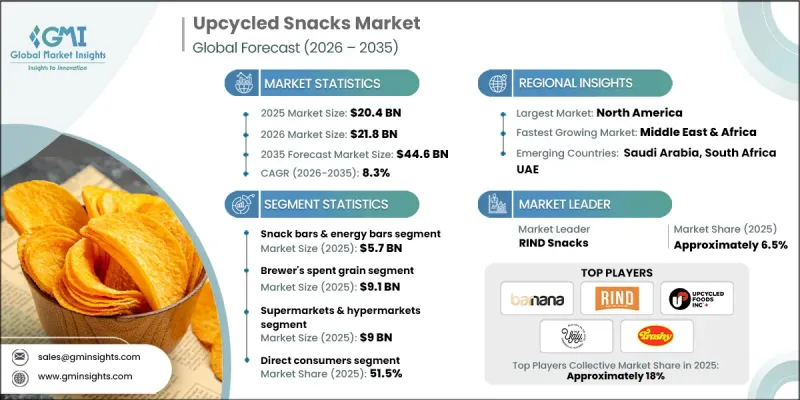
세계의 업사이클링 간식 시장은 2025년에 204억 달러로 평가되었고, 2035년까지 연평균 복합 성장률(CAGR)8.3%로 성장하여 446억 달러에 이를 것으로 예측됩니다.
환경 지속가능성과 음식물 쓰레기 감소에 대한 소비자의 인식이 높아지면서 시장은 강한 모멘텀을 얻고 있습니다. 책임감 있는 소비와 자원 효율성에 대한 인식이 높아지면서 소비자들은 환경 부하를 줄이는데 기여하는 제품을 적극적으로 찾고 있습니다. 순환 경제 원칙에 부합하는 브랜드는 신뢰와 충성도를 얻고 있으며, 제조업체는 업사이클 원료를 주류 스낵 제품군에 통합하도록 장려하고 있습니다. 지속가능성의 가치와 구매 결정의 연동이 세계 시장으로의 침투를 가속화하고 있습니다. 동시에 건강 및 웰빙 트렌드가 업사이클링 간식에 대한 수요를 촉진하고 있습니다. 소비자들은 클린 라벨, 영양가 높은 식품, 기능성 식품을 선호하고 있으며, 업사이클 원료는 우수한 영양 프로파일을 제공함과 동시에 폐기물 감소 노력을 지원합니다. 웰빙을 지향하는 스낵이 소매점 진열대와 전자상거래 플랫폼에 계속 영향을 미치고 있는 가운데, 업사이클 제품은 유통 채널 전반에 걸쳐 존재감을 확대하고 있습니다. 소매점에서의 가용성 확대와 제품 개발의 혁신은 장기적인 시장 성장을 더욱 강화시키고 있습니다.
| 시장 범위 | |
|---|---|
| 개시 연도 | 2025년 |
| 예측 연도 | 2026-2035년 |
| 개시 연도 가치 | 204억 달러 |
| 예측 금액 | 446억 달러 |
| CAGR | 8.3% |
스낵바 및 에너지바 부문은 2025년에 57억 달러의 매출을 기록할 것으로 예상되며, 2026년부터 2035년까지 연평균 8%의 성장률을 보일 것으로 전망됩니다. 이 카테고리는 영양이 풍부한 업사이클 원료와 잘 어울리고, 일상적인 소비 습관에 녹아들어 시장 확대를 뒷받침하고 있습니다. 이 제품들은 이동이 잦은 라이프스타일과 일상적인 식사 대용으로 적합하며, 지속적인 재구매를 가능하게 합니다. 한편, 칩, 크리스피, 크래커 등 짠맛 스낵은 소비자의 폭넓은 수용성으로 인해 수량 성장에 크게 기여하고 있습니다. 대규모 소비 기반을 통해 업사이클 원료를 효율적으로 도입하면서도 주류의 매력과 경쟁력 있는 가격을 유지할 수 있습니다.
양조용 맥아 찌꺼기 부문은 2025년 91억 달러로 평가되며 2035년까지 연평균 복합 성장률(CAGR) 8.1%로 확대될 것으로 예측됩니다. 이 원료 카테고리는 안정적인 공급원과 비용 안정성의 이점을 가지고 있어 상업용 스낵 생산에 매력적입니다. 그 영양학적 특성으로 인해 다양한 제과 및 가공 스낵 제품에 의미 있는 수준의 배합이 가능합니다. 또한, 식물에서 추출한 제품별 스트림은 천연의 맛, 식감, 식이섬유 함량을 제공하여 단맛과 짠맛 스낵 모두에서 배합 혁신을 주도하고 있습니다. 이러한 조달 모델은 원료 효율을 높이고 업사이클링 간식 시장 내 순환형 생산 시스템을 강화합니다.
북미 업사이클링 간식 시장은 2025년 7.9억 달러 규모에 달할 것으로 예상되며, 예측 기간 동안 강력한 성장세를 보일 것으로 예측됩니다. 높은 지속가능성 의식과 제품 혁신 문화가 지역 확장을 뒷받침하고 있습니다. 식품 제조업체들은 폐기물 감축 노력과 클린 라벨에 대한 기대에 부응하기 위해 널리 소비되는 스낵 카테고리에 업사이클 원료를 통합하는 것을 가속화하고 있습니다. 미국은 지속 가능한 식품 개념에 대한 소비자의 높은 수용성과 전문 원료 공급업체의 존재로 인해 지역 성장의 주요 기여 국가로 남아있습니다. 광범위한 소매 유통망, 스타트업 기업의 적극적인 진출, 개인 브랜드의 실험적 전개가 생산량 확대를 뒷받침하고 있습니다. 또한, 식품 회수 시스템이 구축되어 있어 제품별 안정적 조달과 대규모 스낵 제조가 가능하다는 점도 이 지역의 강점입니다.
자주 묻는 질문
목차
제1장 조사 방법
제2장 주요 요약
제3장 업계 인사이트
제4장 경쟁 구도
제5장 시장 추산 및 예측 : 제품 유형별, 2022-2035
제6장 시장 추산 및 예측 : 원료원별, 2022-2035
제7장 시장 추산 및 예측 : 유통 채널별, 2022-2035
제8장 시장 추산 및 예측 : 최종사용자별, 2022-2035
제9장 시장 추산 및 예측 : 지역별, 2022-2035
제10장 기업 개요
LSH 26.03.18The Global Upcycled Snacks Market was valued at USD 20.4 billion in 2025 and is estimated to grow at a CAGR of 8.3% to reach USD 44.6 billion by 2035.
The market is gaining strong momentum as consumers become increasingly conscious of environmental sustainability and food waste reduction. Rising awareness about responsible consumption and resource efficiency is reshaping purchasing behavior, with shoppers actively seeking products that contribute to lowering overall environmental impact. Brands that demonstrate alignment with circular economy principles are earning greater trust and loyalty, encouraging manufacturers to incorporate upcycled ingredients into mainstream snack portfolios. This alignment between sustainability values and buying decisions is accelerating global market penetration. At the same time, health and wellness trends are reinforcing demand for upcycled snacks. Consumers are prioritizing clean label, nutrient-dense, and functional foods, and upcycled ingredients often deliver strong nutritional profiles while supporting waste reduction initiatives. As wellness-focused snacking continues to influence retail shelves and e-commerce platforms, upcycled products are expanding their presence across distribution channels. Broader retail availability and innovation in product development are further strengthening long-term market growth.
| Market Scope | |
|---|---|
| Start Year | 2025 |
| Forecast Year | 2026-2035 |
| Start Value | $20.4 Billion |
| Forecast Value | $44.6 Billion |
| CAGR | 8.3% |
The snack bars and energy bars segment generated USD 5.7 billion in 2025 and is projected to grow at a CAGR of 8% from 2026 to 2035. This category supports market expansion due to its compatibility with nutrient-rich upcycled inputs and its integration into daily consumption routines. These products align well with on-the-go lifestyles and routine meal replacements, allowing consistent repeat purchases. Meanwhile, savory snack formats such as chips, crisps, and crackers contribute significantly to volume growth because of their widespread consumer acceptance. Their large-scale consumption base enables efficient incorporation of upcycled ingredients while maintaining mainstream appeal and competitive pricing.
The brewer's spent grain segment was valued at USD 9.1 billion in 2025 and is anticipated to grow at a CAGR of 8.1% through 2035. This ingredient category benefits from steady supply streams and cost stability, making it attractive for commercial snack production. Its nutritional characteristics support inclusion in various baked and processed snack applications at meaningful levels. Additional plant-based byproduct streams are also driving innovation across both sweet and savory snack formulations by contributing natural flavor profiles, texture, and fiber content. These sourcing models strengthen raw material efficiency and reinforce circular production systems within the upcycled snacks market.
North America Upcycled Snacks Market accounted for USD 7.9 billion in 2025 and is expected to witness strong growth over the forecast period. Regional expansion is supported by high sustainability awareness and a culture of product innovation. Food manufacturers are increasingly integrating upcycled ingredients into widely consumed snack categories to meet waste reduction commitments and clean label expectations. The United States remains a key contributor to regional growth due to strong consumer acceptance of sustainable food concepts and the presence of specialized ingredient suppliers. Broad retail distribution, active startup participation, and private-label experimentation are supporting volume scaling. The region also benefits from established food recovery systems that enable consistent byproduct sourcing and large-scale snack manufacturing.
Major companies operating in the Global Upcycled Snacks Market include Upcycled Foods, Inc., Barnana, The Ugly Company, RIND Snacks, Trashy Chips, and other emerging participants. These players are actively shaping competitive dynamics through product innovation and sustainability-driven branding strategies. Companies in the upcycled snacks market are reinforcing their competitive positioning by investing in supply chain partnerships that secure consistent access to high-quality byproducts. Many brands are emphasizing transparent sourcing, sustainability certifications, and impact-driven marketing to build consumer trust. Product innovation remains central, with firms developing new flavors, textures, and formats to broaden mainstream appeal. Strategic collaborations with retailers and foodservice operators are expanding shelf presence and improving distribution reach.
Table of Contents
Chapter 1 Methodology
- 1.1 Market scope and definition
- 1.2 Research design
- 1.2.1 Research approach
- 1.2.2 Data collection methods
- 1.3 Data mining sources
- 1.3.1 Global
- 1.3.2 Regional/Country
- 1.4 Base estimates and calculations
- 1.4.1 Base year calculation
- 1.4.2 Key trends for market estimation
- 1.5 Primary research and validation
- 1.5.1 Primary sources
- 1.6 Forecast model
- 1.7 Research assumptions and limitations
Chapter 2 Executive Summary
- 2.1 Industry 360° synopsis
- 2.2 Key market trends
- 2.2.1 Regional
- 2.2.2 Product Type
- 2.2.3 Ingredient Source
- 2.2.4 Distribution Channel
- 2.2.5 End-User
- 2.3 TAM Analysis, 2026-2035
- 2.4 CXO perspectives: Strategic imperatives
- 2.4.1 Executive decision points
- 2.4.2 Critical success factors
- 2.5 Future Outlook and Strategic Recommendations
Chapter 3 Industry Insights
- 3.1 Industry ecosystem analysis
- 3.1.1 Supplier Landscape
- 3.1.2 Profit Margin
- 3.1.3 Value addition at each stage
- 3.1.4 Factor affecting the value chain
- 3.1.5 Disruptions
- 3.2 Industry impact forces
- 3.2.1 Growth drivers
- 3.2.2 Industry pitfalls and challenges
- 3.2.3 Market opportunities
- 3.3 Growth potential analysis
- 3.4 Regulatory landscape
- 3.4.1 North America
- 3.4.2 Europe
- 3.4.3 Asia Pacific
- 3.4.4 Latin America
- 3.4.5 Middle East & Africa
- 3.5 Porter's analysis
- 3.6 PESTEL analysis
- 3.7 Price trends
- 3.7.1 By region
- 3.7.2 By product
- 3.8 Future market trends
- 3.9 Technology and Innovation landscape
- 3.9.1 Current technological trends
- 3.9.2 Emerging technologies
- 3.10 Patent Landscape
- 3.11 Trade statistics (Note: the trade statistics will be provided for key countries only)
- 3.11.1 Major importing countries
- 3.11.2 Major exporting countries
- 3.12 Sustainability and Environmental Aspects
- 3.12.1 Sustainable Practices
- 3.12.2 Waste Reduction Strategies
- 3.12.3 Energy Efficiency in Production
- 3.12.4 Eco-friendly Initiatives
- 3.13 Carbon Footprint Considerations
Chapter 4 Competitive Landscape, 2025
- 4.1 Introduction
- 4.2 Company market share analysis
- 4.2.1 By region
- 4.2.1.1 North America
- 4.2.1.2 Europe
- 4.2.1.3 Asia Pacific
- 4.2.1.4 LATAM
- 4.2.1.5 MEA
- 4.2.1 By region
- 4.3 Company matrix analysis
- 4.4 Competitive analysis of major market players
- 4.5 Competitive positioning matrix
- 4.6 Key developments
- 4.6.1 Mergers & acquisitions
- 4.6.2 Partnerships & collaborations
- 4.6.3 New Product Launches
- 4.6.4 Expansion Plans
Chapter 5 Market Estimates and Forecast, By Product Type, 2022- 2035 (USD Billion, Kilo Tons)
- 5.1 Key trends
- 5.2 Snack Bars & Energy Bars
- 5.3 Chips & Crisps
- 5.3.1 Vegetable Chips
- 5.3.2 Tortilla Chips
- 5.3.3 Puffed Snacks
- 5.3.4 Fruit Crisps
- 5.4 Dried Fruits & Fruit Snacks
- 5.5 Crackers & Biscuits
- 5.6 Cookies & Baked Goods
- 5.7 Trail Mix & Granola
- 5.8 Others
Chapter 6 Market Estimates and Forecast, By Ingredient Source, 2022 - 2035 (USD Billion, Kilo Tons)
- 6.1 Key trends
- 6.2 Brewer's Spent Grain (BSG)
- 6.3 Fruit & Vegetable Waste
- 6.4 Juicing & Cold-Press Pulp
- 6.5 Other by-products
- 6.5.1 Soy Processing
- 6.5.2 Coffee
- 6.5.3 Oat & Nut Milk Processing
- 6.5.4 Agricultural & Processing
Chapter 7 Market Estimates and Forecast, By Distribution Channel, 2022 - 2035 (USD Billion, Kilo Tons)
- 7.1 Key trends
- 7.2 Supermarkets & Hypermarkets
- 7.3 Specialty & Health Food Stores
- 7.4 Online Retail
- 7.5 Foodservice & HoReCa
- 7.6 Wholesale & B2B
Chapter 8 Market Estimates and Forecast, By End-User, 2022 - 2035 (USD Billion, Kilo Tons)
- 8.1 Key trends
- 8.2 Direct Consumers
- 8.3 Food & Beverage Manufacturers
- 8.4 Foodservice Operators
- 8.5 Nutraceutical & Functional Food Companies
- 8.6 Others
Chapter 9 Market Estimates and Forecast, By Region, 2022 - 2035 (USD Billion, Kilo Tons)
- 9.1 Key trends
- 9.2 North America
- 9.2.1 U.S.
- 9.2.2 Canada
- 9.3 Europe
- 9.3.1 Germany
- 9.3.2 UK
- 9.3.3 France
- 9.3.4 Italy
- 9.3.5 Spain
- 9.3.6 Rest of Europe
- 9.4 Asia Pacific
- 9.4.1 China
- 9.4.2 India
- 9.4.3 Japan
- 9.4.4 Australia
- 9.4.5 South Korea
- 9.4.6 Rest of Asia Pacific
- 9.5 Latin America
- 9.5.1 Brazil
- 9.5.2 Mexico
- 9.5.3 Argentina
- 9.5.4 Rest of Latin America
- 9.6 Middle East & Africa
- 9.6.1 Saudi Arabia
- 9.6.2 South Africa
- 9.6.3 UAE
- 9.6.4 Rest of Middle East & Africa
Chapter 10 Company Profiles
- 10.1 Barnana
- 10.2 RIND Snacks
- 10.3 Upcycled Foods, Inc.
- 10.4 Trashy Chips
- 10.5 Renewal Mill
- 10.6 Spudsy
- 10.7 The Ugly Company
- 10.8 Confetti Snacks
- 10.9 Theo's Plant-Based
- 10.10 Kazoo Snacks