

|
시장보고서
상품코드
1998731
선박 추진 시스템 시장 기회, 성장요인, 업계 동향 분석 및 예측(2026-2035년)Marine Propulsion Systems Market Opportunity, Growth Drivers, Industry Trend Analysis, and Forecast 2026 - 2035 |
||||||

세계의 선박 추진 시스템 시장은 2025년에 290억 달러로 평가되며, CAGR 3.5%로 성장하며, 2035년까지 412억 달러에 달할 것으로 추정되고 있습니다.
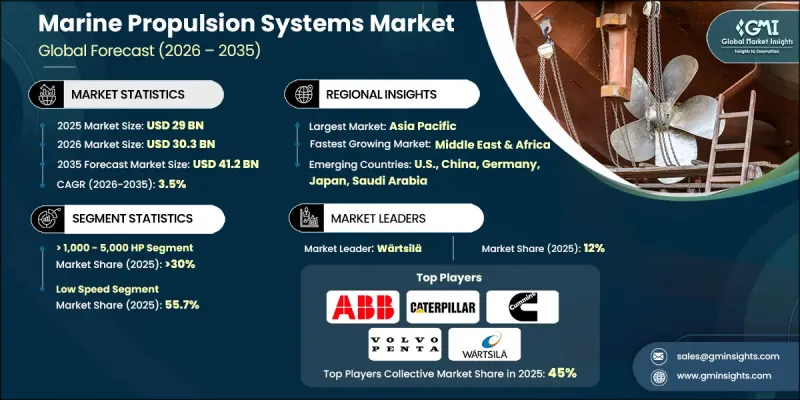
선박 추진 시스템 시장의 성장은 세계 해상 무역의 확대와 선박 기술의 지속적인 현대화와 밀접한 관련이 있습니다. 전 세계에서 운송량이 증가함에 따라 선박 운영사들은 더 무거운 운항 부하에 대응하면서 신뢰할 수 있는 성능을 발휘할 수 있는 추진 솔루션을 찾고 있습니다. 동시에 각 제조업체들은 연료 효율성 향상, 운영 비용 절감, 환경 영향을 최소화하는 추진 기술 개발을 우선순위로 삼고 있습니다. 선박용 추진시스템은 발생된 동력을 추력으로 변환하여 선박이 수중을 이동할 수 있도록 하는 핵심적인 기계적인 틀입니다. 이러한 시스템은 발전설비, 변속기 부품, 추진장치 등 여러 요소를 결합하여 통합된 운영시스템으로 연동하여 작동합니다. 현대의 추진 아키텍처는 전통적 발전 기술 외에도 다양한 해상 조건에서도 성능을 유지하도록 설계된 첨단 하이브리드 또는 전기식 구성이 통합되어 있습니다. 디지털 제어 플랫폼의 통합이 진행됨에 따라 시스템의 효율성이 향상되고 있으며, 운항자는 성능 데이터를 모니터링하고 안정적인 추진력을 유지할 수 있게 되었습니다. 고급 진단 시스템은 가동 매개변수를 지속적으로 추적하여 예기치 않은 유지보수로 인한 중단을 최소화하고 신뢰성을 보장하는 데 도움이 됩니다. 유체역학 공학의 발전으로 추진장치의 성능이 더욱 향상되어 선박 운항 중 보다 부드러운 기동성과 최적화된 에너지 효율을 실현하고 있습니다.
| 시장 범위 | |
|---|---|
| 시작연도 | 2025년 |
| 예측 기간 | 2026-2035 |
| 개시 금액 | 290억 달러 |
| 예측 금액 | 412억 달러 |
| CAGR | 3.5% |
선박 추진 시스템 시장에서 1,000-5,000마력 부문은 2025년 30%의 점유율을 차지하며, 2026-2035년 연평균 복합 성장률(CAGR) 3.5%를 나타낼 것으로 예측됩니다. 이 마력대 추진 시스템은 출력과 운영 효율의 균형이 뛰어나 광범위한 상업적 해상 활동을 지원합니다. 이 엔진들은 장기간의 해상 운항에도 안정적인 성능을 유지하면서 막대한 운항부하를 감당할 수 있다는 점에서 높은 평가를 받고 있습니다. 내구성, 안정적인 토크 발생, 그리고 널리 사용되는 연료와의 호환성은 다양한 선박 카테고리에서 널리 보급되는 데 기여했습니다. 이러한 성능 특성은 추진 시스템 산업 전반에서 이 마력대의 중요성을 더욱 공고히 하고 있습니다.
저속 선박 추진 시스템 시장은 2025년에 55.7%의 점유율을 차지하며 2035년까지 200억 달러에 달할 것으로 예측됩니다. 선박 운항 사업자들이 장거리 항해에서 운항 안정성과 엔진 효율성 향상을 우선시함에 따라 저속 추진 플랫폼에 대한 수요가 증가하고 있습니다. 첨단 엔진 관리 기술의 통합으로 엔진 성능을 보다 정밀하게 제어할 수 있게 되어 균형 잡힌 열적 거동과 보다 원활한 기계적 작동을 유지하는데 기여합니다. 이 시스템은 낮은 회전수에서도 안정적인 토크 출력을 제공하도록 설계되어 점검 간격이 길어지고 장거리 해상 운항이 안정적으로 이루어질 수 있도록 지원합니다. 지속적인 선단 현대화 노력과 청정 연료 솔루션의 채택 확대는 에너지 절약 기술 및 대체 연료 경로와 효율적으로 통합할 수 있으며, 이러한 추진 시스템에 대한 수요 증가에 기여하고 있습니다.
2025년 미국의 선박 추진 시스템 시장은 65%의 점유율을 차지하며 28억 달러의 시장 규모를 기록했습니다. 미국 시장의 성장은 해운 물류 활동의 확대와 국내 조선 프로그램에 대한 지속적인 투자에 의해 지원되고 있습니다. 상선의 현대화가 진행됨에 따라 진화하는 규제 요건을 충족하고 운영 효율성을 향상시키는 첨단 추진 기술에 대한 수요가 증가하고 있습니다. 또한 내륙 및 연안 선단 전체의 업그레이드가 진행됨에 따라 국내 해운 운영 요구를 충족시키기 위해 특별히 설계된 추진 시스템의 채택이 촉진되고 있습니다.
자주 묻는 질문
목차
제1장 조사 방법과 범위
제2장 개요
제3장 업계 인사이트
제4장 경쟁 구도
제5장 시장 규모·예측 : 제품별, 2022-2035
제6장 시장 규모·예측 : 출력별, 2022-2035
제7장 시장 규모·예측 : 기술별, 2022-2035
제8장 시장 규모·예측 : 추진력별, 2022-2035
제9장 시장 규모·예측 : 용도별, 2022-2035
제10장 시장 규모·예측 : 지역별, 2022-2035
제11장 기업 개요
KSA 26.04.20The Global Marine Propulsion Systems Market was valued at USD 29 billion in 2025 and is estimated to grow at a CAGR of 3.5% to reach USD 41.2 billion by 2035.
Growth in the marine propulsion systems market is closely connected to increasing global maritime trade and the continued modernization of vessel technologies. As shipping volumes expand worldwide, vessel operators are seeking propulsion solutions capable of delivering reliable performance while handling heavier operational loads. At the same time, manufacturers are prioritizing the development of propulsion technologies that improve fuel efficiency, reduce operational expenses, and minimize environmental impact. Marine propulsion systems represent the core mechanical framework that enables vessels to move through water by converting generated power into thrust. These systems combine multiple elements, including power generation equipment, transmission components, and propulsive devices that work together as a unified operational system. Modern propulsion architectures incorporate both traditional power generation technologies and advanced hybrid or electric configurations designed to maintain performance across diverse marine conditions. Increasing integration of digital control platforms is also transforming system efficiency, allowing operators to monitor performance data and maintain stable propulsion output. Advanced diagnostic systems continuously track operational parameters, helping ensure reliability while minimizing unexpected maintenance interruptions. Improvements in hydrodynamic engineering have further enhanced propulsor performance, enabling smoother maneuverability and optimized energy efficiency during vessel operations.
| Market Scope | |
|---|---|
| Start Year | 2025 |
| Forecast Year | 2026-2035 |
| Start Value | $29 Billion |
| Forecast Value | $41.2 Billion |
| CAGR | 3.5% |
The >1,000-5,000 HP segment within the marine propulsion systems market accounted for 30% share in 2025 and is projected to grow at a CAGR of 3.5% from 2026 to 2035. Propulsion systems within this horsepower category support a wide range of commercial maritime activities due to their strong balance of power output and operational efficiency. These engines are widely valued for their ability to handle substantial operational loads while maintaining dependable performance during extended marine operations. Their durability, consistent torque generation, and compatibility with widely available fuel options contribute to their widespread use across numerous vessel categories. These performance characteristics continue to reinforce the importance of this horsepower range within the broader propulsion systems industry.
The low-speed marine propulsion systems market represented 55.7% share in 2025 and is expected to reach USD 20 billion by 2035. Demand for low-speed propulsion platforms is increasing as vessel operators prioritize operational stability and improved engine efficiency during long-distance marine operations. The integration of advanced engine management technologies is enabling more precise control over engine performance, helping maintain balanced thermal behavior and smoother mechanical operation. These systems are designed to deliver stable torque output at lower rotational speeds, which supports extended service intervals and reliable long-range maritime operations. Continued fleet modernization initiatives and the growing adoption of cleaner fuel solutions are also contributing to increased demand for these propulsion systems, as they can be efficiently integrated with energy-saving technologies and alternative fuel pathways.
U.S. Marine Propulsion Systems Market accounted for 65% share in 2025 and generated USD 2.8 billion. Market growth in the United States is supported by expanding maritime logistics activity and continued investment in domestic shipbuilding programs. Increased modernization of commercial vessel fleets is also contributing to higher demand for advanced propulsion technologies that meet evolving regulatory requirements while delivering improved operational efficiency. Additionally, upgrades across inland and coastal maritime fleets are encouraging the adoption of propulsion systems specifically engineered to meet domestic maritime operational needs.
Major companies operating in the Global Marine Propulsion Systems Market include Wartsila, Caterpillar, Cummins, Rolls-Royce, Hyundai Heavy Industries, Mitsubishi Heavy Industries, Kawasaki Heavy Industries, ABB, AB Volvo Penta, Scania, Yamaha Motor, Weichai, YANMAR Marine International, IHI Power Systems, MITSUI E&S Co., DEUTZ AG, Deere & Company, Anglo Belgian Corporation, Everllence, and Daihatsu Infinearth MFG. Companies competing in the Marine Propulsion Systems Market are strengthening their industry position through technological innovation, strategic partnerships, and expanded manufacturing capabilities. Many manufacturers are investing heavily in research and development to create propulsion solutions that improve energy efficiency, reduce emissions, and support alternative fuel compatibility. Firms are also integrating advanced digital monitoring systems that allow real-time performance tracking and predictive maintenance. Strategic collaborations with shipbuilders and maritime operators enable companies to develop propulsion technologies tailored to evolving vessel requirements.
Table of Contents
Chapter 1 Methodology & Scope
- 1.1 Research design
- 1.2 Quality commitments
- 1.2.1 GMI AI policy & data integrity commitment
- 1.2.1.1 Source consistency protocol
- 1.2.1 GMI AI policy & data integrity commitment
- 1.3 Research trail & confidence scoring
- 1.3.1 Research trail components
- 1.3.2 Scoring components
- 1.4 Data collection
- 1.4.1 Partial list of primary sources
- 1.5 Data mining sources
- 1.5.1 Paid sources
- 1.5.1.1 Sources, by region
- 1.5.1 Paid sources
- 1.6 Base estimates and calculations
- 1.6.1 Base year calculation for any one approach
- 1.7 Forecast model
- 1.7.1 Quantified market impact analysis
- 1.7.1.1 Mathematical impact of growth parameters on forecast
- 1.7.1 Quantified market impact analysis
- 1.8 Research transparency addendum
- 1.8.1 Source attribution framework
- 1.8.2 Quality assurance metrics
- 1.8.3 Our commitment to trust
- 1.9 Market definitions
Chapter 2 Executive Summary
- 2.1 Industry synopsis, 2022 - 2035
- 2.1.1 Business trends
- 2.1.2 Product trends
- 2.1.3 Power trends
- 2.1.4 Technology trends
- 2.1.5 Propulsion trends
- 2.1.6 Application trends
- 2.1.7 Regional trends
Chapter 3 Industry Insights
- 3.1 Industry ecosystem analysis
- 3.1.1 Raw material availability & sourcing analysis
- 3.1.2 Manufacturing capacity assessment
- 3.1.3 Supply chain resilience & risk factors
- 3.1.4 Distribution network analysis
- 3.2 Regulatory landscape
- 3.3 Industry impact forces
- 3.3.1 Growth drivers
- 3.3.2 Industry pitfalls & challenges
- 3.4 Growth potential analysis
- 3.5 Porter's analysis
- 3.5.1 Bargaining power of suppliers
- 3.5.2 Bargaining power of buyers
- 3.5.3 Threat of new entrants
- 3.5.4 Threat of substitutes
- 3.6 PESTEL analysis
- 3.6.1 Political factors
- 3.6.2 Economic factors
- 3.6.3 Social factors
- 3.6.4 Technological factors
- 3.6.5 Legal factors
- 3.6.6 Environmental factors
- 3.7 Cost structure analysis of marine propulsion systems
- 3.8 Emerging propulsion technologies & opportunities
- 3.9 Smart Propulsion Technologies & IoT-Enabled Monitoring
- 3.10 Investment landscape & growth prospects
Chapter 4 Competitive Landscape, 2026
- 4.1 Introduction
- 4.2 Company market share analysis, by region, 2025
- 4.2.1 North America
- 4.2.2 Europe
- 4.2.3 Asia Pacific
- 4.2.4 Middle East & Africa
- 4.2.5 Latin America
- 4.3 Competitive positioning matrix
- 4.4 Key developments
- 4.4.1 Mergers & acquisitions
- 4.4.2 Partnerships & collaborations
- 4.4.3 New product launches
- 4.4.4 Expansion plans & funding
Chapter 5 Market Size and Forecast, By Product, 2022 - 2035 (USD Million)
- 5.1 Key trends
- 5.2 Diesel
- 5.3 Wind & solar
- 5.4 Gas turbine
- 5.5 Fuel cell
- 5.6 Steam turbine
- 5.7 Natural gas
- 5.8 Hybrid
- 5.9 Others
Chapter 6 Market Size and Forecast, By Power, 2022 - 2035 (USD Million)
- 6.1 Key trends
- 6.2 ≤ 1,000 HP
- 6.3 > 1,000 - 5,000 HP
- 6.4 > 5,000 - 10,000 HP
- 6.5 > 10,000 - 20,000 HP
- 6.6 > 20,000 HP
Chapter 7 Market Size and Forecast, By Technology, 2022 - 2035 (USD Million)
- 7.1 Key trends
- 7.2 Low speed
- 7.3 Medium speed
- 7.4 High speed
Chapter 8 Market Size and Forecast, By Propulsion, 2022 - 2035 (USD Million)
- 8.1 Key trends
- 8.2 2-stroke
- 8.3 4-stroke
Chapter 9 Market Size and Forecast, By Application, 2022 - 2035 (USD Million)
- 9.1 Key trends
- 9.2 Merchant
- 9.2.1 Container vessels
- 9.2.2 Tankers
- 9.2.3 Bulk carriers
- 9.2.4 RO-RO
- 9.2.5 Others
- 9.3 Offshore
- 9.3.1 Drilling rigs & ships
- 9.3.2 Anchor handling vessels
- 9.3.3 Offshore support vessels
- 9.3.4 Floating production units
- 9.3.5 Platform supply vessels
- 9.4 Cruise & ferry
- 9.4.1 Cruise vessels
- 9.4.2 Passenger vessels
- 9.4.3 Passenger/cargo vessels
- 9.4.4 Others
- 9.5 Navy
- 9.6 Others
Chapter 10 Market Size and Forecast, By Region, 2022 - 2035 (USD Million)
- 10.1 Key trends
- 10.2 North America
- 10.2.1 U.S.
- 10.2.2 Canada
- 10.3 Europe
- 10.3.1 Germany
- 10.3.2 UK
- 10.3.3 Italy
- 10.3.4 Norway
- 10.3.5 France
- 10.3.6 Russia
- 10.3.7 Denmark
- 10.3.8 Netherlands
- 10.3.9 Belgium
- 10.4 Asia Pacific
- 10.4.1 China
- 10.4.2 Japan
- 10.4.3 India
- 10.4.4 South Korea
- 10.4.5 Australia
- 10.4.6 Vietnam
- 10.4.7 Singapore
- 10.5 Middle East & Africa
- 10.5.1 Saudi Arabia
- 10.5.2 UAE
- 10.5.3 Iran
- 10.5.4 Angola
- 10.5.5 Egypt
- 10.5.6 South Africa
- 10.6 Latin America
- 10.6.1 Brazil
- 10.6.2 Argentina
- 10.6.3 Mexico
Chapter 11 Company Profiles
- 11.1 AB Volvo Penta
- 11.2 ABB
- 11.3 Anglo Belgian Corporation
- 11.4 Caterpillar
- 11.5 Cummins
- 11.6 DAIHATSU INFINEARTH MFG.
- 11.7 Deere & Company
- 11.8 DEUTZ AG
- 11.9 Everllence
- 11.10 Hyundai Heavy Industries
- 11.11 IHI Power Systems
- 11.12 Kawasaki Heavy Industries
- 11.13 Mitsubishi Heavy Industries
- 11.14 MITSUI E&S Co.
- 11.15 Rolls-Royce
- 11.16 Scania
- 11.17 Wartsila
- 11.18 Weichai
- 11.19 Yamaha Motor
- 11.20 YANMAR Marine International


