

|
시장보고서
상품코드
1998762
도로 화물 서비스 시장 기회, 성장 촉진요인, 업계 동향 분석 및 예측(2026-2035년)Road Freight Services Market Opportunity, Growth Drivers, Industry Trend Analysis, and Forecast 2026 - 2035 |
||||||

세계의 도로 화물 서비스 시장은 2025년에 2조 4,000억 달러로 평가되었고, CAGR 5.5%로 성장하여 2035년까지 4조 달러에 달할 것으로 예측됩니다.
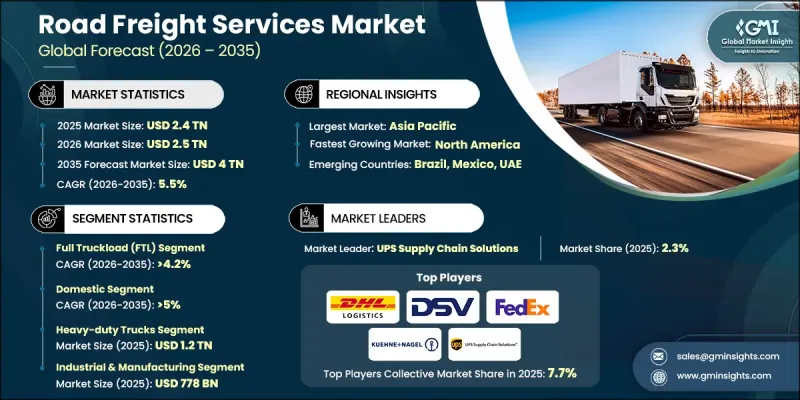
도로 화물은 유연성, 편의성 및 라스트 마일 배송에 대응할 수 있는 능력으로 인해 국내 및 지역 공급망에서 화물 운송에 있어 가장 중요한 물류 수단 중 하나입니다. 전자상거래의 보급 확대와 도시 지역의 지속적인 발전으로 인해 대량의 화물을 보다 신속하게 처리할 수 있는 신뢰할 수 있는 배송 솔루션에 대한 수요가 크게 증가하고 있습니다. 따라서 물류기업과 화주들은 서비스의 효율성과 신뢰성을 높이기 위해 첨단 기술, 차량 현대화, 통합 운송 네트워크에 많은 투자를 하고 있습니다. 디지털 화물 플랫폼, 지능형 물류 관리 도구 및 실시간 추적 기능은 기업이 경로를 최적화하고, 운송 지연을 줄이며, 업무 가시성을 높이는 데 도움이 되고 있습니다. 또한, 현대식 소매 공급망, 제조 네트워크 및 온도 관리형 물류 시스템의 확대로 인해 복잡한 세계 유통 네트워크를 지원할 수 있는 확장성 높은 도로 화물 서비스에 대한 수요가 증가하고 있습니다.
| 시장 범위 | |
|---|---|
| 개시 연도 | 2025년 |
| 예측 연도 | 2026-2035년 |
| 개시 금액 | 2조 4,000억 달러 |
| 예측 금액 | 4조달러 |
| CAGR | 5.5% |
물류 사업자에게 엄격한 환경 규제와 법규를 충족시키면서 운영 비용을 절감해야 한다는 압박이 가중되고 있는 것도 도로 화물 서비스 시장을 변화시키고 있습니다. 운송업체들은 AI를 활용한 경로 최적화 시스템, 첨단 차량 모니터링 기술 등 디지털 물류 인프라에 대한 투자를 가속화하고 있습니다. 지속가능성에 대한 노력은 운송업체들이 더 깨끗한 차량 기술과 에너지 효율적인 운영 방식을 도입하도록 장려하고 있습니다. 디지털화, 자동화, 세계 공급망 재구축이 업계의 우선순위를 재정의하면서 화물 운송 생태계는 진화하고 있습니다. 기업들은 자산 보유를 줄이면서 업무의 민첩성을 높이는 유연한 운영 모델을 점점 더 많이 채택하고 있습니다. 동시에 동적 가격 책정 시스템, 멀티모달 물류 통합, 고객 중심의 서비스 제공은 조직이 변화하는 시장 상황에 신속하게 대응할 수 있도록 돕습니다. 이러한 발전은 네트워크의 효율성을 높이고, 화물 운송 업무의 투명성을 높이며, 소매 유통, 제조, 의료 물류, 인프라 개발, 자동차 공급망과 같은 산업에서 세계 시장 전반의 장기적인 가치 창출을 지원하고 있습니다.
풀 트럭 적재(FTL) 부문은 36%의 점유율을 차지하고 있으며, 2026년부터 2035년까지 연평균 복합 성장률(CAGR) 4.2%를 나타낼 것으로 예측됩니다. 풀 트럭 운송은 기업이 한 번의 운송으로 전체 차량을 활용할 수 있기 때문에 운송 시간을 단축하고 화물의 보안을 향상시켜 대형 화물 운송에 없어서는 안될 중요한 역할을 합니다. 전 세계 무역량과 전자상거래 유통망이 지속적으로 확대됨에 따라, 기업들은 물류센터, 제조시설, 소매 네트워크 간 상품을 효율적으로 운송하기 위해 전용 운송 능력에 대한 의존도를 높이고 있습니다. FTL 솔루션은 물류 사업자가 차량 가동률을 극대화하는 동시에 디지털 화물 플랫폼 및 최신 물류 관리 시스템과의 원활한 연계를 지원합니다. 따라서 국내 및 국경 간 운송 경로에서 신뢰할 수 있는 대용량 운송에 대한 수요가 증가함에 따라 전 세계적으로 풀트럭 로드 화물 서비스에 대한 수요가 꾸준히 증가할 것으로 예측됩니다.
국내 운송 부문은 76%의 점유율을 차지하고 있으며, 2026년부터 2035년까지 연평균 복합 성장률(CAGR) 5%를 나타낼 것으로 예측됩니다. 국내 화물운송은 생산기지, 창고, 소비시장을 연결하는 지역 내 및 주 간 대량 운송을 지원하기 때문에 물류 네트워크의 기본 요소로 자리 잡고 있습니다. 신속한 배송 서비스와 효율적인 유통 네트워크에 대한 수요가 증가하면서 AI를 활용한 경로 계획, 텔레매틱스 기반 차량 관리, 디지털 화물 마켓플레이스와 같은 첨단 기술 도입이 활발해지고 있습니다. 국내 도로화물 운송 사업은 국제 운송 경로에 비해 잘 정비된 운송 인프라, 짧은 이동거리, 규제상의 복잡성이 적다는 장점을 가지고 있습니다. 이러한 이점을 통해 물류 기업은 예측 가능한 운송 일정을 유지하고 차량 생산성을 최적화하여 전체 도로화물 서비스 시장에서 국내 화물 운송의 선도적 인 역할을 강화할 수 있습니다.
중국의 도로화물 서비스 시장은 55%의 점유율을 차지하며, 2025년에는 5,070억 달러 규모에 도달했습니다. 이 나라가 지역 물류 부문에서 선도적인 위치를 차지하고 있는 배경에는 광범위한 제조거점, 거대한 국내 소비 시장, 그리고 선진화된 공급망 인프라가 있습니다. 높은 산업 생산량과 대규모 자동차 생산으로 인해 다양한 산업 분야에서 도로 운송 서비스에 대한 강력한 수요가 지속적으로 창출되고 있습니다. 주요 경제 회랑을 가로지르는 물류 사업자들은 화물 운송의 효율성과 업무 성과를 향상시키기 위해 첨단 차량 관리 기술과 첨단 도로 교통 시스템(ITS)의 도입을 가속화하고 있습니다. 디지털 물류 플랫폼과 커넥티드카 기술의 급속한 보급으로 운송업체는 대규모 화물 네트워크를 보다 효과적으로 관리할 수 있게 되었습니다. 이러한 기술 발전은 대규모 유통 네트워크 전반에 걸쳐 실시간 가시성, 화물 추적 및 업무 조정을 개선하면서 확장 가능한 물류 운영을 지원하고 있습니다.
자주 묻는 질문
목차
제1장 조사 방법과 범위
제2장 주요 요약
제3장 업계 인사이트
제4장 경쟁 구도
제5장 시장 추산 및 예측 : 서비스별, 2022년-2035년
제6장 시장 추산 및 예측 : 차량별, 2022년-2035년
제7장 시장 추산 및 예측 : 발송지별, 2022년-2035년
제8장 시장 추산 및 예측 : 최종 용도별, 2022년-2035년
제9장 시장 추산 및 예측 : 지역별, 2022년-2035년
제10장 기업 개요
LSH 26.04.23The Global Road Freight Services Market was valued at USD 2.4 trillion in 2025 and is estimated to grow at a CAGR of 5.5% to reach USD 4 trillion by 2035.
Road freight remains one of the most critical logistics modes for transporting goods across domestic and regional supply chains due to its flexibility, accessibility, and ability to support last-mile distribution. Expanding e-commerce penetration and the continuous development of urban centers are creating significant demand for reliable delivery solutions capable of handling high shipment volumes with faster turnaround times. Logistics companies and shippers are therefore investing heavily in advanced technologies, fleet modernization initiatives, and integrated transportation networks to improve service efficiency and reliability. Digital freight platforms, intelligent logistics management tools, and real-time tracking capabilities are helping companies optimize routes, reduce transit delays, and enhance operational visibility. In addition, the expansion of modern retail supply chains, manufacturing networks, and temperature-controlled logistics systems is strengthening demand for scalable road freight services that can support complex global distribution networks.
| Market Scope | |
|---|---|
| Start Year | 2025 |
| Forecast Year | 2026-2035 |
| Start Value | $2.4 Trillion |
| Forecast Value | $4 Trillion |
| CAGR | 5.5% |
Growing pressure on logistics providers to lower operational costs while meeting strict environmental and regulatory requirements is also transforming the road freight services market. Transportation companies are accelerating investments in digital logistics infrastructure, including AI-enabled route optimization systems and advanced fleet monitoring technologies. Sustainability initiatives are encouraging carriers to adopt cleaner vehicle technologies and energy-efficient operational practices. The freight ecosystem is evolving as digitalization, automation, and global supply chain restructuring reshape industry priorities. Companies are increasingly adopting flexible operating models that reduce asset ownership while improving operational agility. At the same time, dynamic pricing systems, multimodal logistics integration, and customer-focused service offerings are helping organizations respond quickly to changing market conditions. These developments are improving network efficiency, increasing transparency in freight operations, and supporting long-term value creation for industries such as retail distribution, manufacturing, healthcare logistics, infrastructure development, and automotive supply chains across global markets.
The full truckload segment accounted for 36% share and is expected to grow at a CAGR of 4.2% between 2026 and 2035. Full truckload transportation plays an essential role in large-volume cargo movement because it allows businesses to utilize an entire vehicle for a single shipment, ensuring faster transit and improved cargo security. As global trade volumes and e-commerce distribution networks continue to expand, businesses increasingly rely on dedicated freight capacity to move goods efficiently between distribution centers, manufacturing facilities, and retail networks. FTL solutions also help logistics providers maximize fleet utilization while supporting seamless integration with digital freight platforms and modern logistics management systems. The growing need for reliable high-capacity transportation across domestic and cross-border corridors is therefore expected to sustain strong demand for full truckload freight services worldwide.
The domestic transportation segment held 76% share, and is projected to grow at a CAGR of 5% from 2026 to 2035. Domestic freight movements remain a fundamental component of logistics networks because they support large volumes of intra-regional and inter-state shipments that connect production centers, warehouses, and consumer markets. The increasing demand for quick delivery services and efficient distribution networks is driving the adoption of advanced technologies such as AI-assisted route planning, telematics-based fleet management, and digital freight marketplaces. Domestic road freight operations benefit from well-established transportation infrastructure, shorter travel distances, and fewer regulatory complexities compared with international shipping routes. These advantages allow logistics companies to maintain predictable transit schedules and optimize fleet productivity, reinforcing the dominant role of domestic freight transportation in the overall road freight services market.
China Road Freight Services Market accounted 55% share, generating USD 507 billion in 2025. The country's leadership in the regional logistics sector is supported by its extensive manufacturing base, large domestic consumer market, and advanced supply chain infrastructure. High industrial output and large-scale vehicle production continue to generate strong demand for road transportation services across various industries. Logistics operators across major economic corridors are increasingly adopting advanced fleet management technologies and intelligent transportation systems to improve freight efficiency and operational performance. The rapid adoption of digital logistics platforms and connected vehicle technologies is enabling transportation companies to manage large freight networks more effectively. These technological advancements are supporting scalable logistics operations while improving real-time visibility, shipment tracking, and operational coordination across large distribution networks.
Major companies operating in the Global Road Freight Services Market include C.H. Robinson, DB Schenker, DHL Logistics, DSV, FedEx, Kuehne + Nagel, Nippon Express, Sinotrans, UPS Supply Chain Solutions, and XPO Logistics. Companies competing in the Global Road Freight Services Market are implementing multiple strategic initiatives to strengthen their competitive positions and expand their global logistics capabilities. Many organizations are investing heavily in digital freight platforms, advanced analytics systems, and AI-driven route optimization technologies to improve operational efficiency and reduce transportation costs. Strategic partnerships with e-commerce companies, manufacturers, and supply chain operators are helping logistics providers expand service networks and secure long-term shipping contracts. Firms are also modernizing vehicle fleets by introducing energy-efficient trucks and environmentally sustainable transport solutions to comply with regulatory standards. Additionally, companies are expanding cross-border logistics networks, strengthening warehouse and distribution infrastructure, and adopting flexible asset-light business models to improve scalability and responsiveness within the rapidly evolving global road freight services market.
Table of Contents
Chapter 1 Methodology & Scope
- 1.1 Research approach
- 1.2 Quality Commitments
- 1.2.1 GMI AI policy & data integrity commitment
- 1.3 Research Trail & Confidence Scoring
- 1.3.1 Research Trail Components
- 1.3.2 Scoring Components
- 1.4 Data Collection
- 1.4.1 Partial list of primary sources
- 1.5 Data mining sources
- 1.5.1 Paid sources
- 1.6 Base estimates and calculations
- 1.6.1 Base year calculation
- 1.7 Forecast model
- 1.8 Research transparency addendum
Chapter 2 Executive Summary
- 2.1 Industry 360° synopsis, 2022 - 2035
- 2.2 Key market trends
- 2.2.1 Regional
- 2.2.2 Service
- 2.2.3 Vehicle
- 2.2.4 Destination
- 2.2.5 End Use
- 2.3 TAM Analysis, 2026-2035
- 2.4 CXO perspectives: Strategic imperatives
- 2.4.1 Executive decision points
- 2.4.2 Critical success factors
- 2.5 Future outlook and strategic recommendations
Chapter 3 Industry Insights
- 3.1 Industry ecosystem analysis
- 3.1.1 Supplier Landscape
- 3.1.2 Profit Margin
- 3.1.3 Cost structure
- 3.1.4 Value addition at each stage
- 3.1.5 Factor affecting the value chain
- 3.1.6 Disruptions
- 3.2 Industry impact forces
- 3.2.1 Growth drivers
- 3.2.1.1 Electrification of Vehicles
- 3.2.1.2 Software-Defined Vehicle (SDV) Integration
- 3.2.1.3 Autonomous and ADAS-Enabled Fleets
- 3.2.1.4 Connectivity & High-Speed Networks
- 3.2.2 Industry pitfalls and challenges
- 3.2.2.1 High Implementation Costs
- 3.2.2.2 Regulatory & Cybersecurity Challenges
- 3.2.3 Market opportunities
- 3.2.3.1 Expansion of Intermodal & Express Freight Services
- 3.2.3.2 Emerging Markets’ Growth
- 3.2.3.3 Predictive & AI-Driven Fleet Management
- 3.2.3.4 Partnerships with OEMs & Technology Providers
- 3.2.1 Growth drivers
- 3.3 Growth potential analysis
- 3.4 Regulatory landscape
- 3.4.1 North America
- 3.4.1.1 U.S.: EPA, CARB, NHTSA Standards
- 3.4.1.2 Canada: Transport Canada, CMVSS Regulation
- 3.4.2 Europe
- 3.4.2.1 Germany: BMDV, Euro 6/7
- 3.4.2.2 France: Ministry of Transport, Euro 6/7
- 3.4.2.3 UK: Department for Transport, Euro 6/7
- 3.4.2.4 Italy: Ministry of Infrastructure & Transport
- 3.4.3 Asia Pacific
- 3.4.3.1 China: MIIT, China 6/7 Standards
- 3.4.3.2 Japan: MLIT, JIS Regulations
- 3.4.3.3 South Korea: MOLIT, KS Standards
- 3.4.3.4 India: MoRTH, BS6 Norms
- 3.4.4 Latin America
- 3.4.4.1 Brazil: DENATRAN, CONAMA Standards
- 3.4.4.2 Mexico: Ministry of Communications & Transport
- 3.4.5 Middle East and Africa
- 3.4.5.1 UAE: RTA, ESMA Regulations
- 3.4.5.2 Saudi Arabia: Ministry of Transport, SASO
- 3.4.1 North America
- 3.5 Porter's analysis
- 3.6 PESTEL analysis
- 3.7 Technology and Innovation Landscape
- 3.7.1 Current technological trends
- 3.7.2 Emerging technologies
- 3.8 Pricing Analysis (Driven by Primary Research)
- 3.8.1 Historical Price Trend Analysis
- 3.8.2 Pricing Strategy by Player Type
- 3.9 Cost breakdown analysis
- 3.10 Patent analysis (Driven by Primary Research)
- 3.11 Impact of Artificial Intelligence (AI)
- 3.11.1 AI-driven disruption of existing road freight services business models
- 3.11.2 Predictive maintenance & fleet vehicle system management AI
- 3.11.3 Automated road freight services route and load optimization
- 3.11.4 Supply chain AI for components, vehicle, and platform demand forecasting
- 3.11.5 GenAI use cases & adoption roadmap by segment
- 3.11.5.1 Centralized and zonal computing platform design generation
- 3.11.5.2 Vehicle performance, energy efficiency, and fleet utilization optimization
- 3.11.5.3 Customer service chatbots & technical support
- 3.11.5.4 Marketing and operational content creation
- 3.12 Sustainability and Environmental Aspects
- 3.12.1 Sustainable practices
- 3.12.2 Waste reduction strategies
- 3.12.3 Energy efficiency in production
- 3.12.4 Eco-friendly initiatives
- 3.12.5 Carbon footprint considerations
- 3.13 Use case scenarios
- 3.14 Forecast assumptions & scenario analysis (Driven by Primary Research)
- 3.14.1 Base Case - key macro & industry variables driving CAGR
- 3.14.2 Optimistic Scenarios - Favorable Macro and Industry Tailwinds
- 3.14.3 Pessimistic Scenario - Macroeconomic slowdown or industry headwinds
Chapter 4 Competitive Landscape, 2025
- 4.1 Introduction
- 4.2 Company market share analysis
- 4.2.1 North America
- 4.2.2 Europe
- 4.2.3 Asia Pacific
- 4.2.4 Latin America
- 4.2.5 Middle East & Africa
- 4.3 Competitive analysis of major market players
- 4.4 Competitive positioning matrix
- 4.5 Strategic outlook matrix
- 4.6 Key developments
- 4.6.1 Mergers & acquisitions
- 4.6.2 Partnerships & collaborations
- 4.6.3 New product launches
- 4.6.4 Expansion plans and funding
Chapter 5 Market Estimates & Forecast, By Service, 2022 - 2035 ($Bn)
- 5.1 Key trends
- 5.2 Full truckload (FTL)
- 5.2.1 Dedicated Full Truckload
- 5.2.2 Spot Market Full Truckload
- 5.3 Less-than-truckload (LTL)
- 5.3.1 Regional LTL
- 5.3.2 Long-Haul LTL
- 5.4 Express & parcel services
- 5.4.1 Same-Day Delivery
- 5.4.2 Next-Day Delivery
- 5.4.3 Standard Express
- 5.5 Dedicated contract carriage (DCC)
- 5.5.1 Long-Term Contract (3+ Years)
- 5.5.2 Short-Term Contract (Under 3 Years)
- 5.6 Intermodal transport
- 5.6.1 Road-Rail Intermodal
- 5.6.2 Road-Sea Intermodal
Chapter 6 Market Estimates & Forecast, By Vehicle, 2022 - 2035 ($Bn)
- 6.1 Key trends
- 6.2 Light commercial vehicles (LCVs)
- 6.2.1 Under 3.5 Tons GVW
- 6.3 Medium-duty trucks
- 6.3.1 3.5-7 Tons GVW
- 6.3.2 7-15 Tons GVW
- 6.4 Heavy-duty trucks
- 6.4.1 15-25 Tons GVW
- 6.4.2 Above 25 Tons GVW
Chapter 7 Market Estimates & Forecast, By Destination, 2022 - 2035 ($Bn)
- 7.1 Key trends
- 7.2 Domestic
- 7.3 International
Chapter 8 Market Estimates & Forecast, By End Use, 2022 - 2035 ($Bn)
- 8.1 Key trends
- 8.2 Industrial & manufacturing
- 8.3 Retail & E-commerce
- 8.4 Food & beverage
- 8.5 Automotive
- 8.6 Chemicals & hazardous materials
- 8.7 Pharmaceuticals & healthcare
Chapter 9 Market Estimates & Forecast, By Region, 2022 - 2035 ($Bn)
- 9.1 Key trends
- 9.2 North America
- 9.2.1 US
- 9.2.2 Canada
- 9.3 Europe
- 9.3.1 UK
- 9.3.2 Germany
- 9.3.3 France
- 9.3.4 Italy
- 9.3.5 Spain
- 9.3.6 Belgium
- 9.3.7 Netherlands
- 9.3.8 Sweden
- 9.4 Asia Pacific
- 9.4.1 China
- 9.4.2 India
- 9.4.3 Japan
- 9.4.4 Australia
- 9.4.5 Singapore
- 9.4.6 South Korea
- 9.4.7 Vietnam
- 9.4.8 Indonesia
- 9.5 Latin America
- 9.5.1 Brazil
- 9.5.2 Mexico
- 9.5.3 Argentina
- 9.6 MEA
- 9.6.1 UAE
- 9.6.2 South Africa
- 9.6.3 Saudi Arabia
Chapter 10 Company Profiles
- 10.1 Global Player
- 10.1.1 C.H. Robinson
- 10.1.2 DB Schenker
- 10.1.3 DHL Logistics
- 10.1.4 DSV
- 10.1.5 FedEx
- 10.1.6 Kuehne + Nagel
- 10.1.7 Nippon Express
- 10.1.8 Sinotrans
- 10.1.9 UPS Supply Chain Solutions
- 10.1.10 XPO Logistics
- 10.2 Regional Player
- 10.2.1 Agility Logistics
- 10.2.2 CEVA Logistics
- 10.2.3 Expeditors International
- 10.2.4 Geodis
- 10.2.5 Kintetsu World Express
- 10.2.6 Panther Logistics
- 10.2.7 Rhenus Logistics
- 10.2.8 Southeastern Freight Lines (SEFL)
- 10.2.9 Toll
- 10.2.10 Yusen Logistics


