
|
시장보고서
상품코드
1998803
균사체 시장 기회, 성장요인, 업계 동향 분석 및 예측(2026-2035년)Mycelium Market Opportunity, Growth Drivers, Industry Trend Analysis, and Forecast 2026 - 2035 |
||||||

세계의 균사체 시장은 2025년에 36억 달러로 평가되었고, CAGR 8.3%로 성장하여 2035년까지 79억 달러에 달할 것으로 예측됩니다.
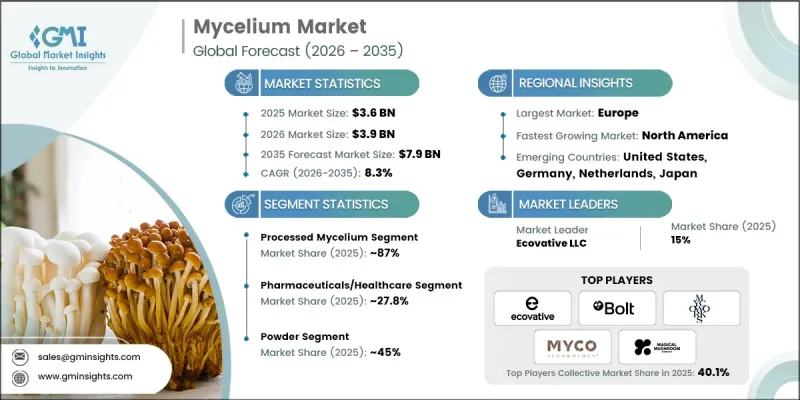
각 산업에서 지속 가능한 소재와 순환 경제의 실천이 점점 더 강조되고 있는 가운데, 전 세계 마이세륨 산업은 꾸준히 성장하고 있습니다. 곰팡이의 뿌리와 같은 네트워크를 형성하는 마이셀리움은 화석연료에서 유래한 기존 소재의 대부분을 대체할 수 있는 재생 가능하고 생분해 가능한 자원으로 인식되고 있습니다. 기업과 소비자들 사이에서 높아지는 환경 의식은 이산화탄소 배출량을 줄이고 환경 부하를 줄이는 바이오 대체 소재의 채택을 촉진하고 있습니다. 또한, 세계 각국의 정부 및 규제 당국도 보다 엄격한 환경 규제와 폐기물 감소 정책을 통해 지속 가능한 소재의 채택을 장려하고 있습니다. 그 결과, 산업계에서는 산업 생산, 소비재 및 첨단 소재 응용을 위한 균사체 기반 솔루션을 적극적으로 모색하고 있습니다. 포장 및 건축 분야에서는 균사체 소재의 경량성, 천연 단열 특성, 유해한 잔류물을 남기지 않고 자연적으로 분해되는 특성으로 인해 큰 관심을 받고 있습니다. 동시에 의료 및 제약 업계에서는 다양한 치료 용도에 도움을 줄 수 있는 생리활성 성분을 함유하고 있어 균사체 유래 화합물의 가능성을 모색하고 있습니다. 또한, 패션 및 섬유 산업에서도 지속가능성이 업계의 중요한 우선순위로 떠오르면서 기존의 동물성 소재를 대체할 수 있는 균사체 기반 대체 소재에 대한 실험이 점점 더 많이 진행되고 있습니다. 이러한 새로운 응용 분야는 바이오패브리케이션 및 배양 방법의 기술 발전과 함께 세계 균사체 시장의 상업적 잠재력을 꾸준히 높이고 있습니다.
| 시장 범위 | |
|---|---|
| 개시 연도 | 2025년 |
| 예측 기간 | 2026-2035년 |
| 개시 연도 시장 규모 | 36억 달러 |
| 예측액 | 79억 달러 |
| CAGR | 8.3% |
가공 균사체 부문은 2025년 87%의 점유율을 차지했으며, 2035년까지 연평균 8.4%의 성장률을 보일 것으로 전망됩니다. 이 부문이 선도적인 위치를 차지하고 있는 이유는 가공된 균사체가 다양한 산업 및 상업용 용도에 쉽게 통합될 수 있기 때문입니다. 특수 가공 및 제조 공정을 통해 생균사체는 다양한 산업의 기능성 및 내구성 요구 사항을 충족하는 고성능 소재로 변모합니다. 가공 기술을 통해 기계적 강도, 구조적 안정성, 균일한 질감 등의 특성이 향상되어 제조업체는 대규모 생산을 위한 신뢰할 수 있는 재료를 생산할 수 있습니다. 그 결과, 제조 공정에서 지속 가능한 원료를 찾는 기업들에게 가공 균사체의 매력은 점점 더 커지고 있습니다. '즉시 사용 가능한' 특성으로 인해 기업은 큰 변경 없이 생산 워크플로우에 이 소재를 직접 통합하여 업무 효율성과 확장성을 향상시킬 수 있습니다.
분말 부문은 2025년 45%의 점유율을 차지했으며, 2035년까지 연평균 복합 성장률(CAGR) 9%를 나타낼 것으로 예측됩니다. 균사체 분말은 다재다능하고 다양한 배합에 쉽게 접목할 수 있어 가장 널리 활용되는 제품 형태 중 하나입니다. 분말 형태는 저장 안정성이 뛰어나며, 제조업체는 제품의 품질을 크게 손상시키지 않고 운송 및 보관할 수 있습니다. 농축된 생리활성 화합물, 단백질, 천연 유래 다당류가 함유되어 있어 다양한 상업적 용도에 매우 적합합니다. 또한, 분말 형태는 정확한 계량 및 투여량 제어가 가능하여 일관된 제형 표준이 요구되는 산업에서 특히 가치가 있습니다. 또한, 제조 공정에서 마이세륨 분말을 다른 원료와 혼합할 수 있기 때문에 대규모 제조 환경에서 실용성이 높아집니다. 천연 원료 및 기능성 제제에 대한 관심이 계속 증가함에 따라, 분말 부문은 여러 응용 분야에서 견고한 성장을 유지할 것으로 예측됩니다.
2025년 북미 균사체 시장은 13.9%의 점유율을 차지했습니다. 북미 균사체 산업은 매우 활발한 생명공학 혁신 생태계와 지속 가능한 소재 개발에 대한 자금 지원 확대의 혜택을 누리고 있습니다. 연구기관, 기술 개발자, 민간 기업 간의 강력한 협력이 균사체 기반 기술의 발전을 가속화하고 있습니다. 또한, 이 지역은 잘 구축된 연구 인프라와 바이오 소재 및 대체 제조 솔루션에 집중하는 스타트업 기업 증가로 혜택을 누리고 있습니다. 친환경 제품에 대한 소비자와 기업의 인식이 높아짐에 따라 다양한 산업 분야에서 친환경 제품에 대한 수요가 더욱 증가하고 있습니다. 북미에서 사업을 운영하는 기업들 역시 장기적인 환경 보호 노력의 일환으로 지속 가능한 공급망과 환경 친화적인 소재를 우선시하고 있습니다.
자주 묻는 질문
목차
제1장 조사 방법과 범위
제2장 주요 요약
제3장 업계 인사이트
제4장 경쟁 구도
제5장 시장 추산 및 예측 : 원료별, 2022-2035
제6장 시장 추산 및 예측 : 제품 유형별, 2022-2035
제7장 시장 추산 및 예측 : 최종 이용 산업별, 2022-2035
제8장 시장 추산 및 예측 : 지역별, 2022-2035
제9장 기업 개요
LSH 26.04.23The Global Mycelium Market was valued at USD 3.6 billion in 2025 and is estimated to grow at a CAGR of 8.3% to reach USD 7.9 billion by 2035.
The mycelium industry worldwide is witnessing consistent expansion as industries increasingly prioritize sustainable materials and circular economy practices. Mycelium, which forms the root-like network of fungi, is gaining recognition as a renewable and biodegradable resource capable of replacing several traditional materials derived from fossil fuels. Rising environmental awareness among businesses and consumers is encouraging the adoption of bio-based alternatives that support lower carbon emissions and reduced environmental impact. Governments and regulatory authorities across multiple regions are also promoting sustainable material adoption through stricter environmental regulations and waste reduction policies. As a result, industries are actively exploring mycelium-based solutions for industrial manufacturing, consumer products, and advanced material applications. The packaging and building sectors are showing significant interest in mycelium materials due to their lightweight composition, natural insulation characteristics, and ability to decompose naturally without leaving harmful residues. At the same time, the healthcare and pharmaceutical industries are exploring the potential of mycelium-derived compounds due to their bioactive components that may support various therapeutic applications. In addition, the fashion and textile sectors are increasingly experimenting with mycelium-based alternatives to traditional animal-derived materials as sustainability becomes a key industry priority. These emerging applications, combined with technological advancements in biofabrication and cultivation methods, are steadily strengthening the commercial potential of the global mycelium market.
| Market Scope | |
|---|---|
| Start Year | 2025 |
| Forecast Year | 2026-2035 |
| Start Value | $3.6 Billion |
| Forecast Value | $7.9 Billion |
| CAGR | 8.3% |
The processed mycelium segment accounted for 87% share in 2025 and is anticipated to grow at a CAGR of 8.4% through 2035. This segment holds a leading position because processed mycelium can be easily integrated into a wide range of industrial and commercial applications. Through specialized treatment and manufacturing processes, raw mycelium is transformed into high-performance materials that meet the functional and durability requirements of various industries. Processing techniques enhance properties such as mechanical strength, structural stability, and uniform texture, allowing manufacturers to produce reliable materials for large-scale production. As a result, processed mycelium has become increasingly attractive for businesses seeking sustainable inputs for manufacturing processes. Its ready-to-use characteristics allow companies to incorporate the material directly into production workflows without significant modification, which improves operational efficiency and scalability.
The powder segment held a 45% share in 2025 and is expected to grow at a CAGR of 9% by 2035. Mycelium powder has become one of the most widely utilized product forms because of its versatility and ease of integration into various formulations. The powdered format provides extended shelf stability and allows manufacturers to transport and store the product without significant degradation. Its composition contains concentrated bioactive compounds, proteins, and naturally occurring polysaccharides, which make it highly suitable for multiple commercial applications. The powder form also enables precise measurement and controlled dosing, which is particularly valuable for industries that require consistent formulation standards. Additionally, the ability to blend mycelium powder with other ingredients during production processes increases its practicality for large-scale manufacturing environments. As interest in natural ingredients and functional formulations continues to expand, the powder segment is expected to maintain strong growth across several application areas.
North America Mycelium Market held a 13.9% share in 2025. The North America mycelium industry is benefiting from a highly active biotechnology innovation ecosystem and growing financial support for sustainable material development. Strong collaboration between research institutions, technology developers, and commercial enterprises is accelerating advancements in mycelium-based technologies. The region also benefits from a well-developed research infrastructure and an increasing number of startups focused on bio-based materials and alternative manufacturing solutions. Rising awareness among consumers and corporations regarding environmentally responsible products is further strengthening demand across multiple industries. Businesses operating in North America are also prioritizing sustainable supply chains and low-impact materials as part of their long-term environmental commitments.
Major companies operating in the Global Mycelium Market include Bolt Projects Holdings Inc., Ecovative LLC, Magical Mushroom Company, Mycelia NV, Mycotech Lab, MycoTechnology, Inc., Citribel, MycoWorks, Infinite Roots, and SQIM. Companies participating in the Global Mycelium Market are implementing several strategic initiatives to strengthen their market presence and expand their technological capabilities. A key strategy involves investing heavily in research and development to improve cultivation techniques, material performance, and large-scale production efficiency. Many companies are also forming strategic partnerships with manufacturers, consumer brands, and research institutions to accelerate the commercialization of mycelium-based products. Expanding production facilities and scaling fermentation technologies are additional priorities aimed at meeting growing market demand. Firms are also focusing on product diversification by developing mycelium materials for multiple industries, including packaging, food ingredients, advanced biomaterials, and textiles.
Table of Contents
Chapter 1 Methodology & Scope
- 1.1 Market scope and definition
- 1.2 Research design
- 1.2.1 Research approach
- 1.2.2 Data collection methods
- 1.3 Data mining sources
- 1.3.1 Global
- 1.3.2 Regional/Country
- 1.4 Base estimates and calculations
- 1.4.1 Base year calculation
- 1.4.2 Key trends for market estimation
- 1.5 Primary research and validation
- 1.5.1 Primary sources
- 1.6 Forecast model
- 1.7 Research assumptions and limitations
Chapter 2 Executive Summary
- 2.1 Industry 360° synopsis
- 2.2 Key market trends
- 2.2.1 Nature
- 2.2.2 Product type
- 2.2.3 End Use Industry
- 2.2.4 Regional
- 2.3 TAM Analysis, 2026-2035
- 2.4 CXO perspectives: Strategic imperatives
Chapter 3 Industry Insights
- 3.1 Industry ecosystem analysis
- 3.1.1 Supplier landscape
- 3.1.2 Profit margin
- 3.1.3 Value addition at each stage
- 3.1.4 Factor affecting the value chain
- 3.1.5 Disruptions
- 3.2 Industry impact forces
- 3.2.1 Growth drivers
- 3.2.2 Industry pitfalls and challenges
- 3.2.3 Market opportunities
- 3.3 Growth potential analysis
- 3.4 Regulatory landscape
- 3.4.1 North America
- 3.4.2 Europe
- 3.4.3 Asia Pacific
- 3.4.4 Latin America
- 3.4.5 Middle East & Africa
- 3.5 Porter's analysis
- 3.6 PESTEL analysis
- 3.7 Price trends
- 3.7.1 By region
- 3.7.2 By product type
- 3.8 Future market trends
- 3.9 Technology and Innovation landscape
- 3.9.1 Current technological trends
- 3.9.2 Emerging technologies
- 3.10 Patent Landscape
- 3.11 Trade statistics (HS code)
- 3.11.1 Major importing countries
- 3.11.2 Major exporting countries
- 3.12 Sustainability and environmental aspects
- 3.12.1 Sustainable practices
- 3.12.2 Waste reduction strategies
- 3.12.3 Energy efficiency in production
- 3.12.4 Eco-friendly initiatives
Chapter 4 Competitive Landscape, 2025
- 4.1 Introduction
- 4.2 Company market share analysis
- 4.2.1 By region
- 4.2.1.1 North America
- 4.2.1.2 Europe
- 4.2.1.3 Asia Pacific
- 4.2.1.4 LATAM
- 4.2.1.5 MEA
- 4.2.1 By region
- 4.3 Competitive analysis of major market players
- 4.4 Competitive positioning matrix
- 4.5 Key developments
- 4.5.1 Mergers & acquisitions
- 4.5.2 Partnerships & collaborations
- 4.5.3 New Product Launches
- 4.5.4 Expansion Plans
Chapter 5 Market Estimates and Forecast, By Nature, 2022-2035 (USD Billion) (Kilo Tons)
- 5.1 Key trends
- 5.2 Raw Mycelium
- 5.3 Processed Mycelium
Chapter 6 Market Estimates and Forecast, By Product Type, 2022-2035 (USD Billion) (Kilo Tons)
- 6.1 Key trends
- 6.2 Powder
- 6.3 Dough
- 6.4 Tablets
- 6.5 Others
Chapter 7 Market Estimates and Forecast, By End Use Industry, 2022-2035 (USD Billion) (Kilo Tons)
- 7.1 Key trends
- 7.2 Packaging
- 7.3 Construction
- 7.4 Pharmaceuticals/Healthcare
- 7.5 Clothing and apparel
- 7.6 Automotive
- 7.7 Food and beverage
- 7.8 Others
Chapter 8 Market Estimates and Forecast, By Region, 2022-2035 (USD Billion) (Kilo Tons)
- 8.1 Key trends
- 8.2 North America
- 8.2.1 U.S.
- 8.2.2 Canada
- 8.3 Europe
- 8.3.1 Germany
- 8.3.2 UK
- 8.3.3 France
- 8.3.4 Spain
- 8.3.5 Italy
- 8.3.6 Rest of Europe
- 8.4 Asia Pacific
- 8.4.1 China
- 8.4.2 India
- 8.4.3 Japan
- 8.4.4 Australia
- 8.4.5 South Korea
- 8.4.6 Rest of Asia Pacific
- 8.5 Latin America
- 8.5.1 Brazil
- 8.5.2 Mexico
- 8.5.3 Argentina
- 8.5.4 Rest of Latin America
- 8.6 Middle East and Africa
- 8.6.1 Saudi Arabia
- 8.6.2 South Africa
- 8.6.3 UAE
- 8.6.4 Rest of Middle East and Africa
Chapter 9 Company Profiles
- 9.1 Bolt Projects Holdings Inc.
- 9.2 Ecovative LLC
- 9.3 Magical Mushroom Company
- 9.4 Mycelia NV
- 9.5 Mycotech Lab
- 9.6 MycoTechnology, Inc.
- 9.7 Citribel
- 9.8 MycoWorks
- 9.9 Infinite Roots
- 9.10 SQIM