

|
시장보고서
상품코드
2019234
스마트 약물전달 시스템 시장 기회, 성장 촉진요인, 업계 동향 분석 및 예측(2026-2035년)Smart Drug Delivery Systems Market Opportunity, Growth Drivers, Industry Trend Analysis, and Forecast 2026 - 2035 |
||||||

세계의 스마트 약물전달 시스템 시장은 2025년에 139억 달러로 평가되었으며, 2035년까지 CAGR 16.7%로 성장하여 645억 달러에 달할 것으로 추정됩니다.
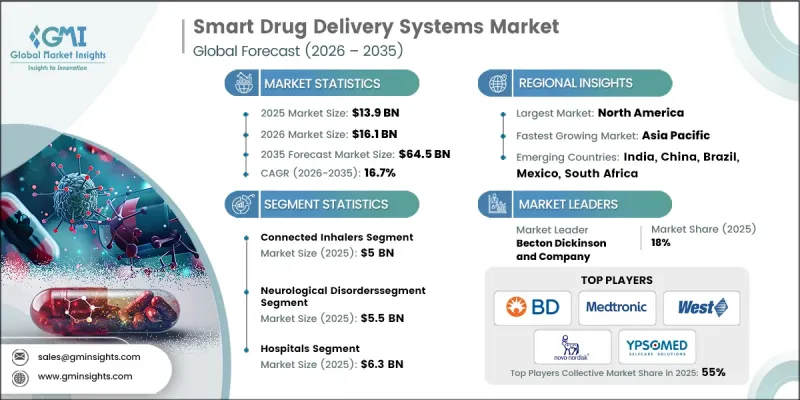
만성질환의 부담 증가, 디지털 헬스케어 솔루션의 도입 확대, 환자 중심 및 재택 치료로의 전환이 시장 성장을 뒷받침하고 있습니다. 장기적인 건강 문제의 발생률이 증가함에 따라 보다 정확하고 효율적인 치료 솔루션에 대한 수요가 증가하고 있습니다. 이는 기존의 약물전달 방법에는 정확성과 일관성이 부족한 경우가 많기 때문입니다. 스마트 약물전달 시스템 기술은 제어되고, 표적화되고, 프로그래밍 가능한 약물 투여를 가능하게함으로써 이러한 문제를 해결하고, 치료 효과와 환자 순응도를 크게 향상시킵니다. 이와 함께 의료 시스템은 편의성, 비용 최적화 및 환자 결과 개선에 점점 더 중점을 두고 있으며, 전통적인 임상 환경 이외의 첨단 전달 시스템의 활용을 촉진하고 있습니다. 지속적인 기술 발전과 더불어 커넥티드 디바이스 및 데이터 기반 의료 모델의 통합으로 인해 이러한 시스템의 도입이 더욱 가속화되고 있으며, 현대 의료 서비스 제공의 진화에서 중요한 구성요소로 자리매김하고 있습니다.
| 시장 범위 | |
|---|---|
| 시작 연도 | 2025년 |
| 예측 기간 | 2026-2035년 |
| 시작 시점 시장 규모 | 139억 달러 |
| 예측 규모 | 645억 달러 |
| CAGR | 16.7% |
커넥티드 흡입기 부문은 2025년 50억 달러의 시장 규모를 기록했으며, 스마트 약물전달 시스템 시장에서 상당한 비중을 차지하고 있습니다. 이러한 장치는 약물 복용의 편차 및 환자의 복약 순응도 파악의 어려움과 같은 호흡기 치료의 오랜 과제에 대응할 수 있다는 점에서 널리 보급되고 있습니다. 커넥티드 흡입기는 디지털 추적 기능을 통합하여 사용 패턴과 투여 빈도를 정확하게 모니터링하여 전반적인 치료 관리를 개선할 수 있습니다. 원격의료 서비스 및 디지털 통합 치료 솔루션의 보급 확대는 이 부문의 성장을 더욱 촉진하고 있습니다.
신경질환 부문은 2025년 55억 달러를 차지했습니다. 이 부문은 신경계에 영향을 미치는 복잡한 질병을 관리하기 위해 정확하고 일관성 있는 약물 투여가 필요하기 때문에 이 부문이 주도하고 있습니다. 이러한 질환의 경우, 상태를 안정시키고 합병증을 예방하기 위해 지속적이고 통제된 약물 투여가 필요한 경우가 많습니다. 스마트 약물전달 시스템은 자동 투약 및 실시간 모니터링과 같은 첨단 기능을 제공하여 기존 치료법에 따른 문제점을 극복하고 환자의 치료 결과를 개선할 수 있도록 돕습니다.
2025년 북미 스마트 약물전달 시스템 시장은 45.7%의 점유율을 차지했습니다. 이 지역은 만성질환 유병률 증가와 디지털 헬스 기술의 급속한 보급으로 인해 강력한 성장세를 보이고 있습니다. 잘 구축된 의료 인프라와 커넥티드 의료기기의 광범위한 도입이 결합되어 첨단 약물전달 솔루션의 통합을 지원하고 있습니다. 원격 모니터링, 데이터 기반 의료 시스템, 자동화된 치료 접근법의 사용 확대는 시장 확대를 더욱 촉진하고 있습니다. 디지털 헬스 툴과 커넥티드 케어 솔루션의 지속적인 혁신은 스마트 약물전달 시스템 기술 도입에 유리한 환경을 조성하고 있습니다.
자주 묻는 질문
목차
제1장 조사 방법과 범위
제2장 주요 요약
제3장 업계 인사이트
제4장 경쟁 구도
제5장 시장 추정 및 예측 : 제품별, 2022-2035
제6장 시장 추정 및 예측 : 용도별, 2022-2035
제7장 시장 추정 및 예측 : 투여 경로별, 2022-2035
제8장 시장 추정 및 예측 : 최종 용도별, 2022-2035
제9장 시장 추정 및 예측 : 지역별, 2022-2035
제10장 기업 개요
KSM 26.05.06The Global Smart Drug Delivery Systems Market was valued at USD 13.9 billion in 2025 and is estimated to grow at a CAGR of 16.7% to reach USD 64.5 billion by 2035.
Market growth is supported by the increasing burden of chronic diseases, rising adoption of digital healthcare solutions, and a growing shift toward patient-focused and home-based treatment approaches. The rising incidence of long-term health conditions is driving demand for more precise and efficient therapeutic solutions, as conventional drug delivery methods often lack accuracy and consistency. Smart drug delivery technologies address these challenges by enabling controlled, targeted, and programmable drug administration, significantly improving treatment effectiveness and patient compliance. In parallel, healthcare systems are increasingly emphasizing convenience, cost optimization, and improved patient outcomes, encouraging the use of advanced delivery systems outside traditional clinical environments. Continuous technological advancements, combined with the integration of connected devices and data-driven healthcare models, are further accelerating the adoption of these systems, positioning them as a critical component in the evolution of modern healthcare delivery.
| Market Scope | |
|---|---|
| Start Year | 2025 |
| Forecast Year | 2026-2035 |
| Start Value | $13.9 Billion |
| Forecast Value | $64.5 Billion |
| CAGR | 16.7% |
The connected inhalers segment generated USD 5 billion in 2025, holding a substantial share within the smart drug delivery systems market. These devices are gaining widespread adoption due to their ability to address persistent challenges in respiratory care, including inconsistent medication usage and limited visibility into patient adherence. By incorporating digital tracking capabilities, connected inhalers enable accurate monitoring of usage patterns and dosing frequency, improving overall treatment management. The increasing adoption of remote healthcare services and digitally integrated treatment solutions is further supporting the growth of this segment.
The neurological disorders segment accounted for USD 5.5 billion in 2025. This segment is driven by the need for precise and consistent drug administration to manage complex conditions affecting the nervous system. Such conditions often require continuous and controlled medication delivery to maintain stability and prevent complications. Smart drug delivery systems provide advanced capabilities such as automated dosing and real-time monitoring, helping to overcome challenges associated with traditional treatment methods and improving patient outcomes.
North America Smart Drug Delivery Systems Market accounted for 45.7% share in 2025. The region is witnessing strong growth due to the increasing prevalence of chronic conditions and the rapid adoption of digital health technologies. A well-developed healthcare infrastructure, combined with widespread implementation of connected medical devices, is supporting the integration of advanced drug delivery solutions. The growing use of remote monitoring, data-driven healthcare systems, and automated treatment approaches is further enhancing market expansion. Continuous innovation in digital health tools and connected care solutions is creating a favorable environment for the adoption of smart drug delivery technologies.
Key companies operating in the Global Smart Drug Delivery Systems Market include Amiko Digital Health, Becton Dickinson and Company, Biocorp, Elcam Medical, Medtronic, Medtrum, Nemera, Novo Nordisk, Phillips-Medisize, Portal Instruments, Teva Pharmaceutical Industries, West Pharmaceutical Services, Ypsomed, Haselmeier, and Insulet. Companies in the Smart Drug Delivery Systems Market are strengthening their market position through continuous innovation, strategic partnerships, and expansion of digital capabilities. A primary focus is being placed on integrating advanced technologies such as connected devices and data analytics to enhance treatment precision and patient engagement. Firms are investing heavily in research and development to introduce next-generation delivery systems with improved accuracy and usability. Collaborations with healthcare providers and technology companies are helping expand product reach and adoption. Additionally, companies are focusing on developing patient-centric solutions that support home-based care. Geographic expansion, along with the enhancement of product portfolios and digital ecosystems, remains a key strategy to capture emerging opportunities and sustain long-term growth.
Table of Contents
Chapter 1 Methodology and Scope
- 1.1 Market scope and definitions
- 1.2 Research design
- 1.2.1 Research approach
- 1.2.2 Data collection methods
- 1.3 Data mining sources
- 1.3.1 Global
- 1.3.2 Regional/Country
- 1.4 Base estimates and calculations
- 1.4.1 Base year calculation
- 1.4.2 Key trends for market estimation
- 1.5 Primary research and validation
- 1.5.1 Primary sources
- 1.6 Forecast model
- 1.7 Research assumptions and limitations
Chapter 2 Executive Summary
- 2.1 Industry 360° synopsis
- 2.2 Key market trends
- 2.2.1 Product trends
- 2.2.2 Application trends
- 2.2.3 Route of Administration trends
- 2.2.4 End Use trends
- 2.2.5 Regional trends
- 2.3 CXO perspectives: Strategic imperatives
Chapter 3 Industry Insights
- 3.1 Industry ecosystem analysis
- 3.2 Industry impact forces
- 3.2.1 Growth drivers
- 3.2.1.1 Rising prevalence of chronic diseases
- 3.2.1.2 Growing adoption of digital health technologies
- 3.2.1.3 Shift towards patient-centric and home-based care
- 3.2.1.4 Technological advancements in drug delivery
- 3.2.2 Industry pitfalls and challenges
- 3.2.2.1 High cost associated with device development and production
- 3.2.2.2 Lack of standardization
- 3.2.3 Market opportunities
- 3.2.3.1 Expansion of connected and data-driven drug delivery platforms
- 3.2.1 Growth drivers
- 3.3 Growth potential analysis (Driven by Primary Research)
- 3.4 Regulatory landscape
- 3.4.1 North America
- 3.4.2 Europe
- 3.5 Technology landscape (Driven by Primary Research)
- 3.5.1 Current technological trends
- 3.5.2 Emerging technologies
- 3.6 Future market trends (Driven by Primary Research)
- 3.7 Impact of AI and generative AI on the market
- 3.8 Porter's analysis
- 3.9 PESTEL analysis
Chapter 4 Competitive Landscape, 2025
- 4.1 Introduction
- 4.2 Company market share analysis
- 4.3 Company matrix analysis
- 4.4 Competitive analysis of major market players
- 4.5 Competitive positioning matrix
- 4.6 Strategy dashboard
- 4.7 Key developments
- 4.7.1 Mergers and acquisitions
- 4.7.2 Partnerships and collaborations
- 4.7.3 New product launches
- 4.7.4 Expansion plans
Chapter 5 Market Estimates and Forecast, By Product, 2022 - 2035 ($ Mn)
- 5.1 Key trends
- 5.2 Connected inhalers
- 5.3 Connected autoinjectors
- 5.4 Connected pen injectors
- 5.5 Connected wearable injectors
- 5.6 Add-on sensors
- 5.7 Other products
Chapter 6 Market Estimates and Forecast, By Application, 2022 - 2035 ($ Mn)
- 6.1 Key trends
- 6.2 Metabolic disorders
- 6.3 Neurological disorders
- 6.4 Respiratory disorders
- 6.5 Hormonal disorders
- 6.6 Other applications
Chapter 7 Market Estimates and Forecast, By Route of Administration, 2022 - 2035 ($ Mn)
- 7.1 Key trends
- 7.2 Injectable
- 7.3 Inhalation
- 7.4 Oral
Chapter 8 Market Estimates and Forecast, By End Use, 2022 - 2035 ($ Mn)
- 8.1 Key trends
- 8.2 Hospitals
- 8.3 Clinics
- 8.4 Home care
- 8.5 Ambulatory care settings
- 8.6 Other end users
Chapter 9 Market Estimates and Forecast, By Region, 2022 - 2035 ($ Mn)
- 9.1 Key trends
- 9.2 North America
- 9.2.1 U.S.
- 9.2.2 Canada
- 9.3 Europe
- 9.3.1 Germany
- 9.3.2 UK
- 9.3.3 France
- 9.3.4 Spain
- 9.3.5 Italy
- 9.3.6 Netherlands
- 9.4 Asia Pacific
- 9.4.1 China
- 9.4.2 Japan
- 9.4.3 India
- 9.4.4 Australia
- 9.4.5 South Korea
- 9.5 Latin America
- 9.5.1 Brazil
- 9.5.2 Mexico
- 9.5.3 Argentina
- 9.6 Middle East and Africa
- 9.6.1 South Africa
- 9.6.2 Saudi Arabia
- 9.6.3 UAE
Chapter 10 Company Profiles
- 10.1 Amiko Digital Health
- 10.2 Becton, Dickinson and Company
- 10.3 Biocorp
- 10.4 Elcam Medical
- 10.5 Medtronic
- 10.6 Medtrum
- 10.7 Nemera
- 10.8 Novo Nordisk
- 10.9 Phillips-Medisize
- 10.10 Portal Instruments
- 10.11 Teva Pharmaceutical Industries
- 10.12 West Pharmaceutical Services
- 10.13 Ypsomed
- 10.14 Haselmeier
- 10.15 Insulet


