

|
시장보고서
상품코드
2121575
첨단 약물전달 시스템 : 시장 점유율 분석, 업계 동향과 통계, 성장 예측(2026-2031년)Advanced Drug Delivery Systems - Market Share Analysis, Industry Trends & Statistics, Growth Forecasts (2026 - 2031) |
||||||
 Mordor Intelligence
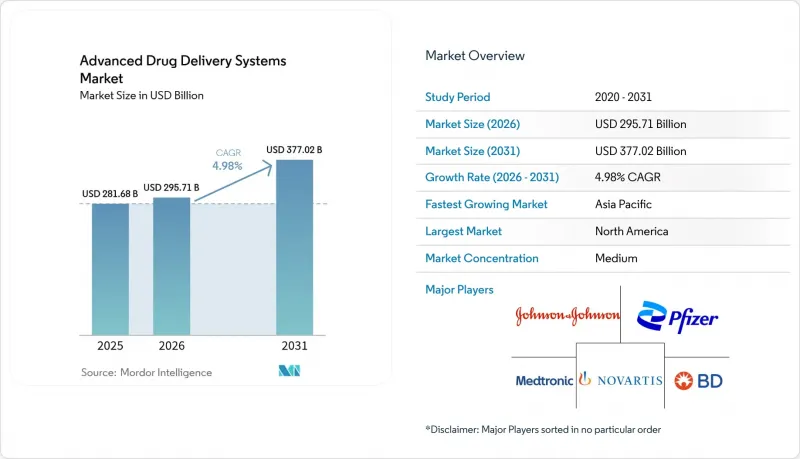
Mordor Intelligence에 따르면 첨단 약물전달 시스템 시장 규모는 2026년에 2,957억 1,000만 달러로 추정되며, 2025년 2,816억 8,000만 달러에서 확대되어 2031년에는 3,770억 2,000만 달러에 달할 것으로 예측됩니다.
2026년부터 2031년까지의 연평균 성장률(CAGR)은 4.98%가 될 전망입니다.
본 보고서는 유형(경구 약물전달 시스템, 주사 약물전달 시스템 등), 용도(순환기, 종양 등), 기술 플랫폼(전구체·자극 반응형, 지질계 나노 캐리어 등), 최종사용자(병원·진료소, 재택의료·자가 투여 등), 및 지역별로 분류되어 있습니다. 시장 전망은 금액(달러) 기준으로 제시되어 있습니다.
세계 첨단 약물전달 시스템 시장의 동향 및 인사이트
바이오의약품 파이프라인 확대
바이오의약품 파이프라인이 확대됨에 따라, 단백질, 항체 및 핵산 치료법에는 취약한 구조를 보호하고 복잡한 조직을 표적으로 삼는 캐리어가 필요하기 때문에 전달에 대한 수요가 재편되고 있습니다. 화이자가 발-이란 대학과 제휴하여 진행 중인 DNA 나노로봇 개발은 바이오의약품의 유효 성분과 정밀한 전달체를 융합하려는 움직임을 여실히 보여주고 있습니다. 종양학 프로그램은 이러한 필요성을 여실히 드러내고 있습니다. 현재 진행 중인 암 임상시험의 60% 이상을 바이오의약품이 차지하고 있으며, 효능을 저해하지 않으면서 혈관 및 세포 장벽을 극복할 수 있는 전달 시스템의 설계가 요구되고 있습니다. 존슨앤드존슨의 ‘AKEEGA’ 듀얼 액션 정제와 같은 복합 제제는 두 가지 서로 다른 작용기전을 하나의 전달 형태로 통합함으로써, BRCA 변이를 가진 전립선암의 질병 진행을 거의 절반으로 줄일 수 있음을 보여주고 있습니다.
나노 캐리어 설계의 획기적인 진전
최근 나노 캐리어 설계 분야의 성과를 통해 세포 내 흡수율, 면역 회피성 및 유효 성분의 수용 능력이 향상되고 있습니다. 큐보좀 제제는 세포막과 직접 융합함으로써 기존의 리포솜에 비해 최대 8배의 세포 내 흡수율을 실현하고 있습니다. 강글리오시드를 기반으로 한 지질 나노입자는 PEG를 제거하면서도 스텔스성을 유지하고 있어, 위양성 면역원성에 대한 우려를 해소하고 있습니다. 현재, 인공지능(AI)을 활용한 스크리닝을 통해 수천만 개의 이온화 가능한 지질 후보 물질을 인실리코로 평가할 수 있게 되어, 신약 개발 주기가 단축됨과 동시에 mRNA 치료제에 최적화된 전달 벡터를 확보하고 있습니다. 오리건 주립 대학의 폐 표적형 나노입자는 이러한 이점을 낭포성섬유증 유전자 치료 시험으로 확대하고 있습니다.
로트 간 편차 및 리콜
FDA의 2025년판 균일성 지침은 제조업체에 실시간 분석 및 연속 생산 도입을 요구하고 있습니다. 지질 나노입자의 입자 직경에 미세한 변동만 발생해도 생체 내 분포와 효능이 변화하여, 기업은 막대한 비용이 드는 리콜 위험에 노출될 수 있습니다. 연속 생산은 보다 엄격한 관리를 보장하지만, 막대한 설비 투자와 광범위한 검증 절차가 필요하기 때문에 중소기업에게는 부담이 되고 있습니다.
부문 분석
경구 제제는 익숙한 투여 방법과 효율적인 제조를 바탕으로 2025년 첨단 약물전달 시스템 시장에서 44.71%의 매출 점유율을 유지했습니다. 마이크로니들 패치와 침투 촉진제를 통해 주사 없이도 생물학적 제제를 투여할 수 있게 됨에 따라, 경피 흡수 플랫폼은 연평균 성장률(CAGR) 7.12%로 점유율을 확대하고 있습니다. 경구용 제품을 위한 첨단 약물전달 시스템의 시장 규모는 꾸준히 확대될 것으로 예상되지만, 장 내에서 분해되는 분자를 주사제나 흡입제가 흡수함에 따라 그 점유율은 감소할 가능성이 있습니다. 현재 시범 생산 단계에 있는 3D 프린팅 다층 정제는 정밀 투여를 지원하기 위해 경구 투여 시스템이 어떻게 진화해 나갈지를 보여주고 있습니다. 한편, 경피 흡수형 후보 제품에서는 삽입 후 용해되는 생분해성 마이크로니들이 활용되어 날카로운 폐기물 처리가 필요 없어집니다. 제약사들은월 1회 또는 분기별 교체 주기를 가능하게 하는 지속형 경피 흡수형 피임약 및 호르몬 요법에 연구개발 예산을 할당하고 있으며, 이를 통해 복약 순응도가 향상되고 병원 방문 횟수가 감소할 것으로 기대됩니다.
이러한 변화를 주도하고 있는 것은 환자의 수용성입니다. 조사에 따르면, 동등한 유효성이 보장될 경우 성인의 70% 이상이 패치를 통한 투여를 선호하는 것으로 나타났습니다. 또한, 많은 첨가제가 이미 GRAS(일반적으로 안전하다고 인정됨) 지위를 보유하고 있기 때문에 제약 기업들은 경피 제제 분야의 제품 라인 확장 전략에 있어 규제 부담이 적다는 점도 높이 평가하고 있습니다. 그러나 다양한 피부 유형에서 일관된 약물 방출량을 달성하는 것은 여전히 기술적 장벽으로 남아 있습니다. 피부과 전문가와의 협력을 통해 제제의 유변학적 특성과 기저층 설계를 개선하여 이러한 과제를 완화하는 것을 목표로 하고 있습니다.
2025년 매출의 29.83%를 종양 치료제가 차지하고 있으며, 이는 복잡한 유효 성분의 적재 요건과 표적 지향형 캐리어에 대한 지불 의향을 반영하고 있습니다. CAR-T, ADC, 방사성 리간드 파이프라인이 상용화됨에 따라, 종양 분야에서의 첨단 약물전달 시스템 시장 규모는 계속해서 지배적인 위치를 유지할 전망입니다. 존슨앤드존슨의 TAR-200 방광 내 투여 시스템은 방광암에서 82.4%의 완전 반응을 달성하여 표적 부위에 대한 국소 투여의 잠재력을 부각시켰습니다. 한편, 안과 분야에서는 비마토프로스트 방수 내 링이나 항-VEGF 리저버와 같은 서방형 임플란트를 바탕으로 가장 빠른 성장세를 보이고 있습니다. 이러한 기기들은 주사 빈도를월 1회에서 연 2회로 줄여 진료소의 부담을 경감시키고 있습니다.
또한, 장시간 작용형 안구 삽입제는 전문의 접근성이 제한된 지역에서 만성 녹내장의 치료 범위를 확대하고 있습니다. 심혈관 분야에서는 항증식제를 방출하는 생분해성 폴리머 스텐트가 채택되고 있으며, 대사성 질환 분야에서는 주 1회 주사형 GLP-1 아날로그의 개발이 진행 중입니다. 중추신경계 적응증의 경우, 혈액-뇌 장벽이라는 장벽에 직면해 있기 때문에 집속 초음파로 활성화되는 운반체나 전신 순환을 우회하는 비강 투여 경로에 대한 연구가 진행되고 있습니다.
지역별 분석
북미는 성숙한 보험 환급 제도, 풍부한 벤처 자금, 그리고 혁신적인 제조 경로에 대한 FDA의 지원에 힘입어 2025년에도 매출 점유율 37.05%를 유지했습니다. 또한, 이 지역에는 검증된 클린룸 시설 내에서 지질 나노입자의 생산을 확대할 수 있는 대형 위탁 제조 기업이 거점을 두고 있습니다. 존슨앤드존슨은 의료 기술 부문에서 첨단 전달 기술에 15억 6,000만 달러를 할당하여 파이프라인의 지속적인 처리 능력을 확보하고 있습니다. 노바티스는 표적 전립선암 치료를 지원하기 위해 인디애나폴리스에 방사성 리간드 제조 시설을 개설하며, 복잡한 캐리어 형태에 대한 자신감을 보여주고 있습니다.
연평균 성장률(CAGR) 8.02%로 확대되고 있는 아시아태평양은 낮은 제조 비용과 정부의 적극적인 지원 정책을 활용하고 있습니다. 중국은 공공 자금을 나노기술 허브에 투자하고 있는 반면, 한국의 반도체 기술은 스마트 임플란트 생산을 가속화하고 있습니다. 인도의 제약 기반은 ‘메이크 인 인디아(Make in India)’ 보조금 제도를 활용하여 무균 지질 나노입자 생산 라인을 수용할 수 있도록 업그레이드가 진행되고 있습니다. 아세안(ASEAN) 전역의 규제 당국은 ICH 지침 준수를 더욱 추진하고 있어, 여러 국가에서의 승인 절차가 원활해지고 있습니다.
유럽은 엄격한 안전 기준과 친환경 제조를 우선시하는 태도를 통해 여전히 큰 영향력을 유지하고 있습니다. EMA(유럽의약품청)의 나노독성학에 관한 지침은 세계적 기준이 되었으며, 개발자들에게 생분해성 첨가제의 채택을 권장하고 있습니다. 독일의 정밀 공학 기업은 임플란트 하우징용 마이크로 성형 장비를 공급하고 있으며, 스위스의 생명공학 클러스터는 항체약물접합체(ADC) 전달 기술을 추진하고 있습니다. 브렉시트 이후, 영국은 미국의 패스트트랙 프로그램에 뒤처지지 않도록 승인 절차 신속화 조치를 시행하고 있습니다.
기타 혜택:
- Excel 형식의 시장 예측(ME) 시트
- 3개월간의 애널리스트 지원
자주 묻는 질문
목차
제1장 소개
제2장 분석 방법
제3장 주요 요약
제4장 시장 구도
제5장 시장 규모·성장률 예측
제6장 경쟁 구도
제7장 시장 기회와 향후 전망
KSM 26.09.07According to Mordor Intelligence, advanced drug delivery systems market size in 2026 is estimated at USD 295.71 billion, growing from 2025 value of USD 281.68 billion with 2031 projections showing USD 377.02 billion, growing at 4.98% CAGR over 2026-2031.
This report is Segmented by Type (Oral Drug Delivery System, Injection-Based Drug Delivery System, and More), Application (Cardiovascular, Oncology, and More), Technology Platform (Pro-Drug & Stimuli-Responsive, Lipid-Based Nanocarriers and More), End User (Hospitals & Clinics, Home-Care & Self-Administration and More) and Geography. The Market Forecasts are Provided in Terms of Value (USD).
Global Advanced Drug Delivery Systems Market Trends and Insights
Biologics Pipeline Expansion
A widening biologics pipeline is reshaping delivery demands as proteins, antibodies, and nucleic-acid therapies require carriers that protect fragile structures and target complex tissues. Pfizer's partnership with Bar-Ilan University on DNA nanorobots illustrates the push to marry biologic payloads with precision carriers. Oncology programs underscore this need: biologics now form more than 60% of active cancer trials, prompting delivery designs that cross vascular and cellular barriers without compromising potency. Combination products, such as Johnson & Johnson's AKEEGA dual-action tablet, highlight how integrating two distinct mechanisms in one delivery format can cut disease progression by nearly half in BRCA-altered prostate cancer.
Nano-carrier Design Breakthroughs
Recent nano-carrier design wins are improving cell uptake, immune evasion, and payload capacity. Cubosome formulations achieve up to eight-fold greater cellular entry than traditional liposomes by fusing directly with membranes. Ganglioside-based lipid nanoparticles remove PEG yet maintain stealth capabilities, addressing false-positive immunogenicity concerns. Artificial-intelligence screening now evaluates tens of millions of ionizable lipid candidates in silico, compressing discovery cycles and yielding delivery vectors optimized for mRNA therapeutics. Oregon State University's lung-targeting nanoparticles extend these advantages into cystic fibrosis gene therapy trials.
Batch-to-batch Complexity & Recalls
The FDA's 2025 guidance on uniformity pressures manufacturers to adopt real-time analytics and continuous processing. Minor particle-size shifts in lipid nanoparticles can alter biodistribution and efficacy, exposing companies to costly recalls. Continuous manufacturing promises tighter control but demands high capital outlay and extensive validation, straining smaller firms.
Other drivers and restraints analyzed in the detailed report include:
- Chronic-disease Prevalence & Adherence Focus
- Venture Funding for Platform DDS Start-ups
- Stringent CMC & Combination-product Regulation
For complete list of drivers and restraints, kindly check the Table Of Contents.
Segment Analysis
Oral formulations retained 44.71% revenue share of the advanced drug delivery systems market in 2025, supported by familiar dosing and efficient manufacturing. Transdermal platforms are gaining at a 7.12% CAGR as microneedle patches and permeation enhancers deliver biologics without injections. The advanced drug delivery systems market size for oral products is projected to expand steadily, yet its share may slip as injectables and inhalables capture molecules that degrade in the gut. 3D-printed multilayer tablets, now in pilot production, show how oral systems will evolve to support precision dosing. Meanwhile, transdermal candidates leverage biodegradable microneedles that dissolve after insertion, eliminating sharp-waste handling. Pharmaceutical companies allocate R&D budgets toward long-acting transdermal contraceptives and hormone therapies that promise monthly or quarterly replacement cycles, boosting adherence and reducing clinic visits.
Patient acceptance drives this shift. Surveys indicate that more than 70% of adults prefer patch-based administration when equivalent efficacy is assured. Drug developers also appreciate the lower regulatory burden for line-extension strategies in transdermal formats because many excipients already hold GRAS status. However, achieving consistent flux across variable skin types remains a technical barrier. Collaborations with dermatology specialists aim to refine formulation rheology and backing-layer design to mitigate these challenges.
Oncology therapies commanded 29.83% of 2025 sales, a reflection of complex payload requirements and willingness to pay for targeted carriers. The advanced drug delivery systems market size for oncology is set to remain dominant as CAR-T, ADC, and radioligand pipelines reach commercialization. Johnson & Johnson's TAR-200 intravesical system achieved an 82.4% complete response in bladder cancer, underscoring the potential of site-directed depots. Ophthalmology, however, grows fastest on the back of sustained-release implants like bimatoprost intracameral rings and anti-VEGF reservoirs. These devices cut injection frequency from monthly to twice yearly, reducing clinic burden.
Long-acting ocular inserts also widen chronic glaucoma coverage in regions with limited specialist access. Cardiovascular applications adopt biodegradable polymer stents that elute antiproliferative agents, while metabolic disorders advance weekly injectable GLP-1 analogs. Central nervous system indications face the blood-brain barrier hurdle, prompting research into focused ultrasound-activated carriers and intranasal routes that bypass systemic circulation.
Complete Report Scope:
- By Type
- Oral Drug Delivery System
- Injection-based Drug Delivery System
- Inhalation/Pulmonary Drug Delivery System
- Transdermal Drug Delivery System
- Trans mucosal Drug Delivery System
- Carrier-based Drug Delivery System
- Other Types
- By Application
- Oncology
- Cardiovascular
- Metabolic (Diabetes, Obesity)
- CNS Disorders
- Infectious Diseases
- Ophthalmology
- Urology & Women's Health
- Others
- By Technology Platform
- Pro-drug & Stimuli-responsive
- Lipid-based Nanocarriers (liposomes, LNP, SLN)
- Polymeric Nanocarriers (PLGA, PEG, micelles)
- Targeted Ligand-conjugated
- Smart Implantables & Electro-responsive
- 3-D Printed & Micro-needle
- Others
- By End-user
- Hospitals & Clinics
- Home-care & Self-administration
- Specialty & Ambulatory Centers
- CRO / CDMO & Academic Labs
- By Geography
- North America
- United States
- Canada
- Mexico
- Europe
- Germany
- United Kingdom
- France
- Italy
- Spain
- Rest of Europe
- Asia-Pacific
- China
- Japan
- India
- Australia
- South Korea
- Rest of Asia-Pacific
- Middle East and Africa
- GCC
- South Africa
- Rest of Middle East and Africa
- South America
- Brazil
- Argentina
- Rest of South America
- North America
Geography Analysis
North America retained 37.05% revenue share in 2025, buoyed by a mature reimbursement system, deep venture pools, and the FDA's support for innovative manufacturing pathways. The region also houses major contract manufacturers that can scale lipid nanoparticle production within validated clean-room suites. Johnson & Johnson allotted USD 1.56 billion for advanced delivery technologies within its MedTech division, ensuring sustained pipeline throughput. Novartis opened an Indianapolis radioligand facility to support targeted prostate cancer therapy, signaling confidence in complex carrier formats.
Asia-Pacific, expanding at an 8.02% CAGR, capitalizes on lower fabrication costs and robust government incentives. China channels public funds into nanotechnology hubs, while South Korea's semiconductor expertise accelerates smart implant production. India's pharmaceutical base is upgrading to accommodate sterile lipid nanoparticle lines, leveraging Make-in-India subsidies. Regulatory agencies across ASEAN align more closely with ICH guidelines, smoothing multi-country approvals.
Europe remains influential through rigorous safety standards and green manufacturing priorities. EMA's guidance on nanotoxicology drives global benchmarks, compelling developers to adopt biodegradable excipients. Germany's precision-engineering firms supply micro-molding equipment for implant housings, and Switzerland's biotech cluster advances antibody-drug conjugate delivery. Post-Brexit, the United Kingdom implements accelerated pathways to keep pace with US fast-track programs.
- Beckton Dickinson
- Johnson & Johnson (Janssen & Ethicon)
- Pfizer
- Novartis
- Medtronic
- Abbott Laboratories
- Baxter
- Bayer
- Boston Scientific
- Kindeva Drug Delivery
- Ypsomed
- Abbvie
- AstraZeneca
- Gerresheimer
- Catalent
- West Pharmaceutical Services
- SHL Medical
- Insulet
- Nemera
- Elcam Medical
Additional Benefits:
- The market estimate (ME) sheet in Excel format
- 3 months of analyst support
TABLE OF CONTENTS
1 Introduction
- 1.1 Study Assumptions and Market Definition
- 1.2 Scope of the Study
2 Research Methodology
3 Executive Summary
4 Market Landscape
- 4.1 Market Overview
- 4.2 Market Drivers
- 4.2.1 Biologics Pipeline Expansion
- 4.2.2 Nano-Carrier Design Breakthroughs
- 4.2.3 Chronic-Disease Prevalence & Adherence Focus
- 4.2.4 Venture Funding For "Platform" DDS Start-Ups
- 4.2.5 Micro-Reservoir Implants For Digital Therapeutics
- 4.2.6 3-D Printed Personalized Dosage Forms
- 4.3 Market Restraints
- 4.3.1 Batch-To-Batch Complexity & Recalls
- 4.3.2 Stringent CMC & Combination-Product Regulation
- 4.3.3 Cold-Chain Cost Escalation For Biologic DDS
- 4.3.4 Nano-Carrier Environmental Toxicity Concerns
- 4.4 Value / Supply-Chain Analysis
- 4.5 Regulatory Landscape
- 4.6 Technology Outlook
- 4.7 Porter's Five Forces Analysis
- 4.7.1 Bargaining Power of Suppliers
- 4.7.2 Bargaining Power of Buyers
- 4.7.3 Threat of New Entrants
- 4.7.4 Threat of Substitutes
- 4.7.5 Intensity of Competitive Rivalry
5 Market Size and Growth Forecasts (Value-USD)
- 5.1 By Type
- 5.1.1 Oral Drug Delivery System
- 5.1.2 Injection-based Drug Delivery System
- 5.1.3 Inhalation/Pulmonary Drug Delivery System
- 5.1.4 Transdermal Drug Delivery System
- 5.1.5 Trans mucosal Drug Delivery System
- 5.1.6 Carrier-based Drug Delivery System
- 5.1.7 Other Types
- 5.2 By Application
- 5.2.1 Oncology
- 5.2.2 Cardiovascular
- 5.2.3 Metabolic (Diabetes, Obesity)
- 5.2.4 CNS Disorders
- 5.2.5 Infectious Diseases
- 5.2.6 Ophthalmology
- 5.2.7 Urology & Women's Health
- 5.2.8 Others
- 5.3 By Technology Platform
- 5.3.1 Pro-drug & Stimuli-responsive
- 5.3.2 Lipid-based Nanocarriers (liposomes, LNP, SLN)
- 5.3.3 Polymeric Nanocarriers (PLGA, PEG, micelles)
- 5.3.4 Targeted Ligand-conjugated
- 5.3.5 Smart Implantables & Electro-responsive
- 5.3.6 3-D Printed & Micro-needle
- 5.3.7 Others
- 5.4 By End-user
- 5.4.1 Hospitals & Clinics
- 5.4.2 Home-care & Self-administration
- 5.4.3 Specialty & Ambulatory Centers
- 5.4.4 CRO / CDMO & Academic Labs
- 5.5 By Geography
- 5.5.1 North America
- 5.5.1.1 United States
- 5.5.1.2 Canada
- 5.5.1.3 Mexico
- 5.5.2 Europe
- 5.5.2.1 Germany
- 5.5.2.2 United Kingdom
- 5.5.2.3 France
- 5.5.2.4 Italy
- 5.5.2.5 Spain
- 5.5.2.6 Rest of Europe
- 5.5.3 Asia-Pacific
- 5.5.3.1 China
- 5.5.3.2 Japan
- 5.5.3.3 India
- 5.5.3.4 Australia
- 5.5.3.5 South Korea
- 5.5.3.6 Rest of Asia-Pacific
- 5.5.4 Middle East and Africa
- 5.5.4.1 GCC
- 5.5.4.2 South Africa
- 5.5.4.3 Rest of Middle East and Africa
- 5.5.5 South America
- 5.5.5.1 Brazil
- 5.5.5.2 Argentina
- 5.5.5.3 Rest of South America
- 5.5.1 North America
6 Competitive Landscape
- 6.1 Market Concentration
- 6.2 Market Share Analysis
- 6.3 Company profiles (includes Global level Overview, Market level overview, Core Segments, Financials as available, Strategic Information, Market Rank/Share for key companies, Products and Services, and Recent Developments)
- 6.3.1 Becton, Dickinson and Company
- 6.3.2 Johnson & Johnson (Janssen & Ethicon)
- 6.3.3 Pfizer Inc.
- 6.3.4 Novartis AG
- 6.3.5 Medtronic Plc
- 6.3.6 Abbott Laboratories
- 6.3.7 Baxter International
- 6.3.8 Bayer AG
- 6.3.9 Boston Scientific Corp.
- 6.3.10 Kindeva Drug Delivery
- 6.3.11 Ypsomed AG
- 6.3.12 AbbVie Inc.
- 6.3.13 AstraZeneca Plc
- 6.3.14 Gerresheimer AG
- 6.3.15 Catalent Inc.
- 6.3.16 West Pharmaceutical Services
- 6.3.17 SHL Medical
- 6.3.18 Insulet Corporation
- 6.3.19 Nemera
- 6.3.20 Elcam Medical
7 Market Opportunities and Future Outlook
- 7.1 White-Space and Unmet-Need Assessment


