

|
시장보고서
상품코드
2027499
락 : 시장 기회, 성장 촉진요인, 업계 동향 분석 및 예측(2026-2035년)Locks Market Opportunity, Growth Drivers, Industry Trend Analysis, and Forecast 2026 - 2035 |
||||||

세계의 락 시장은 2025년에 388억 달러로 평가되었고 CAGR 5.4%를 나타내 2035년까지 651억 달러에 이를 것으로 추정되고 있습니다.
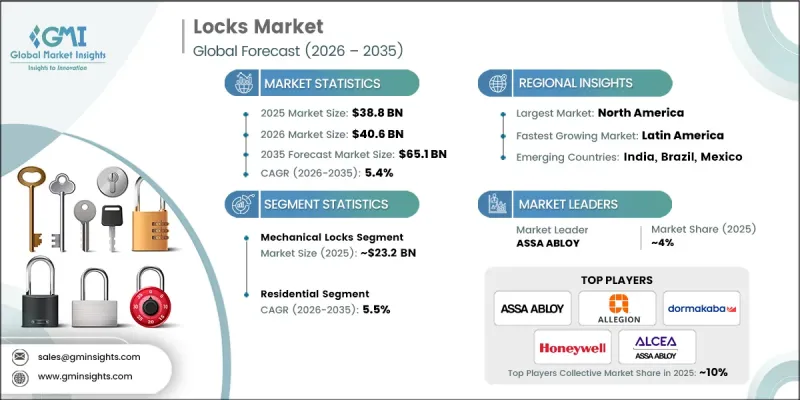
시장 성장은 보안에 대한 관심 증가, 지속적인 기술 혁신, 기계식 및 전자식 락 솔루션에 대한 수요 증가에 의해 주도되고 있습니다. 급속한 도시화와 산업 확대로 인해 주거, 상업, 산업 분야에서 고도의 자동화된 보안 시스템 도입이 가속화되고 있습니다. 안전과 자산 보호에 대한 인식이 높아짐에 따라 소비자와 조직은 보다 안정적이고 정교한 락 기술에 투자하고 있습니다. 동시에 스마트홈 생태계가 확산됨에 따라 시장 상황이 변화하고 있으며, IoT 대응과 생체인증 솔루션이 주목받고 있습니다. 기존 락 시스템에서 블루투스, Wi-Fi, RFID 지원 솔루션과 같은 연결 기술로의 전환은 제조업체에게 새로운 기회를 창출하고 있습니다. 소비자들은 보안과 편의성, 현대적 라이프스타일과의 통합을 위해 프리미엄 제품으로 업그레이드하려는 의지가 강해짐에 따라 자물쇠 시장은 점점 더 역동적이고 혁신이 주도하는 시장으로 변모하고 있습니다.
| 시장 범위 | |
|---|---|
| 시작 연도 | 2025년 |
| 예측 기간 | 2026-2035년 |
| 개시 연도 시장 규모 | 388억 달러 |
| 예측액 | 651억 달러 |
| CAGR | 5.4% |
기계식 락 장치 시장은 2025년 232억 달러 규모에 달했으며, 저렴한 가격, 신뢰성, 전원에 의존하지 않는 장점으로 인해 2035년까지 연평균 5.1%의 성장률을 나타낼 것으로 전망됩니다. 기계식 시스템은 스프링, 핀, 텀블러 등의 내부 부품에 의해 작동하며, 다양한 환경에서도 안정적인 성능을 발휘합니다. 또한, 주거, 상업, 산업용으로 널리 도입되어 교체 및 업그레이드에 대한 지속적인 수요를 창출하고 있습니다. 또한, 사이버 보안 위험에 영향을 받지 않는 특성도 소비자들의 지속적인 지지를 받고 있습니다.
주거용 부문은 2025년 30.4%의 점유율을 차지했으며, 2026년부터 2035년까지 연평균 5.5%의 성장률을 나타낼 것으로 전망됩니다. 이 부문 수요는 주택 소유자의 보안에 대한 인식 증가, 스마트홈의 보급 확대, 주택 건설의 꾸준한 성장에 의해 주도되고 있습니다. 주거용 락 솔루션은 보안 성능, 사용 편의성, 외관과의 조화 및 비용 측면의 고려사항의 균형을 맞추도록 설계되었습니다. 주택 소유주들이 기존 시스템을 보다 진보된 솔루션으로 계속 업그레이드하는 가운데, 교체 주기와 리노베이션 공사도 수요 지속에 더욱 기여하고 있습니다.
미국 락장치 시장은 2025년 98억 달러에 달했으며, 보안에 대한 인식 증가, 건설 활동 확대, 스마트홈 기술 보급에 힘입어 2035년까지 연평균 5%의 성장률을 나타낼 것으로 전망됩니다. 소비자와 기업이 첨단 보호 솔루션을 우선시하는 가운데, 키리스 및 커넥티드 락 시스템으로의 전환이 가속화되고 있습니다. 또한, 주거 및 상업 환경의 노후화된 인프라 교체 및 보안 강화의 필요성도 수요에 영향을 미치고 있습니다.
자주 묻는 질문
목차
제1장 조사 방법과 범위
제2장 주요 요약
제3장 업계 인사이트
제4장 경쟁 구도
제5장 시장 추산 및 예측 : 제품 유형별(2022-2035년)
제6장 시장 추산 및 예측 : 용도별(2022-2035년)
제7장 시장 추산 및 예측 : 유통 채널별(2022-2035년)
제8장 시장 추산 및 예측 : 지역별(2022-2035년)
제9장 기업 개요
KTH 26.05.20The Global Locks Market was valued at USD 38.8 billion in 2025 and is estimated to grow at a CAGR of 5.4% to reach USD 65.1 billion by 2035.
Market growth is driven by rising security concerns, continuous technological innovation, and increasing demand for both mechanical and electronic locking solutions. Rapid urbanization and industrial expansion are accelerating the adoption of advanced and automated security systems across residential, commercial, and industrial sectors. Growing awareness around safety and asset protection is encouraging consumers and organizations to invest in more reliable and sophisticated locking technologies. At the same time, the increasing penetration of smart home ecosystems is reshaping the market landscape, with IoT-enabled and biometric solutions gaining traction. The shift from traditional locking systems toward connected technologies, including Bluetooth, Wi-Fi, and RFID-enabled solutions, is creating new opportunities for manufacturers. Consumers are demonstrating a stronger willingness to upgrade to premium products that offer enhanced security, convenience, and integration with modern lifestyles, making the locks market increasingly dynamic and innovation-driven.
| Market Scope | |
|---|---|
| Start Year | 2025 |
| Forecast Year | 2026-2035 |
| Start Value | $38.8 Billion |
| Forecast Value | $65.1 Billion |
| CAGR | 5.4% |
The mechanical locks segment generated USD 23.2 billion in 2025 and is expected to grow at a CAGR of 5.1% through 2035, owing to its affordability, reliability, and independence from power sources. Mechanical systems operate through internal components such as springs, pins, and tumblers, ensuring consistent performance across various environments. Their widespread installed base across residential, commercial, and industrial applications also creates ongoing demand for replacement and upgrades. Additionally, their immunity to cybersecurity risks reinforces continued consumer preference.
The residential segment accounted for 30.4% share in 2025 and is projected to grow at a CAGR of 5.5% from 2026 to 2035. Demand within this segment is driven by increasing security awareness among homeowners, the expansion of smart home adoption, and steady growth in housing construction. Residential locking solutions are designed to balance security performance, ease of use, visual compatibility, and cost considerations. Replacement cycles and retrofitting activities further contribute to sustained demand, as homeowners continue to upgrade existing systems to more advanced solutions.
United States Locks Market reached USD 9.8 billion in 2025, with a projected CAGR of 5% through 2035, supported by rising security awareness, expanding construction activities, and increased adoption of smart home technologies. The transition toward keyless and connected locking systems is gaining momentum as consumers and businesses prioritize advanced protection solutions. Demand is also influenced by the need to replace outdated infrastructure and enhance security measures across residential and commercial environments.
Key companies operating in the Global Locks Market include ASSA ABLOY AB, Allegion plc, dormakaba Holding AG, Godrej & Boyce Manufacturing Company Limited, Hafele GmbH & Co KG, Honeywell International Inc, GEZE GmbH, Master Lock Company LLC, SALTO Systems, MIWA Lock Co, August Home, Level Home Inc, Lockly, Ultraloq, and Wyze Labs. Companies in the Locks Market are strengthening their competitive position through continuous innovation and technology integration. Manufacturers are focusing on developing smart, connected, and biometric locking systems that align with modern security requirements. Investment in research and development enables the introduction of advanced features such as remote access, real-time monitoring, and enhanced encryption. Strategic partnerships and expansion of distribution networks are helping companies increase market reach. Firms emphasize design, durability, and user-friendly interfaces to attract diverse customer segments. In addition, after-sales services, software updates, and integration with smart home platforms support long-term customer engagement and brand loyalty.
Table of Contents
Chapter 1 Methodology & Scope
- 1.1 Market scope and definition
- 1.2 Research design
- 1.2.1 Research approach
- 1.2.2 Data collection methods
- 1.3 Data mining sources
- 1.3.1 Global
- 1.3.2 Regional/Country
- 1.4 Base estimates and calculations
- 1.4.1 Base year calculation
- 1.4.2 Key trends for market estimation
- 1.5 Primary research and validation
- 1.5.1 Primary sources
- 1.6 Forecast model
- 1.7 Research assumptions and limitations
Chapter 2 Executive Summary
- 2.1 Industry 360° synopsis
- 2.2 Key market trends
- 2.2.1 Regional
- 2.2.2 Product type
- 2.2.3 Application
- 2.2.4 Distribution channel
Chapter 3 Industry Insights
- 3.1 Industry ecosystem analysis
- 3.1.1 Supplier landscape
- 3.1.2 Profit margin
- 3.1.3 Value addition at each stage
- 3.1.4 Factor affecting the value chain
- 3.2 Industry impact forces
- 3.2.1 Growth drivers
- 3.2.1.1 Rising security concerns driving demand for advanced locking systems
- 3.2.1.2 Smart home & building automation trends accelerating smart lock adoption
- 3.2.1.3 Urbanization & construction boom in emerging economies
- 3.2.2 Industry pitfalls & challenges
- 3.2.2.1 Cybersecurity vulnerabilities in smart locks
- 3.2.2.2 Integration and compatibility issues
- 3.2.1 Growth drivers
- 3.3 Growth potential analysis
- 3.4 Future market trends
- 3.5 Technology and innovation landscape
- 3.5.1 Current technological trends
- 3.5.2 Emerging technologies
- 3.6 Price trends
- 3.6.1 By region
- 3.6.2 By product type
- 3.7 Regulatory landscape
- 3.7.1 Standards and compliance requirements
- 3.7.2 Regional regulatory frameworks
- 3.7.3 Certification standards
- 3.8 Porter’s analysis
- 3.9 PESTEL analysis
- 3.10 Consumer behavior analysis
- 3.10.1 Purchasing patterns
- 3.10.2 Preference analysis
- 3.10.3 Regional variations in consumer behavior
Chapter 4 Competitive Landscape, 2025
- 4.1 Introduction
- 4.2 Company market share analysis
- 4.2.1 By Region
- 4.2.1.1 North America
- 4.2.1.2 Europe
- 4.2.1.3 Asia Pacific
- 4.2.1.4 Latin America
- 4.2.1.5 Middle East & Africa
- 4.2.1 By Region
- 4.3 Company matrix analysis
- 4.4 Competitive analysis of major market players
- 4.5 Competitive positioning matrix
- 4.6 Key developments
- 4.6.1 Mergers & acquisitions
- 4.6.2 Partnerships & collaborations
- 4.6.3 New product launches
- 4.6.4 Expansion plans
Chapter 5 Market Estimates & Forecast, By Product Type, 2022 - 2035, (USD Billion) (Units)
- 5.1 Key trends
- 5.2 Mechanical Locks
- 5.2.1 Deadbolts
- 5.2.2 Padlocks
- 5.2.3 Knob Locks
- 5.2.4 Lever Handle Locks
- 5.2.5 Others
- 5.3 Electronic Locks
- 5.3.1 Card-Based Locks
- 5.3.2 Biometric Locks
- 5.3.3 Magnetic Locks
- 5.4 Smart Locks
- 5.4.1 Wi-Fi Enabled
- 5.4.2 Bluetooth Enabled
Chapter 6 Market Estimates & Forecast, By Application, 2022 - 2035, (USD Billion) (Units)
- 6.1 Key trends
- 6.2 Residential
- 6.3 Commercial
- 6.4 Industrial
- 6.5 Institutional
- 6.6 Automotive
Chapter 7 Market Estimates & Forecast, By Distribution Channel, 2022 - 2035, (USD Billion) (Units)
- 7.1 Key trends
- 7.2 Online
- 7.3 Offline
Chapter 8 Market Estimates & Forecast, By Region, 2022 - 2035, (USD Billion) (Units)
- 8.1 Key trends
- 8.2 North America
- 8.2.1 U.S.
- 8.2.2 Canada
- 8.3 Europe
- 8.3.1 Germany
- 8.3.2 UK
- 8.3.3 France
- 8.3.4 Italy
- 8.3.5 Spain
- 8.4 Asia Pacific
- 8.4.1 China
- 8.4.2 India
- 8.4.3 Japan
- 8.4.4 South Korea
- 8.4.5 Australia
- 8.4.6 Indonesia
- 8.4.7 Malaysia
- 8.5 Latin America
- 8.5.1 Brazil
- 8.5.2 Mexico
- 8.5.3 Argentina
- 8.6 MEA
- 8.6.1 Saudi Arabia
- 8.6.2 UAE
- 8.6.3 South Africa
Chapter 9 Company Profiles
- 9.1 Allegion plc
- 9.2 ASSA ABLOY AB
- 9.3 August Home
- 9.4 dormakaba Holding AG
- 9.5 GEZE GmbH
- 9.6 Godrej & Boyce Manufacturing Company Limited
- 9.7 Hafele GmbH & Co KG
- 9.8 Honeywell International Inc
- 9.9 Level Home Inc
- 9.10 Lockly
- 9.11 Master Lock Company LLC
- 9.12 MIWA Lock Co
- 9.13 SALTO Systems
- 9.14 Ultraloq
- 9.15 Wyze Labs


