|
시장보고서
상품코드
2038357
오토바이 시장 : 시장 기회, 성장요인, 업계 동향 분석 및 예측(2026-2035년)Motorcycle Market Opportunity, Growth Drivers, Industry Trend Analysis, and Forecast 2026 - 2035 |
||||||

세계의 오토바이 시장은 2025년에 1,534억 달러로 평가되었고, CAGR 5.3%로 성장할 전망이며, 2035년까지 2,574억 달러에 이를 것으로 추정되고 있습니다.
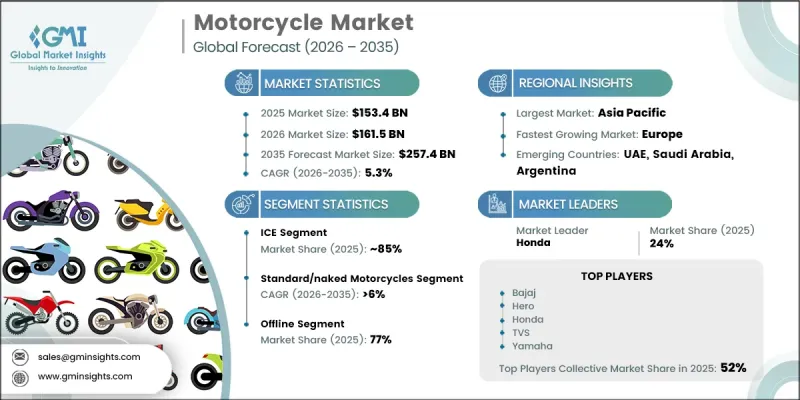
시장 성장은 인구 밀집 지역에서의 교통 문제 증가에 힘입어 성장하고 있습니다. 이러한 지역에서는 주차 공간 부족과 교통 혼잡이 심각해지면서 소형 모빌리티 솔루션의 도입이 촉진되고 있습니다. 오토바이는 대형 차량에 비해 효율적인 이동, 연료 소비 감소 및 소유 비용 절감을 실현할 수 있는 수단으로 널리 알려져 있습니다. 편리한 단거리 이동과 효율적인 도시 모빌리티에 대한 요구가 높아지면서 도시와 교외 지역 모두에서 수요가 증가하고 있습니다. 또한, 배송 및 모빌리티 서비스와 같은 상업적 용도의 오토바이 이용 확대는 시장 성장을 더욱 촉진하고 있습니다. 오토바이가 유지보수 부담이 적고 비용 효율적인 이동수단이기 때문에 저렴한 가격도 여전히 중요한 요소로 작용하고 있습니다. 동시에 규제와 배터리 성능 향상에 힘입어 업계는 전기 모빌리티로의 전환이 가속화되고 있습니다. 주행거리와 주행 효율의 향상, 그리고 환경 의식 증가는 전기 오토바이의 보급을 가속화하고 전체 시장의 진화에 기여하고 있습니다.
| 시장 범위 | |
|---|---|
| 개시 연도 | 2025년 |
| 예측 기간 | 2026-2035년 |
| 개시 시점 시장 규모 | 1,534억 달러 |
| 예측 시장 규모 | 2,574억 달러 |
| CAGR | 5.3% |
내연기관 부문은 2025년 85%의 점유율을 차지했으며, 2026-2035년 연평균 복합 성장률(CAGR) 4%를 나타낼 것으로 예측됩니다. 이러한 오토바이에 대한 수요가 지속되고 있는 것은 초기 비용이 저렴하고 쉽게 구할 수 있기 때문입니다. 특히 개발도상국에서 가격에 민감한 소비자들이 쉽게 구할 수 있다는 점에서 선호하고 있습니다. 또한, 잘 구축된 주유 인프라와 성숙한 공급망은 충전 네트워크에 의존하지 않고 다양한 지역에서 편의성을 제공하기 때문에 이 부문의 지속적인 우위에 기여하고 있습니다.
표준 및 네이키드 바이크 부문은 2025년 29%의 점유율을 차지했으며, 2035년까지 연평균 6%의 성장률을 보일 것으로 예측됩니다. 이 모델에 대한 수요는 성능, 편안함, 연비 효율의 균형으로 뒷받침되며, 일상적인 출퇴근에 적합합니다. 심플한 디자인, 다루기 쉬움, 상대적으로 낮은 유지비, 처음 자전거를 구입하는 사람들을 포함한 다양한 소비자층을 끌어들이고 있습니다. 또한, 가벼운 구조와 기동성으로 인해 혼잡한 환경에서의 주행에도 적합하여 단거리 이동에 있어 그 인기를 더욱 높이고 있습니다.
2025년 인도 오토바이 시장은 34%의 점유율을 차지했으며, 572억 달러 시장 규모를 기록했습니다. 이 나라에서 활발한 수요는 방대한 인구 기반과 일상적인 이동 수단으로 오토바이에 대한 의존도가 널리 퍼져 있는 것에 기인합니다. 급속한 도시화, 교통 혼잡 증가, 변화하는 모빌리티 니즈가 시장 확대를 주도하고 있습니다. 소득 수준 상승과 구매 편의성 향상도 소비자들이 더 높은 성능과 기능이 풍부한 오토바이 모델로 이동하도록 유도하여 시장의 지속적인 확대에 기여하고 있습니다.
자주 묻는 질문
목차
제1장 조사 방법
제2장 주요 요약
제3장 업계 인사이트
제4장 경쟁 구도
제5장 시장 추산 및 예측 : 제품별(2022-2035년)
제6장 시장 추산 및 예측 : 추진 방식별(2022-2035년)
제7장 시장 추산 및 예측 : 배기량별(2022-2035년)
제8장 시장 추산 및 예측 : 유통 채널별(2022-2035년)
제9장 시장 추산 및 예측 : 최종 용도별(2022-2035년)
제10장 시장 추산 및 예측 : 지역별(2022-2035년)
제11장 기업 개요
AJY 26.06.11The Global Motorcycle Market was valued at USD 153.4 billion in 2025 and is estimated to grow at a CAGR of 5.3% to reach USD 257.4 billion by 2035.
Market growth is fueled by increasing transportation challenges in densely populated areas, where limited parking space and heavy traffic conditions are encouraging the adoption of compact mobility solutions. Motorcycles are widely recognized for offering efficient travel, reduced fuel consumption, and lower ownership costs compared to larger vehicles. The growing need for convenient short-distance transportation and efficient urban mobility is supporting rising demand across both urban and semi-urban regions. In addition, the expanding use of two-wheelers for commercial applications such as delivery and mobility services is further strengthening market growth. Affordability remains a key factor, as motorcycles provide cost-effective transportation options with lower maintenance requirements. At the same time, the industry is witnessing a transition toward electric mobility, supported by regulatory initiatives and advancements in battery performance. Improvements in driving range, operating efficiency, and environmental awareness are accelerating the acceptance of electric motorcycles, contributing to the overall evolution of the market.
| Market Scope | |
|---|---|
| Start Year | 2025 |
| Forecast Year | 2026-2035 |
| Start Value | $153.4 Billion |
| Forecast Value | $257.4 Billion |
| CAGR | 5.3% |
The internal combustion engine segment accounted for 85% share in 2025 and is expected to grow at a CAGR of 4% between 2026 and 2035. Continued demand for these motorcycles is driven by their lower initial cost and widespread availability. Their accessibility makes them a preferred option for price-sensitive consumers, particularly in developing regions. In addition, established fueling infrastructure and mature supply chains contribute to their continued dominance, as they offer convenience across diverse geographic areas without reliance on charging networks.
The standard and naked motorcycles segment held 29% share in 2025 and is projected to grow at a CAGR of 6% through 2035. Demand for these models is supported by their balance of performance, comfort, and fuel efficiency, making them suitable for everyday commuting. Their simple design, ease of handling, and relatively low maintenance costs attract a broad consumer base, including first-time buyers. Their lightweight structure and maneuverability also make them well-suited for navigating congested environments, reinforcing their popularity for short-distance travel.
India Motorcycle Market accounted for 34% share and generated USD 57.2 billion in 2025. Strong demand in the country is supported by a large population base and widespread reliance on two-wheelers for daily transportation needs. Rapid urbanization, increasing traffic congestion, and evolving mobility requirements continue to drive adoption. Rising income levels and improved affordability are also encouraging consumers to shift toward more advanced and feature-rich motorcycle models, contributing to sustained market expansion.
Key companies operating in the Global Motorcycle Market include Honda, Yamaha, Bajaj, TVS, Suzuki, Hero, KTM, Kawasaki, Harley-Davidson, and Haojue. Companies in the motorcycle market are strengthening their market position by investing in product innovation and expanding their portfolios to include both conventional and electric models. Manufacturers are focusing on enhancing fuel efficiency, performance, and safety features to meet evolving consumer expectations. Strategic partnerships and collaborations are being utilized to improve technology integration and expand market reach. Companies are also investing in manufacturing capacity and supply chain optimization to ensure consistent product availability. In addition, firms are emphasizing digital sales channels and customer engagement strategies to improve brand visibility. Competitive pricing, financing options, and targeted marketing campaigns are further helping companies attract a wider consumer base and maintain a strong foothold in the global market.
Table of Contents
Chapter 1 Methodology
- 1.1 Research approach
- 1.2 Quality Commitments
- 1.2.1 GMI AI policy & data integrity commitment
- 1.2.1.1 Source consistency protocol
- 1.2.1 GMI AI policy & data integrity commitment
- 1.3 Research Trail & Confidence Scoring
- 1.3.1 Research Trail Components
- 1.3.2 Scoring Components
- 1.4 Data Collection
- 1.4.1 Partial list of primary sources
- 1.5 Data mining sources
- 1.5.1 Paid sources
- 1.5.2 Sources, by region
- 1.6 Base estimates and calculations
- 1.6.1 Base year calculation
- 1.7 Forecast model
- 1.7.1 Quantified market impact analysis
- 1.7.1.1 Mathematical impact of growth parameters on forecast
- 1.7.1 Quantified market impact analysis
- 1.8 Research transparency addendum
- 1.8.1 Source attribution framework
- 1.8.2 Quality assurance metrics
- 1.8.3 Our commitment to trust
Chapter 2 Executive Summary
- 2.1 Industry 360° synopsis, 2022 - 2035
- 2.2 Key market trends
- 2.2.1 Regional
- 2.2.2 Product
- 2.2.3 Propulsion
- 2.2.4 Displacement
- 2.2.5 Distribution Channel
- 2.2.6 End Use
- 2.3 TAM Analysis, 2026-2035
- 2.4 CXO perspectives: Strategic imperatives
Chapter 3 Industry Insights
- 3.1 Industry ecosystem analysis
- 3.1.1 Supplier landscape
- 3.1.2 Profit margin analysis
- 3.1.3 Cost structure
- 3.1.4 Value addition at each stage
- 3.1.5 Factor affecting the value chain
- 3.1.6 Disruptions
- 3.2 Industry impact forces
- 3.2.1 Growth drivers
- 3.2.1.1 Rising urbanization and traffic congestion
- 3.2.1.2 Growing demand for fuel-efficient mobility
- 3.2.1.3 Expansion of electric motorcycles
- 3.2.1.4 Increasing disposable income in emerging economies
- 3.2.2 Industry pitfalls and challenges
- 3.2.2.1 Stringent emission regulations
- 3.2.2.2 High competition and price sensitivity
- 3.2.2.3 Supply chain disruptions
- 3.2.2.4 Safety concerns and accident rates
- 3.2.3 Market opportunities
- 3.2.3.1 Growth in electric two-wheeler segment
- 3.2.3.2 Expansion in Africa and Southeast Asia
- 3.2.3.3 Development of connected motorcycles
- 3.2.3.4 Rise of motorcycle leasing and sharing services
- 3.2.1 Growth drivers
- 3.3 Growth potential analysis
- 3.4 Regulatory landscape
- 3.4.1 North America
- 3.4.1.1 Environmental Protection Agency (EPA)
- 3.4.1.2 National Highway Traffic Safety Administration (NHTSA)
- 3.4.1.3 Occupational Safety and Health Administration (OSHA)
- 3.4.1.4 U.S. Department of Transportation (DOT)
- 3.4.1.5 Canadian Motor Vehicle Safety Standards (CMVSS)
- 3.4.2 Europe
- 3.4.2.1 EU Machinery Regulation
- 3.4.2.2 CE Marking Compliance
- 3.4.2.3 REACH (Registration, Evaluation, Authorisation and Restriction of Chemicals)
- 3.4.2.4 EU Tire Labelling Regulation
- 3.4.2.5 National Type Approval & Road Homologation Requirements
- 3.4.3 Asia Pacific
- 3.4.3.1 China Compulsory Certification (CCC)
- 3.4.3.2 Indian Central Motor Vehicle Rules (CMVR)
- 3.4.3.3 Japanese Industrial Standards (JIS)
- 3.4.3.4 ASEAN Harmonized Technical Regulations
- 3.4.3.5 Australian Design Rules (ADR)
- 3.4.4 Latin America
- 3.4.4.1 Brazilian National Institute of Metrology (INMETRO) Regulations
- 3.4.4.2 Brazilian National Traffic Council (CONTRAN)
- 3.4.4.3 Mexican NOM Tire Safety Standards
- 3.4.4.4 Regional Import & Certification Requirements
- 3.4.5 Middle East & Africa
- 3.4.5.1 GCC Standardization Organization (GSO) Tire Regulations
- 3.4.5.2 Saudi Standards, Metrology and Quality Organization (SASO)
- 3.4.5.3 South African National Regulator for Compulsory Specifications (NRCS)
- 3.4.5.4 National Road Traffic Act (NRTA) Compliance
- 3.4.1 North America
- 3.5 Porter's analysis
- 3.6 PESTEL analysis
- 3.7 Technology and innovation landscape
- 3.7.1 Current technological trends
- 3.7.2 Emerging technologies
- 3.8 Price analysis (Driven by Primary Research)
- 3.8.1 Historical Price Trend Analysis
- 3.8.2 Pricing Strategy by Player Type (Premium / Value / Cost-plus)
- 3.9 Trade data analysis (Driven by Paid Research)
- 3.9.1 Import/export volume & value trends
- 3.9.2 Key trade corridors & tariff impact
- 3.10 Cost breakdown analysis
- 3.11 Patent analysis (Driven by Primary Research)
- 3.12 Impact of AI & generative AI on the market
- 3.12.1 AI-driven disruption of existing business models
- 3.12.2 GenAI use cases & adoption roadmap by segment
- 3.12.3 Risks, limitations & regulatory considerations
- 3.13 Capacity & production landscape (Driven by Primary Research)
- 3.13.1 Installed capacity by region & key producer
- 3.13.2 Capacity utilization rates & expansion pipelines
- 3.14 Sustainability and environmental aspects
- 3.14.1 Sustainable practices
- 3.14.2 Waste reduction strategies
- 3.14.3 Energy efficiency in production
- 3.14.4 Eco-friendly Initiatives
- 3.14.5 Carbon footprint considerations
- 3.15 Forecast assumptions & scenario analysis (Driven by Primary Research)
- 3.15.1 Base Case - key macro & industry variables driving CAGR
- 3.15.2 Optimistic Scenarios - Favorable macro and industry tailwinds
- 3.15.3 Pessimistic Scenario - Macroeconomic slowdown or industry headwinds
Chapter 4 Competitive Landscape, 2025
- 4.1 Introduction
- 4.2 Company market share analysis
- 4.2.1 North America
- 4.2.2 Europe
- 4.2.3 Asia Pacific
- 4.2.4 LATAM
- 4.2.5 MEA
- 4.3 Competitive analysis of major market players
- 4.4 Competitive positioning matrix
- 4.5 Key developments
- 4.5.1 Mergers & acquisitions
- 4.5.2 Partnerships & collaborations
- 4.5.3 New Product Launches
- 4.5.4 Expansion Plans and funding
- 4.6 Company tier benchmarking
- 4.6.1 Tier classification criteria & qualifying thresholds
- 4.6.2 Tier positioning matrix by revenue, geography & innovation
Chapter 5 Market Estimates & Forecast, By Product, 2022 - 2035 ($Mn, Units)
- 5.1 Key trends
- 5.2 Cruiser motorcycles
- 5.3 Sport motorcycles
- 5.4 Touring motorcycles
- 5.5 Standard/naked motorcycles
- 5.6 Adventure/dual-sport motorcycles
- 5.7 Off-road/dirt motorcycles
Chapter 6 Market Estimates & Forecast, By Propulsion, 2022 - 2035 ($Mn, Units)
- 6.1 Key trends
- 6.2 ICE
- 6.3 Electric
Chapter 7 Market Estimates & Forecast, By Displacement, 2022 - 2035 ($Mn, Units)
- 7.1 Key trends
- 7.2 Under 250cc
- 7.3 250cc-500cc
- 7.4 500cc-1000cc
- 7.5 Above 1000cc
Chapter 8 Market Estimates & Forecast, By Distribution Channel, 2022 - 2035 ($Mn, Units)
- 8.1 Key trends
- 8.2 Offline
- 8.3 Online
Chapter 9 Market Estimates & Forecast, By End Use, 2022 - 2035 ($Mn, Units)
- 9.1 Key trends
- 9.2 Personal
- 9.3 Commercial
Chapter 10 Market Estimates & Forecast, By Region, 2022 - 2035 ($Mn, Units)
- 10.1 Key trends
- 10.2 North America
- 10.2.1 US
- 10.2.2 Canada
- 10.3 Europe
- 10.3.1 UK
- 10.3.2 Germany
- 10.3.3 France
- 10.3.4 Italy
- 10.3.5 Spain
- 10.3.6 Russia
- 10.3.7 Nordics
- 10.4 Asia Pacific
- 10.4.1 China
- 10.4.2 India
- 10.4.3 Japan
- 10.4.4 South Korea
- 10.4.5 Southeast Asia
- 10.4.6 ANZ
- 10.5 Latin America
- 10.5.1 Brazil
- 10.5.2 Argentina
- 10.5.3 Mexico
- 10.6 MEA
- 10.6.1 UAE
- 10.6.2 Saudi Arabia
- 10.6.3 South Africa
Chapter 11 Company Profiles
- 11.1 Global Manufacturers
- 11.1.1 BMW Motorrad
- 11.1.2 Ducati
- 11.1.3 Haojue
- 11.1.4 Harley-Davidson
- 11.1.5 Honda
- 11.1.6 Kawasaki
- 11.1.7 KTM
- 11.1.8 Suzuki
- 11.1.9 Triumph
- 11.1.10 Yamaha
- 11.2 Regional Manufacturers
- 11.2.1 Hero MotoCorp
- 11.2.2 Bajaj Auto
- 11.2.3 Royal Enfield
- 11.2.4 TVS Motor
- 11.3 Emerging Manufacturers
- 11.3.1 Aprilia
- 11.3.2 Benelli
- 11.3.3 CFMoto
- 11.3.4 Indian Motorcycle
- 11.3.5 MV Agusta
- 11.3.6 Zero Motorcycles