

|
시장보고서
상품코드
2038388
금속 유기 구조체(MOF) 시장 : 시장 기회, 성장요인, 업계 동향 분석 및 예측(2026-2035년)Metal Organic Framework Market Opportunity, Growth Drivers, Industry Trend Analysis, and Forecast 2026 - 2035 |
||||||

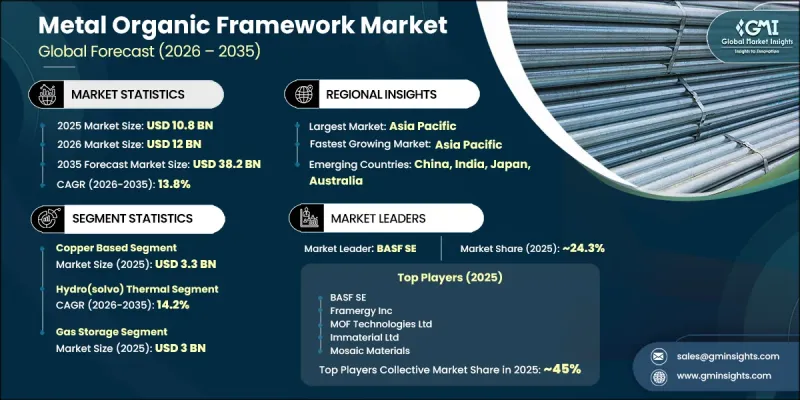
세계의 금속 유기 구조체(MOF) 시장은 2025년에 108억 달러로 평가되었고, 2035년까지 연평균 복합 성장률(CAGR) 13.8%로 성장할 전망이며, 382억 달러에 이를 것으로 추정되고 있습니다.
시장 확대는 매우 높은 비표면적, 조절 가능한 기공 구조, 유연한 화학적 기능성을 갖춘 첨단 다공성 소재에 대한 수요 증가에 의해 주도되고 있습니다. 이러한 특성으로 인해 금속 유기 구조체(MOF)는 흡착, 센싱, 촉매, 가스 관련 공정 등 다양한 산업 분야에서 고효율 재료로 자리매김하고 있습니다. 배출 감소, 에너지 효율성 및 자원 최적화에 대한 관심이 높아짐에 따라 각 조직은 기존 재료의 대안으로 MOF를 평가했습니다. 학술연구에서 파일럿 규모의 생산, 그리고 초기 단계의 상업화로의 전환이 진행됨에 따라 업계 전반의 인지도 향상과 소재 표준화가 가속화되고 있습니다. 에너지 및 환경 분야에서 이러한 재료의 중요성이 높아짐에 따라 시장의 발전이 계속되고 있습니다. 가스 분자와 선택적으로 상호 작용하는 능력으로 인해 MOF는 가스 회수, 정제 및 저장과 관련된 용도 분야에 매우 적합합니다. 환경 문제에 대한 관심이 높아지고 지속 가능한 산업 공정의 추진이 수요를 더욱 강화하는 한편, 연구기관과 산업계 이해관계자들과의 지속적인 협력으로 신기술 분야의 잠재적 용도가 확대되고 있습니다.
| 시장 범위 | |
|---|---|
| 개시 연도 | 2025년 |
| 예측 기간 | 2026-2035년 |
| 개시 연도 시장 규모 | 108억 달러 |
| 예측 시장 규모 | 382억 달러 |
| CAGR | 13.8% |
수열(용제열) 부문은 2025년 37억 달러로 평가되었고, 2026-2035년 연평균 14.2% 성장할 것으로 예측됩니다. 이 합성법은 일관된 재료 품질을 제공할 수 있고, 다양한 금속-배위자 조합에 대응할 수 있기 때문에 널리 사용되고 있습니다. 동시에 생산 효율성 향상, 처리 시간 단축, 구조의 균일성 개선을 위해 대체 기술 연구가 진행되고 있으며, 보다 광범위한 산업 규모에 적용될 수 있도록 촉진하고 있습니다.
가스 저장 부문은 2025년 30억 달러에 달했습니다. 금속 유기 구조체(MOF) 시장의 용도 분야는 가스 분리, 정제, 촉매, 약물 전달, 탄소 포집 및 첨단 환경 솔루션에 이르기까지 다양합니다. 가스 관련 용도 분야에서는 선택적 흡착과 분자 수준의 분리가 중요시되는 반면, 촉매 용도 분야에서는 전체 산업 공정에서 반응 효율을 향상시키고 공정 최적화를 실현하는 맞춤형 활성 부위가 활용되고 있습니다.
2025년 북미의 금속 유기 구조체(MOF) 시장 규모는 33억 달러에 달했습니다. 이 지역의 성장은 첨단 연구 인프라와 상업적으로 실용적인 제품 개발의 확대에 의해 뒷받침되고 있습니다. 미국은 재료과학, 에너지 기술, 환경 혁신에 대한 지속적인 투자를 통해 선도적인 역할을 계속하고 있습니다. 학계, 국립 연구소, 민간 기업 간의 협력으로 다양한 산업 분야에서 MOF의 평가와 도입이 가속화되고 있습니다.
자주 묻는 질문
목차
제1장 조사 방법 및 범위
제2장 주요 요약
제3장 업계 인사이트
제4장 경쟁 구도
제5장 시장 추산 및 예측 : 제품별(2022-2035년)
제6장 시장 추산 및 예측 : 합성 방법별(2022-2035년)
제7장 시장 추산 및 예측 : 용도별(2022-2035년)
제8장 시장 추산 및 예측 : 지역별(2022-2035년)
제9장 기업 개요
AJY 26.06.11The Global Metal Organic Framework Market was valued at USD 10.8 billion in 2025 and is estimated to grow at a CAGR of 13.8% to reach USD 38.2 billion by 2035.
Market expansion is driven by rising demand for advanced porous materials that offer exceptionally high surface area, adjustable pore structures, and flexible chemical functionality. These characteristics position metal organic frameworks as highly efficient materials for a wide range of industrial uses, including adsorption, sensing, catalysis, and gas-related processes. Increasing focus on emission reduction, energy efficiency, and resource optimization is encouraging organizations to evaluate MOFs as alternatives to conventional materials. The transition from academic research toward pilot-scale production and early commercialization has accelerated awareness and material standardization across industries. The growing relevance of these materials in energy and environmental applications continues to support market development. Their ability to selectively interact with gas molecules makes them highly suitable for applications involving gas capture, purification, and storage. Rising environmental concerns and the push for sustainable industrial processes are further strengthening demand, while continuous collaboration between research institutions and industrial stakeholders is expanding their potential use across emerging technological fields.
| Market Scope | |
|---|---|
| Start Year | 2025 |
| Forecast Year | 2026-2035 |
| Start Value | $10.8 Billion |
| Forecast Value | $38.2 Billion |
| CAGR | 13.8% |
The hydro(solvo) thermal segment accounted for USD 3.7 billion in 2025 and is expected to grow at a CAGR of 14.2% between 2026 and 2035. This synthesis approach remains widely utilized due to its ability to deliver consistent material quality and adaptability across diverse metal-ligand combinations. At the same time, alternative techniques are being explored to enhance production efficiency, reduce processing time, and improve structural uniformity, supporting broader industrial scalability.
The gas storage segment reached USD 3 billion in 2025. Applications across the metal organic framework market span gas separation, purification, catalysis, drug delivery, carbon capture, and advanced environmental solutions. Gas-focused applications emphasize selective adsorption and molecular-level separation, while catalytic uses rely on customizable active sites that improve reaction efficiency and process optimization across industrial operations.
North America Metal Organic Framework Market was valued at USD 3.3 billion in 2025. Regional growth is supported by advanced research infrastructure and increasing development of commercially viable products. The United States continues to play a leading role through sustained investment in materials science, energy technologies, and environmental innovation. Collaboration among academic institutions, national laboratories, and private sector companies is accelerating the evaluation and deployment of MOFs across multiple industrial applications.
Key players operating in the Global Metal Organic Framework Industry include BASF SE, NuMat Technologies, MOF Technologies Ltd, Framergy Inc., Immaterial Ltd, Mosaic Materials, Promethean Particles Ltd, Nanorh, novoMOF, ProfMOF, and other emerging participants. Companies in the metal organic framework market are strengthening their competitive position through strategic investments in large-scale production capabilities and advanced material innovation. They are focusing on developing application-specific MOFs with improved selectivity, stability, and performance characteristics. Partnerships with energy companies, research institutions, and industrial manufacturers are enabling faster commercialization and broader adoption. Firms are also prioritizing sustainable production methods and cost-efficient synthesis techniques to enhance scalability. Expansion into high-growth sectors such as clean energy, environmental remediation, and advanced manufacturing is further supporting market presence.
Table of Contents
Chapter 1 Methodology & Scope
- 1.1 Market scope and definition
- 1.2 Research design
- 1.2.1 Research approach
- 1.2.2 Data collection methods
- 1.3 Data mining sources
- 1.3.1 Global
- 1.3.2 Regional/Country
- 1.4 Base estimates and calculations
- 1.4.1 Base year calculation
- 1.4.2 Key trends for market estimation
- 1.5 Primary research and validation
- 1.5.1 Primary sources
- 1.6 Forecast model
- 1.7 Research assumptions and limitations
Chapter 2 Executive Summary
- 2.1 Industry 360° synopsis
- 2.2 Key market trends
- 2.2.1 Regional
- 2.2.2 Product
- 2.2.3 Synthetic Method
- 2.2.4 Application
- 2.3 TAM Analysis, 2026-2035
- 2.4 CXO perspectives: Strategic imperatives
Chapter 3 Industry Insights
- 3.1 Industry ecosystem analysis
- 3.1.1 Supplier landscape
- 3.1.2 Profit margin
- 3.1.3 Value addition at each stage
- 3.1.4 Factor affecting the value chain
- 3.1.5 Disruptions
- 3.2 Industry impact forces
- 3.2.1 Growth drivers
- 3.2.2 Industry pitfalls and challenges
- 3.2.3 Market opportunities
- 3.3 Growth potential analysis
- 3.4 Regulatory landscape
- 3.4.1 North America
- 3.4.2 Europe
- 3.4.3 Asia Pacific
- 3.4.4 Latin America
- 3.4.5 Middle East & Africa
- 3.5 Porter's analysis
- 3.6 PESTEL analysis
- 3.7 Price trends
- 3.7.1 By region
- 3.7.2 By type
- 3.8 Future market trends
- 3.9 Technology and Innovation landscape
- 3.9.1 Current technological trends
- 3.9.2 Emerging technologies
- 3.10 Patent Landscape
- 3.11 Trade statistics (HS code)
- 3.11.1 Major importing countries
- 3.11.2 Major exporting countries
- 3.12 Sustainability and environmental aspects
- 3.12.1 Sustainable practices
- 3.12.2 Waste reduction strategies
- 3.12.3 Energy efficiency in production
- 3.12.4 Eco-friendly initiatives
- 3.13 Carbon footprint consideration
Chapter 4 Competitive Landscape, 2025
- 4.1 Introduction
- 4.2 Company market share analysis
- 4.2.1 By region
- 4.2.1.1 North America
- 4.2.1.2 Europe
- 4.2.1.3 Asia Pacific
- 4.2.1.4 LATAM
- 4.2.1.5 MEA
- 4.2.1 By region
- 4.3 Company matrix analysis
- 4.4 Competitive analysis of major market players
- 4.5 Competitive positioning matrix
- 4.6 Key developments
- 4.6.1 Mergers & acquisitions
- 4.6.2 Partnerships & collaborations
- 4.6.3 New Product Launches
- 4.6.4 Expansion Plans
Chapter 5 Market Estimates and Forecast, By Product, 2022-2035 (USD Billion) (Kilo Tons)
- 5.1 Key trends
- 5.2 Aluminium Based
- 5.3 Copper Based
- 5.4 Iron Based
- 5.5 Zinc Based
- 5.6 Magnesium Based
- 5.7 zirconium
- 5.8 Others
Chapter 6 Market Estimates and Forecast, By Synthetic Method, 2022-2035 (USD Billion) (Kilo Tons)
- 6.1 Key trends
- 6.2 Hydro(solvo)thermal
- 6.3 Microwave
- 6.4 Ultrasonic
- 6.5 Mechanochemical
- 6.6 Electrochemical
- 6.7 Vapor-assisted
- 6.8 Ionothermal
- 6.9 Supercritical CO2-assisted
- 6.10 Others
Chapter 7 Market Estimates and Forecast, By Application, 2022-2035 (USD Billion) (Kilo Tons)
- 7.1 Key trends
- 7.2 Gas separation and purification
- 7.3 Catalyst
- 7.4 Gas Storage
- 7.5 Drug delivery
- 7.6 Carbon capture
- 7.7 Atmospheric water harvesting
- 7.8 Others
Chapter 8 Market Estimates and Forecast, By Region, 2022-2035 (USD Billion) (Kilo Tons)
- 8.1 Key trends
- 8.2 North America
- 8.2.1 U.S.
- 8.2.2 Canada
- 8.3 Europe
- 8.3.1 Germany
- 8.3.2 UK
- 8.3.3 France
- 8.3.4 Spain
- 8.3.5 Italy
- 8.3.6 Rest of Europe
- 8.4 Asia Pacific
- 8.4.1 China
- 8.4.2 India
- 8.4.3 Japan
- 8.4.4 Australia
- 8.4.5 South Korea
- 8.4.6 Rest of Asia Pacific
- 8.5 Latin America
- 8.5.1 Brazil
- 8.5.2 Mexico
- 8.5.3 Argentina
- 8.5.4 Rest of Latin America
- 8.6 Middle East and Africa
- 8.6.1 Saudi Arabia
- 8.6.2 South Africa
- 8.6.3 UAE
- 8.6.4 Rest of Middle East and Africa
Chapter 9 Company Profiles
- 9.1 BASF SE
- 9.2 Framergy Inc
- 9.3 Immaterial Ltd
- 9.4 MOF Technologies Ltd
- 9.5 Mosaic Materials
- 9.6 Nanorh
- 9.7 novoMOF
- 9.8 NuMat Technologies
- 9.9 ProfMOF
- 9.10 Promethean Particles Ltd


