
|
시장보고서
상품코드
2102912
금속 유기 구조체(MOF) 시장 예측(-2031년) : 유형(아연계, 구리계, 철계, 알루미늄계, 크롬계), 합성 방법(솔보서멀/수열 합성, 마이크로파 지원 합성, 기계화 학 합성), 지역별Metal Organic Frameworks Market by Type (Zinc-based, Copper-based, Iron-based, Aluminum-based, Chromium-based), Synthesis Method (Solvothermal/Hydrothermal, Microwave-assisted, Mechanochemical), and Region - Global forecast to 2031 |
||||||

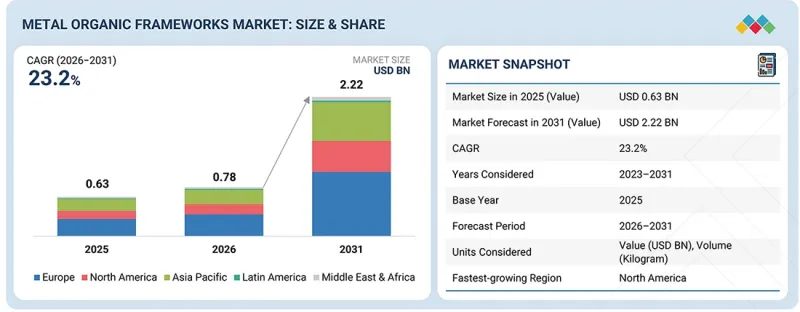
금속 유기 구조체(MOF) 시장 규모는 2026년에 7억 8,000만 달러 규모에 달하며, 2031년까지 22억 2,000만 달러에 달할 것으로 추정되고 있으며, 2026-2031년까지 CAGR은 23.2%에 달할 전망입니다.
알루미늄계 금속-유기 골격체(MOF)는 높은 내수열성 및 내화학성, 낮은 제조 비용, 더불어 대규모 산업에 대한 적용 가능성을 갖추고 있으며, 수요가 확대되고 있습니다.
| 조사 범위 | |
|---|---|
| 조사 대상 기간 | 2023-2031년 |
| 기준연도 | 2025년 |
| 예측 기간 | 2026-2031년 |
| 단위 | 금액(달러)·수량(킬로그램) |
| 부문 | 유형, 합성 방법, 용도, 지역별 |
| 대상 지역 | 유럽, 북미, 아시아태평양, 라틴아메리카, 중동 및 아프리카 |
MIL-53(Al), MIL-160(Al), 푸마르산 알루미늄 등의 알루미늄계 MOF는 높은 안정성과 낮은 독성으로 인해 가스 흡착, 수분 회수, 열 변환, 습도 제어 시스템에서 널리 이용되고 있습니다. 또한 대규모 생산이 가능하므로 상업적으로도 보급이 확대되고 있습니다. 상기 특성으로 인해 알루미늄계 MOF는 금속유기골격체(MOF) 시장에서 시장 점유율 3위를 차지하고 있습니다.
"금액 기준으로 볼 때, 솔보열/수열 합성법이 시장에서 가장 큰 점유율을 차지했습니다."
솔보열/수열 합성법이 금속 유기 골격(MOF) 시장에서 가장 큰 점유율을 차지한 이유는 CALF-20, HKUST-1, UiO-66, MIL-101, ZIF-8 등 가스 분리 및 탄소 포집에 사용되는 상업적으로 중요한 MOF 제조 과정에서 이 방법이 선호되기 때문입니다. BASF, novoMOF, Numat Technologies 등의 주요 제조업체들은 파일럿 규모 및 상업적 규모의 생산을 위해 솔보열 합성 공정을 최적화하고 있습니다. 이 방법은 제품의 재현성이 높고, 흡착 성능에 매우 중요한 결정 크기나 골격의 결함을 정밀하게 제어할 수 있기 때문입니다. 지난 10년 동안 수행된 산업 실증, 공정 최적화, 스케일업 연구의 대부분은 솔보열 합성을 기반으로 하고 있으며, 그 결과 기계화학적 합성, 전기화학적 합성, 마이크로파 보조 합성 등의 새로운 기법과 비교했을 때 솔보열법은 가장 성숙하고 상업적으로 확립된 제조 기술이 되었습니다.
"금액 기준으로 볼 때, 가스 저장 용도가 전체 시장에서 가장 큰 점유율을 차지했습니다."
가스 저장 용도는 MOF가 매우 큰 비표면적, 조절 가능한 기공 구조, 높은 흡착 용량을 갖추고 있으며, 수소, 메탄 및 기타 산업용 가스를 효율적으로 저장할 수 있으므로 금속-유기 골격체 시장에서 가장 큰 점유율을 차지했습니다. 수소 에너지 인프라, 천연가스 구동 운송 수단, 청정 에너지 시스템에 대한 투자 확대에 따라 고밀도 가스 저장 솔루션 분야에서 MOF의 채택이 가속화되고 있습니다. 엄격한 탈탄소화 목표와 안전하고 소형이며 에너지 효율이 높은 가스 저장 기술에 대한 수요 증가가 에너지 및 산업 분야 전반의 수요를 지원하고 있습니다. 수소 및 메탄 저장을 위한 첨단 MOF 소재의 상용화가 지속되고 있는 점도 이 용도 부문의 우위를 더욱 지원하고 있습니다.
"금액 기준으로 볼 때, 유럽이 시장에서 가장 큰 점유율을 차지했습니다."
유럽은 MOF를 활용한 탄소 포집 기술의 상용화가 조기에 진행되었을 뿐만 아니라, 대규모 생산 능력이 지역 내에 구축되어 있으며, 금속-유기 골격체 시장에서 최대 점유율을 차지했습니다. BASF 등의 기업은 Svante의 구조화된 탄소 포집 필터용으로 CALF-20 MOF를 상용화하고 있으며, 시멘트, 철강, 수소, 펄프·제지, 화학 등 배출 감축이 어려운 산업 분야에 공급하고 있습니다. 한편, 영국에 본사를 둔 Nuada와 Promethean Particles는 에너지 효율이 높은 가스 분리를 위한 MOF 막 개발을 추진하고 있습니다. 유럽에서는 탄소 포집, 바이오메탄 정제, 수소 정제에 초점을 맞춘 여러 파일럿 프로젝트와 실증 프로젝트가 진행되고 있으며, 실험실 수준의 연구에 그치지 않는 MOF에 대한 지속적인 수요를 창출하고 있습니다. 이 지역의 성숙한 산업 탈탄소화 생태계와 제조사, 기술 개발자, 연구 기관 간의 강력한 협력을 통해 다른 지역에 비해 MOF 기반 솔루션의 도입이 가속화되고 있습니다.
이 보고서에서는 전 세계 금속-유기 골격체(MOF) 시장을 조사하여, 시장 개요, 시장 성장에 영향을 미치는 다양한 요인의 분석, 기술 및 특허 동향, 법규제 환경, 사례 연구, 시장 규모 추이 및 전망, 각종 분류·지역/주요 국가별 상세 분석, 경쟁 구도, 주요 기업 개요 등을 정리하여 전해드립니다.
자주 묻는 질문
목차
제1장 서론
제2장 개요
제3장 주요 인사이트
제4장 시장 개요
제5장 업계 동향
제6장 기술, 특허, 디지털 기술, AI의 도입에 의한 전략적 디스럽션
제7장 지속가능성과 규제 상황
제8장 고객 상황과 구매 행동
제9장 금속 유기 구조체(MOF) 시장 : 유형별
제10장 금속 유기 구조체(MOF) 시장 : 합성 방법별
제11장 금속 유기 구조체(MOF) 시장 : 용도별
제12장 금속 유기 구조체(MOF) 시장 : 지역별
제13장 경쟁 구도
제14장 기업 개요
제15장 조사 방법
제16장 부록
KSA 26.08.05The metal organic frameworks market is estimated to be valued at USD 0.78 billion in 2026 and reach USD 2.22 billion by 2031, at a CAGR of 23.2% from 2026 to 2031. The demand for aluminum-based metal organic frameworks is influenced by their high hydrothermal and chemical stability, economical production, and application in large-scale industries.
| Scope of the Report | |
|---|---|
| Years Considered for the Study | 2023-2031 |
| Base Year | 2025 |
| Forecast Period | 2026-2031 |
| Units Considered | Value (USD million) and volume (kilogram) |
| Segments | By Type, Synthesis method, Application, and Region |
| Regions covered | Europe, North America, Asia Pacific, Latin America, Middle East, and Africa |
Aluminum-based MOFs such as MIL-53(Al), MIL-160(Al), and Al-fumarate are being widely used in gas adsorption, water harvesting, heat transformation, and humidity control systems owing to their highly stable nature and low toxicity levels. Due to their feasibility for scaled production, they have also become commercially popular. The above-listed properties have made aluminum-based MOFs occupy the third-largest market share in the metal organic frameworks market.
''Solvothermal/Hydrothermal synthesis method accounted for the largest share of the metal organic frameworks market, in terms of value.''
The solvothermal/hydrothermal synthesis method accounted for the largest share of the metal organic frameworks market because it is the preferred production route for commercially relevant MOFs used in gas separation and carbon capture, including CALF-20, HKUST-1, UiO-66, MIL-101, and ZIF-8. Major manufacturers, such as BASF, novoMOF, and Numat Technologies, have optimized solvothermal processes for pilot- and commercial-scale production, as the method offers high product reproducibility and enables precise control over crystal size and framework defects, critical for adsorption performance. The majority of industrial validation, process optimization, and scale-up studies over the past decade have been based on solvothermal synthesis, making it the most mature and commercially established manufacturing technology compared with newer methods such as mechanochemical, electrochemical, or microwave-assisted synthesis.
''In terms of value, gas storage application accounted for the largest share of the overall metal organic frameworks market.''
Gas storage applications accounted for the largest share of the metal organic frameworks market due to the exceptional surface area, tunable pore structures, and high adsorption capacity of MOFs, enabling efficient storage of hydrogen, methane, and other industrial gases. Growing investments in hydrogen energy infrastructure, natural gas-powered transportation, and clean energy systems have accelerated the adoption of MOFs for high-density gas storage solutions. Stringent decarbonization targets and the increasing need for safe, compact, and energy-efficient gas storage technologies have strengthened demand across the energy and industrial sectors. Continued commercialization of advanced MOF materials for hydrogen and methane storage further supports the dominance of this application segment.
"Europe accounted for the largest share in the metal organic frameworks market, in terms of value."
Europe accounted for the largest share of the metal organic frameworks market owing to the early commercialization of MOF-based carbon capture technologies and the presence of large-scale production capabilities in the region. Companies such as BASF have commercialized CALF-20 MOFs for Svante's structured carbon capture filters, supplying hard-to-abate industries including cement, steel, hydrogen, pulp & paper, and chemicals, while UK-based Nuada and Promethean Particles are advancing MOF membranes for energy-efficient gas separation. Europe hosts several pilot and demonstration projects focused on carbon capture, biomethane upgrading, and hydrogen purification, creating sustained demand for MOFs beyond laboratory research. The region's mature industrial decarbonization ecosystem and strong collaboration between manufacturers, technology developers, and research institutes have enabled faster adoption of MOF-based solutions compared with other regions.
This study has been validated through primary interviews with industry experts globally. The primary sources have been divided into the following three categories:
- By Company Type: Tier 1 - 60%, Tier 2 - 20%, and Tier 3 - 20%
- By Designation: C-level - 33%, Director-level - 33%, and Managers - 34%
- By Region: North America - 20%, Europe - 25%, Asia Pacific - 25%, the Middle East & Africa - 20%, and Latin America - 10%
The report provides a comprehensive analysis of the following companies:
Prominent companies in this market include Nanorh (US), Framergy, Inc. (US), novoMOF (Switzerland), BASF SE (Germany), Numat Technologies, Inc. (US), MOFapps (Norway), Nuada (UK), ProfMOF (Norway), ACSYNAM (Canada), and Promethean Particles Ltd. (UK).
Research coverage
This research report categorizes the metal organic frameworks market by type (zinc-based, copper-based, iron-based, aluminum-based, chromium-based, and other types), by synthesis method (solvothermal/hydrothermal, sonochemical, microwave-assisted, mechanochemical, electrochemical, and other synthesis methods), application (gas & liquid adsorption/separation, water harvesting, gas storage, sensing & detection, catalysis, and other applications), region (North America, Europe, Asia Pacific, the Middle East & Africa, and Latin America). The scope of the report includes detailed information about the major factors influencing the growth of the metal organic frameworks market, such as drivers, restraints, challenges, and opportunities. A thorough examination of key industry players has been conducted to provide insights into their business overview, solutions and services, key strategies, contracts, partnerships, and agreements. It also covers new product and service launches, mergers and acquisitions, and recent developments in the metal organic frameworks market. This report includes a competitive analysis of upcoming startups in the metal organic frameworks market ecosystem.
Reasons to buy this report:
The report will help market leaders/new entrants in this market with information on the closest approximations of revenue for the overall metal organic frameworks market and its subsegments. This report will help stakeholders understand the competitive landscape and gain insights to better position their businesses and plan suitable go-to-market strategies. The report also helps stakeholders understand the pulse of the market and provides them with information on key market drivers, restraints, challenges, and opportunities.
The report provides insights into the following pointers:
- Analysis of key drivers (Higher operational yield of metal organic frameworks for efficient gas storage, Increasing government initiatives and funding for R&D), restraints (Stability issues of metal organic frameworks, High costs of metal organic frameworks), opportunities (Integration into advanced battery and supercapacitor technologies, Innovative water harvesting technologies), and challenges (Scalability issues in metal organic framework production, Toxicity, biocompatibility, and environmental safety concerns) influencing the growth of the metal organic frameworks market.
- Product Development/Innovation: Detailed insights on upcoming technologies, research & development activities, and service launches in the metal organic frameworks market.
- Market Development: Comprehensive information about lucrative markets - the report analyses the metal organic frameworks market across varied regions.
- Market Diversification: Exhaustive information about services, untapped geographies, recent developments, and investments in the metal organic frameworks market.
- Competitive Assessment: In-depth assessment of market shares, growth strategies, and service offerings of leading players Nanorh (US), Framergy, Inc. (US), novoMOF (Switzerland), BASF SE (Germany), Numat Technologies, Inc. (US), MOFapps (Norway), Nuada (UK), ProfMOF (Norway), ACSYNAM (Canada), and Promethean Particles Ltd. (UK), in the metal organic frameworks market.
TABLE OF CONTENTS
1 INTRODUCTION
- 1.1 STUDY OBJECTIVES
- 1.2 MARKET DEFINITION
- 1.3 STUDY SCOPE
- 1.3.1 MARKETS COVERED AND REGIONAL SCOPE
- 1.3.2 INCLUSIONS AND EXCLUSIONS
- 1.3.3 YEARS CONSIDERED
- 1.3.4 CURRENCY CONSIDERED
- 1.3.5 UNITS CONSIDERED
- 1.4 LIMITATIONS
- 1.5 STAKEHOLDERS
- 1.6 SUMMARY OF CHANGES
2 EXECUTIVE SUMMARY
- 2.1 KEY INSIGHTS AND MARKET HIGHLIGHTS
- 2.2 KEY MARKET PARTICIPANTS: SHARE INSIGHTS AND STRATEGIC DEVELOPMENTS
- 2.3 DISRUPTIVE TRENDS SHAPING MARKET
- 2.4 HIGH-GROWTH SEGMENTS & EMERGING FRONTIERS
- 2.5 SNAPSHOT: GLOBAL MARKET SIZE, GROWTH RATE, AND FORECAST
3 PREMIUM INSIGHTS
- 3.1 ATTRACTIVE OPPORTUNITIES FOR PLAYERS IN METAL ORGANIC FRAMEWORKS MARKET
- 3.2 METAL ORGANIC FRAMEWORKS MARKET, BY APPLICATION AND REGION
- 3.3 METAL ORGANIC FRAMEWORKS MARKET SHARE, BY TYPE
- 3.4 METAL ORGANIC FRAMEWORKS MARKET SHARE, BY SYNTHESIS METHOD
- 3.5 METAL ORGANIC FRAMEWORKS MARKET, BY COUNTRY
4 MARKET OVERVIEW
- 4.1 INTRODUCTION
- 4.2 MARKET DYNAMICS
- 4.2.1 DRIVERS
- 4.2.1.1 Higher operational yield of metal organic frameworks for efficient gas storage
- 4.2.1.2 Rising demand for carbon capture and decarbonization technologies
- 4.2.1.3 Increasing government initiatives and funding for R&D
- 4.2.1.4 Expanding industrial demand for advanced gas separation solutions
- 4.2.2 RESTRAINTS
- 4.2.2.1 Stability issues of metal organic frameworks
- 4.2.2.2 High costs of metal organic frameworks
- 4.2.3 OPPORTUNITIES
- 4.2.3.1 Integration into advanced battery and supercapacitor technologies
- 4.2.3.2 Innovative water harvesting technologies
- 4.2.3.3 Growth of precision medicine and targeted drug delivery
- 4.2.3.4 AI-driven discovery and scalable commercialization of MOFs
- 4.2.4 CHALLENGES
- 4.2.4.1 Scalability issues in metal organic framework production
- 4.2.4.2 Toxicity, biocompatibility, and environmental safety concerns
- 4.2.1 DRIVERS
- 4.3 UNMET NEEDS AND WHITE SPACES
- 4.3.1 UNMET NEEDS IN METAL ORGANIC FRAMEWORKS MARKET
- 4.3.2 WHITE SPACE OPPORTUNITIES
- 4.4 INTERCONNECTED MARKETS AND CROSS-SECTOR OPPORTUNITIES
- 4.4.1 INTERCONNECTED MARKETS
- 4.4.2 CROSS-SECTOR OPPORTUNITIES
- 4.5 EMERGING BUSINESS MODELS AND ECOSYSTEM SHIFTS
- 4.5.1 EMERGING BUSINESS MODELS
- 4.5.2 ECOSYSTEM SHIFTS
- 4.6 STRATEGIC MOVES BY TIER-1/2/3 PLAYERS
- 4.6.1 KEY MOVES AND STRATEGIC FOCUS
5 INDUSTRY TRENDS
- 5.1 PORTER'S FIVE FORCES ANALYSIS
- 5.1.1 THREAT OF NEW ENTRANTS
- 5.1.2 THREAT OF SUBSTITUTES
- 5.1.3 BARGAINING POWER OF SUPPLIERS
- 5.1.4 BARGAINING POWER OF BUYERS
- 5.1.5 INTENSITY OF COMPETITIVE RIVALRY
- 5.2 MACROECONOMICS INDICATORS
- 5.2.1 INTRODUCTION
- 5.2.2 GDP TRENDS AND FORECAST
- 5.2.3 TRENDS IN GLOBAL METAL ORGANIC FRAMEWORKS INDUSTRY
- 5.3 VALUE CHAIN ANALYSIS
- 5.4 ECOSYSTEM ANALYSIS
- 5.5 PRICING ANALYSIS
- 5.5.1 AVERAGE SELLING PRICE, BY KEY PLAYERS
- 5.5.2 AVERAGE SELLING PRICE TREND OF METAL ORGANIC FRAMEWORKS, BY REGION
- 5.6 KEY CONFERENCES AND EVENTS, 2026-2027
- 5.7 TRENDS/DISRUPTIONS IMPACTING CUSTOMER BUSINESS
- 5.8 INVESTMENT AND FUNDING SCENARIO
- 5.9 CASE STUDY ANALYSIS
- 5.9.1 CALF-20: GAME-CHANGING METAL ORGANIC FRAMEWORK FOR CARBON CAPTURE
- 5.9.2 FRAMERGY, INC. COLLABORATED WITH ALICAT SCIENTIFIC, INC. FOR NATURAL GAS PURIFICATION
- 5.9.3 MOF-5: PIONEERING POROUS FRAMEWORKS FOR HYDROGEN FUEL STORAGE
6 STRATEGIC DISRUPTION THROUGH TECHNOLOGY, PATENTS, DIGITAL, AND AI ADOPTIONS
- 6.1 KEY EMERGING TECHNOLOGIES
- 6.1.1 SOLVOTHERMAL/HYDROTHERMAL SYNTHESIS
- 6.1.2 SONOCHEMICAL SYNTHESIS
- 6.1.3 MICROWAVE-ASSISTED SYNTHESIS
- 6.1.4 MECHANOCHEMICAL SYNTHESIS
- 6.1.5 ELECTROCHEMICAL SYNTHESIS
- 6.2 COMPLEMENTARY TECHNOLOGIES
- 6.2.1 SPRAY DRYING
- 6.3 TECHNOLOGY/PRODUCT ROADMAP
- 6.3.1 SHORT-TERM (2025-2027) | FOUNDATION & EARLY COMMERCIALIZATION
- 6.3.2 MID-TERM (2027-2030) | EXPANSION & STANDARDIZATION
- 6.3.3 LONG-TERM (2030-2035+) | MASS COMMERCIALIZATION & DISRUPTION
- 6.4 PATENT ANALYSIS
- 6.4.1 INTRODUCTION
- 6.4.2 METHODOLOGY
- 6.4.3 DOCUMENT TYPE
- 6.4.4 INSIGHTS
- 6.4.5 LEGAL STATUS OF PATENTS
- 6.4.6 JURISDICTION ANALYSIS
- 6.4.7 TOP APPLICANTS
- 6.4.8 LIST OF PATENTS BY ZHEJIANG UNIVERSITY
- 6.5 FUTURE APPLICATIONS
- 6.5.1 CARBON CAPTURE & GAS SEPARATION: SELECTIVE ADSORPTION MATERIALS FOR CO2 CAPTURE AND INDUSTRIAL GAS PURIFICATION
- 6.5.2 DRUG DELIVERY & BIOMEDICAL APPLICATIONS: TARGETED DRUG DELIVERY AND CONTROLLED THERAPEUTIC RELEASE SYSTEMS
- 6.5.3 WATER PURIFICATION & ENVIRONMENTAL REMEDIATION: ADVANCED ADSORBENTS FOR CONTAMINANT REMOVAL AND WASTEWATER TREATMENT
- 6.5.4 HYDROGEN STORAGE & CLEAN ENERGY: HIGH-CAPACITY POROUS MATERIALS FOR HYDROGEN STORAGE AND FUEL CELL SYSTEMS
- 6.5.5 CATALYSIS & INDUSTRIAL PROCESSING: HIGHLY EFFICIENT CATALYSTS FOR CHEMICAL SYNTHESIS AND SUSTAINABLE MANUFACTURING
- 6.6 IMPACT OF AI/GEN AI ON METAL ORGANIC FRAMEWORKS MARKET
- 6.6.1 TOP USE CASES AND MARKET POTENTIAL
- 6.6.2 BEST PRACTICES IN METAL ORGANIC FRAMEWORKS PROCESSING
- 6.6.3 CASE STUDIES OF AI IMPLEMENTATION IN METAL ORGANIC FRAMEWORKS MARKET
- 6.6.4 INTERCONNECTED ADJACENT ECOSYSTEM AND IMPACT ON MARKET PLAYERS
- 6.6.5 CLIENTS' READINESS TO ADOPT GENERATIVE AI IN METAL ORGANIC FRAMEWORKS MARKET
- 6.7 SUCCESS STORIES AND REAL-WORLD APPLICATIONS
- 6.7.1 PROMETHEAN PARTICLES: AI-BASED INDUSTRIAL MOF DISCOVERY
- 6.7.2 NUMAT TECHNOLOGIES: AI-POWERED MOF DISCOVERY FOR DIRECT AIR CAPTURE
7 SUSTAINABILITY AND REGULATORY LANDSCAPE
- 7.1 REGIONAL REGULATIONS AND COMPLIANCE
- 7.1.1 REGULATORY BODIES, GOVERNMENT AGENCIES, AND OTHER ORGANIZATIONS
- 7.1.2 INDUSTRY STANDARDS
- 7.2 SUSTAINABILITY INITIATIVES
- 7.2.1 CARBON IMPACT AND ECO-APPLICATIONS OF METAL ORGANIC FRAMEWORKS
- 7.2.1.1 Carbon impact reduction
- 7.2.1.2 Eco-Applications
- 7.2.1 CARBON IMPACT AND ECO-APPLICATIONS OF METAL ORGANIC FRAMEWORKS
- 7.3 SUSTAINABILITY IMPACT AND REGULATORY POLICY INITIATIVES
- 7.4 CERTIFICATIONS, LABELING, AND ECO-STANDARDS
8 CUSTOMER LANDSCAPE & BUYER BEHAVIOR
- 8.1 DECISION-MAKING PROCESS
- 8.2 BUYER STAKEHOLDERS AND BUYING EVALUATION CRITERIA
- 8.2.1 KEY STAKEHOLDERS IN BUYING PROCESS
- 8.2.2 BUYING CRITERIA
- 8.3 ADOPTION BARRIERS & INTERNAL CHALLENGES
- 8.4 UNMET NEEDS FROM VARIOUS APPLICATIONS
- 8.5 MARKET PROFITABILITY
- 8.5.1 REVENUE POTENTIAL
- 8.5.2 COST DYNAMICS
- 8.5.3 MARGIN OPPORTUNITIES, BY APPLICATION
9 METAL ORGANIC FRAMEWORKS MARKET, BY TYPE
- 9.1 INTRODUCTION
- 9.2 ZINC-BASED
- 9.2.1 RISING ADOPTION IN GAS STORAGE, SEPARATION, AND CARBON CAPTURE APPLICATIONS TO DRIVE MARKET
- 9.3 COPPER-BASED
- 9.3.1 SURGE IN CATALYTIC APPLICATIONS AND CO2 REDUCTION EFFORTS TO DRIVE DEMAND
- 9.4 IRON-BASED
- 9.4.1 HIGH STABILITY AND TUNABLE CHEMISTRY TO DRIVE ADOPTION IN CARBON CAPTURE AND ENVIRONMENTAL APPLICATIONS
- 9.5 ALUMINUM-BASED
- 9.5.1 INNOVATION IN ADSORPTION TECHNOLOGIES FOR LOW-ENERGY CARBON CAPTURE SOLUTIONS TO DRIVE DEMAND
- 9.6 CHROMIUM-BASED
- 9.6.1 IMPROVED CATALYTIC PERFORMANCE AND ADSORPTION EFFICIENCY TO DRIVE DEMAND
- 9.7 OTHER TYPES
10 METAL ORGANIC FRAMEWORKS MARKET, BY SYNTHESIS METHOD
- 10.1 INTRODUCTION
- 10.2 SOLVOTHERMAL/HYDROTHERMAL
- 10.2.1 OFFERS CRYSTAL SYNTHESIS AT HIGH TEMPERATURES AND PRESSURES
- 10.3 SONOCHEMICAL
- 10.3.1 REDUCED SOLVENT CONSUMPTION TO DRIVE DEMAND
- 10.4 MICROWAVE-ASSISTED
- 10.4.1 LOW ENERGY REQUIREMENTS AND RAPID SYNTHESIS TO DRIVE ADOPTION
- 10.5 MECHANOCHEMICAL
- 10.5.1 DEMAND FOR AFFORDABLE AND SOLVENT-FREE ALTERNATIVE TO FUEL GROWTH
- 10.6 ELECTROCHEMICAL
- 10.6.1 HIGH YIELD AND LOW ENERGY CONSUMPTION TO DRIVE DEMAND
- 10.7 OTHER SYNTHESIS METHODS
11 METAL ORGANIC FRAMEWORKS MARKET, BY APPLICATION
- 11.1 INTRODUCTION
- 11.2 GAS & LIQUID ADSORPTION/SEPARATION
- 11.2.1 HIGH DEMAND DUE TO CARBON DIOXIDE CAPTURE AND GAS SEPARATION
- 11.3 WATER HARVESTING
- 11.3.1 SOLUTION FOR WATER SCARCITY AMID RISING FRESHWATER DEMAND
- 11.4 GAS STORAGE
- 11.4.1 NEED FOR EFFICIENT GAS STORAGE FOR CLEAN ENERGY TRANSITION TO DRIVE MARKET
- 11.5 SENSING & DETECTION
- 11.5.1 ENHANCED SENSING AND DETECTION WITH ADVANCED SENSITIVITY AND SELECTIVITY TO DRIVE ADOPTION
- 11.6 CATALYSIS
- 11.6.1 OFFERS SCALABLE MOF CATALYSTS FOR NEXT-GENERATION CHEMICAL PROCESSING
- 11.7 OTHER APPLICATIONS
12 METAL ORGANIC FRAMEWORKS MARKET, BY REGION
- 12.1 INTRODUCTION
- 12.2 NORTH AMERICA
- 12.2.1 NORTH AMERICA: METAL ORGANIC FRAMEWORKS MARKET, BY SYNTHESIS METHOD
- 12.2.2 NORTH AMERICA: METAL ORGANIC FRAMEWORKS MARKET, BY APPLICATION
- 12.2.3 NORTH AMERICA: METAL ORGANIC FRAMEWORKS MARKET, BY TYPE
- 12.2.4 NORTH AMERICA: METAL ORGANIC FRAMEWORKS MARKET, BY COUNTRY
- 12.2.4.1 US
- 12.2.4.1.1 Presence of major manufacturers to drive market
- 12.2.4.2 Canada
- 12.2.4.2.1 Carbon capture commercialization to drive demand
- 12.2.4.1 US
- 12.3 EUROPE
- 12.3.1 EUROPE: METAL ORGANIC FRAMEWORKS MARKET, BY SYNTHESIS METHOD
- 12.3.2 EUROPE: METAL ORGANIC FRAMEWORKS MARKET, BY APPLICATION
- 12.3.3 EUROPE: METAL ORGANIC FRAMEWORKS MARKET, BY TYPE
- 12.3.4 EUROPE: METAL ORGANIC FRAMEWORKS MARKET, BY COUNTRY
- 12.3.4.1 Germany
- 12.3.4.1.1 Climate neutrality targets boosting demand for MOF-based technologies
- 12.3.4.2 France
- 12.3.4.2.1 Research excellence and industrial partnerships to propel growth
- 12.3.4.3 UK
- 12.3.4.3.1 Industrial deployment and funding support to strengthen demand
- 12.3.4.4 Italy
- 12.3.4.4.1 Strategic research programs to fuel demand
- 12.3.4.5 Spain
- 12.3.4.5.1 Circular economy and upcycled botanical extracts to drive market growth
- 12.3.4.6 Rest of Europe
- 12.3.4.1 Germany
- 12.4 ASIA PACIFIC
- 12.4.1 ASIA PACIFIC: METAL ORGANIC FRAMEWORKS MARKET, BY SYNTHESIS METHOD
- 12.4.2 ASIA PACIFIC: METAL ORGANIC FRAMEWORKS MARKET, BY APPLICATION
- 12.4.3 ASIA PACIFIC: METAL ORGANIC FRAMEWORKS MARKET, BY TYPE
- 12.4.4 ASIA PACIFIC: METAL ORGANIC FRAMEWORKS MARKET, BY COUNTRY
- 12.4.4.1 China
- 12.4.4.1.1 Rising hydrogen economy and carbon capture investments to drive demand
- 12.4.4.2 India
- 12.4.4.2.1 Growing research and clean energy initiatives to drive demand
- 12.4.4.3 Japan
- 12.4.4.3.1 Environmental regulations and technological advancements to drive market
- 12.4.4.4 South Korea
- 12.4.4.4.1 Rising hydrogen economy and advanced material innovations to drive demand
- 12.4.4.5 Rest of Asia Pacific
- 12.4.4.1 China
- 12.5 LATIN AMERICA
- 12.5.1 LATIN AMERICA: METAL ORGANIC FRAMEWORKS MARKET, BY SYNTHESIS METHOD
- 12.5.2 LATIN AMERICA: METAL ORGANIC FRAMEWORKS MARKET, BY APPLICATION
- 12.5.3 LATIN AMERICA: METAL ORGANIC FRAMEWORKS MARKET, BY TYPE
- 12.5.4 LATIN AMERICA: METAL ORGANIC FRAMEWORKS MARKET, BY COUNTRY
- 12.5.4.1 Mexico
- 12.5.4.1.1 Expanding clean energy and industrial gas applications to drive market growth
- 12.5.4.2 Brazil
- 12.5.4.2.1 Carbon capture and clean energy initiatives to drive demand
- 12.5.4.3 Rest of Latin America
- 12.5.4.1 Mexico
- 12.6 MIDDLE EAST & AFRICA
- 12.6.1 MIDDLE EAST & AFRICA: METAL ORGANIC FRAMEWORKS MARKET, BY SYNTHESIS METHOD
- 12.6.2 MIDDLE EAST & AFRICA: METAL ORGANIC FRAMEWORKS MARKET, BY APPLICATION
- 12.6.3 MIDDLE EAST & AFRICA: METAL ORGANIC FRAMEWORKS MARKET, BY TYPE
- 12.6.4 MIDDLE EAST & AFRICA: METAL ORGANIC FRAMEWORKS MARKET, BY COUNTRY
- 12.6.5 GCC COUNTRIES
- 12.6.5.1 UAE
- 12.6.5.1.1 Industrial Initiatives and R&D to boost market growth
- 12.6.5.2 Saudi Arabia
- 12.6.5.2.1 Government-led clean energy initiatives to drive market
- 12.6.5.3 Rest of GCC countries
- 12.6.5.4 South Africa
- 12.6.5.4.1 Research & development activities to drive demand
- 12.6.5.5 Rest of Middle East & Africa
- 12.6.5.1 UAE
13 COMPETITIVE LANDSCAPE
- 13.1 OVERVIEW
- 13.2 KEY PLAYERS' STRATEGIES/RIGHT TO WIN
- 13.3 REVENUE ANALYSIS
- 13.4 MARKET SHARE ANALYSIS
- 13.5 BRAND/PRODUCT COMPARISON
- 13.6 COMPANY EVALUATION MATRIX: KEY PLAYERS, 2025
- 13.6.1 STARS
- 13.6.2 EMERGING LEADERS
- 13.6.3 PERVASIVE PLAYERS
- 13.6.4 PARTICIPANTS
- 13.6.5 COMPANY FOOTPRINT: KEY PLAYERS, 2025
- 13.6.5.1 Company footprint
- 13.6.5.2 Region footprint
- 13.6.5.3 Type footprint
- 13.6.5.4 Synthesis method footprint
- 13.6.5.5 Application footprint
- 13.7 COMPANY EVALUATION MATRIX: STARTUPS/SMES, 2025
- 13.7.1 PROGRESSIVE COMPANIES
- 13.7.2 RESPONSIVE COMPANIES
- 13.7.3 DYNAMIC COMPANIES
- 13.7.4 STARTING BLOCKS
- 13.7.5 COMPETITIVE BENCHMARKING: STARTUPS/SMES, 2025
- 13.7.5.1 Detailed list of key startups/SMEs
- 13.7.5.2 Competitive benchmarking of key startups/SMEs
- 13.8 COMPANY VALUATION AND FINANCIAL METRICS
- 13.9 COMPETITIVE SCENARIO
- 13.9.1 PRODUCT LAUNCHES
- 13.9.2 DEALS
- 13.9.3 EXPANSIONS
14 COMPANY PROFILES
- 14.1 KEY COMPANIES
- 14.1.1 NANORH
- 14.1.1.1 Business overview
- 14.1.1.2 Products offered
- 14.1.1.3 MnM view
- 14.1.1.3.1 Right to win
- 14.1.1.3.2 Strategic choices
- 14.1.1.3.3 Weaknesses and competitive threats
- 14.1.2 FRAMERGY, INC.
- 14.1.2.1 Business overview
- 14.1.2.2 Products offered
- 14.1.2.3 MnM view
- 14.1.2.3.1 Right to win
- 14.1.2.3.2 Strategic choices
- 14.1.2.3.3 Weaknesses and competitive threats
- 14.1.3 NOVOMOF
- 14.1.3.1 Business overview
- 14.1.3.2 Products offered
- 14.1.3.3 MnM view
- 14.1.3.3.1 Right to win
- 14.1.3.3.2 Strategic choices
- 14.1.3.3.3 Weaknesses and competitive threats
- 14.1.4 BASF
- 14.1.4.1 Business overview
- 14.1.4.2 Products offered
- 14.1.4.3 Recent developments
- 14.1.4.3.1 Deals
- 14.1.4.4 MnM view
- 14.1.4.4.1 Right to win
- 14.1.4.4.2 Strategic choices
- 14.1.4.4.3 Weaknesses and competitive threats
- 14.1.5 NUMAT TECHNOLOGIES, INC.
- 14.1.5.1 Business overview
- 14.1.5.2 Products offered
- 14.1.5.3 Recent developments
- 14.1.5.3.1 Product launches
- 14.1.5.3.2 Deals
- 14.1.5.3.3 Expansions
- 14.1.5.4 MnM view
- 14.1.5.4.1 Right to win
- 14.1.5.4.2 Strategic choices
- 14.1.5.4.3 Weaknesses and competitive threats
- 14.1.6 MOFAPPS
- 14.1.6.1 Business overview
- 14.1.6.2 Products offered
- 14.1.6.3 Recent developments
- 14.1.6.3.1 Product launches
- 14.1.6.3.2 Deals
- 14.1.6.4 MnM view
- 14.1.6.4.1 Right to win
- 14.1.6.4.2 Strategic choices
- 14.1.6.4.3 Weaknesses and competitive threats
- 14.1.7 NUADA
- 14.1.7.1 Business overview
- 14.1.7.2 Products offered
- 14.1.7.3 Recent developments
- 14.1.7.3.1 Deals
- 14.1.7.3.2 Expansions
- 14.1.7.4 MnM view
- 14.1.7.4.1 Right to win
- 14.1.7.4.2 Strategic choices
- 14.1.7.4.3 Weaknesses and competitive threats
- 14.1.8 PROFMOF
- 14.1.8.1 Business overview
- 14.1.8.2 Products offered
- 14.1.8.3 Recent developments
- 14.1.8.3.1 Deals
- 14.1.8.4 MnM view
- 14.1.8.4.1 Right to win
- 14.1.8.4.2 Strategic choices
- 14.1.8.4.3 Weaknesses and competitive threats
- 14.1.9 ACSYNAM
- 14.1.9.1 Business overview
- 14.1.9.2 Products offered
- 14.1.9.3 Recent developments
- 14.1.9.3.1 Deals
- 14.1.9.4 MnM view
- 14.1.9.4.1 Right to win
- 14.1.9.4.2 Strategic choices
- 14.1.9.4.3 Weaknesses and competitive threats
- 14.1.10 PROMETHEAN PARTICLES LTD.
- 14.1.10.1 Business overview
- 14.1.10.2 Products offered
- 14.1.10.3 Recent developments
- 14.1.10.3.1 Deals
- 14.1.10.4 MnM view
- 14.1.10.4.1 Right to win
- 14.1.10.4.2 Strategic choices
- 14.1.10.4.3 Weaknesses and competitive threats
- 14.1.1 NANORH
- 14.2 OTHER PLAYERS
- 14.2.1 ACMOFS
- 14.2.2 GS ALLIANCE CO., LTD.
- 14.2.3 PHYSICAL SCIENCES INC.
- 14.2.4 MAJD ONSOR FARTAK
- 14.2.5 SYNCMOF INC.
- 14.2.6 IMMATERIAL LTD.
- 14.2.7 ATOMIS INC.
- 14.2.8 CD BIOPARTICLES
- 14.2.9 NANOWIZ TECH
- 14.2.10 KERONE ENGINEERING SOLUTIONS LTD.
- 14.2.11 NANOSHEL LLC
- 14.2.12 JIANGSU XIANFENG NANOMATERIAL TECHNOLOGY CO., LTD.
- 14.2.13 DECARBONTEK, INC.
- 14.2.14 SVANTE TECHNOLOGIES INC.
- 14.2.15 ARITECH CHEMAZONE PVT. LTD.
- 14.2.16 NANOGRAFI
15 RESEARCH METHODOLOGY
- 15.1 RESEARCH DATA
- 15.1.1 SECONDARY DATA
- 15.1.1.1 Key data from secondary sources
- 15.1.2 PRIMARY DATA
- 15.1.2.1 Key data from primary sources
- 15.1.2.2 Key primary interview participants
- 15.1.2.3 Breakdown of interviews with experts
- 15.1.2.4 Key industry insights
- 15.1.1 SECONDARY DATA
- 15.2 MARKET SIZE ESTIMATION
- 15.2.1 BOTTOM-UP APPROACH
- 15.2.2 TOP-DOWN APPROACH
- 15.3 BASE NUMBER CALCULATION
- 15.3.1 APPROACH 1: SUPPLY-SIDE ANALYSIS
- 15.3.2 APPROACH 2: DEMAND-SIDE ANALYSIS
- 15.4 FORECAST NUMBER CALCULATION
- 15.5 DATA TRIANGULATION
- 15.6 FACTOR ANALYSIS
- 15.7 RESEARCH ASSUMPTIONS
- 15.8 RESEARCH LIMITATIONS AND RISK ASSESSMENT
16 APPENDIX
- 16.1 DISCUSSION GUIDE
- 16.2 KNOWLEDGESTORE: MARKETSANDMARKETS' SUBSCRIPTION PORTAL
- 16.3 CUSTOMIZATION OPTIONS
- 16.4 RELATED REPORTS
- 16.5 AUTHOR DETAILS


