|
시장보고서
상품코드
2119371
금속 유기 구조체(MOFs) : 시장 점유율 분석, 업계 동향 및 통계, 성장 예측(2026-2031년)Metal-Organic Frameworks (MOFs) - Market Share Analysis, Industry Trends & Statistics, Growth Forecasts (2026 - 2031) |
||||||
 Mordor Intelligence
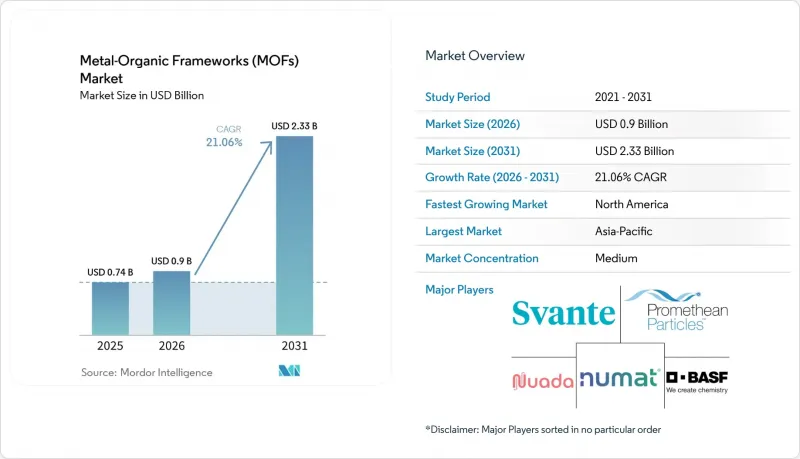
Mordor Intelligence에 의하면, 금속 유기 구조체(MOFs) 시장은 2025년에 7억 4,000만 달러 규모로 평가되었습니다. 2026년 9억 달러에서 2031년까지 23억 3,000만 달러에 이를 것으로 추정되고 예측 기간(2026-2031년) CAGR은 21.06%를 나타낼 전망입니다.
본 보고서는 제품 유형(구리계 MOF 등), 형태(분말, 과립·펠릿 등),합성 방법(용매열법·수열법 등), 용도(가스 저장·분리, 탄소 포집 등), 지역(아시아태평양, 북미, 유럽, 남미, 중동 및 아프리카)별로 분류되어 있습니다. 시장 예측은 금액(달러) 기준으로 제시되어 있습니다.
세계의 금속 유기 구조체(MOFs) 시장 동향 및 인사이트
탄소 포집 및 산업 부문의 탈탄소화 전개
탄소 가격 책정, 탄소 중립(넷 제로) 공약, 그리고 흡착제의 경제성 향상이 금속 유기 구조체(MOFs) 시장 수요를 뒷받침하고 있습니다. 금속 유기 구조체(MOFs)를 이용한 고체 흡착제 시스템은 액체 아민을 사용하는 대체 기술에 비해 재생에 필요한 에너지가 적으며, 습한 배가스 흐름에 대한 제습 전처리를 생략할 수 있습니다. 이 때문에 시멘트 가마, 보일러, 에탄올 발효조 등에서 활용될 것으로 기대되고 있습니다. Svante Technologies사는 2025년 5월 브리티시컬럼비아주 버나비에서 레드우드 시설을 가동했습니다. 이 시설은 연간 1,000만 메트릭톤의 이산화탄소 포집에 대응하는 필터를 공급할 수 있는 능력을 갖추고 있습니다. 고베제강소, 아토미스, 나가세산업은 2026년 4월에 하루 30kg이라는 일본 최초의 유틸리티 규모로 금속 유기 구조체(MOFs)를 이용한 이산화탄소 포집 실증 시험을 완료했으며, 2026년도에는 1메트릭톤 규모의 시험을 계획하고 있습니다. 이러한 프로젝트를 통해 금속 유기 구조체(MOFs) 시장의 조달 관심사는 재료 시험에서 신뢰성 높은 필터공급 및 운용 성능으로 점차 전환되고 있습니다.
에너지 효율이 높은 가스 분리·정제
금속 유기 구조체(MOFs) 시장은 가스 분리 및 정제 분야의 에너지 사용량 감축 수요로부터 혜택을 받고 있습니다. 다변량 알루미늄계 구조체는 이산화탄소 흡착 용량과 메탄 선택성을 모두 보여줌으로써, 기존의 다공성 고체에서 나타나는 한계를 해소했습니다. 2026년 연구에서는 부피 비율로 90% 이상의 금속 유기 골격을 포함하는 준순도 ZIF-67 막의 연속 롤-투-롤 제조가 입증되었습니다. 이 막은 프로파일렌과 프로판, 에틸렌과 에탄, 그리고 이산화탄소와 질소의 분리 성능을 달성했습니다. HKUST-1과 같은 구리계 소재는 이산화탄소와 질소의 선택성을 확립하고 있지만, 미량의 불순물을 포함하는 습한 기류에서도 이 성능을 유지해야 합니다. Numat Technologies사는 초고순도 특수 가스를 위한 감압 가스 공급 시스템의 실증에 성공하여, 이 이용 사례가 금속 유기 구조체(MOFs) 시장에서 상업적 의의를 지닌다는 것을 보여주었습니다.
링커, 용매 및 정밀 가공 공정에 드는 높은 비용
높은 재료비 및 가공 비용으로 인해 금속 유기 구조체(MOFs) 시장의 보급 확대가 여전히 저해되고 있습니다. 고성능 소재의 합성 비용 중 카르복실산염계 배위자 및 질소 함유 복합환식 화합물이 큰 비중을 차지하고 있습니다. 또한, 디메틸포름아미드와 같은 고비점 용매는 폐기물 처리 요건도 발생시킵니다. AirJoule사와 BASF사가 달성한 비용 절감은 산업 공학을 통해 특정 프레임워크의 경제성을 향상시킬 수 있음을 보여줍니다. 그러나 이러한 경험은 특수 링커의 가격이 여전히 높은 수준을 유지하고 있는 대부분의 프레임워크 조성에는 아직 적용되지 않았습니다. 따라서 연구용 등급의 원료를 구매하는 신규 진출기업은 대규모 조달 파트너십을 확보할 때까지 비용 면에서 불리한 입장에 놓이게 됩니다.
부문 분석
2025년, 구리계 MOF는 매출의 38.42%를 차지했습니다. 이러한 위상은 충분히 확립된 합성 프로토콜, 쉽게 구할 수 있는 구리염 원료, 그리고 이산화탄소와 질소, 이산화탄소와 메탄에 대한 선택성을 반영한 것입니다. 구리(II)의 개방 금속 부위는 이산화탄소의 선택적 흡착을 뒷받침하는 루이스산 결합을 제공합니다. 이 메커니즘은 결정학적 수준에서는 신뢰성이 높지만, 이산화탄소 포집와 관련된 습한 산업 환경에서는 성능이 저하될 가능성이 있습니다. 이러한 성능 조건은 산업용 시스템에서의 제품 선정에 영향을 미칩니다.
아연계 MOF는 금속 유기 구조체(MOFs) 시장에서 2031년까지 연평균 성장률(CAGR) 22.34%를 나타낼 것으로 예측됩니다. 이러한 성장은 BASF가 Svante Technologies의 이산화탄소 포집 프로그램을 위해 제조한 CALF-20과 밀접한 관련이 있습니다. 이러한 도입으로 인해 아연계 소재는 학술적 참고 자료에서 산업용 조달의 벤치마크로 그 위상이 변화했습니다. 철계 MOF는 저비용 원료를 공급하며, 광화학 반응이나 펜톤형 반응에서 촉매 활성을 발휘합니다. 지르코늄계 MOF는 가혹한 산업 환경에서 내습성 및 내열성을 제공하며, 규제에 따라 성능 검증이 요구되는 경우 그 신뢰성은 높은 초기 재료 비용을 상회하는 가치를 지닙니다.
2025년에는 분말이 매출의 61.08%를 차지했습니다. 분말은 실험실에서의 합성, 공정 개발 및 충전층 흡착 시스템에서 여전히 핵심적인 역할을 수행하고 있습니다. 그러나 분말은 취급이 어려워 제어할 수 없는 압력 손실을 유발하거나 산업 안전상의 우려를 야기할 가능성이 있습니다. 이러한 한계로 인해 보다 실용적인 형태에 대한 수요가 증가하고 있습니다. 과립 및 펠릿은 충진층 흡착제로의 직접적인 경로를 제공합니다.
금속 유기 구조체(MOFs) 시장에서 막 및 박막은 2031년까지 연평균 성장률(CAGR) 24.83%로 확대될 것으로 예측됩니다. 준순도 ZIF-67 막의 연속 롤-투-롤 제조는 산업용 모듈 생산으로의 잠재적 경로를 보여주었습니다. 이 공정을 통해 프로파일렌과 프로판, 에틸렌과 에탄, 이산화탄소와 질소 사이에서 벤치마크가 되는 분리 성능이 달성되었습니다. 펠릿화를 통해 브루나우어-에멧-테러(BET) 비표면적을 최대 50%까지 줄일 수 있는 한편, 친환경 결합제를 사용함으로써 Kg 규모의 펠릿 배치에서 90% 이상의 가스 흡착 능력을 유지할 수 있었습니다. 결합제 및 제조 방법의 개선을 통해 분말과 실용 가능한 형태 간의 성능 격차는 점차 줄어들고 있습니다.
지역별 분석
2025년, 아시아태평양은 매출의 35.04%를 차지했습니다. 중국의 통합 화학 기반은 금속염 및 유기 링커에서 가스 분리 및 촉매 용도에 이르기까지 광범위합니다. 한국, 일본, 대만은 밀집된 반도체 제조 거점을 형성하고 있습니다. 고베제강소, 아토미스,나가세산업은 2026년 4월, 하루 30Kg이라는 일본 최초의 유틸리티 규모 이산화탄소 포집 실증 실험을 완료했으며, 2026년도에는 1메트릭톤 규모의 시험을 계획하고 있습니다. 인도의 제약 및 수처리 분야는 새로운 수요원으로 성장하고 있습니다.
북미에서는 탄소 포집에 대한 투자와 반도체 수요에 힘입어 금속 유기 구조체(MOFs) 시장이 2031년까지 연평균 성장률(CAGR) 22.81%로 확대될 것으로 예측됩니다. 스반테(Svante)사의 레드우드 공장은 금속 유기 구조체 코팅 필터의 북미 생산 거점 역할을 하고 있습니다. AirJoule Technologies사는 2026년 6월에 ‘AirJoule Prime’을 발표했으며, 2026년 7월에는 뉴욕주 니스카유나에 위치한 GE Vernova사의 프론티어 캠퍼스에 ‘AirJoule Core’를 도입했습니다. 캐나다 천연자원부는 2026년, 필터의 내구성을 검증하기 위해 Svante사에 자금을 지원했습니다. 정부의 지원으로 초기 상업 프로젝트의 위험 자본을 줄일 수 있습니다.
유럽에서는 독일이 산업 화학 기반과 성숙한 탈탄소화 요건 덕분에 국내에서 확고한 입지를 다졌습니다. novoMOF사는 2025년 4월, 산업용 이산화탄소 포집 프로젝트를 위해 440만 스위스 프랑(490만 달러 상당)의 자금을 확보했으며, 한편 Promethean Particles사는 2025년 11월, 유럽의 가스 저장 사업자에게 4메트릭톤의 제품을 출하했습니다. 남미, 중동 및 아프리카는 여전히 소규모 시장이지만, 건조 지역에서는 이산화탄소 포집나 반도체 용도와는 별도로 대기 중 수분 회수 수요가 예상됩니다.
기타 혜택 :
- 엑셀 형식 시장 예측(ME) 시트
- 3개월간 애널리스트의 지원
자주 묻는 질문
목차
제1장 서론
제2장 조사 방법
제3장 주요 요약
제4장 시장 구도
제5장 시장 규모 및 성장 예측
제6장 경쟁 구도
제7장 시장 기회 및 향후 전망
KTH 26.09.10According to Mordor Intelligence, the metal-Organic frameworks (MOFs) market was valued at USD 0.74 billion in 2025 and is estimated to grow from USD 0.90 billion in 2026 to reach USD 2.33 billion by 2031, at a CAGR of 21.06% during the forecast period (2026-2031).
This report is Segmented by Product Type (Copper-Based MOFs, and More), Form (Powder, Granules and Pellets, and More), Synthesis Method (Solvothermal and Hydrothermal, and More), Application (Gas Storage and Separation, Carbon Capture, and More), and Geography (Asia-Pacific, North America, Europe, South America, and Middle-East and Africa). The Market Forecasts are Provided in Terms of Value (USD).
Global Metal-Organic Frameworks (MOFs) Market Trends and Insights
Carbon Capture and Industrial Decarbonization Deployment
Carbon pricing, net-zero commitments, and improving sorbent economics are supporting demand for the metal-organic frameworks (MOFs) market. Metal-organic framework solid-sorbent systems can require less regeneration energy than liquid amine alternatives and can avoid moisture-removal pretreatment for a wet flue-gas stream. This makes them relevant to cement kilns, boilers, and ethanol fermenters. Svante Technologies commissioned its Redwood facility in Burnaby, British Columbia, in May 2025, with the capacity to supply filters supporting 10 million metric tons of annual carbon dioxide capture. Kobe Steel, Atomis, and Nagase & Co. completed Japan's first practical-scale metal-organic framework carbon dioxide capture demonstration at 30 kilograms per day in April 2026 and are planning a metric-ton-scale test in fiscal 2026. These projects are shifting procurement attention from materials testing toward dependable filter supply and operating performance within the metal-organic frameworks (MOFs) market.
Energy-Efficient Gas Separation and Purification
The metal-organic frameworks (MOFs) market benefits from the need to reduce energy use in gas separation and purification. Multivariate aluminum-based frameworks demonstrated both carbon dioxide capacity and methane selectivity, addressing a constraint for earlier porous solids. A 2026 study demonstrated continuous roll-to-roll manufacture of quasi-pure ZIF-67 membranes containing more than 90% metal-organic framework by volume. The membranes achieved separation performance across propylene and propane, ethylene and ethane, and carbon dioxide and nitrogen. Copper-based materials such as HKUST-1 have established carbon dioxide and nitrogen selectivity, but they must maintain this performance in humid gas streams with trace contaminants. Numat Technologies has demonstrated sub-atmospheric gas delivery systems for ultra-high-purity specialty gases, showing that this use case has commercial relevance within the metal-organic frameworks (MOFs) market.
High Cost of Linkers, Solvents, and Controlled Processing
High material and processing costs continue to limit wider adoption in the metal-organic frameworks (MOFs) market. Carboxylate-based ligands and nitrogen-heterocycle compounds account for a major share of the synthesis cost for high-performance materials. High-boiling solvents such as dimethylformamide also create waste-treatment requirements. The cost reduction achieved by AirJoule and BASF shows that industrial engineering can improve economics for selected frameworks. That experience does not yet apply across most framework compositions, where specialty linker prices remain high. New entrants buying research-grade inputs, therefore, face a cost disadvantage until they secure larger procurement partnerships.
Other drivers and restraints analyzed in the detailed report include:
- Hydrogen and Alternative Gas Storage Qualification
- AI-Assisted Discovery and Application-Specific MOF Design
- Moisture and Harsh-Condition Stability Gaps
For complete list of drivers and restraints, kindly check the Table Of Contents.
Segment Analysis
Copper-Based MOFs held 38.42% of revenue in 2025. Their position reflected well-characterized synthesis protocols, accessible copper-salt feedstocks, and selectivity across carbon dioxide and nitrogen and carbon dioxide and methane. Copper(II) open-metal sites provide Lewis acid binding that supports selective carbon dioxide uptake. The mechanism remains reliable at the crystallographic level but can decline in wet industrial conditions relevant to carbon capture. These performance conditions influence product selection for industrial systems.
Zinc-Based MOFs are projected to advance at a 22.34% CAGR through 2031 within the metal-organic frameworks (MOFs) market. Their growth is linked to CALF-20, which BASF produced for Svante Technologies' carbon capture program. This deployment moved zinc-based materials from an academic reference to an industrial procurement benchmark. Iron-Based MOFs offer lower-cost feedstocks and catalytic activity in photochemical and Fenton-type reactions. Zirconium-Based variants provide moisture and thermal resilience for harsh industrial settings, and their reliability can outweigh higher initial material costs where regulations require validated performance.
Powder held 61.08% of revenue in 2025. It remained central to laboratory synthesis, process development, and packed-bed adsorption systems. Powder can be difficult to handle, can create uncontrolled pressure drop, and can raise occupational safety concerns. These limitations support demand for more practical formats. Granules and pellets offer a direct route to packed-bed adsorbents.
Membranes and thin films are projected to advance at a 24.83% CAGR through 2031 in the metal-organic frameworks (MOFs) market. Continuous roll-to-roll fabrication of quasi-pure ZIF-67 membranes demonstrated a potential route to industrial module production. The process delivered benchmark separation across propylene and propane, ethylene and ethane, and carbon dioxide and nitrogen. Pelletization can reduce Brunauer-Emmett-Teller surface area by up to 50%, while green binders retained more than 90% of gas uptake in kilogram-scale pellet batches. Improvements in binders and fabrication methods are narrowing the performance gap between powder and deployable forms.
Complete Report Scope:
- By Product Type
- Copper-Based MOFs
- Zinc-Based MOFs
- Iron-Based MOFs
- Zirconium-Based MOFs
- Other Product Types
- By Form
- Powder
- Granules and Pellets
- Membranes and Thin Films
- Other Forms
- By Synthesis Method
- Solvothermal and Hydrothermal
- Mechanochemical
- Microwave-Assisted
- Sonochemical
- Other Synthesis Methods
- By Application
- Gas Storage and Separation
- Carbon Capture
- Catalysis
- Water Treatment
- Other Applications
- By Geography
- Asia-Pacific
- China
- India
- Japan
- South Korea
- ASEAN Countries
- Rest of Asia-Pacific
- North America
- United States
- Canada
- Mexico
- Europe
- Germany
- United Kingdom
- France
- Italy
- NORDIC Countries
- Rest of Europe
- South America
- Brazil
- Argentina
- Rest of South America
- Middle-East and Africa
- Saudi Arabia
- South Africa
- Rest of Middle-East and Africa
- Asia-Pacific
Geography Analysis
Asia-Pacific held 35.04% of revenue in 2025. China's integrated chemical base extends from metal salts and organic linkers to gas separation and catalysis applications. South Korea, Japan, and Taiwan add a dense semiconductor manufacturing base. Kobe Steel, Atomis, and Nagase & Co. completed Japan's first practical-scale carbon dioxide capture demonstration at 30 kilograms per day in April 2026 and are planning a metric-ton-scale test in fiscal 2026. India's pharmaceutical and water-treatment sectors provide an additional, developing source of demand.
North America is projected to advance at a 22.81% CAGR through 2031 in the metal-organic frameworks (MOFs) market, supported by carbon capture investment and semiconductor demand. Svante's Redwood facility serves as a North American production anchor for metal-organic framework-coated filters. AirJoule Technologies unveiled AirJoule Prime in June 2026 and deployed AirJoule Core at GE Vernova's Frontier Campus in Niskayuna, New York, in July 2026. Natural Resources Canada provided funding to Svante in 2026 to validate filter durability. Government support can reduce the capital at risk for early commercial projects.
In Europe, Germany held a strong national position because of its industrial chemistry base and mature decarbonization requirements. novoMOF secured CHF 4.4 million, equivalent to USD 4.9 million, in April 2025 for industrial carbon dioxide capture projects, while Promethean Particles shipped 4 metric tons to a European gas-storage customer in November 2025. South America, and Middle-East and Africa remain smaller markets, although arid areas can support atmospheric water harvesting demand that is separate from carbon capture and semiconductor applications.
- ACSYNAM
- AirJoule LLC
- BASF
- framergy, Inc.
- Immaterial Ltd.
- Merck KGaA
- MOF Technologies Ltd.
- MOFapps AS
- Nanorh
- novoMOF
- NUMAT TECHNOLOGIES, INC.
- Promethean Particles
- Svante Technologies Inc.
- UniSieve Ltd
Additional Benefits:
- The market estimate (ME) sheet in Excel format
- 3 months of analyst support
TABLE OF CONTENTS
1 Introduction
- 1.1 Study Assumptions and Market Definition
- 1.2 Scope of the Study
2 Research Methodology
3 Executive Summary
4 Market Landscape
- 4.1 Market Overview
- 4.2 Market Drivers
- 4.2.1 Carbon Capture and Industrial Decarbonization Deployment
- 4.2.2 Energy-Efficient Gas Separation and Purification
- 4.2.3 Hydrogen and Alternative Gas Storage Qualification
- 4.2.4 Semiconductor Toxic-Gas Safety and Yield Requirements
- 4.2.5 AI-Assisted Discovery and Application-Specific MOF Design
- 4.2.6 Water Scarcity and Low-Energy Atmospheric Water Harvesting
- 4.3 Market Restraints
- 4.3.1 High Cost of Linkers, Solvents, and Controlled Processing
- 4.3.2 Moisture and Harsh-Condition Stability Gaps
- 4.3.3 Powder Forming and Performance-Retention Difficulty
- 4.3.4 Qualification, Compliance, and Scale-Up Proof Burden
- 4.4 Value Chain Analysis
- 4.5 Porter's Five Forces Analysis
- 4.5.1 Threat of New Entrants
- 4.5.2 Bargaining Power of Suppliers
- 4.5.3 Bargaining Power of Buyers
- 4.5.4 Threat of Substitutes
- 4.5.5 Competitive Rivalry
5 Market Size and Growth Forecasts (Value)
- 5.1 By Product Type
- 5.1.1 Copper-Based MOFs
- 5.1.2 Zinc-Based MOFs
- 5.1.3 Iron-Based MOFs
- 5.1.4 Zirconium-Based MOFs
- 5.1.5 Other Product Types
- 5.2 By Form
- 5.2.1 Powder
- 5.2.2 Granules and Pellets
- 5.2.3 Membranes and Thin Films
- 5.2.4 Other Forms
- 5.3 By Synthesis Method
- 5.3.1 Solvothermal and Hydrothermal
- 5.3.2 Mechanochemical
- 5.3.3 Microwave-Assisted
- 5.3.4 Sonochemical
- 5.3.5 Other Synthesis Methods
- 5.4 By Application
- 5.4.1 Gas Storage and Separation
- 5.4.2 Carbon Capture
- 5.4.3 Catalysis
- 5.4.4 Water Treatment
- 5.4.5 Other Applications
- 5.5 By Geography
- 5.5.1 Asia-Pacific
- 5.5.1.1 China
- 5.5.1.2 India
- 5.5.1.3 Japan
- 5.5.1.4 South Korea
- 5.5.1.5 ASEAN Countries
- 5.5.1.6 Rest of Asia-Pacific
- 5.5.2 North America
- 5.5.2.1 United States
- 5.5.2.2 Canada
- 5.5.2.3 Mexico
- 5.5.3 Europe
- 5.5.3.1 Germany
- 5.5.3.2 United Kingdom
- 5.5.3.3 France
- 5.5.3.4 Italy
- 5.5.3.5 NORDIC Countries
- 5.5.3.6 Rest of Europe
- 5.5.4 South America
- 5.5.4.1 Brazil
- 5.5.4.2 Argentina
- 5.5.4.3 Rest of South America
- 5.5.5 Middle-East and Africa
- 5.5.5.1 Saudi Arabia
- 5.5.5.2 South Africa
- 5.5.5.3 Rest of Middle-East and Africa
- 5.5.1 Asia-Pacific
6 Competitive Landscape
- 6.1 Market Concentration
- 6.2 Strategic Moves
- 6.3 Market Share (%)/Ranking Analysis
- 6.4 Company Profiles (includes Global Overview, Market Overview, Core Segments, Financials as available, Strategic Information, Products and Services, and Recent Developments)
- 6.4.1 ACSYNAM
- 6.4.2 AirJoule LLC
- 6.4.3 BASF
- 6.4.4 framergy, Inc.
- 6.4.5 Immaterial Ltd.
- 6.4.6 Merck KGaA
- 6.4.7 MOF Technologies Ltd.
- 6.4.8 MOFapps AS
- 6.4.9 Nanorh
- 6.4.10 novoMOF
- 6.4.11 NUMAT TECHNOLOGIES, INC.
- 6.4.12 Promethean Particles
- 6.4.13 Svante Technologies Inc.
- 6.4.14 UniSieve Ltd
7 Market Opportunities and Future Outlook
- 7.1 White-Space and Unmet-Need Assessment