

|
시장보고서
상품코드
2038431
동물사료용 항산화제 시장 : 시장 기회, 성장요인, 업계 동향 분석 및 예측(2026-2035년)Animal Feed Antioxidant Market Opportunity, Growth Drivers, Industry Trend Analysis, and Forecast 2026 - 2035 |
||||||

세계의 동물사료용 항산화제 시장은 2025년에 3억 9,930만 달러로 평가되었고, CAGR 5.2%로 성장할 전망이며, 2035년까지 6억 6,260만 달러에 이를 것으로 추정되고 있습니다.
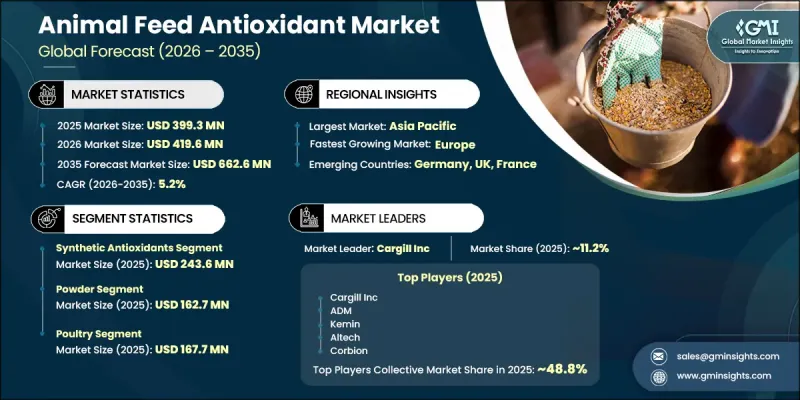
시장 성장은 전 세계 가축 사육두수 증가와 더 많은 배합사료와 성능 향상 첨가제를 필요로 하는 집약적 축산으로 전환하는 추세에 힘입어 성장하고 있습니다. 사료 생산이 확대됨에 따라 장기 보관 및 유통 기간 동안 영양가 및 품질 안정성을 유지하는 것이 필수적이며, 이에 따라 항산화제 솔루션의 채택이 확대되고 있습니다. 이러한 첨가제는 산화를 방지하고, 영양소의 완전성을 유지하며, 사료의 성능을 일정하게 유지하는 데 중요한 역할을 합니다. 축산 시스템의 산업화로 인해 생산자들이 생산성을 향상시키고 사료의 품질을 유지하기 위한 효율적인 솔루션을 찾고 있는 가운데, 이러한 수요는 더욱 강화되고 있습니다. 또한, 동물성 단백질의 소비가 증가함에 따라 생산자들은 사료 효율과 가축의 건강 상태를 최적화하기 위해 노력하고 있습니다. 사료의 안전성, 품질 기준, 유통기한의 안정성에 초점을 맞춘 규제 프레임워크도 시장 확대에 기여하고 있습니다. 이는 제조업체가 진화하는 업계의 요구 사항을 준수하고 제품의 신뢰성을 보장하기 위해 항산화제를 채택했기 때문입니다.
| 시장 범위 | |
|---|---|
| 개시 연도 | 2025년 |
| 예측 기간 | 2026-2035년 |
| 개시 연도 시장 규모 | 3억 9,930만 달러 |
| 예측 시장 규모 | 6억 6,260만 달러 |
| CAGR | 5.2% |
2025년 합성 항산화제 부문 시장 규모는 2억 4,360만 달러였습니다. 이 부문은 비용 효율성, 높은 안정성, 대규모 사료 생산에서 항산화 효과로 인해 견고한 위치를 유지하고 있습니다. 합성 항산화제는 여전히 널리 사용되고 있지만, 업계에서는 변화하는 규제 요건과 지속가능성 목표에 따라 대체 솔루션에 대한 관심이 높아지고 있습니다. 각 업체들은 성능 효율성과 안전성을 동시에 충족시키기 위해 제품 개발 전략을 조정하고 있으며, 보다 엄격한 품질 기준을 준수하면서 사료 생산자의 변화하는 요구에 부응하고 있습니다.
가금류 부문은 2025년 1억 6,770만 달러 시장 규모를 기록했으며, 가축 부문에서 수요를 견인하는 중요한 역할을 할 것으로 예측됩니다. 가금류, 돼지, 반추동물을 포함한 전체 가축 부문의 성장은 대량 생산에서 사료 품질의 안정적 유지와 영양소 보존의 필요성과 밀접한 관련이 있습니다. 성장주기가 짧은 특징을 가진 가금류 생산은 최적의 생산성을 보장하기 위해 안정적이고 영양이 풍부한 사료가 필요합니다. 마찬가지로, 다른 가축 카테고리도 생산성과 사료 효율성 향상에 중점을 두어 전체 수요에 기여하고 있습니다. 대량 생산된 사료의 영양소 저하를 방지해야 할 필요성은 이러한 부문 전반에 걸쳐 항산화제의 중요성을 계속 강조하고 있습니다.
북미의 동물사료용 항산화제 시장은 2025년 1억 3,080만 달러 규모를 기록했습니다. 이 지역의 탄탄한 지위는 선진적인 사료 생산 인프라와 확립된 축산업이 뒷받침하고 있습니다. 미국은 대규모 사업 전개와 항산화제 사용을 통한 높은 사료 품질 기준 유지에 중점을 두어 중요한 역할을 하고 있습니다. 사료의 안전성 및 영양소 보존에 대한 규제 요건은 도입 추세에 계속 영향을 미치고 있습니다. 또한, 이 지역에서는 클린 라벨 사료 솔루션과 동물 영양 관리 관행 개선에 대한 관심이 높아지고 있습니다. 사료 배합 기술의 지속적인 발전과 배합 사료의 보급은 지역 시장의 추가 발전에 기여하고 항산화제 솔루션에 대한 안정적인 수요를 보장하고 있습니다.
자주 묻는 질문
목차
제1장 조사 방법과 범위
제2장 주요 요약
제3장 업계 인사이트
제4장 경쟁 구도
제5장 시장 추산 및 예측 : 유형별(2022-2035년)
제6장 시장 추산 및 예측 : 형태별(2022-2035년)
제7장 시장 추산 및 예측 : 원료별(2022-2035년)
제8장 시장 추산 및 예측 : 지역별(2022-2035년)
제9장 기업 개요
AJY 26.06.11The Global Animal Feed Antioxidant Market was valued at USD 399.3 million in 2025 and is estimated to grow at a CAGR of 5.2% to reach USD 662.6 million by 2035.
Market growth is being driven by the rising global livestock population and the increasing shift toward intensive farming practices that require higher volumes of compound feed and performance-enhancing additives. As feed production scales up, maintaining nutritional quality and stability over extended storage and distribution periods has become essential, leading to greater adoption of antioxidant solutions. These additives play a critical role in preventing oxidation, preserving nutrient integrity, and ensuring consistent feed performance. The transition toward industrialized animal farming systems has further strengthened demand, as producers seek efficient solutions to enhance productivity and maintain feed quality. Additionally, rising consumption of animal-based protein is encouraging producers to optimize feed efficiency and animal health outcomes. Regulatory frameworks focused on feed safety, quality standards, and shelf-life stability are also contributing to market expansion, as manufacturers adopt antioxidants to comply with evolving industry requirements and ensure product reliability.
| Market Scope | |
|---|---|
| Start Year | 2025 |
| Forecast Year | 2026-2035 |
| Start Value | $399.3 Million |
| Forecast Value | $662.6 Million |
| CAGR | 5.2% |
The synthetic antioxidants segment accounted for USD 243.6 million in 2025. This segment maintains a strong position due to its cost efficiency, high stability, and effectiveness in preventing oxidation in large-scale feed production. While synthetic variants remain widely used, the industry is gradually witnessing increased interest in alternative solutions that align with evolving regulatory expectations and sustainability goals. Companies are adapting their product development strategies to balance performance efficiency with safety considerations, ensuring compliance with stricter quality standards while meeting the changing preferences of feed producers.
The poultry segment generated USD 167.7 million in 2025, reflecting its prominent role in driving demand within the livestock category. Growth across livestock segments, including poultry, swine, and ruminants, is closely linked to the need for maintaining consistent feed quality and nutrient preservation in high-volume operations. Poultry production, characterized by rapid growth cycles, requires stable and nutrient-rich feed to ensure optimal performance. Similarly, other livestock categories contribute to overall demand through their focus on improved productivity and feed efficiency. The necessity to prevent nutrient degradation in bulk feed continues to reinforce the importance of antioxidants across these segments.
North America Animal Feed Antioxidant Market recorded USD 130.8 million in 2025. The region's strong position is supported by its advanced feed production infrastructure and well-established livestock industry. The United States plays a key role due to its large-scale operations and emphasis on maintaining high feed quality standards through the use of antioxidants. Regulatory requirements related to feed safety and nutrient preservation continue to influence adoption patterns. In addition, the region is experiencing increased interest in clean-label feed solutions and enhanced animal nutrition practices. Ongoing advancements in feed formulation technologies and widespread use of compound feed are further contributing to regional market development, ensuring consistent demand for antioxidant solutions.
Major players operating in the Global Animal Feed Antioxidant Industry include ADM, Altech, BTSA, Camlin Fine Science, Cargill Inc, Corbion, Food Safe Technologies, Kemin, Lallemand Nutrition, Miavit, Oxiris, and VDH Chemtech Pvt Ltd. Companies operating in the Animal Feed Antioxidant Market are focusing on strategic initiatives aimed at strengthening their competitive position and expanding their global presence. Key strategies include investing in research and development to create more efficient and sustainable antioxidant solutions that meet evolving regulatory standards. Businesses are also emphasizing product innovation to enhance performance and improve compatibility with modern feed formulations. Strategic partnerships and collaborations with feed manufacturers are helping companies expand their distribution networks and market reach. In addition, firms are prioritizing capacity expansion and technological advancements to support large-scale production requirements. Efforts to align with sustainability trends, including the development of eco-friendly and safer antioxidant solutions, are further enabling companies to differentiate themselves while addressing the growing demand for high-quality feed additives.
Table of Contents
Chapter 1 Methodology & Scope
- 1.1 Market scope and definition
- 1.2 Research design
- 1.2.1 Research approach
- 1.2.2 Data collection methods
- 1.3 Data mining sources
- 1.3.1 Global
- 1.3.2 Regional/Country
- 1.4 Base estimates and calculations
- 1.4.1 Base year calculation
- 1.4.2 Key trends for market estimation
- 1.5 Primary research and validation
- 1.5.1 Primary sources
- 1.6 Forecast model
- 1.7 Research assumptions and limitations
Chapter 2 Executive Summary
- 2.1 Industry 360° synopsis
- 2.2 Key market trends
- 2.2.1 Regional
- 2.2.2 Type
- 2.2.3 Form
- 2.2.4 Feedstock
- 2.3 TAM Analysis, 2026-2035
- 2.4 CXO perspectives: Strategic imperatives
- 2.4.1 Executive decision points
- 2.4.2 Critical success factors
- 2.5 Future Outlook and Strategic Recommendations
Chapter 3 Industry Insights
- 3.1 Industry ecosystem analysis
- 3.1.1 Supplier Landscape
- 3.1.2 Profit Margin
- 3.1.3 Value addition at each stage
- 3.1.4 Factor affecting the value chain
- 3.1.5 Disruptions
- 3.2 Industry impact forces
- 3.2.1 Growth drivers
- 3.2.1.1 Growing livestock population & intensification of animal farming
- 3.2.1.2 Increasing demand for quality animal protein
- 3.2.1.3 Rising awareness of oxidative stress impact on animal health
- 3.2.2 Industry pitfalls and challenges
- 3.2.2.1 Regulatory restrictions on synthetic antioxidants
- 3.2.2.2 High cost of natural antioxidants
- 3.2.3 Market opportunities
- 3.2.3.1 Shift toward clean label & natural feed additives
- 3.2.3.2 Innovation in botanical extract-based antioxidants
- 3.2.1 Growth drivers
- 3.3 Growth potential analysis
- 3.4 Regulatory landscape
- 3.4.1 North America
- 3.4.2 Europe
- 3.4.3 Asia Pacific
- 3.4.4 Latin America
- 3.4.5 Middle East & Africa
- 3.5 Porter's analysis
- 3.6 PESTEL analysis
- 3.7 Price trends
- 3.7.1 By region
- 3.7.2 Product type
- 3.8 Future market trends
- 3.9 Technology and Innovation Landscape
- 3.9.1 Current technological trends
- 3.9.2 Emerging technologies
- 3.10 Patent Landscape
- 3.11 Trade statistics (HS code) (Note: the trade statistics will be provided for key countries only)
- 3.11.1 Major importing countries
- 3.11.2 Major exporting countries
- 3.12 Sustainability and environmental aspects
- 3.12.1 Sustainable practices
- 3.12.2 Waste reduction strategies
- 3.12.3 Energy efficiency in production
- 3.12.4 Eco-friendly initiatives
Chapter 4 Competitive Landscape, 2025
- 4.1 Introduction
- 4.2 Company market share analysis
- 4.2.1 By region
- 4.2.1.1 North America
- 4.2.1.2 Europe
- 4.2.1.3 Asia Pacific
- 4.2.1.4 LATAM
- 4.2.1.5 MEA
- 4.2.1 By region
- 4.3 Company matrix analysis
- 4.4 Competitive analysis of major market players
- 4.5 Competitive positioning matrix
- 4.6 Key developments
- 4.6.1 Mergers & acquisitions
- 4.6.2 Partnerships & collaborations
- 4.6.3 New product launches
- 4.6.4 Expansion plans
Chapter 5 Market Estimates and Forecast, By Type, 2022 - 2035 (USD Billion) (Tons)
- 5.1 Key trends
- 5.2 Synthetic antioxidants
- 5.2.1 Butylated hydroxytoluene (BHT)
- 5.2.2 Butylated hydroxyanisole (BHA)
- 5.2.3 Ethoxyquin
- 5.2.4 Propyl gallate
- 5.2.5 Tertiary butylhydroquinone (TBHQ)
- 5.3 Natural antioxidants
- 5.3.1 Tocopherols (Vitamin E)
- 5.3.2 Ascorbic acid (Vitamin C)
- 5.3.3 Botanical/plant extracts
- 5.3.3.1 Rosemary extract
- 5.3.3.2 Green tea extract
- 5.3.3.3 Oregano extract
- 5.3.3.4 Others
- 5.3.4 Carotenoids
Chapter 6 Market Estimates and Forecast, By Form, 2022 - 2035 (USD Billion) (Tons)
- 6.1 Key trends
- 6.2 Powder
- 6.3 Granular
- 6.4 Liquid
- 6.5 Pellet
Chapter 7 Market Estimates and Forecast, By Feedstock, 2022 - 2035 (USD Million) (Tons)
- 7.1 Key trends
- 7.2 Poultry
- 7.2.1 Broilers
- 7.2.2 Layers
- 7.3 Swine/Pigs
- 7.4 Ruminants
- 7.4.1 Cattle (Dairy & Beef)
- 7.4.2 Sheep
- 7.4.3 Goats
- 7.5 Aquaculture
- 7.5.1 Fish
- 7.5.2 Shrimp
- 7.6 Companion Animals
- 7.6.1 Dogs
- 7.6.2 Cats
- 7.7 Equine
- 7.8 Others
Chapter 8 Market Estimates and Forecast, By Region, 2022 - 2035 (USD Billion) (Tons)
- 8.1 Key trends
- 8.2 North America
- 8.2.1 U.S.
- 8.2.2 Canada
- 8.3 Europe
- 8.3.1 Germany
- 8.3.2 UK
- 8.3.3 France
- 8.3.4 Spain
- 8.3.5 Italy
- 8.3.6 Rest of Europe
- 8.4 Asia Pacific
- 8.4.1 China
- 8.4.2 India
- 8.4.3 Japan
- 8.4.4 Australia
- 8.4.5 South Korea
- 8.4.6 Rest of Asia Pacific
- 8.5 Latin America
- 8.5.1 Brazil
- 8.5.2 Mexico
- 8.5.3 Rest of Latin America
- 8.6 Middle East and Africa
- 8.6.1 Saudi Arabia
- 8.6.2 South Africa
- 8.6.3 UAE
- 8.6.4 Rest of Middle East and Africa
Chapter 9 Company Profiles
- 9.1 ADM
- 9.2 Altech
- 9.3 BTSA
- 9.4 Camlin fine science
- 9.5 Cargill Inc
- 9.6 Corbion
- 9.7 Food safe technologies
- 9.8 Kemin
- 9.9 Lallemand Nutrition
- 9.10 Miavit
- 9.11 Oxiris
- 9.12 VDH chemtech pvt ltd


