

|
시장보고서
상품코드
2123536
동물 사료용 유기 미량 미네랄 시장 : 점유율 분석, 업계 동향과 통계, 성장 예측(2026-2031년)Animal Feed Organic Trace Minerals - Market Share Analysis, Industry Trends & Statistics, Growth Forecasts (2026 - 2031) |
||||||
 Mordor Intelligence
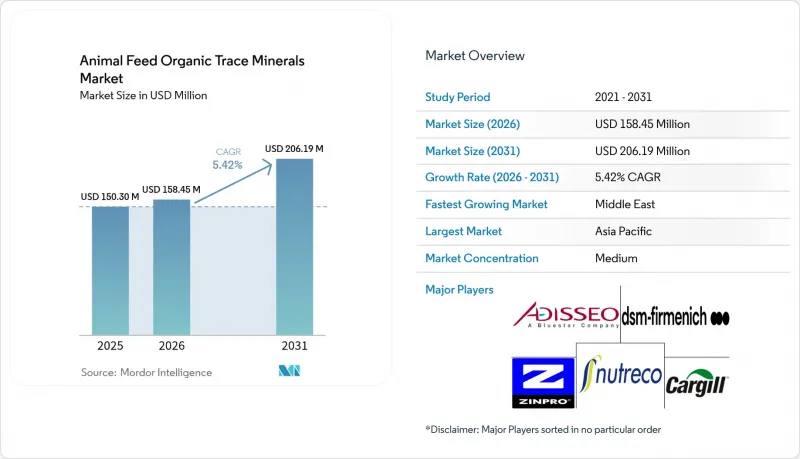
Mordor Intelligence에 의하면, 동물 사료용 유기 미량 미네랄 시장 규모는 2025년 1억 5,030만 달러에서 2026년에는 1억 5,845만 달러로 확대되어 2026년부터 2031년까지 CAGR 5.42%로 성장을 지속하여, 2031년에는 2억 619만 달러에 이를 것으로 예측됩니다.
본 보고서는 미량 원소의 유형(아연, 철, 구리, 망간, 셀레늄 등), 킬레이트화 방식(아미노산 킬레이트, 단백산염 등), 가축의 유형(젖소, 육우, 가금류 등), 지역(북미, 유럽, 아시아태평양, 남미 등)별로 분류되어 있습니다. 시장 전망은 금액(달러) 기준으로 제시되어 있습니다.
전 세계 동물 사료용 유기 미량 미네랄 시장 동향 및 인사이트
고품질 동물성 단백질에 대한 수요 증가
아시아태평양 및 남미의 가처분 소득 증가에 따라 고품질 육류, 우유, 생선, 계란의 소비가 확대되고 있으며, 생산자들은 대량 생산보다는 영양가 향상에 주력하고 있습니다. 킬레이트화된 셀레늄과 아연을 사용하면 항산화 작용이 강화되고, 제품의 유통 기한이 연장되며, 관능적 특성이 향상되어 소매 가격을 인상할 수 있게 됩니다. 조사에 따르면, 생체 이용 가능한 미네랄은 무기염에 비해 사료 전환율을 3-5% 향상시켜 첨가 비용 상승을 상쇄하면서도 붉은살고기에 대한 수요를 충족시키는 것으로 나타났습니다. 소매 체인은 공급업체와의 계약에 미네랄 강화 사양을 포함시키고 있으며, 이를 통해 통합 공급망 전반에 걸친 도입이 촉진되고 있습니다. 또한, 단백질 부족으로 어려움을 겪는 지역의 정부는 식량 안보 노력의 일환으로 미네랄 최적화를 추진하고 있습니다.
항생제 성장 촉진제(AGP)에 대한 엄격한 금지 조치
북미 및 유럽 규제 당국의 사료 내 항생제 일상적 사용 금지, 그리고 아시아태평양 시장에서 예정된 단계적 폐지 정책으로 인해 축산업계에서는 생산성 문제가 대두되고 있습니다. 아연 및 구리 킬레이트 화합물은 장내 환경 유지와 면역 기능 향상에 기여하기 때문에 중요한 대안으로 주목받고 있습니다. 항생제 금지 이후 실시된 현장 시험에서는 유기 미네랄 보충 프로그램을 통해 기존 체중 증가 실적이 최대 90%까지 달성될 수 있음이 입증되었으며, 이는 집약적인 축산 경영에서 수익성 유지에 기여하고 있습니다. 현재 각 사료 제조업체들은 킬레이트화된 미네랄과 식물 유래 화합물을 결합하여, 프리미엄 가격대의 항생제 무첨가 농축 사료를 개발하고 있습니다. 신흥 경제국에서의 항생제 규제 도입으로 인해, 동물 사료용 유기 미량 미네랄 시장의 잠재력은 확대되고 있습니다.
고가 제품군과 무기 미네랄과의 비교
유기 미량 미네랄은 산화물이나 황산염에 비해 2-4배의 비용이 들기 때문에 생산 비용의 70% 이상을 사료가 차지하는 가금류 및 돼지 업계에서의 도입이 제한되고 있습니다. 옥수수나 대두박의 가격 변동으로 인해 사료 첨가물에 대한 심사가 더욱 엄격해지고 있습니다. 생산자들은 킬레이트화 미네랄 프로그램을 도입하기 전에, 데이터에 근거한 투자 수익률(ROI) 분석을 요구하고 있습니다. 영양 관련 기업들은 단계별 제품 라인, 수량에 따른 리베이트, 그리고 여러 가지 성능상의 이점을 통해 비용을 분산시키기 위한 세트 배합을 제공합니다. 배합 비율을 도체 수율 향상으로 환산하는 디지털 계산 도구는 사료 비용의 관점을 넘어선 가치를 입증하는 데 도움이 됩니다.
부문 분석
아연은 면역 기능, 상피 건강 및 생식에 영향을 미치는 80종 이상의 금속 효소에서 필수적인 역할을 수행하기 때문에 2025년 동물 사료용 유기 미량 미네랄 시장에서 35.62%의 점유율을 유지했습니다. 유기 아연은 생체 이용률이 높기 때문에 생산자는 환경 배출 기준을 충족하면서 사료 첨가율을 낮출 수 있으며, 그 결과 환경 관련 비용 절감과 이익률 향상을 실현할 수 있습니다. 셀레늄은 사료 내 필요량이 극히 적음에도 불구하고 연평균 성장률(CAGR) 7.78%라는 최고의 성장률을 달성했습니다. 이는 특히 해상 운송 중 산화 열화에 취약한 양식 필레의 경우, 냉장육의 유통 기한을 연장하기 위해 항산화 특성 향상을 추구하는 가공업체들에 의해 주도된 결과입니다. 구리, 망간, 철은 여전히 필수 영양소이지만 엄격한 배합 제한에 직면해 있으며, 저농도에서도 성능을 유지할 수 있는 킬레이트화 형태에 대한 수요가 증가하고 있습니다.
미량 원소의 분포는 생물학적 요건과 규제상의 제약 모두를 반영하고 있습니다. 아연이 시장을 계속 독점하고 있는 반면, 셀레늄은 더 높은 가격을 유지하고 있으며, ‘셀레늄 강화’라는 제품 표기를 통한 마케팅상의 우위를 누리고 있습니다. 코발트와 크롬은 루멘 대사 및 포도당 이용에 있어 특정 기능을 수행하며, 요오드와 몰리브덴은 지역적인 결핍 문제를 해결하고 있습니다. 시장 성장은 제품 품질을 향상시키는 동시에 폐기물 관리 규정을 준수하는 데 기여하는 원소들에게 유리하게 작용하고 있습니다. 이러한 요인들이 동물 사료용 유기 미량 미네랄 시장에서 상호 연관된 기반을 형성하고 있습니다.
지역별 분석
아시아태평양은 중국의 양식 생산 및 인도의 육계·새우 산업의 성장에 힘입어 2025년 동물 사료용 유기 미량 미네랄 시장 매출의 43.65%를 차지하고 있습니다. 국내 사료 첨가물에 대한 정부의 보조금으로 인해 흡수율이 높은 미네랄 형태의 채택이 진행되고 있습니다. 이 지역 시장 규모는 물류 비용을 절감하고 공급업체와 통합 업체 간의 직접적인 관계를 가능하게 하는 집중된 생산 클러스터의 혜택을 받고 있습니다. 일본과 한국의 기술적 전문 지식 및 연구 능력은 환경적 이점이 입증된 첨단 킬레이트제의 도입을 뒷받침하고 있습니다.
중동 시장은 2031년까지 연평균 성장률(CAGR) 7.82%를 나타낼 것으로 예측되며, 이는 2030년까지 60만 미터톤의 어류 생산을 목표로 하는 사우디아라비아를 비롯한 단백질 생산 능력에 대한 정부 투자가 뒷받침하고 있습니다. 이 지역의 수자원 부족으로 인해 배수량을 줄이기 위한 정밀한 미네랄 급여가 필수적입니다. 연안 양식 거점 근처에 위치한 사료 공장에서는 운송 중 산화를 최소화할 수 있어, 내열성이 있는 미량 미네랄 제제에 대한 수요가 증가하고 있습니다.
북미와 유럽은 규제 요건과 지속가능성 노력으로 꾸준한 성장을 보이고 있는 성숙한 시장입니다. FDA(미국 식품의약국)의 ‘수의용 사료 지침’과 유럽의 항생제 사용 규제로 인해 가축의 생산성을 유지하기 위한 유기 미네랄 공급이 촉진되고 있습니다. 미네랄 배출에 관한 환경 규제는 생체 이용률이 높은 형태의 사용을 뒷받침하고 있습니다. 남미에서는 돼지 및 가금류 통합 생산자들이 수출 시장 요건을 충족하기 위해 영양 프로그램을 강화하고 있으며, 비용 측면의 고려와 킬레이트화 미네랄 도입 확대 간의 균형을 모색함으로써 성장 기회가 예상됩니다. 이러한 지역적 동향은 동물 사료용 유기 미량 미네랄 시장에서 다양한 성장 기회를 시사하고 있습니다.
기타 혜택:
- 엑셀 형식 시장 예측(ME) 시트
- 3개월간의 애널리스트 지원
자주 묻는 질문
목차
제1장 서론
제2장 조사 방법
제3장 주요 요약
제4장 시장 구도
제5장 시장 규모와 성장 예측
제6장 경쟁 구도
제7장 시장 기회와 향후 전망
JHS 26.09.09According to Mordor Intelligence, the animal feed organic trace minerals market size is expected to grow from USD 150.3 million in 2025 to USD 158.45 million in 2026 and is forecast to reach USD 206.19 million by 2031 at 5.42% CAGR over 2026-2031.
This report is Segmented by Trace Element Type (Zinc, Iron, Copper, Manganese, Selenium, and More), by Chelation Type (Amino-Acid Chelates, Proteinates, and More), by Animal Type (Dairy Cattle, Beef Cattle, Poultry, and More), and by Geography (North America, Europe, Asia-Pacific, South America, and More). The Market Forecasts are Provided in Terms of Value (USD).
Global Animal Feed Organic Trace Minerals Market Trends and Insights
Escalating Demand for High-Quality Animal Protein
The increasing disposable income in Asia-Pacific and South America has elevated the consumption of premium meat, milk, fish, and eggs, prompting producers to focus on nutritional value enhancement rather than volume production. The use of chelated selenium and zinc improves antioxidant levels, extends product shelf-life, and enhances sensory characteristics, enabling higher retail prices. Research indicates that bioavailable minerals deliver 3-5% better feed conversion compared to inorganic salts, compensating for higher additive costs while meeting lean-meat requirements. Retail chains include mineral-enrichment specifications in supplier agreements, driving adoption throughout integrated supply chains. Additionally, governments in regions with protein deficiency promote mineral optimization as part of their food security initiatives.
Stringent Bans on Antibiotic Growth Promoters (AGPs)
The ban on routine in-feed antibiotics by North American and European regulators, along with upcoming phase-out policies in Asia-Pacific markets, has created a productivity challenge in animal farming. Zinc and copper chelates have emerged as crucial alternatives, as they help maintain gut health and enhance immune function. Field trials conducted after the antibiotic ban demonstrate that organic mineral supplementation programs can achieve up to 90% of previous weight-gain performance, helping maintain profitability in intensive farming operations. Feed manufacturers are now combining chelated minerals with phytogenic compounds to develop antibiotic-free feed concentrates at premium price points. The implementation of antibiotic restrictions across emerging economies is expanding the market potential for animal feed organic trace minerals.
Premium Pricing Versus Inorganic Counterparts
Organic trace minerals cost 2-4 times more than oxides or sulfates, which limits their adoption in the poultry and pig sectors, where feed represents over 70% of production costs. The volatility in corn and soybean meal prices increases scrutiny of feed additives. Producers require a return on investment analyses supported by data before implementing chelated mineral programs. Nutrition companies offer tiered product lines, volume rebates, and bundled formulations to distribute costs across multiple performance benefits. Digital calculators that convert inclusion rates into carcass-yield gains help demonstrate value beyond feed cost considerations.
Other drivers and restraints analyzed in the detailed report include:
- Tighter Manure-Phosphorus and Heavy-Metal Discharge Regulations
- Rapid Adoption of Precision-Chelation and Micro-Encapsulation Technology
- Limited Awareness Among Smallholder Farmers
For complete list of drivers and restraints, kindly check the Table Of Contents.
Segment Analysis
Zinc maintained 35.62% of the animal feed organic trace minerals market share in 2025, supported by its essential role in over 80 metalloenzymes that influence immune function, epithelial integrity, and reproduction. The higher bioavailability of organic zinc enables producers to reduce dietary inclusion rates while meeting environmental excretion limits, resulting in lower environmental fees and improved profit margins. Selenium, despite its minimal dietary requirement, achieved the highest growth rate at 7.78% CAGR, driven by processors seeking enhanced antioxidant properties to extend the shelf-life of chilled meat, particularly in aquaculture fillets susceptible to oxidative deterioration during maritime transport. Copper, manganese, and iron remain essential nutrients but face strict inclusion limits, increasing the demand for chelated forms that maintain performance at reduced concentrations.
The distribution of trace elements reflects both biological requirements and regulatory constraints. While zinc maintains market dominance, selenium commands higher prices and benefits from marketing advantages through "selenium-enriched" product labeling. Cobalt and chromium serve specific functions in rumen metabolism and glucose utilization, while iodine and molybdenum address regional deficiency issues. Market growth favors elements that improve product quality while helping meet waste management regulations. These factors create an interconnected foundation for the animal feed organic trace minerals market.
Complete Report Scope:
- By Trace Element Type
- Zinc
- Copper
- Iron
- Manganese
- Selenium
- Cobalt
- Chromium
- Others
- By Chelation Type
- Amino-Acid Chelates
- Proteinates
- Polysaccharide Complexes
- Hydroxy-Trace Minerals
- Propionates
- Yeast-Based Complexes
- Others
- By Animal Type
- Dairy cattle
- Beef cattle
- Poultry
- Swine
- Aquaculture
- Pets
- Equine
- Others
- By Geography
- North America
- United States
- Canada
- Mexico
- Rest of North America
- Europe
- Germany
- France
- United Kingdom
- Italy
- Spain
- Netherlands
- Russia
- Rest of Europe
- Asia-Pacific
- China
- India
- Japan
- Australia
- South Korea
- Rest of Asia-Pacific
- South America
- Brazil
- Argentina
- Chile
- Rest of South America
- Middle East
- Saudi Arabia
- Turkey
- UAE
- Rest of Middle East
- Africa
- South Africa
- Egypt
- Kenya
- Rest of Africa
- North America
Geography Analysis
Asia-Pacific holds 43.65% of the 2025 revenue in the animal feed organic trace minerals market, driven by China's aquaculture production and India's growing broiler and shrimp industries. Government subsidies for domestic feed additives increase the adoption of high-absorption mineral formats. The region's market size benefits from concentrated production clusters that reduce logistics costs and enable direct relationships between suppliers and integrators. Japan and South Korea's technical expertise and research capabilities support the implementation of advanced chelates with proven environmental benefits.
The Middle East market projects an 7.82% CAGR through 2031, supported by government investments in protein production capacity, including Saudi Arabia's target of 600,000 metric tons of fish by 2030. The region's water scarcity necessitates precise mineral feeding to reduce effluent discharge. Feed mills positioned near coastal farming centers minimize oxidation during transport, increasing demand for temperature-resistant trace mineral formats.
North America and Europe represent established markets where regulatory requirements and sustainability commitments generate steady growth. The FDA's Veterinary Feed Directive and European restrictions on antibiotic usage encourage organic mineral supplementation to maintain animal performance. Environmental regulations on mineral discharge promote the use of highly bioavailable forms. South America shows growth potential as swine and poultry integrators enhance nutrition programs to comply with export market requirements, balancing cost considerations with increased adoption of chelated minerals. These regional developments indicate diverse growth opportunities in the animal feed organic trace minerals market.
- Alltech
- ADM
- Balchem Corp.
- Biochem Zusatzstoffe Handels
- DSM-Firmenich
- Adisseo (A Bluestar Company)
- Cargill, Incorporated
- Kemin Industries, Inc.
- Novus International, Inc.
- SHV (Nutreco NV)
- Orffa
- BASF SE
- Phibro Animal Health
- Zinpro
- Vamso Biotec Pvt. Ltd.
Additional Benefits:
- The market estimate (ME) sheet in Excel format
- 3 months of analyst support
TABLE OF CONTENTS
1 Introduction
- 1.1 Study Assumptions and Market Definition
- 1.2 Scope of the Study
2 Research Methodology
3 Executive Summary
4 Market Landscape
- 4.1 Market Overview
- 4.2 Market Drivers
- 4.2.1 Escalating Demand for High-Quality Animal Protein
- 4.2.2 Stringent Bans on Antibiotic Growth Promoters (AGPs)
- 4.2.3 Tighter Manure-Phosphorus and Heavy-Metal Discharge Regulations
- 4.2.4 Rapid Adoption of Precision-Chelation and Micro-Encapsulation Technology
- 4.2.5 Livestock Carbon Footprint Measurement and Dietary Impact
- 4.2.6 AI-Driven Digital Feed-Formulation Platforms Standardizing Organic Trace Minerals
- 4.3 Market Restraints
- 4.3.1 Premium Pricing Versus Inorganic Counterparts
- 4.3.2 Limited Awareness Among Smallholder Farmers
- 4.3.3 Supply Bottlenecks for Key Chelating Ligands
- 4.3.4 Regulatory Fragmentation Across Organic-Livestock Certification Bodies
- 4.4 Regulatory Landscape
- 4.5 Technological Outlook
- 4.6 Porter's Five Forces Analysis
- 4.6.1 Bargaining Power of Buyers
- 4.6.2 Bargaining Power of Suppliers
- 4.6.3 Threat of New Entrants
- 4.6.4 Threat of Substitutes
- 4.6.5 Intensity of Competitive Rivalry
5 Market Size and Growth Forecasts (Value)
- 5.1 By Trace Element Type
- 5.1.1 Zinc
- 5.1.2 Copper
- 5.1.3 Iron
- 5.1.4 Manganese
- 5.1.5 Selenium
- 5.1.6 Cobalt
- 5.1.7 Chromium
- 5.1.8 Others
- 5.2 By Chelation Type
- 5.2.1 Amino-Acid Chelates
- 5.2.2 Proteinates
- 5.2.3 Polysaccharide Complexes
- 5.2.4 Hydroxy-Trace Minerals
- 5.2.5 Propionates
- 5.2.6 Yeast-Based Complexes
- 5.2.7 Others
- 5.3 By Animal Type
- 5.3.1 Dairy cattle
- 5.3.2 Beef cattle
- 5.3.3 Poultry
- 5.3.4 Swine
- 5.3.5 Aquaculture
- 5.3.6 Pets
- 5.3.7 Equine
- 5.3.8 Others
- 5.4 By Geography
- 5.4.1 North America
- 5.4.1.1 United States
- 5.4.1.2 Canada
- 5.4.1.3 Mexico
- 5.4.1.4 Rest of North America
- 5.4.2 Europe
- 5.4.2.1 Germany
- 5.4.2.2 France
- 5.4.2.3 United Kingdom
- 5.4.2.4 Italy
- 5.4.2.5 Spain
- 5.4.2.6 Netherlands
- 5.4.2.7 Russia
- 5.4.2.8 Rest of Europe
- 5.4.3 Asia-Pacific
- 5.4.3.1 China
- 5.4.3.2 India
- 5.4.3.3 Japan
- 5.4.3.4 Australia
- 5.4.3.5 South Korea
- 5.4.3.6 Rest of Asia-Pacific
- 5.4.4 South America
- 5.4.4.1 Brazil
- 5.4.4.2 Argentina
- 5.4.4.3 Chile
- 5.4.4.4 Rest of South America
- 5.4.5 Middle East
- 5.4.5.1 Saudi Arabia
- 5.4.5.2 Turkey
- 5.4.5.3 UAE
- 5.4.5.4 Rest of Middle East
- 5.4.6 Africa
- 5.4.6.1 South Africa
- 5.4.6.2 Egypt
- 5.4.6.3 Kenya
- 5.4.6.4 Rest of Africa
- 5.4.1 North America
6 Competitive Landscape
- 6.1 Market Concentration
- 6.2 Strategic Moves
- 6.3 Market Share Analysis
- 6.4 Company Profiles (includes Global-level Overview, Market-level Overview, Core Segments, Financials, Strategic Information, Market Rank/Share, Products and Services, Recent Developments)
- 6.4.1 Alltech
- 6.4.2 ADM
- 6.4.3 Balchem Corp.
- 6.4.4 Biochem Zusatzstoffe Handels
- 6.4.5 DSM-Firmenich
- 6.4.6 Adisseo (A Bluestar Company)
- 6.4.7 Cargill, Incorporated
- 6.4.8 Kemin Industries, Inc.
- 6.4.9 Novus International, Inc.
- 6.4.10 SHV (Nutreco NV)
- 6.4.11 Orffa
- 6.4.12 BASF SE
- 6.4.13 Phibro Animal Health
- 6.4.14 Zinpro
- 6.4.15 Vamso Biotec Pvt. Ltd.


