

|
시장보고서
상품코드
2038474
창상관리용 바이오로직스 시장 : 시장 기회, 성장요인, 업계 동향 분석 및 예측(2026-2035년)Wound Care Biologics Market Opportunity, Growth Drivers, Industry Trend Analysis, and Forecast 2026 - 2035 |
||||||

세계의 창상관리용 바이오로직스 시장은 2025년에 20억 달러로 평가되었고, CAGR 5.9%로 성장할 전망이며, 2035년까지 35억 달러에 이를 것으로 추정되고 있습니다.
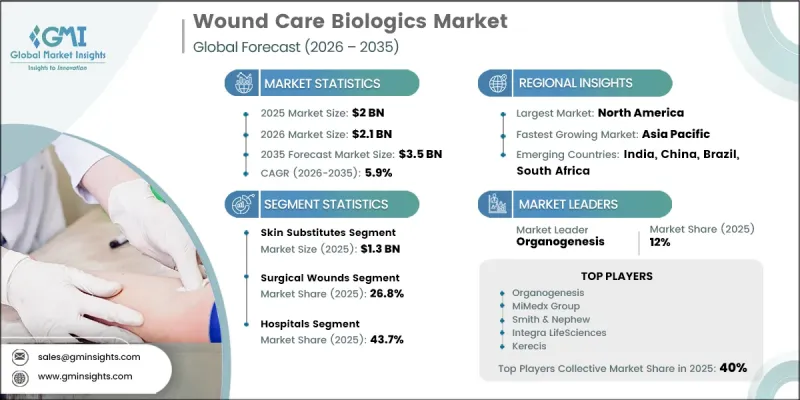
의료 시스템에서 복잡하고 만성적인 상처에 대한 첨단 치료법이 점점 더 중요해지면서 이 산업은 성장하고 있습니다. 특히 고급 의료에 대한 접근성이 제한적인 지역에서 화상 환자가 증가함에 따라 상처용 바이오로직스 제품에 대한 수요가 증가하고 있습니다. 치료 지연, 불충분한 인프라, 높은 감염 위험은 종종 치료 과정을 복잡하게 만들어 혁신적인 생물학적 개입의 필요성을 높입니다. 이러한 솔루션은 조직의 회복을 지원하고 회복의 성과를 향상시킬 수 있는 능력으로 주목받고 있습니다. 또한, 고령화의 진행도 시장 역학에 큰 영향을 미치고 있습니다. 노인들은 욕창이나 당뇨병 관련 합병증과 같은 만성 상처에 걸리기 쉽기 때문입니다. 재생의료에 대한 임상적 관심 증가와 더불어 바이오로직스 제품의 발전은 이러한 제품의 채택을 더욱 촉진하고 있습니다. 의료진이 빠른 치유와 합병증 감소를 중시하는 가운데, 창상관리용 바이오로직스 관리 제품은 현대의 치료 프로토콜에 필수적인 요소로 자리 잡으며 장기적인 시장 확대에 힘을 실어주고 있습니다.
| 시장 범위 | |
|---|---|
| 개시 연도 | 2025년 |
| 예측 기간 | 2026-2035년 |
| 개시 연도 시장 규모 | 20억 달러 |
| 예측 시장 규모 | 35억 달러 |
| CAGR | 5.9% |
창상관리용 바이오로직스는 체내 자연 치유 반응을 활성화시켜 치유가 어려운 상처에 대처하기 위해 개발된 첨단 바이오 엔지니어링 치료법입니다. 이러한 솔루션은 조직 회복을 촉진하고, 회복 기간을 단축하며, 기능 상실을 포함한 심각한 합병증의 위험을 줄이기 위해 고안되었습니다.
2025년 피부 대체재 부문은 13억 달러 시장 규모를 기록하며 시장 선두를 유지했습니다. 이러한 장점은 모든 유형의 만성 및 급성 상처에서 조직 재생을 촉진하는 동시에 구조적 지지력을 제공하는 효과에 기인합니다. 장기적인 상처 유병률 증가는 이러한 솔루션에 대한 지속적인 수요를 지속적으로 견인하고 있습니다.
2025년 병원 부문은 43.7%의 점유율을 차지했습니다. 의료시설은 다양한 상처 상태의 치료에 중요한 역할을 하기 때문에 창상관리용 바이오로직스 관리 제품의 주요 사용자로 남아있습니다. 생체 유래 드레싱과 재생 의료를 포함한 첨단 치료법의 도입은 치료 성과 향상에 기여하는 동시에 감염 위험을 감소시키는 데에도 기여하고 있습니다.
2025년 미국의 창상관리용 바이오로직스 시장 규모는 6억 9,160만 달러로 평가되었습니다. 만성 상처에 대한 부담 증가와 대사성 질환 증가가 결합하여 수요를 지속적으로 견인하고 있습니다. 이러한 질환은 환자의 삶의 질에 심각한 영향을 미치고 있으며, 효과적이고 진보된 상처 관리 솔루션에 대한 강력한 요구가 발생하고 있습니다.
자주 묻는 질문
목차
제1장 조사 방법
제2장 주요 요약
제3장 업계 인사이트
제4장 경쟁 구도
제5장 시장 추산 및 예측 : 제품 유형별(2022-2035년)
제6장 시장 추산 및 예측 : 창상 유형별(2022-2035년)
제7장 시장 추산 및 예측 : 최종 용도별(2022-2035년)
제8장 시장 추산 및 예측 : 지역별(2022-2035년)
제9장 기업 개요
AJY 26.06.11The Global Wound Care Biologics Market was valued at USD 2 billion in 2025 and is estimated to grow at a CAGR of 5.9% to reach USD 3.5 billion by 2035.
The industry is witnessing growth as healthcare systems increasingly prioritize advanced therapies for complex and chronic wounds. Rising cases of burn injuries, particularly in regions with limited access to advanced medical care, are contributing to higher demand for biologic wound solutions. Delayed treatment, inadequate infrastructure, and elevated infection risks often complicate healing processes, thereby strengthening the need for innovative biologic interventions. These solutions are gaining traction due to their ability to support tissue repair and improve recovery outcomes. In addition, the growing aging population is significantly influencing market dynamics, as older individuals are more susceptible to chronic wounds such as pressure injuries and diabetic-related complications. Increasing clinical focus on regenerative therapies, coupled with advancements in bioengineered products, is further supporting adoption. As healthcare providers emphasize faster healing and reduced complications, biologic wound care products are becoming integral to modern treatment protocols, reinforcing long-term market expansion.
| Market Scope | |
|---|---|
| Start Year | 2025 |
| Forecast Year | 2026-2035 |
| Start Value | $2 Billion |
| Forecast Value | $3.5 Billion |
| CAGR | 5.9% |
Wound care biologics represent advanced bioengineered therapies developed to address difficult-to-heal wounds by activating natural healing responses within the body. These solutions are designed to enhance tissue repair, reduce recovery time, and lower the risk of severe complications, including loss of function.
The skin substitutes segment generated USD 1.3 billion in 2025, maintaining a leading position in the market. This dominance is attributed to their effectiveness in providing structural support while promoting tissue regeneration across both chronic and acute wound types. Increasing prevalence of long-term wounds continues to drive sustained demand for these solutions.
The hospitals segment accounted for 43.7% share in 2025. Healthcare facilities remain the primary users of biologic wound care products due to their critical role in treating a wide range of wound conditions. The adoption of advanced therapies, including biologically derived dressings and regenerative treatments, is helping improve healing outcomes while reducing infection risks.
U.S. Wound Care Biologics Market was valued at USD 691.6 million in 2025. The country's growing burden of chronic wounds, combined with increasing cases of metabolic conditions, continues to drive demand. These conditions significantly impact patient quality of life, creating a strong need for effective and advanced wound management solutions.
Key companies operating in the Wound Care Biologics Market include Amnio Technology, Convatec, Vericel Corporation, Organogenesis, Celularity Inc., Kerecis, Avita Medical, MiMedx Group, Derma Sciences, Integra Life Sciences, Smith & Nephew, Osiris Therapeutics, Tides Medical, and 3M. Companies in the Wound Care Biologics Market are focusing on strengthening their position through continuous innovation, strategic collaborations, and expansion into emerging markets. Many players are investing in research and development to introduce next-generation bioengineered products that enhance healing efficiency and reduce treatment time. Partnerships with healthcare providers and research institutions are helping accelerate product development and clinical validation. Firms are also expanding manufacturing capabilities to meet rising global demand while improving supply chain efficiency. In addition, companies are adopting advanced technologies to improve product performance and patient outcomes.
Table of Contents
Chapter 1 Research Methodology
- 1.1 Research approach
- 1.2 Quality commitments
- 1.2.1 GMI AI policy & data integrity commitment
- 1.2.1.1 Source consistency protocol
- 1.2.1 GMI AI policy & data integrity commitment
- 1.3 Research trail & confidence scoring
- 1.3.1 Research trail components
- 1.3.2 Scoring components
- 1.4 Data collection
- 1.4.1 Partial list of primary sources
- 1.5 Data mining sources
- 1.5.1 Paid sources
- 1.5.1.1 Sources, by region
- 1.5.1 Paid sources
- 1.6 Base estimates and calculations
- 1.6.1 Base year calculation for any one approach
- 1.7 Forecast model
- 1.7.1 Quantified market impact analysis
- 1.7.1.1 Mathematical impact of growth parameters on forecast
- 1.7.1 Quantified market impact analysis
- 1.8 Research transparency addendum
- 1.8.1 Source attribution framework
- 1.8.2 Quality assurance metrics
- 1.8.3 Our commitment to trust
Chapter 2 Executive Summary
- 2.1 Industry 360° synopsis
- 2.2 Key market trends
- 2.2.1 Product type trends
- 2.2.2 Wound type trends
- 2.2.3 End use trends
- 2.3 CXO perspectives: Strategic imperatives
Chapter 3 Industry Insights
- 3.1 Industry ecosystem analysis
- 3.2 Industry impact forces
- 3.2.1 Growth drivers
- 3.2.1.1 Rising burn injuries in developing and underdeveloped regions
- 3.2.1.2 Increasing geriatric population globally
- 3.2.1.3 Technological advancements in wound care biologics
- 3.2.1.4 Surge in government initiatives regarding wound care treatment
- 3.2.2 Industry pitfalls and challenges
- 3.2.2.1 Lack of trained physicians in underdeveloped economies
- 3.2.2.2 High cost of biologic wound-care products
- 3.2.3 Market opportunity
- 3.2.3.1 Rising demand for cost-effective biologics under value-based care frameworks
- 3.2.3.2 Growing focus on diabetic foot ulcer (DFU) prevention
- 3.2.1 Growth drivers
- 3.3 Growth potential analysis
- 3.4 Regulatory landscape
- 3.4.1 North America
- 3.4.2 Europe
- 3.4.3 Asia Pacific
- 3.4.4 Latin America
- 3.4.5 Middle East and Africa
- 3.5 Technological landscape (Driven by Primary Research)
- 3.5.1 Current technologies
- 3.5.1.1 Placental-derived allograft technologies
- 3.5.1.2 Collagen and extracellular-matrix-based wound scaffolds
- 3.5.2 Emerging technologies
- 3.5.2.1 Bioengineered and next-generation skin substitute platforms
- 3.5.2.2 Fish-skin and novel xenograft biologic platforms
- 3.5.1 Current technologies
- 3.6 Future market trends (Driven by Primary Research)
- 3.7 Pricing analysis (Driven by Primary Research)
- 3.8 Impact of AI and Generative AI on the market (Driven by Primary Research)
- 3.9 Porter's analysis
- 3.10 PESTEL analysis
Chapter 4 Competitive Landscape, 2025
- 4.1 Introduction
- 4.2 Company market share analysis
- 4.2.1 North America
- 4.2.2 Europe
- 4.2.3 Asia Pacific
- 4.3 Company matrix analysis
- 4.4 Competitive analysis of major market players
- 4.5 Competitive positioning matrix
- 4.6 Key developments
- 4.6.1 Merger and acquisition
- 4.6.2 Partnership and collaboration
- 4.6.3 New product launches
- 4.6.4 Expansion plans
Chapter 5 Market Estimates and Forecast, By Product Type, 2022-2035 ($ Mn)
- 5.1 Key trends
- 5.2 Skin substitutes
- 5.2.1 Biological
- 5.2.1.1 Allograft
- 5.2.1.2 Xenograft
- 5.2.1.3 Other biological skin substitutes
- 5.2.2 Synthetic
- 5.2.1 Biological
- 5.3 Topical agents
Chapter 6 Market Estimates and Forecast, By Wound Type, 2022-2035 ($ Mn)
- 6.1 Key trends
- 6.2 Diabetic foot ulcers
- 6.3 Venous leg ulcers
- 6.4 Pressure ulcers
- 6.5 Surgical wounds
- 6.6 Burns
- 6.7 Other wound types
Chapter 7 Market Estimates and Forecast, By End Use, 2022-2035 ($ Mn)
- 7.1 Key trends
- 7.2 Hospitals
- 7.3 Ambulatory surgical centers
- 7.4 Other end use
Chapter 8 Market Estimates and Forecast, By Region, 2022-2035 ($ Mn)
- 8.1 Key trends
- 8.2 North America
- 8.2.1 U.S.
- 8.2.2 Canada
- 8.3 Europe
- 8.3.1 Germany
- 8.3.2 UK
- 8.3.3 France
- 8.3.4 Spain
- 8.3.5 Italy
- 8.3.6 Netherlands
- 8.4 Asia Pacific
- 8.4.1 China
- 8.4.2 Japan
- 8.4.3 India
- 8.4.4 Australia
- 8.4.5 South Korea
- 8.5 Latin America
- 8.5.1 Brazil
- 8.5.2 Mexico
- 8.5.3 Argentina
- 8.6 Middle East and Africa
- 8.6.1 South Africa
- 8.6.2 Saudi Arabia
- 8.6.3 UAE
Chapter 9 Company Profiles
- 9.1 3M
- 9.2 Amnio Technology
- 9.3 Avita Medical
- 9.4 Celularity Inc.
- 9.5 Convatec
- 9.6 Derma Sciences
- 9.7 Integra Life Sciences
- 9.8 Kerecis
- 9.9 MiMedx Group
- 9.10 Organogenesis
- 9.11 Osiris Therapeutics
- 9.12 Smith & Nephew
- 9.13 Tides Medical
- 9.14 Vericel Corporation


